


 Скачать презентацию CHAPTER 10 Launching the Nation Section 1 Laying
fb90a5fc109f010baafb0b8441fe6582.ppt
- Количество слайдов: 57
 CHAPTER 10 Launching the Nation Section 1: Laying the Foundations of Government Section 2: Hamilton and National Finances Section 3: Troubles Abroad Section 4: Challenges at Home Section 5: John Adams’s Presidency
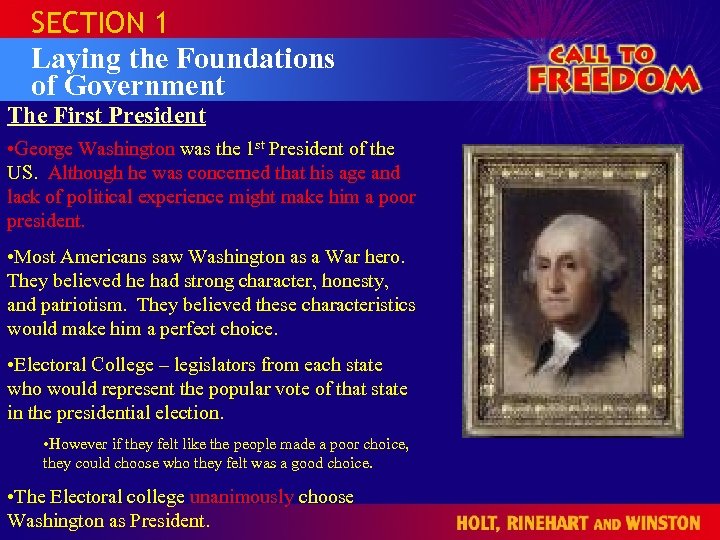 SECTION 1 Laying the Foundations of Government The First President • George Washington was the 1 st President of the US. Although he was concerned that his age and lack of political experience might make him a poor president. • Most Americans saw Washington as a War hero. They believed he had strong character, honesty, and patriotism. They believed these characteristics would make him a perfect choice. • Electoral College – legislators from each state who would represent the popular vote of that state in the presidential election. • However if they felt like the people made a poor choice, they could choose who they felt was a good choice. • The Electoral college unanimously choose Washington as President.
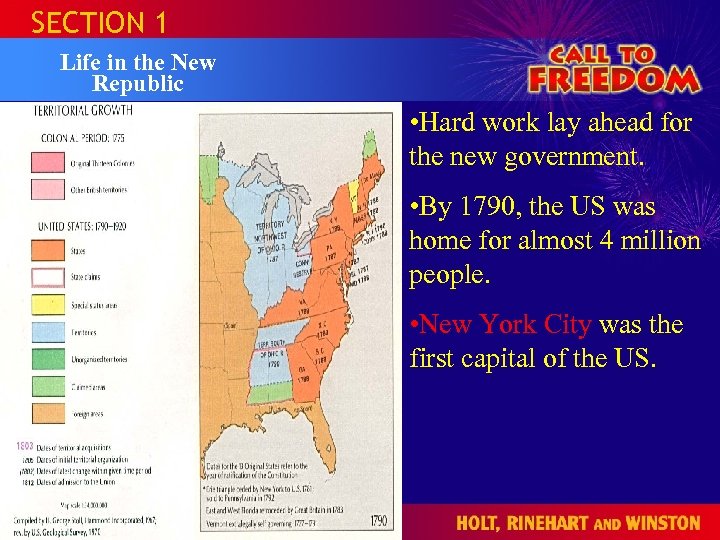 SECTION 1 Life in the New Republic • Hard work lay ahead for the new government. • By 1790, the US was home for almost 4 million people. • New York City was the first capital of the US.
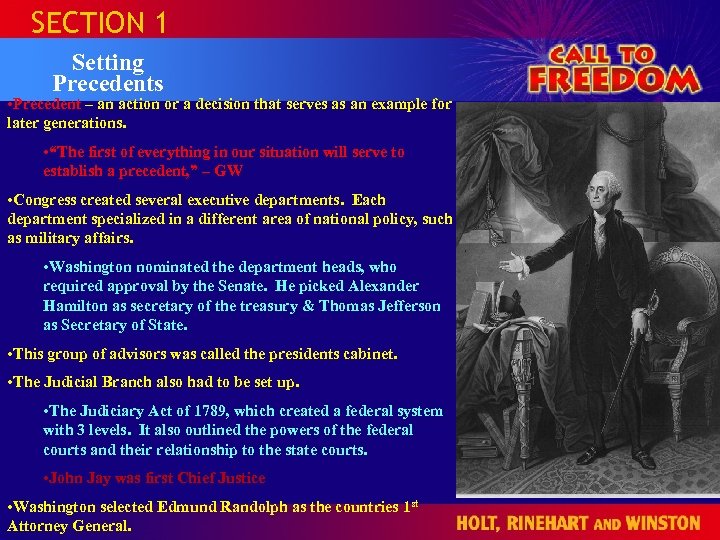 SECTION 1 Setting Precedents • Precedent – an action or a decision that serves as an example for later generations. • “The first of everything in our situation will serve to establish a precedent, ” – GW • Congress created several executive departments. Each department specialized in a different area of national policy, such as military affairs. • Washington nominated the department heads, who required approval by the Senate. He picked Alexander Hamilton as secretary of the treasury & Thomas Jefferson as Secretary of State. • This group of advisors was called the presidents cabinet. • The Judicial Branch also had to be set up. • The Judiciary Act of 1789, which created a federal system with 3 levels. It also outlined the powers of the federal courts and their relationship to the state courts. • John Jay was first Chief Justice • Washington selected Edmund Randolph as the countries 1 st Attorney General.
 SECTION 1 Laying the Foundations of Government Questions: • Define: Inaugurated • Define: Precedent • Who was the unanimous choice for President? • Who became vice president? • What was the task of the first congress? • What was the Federal Judiciary Act? • Who was the first Chief Justice of the Supreme Court? • What 3 departments were created by Congress & who was chosen to head each one? • Who became attorney General?
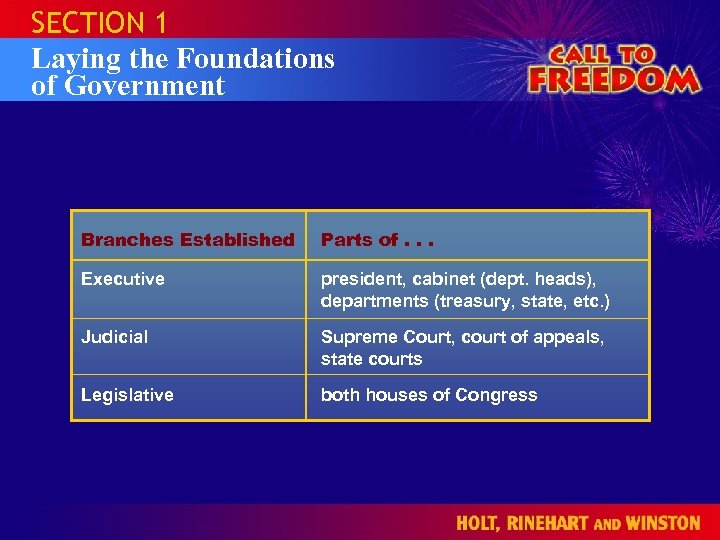 SECTION 1 Laying the Foundations of Government Branches Established Parts of. . . Executive president, cabinet (dept. heads), departments (treasury, state, etc. ) Judicial Supreme Court, court of appeals, state courts Legislative both houses of Congress
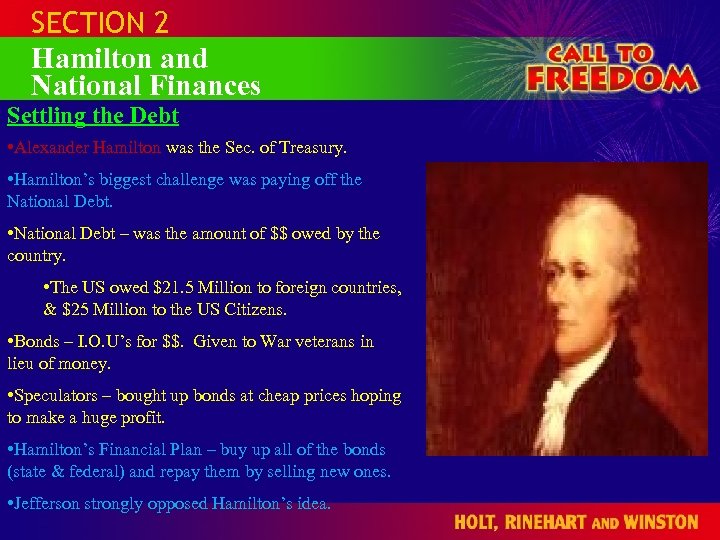 SECTION 2 Hamilton and National Finances Settling the Debt • Alexander Hamilton was the Sec. of Treasury. • Hamilton’s biggest challenge was paying off the National Debt. • National Debt – was the amount of $$ owed by the country. • The US owed $21. 5 Million to foreign countries, & $25 Million to the US Citizens. • Bonds – I. O. U’s for $$. Given to War veterans in lieu of money. • Speculators – bought up bonds at cheap prices hoping to make a huge profit. • Hamilton’s Financial Plan – buy up all of the bonds (state & federal) and repay them by selling new ones. • Jefferson strongly opposed Hamilton’s idea.
 SECTION 2 The States Debts • The States owed over $25 Million for War expenses. • Hamilton wanted the government to pay for these debts (national & State) b/c he thought it would help the economy and lend credibility to the new nation. • Not all states agreed w/ this plan, as they already paid off their debts. • B/c of this, Hamilton knew he would need help from the Southerners in Congress to pass his bill, so he offered them a deal. • He would move the nations capitol from the North (NY) to the South (Washington D. C. ) • The Southerners agreed and Hamilton’s Financial Plan passed.
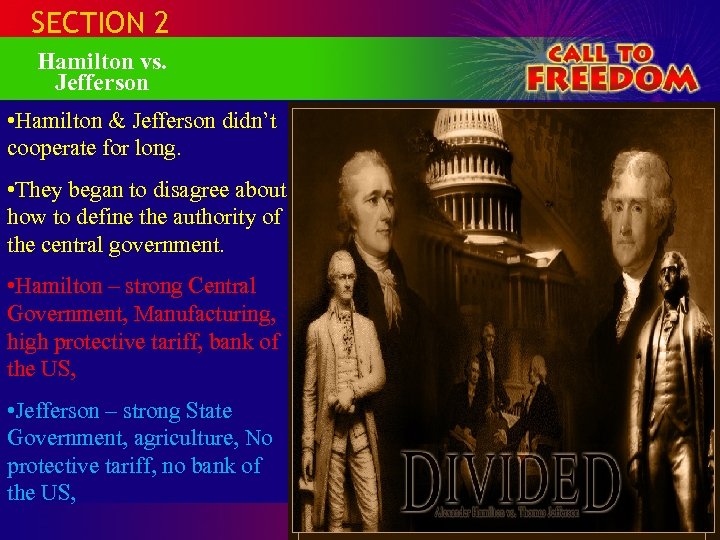 SECTION 2 Hamilton vs. Jefferson • Hamilton & Jefferson didn’t cooperate for long. • They began to disagree about how to define the authority of the central government. • Hamilton – strong Central Government, Manufacturing, high protective tariff, bank of the US, • Jefferson – strong State Government, agriculture, No protective tariff, no bank of the US,
 SECTION 2 Hamilton vs. Jefferson A. H T. J. • All communities divide themselves into the few and many. The first are rich and well born, the many born other are the poor and average. The people have average been said to have the voice of God, but that is not true. They are turbulent and changing. The seldom judge or determine right. • Those who labor the earth are the chosen people of God. • Can a democratic assembly who annually (through elections) revolve in the masses of people be supposed to pursue the public good? NO ! Only a permanent fixture like a king can check the imprudence of democracy. • Take mankind in general, they are vicious, and passionate. One great error the public tends to make it believe that mankind is more honest than they really are. • I have an indifferent (low) opinion of the honesty of this country, and ill foreboding as to its future. (1783) • Men are naturally divided into 2 groups, 1 who fear and distrust people, and the other who relates to the people. The later have confidence in men, people cherish them, and consider them to be honest and safe. • Whenever the people are well informed, they can informed be trusted with their own government. If things go too bad, the people can be counted on to set them right. • I have great confidence in the common sense of mankind in general. (1800)
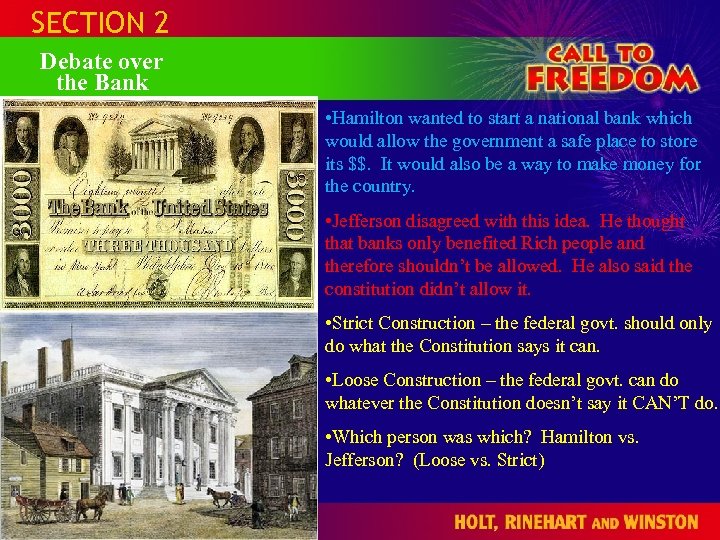 SECTION 2 Debate over the Bank • Hamilton wanted to start a national bank which would allow the government a safe place to store its $$. It would also be a way to make money for the country. • Jefferson disagreed with this idea. He thought that banks only benefited Rich people and therefore shouldn’t be allowed. He also said the constitution didn’t allow it. • Strict Construction – the federal govt. should only do what the Constitution says it can. • Loose Construction – the federal govt. can do whatever the Constitution doesn’t say it CAN’T do. • Which person was which? Hamilton vs. Jefferson? (Loose vs. Strict)
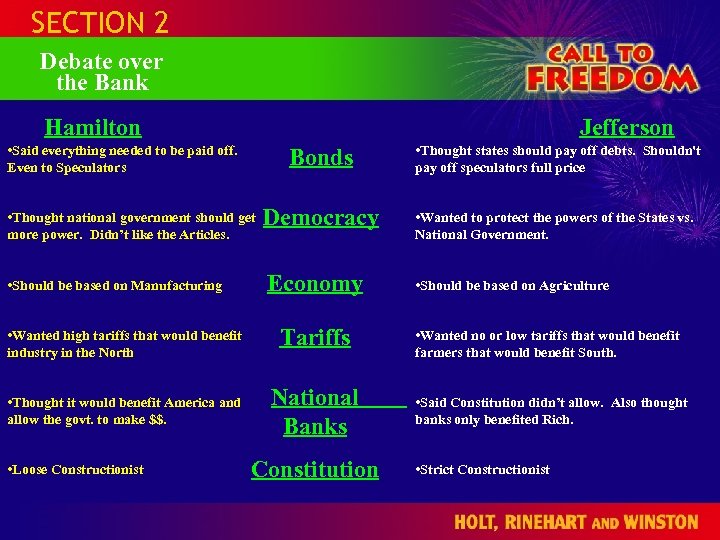 SECTION 2 Debate over the Bank Hamilton Jefferson • Said everything needed to be paid off. Even to Speculators Bonds • Thought states should pay off debts. Shouldn't pay off speculators full price • Thought national government should get more power. Didn’t like the Articles. Democracy • Wanted to protect the powers of the States vs. National Government. • Should be based on Manufacturing Economy • Should be based on Agriculture • Wanted high tariffs that would benefit industry in the North Tariffs • Wanted no or low tariffs that would benefit farmers that would benefit South. • Thought it would benefit America and allow the govt. to make $$. National Banks • Said Constitution didn’t allow. Also thought banks only benefited Rich. • Loose Constructionist Constitution • Strict Constructionist
 SECTION 2 Hamilton and National Finances Question: • What was the government’s most pressing problem? • Define: Public Debt • Define: Bond • Define: Interest • How much $$ did the US owe? • What did Hamilton’s plan call for? • What was the argument against Hamilton’s plan? • How did Jefferson feel about wealth? • Whose support did Hamilton have to pass his financial plan? • What did Hamilton have to give up to get his financial plan passed? • Define: Strict Construction • Define: Loose Construction • When was the first bank of the US established?
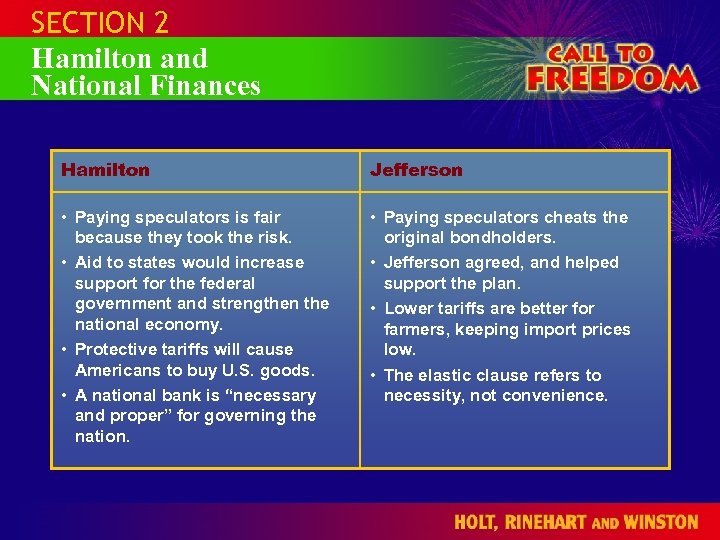 SECTION 2 Hamilton and National Finances Hamilton Jefferson • Paying speculators is fair because they took the risk. • Aid to states would increase support for the federal government and strengthen the national economy. • Protective tariffs will cause Americans to buy U. S. goods. • A national bank is “necessary and proper” for governing the nation. • Paying speculators cheats the original bondholders. • Jefferson agreed, and helped support the plan. • Lower tariffs are better for farmers, keeping import prices low. • The elastic clause refers to necessity, not convenience.
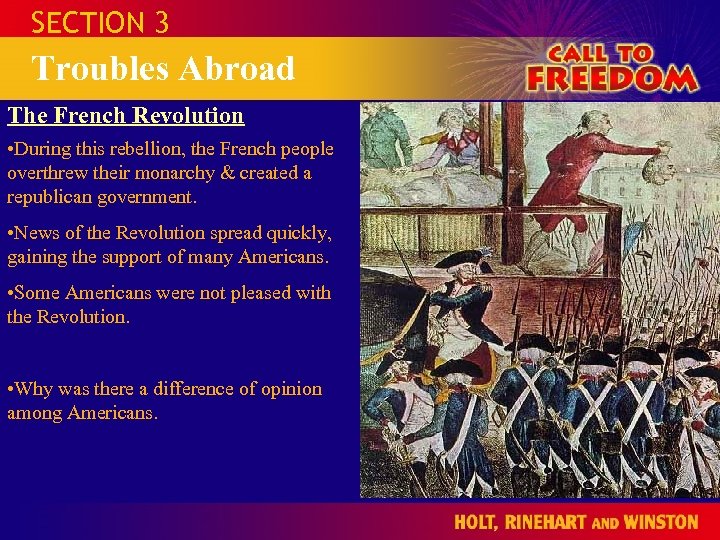 SECTION 3 Troubles Abroad The French Revolution • During this rebellion, the French people overthrew their monarchy & created a republican government. • News of the Revolution spread quickly, gaining the support of many Americans. • Some Americans were not pleased with the Revolution. • Why was there a difference of opinion among Americans.
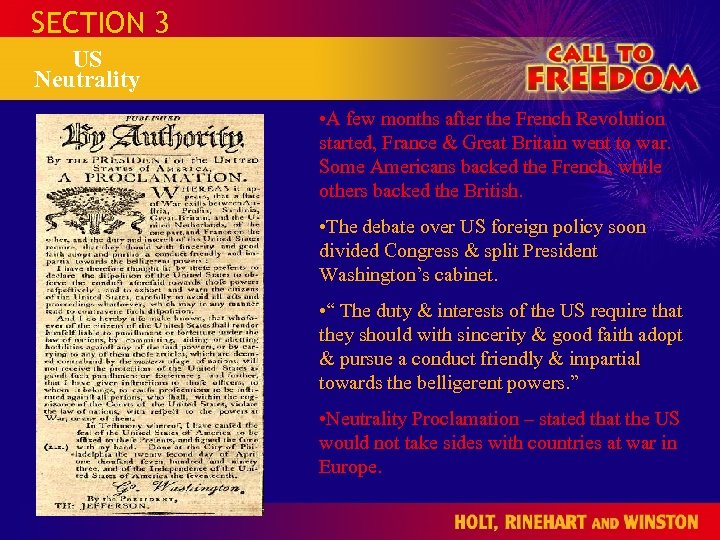 SECTION 3 US Neutrality • A few months after the French Revolution started, France & Great Britain went to war. Some Americans backed the French, while others backed the British. • The debate over US foreign policy soon divided Congress & split President Washington’s cabinet. • “ The duty & interests of the US require that they should with sincerity & good faith adopt & pursue a conduct friendly & impartial towards the belligerent powers. ” • Neutrality Proclamation – stated that the US would not take sides with countries at war in Europe.
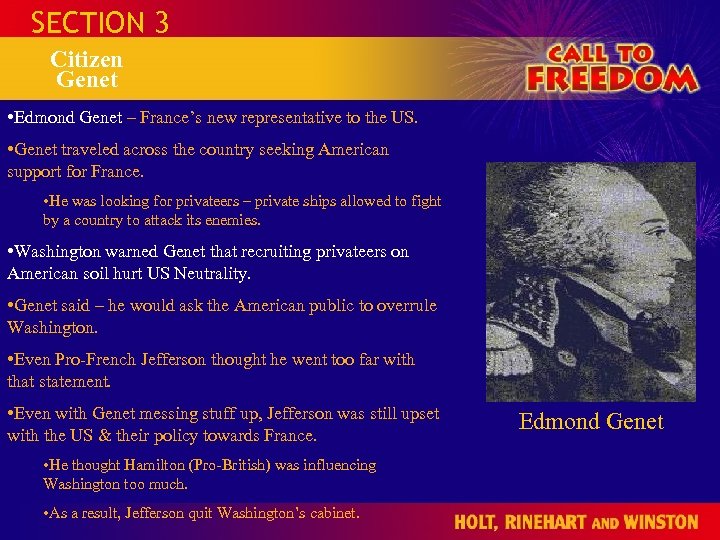 SECTION 3 Citizen Genet • Edmond Genet – France’s new representative to the US. • Genet traveled across the country seeking American support for France. • He was looking for privateers – private ships allowed to fight by a country to attack its enemies. • Washington warned Genet that recruiting privateers on American soil hurt US Neutrality. • Genet said – he would ask the American public to overrule Washington. • Even Pro-French Jefferson thought he went too far with that statement. • Even with Genet messing stuff up, Jefferson was still upset with the US & their policy towards France. • He thought Hamilton (Pro-British) was influencing Washington too much. • As a result, Jefferson quit Washington’s cabinet. Edmond Genet
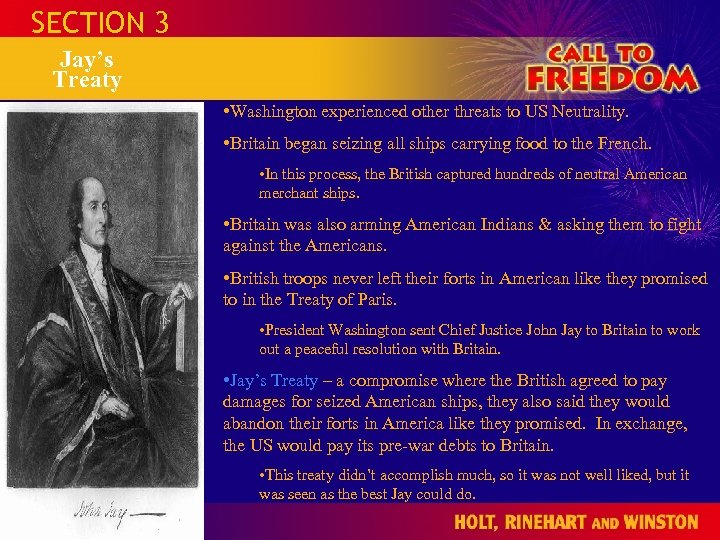 SECTION 3 Jay’s Treaty • Washington experienced other threats to US Neutrality. • Britain began seizing all ships carrying food to the French. • In this process, the British captured hundreds of neutral American merchant ships. • Britain was also arming American Indians & asking them to fight against the Americans. • British troops never left their forts in American like they promised to in the Treaty of Paris. • President Washington sent Chief Justice John Jay to Britain to work out a peaceful resolution with Britain. • Jay’s Treaty – a compromise where the British agreed to pay damages for seized American ships, they also said they would abandon their forts in America like they promised. In exchange, the US would pay its pre-war debts to Britain. • This treaty didn’t accomplish much, so it was not well liked, but it was seen as the best Jay could do.
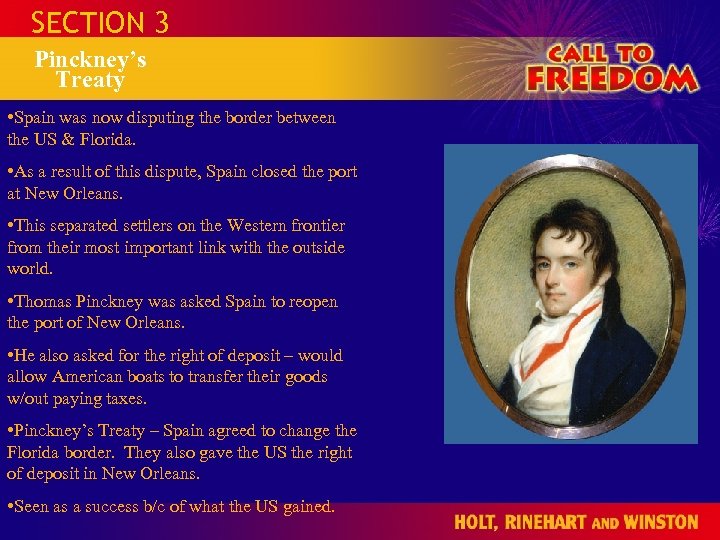 SECTION 3 Pinckney’s Treaty • Spain was now disputing the border between the US & Florida. • As a result of this dispute, Spain closed the port at New Orleans. • This separated settlers on the Western frontier from their most important link with the outside world. • Thomas Pinckney was asked Spain to reopen the port of New Orleans. • He also asked for the right of deposit – would allow American boats to transfer their goods w/out paying taxes. • Pinckney’s Treaty – Spain agreed to change the Florida border. They also gave the US the right of deposit in New Orleans. • Seen as a success b/c of what the US gained.
 SECTION 3 Troubles Abroad Question: • Define: French Revolution • What problem did Washington and America face in regards to the French Revolution? • Define: Neutral • Why was it important to stay on good terms with the British? • What did Edmund Genet do? • Why did Washington urge Congress to start a Navy in 1794? • Describe: Jay’s Treaty with Britain? • Describe: Pinckney’s Treaty with Spain?
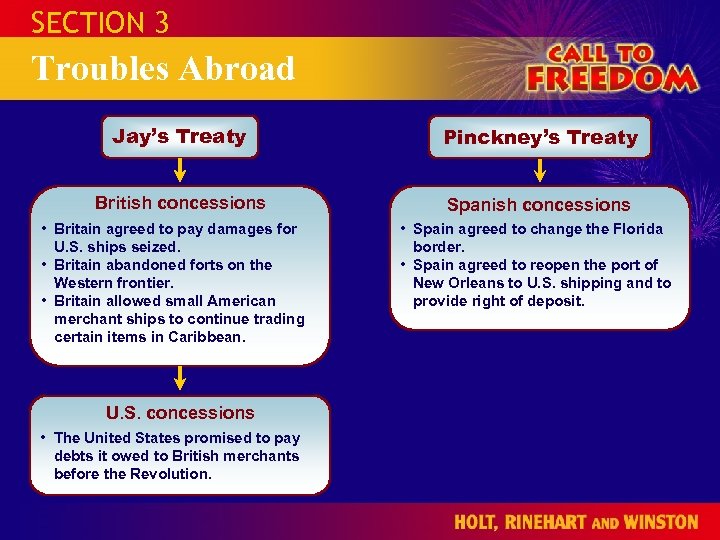 SECTION 3 Troubles Abroad Jay’s Treaty Pinckney’s Treaty British concessions Spanish concessions • Britain agreed to pay damages for U. S. ships seized. • Britain abandoned forts on the Western frontier. • Britain allowed small American merchant ships to continue trading certain items in Caribbean. U. S. concessions • The United States promised to pay debts it owed to British merchants before the Revolution. • Spain agreed to change the Florida border. • Spain agreed to reopen the port of New Orleans to U. S. shipping and to provide right of deposit.
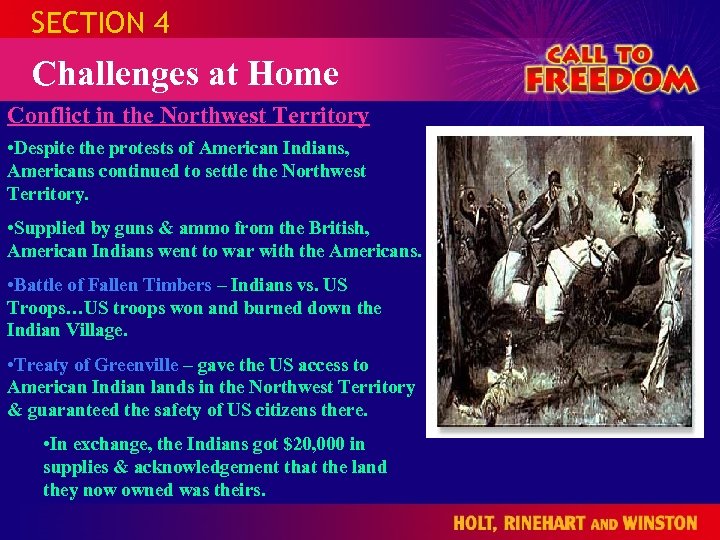 SECTION 4 Challenges at Home Conflict in the Northwest Territory • Despite the protests of American Indians, Americans continued to settle the Northwest Territory. • Supplied by guns & ammo from the British, American Indians went to war with the Americans. • Battle of Fallen Timbers – Indians vs. US Troops…US troops won and burned down the Indian Village. • Treaty of Greenville – gave the US access to American Indian lands in the Northwest Territory & guaranteed the safety of US citizens there. • In exchange, the Indians got $20, 000 in supplies & acknowledgement that the land they now owned was theirs.
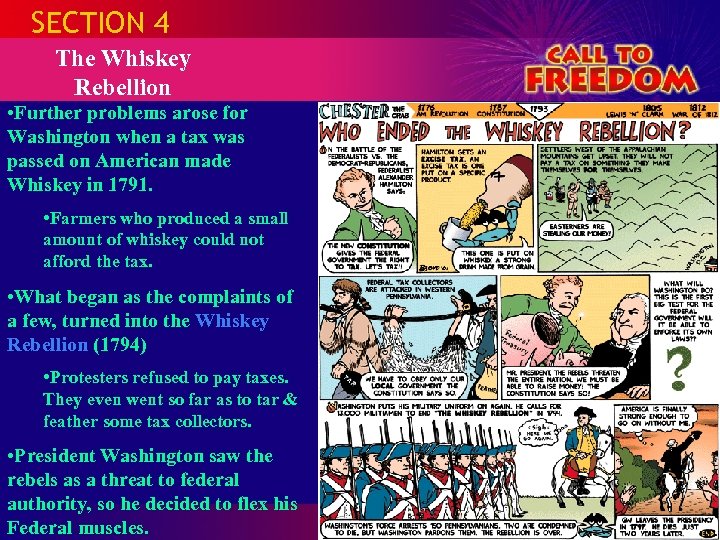 SECTION 4 The Whiskey Rebellion • Further problems arose for Washington when a tax was passed on American made Whiskey in 1791. • Farmers who produced a small amount of whiskey could not afford the tax. • What began as the complaints of a few, turned into the Whiskey Rebellion (1794) • Protesters refused to pay taxes. They even went so far as to tar & feather some tax collectors. • President Washington saw the rebels as a threat to federal authority, so he decided to flex his Federal muscles.
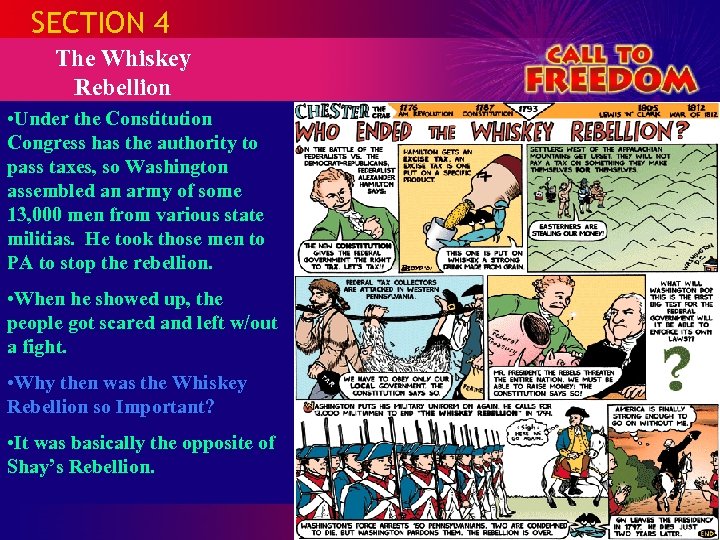 SECTION 4 The Whiskey Rebellion • Under the Constitution Congress has the authority to pass taxes, so Washington assembled an army of some 13, 000 men from various state militias. He took those men to PA to stop the rebellion. • When he showed up, the people got scared and left w/out a fight. • Why then was the Whiskey Rebellion so Important? • It was basically the opposite of Shay’s Rebellion.
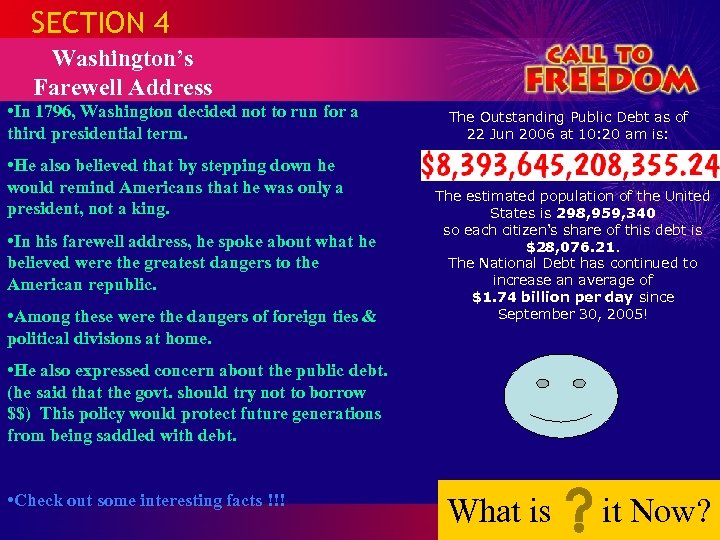 SECTION 4 Washington’s Farewell Address • In 1796, Washington decided not to run for a third presidential term. • He also believed that by stepping down he would remind Americans that he was only a president, not a king. • In his farewell address, he spoke about what he believed were the greatest dangers to the American republic. • Among these were the dangers of foreign ties & political divisions at home. The Outstanding Public Debt as of 22 Jun 2006 at 10: 20 am is: The estimated population of the United States is 298, 959, 340 so each citizen's share of this debt is $28, 076. 21. The National Debt has continued to increase an average of $1. 74 billion per day since September 30, 2005! • He also expressed concern about the public debt. (he said that the govt. should try not to borrow $$) This policy would protect future generations from being saddled with debt. • Check out some interesting facts !!! What is it Now?
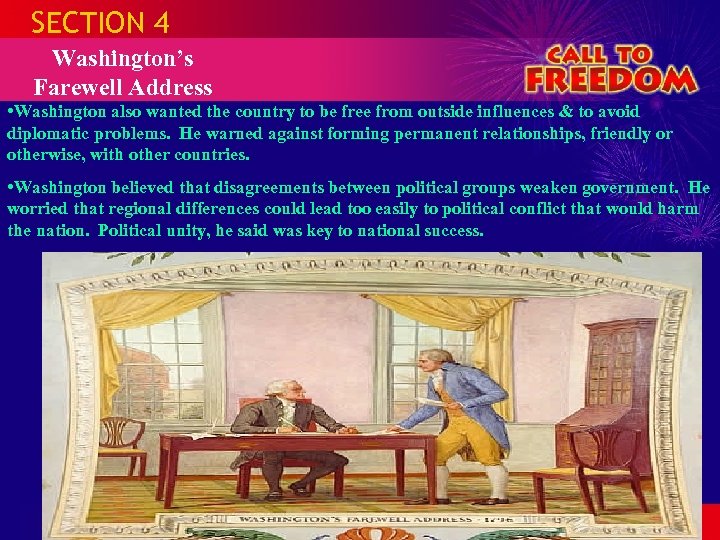 SECTION 4 Washington’s Farewell Address • Washington also wanted the country to be free from outside influences & to avoid diplomatic problems. He warned against forming permanent relationships, friendly or otherwise, with other countries. • Washington believed that disagreements between political groups weaken government. He worried that regional differences could lead too easily to political conflict that would harm the nation. Political unity, he said was key to national success.
 SECTION 4 Challenges at Home Question: • What did the US do in the battle of Fallen Timbers to show the Indians they should stop fighting? • Who was supplying the Indians in the West to keep them fighting the Americans? • What unpopular tax did Alexander Hamilton come up with? • Describe the Whiskey Rebellion. • How did Washington handle this rebellion? How was this different from Shay’s Rebellion? What did this prove? • Why did Washington not run for a 3 rd term of office? • Who was the only president to break Washington’s precedent and run for a 3 rd term? • What were the 3 things he warned against in his farewell address?
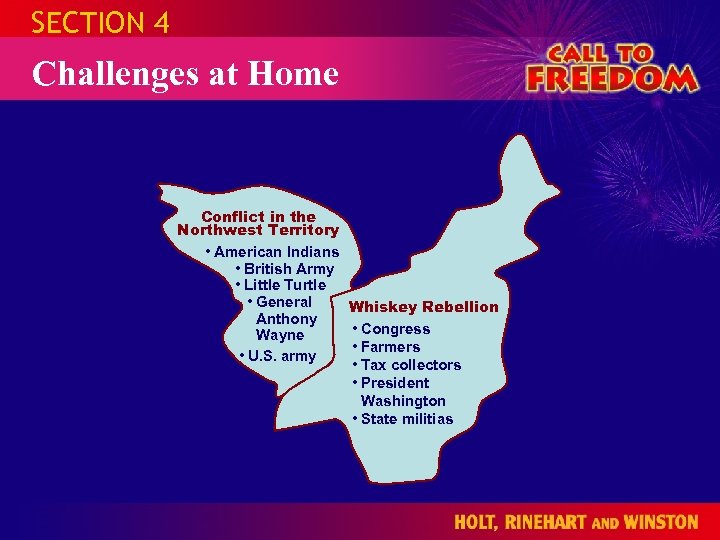 SECTION 4 Challenges at Home Conflict in the Northwest Territory • American Indians • British Army • Little Turtle • General Whiskey Rebellion Anthony • Congress Wayne • Farmers • U. S. army • Tax collectors • President Washington • State militias
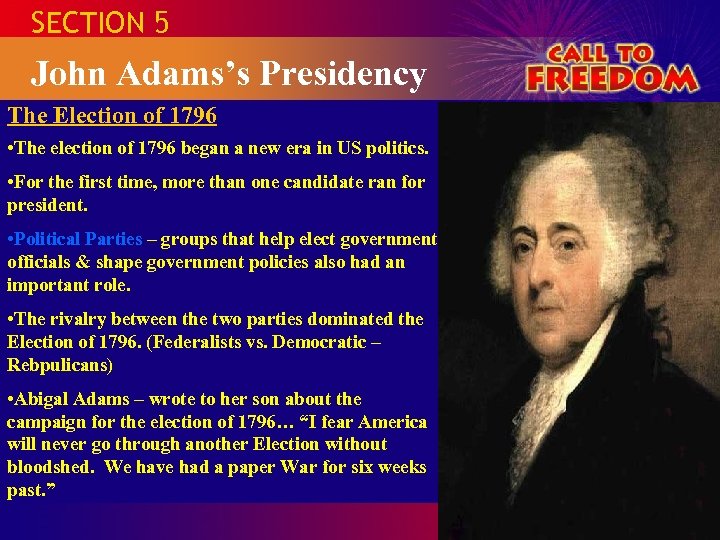 SECTION 5 John Adams’s Presidency The Election of 1796 • The election of 1796 began a new era in US politics. • For the first time, more than one candidate ran for president. • Political Parties – groups that help elect government officials & shape government policies also had an important role. • The rivalry between the two parties dominated the Election of 1796. (Federalists vs. Democratic – Rebpulicans) • Abigal Adams – wrote to her son about the campaign for the election of 1796… “I fear America will never go through another Election without bloodshed. We have had a paper War for six weeks past. ”
 SECTION 5 John Adams’s Presidency cont. Federalist Party Democratic – Republican Party • Leaders were: Alexander Hamilton & former V. P. John Adams • Leaders were: Thomas Jefferson & James Madison • Wanted to make the federal govt. strong. • Wanted to make the state govt. strong. • Promote industry & trade • Promote farming & agriculture • Most popular in New England. • Most popular in South & Western frontier • Election of 1796 – Adams & Thomas Pinckney (treaty) were Federalist candidates for President. • Election of 1796 – Jefferson & Aaron Burr were Dem. – Rep. candidates for President. • Said Jefferson was greatly influenced by French • Said Adams was greatly influenced by British. • Nothing to do with present day Republican Party.
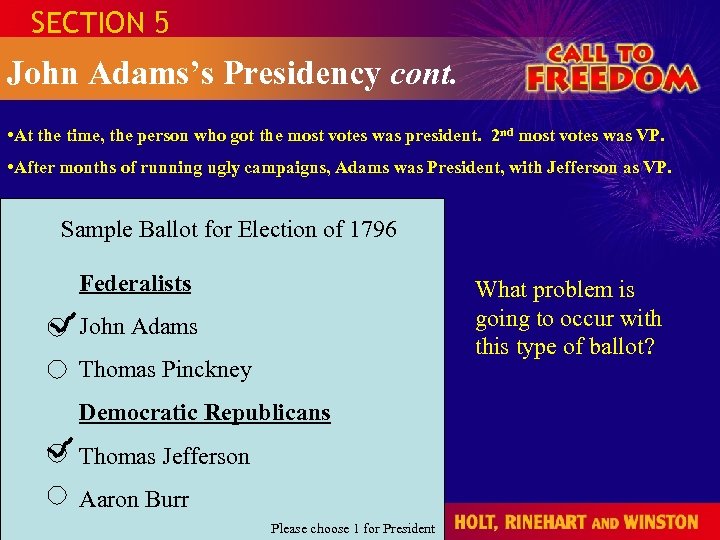 SECTION 5 John Adams’s Presidency cont. • At the time, the person who got the most votes was president. 2 nd most votes was VP. • After months of running ugly campaigns, Adams was President, with Jefferson as VP. Sample Ballot for Election of 1796 Federalists What problem is going to occur with this type of ballot? John Adams Thomas Pinckney Democratic Republicans Thomas Jefferson Aaron Burr Please choose 1 for President
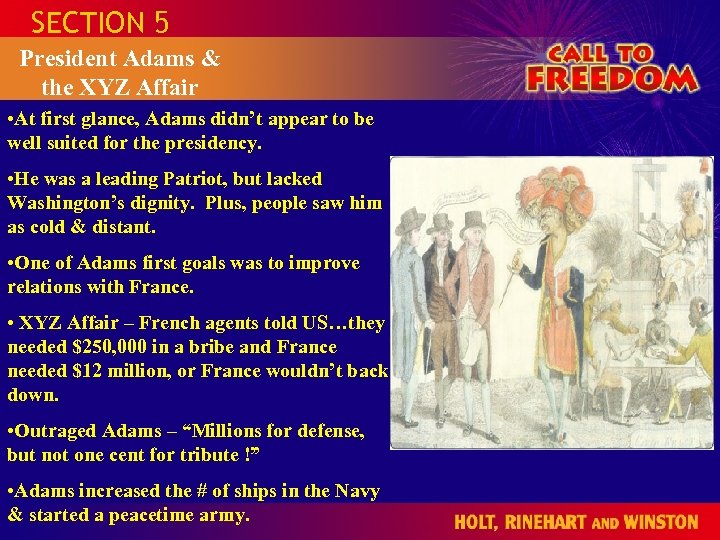 SECTION 5 President Adams & the XYZ Affair • At first glance, Adams didn’t appear to be well suited for the presidency. • He was a leading Patriot, but lacked Washington’s dignity. Plus, people saw him as cold & distant. • One of Adams first goals was to improve relations with France. • XYZ Affair – French agents told US…they needed $250, 000 in a bribe and France needed $12 million, or France wouldn’t back down. • Outraged Adams – “Millions for defense, but not one cent for tribute !” • Adams increased the # of ships in the Navy & started a peacetime army.
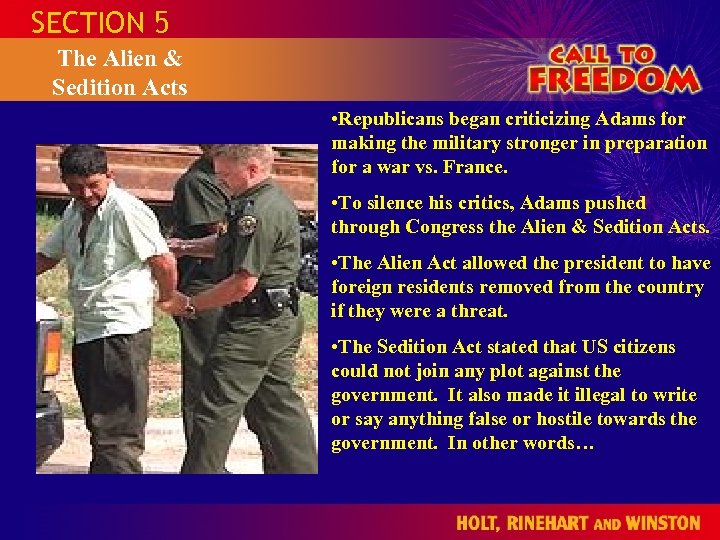 SECTION 5 The Alien & Sedition Acts • Republicans began criticizing Adams for making the military stronger in preparation for a war vs. France. • To silence his critics, Adams pushed through Congress the Alien & Sedition Acts. • The Alien Act allowed the president to have foreign residents removed from the country if they were a threat. • The Sedition Act stated that US citizens could not join any plot against the government. It also made it illegal to write or say anything false or hostile towards the government. In other words…
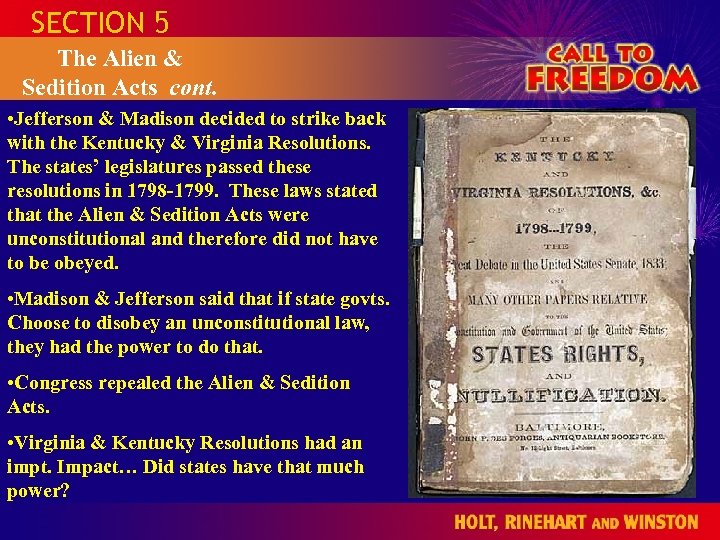 SECTION 5 The Alien & Sedition Acts cont. • Jefferson & Madison decided to strike back with the Kentucky & Virginia Resolutions. The states’ legislatures passed these resolutions in 1798 -1799. These laws stated that the Alien & Sedition Acts were unconstitutional and therefore did not have to be obeyed. • Madison & Jefferson said that if state govts. Choose to disobey an unconstitutional law, they had the power to do that. • Congress repealed the Alien & Sedition Acts. • Virginia & Kentucky Resolutions had an impt. Impact… Did states have that much power?
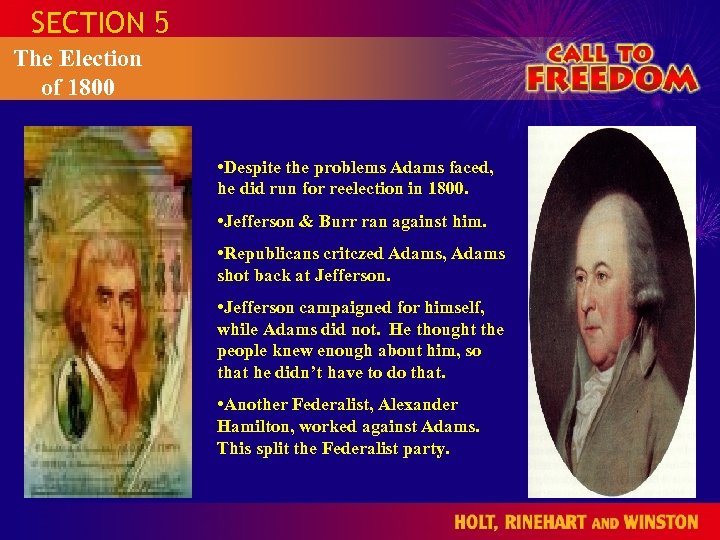 SECTION 5 The Election of 1800 • Despite the problems Adams faced, he did run for reelection in 1800. • Jefferson & Burr ran against him. • Republicans critczed Adams, Adams shot back at Jefferson. • Jefferson campaigned for himself, while Adams did not. He thought the people knew enough about him, so that he didn’t have to do that. • Another Federalist, Alexander Hamilton, worked against Adams. This split the Federalist party.
 SECTION 5 The Election of 1800 vs. John Adams Thomas Jefferson Our Country’s First Real Election
 SECTION 5 The Election of 1800
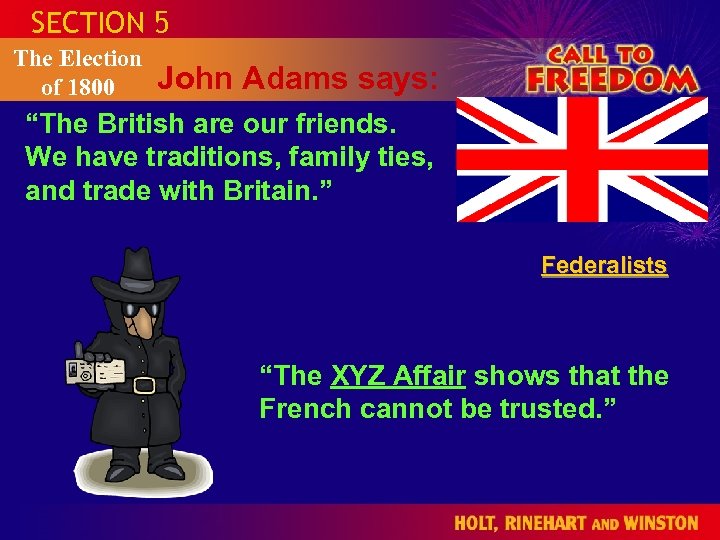 SECTION 5 The Election of 1800 John Adams says: “The British are our friends. We have traditions, family ties, and trade with Britain. ” Federalists “The XYZ Affair shows that the French cannot be trusted. ”
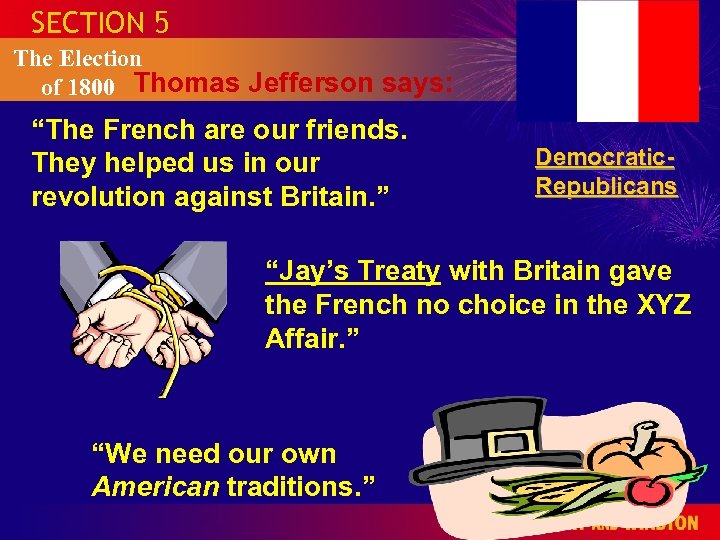 SECTION 5 The Election of 1800 Thomas Jefferson says: “The French are our friends. They helped us in our revolution against Britain. ” Democratic. Republicans “Jay’s Treaty with Britain gave the French no choice in the XYZ Affair. ” “We need our own American traditions. ”
 SECTION 5 The Election of 1800
 SECTION 5 The Election of 1800 John Adams says: “We need a strong military to protect our country. ” Federalists “Our navy got the attention of the French during the XYZ Affair. ” “We need a strong navy to protect our trade. ”
 SECTION 5 Democratic- Republicans The Election of 1800 Thomas Jefferson says: “We do not need a standing army because it can be used against the people. I support a militia. ” “The Federalist use the army to keep themselves in power. They only appoint Federalists as officers. ”
 SECTION 5 The Election of 1800 Subversion is an attempt to overthrow the authority
 SECTION 5 The Election of 1800 John Adams says: “The Alien and Sedition Acts protect our young and vulnerable country from subversion by allowing us to remove dangerous people. ”
 SECTION 5 The Election of 1800 Thomas Jefferson says: “The Alien and Sedition Acts violate our First Amendment freedoms. ” “Federalists do not fear subversion as much as they fear any criticism of their policies. ”
 SECTION 5 The Election of 1800
 SECTION 5 The Election of 1800 John Adams says: “I am against the Kentucky and Virginia Resolutions because the Constitution gives the federal government power and reserves power to the state governments. ” “The federal government should always be stronger than the state governments. ”
 SECTION 5 The Election of 1800 Thomas Jefferson says: “I support the Kentucky and Virginia Resolutions. States should be stronger so that we do not have a federal government with too much power. ” “The government gets its power from the people, and smaller state governments are more responsive to the people. ”
 SECTION 5 The Election of 1800
 SECTION 5 The Election of 1800 John Adams says: “The rich and educated should rule because they have a vested interest in and knowledge of government. ”
 SECTION 5 The Election of 1800 Thomas Jefferson says: “The common people should have more say in the government. After all, they make up the greatest majority of Americans. ” “Always remember the first words of the Constitution…. ‘We the people…’”
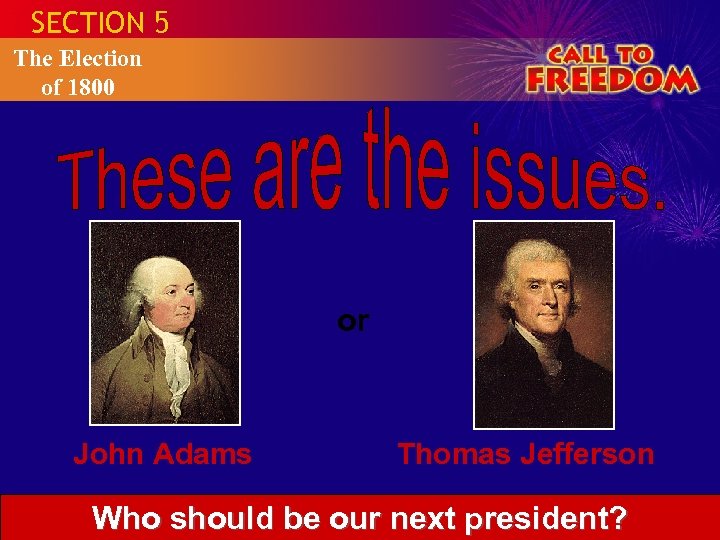 SECTION 5 The Election of 1800 or John Adams Thomas Jefferson Who should be our next president?
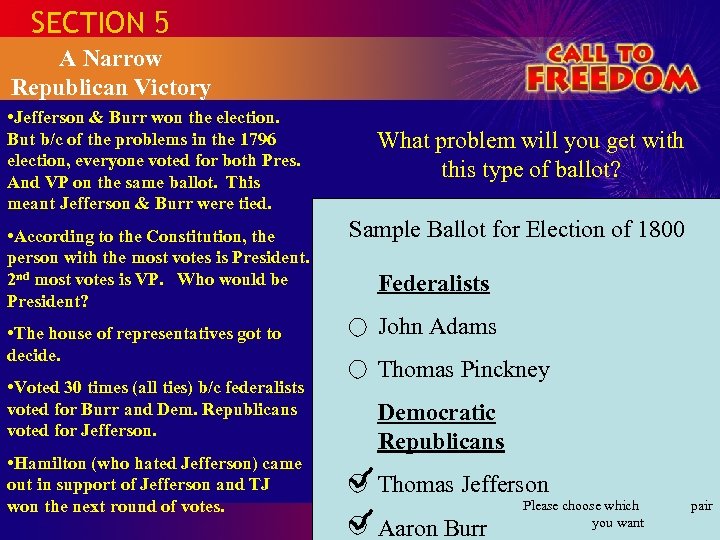 SECTION 5 A Narrow Republican Victory • Jefferson & Burr won the election. But b/c of the problems in the 1796 election, everyone voted for both Pres. And VP on the same ballot. This meant Jefferson & Burr were tied. • According to the Constitution, the person with the most votes is President. 2 nd most votes is VP. Who would be President? • The house of representatives got to decide. • Voted 30 times (all ties) b/c federalists voted for Burr and Dem. Republicans voted for Jefferson. • Hamilton (who hated Jefferson) came out in support of Jefferson and TJ won the next round of votes. What problem will you get with this type of ballot? Sample Ballot for Election of 1800 Federalists John Adams Thomas Pinckney Democratic Republicans Thomas Jefferson Aaron Burr Please choose which you want pair
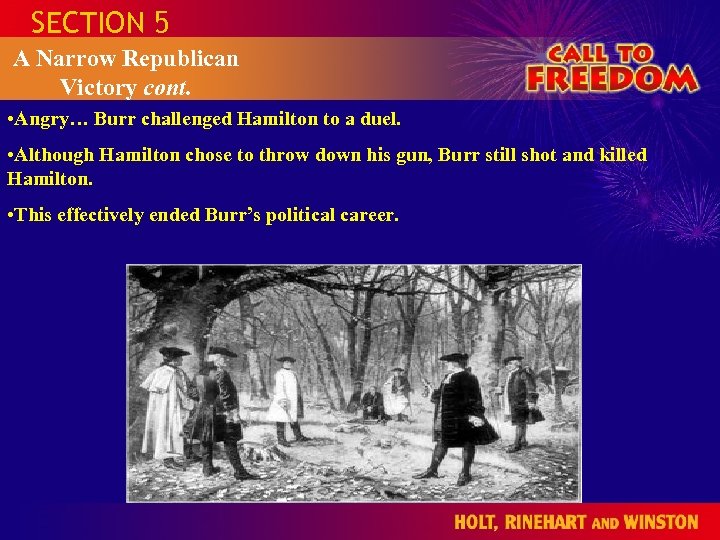 SECTION 5 A Narrow Republican Victory cont. • Angry… Burr challenged Hamilton to a duel. • Although Hamilton chose to throw down his gun, Burr still shot and killed Hamilton. • This effectively ended Burr’s political career.
 SECTION 5 John Adams’s Presidency Question: • What happened in the election of 1796 that wouldn’t happen today? • Define: Political Parties • Why did Jefferson Quit Washington’s Cabinet? • What Political Party did Jefferson start? • Describe the beliefs of the party. • What party did Adams and Hamilton start? • Describe their beliefs. • Who is Abigal Adams and what did she fight for? • Describe the XYZ affair. • What was the popular slogan used about the XYZ affair? • Define: Aliens • Define: Sedition • What did critics of the Alien and Sedition acts claim? • Who were the Alien & Sedition Acts supposed to silence? • Define: States’ Rights • What did the Kentucky and Virginia Resolutions claim?
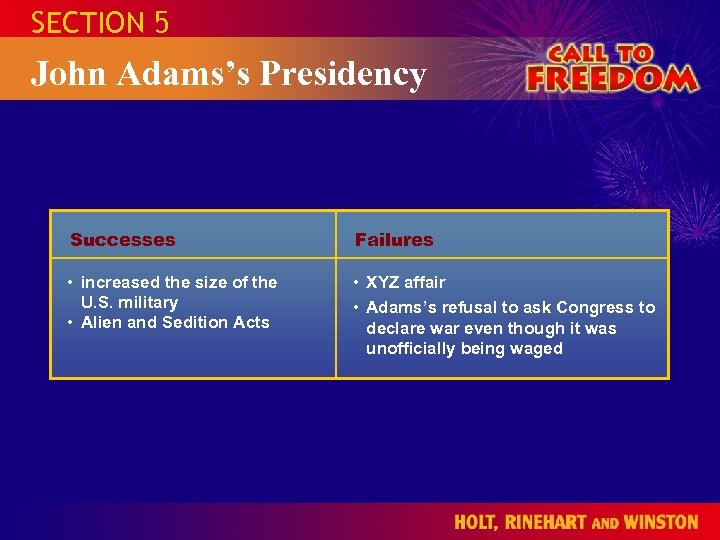 SECTION 5 John Adams’s Presidency Successes Failures • increased the size of the U. S. military • Alien and Sedition Acts • XYZ affair • Adams’s refusal to ask Congress to declare war even though it was unofficially being waged
 CHAPTER 10 Chapter Wrap-Up 1. How did Presidents Washington and Adams address foreign-policy issues? 2. What constitutional issues did Alexander Hamilton confront when he proposed the creation of a national bank? 3. How did Alexander Hamilton propose handling federal and state debts, and why?