


 Скачать презентацию Chapter 10 Innovation and Change What Would
ffb348707aabcdc560e2dccf86a220a0.ppt
- Количество слайдов: 35
 Chapter 10 Innovation and Change
 What Would You Do? Product Innovation at Kimberly-Clark n n n Procter & Gamble is determined to lead the market in diapers P&G responds aggressively to new innovations by Kimberly-Clark Other products, such as toilet paper are perceived to have little room for innovation 2
 Learning Objectives Organizational Innovation After discussing this section, you should be able to: 1. 2. explain why innovation matters to companies. discuss the different methods that managers can use to effectively manage innovation in their organizations. 3
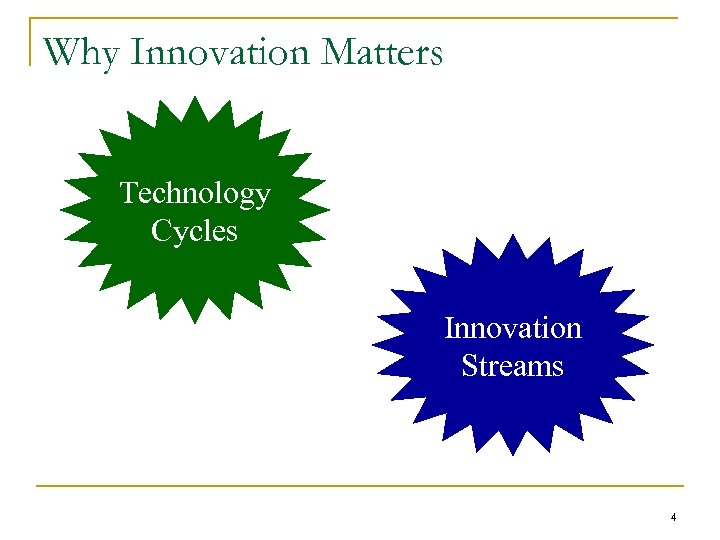 Why Innovation Matters Technology Cycles Innovation Streams 4
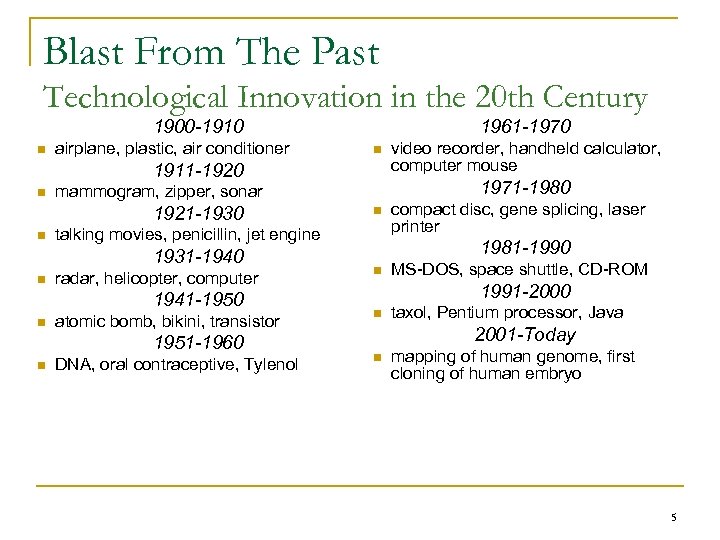 Blast From The Past Technological Innovation in the 20 th Century 1900 -1910 n airplane, plastic, air conditioner 1961 -1970 n 1911 -1920 n n radar, helicopter, computer 1941 -1950 n atomic bomb, bikini, transistor 1951 -1960 n n talking movies, penicillin, jet engine 1931 -1940 n 1971 -1980 mammogram, zipper, sonar 1921 -1930 DNA, oral contraceptive, Tylenol video recorder, handheld calculator, computer mouse compact disc, gene splicing, laser printer 1981 -1990 n MS-DOS, space shuttle, CD-ROM 1991 -2000 n taxol, Pentium processor, Java 2001 -Today n mapping of human genome, first cloning of human embryo 5
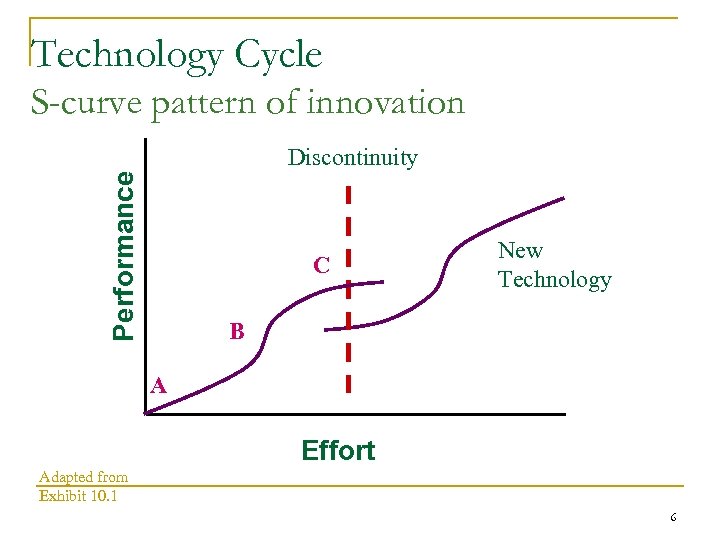 Technology Cycle S-curve pattern of innovation Performance Discontinuity C New Technology B A Effort Adapted from Exhibit 10. 1 6
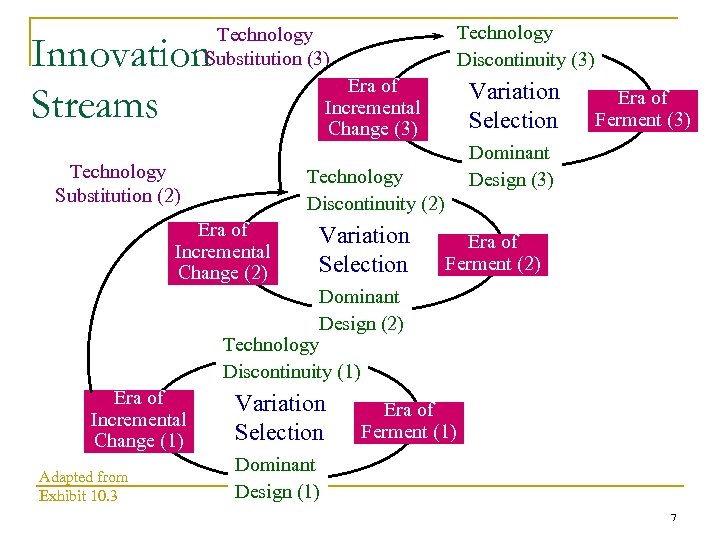 Technology Discontinuity (3) Technology Substitution (3) Innovation Streams Era of Incremental Change (3) Technology Substitution (2) Variation Selection Dominant Design (3) Technology Discontinuity (2) Era of Incremental Change (2) Variation Selection Era of Ferment (3) Era of Ferment (2) Dominant Design (2) Technology Discontinuity (1) Era of Incremental Change (1) Adapted from Exhibit 10. 3 Variation Selection Era of Ferment (1) Dominant Design (1) 7
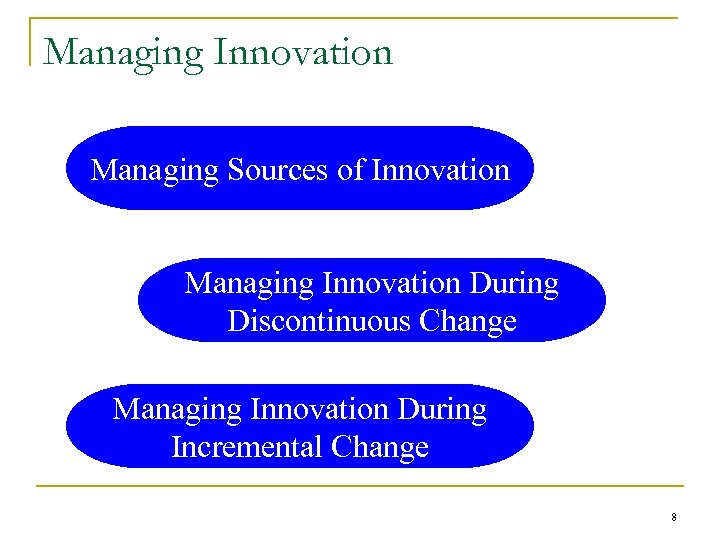 Managing Innovation Managing Sources of Innovation Managing Innovation During Discontinuous Change Managing Innovation During Incremental Change 8
 Managing Sources of Innovation n Creative work environments Ø n workplace cultures in which workers perceive that new ideas are encouraged Flow Ø the psychological state of effortlessness 9
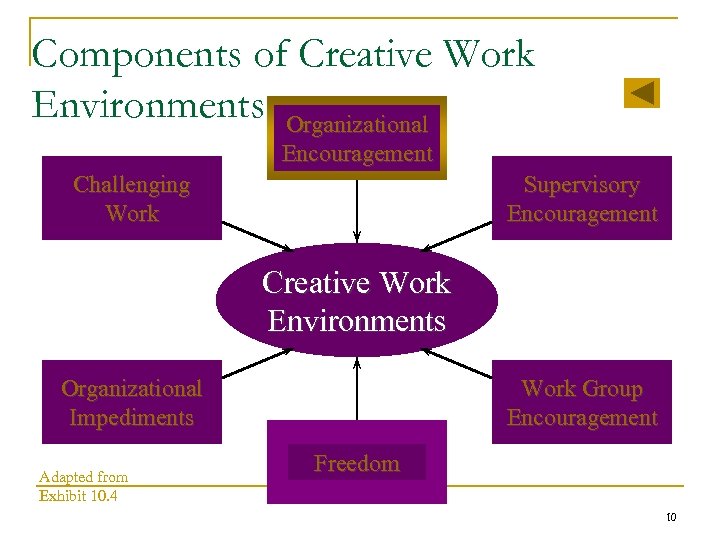 Components of Creative Work Environments Organizational Encouragement Challenging Work Supervisory Encouragement Creative Work Environments Organizational Impediments Adapted from Exhibit 10. 4 Work Group Encouragement Freedom 10
 Been There, Done That John Cleese on Innovations & Creativity n n n We need to have a positive attitudes towards mistakes Fear of failure hurts creativity Mistakes should be fixed, not concealed 11
 Managing Innovation During Discontinuous Change n Discontinuous Change Ø n technology discontinuity creates a significant breakthrough Use the experiential approach to innovation Ø innovation created by intuition, flexible options, and hands-on experience in an uncertain environment 12
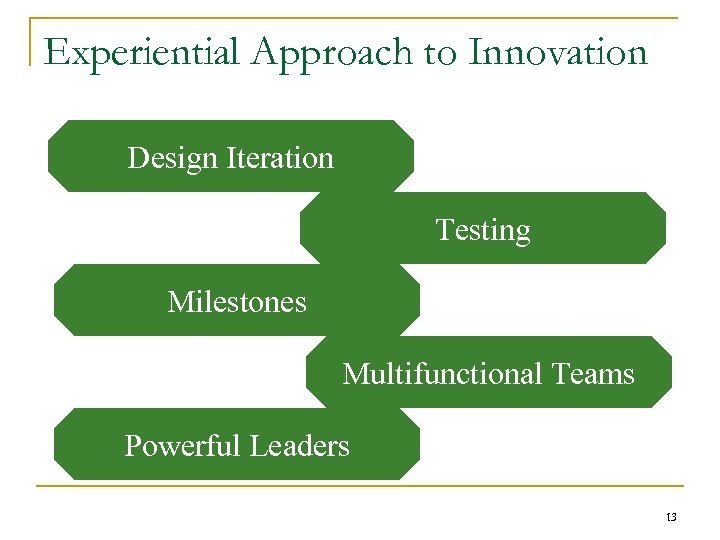 Experiential Approach to Innovation Design Iteration Testing Milestones Multifunctional Teams Powerful Leaders 13
 Managing Innovation during Incremental Change n Compression approach to innovation Ø n assumes that innovation is a predictable process that can be planned in steps Generational change Ø based on incremental improvements to a dominant technological design and achieving backward compatibility with older technology 14
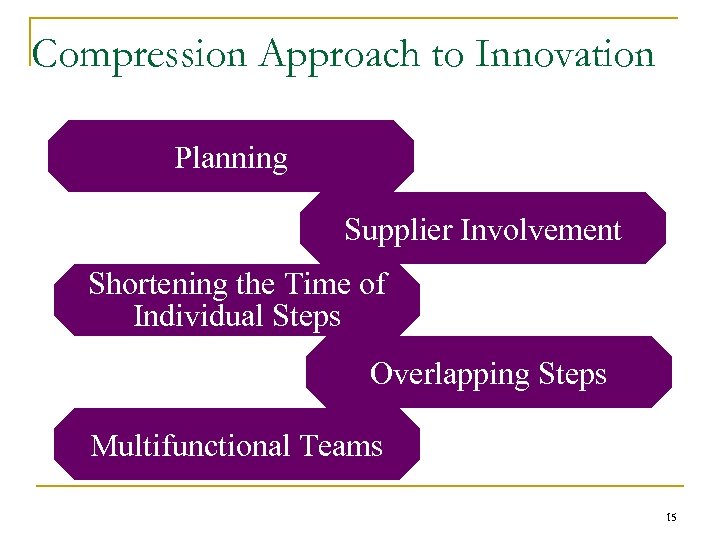 Compression Approach to Innovation Planning Supplier Involvement Shortening the Time of Individual Steps Overlapping Steps Multifunctional Teams 15
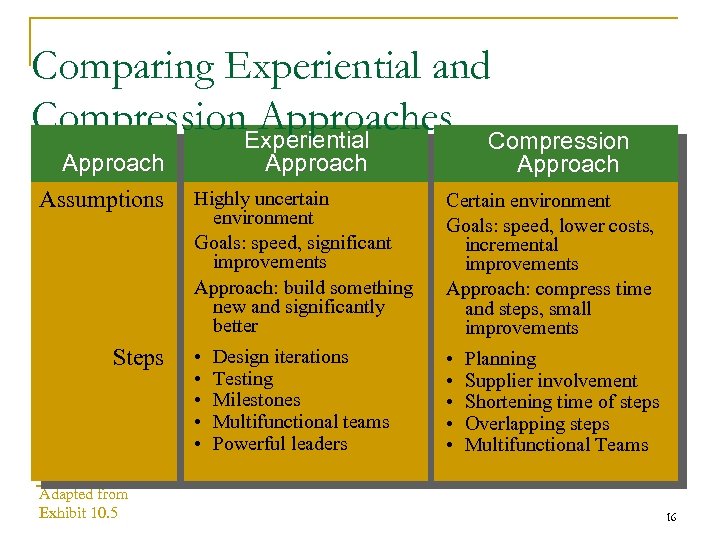 Comparing Experiential and Compression. Experiential Approaches Compression Approach Assumptions Steps Adapted from Exhibit 10. 5 Compression Approach Highly uncertain environment Goals: speed, significant improvements Approach: build something new and significantly better Certain environment Goals: speed, lower costs, incremental improvements Approach: compress time and steps, small improvements • • • Design iterations Testing Milestones Multifunctional teams Powerful leaders Planning Supplier involvement Shortening time of steps Overlapping steps Multifunctional Teams 16
 Learning Objectives Organizational Change After discussing this section, you should be able to: 3. 4. discuss why change occurs and why it matters. discuss the different methods that managers can use to better manage change as it occurs. 17
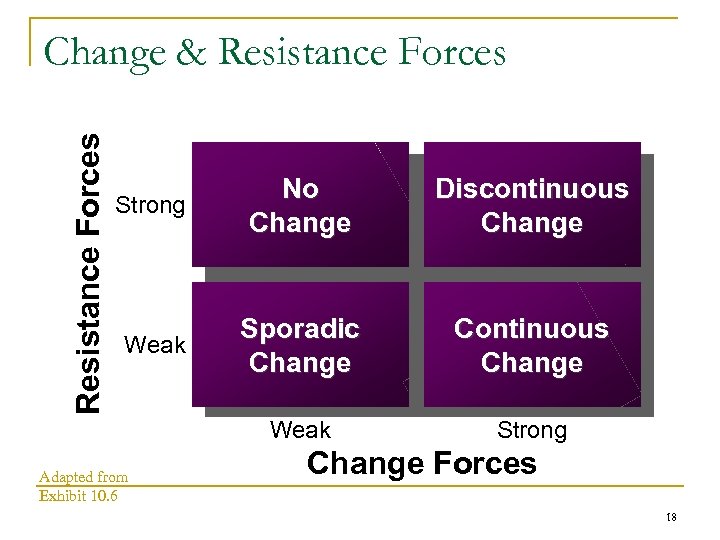 Resistance Forces Change & Resistance Forces Strong No Change Discontinuous Change Weak Sporadic Change Continuous Change Weak Strong Adapted from Exhibit 10. 6 Change Forces 18
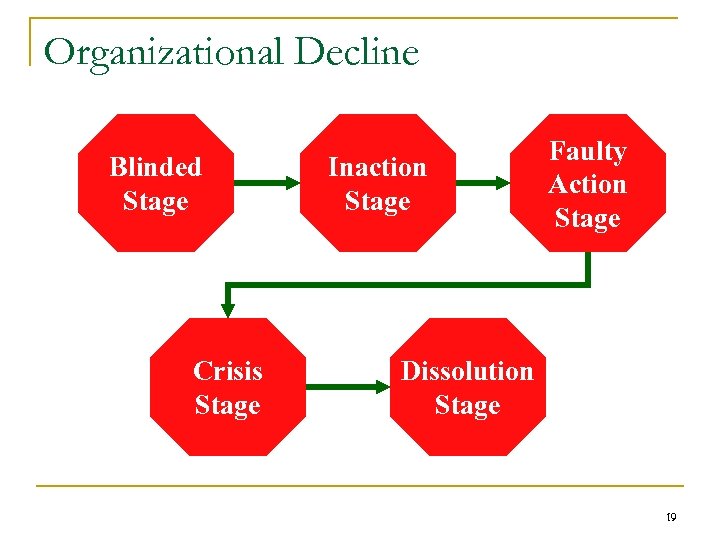 Organizational Decline Blinded Stage Crisis Stage Inaction Stage Faulty Action Stage Dissolution Stage 19
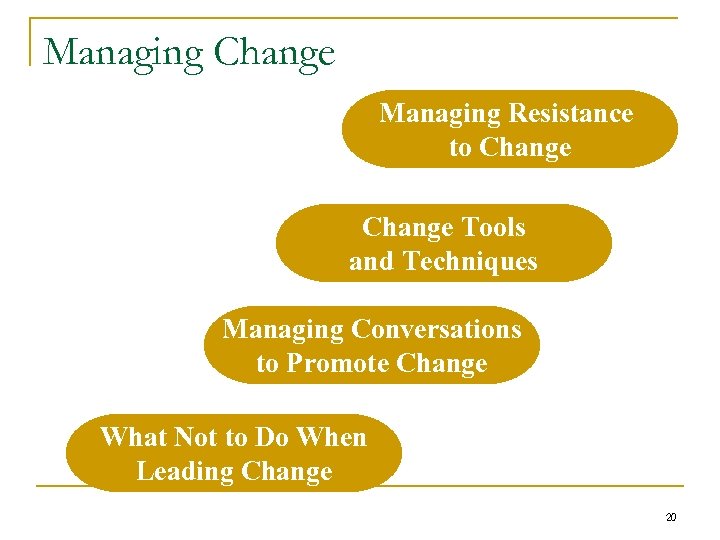 Managing Change Managing Resistance to Change Tools and Techniques Managing Conversations to Promote Change What Not to Do When Leading Change 20
 Managing Resistance to Change n n Lewin’s Framework Methods of Managing Resistance to Change 21
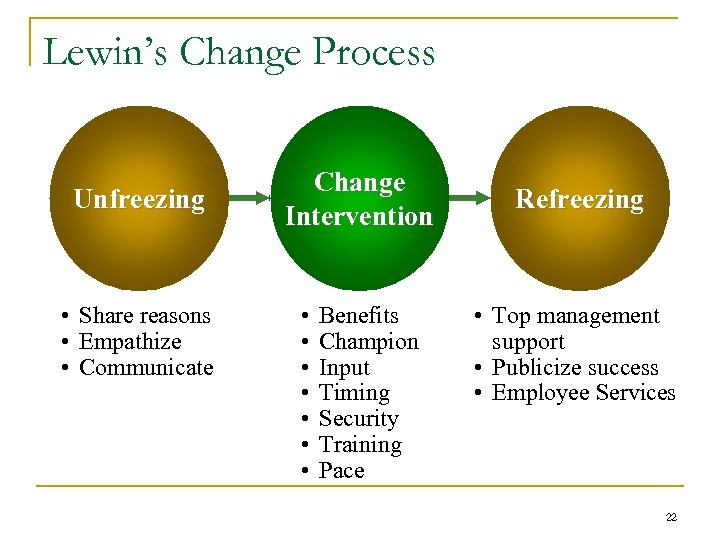 Lewin’s Change Process Unfreezing • Share reasons • Empathize • Communicate Change Intervention • • Benefits Champion Input Timing Security Training Pace Refreezing • Top management support • Publicize success • Employee Services 22
 Methods of Managing Resistance to Change n n n Education & Communication Participation Negotiation Top Management Support Coercion 23
 Change Tools and Techniques Results-Driven Change General Electric Workout Transition Management Team Organizational Development Change Agent 24
 Results-Driven Change n Creates quick change by focusing on measurement and improvement of results Ø Ø Ø create measurable, short-term goals use action steps likely to improve performance importance of immediate improvements consultants and staffers help managers test actions steps to see if yield improvements few resources required to get change started 25
 General Electric Three Day Workout n n n Boss sets agenda and identifies targets, then leaves Outside facilitator works with sub-groups, who debate solutions “Town Meeting” on day three Ø Ø subgroups make suggestions boss must decide on the spot 26
 Transition Management Team (TMT) n n A team of employees whose full-time job is managing change Anticipate and manage employee reactions to change Top management determines change initiatives TMT accomplishes those initiatives 27
 Organizational Development (OD) n n n A philosophy and collection of planned change interventions Designed to ensure organizations long-term survival Change Agent Ø Ø the person formally charged with guiding a change effort can be internal or external person 28
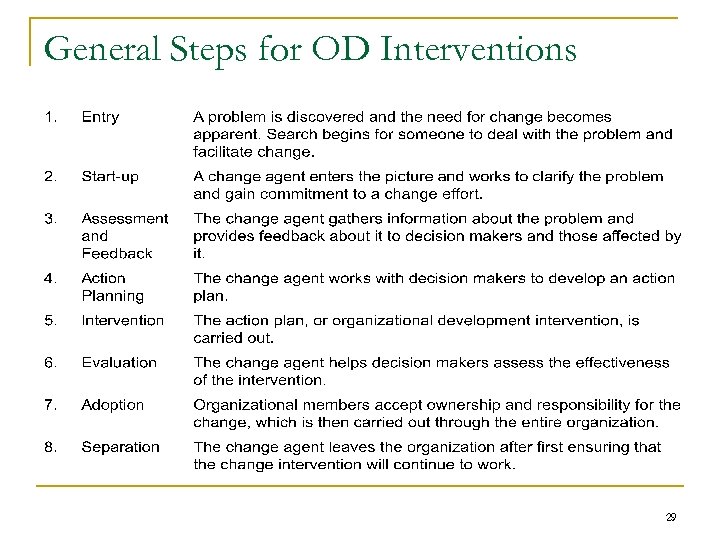 General Steps for OD Interventions 29
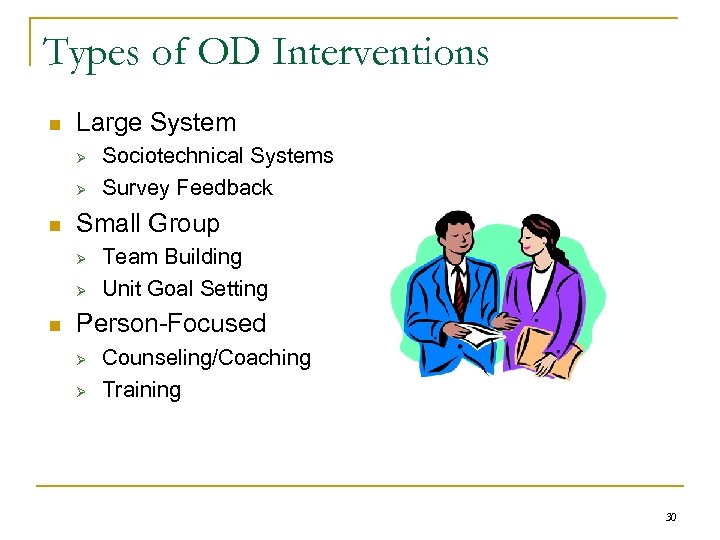 Types of OD Interventions n Large System Ø Ø n Small Group Ø Ø n Sociotechnical Systems Survey Feedback Team Building Unit Goal Setting Person-Focused Ø Ø Counseling/Coaching Training 30
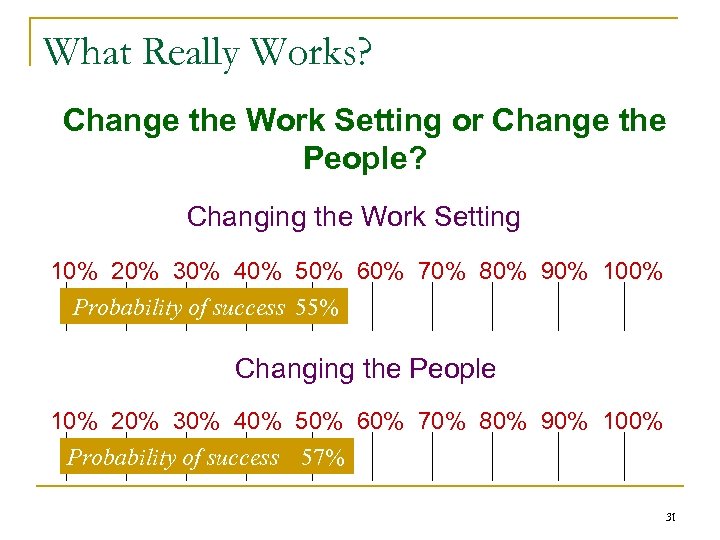 What Really Works? Change the Work Setting or Change the People? Changing the Work Setting 10% 20% 30% 40% 50% 60% 70% 80% 90% 100% Probability of success 55% Changing the People 10% 20% 30% 40% 50% 60% 70% 80% 90% 100% Probability of success 57% 31
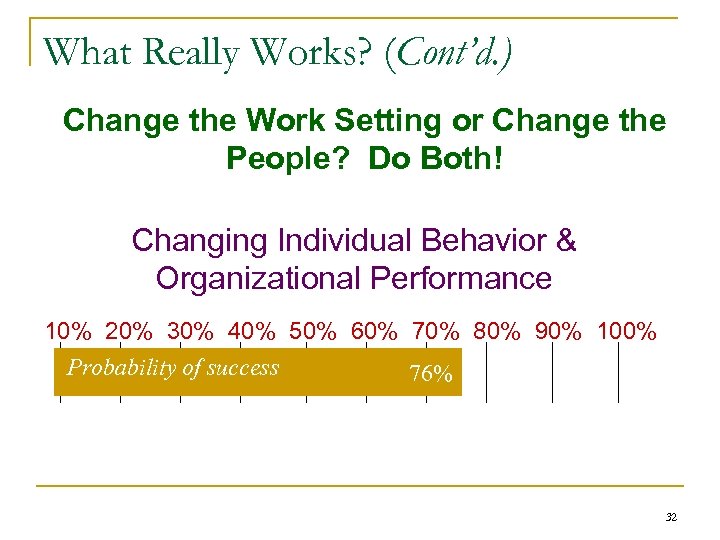 What Really Works? (Cont’d. ) Change the Work Setting or Change the People? Do Both! Changing Individual Behavior & Organizational Performance 10% 20% 30% 40% 50% 60% 70% 80% 90% 100% Probability of success 76% 32
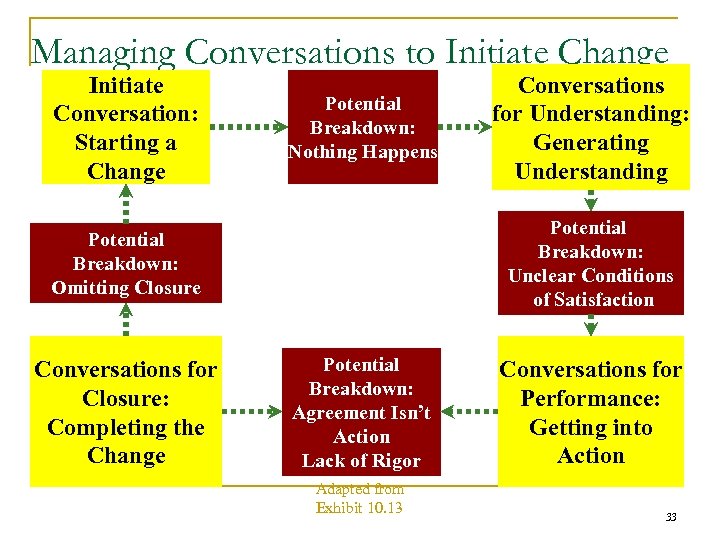 Managing Conversations to Initiate Change Initiate Conversation: Starting a Change Potential Breakdown: Nothing Happens Potential Breakdown: Unclear Conditions of Satisfaction Potential Breakdown: Omitting Closure Conversations for Closure: Completing the Change Conversations for Understanding: Generating Understanding Potential Breakdown: Agreement Isn’t Action Lack of Rigor Adapted from Exhibit 10. 13 Conversations for Performance: Getting into Action 33
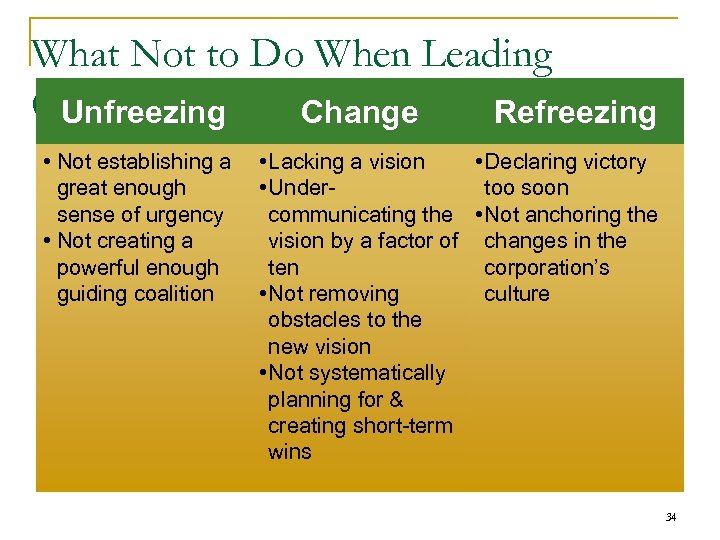 What Not to Do When Leading Change Unfreezing Change Refreezing • Not establishing a great enough sense of urgency • Not creating a powerful enough guiding coalition • Lacking a vision • Declaring victory • Undertoo soon communicating the • Not anchoring the vision by a factor of changes in the ten corporation’s • Not removing culture obstacles to the new vision • Not systematically planning for & creating short-term wins 34
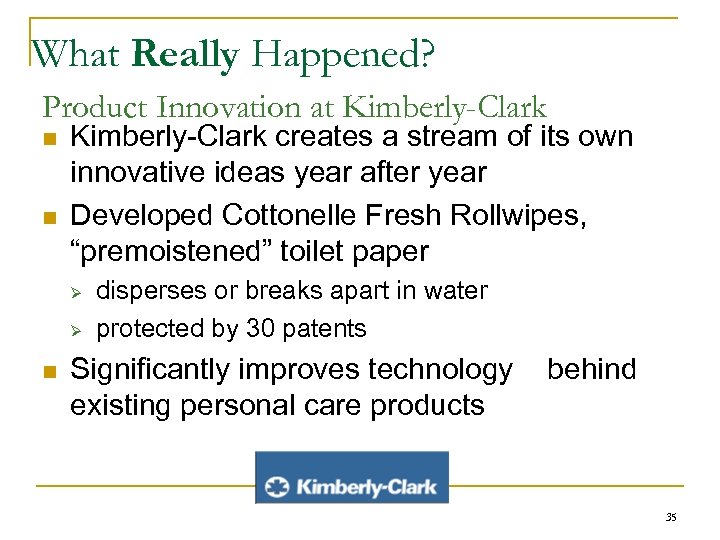 What Really Happened? Product Innovation at Kimberly-Clark n n Kimberly-Clark creates a stream of its own innovative ideas year after year Developed Cottonelle Fresh Rollwipes, “premoistened” toilet paper Ø Ø n disperses or breaks apart in water protected by 30 patents Significantly improves technology existing personal care products behind 35