


 Скачать презентацию CHAPTER 10 Identification and Authentication IV 054 Secret
2c9cfa2bc10e323641e2e158174c4ab0.ppt
- Количество слайдов: 35
 CHAPTER 10: Identification and Authentication, IV 054 Secret sharing and E-commerce applications Most of today's applications of cryptography ask for authentic data rather than secret data. The main problem is how to protect data and communication against an active attack. Main problems to deal with: 1. User identification (authentication): How can a person prove his (her) identity? 2. Message authenticity: Can tools be provided to decide for the recipient that the message is from the person who is supposed to send it? 3. Message integrity: Can tools be provided to decide for the recipient whether or not the message was changed? 1. One practical objectives is to find an identification scheme that is simple enough so that it can be implemented on smart cards - they are essentially credit cars equipped with a chip that can perform arithmetical operations and communications. E-commerce: One of the main new application of the cryptographic techniques is to establish secure and convenient manipulation with digital money, especially for ecommerce. Identification and Authentication 1
 IV 054 AUTHENTICATION Authentication (or entity (user) authentication or identification) is a process in which one party (referred often as a Prover) convinces the second party (referred often as a Verifier) of Prover’s identity and that the Prover has actually participated in the authentication process (I. e that the Prover is active in the time the confirmative evidence of identity is acquired). The purpose of any authentication process is to preclude some impersonation (zosobnenie). Authentication serves to control access to a resource (often a resource should be accessed only by a privileged user). Identification and Authentication 2
 IV 054 OBJECTIVES of AUTHENTICATION Authentication has to satisfy the following objectives: • The Verifier has to accept Prover’s identity if both parties are honest; • The Verifier cannot later, after successful authentication, pose as a Prover and authenticate himself to another Verifier; • A dishonest party that claims to be other party has only negligible chance to authenticate itself successfully; • Each of the above conditions remains true even if an attacker has observed or has participated in several authentication protocols. Identification and Authentication 3
 IV 054 Identification using a PKC system • Alice chooses a random r and sends e B (r) to Bob. • Alice identifies a communicationg persdon as Bob if he can send back r. • Bob identifies a communicating person as Alice if she can send him r. A misuse of the above system We show that (non-honest) Alice could misuse the above identification system. Indeed, Alice could intercept a communication of a Jane ( a new “player'') with Bob, and get a cryptotext e B (w) Jana has been sending to Bob, and then Alice could send e B (w) to Bob. Honest Bob, who follows fully the protocol, would then return w to Alice and she would get this way the plaintext w. Identification and Authentication 4
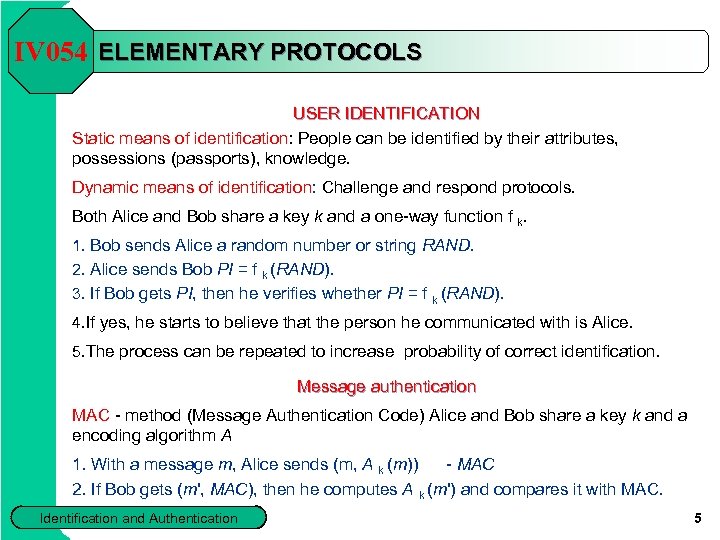 IV 054 ELEMENTARY PROTOCOLS USER IDENTIFICATION Static means of identification: People can be identified by their attributes, possessions (passports), knowledge. Dynamic means of identification: Challenge and respond protocols. Both Alice and Bob share a key k and a one-way function f k. 1. Bob sends Alice a random number or string RAND. 2. Alice sends Bob PI = f k (RAND). 3. If Bob gets PI, then he verifies whether PI = f k (RAND). 4. If yes, he starts to believe that the person he communicated with is Alice. 5. The process can be repeated to increase probability of correct identification. Message authentication MAC - method (Message Authentication Code) Alice and Bob share a key k and a encoding algorithm A 1. With a message m, Alice sends (m, A k (m)) - MAC 2. If Bob gets (m', MAC), then he computes A k (m') and compares it with MAC. Identification and Authentication 5
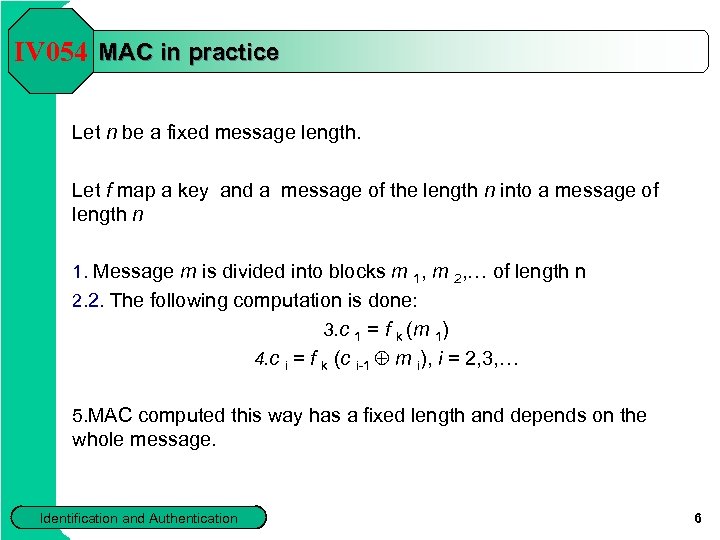 IV 054 MAC in practice Let n be a fixed message length. Let f map a key and a message of the length n into a message of length n 1. Message m is divided into blocks m 1, m 2, … of length n 2. 2. The following computation is done: 3. c 1 = f k (m 1) 4. c i = f k (c i-1 Å m i), i = 2, 3, … 5. MAC computed this way has a fixed length and depends on the whole message. Identification and Authentication 6
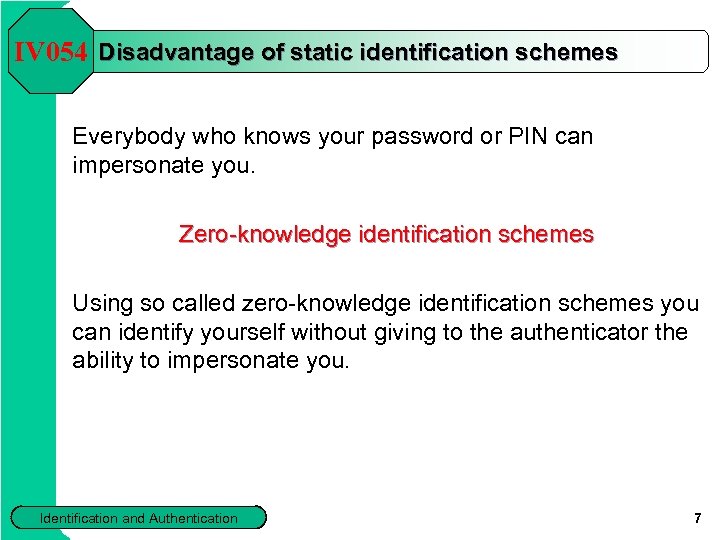 IV 054 Disadvantage of static identification schemes Everybody who knows your password or PIN can impersonate you. Zero-knowledge identification schemes Using so called zero-knowledge identification schemes you can identify yourself without giving to the authenticator the ability to impersonate you. Identification and Authentication 7
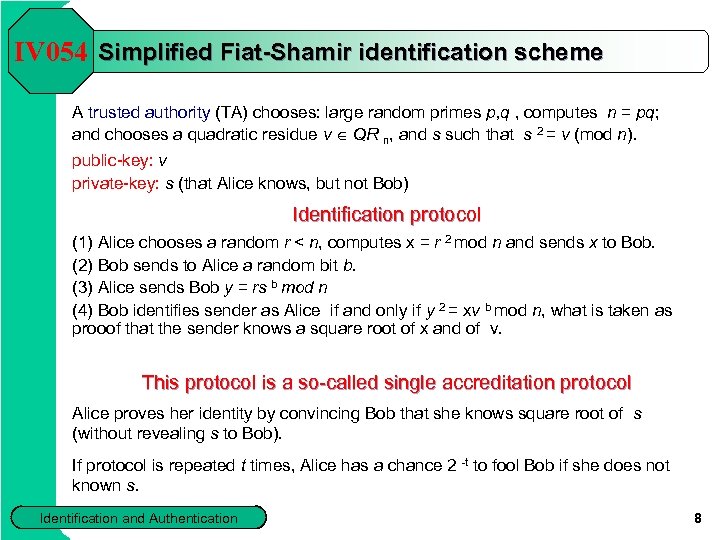 IV 054 Simplified Fiat-Shamir identification scheme A trusted authority (TA) chooses: large random primes p, q , computes n = pq; and chooses a quadratic residue v Î QR n, and s such that s 2 = v (mod n). public-key: v private-key: s (that Alice knows, but not Bob) Identification protocol (1) Alice chooses a random r < n, computes x = r 2 mod n and sends x to Bob. (2) Bob sends to Alice a random bit b. (3) Alice sends Bob y = rs b mod n (4) Bob identifies sender as Alice if and only if y 2 = xv b mod n, what is taken as prooof that the sender knows a square root of x and of v. This protocol is a so-called single accreditation protocol Alice proves her identity by convincing Bob that she knows square root of s (without revealing s to Bob). If protocol is repeated t times, Alice has a chance 2 -t to fool Bob if she does not known s. Identification and Authentication 8
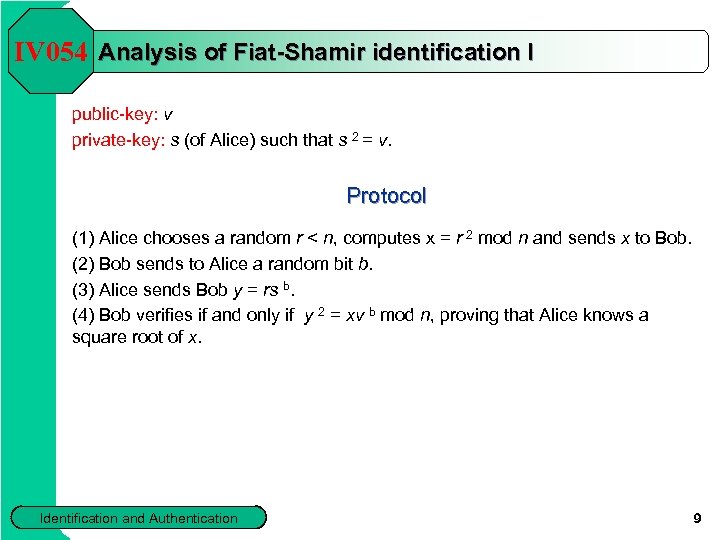 IV 054 Analysis of Fiat-Shamir identification I public-key: v private-key: s (of Alice) such that s 2 = v. Protocol (1) Alice chooses a random r < n, computes x = r 2 mod n and sends x to Bob. (2) Bob sends to Alice a random bit b. (3) Alice sends Bob y = rs b. (4) Bob verifies if and only if y 2 = xv b mod n, proving that Alice knows a square root of x. Identification and Authentication 9
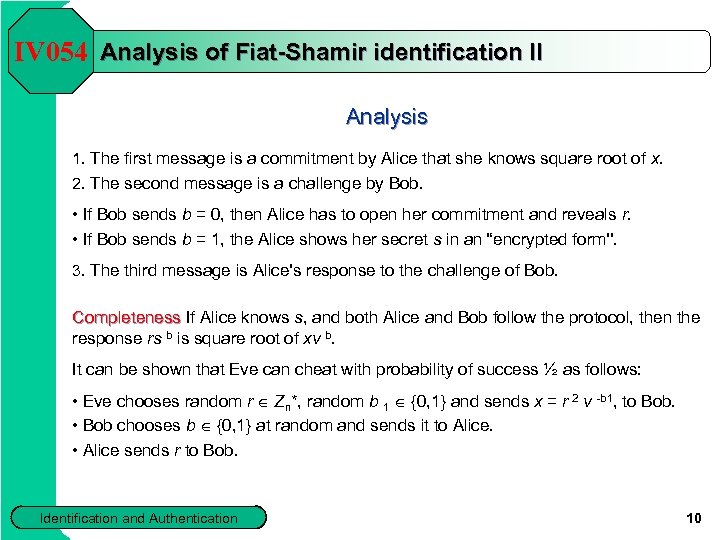 IV 054 Analysis of Fiat-Shamir identification II Analysis 1. The first message is a commitment by Alice that she knows square root of x. 2. The second message is a challenge by Bob. • If Bob sends b = 0, then Alice has to open her commitment and reveals r. • If Bob sends b = 1, the Alice shows her secret s in an “encrypted form''. 3. The third message is Alice's response to the challenge of Bob. Completeness If Alice knows s, and both Alice and Bob follow the protocol, then the response rs b is square root of xv b. It can be shown that Eve can cheat with probability of success ½ as follows: • Eve chooses random r Î Zn*, random b 1 Î {0, 1} and sends x = r 2 v -b 1, to Bob. • Bob chooses b Î {0, 1} at random and sends it to Alice. • Alice sends r to Bob. Identification and Authentication 10
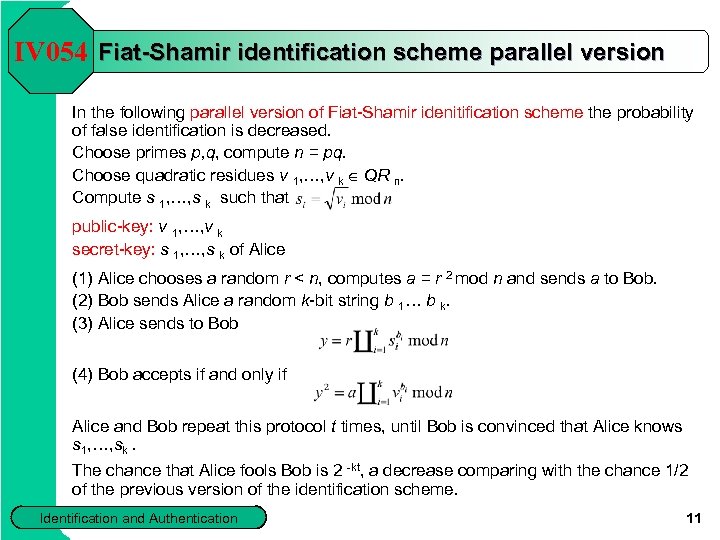 IV 054 Fiat-Shamir identification scheme parallel version In the following parallel version of Fiat-Shamir idenitification scheme the probability of false identification is decreased. Choose primes p, q, compute n = pq. Choose quadratic residues v 1, …, v k Î QR n. Compute s 1, …, s k such that public-key: v 1, …, v k secret-key: s 1, …, s k of Alice (1) Alice chooses a random r < n, computes a = r 2 mod n and sends a to Bob. (2) Bob sends Alice a random k-bit string b 1… b k. (3) Alice sends to Bob (4) Bob accepts if and only if Alice and Bob repeat this protocol t times, until Bob is convinced that Alice knows s 1, …, sk. The chance that Alice fools Bob is 2 -kt, a decrease comparing with the chance 1/2 of the previous version of the identification scheme. Identification and Authentication 11
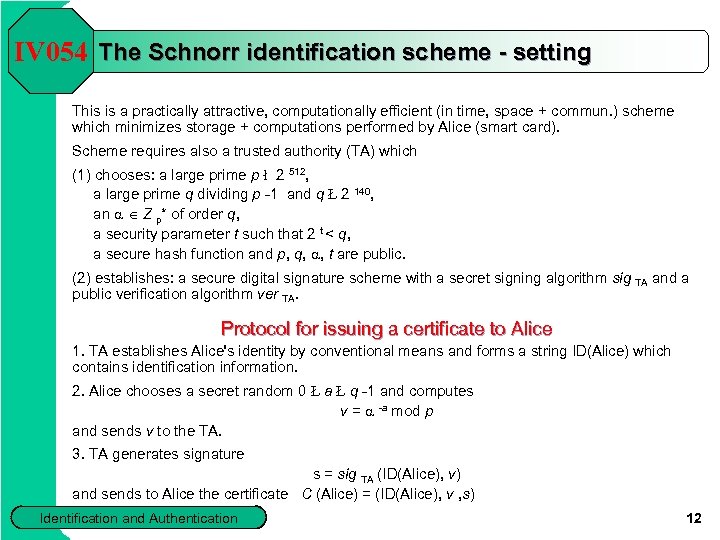 IV 054 The Schnorr identification scheme - setting This is a practically attractive, computationally efficient (in time, space + commun. ) scheme which minimizes storage + computations performed by Alice (smart card). Scheme requires also a trusted authority (TA) which (1) chooses: a large prime p ł 2 512, a large prime q dividing p -1 and q Ł 2 140, an a Î Z p* of order q, a security parameter t such that 2 t < q, a secure hash function and p, q, a, t are public. (2) establishes: a secure digital signature scheme with a secret signing algorithm sig TA and a public verification algorithm ver TA. Protocol for issuing a certificate to Alice 1. TA establishes Alice's identity by conventional means and forms a string ID(Alice) which contains identification information. 2. Alice chooses a secret random 0 Ł a Ł q -1 and computes v = a -a mod p and sends v to the TA. 3. TA generates signature s = sig TA (ID(Alice), v) and sends to Alice the certificate C (Alice) = (ID(Alice), v , s) Identification and Authentication 12
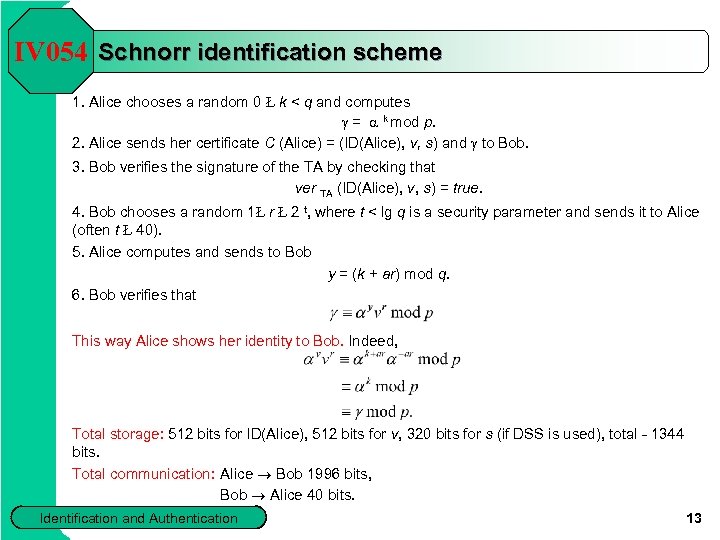 IV 054 Schnorr identification scheme 1. Alice chooses a random 0 Ł k < q and computes g = a k mod p. 2. Alice sends her certificate C (Alice) = (ID(Alice), v, s) and g to Bob. 3. Bob verifies the signature of the TA by checking that ver TA (ID(Alice), v, s) = true. 4. Bob chooses a random 1Ł r Ł 2 t, where t < lg q is a security parameter and sends it to Alice (often t Ł 40). 5. Alice computes and sends to Bob y = (k + ar) mod q. 6. Bob verifies that This way Alice shows her identity to Bob. Indeed, Total storage: 512 bits for ID(Alice), 512 bits for v, 320 bits for s (if DSS is used), total - 1344 bits. Total communication: Alice ® Bob 1996 bits, Bob ® Alice 40 bits. Identification and Authentication 13
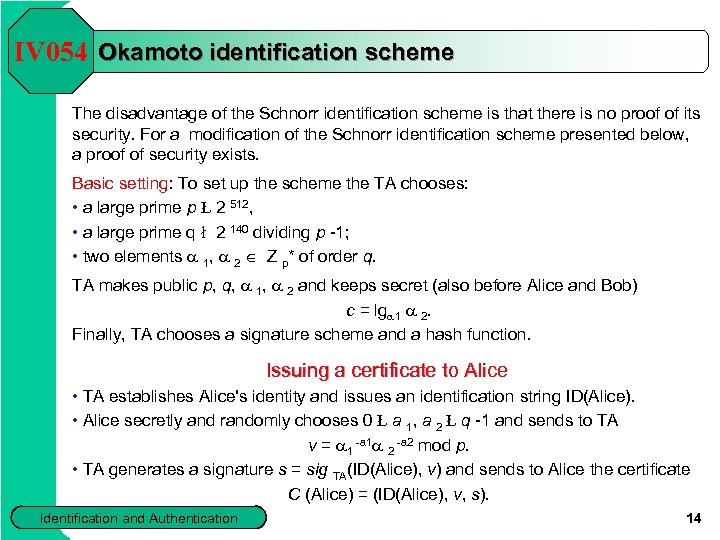 IV 054 Okamoto identification scheme The disadvantage of the Schnorr identification scheme is that there is no proof of its security. For a modification of the Schnorr identification scheme presented below, a proof of security exists. Basic setting: To set up the scheme the TA chooses: • a large prime p Ł 2 512, • a large prime q ł 2 140 dividing p -1; • two elements a 1, a 2 Î Z p* of order q. TA makes public p, q, a 1, a 2 and keeps secret (also before Alice and Bob) c = lga 1 a 2. Finally, TA chooses a signature scheme and a hash function. Issuing a certificate to Alice • TA establishes Alice's identity and issues an identification string ID(Alice). • Alice secretly and randomly chooses 0 Ł a 1, a 2 Ł q -1 and sends to TA v = a 1 -a 1 a 2 -a 2 mod p. • TA generates a signature s = sig TA(ID(Alice), v) and sends to Alice the certificate C (Alice) = (ID(Alice), v, s). Identification and Authentication 14
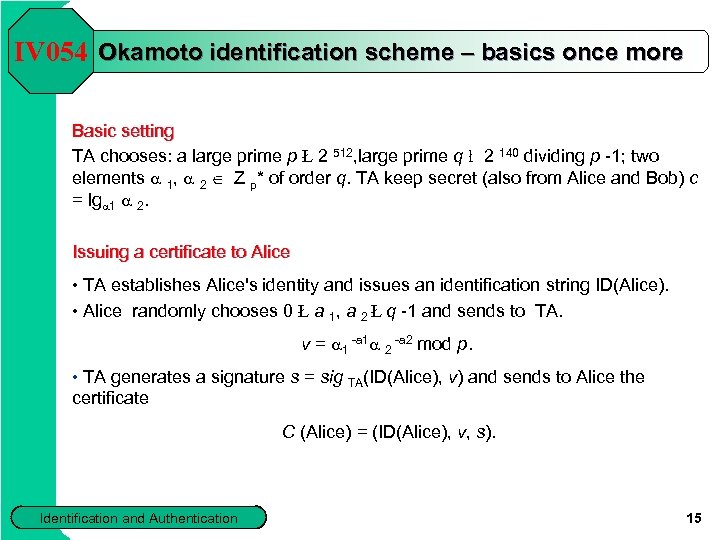 IV 054 Okamoto identification scheme – basics once more Basic setting TA chooses: a large prime p Ł 2 512, large prime q ł 2 140 dividing p -1; two elements a 1, a 2 Î Z p* of order q. TA keep secret (also from Alice and Bob) c = lga 1 a 2. Issuing a certificate to Alice • TA establishes Alice's identity and issues an identification string ID(Alice). • Alice randomly chooses 0 Ł a 1, a 2 Ł q -1 and sends to TA. v = a 1 -a 1 a 2 -a 2 mod p. • TA generates a signature s = sig TA(ID(Alice), v) and sends to Alice the certificate C (Alice) = (ID(Alice), v, s). Identification and Authentication 15
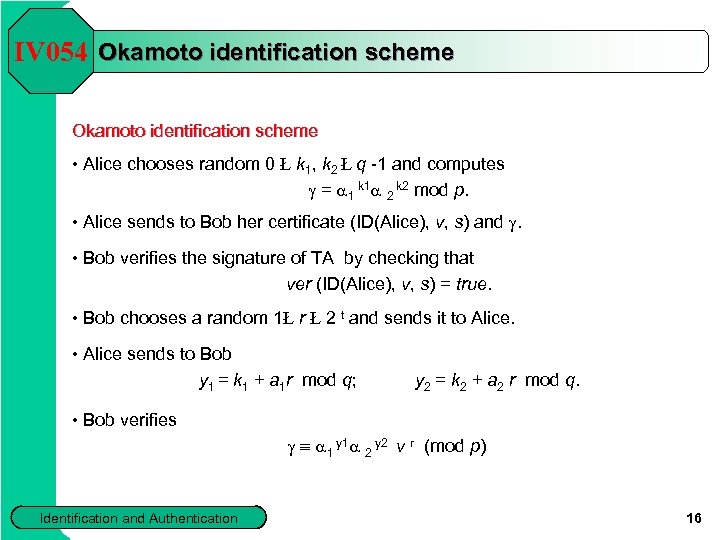 IV 054 Okamoto identification scheme • Alice chooses random 0 Ł k 1, k 2 Ł q -1 and computes g = a 1 k 1 a 2 k 2 mod p. • Alice sends to Bob her certificate (ID(Alice), v, s) and g. • Bob verifies the signature of TA by checking that ver (ID(Alice), v, s) = true. • Bob chooses a random 1Ł r Ł 2 t and sends it to Alice. • Alice sends to Bob y 1 = k 1 + a 1 r mod q; y 2 = k 2 + a 2 r mod q. • Bob verifies g º a 1 y 1 a 2 y 2 v r (mod p) Identification and Authentication 16
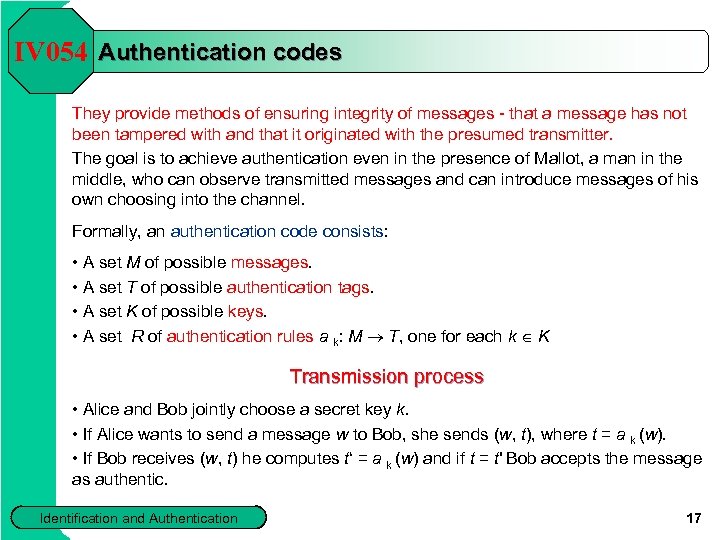 IV 054 Authentication codes They provide methods of ensuring integrity of messages - that a message has not been tampered with and that it originated with the presumed transmitter. The goal is to achieve authentication even in the presence of Mallot, a man in the middle, who can observe transmitted messages and can introduce messages of his own choosing into the channel. Formally, an authentication code consists: • A set M of possible messages. • A set T of possible authentication tags. • A set K of possible keys. • A set R of authentication rules a k: M ® T, one for each k Î K Transmission process • Alice and Bob jointly choose a secret key k. • If Alice wants to send a message w to Bob, she sends (w, t), where t = a k (w). • If Bob receives (w, t) he computes t‘ = a k (w) and if t = t' Bob accepts the message as authentic. Identification and Authentication 17
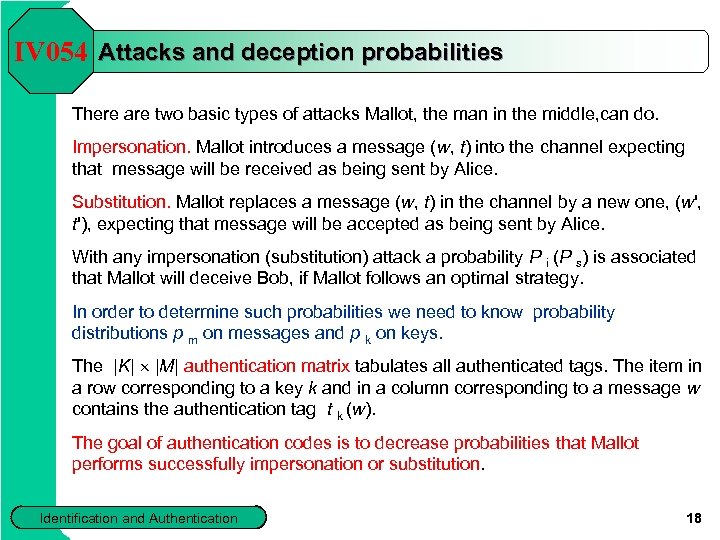 IV 054 Attacks and deception probabilities There are two basic types of attacks Mallot, the man in the middle, can do. Impersonation. Mallot introduces a message (w, t) into the channel expecting that message will be received as being sent by Alice. Substitution. Mallot replaces a message (w, t) in the channel by a new one, (w', t'), expecting that message will be accepted as being sent by Alice. With any impersonation (substitution) attack a probability P i (P s) is associated that Mallot will deceive Bob, if Mallot follows an optimal strategy. In order to determine such probabilities we need to know probability distributions p m on messages and p k on keys. The |K| ´ |M| authentication matrix tabulates all authenticated tags. The item in a row corresponding to a key k and in a column corresponding to a message w contains the authentication tag t k (w). The goal of authentication codes is to decrease probabilities that Mallot performs successfully impersonation or substitution. Identification and Authentication 18
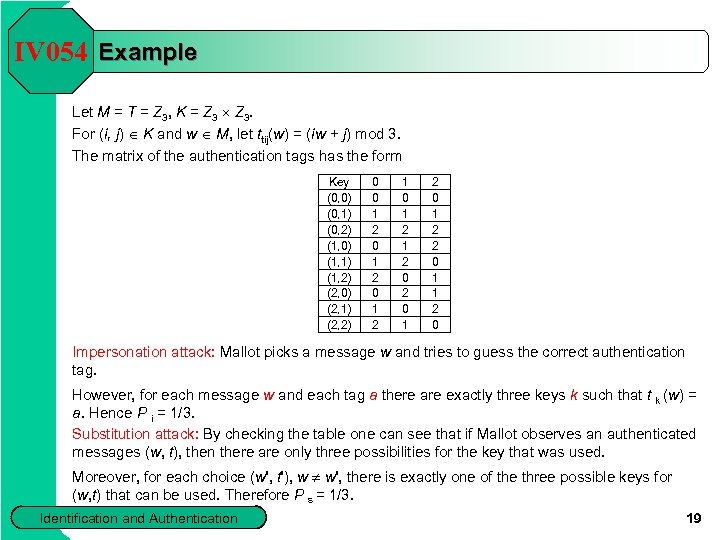 IV 054 Example Let M = T = Z 3, K = Z 3 ´ Z 3. For (i, j) Î K and w Î M, let ttij(w) = (iw + j) mod 3. The matrix of the authentication tags has the form Key (0, 0) (0, 1) (0, 2) (1, 0) (1, 1) (1, 2) (2, 0) (2, 1) (2, 2) 0 0 1 2 1 2 0 1 2 2 0 1 1 2 0 Impersonation attack: Mallot picks a message w and tries to guess the correct authentication tag. However, for each message w and each tag a there are exactly three keys k such that t k (w) = a. Hence P i = 1/3. Substitution attack: By checking the table one can see that if Mallot observes an authenticated messages (w, t), then there are only three possibilities for the key that was used. Moreover, for each choice (w', t'), w ¹ w', there is exactly one of the three possible keys for (w, t) that can be used. Therefore P s = 1/3. Identification and Authentication 19
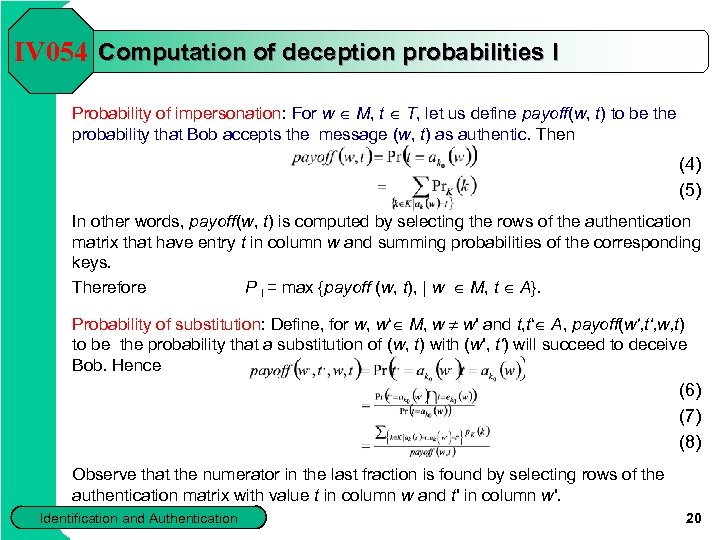 IV 054 Computation of deception probabilities I Probability of impersonation: For w Î M, t Î T, let us define payoff(w, t) to be the probability that Bob accepts the message (w, t) as authentic. Then (4) (5) In other words, payoff(w, t) is computed by selecting the rows of the authentication matrix that have entry t in column w and summing probabilities of the corresponding keys. Therefore P I = max {payoff (w, t), | w Î M, t Î A}. Probability of substitution: Define, for w, w‘Î M, w ¹ w' and t, t‘Î A, payoff(w', t‘, w, t) to be the probability that a substitution of (w, t) with (w', t') will succeed to deceive Bob. Hence (6) (7) (8) Observe that the numerator in the last fraction is found by selecting rows of the authentication matrix with value t in column w and t' in column w'. Identification and Authentication 20
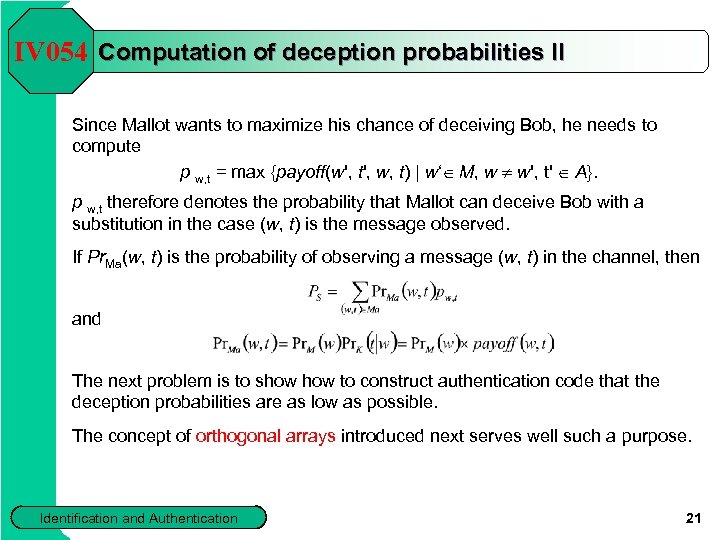 IV 054 Computation of deception probabilities II Since Mallot wants to maximize his chance of deceiving Bob, he needs to compute p w, t = max {payoff(w', t', w, t) | w‘Î M, w ¹ w', t' Î A}. p w, t therefore denotes the probability that Mallot can deceive Bob with a substitution in the case (w, t) is the message observed. If Pr. Ma(w, t) is the probability of observing a message (w, t) in the channel, then and The next problem is to show to construct authentication code that the deception probabilities are as low as possible. The concept of orthogonal arrays introduced next serves well such a purpose. Identification and Authentication 21
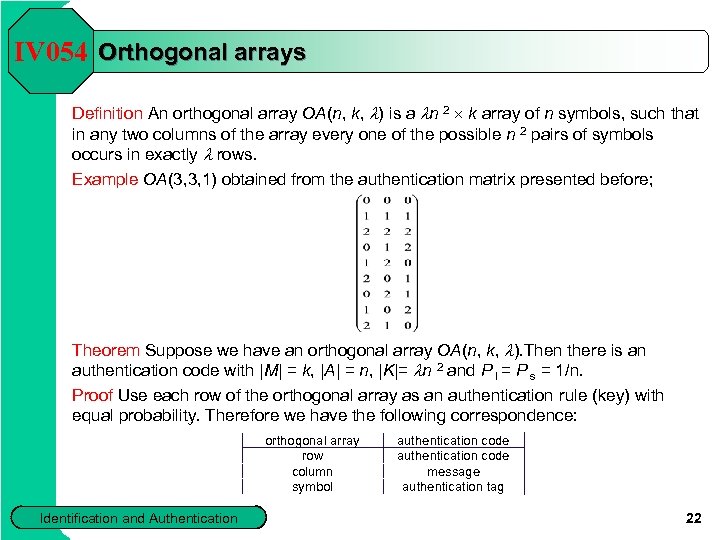 IV 054 Orthogonal arrays Definition An orthogonal array OA(n, k, l) is a ln 2 ´ k array of n symbols, such that in any two columns of the array every one of the possible n 2 pairs of symbols occurs in exactly l rows. Example OA(3, 3, 1) obtained from the authentication matrix presented before; Theorem Suppose we have an orthogonal array OA(n, k, l). Then there is an authentication code with |M| = k, |A| = n, |K|= ln 2 and P I = P s = 1/n. Proof Use each row of the orthogonal array as an authentication rule (key) with equal probability. Therefore we have the following correspondence: orthogonal array row column symbol Identification and Authentication authentication code message authentication tag 22
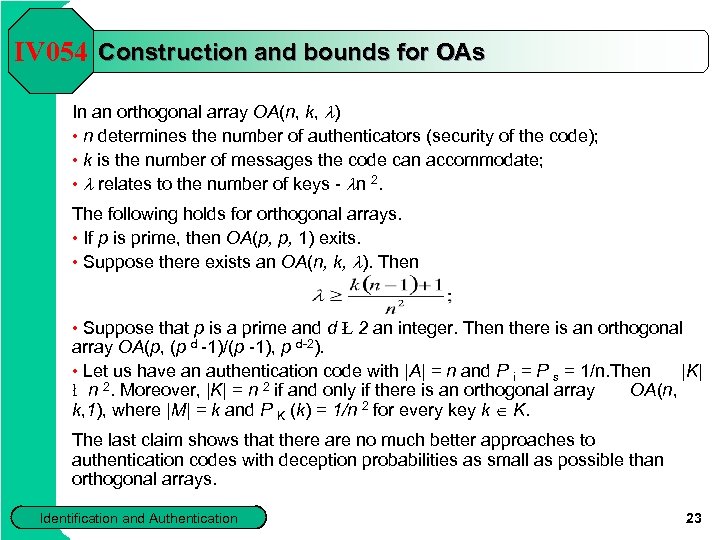 IV 054 Construction and bounds for OAs In an orthogonal array OA(n, k, l) • n determines the number of authenticators (security of the code); • k is the number of messages the code can accommodate; • l relates to the number of keys - ln 2. The following holds for orthogonal arrays. • If p is prime, then OA(p, p, 1) exits. • Suppose there exists an OA(n, k, l). Then • Suppose that p is a prime and d Ł 2 an integer. Then there is an orthogonal array OA(p, (p d -1)/(p -1), p d-2). • Let us have an authentication code with |A| = n and P i = P s = 1/n. Then |K| 2. Moreover, |K| = n 2 if and only if there is an orthogonal array ł n OA(n, 2 for every key k Î K. k, 1), where |M| = k and P K (k) = 1/n The last claim shows that there are no much better approaches to authentication codes with deception probabilities as small as possible than orthogonal arrays. Identification and Authentication 23
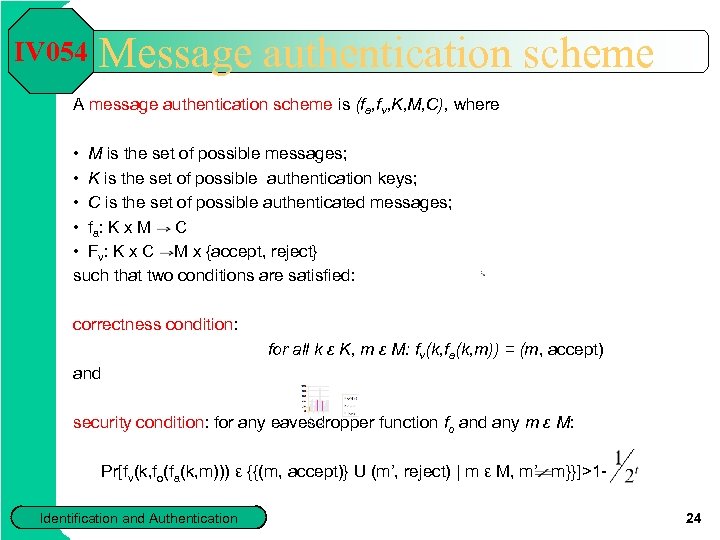 IV 054 Message authentication scheme A message authentication scheme is (fa, fv, K, M, C), where • M is the set of possible messages; • K is the set of possible authentication keys; • C is the set of possible authenticated messages; • fa: K x M C • Fv: K x C M x {accept, reject} such that two conditions are satisfied: correctness condition: for all k ε K, m ε M: fv(k, fa(k, m)) = (m, accept) and security condition: for any eavesdropper function fo and any m ε M: Pr[fv(k, fo(fa(k, m))) ε {{(m, accept)} U (m’, reject) | m ε M, m’ m}}]>1 Identification and Authentication 24
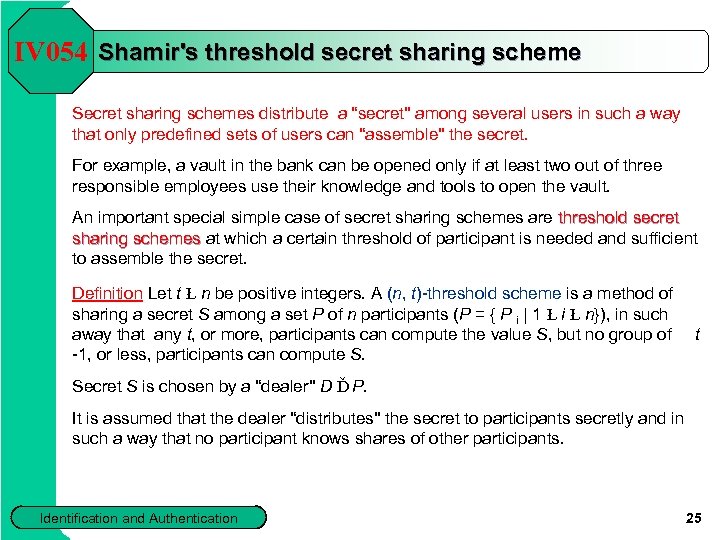 IV 054 Shamir's threshold secret sharing scheme Secret sharing schemes distribute a “secret'' among several users in such a way that only predefined sets of users can “assemble'' the secret. For example, a vault in the bank can be opened only if at least two out of three responsible employees use their knowledge and tools to open the vault. An important special simple case of secret sharing schemes are threshold secret sharing schemes at which a certain threshold of participant is needed and sufficient to assemble the secret. Definition Let t Ł n be positive integers. A (n, t)-threshold scheme is a method of sharing a secret S among a set P of n participants (P = { P i | 1 Ł i Ł n}), in such away that any t, or more, participants can compute the value S, but no group of -1, or less, participants can compute S. t Secret S is chosen by a “dealer'' D Ď P. It is assumed that the dealer “distributes'' the secret to participants secretly and in such a way that no participant knows shares of other participants. Identification and Authentication 25
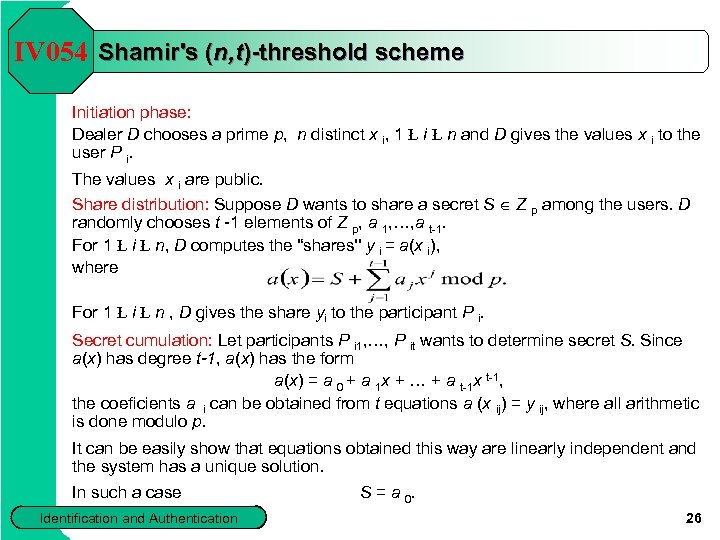 IV 054 Shamir's (n, t)-threshold scheme Initiation phase: Dealer D chooses a prime p, n distinct x i, 1 Ł i Ł n and D gives the values x i to the user P i. The values x i are public. Share distribution: Suppose D wants to share a secret S Î Z p among the users. D randomly chooses t -1 elements of Z p, a 1, …, a t-1. For 1 Ł i Ł n, D computes the “shares'' y i = a(x i), where For 1 Ł i Ł n , D gives the share yi to the participant P i. Secret cumulation: Let participants P i 1, …, P it wants to determine secret S. Since a(x) has degree t-1, a(x) has the form a(x) = a 0 + a 1 x + … + a t-1 x t-1, the coeficients a i can be obtained from t equations a (x ij) = y ij, where all arithmetic is done modulo p. It can be easily show that equations obtained this way are linearly independent and the system has a unique solution. In such a case Identification and Authentication S = a 0. 26
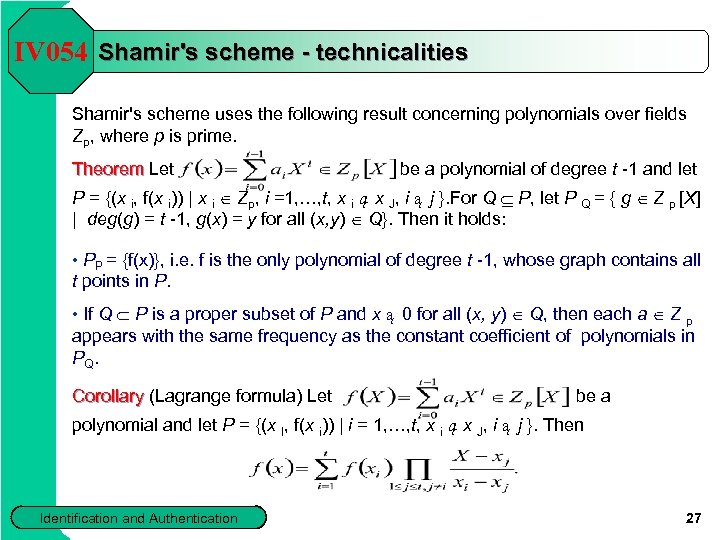 IV 054 Shamir's scheme - technicalities Shamir's scheme uses the following result concerning polynomials over fields Zp, where p is prime. Theorem Let be a polynomial of degree t -1 and let P = {(x i, f(x i)) | x i Î Zp, i =1, …, t, x i ą x J, i ą j }. For Q Í P, let P Q = { g Î Z p [X] | deg(g) = t -1, g(x) = y for all (x, y) Î Q}. Then it holds: • PP = {f(x)}, i. e. f is the only polynomial of degree t -1, whose graph contains all t points in P. • If Q Ì P is a proper subset of P and x ą 0 for all (x, y) Î Q, then each a Î Z p appears with the same frequency as the constant coefficient of polynomials in PQ. Corollary (Lagrange formula) Let be a polynomial and let P = {(x I, f(x i)) | i = 1, …, t, x i ą x J, i ą j }. Then Identification and Authentication 27
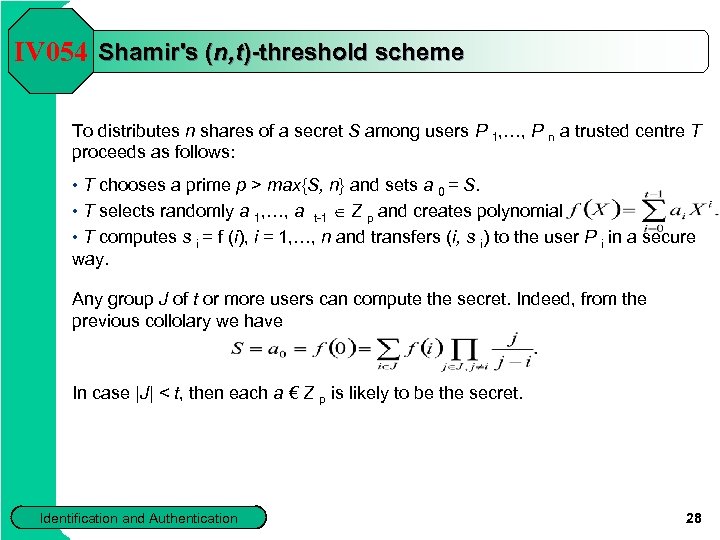 IV 054 Shamir's (n, t)-threshold scheme To distributes n shares of a secret S among users P 1, …, P n a trusted centre T proceeds as follows: • T chooses a prime p > max{S, n} and sets a 0 = S. Î Z p and creates polynomial • T computes s i = f (i), i = 1, …, n and transfers (i, s i) to the user P i in a secure way. • T selects randomly a 1, …, a t-1 Any group J of t or more users can compute the secret. Indeed, from the previous collolary we have In case |J| < t, then each a € Z p is likely to be the secret. Identification and Authentication 28
 IV 054 E-COMMERCE Very important is to ensure security of e-money transactions needed for ecommerce. In addition to providing security and privacy, the task is to prevent alterations of purchase orders and forgery of credit card information. Basic requirements for e-commerce system: Authenticity: Participants in transactions cannot be impersonated and signatures cannot be forged. Integrity: Documents (purchase orders, payment instructions, . . . ) cannot be forged. Privacy: Details of transaction should be kept secret. Security: Sensitive information (as credit card numbers) must be protected. Anonimity: Anonimity of money senders should be garanted. Additional requirement: In order to allow an efficient fighting of the organized crime a system for processing e-money has to be such that under well defined conditions it has to be possible to revoke customer's identity and flow of e-money - to have a fair payment system. (Secure Electronic Transaction) protocol was created to standardize the exchange of credit card information. Development os SET initiated in 1996 credit card companies Master. Card and Visa. Identification and Authentication 29
 IV 054 DUAL SIGNATURE PROTOCOL We describe a protocol to solve the following problem: at a shopping banks should not know what cardholders are ordering and shops should not learn credit-cards numbers. Participants of protocol: a bank, a cardholder, a shop The cardholder uses the following information: • GSO - Goods and Service Order (cardholder's name, shop's name, items ordered, their quantity, . . . ) • PI - Payment instructions (shop's name, card number, total price, . . . ) Protocol uses a public hash function h. RSA cryptosystem is used and • e C, e S and e B are public keys of cardholder, shop, bank and • d C, d S and d B are their secret keys. Identification and Authentication 30
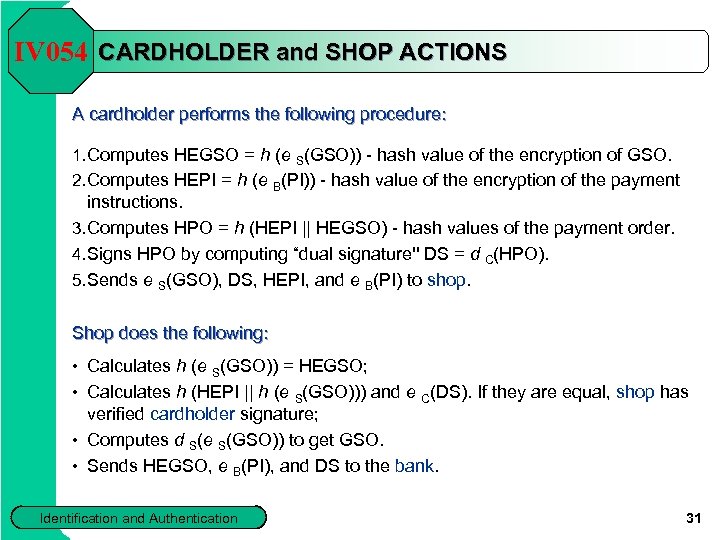 IV 054 CARDHOLDER and SHOP ACTIONS A cardholder performs the following procedure: 1. Computes HEGSO = h (e S(GSO)) - hash value of the encryption of GSO. 2. Computes HEPI = h (e B(PI)) - hash value of the encryption of the payment instructions. 3. Computes HPO = h (HEPI || HEGSO) - hash values of the payment order. 4. Signs HPO by computing “dual signature'' DS = d C(HPO). 5. Sends e S(GSO), DS, HEPI, and e B(PI) to shop. Shop does the following: • Calculates h (e S(GSO)) = HEGSO; • Calculates h (HEPI || h (e S(GSO))) and e C(DS). If they are equal, shop has verified cardholder signature; • Computes d S(e S(GSO)) to get GSO. • Sends HEGSO, e B(PI), and DS to the bank. Identification and Authentication 31
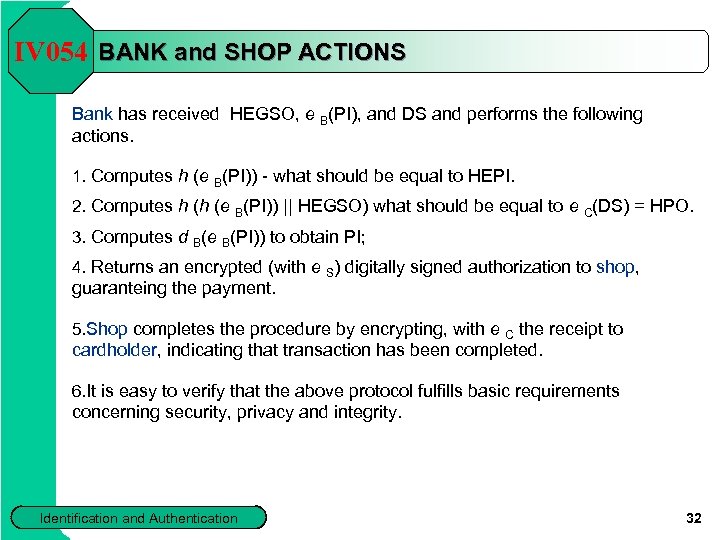 IV 054 BANK and SHOP ACTIONS Bank has received HEGSO, e B(PI), and DS and performs the following actions. 1. Computes h (e B(PI)) - what should be equal to HEPI. 2. Computes h (h (e B(PI)) || HEGSO) what should be equal to e C(DS) = HPO. 3. Computes d B(e B(PI)) to obtain PI; 4. Returns an encrypted (with e S) digitally signed authorization to shop, guaranteing the payment. 5. Shop completes the procedure by encrypting, with e C the receipt to cardholder, indicating that transaction has been completed. 6. It is easy to verify that the above protocol fulfills basic requirements concerning security, privacy and integrity. Identification and Authentication 32
 IV 054 DIGITAL MONEY Is it possible to have electronic money? It seems that not, because copies of digital information are indistinguishable from origin and one could hardly prevent double spending, . . T. Okamoto and K. Ohta formulated six properties any digital money system should have. 1. One should be able to send e-money through e-networks. 2. It should not be possible to copy and reuse e-money. 3. Transactions using e-money should be done off-line - that is no communication with central bank should be needed during translation. 4. One should be able to sent e-money to anybody. 5. An e-coin could be divided into e-coins of smaller values. 6. Several system of e-money have been created that satisfy all or at least some of the above requirements. Identification and Authentication 33
 IV 054 BLIND SIGNATURES - applications Blind digital signatures allow the signer (bank) to sign a message without seeing its content. Scenario: Customer Bob would like to give e-money to Shop. E-money are signed by a Bank. Shop must be able to verify Bank's signature. Later, when Shop sends e-money to Bank, Bank should not be able to recognize that it signed these e-money for Bob. Bank has therefore to sign money blindly. Bob can obtain a blind signature for a message m from Bank by executing the Shnorr blind signature protocol described on next slide. Basic setting Bank chooses large primes p, q | (p -1) and an g Î Z p of order q. Let h: {0, 1}* ® Z p be a collision-free hash function. Bank's secret will be a randomly chosen x Î {0, …, p -1}. Public information: (p, q, g, y = g x ). Identification and Authentication 34
 IV 054 BLIND SIGNATURES - protocols Shnorr's simplified identification protocol in which Bank proves its identity by proving that it knows x. • Bank chooses a random r Î {0, …, q -1} and send a = g r to Bob. {By that Bank ``commits’’ itself to r}. • Bob send to Bank a random c Î {0, …, q -1} {a challenge}. • Bank sends to Bob b = r - cx. • Bob accepts the proof if a = g b y c. Transfer of the identification scheme to a signature scheme: Bob does not choose c randomly but as c = h (m || a), where m is message to sign. Signature: (c, b); Verification rule: a = g b y c; Transcript: (a, c, b). Shnorr's blind signature scheme • Bank sends to Bob a’ = g r’ with random r’ Î {0, …, q -1}. • Bob choses random u, v, w Î {0, …, q -1}, u ą 0, Computes a = a’ u g v y w, c = h (m||a), c’ = (c - w)u -1 and sends c’ to Bank. • Bank sends to Bob b’ = r’ - c’x. Bob verifies whether a’ = g b’y c’, computes b = ub’ + v and gets blind signature s(m) = (c, b) of m. Verification condition for the blind signature: c = h (m || g b y c). Both (a, c, b) and (a’, c’, b’) are valid transcripts. Identification and Authentication 35