


 Скачать презентацию Chapter 10 Fluids Three common phases of
8416e23ccfb5e725eb4ddd7eb98e98a4.ppt
- Количество слайдов: 21
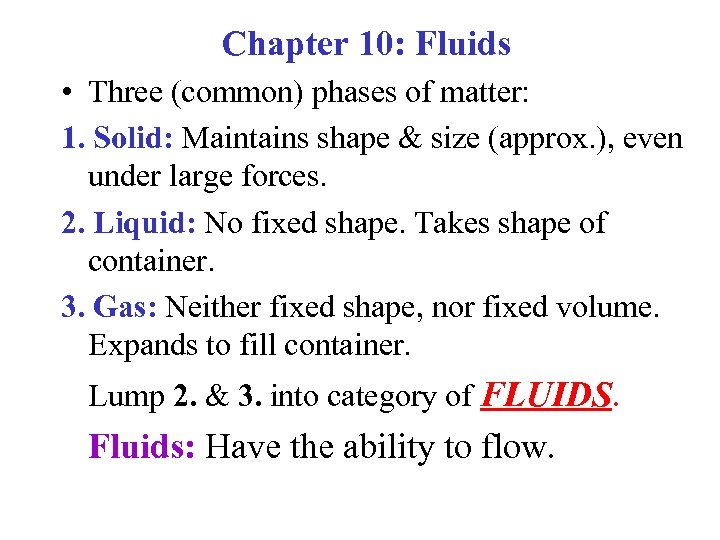 Chapter 10: Fluids • Three (common) phases of matter: 1. Solid: Maintains shape & size (approx. ), even under large forces. 2. Liquid: No fixed shape. Takes shape of container. 3. Gas: Neither fixed shape, nor fixed volume. Expands to fill container. Lump 2. & 3. into category of FLUIDS. Fluids: Have the ability to flow.
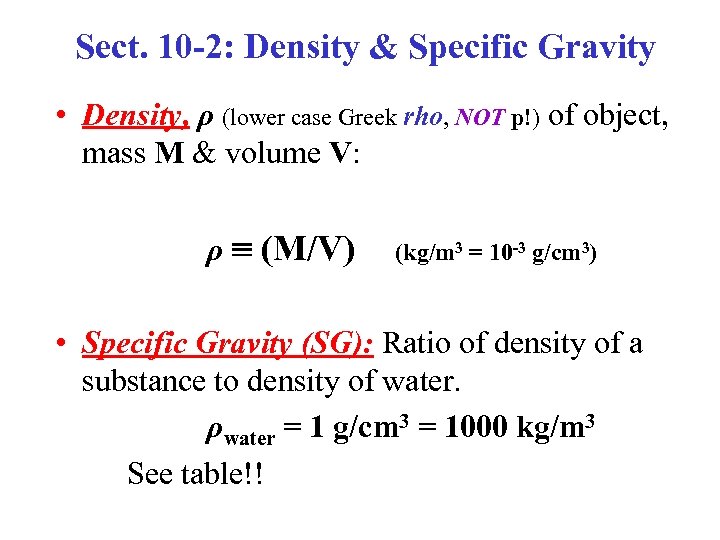 Sect. 10 -2: Density & Specific Gravity • Density, ρ (lower case Greek rho, NOT p!) of object, mass M & volume V: ρ (M/V) (kg/m 3 = 10 -3 g/cm 3) • Specific Gravity (SG): Ratio of density of a substance to density of water. ρwater = 1 g/cm 3 = 1000 kg/m 3 See table!!
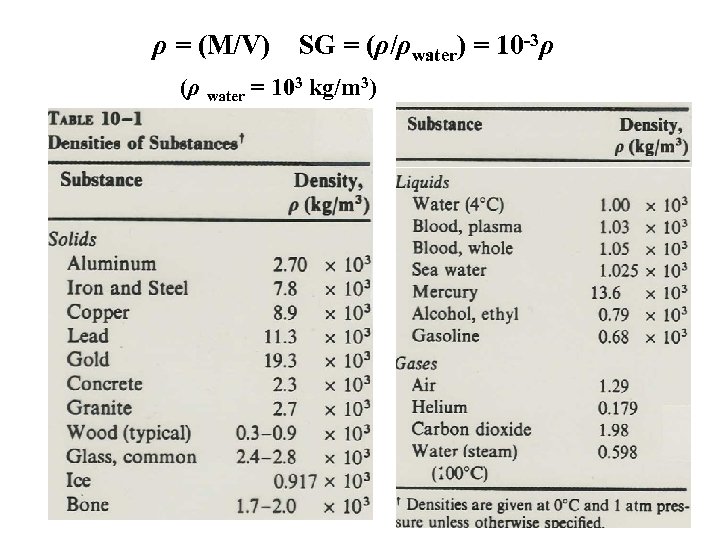 ρ = (M/V) SG = (ρ/ρwater) = 10 -3ρ (ρ water = 103 kg/m 3)
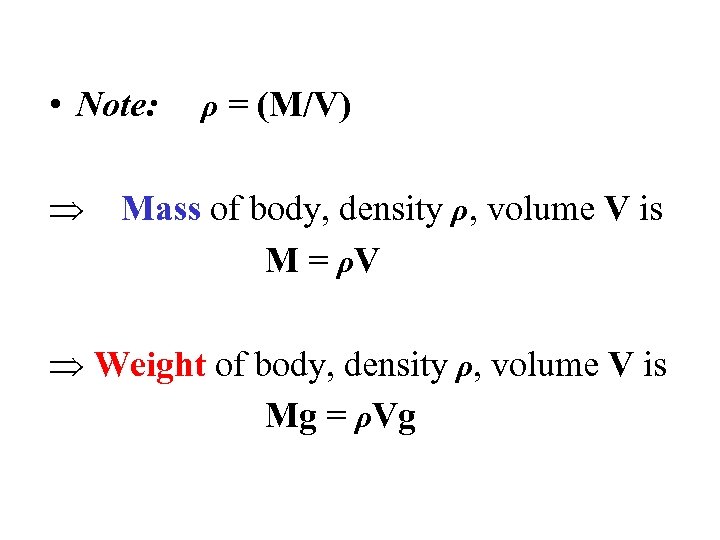 • Note: ρ = (M/V) Mass of body, density ρ, volume V is M = ρV Weight of body, density ρ, volume V is Mg = ρVg
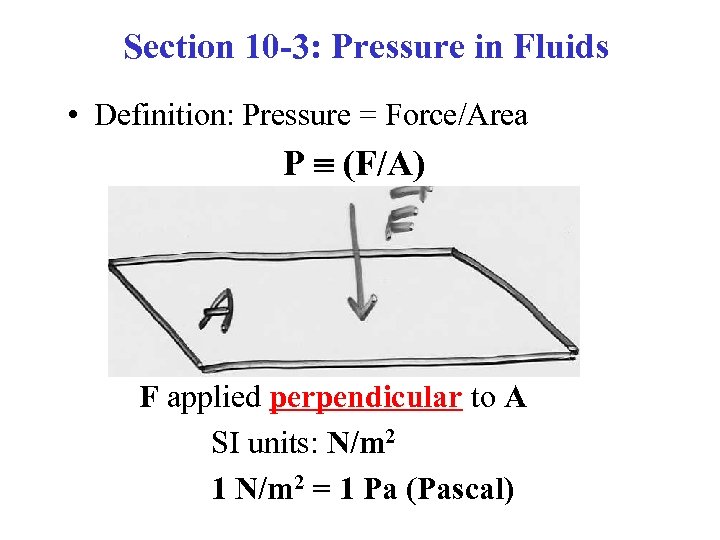 Section 10 -3: Pressure in Fluids • Definition: Pressure = Force/Area P (F/A) F applied perpendicular to A SI units: N/m 2 1 N/m 2 = 1 Pa (Pascal)
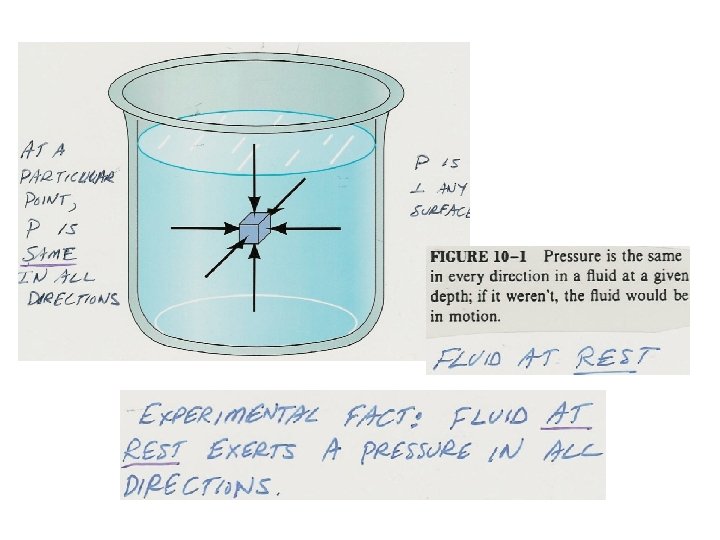
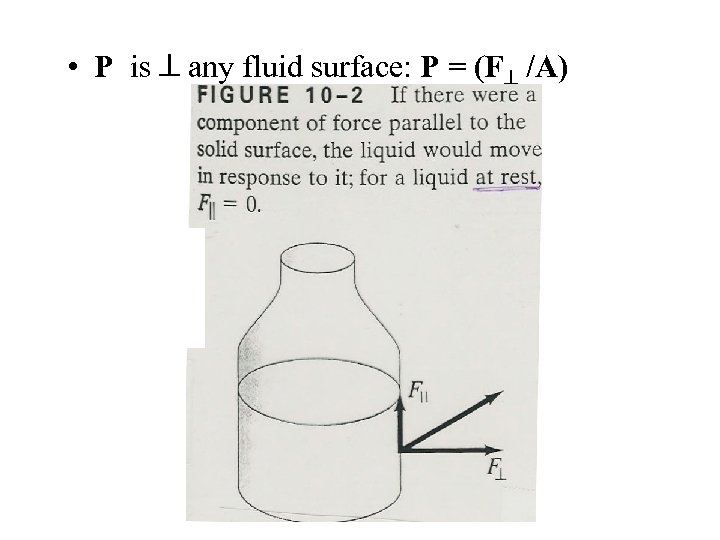 • P is any fluid surface: P = (F /A)
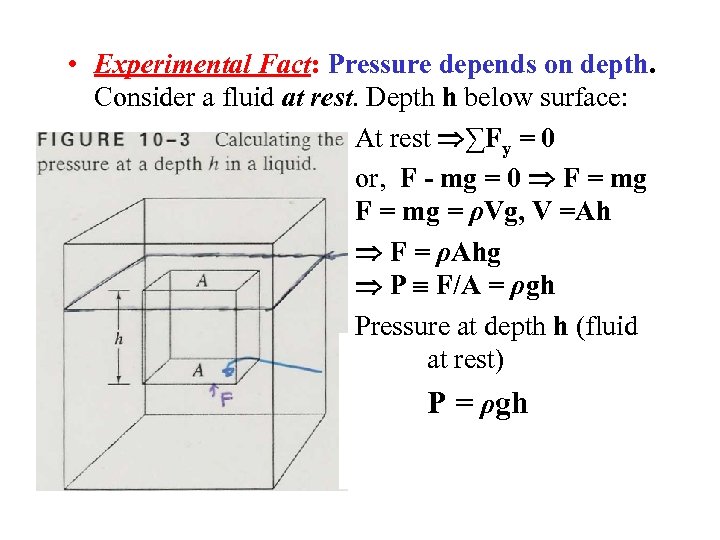 • Experimental Fact: Pressure depends on depth. Consider a fluid at rest. Depth h below surface: At rest ∑Fy = 0 or, F - mg = 0 F = mg = ρVg, V =Ah F = ρAhg P F/A = ρgh Pressure at depth h (fluid at rest) P = ρgh
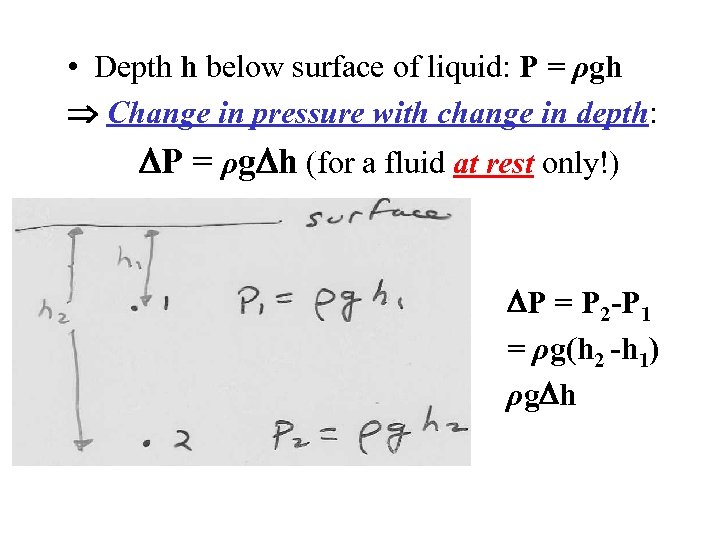 • Depth h below surface of liquid: P = ρgh Change in pressure with change in depth: P = ρg h (for a fluid at rest only!) P = P 2 -P 1 = ρg(h 2 -h 1) ρg h
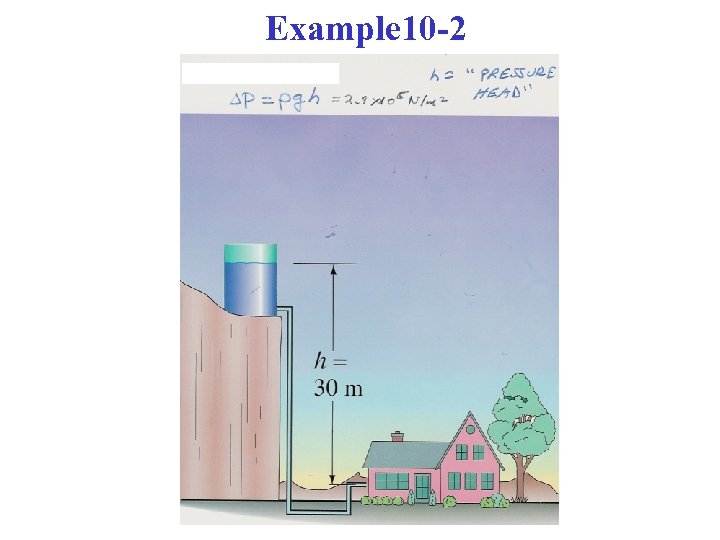 Example 10 -2
 Section 10 -4: Atmospheric Pressure • Earth’s atmosphere: A fluid. – But doesn’t have a fixed top “surface”! • Change in height h above Earth’s surface: Change in pressure: P = ρg h • Sea level: PA 1. 013 105 N/m 2 = 101. 3 k. Pa 1 atm – Old units: 1 bar = 1. 00 105 N/m 2 • Physics: Cause of pressure at any height: Weight of air above that height!
 Gauge Pressure • Pressure gauges (like tire gauges, etc. ) measure difference between atmospheric pressure PA & internal pressure (of tire, for example). • Gauge pressure: PG = P - PA
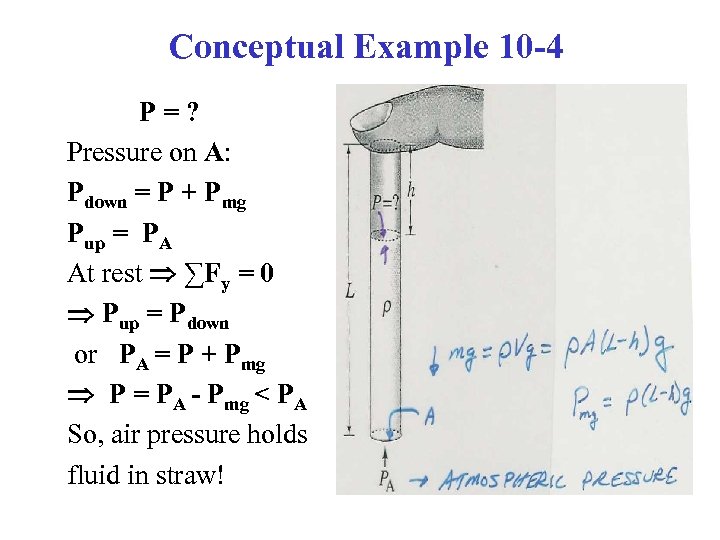 Conceptual Example 10 -4 P=? Pressure on A: Pdown = P + Pmg Pup = PA At rest ∑Fy = 0 Pup = Pdown or PA = P + Pmg P = PA - Pmg < PA So, air pressure holds fluid in straw!
 Section 10 -5: Pascal’s Principle • Experimental fact: An external pressure P applied to confined fluid increases the pressure throughout by P Pascal’s Principle • Simple example: Water in a lake (at rest). At depth h below surface, pressure is P = PA + ρgh (PA = atmospheric pressure)
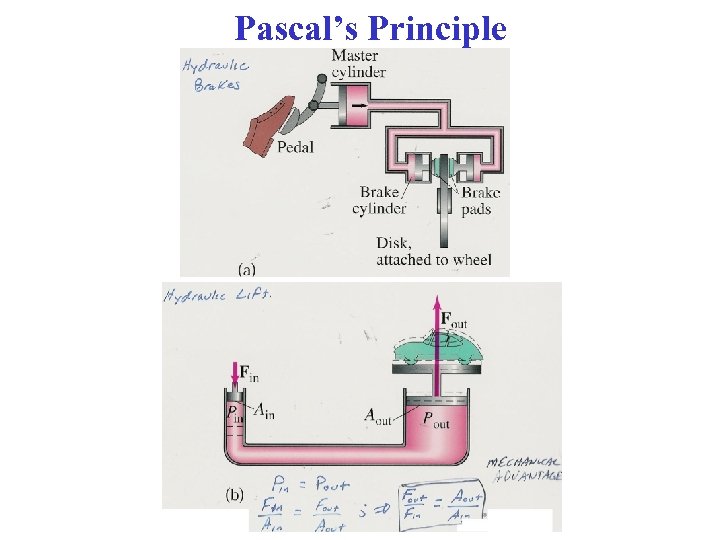 Pascal’s Principle
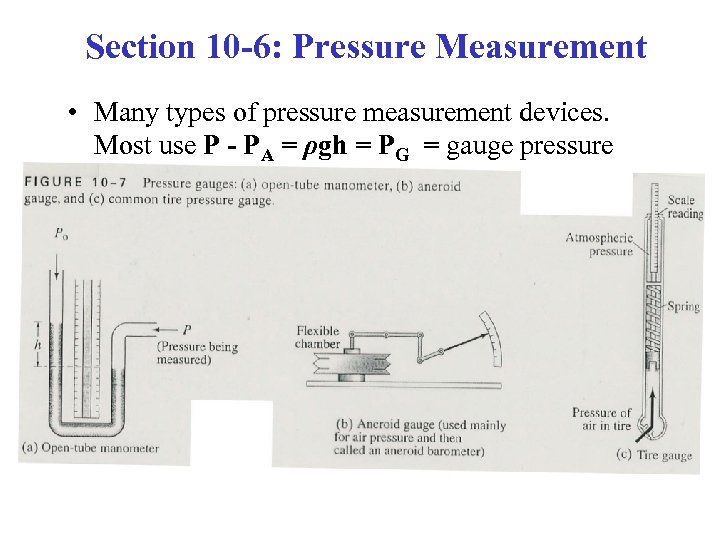 Section 10 -6: Pressure Measurement • Many types of pressure measurement devices. Most use P - PA = ρgh = PG = gauge pressure
 Various Pressure Units • Gauge Pressure: PA = ρgh Alternate unit of pressure: Instead of calculating ρgh, common to use standard liquid (mercury, Hg or alcohol, where ρ is standard) & measure h Quote pressure in length units! For example: “millimeters of mercury” mm Hg For h = 1 mm Hg = 10 -3 m Hg ρmercury gh = (1. 36 104 kg/m 3) (9. 8 m/s 2)(10 -3 m) = 133 N/m 2 = 133 Pa 1 Torr (another pressure unit!) mm Hg & Torr are not proper SI pressure units!
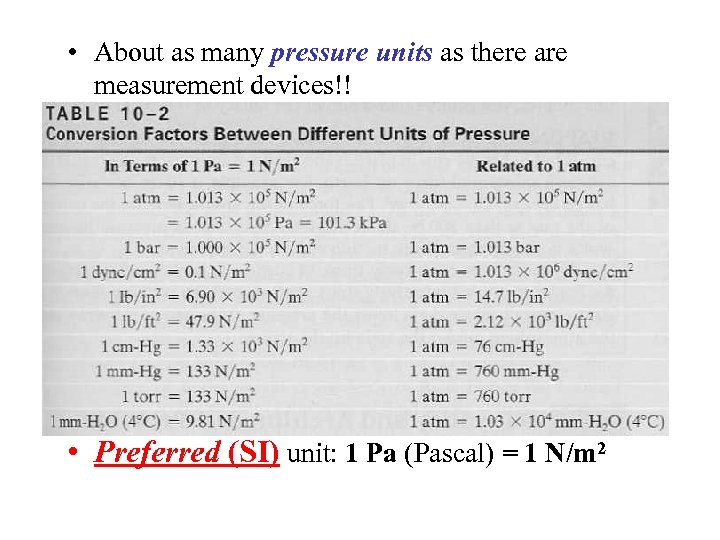 • About as many pressure units as there are measurement devices!! • Preferred (SI) unit: 1 Pa (Pascal) = 1 N/m 2
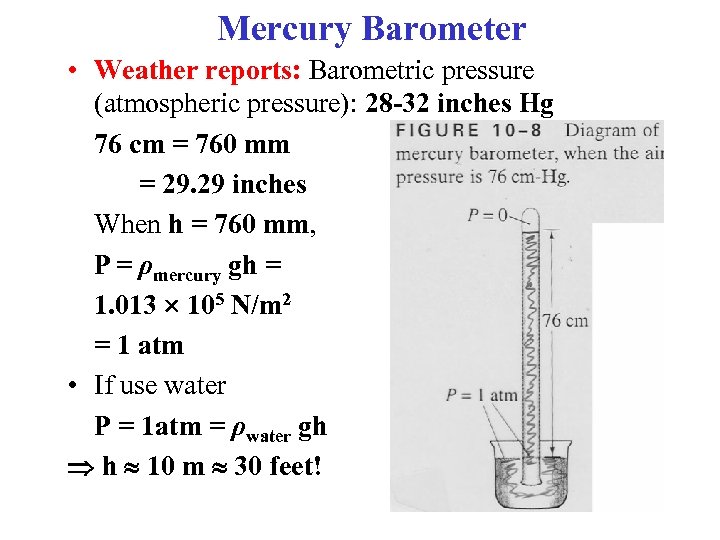 Mercury Barometer • Weather reports: Barometric pressure (atmospheric pressure): 28 -32 inches Hg 76 cm = 760 mm = 29. 29 inches When h = 760 mm, P = ρmercury gh = 1. 013 105 N/m 2 = 1 atm • If use water P = 1 atm = ρwater gh h 10 m 30 feet!
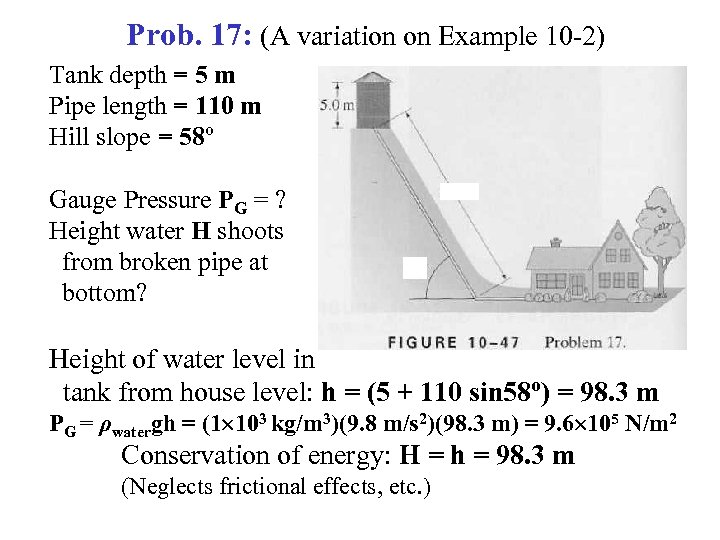 Prob. 17: (A variation on Example 10 -2) Tank depth = 5 m Pipe length = 110 m Hill slope = 58º Gauge Pressure PG = ? Height water H shoots from broken pipe at bottom? Height of water level in tank from house level: h = (5 + 110 sin 58º) = 98. 3 m PG = ρwatergh = (1 103 kg/m 3)(9. 8 m/s 2)(98. 3 m) = 9. 6 105 N/m 2 Conservation of energy: H = h = 98. 3 m (Neglects frictional effects, etc. )