


 Скачать презентацию Chapter 10 Delivering the System Shari L Pfleeger
b2d17e0130c3eeaa69c23dcab27cc013.ppt
- Количество слайдов: 24
 Chapter 10 Delivering the System Shari L. Pfleeger Joann M. Atlee 4 th Edition
 Contents 10. 1 Training 10. 2 Documentation 10. 3 Information System Example 10. 4 Real Time Example 10. 5 What this Chapter Means for You Pfleeger and Atlee, Software Engineering: Theory and Practice Chapter 10. 2
 Chapter 10 Objectives • Training • Documentation Pfleeger and Atlee, Software Engineering: Theory and Practice Chapter 10. 3
 Chapter 10: Delivering the System • Delivery involves more than putting the system in place • Delivery involves helping users to understand feel comfortable with the system – Training – Documentation Pfleeger and Atlee, Software Engineering: Theory and Practice Chapter 10. 4
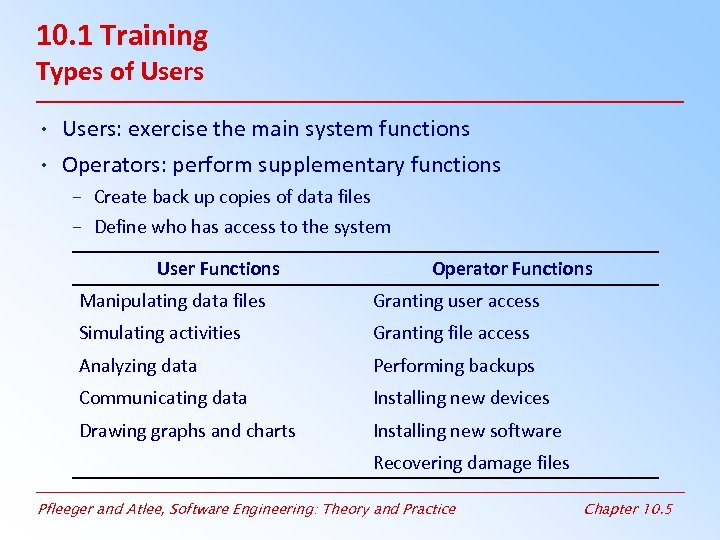 10. 1 Training Types of Users • Users: exercise the main system functions • Operators: perform supplementary functions – Create back up copies of data files – Define who has access to the system User Functions Operator Functions Manipulating data files Granting user access Simulating activities Granting file access Analyzing data Performing backups Communicating data Installing new devices Drawing graphs and charts Installing new software Recovering damage files Pfleeger and Atlee, Software Engineering: Theory and Practice Chapter 10. 5
 10. 1 Training Types of Training • User training • Operator training • Special training needs Pfleeger and Atlee, Software Engineering: Theory and Practice Chapter 10. 6
 10. 1 Training User Training • Introduces the primary functions – Record management: record creation, deletion, retrieval, sorting – Navigation thru the system – No need to know internal mechanism (e. g. , sorting algorithms, data structures) • Relates how the functions are performed now, how to perform later with the new system – Need to take into account the difficulty of transition learning Pfleeger and Atlee, Software Engineering: Theory and Practice Chapter 10. 7
 10. 1 Training Operator Training • Focuses on support functions and addresses how the system works rather than what the system does – How the system works rather than what the system does • Runs in two levels – How to bring up and run the new system – How to support users Pfleeger and Atlee, Software Engineering: Theory and Practice Chapter 10. 8
 10. 1 Training Special Training Needs • Infrequent vs. frequent users – Certain functions may become forgotten • New users (who have replaced trained users) • Existing users interested to brush-up on things missed in the original training • Need for specialized training Pfleeger and Atlee, Software Engineering: Theory and Practice Chapter 10. 9
 10. 1 Training Aids • Documents – Formal documentation, manuals – A small percentages of the users read them • Icons and online help – Metaphors (for objects and functions) – Online manuals provide hypertext links • Demonstrations and classes – More individualized, more dynamic; uses of multimedia (hearing, seeing) • Expert users (and trained individuals) – Role models can be convincing Pfleeger and Atlee, Software Engineering: Theory and Practice Chapter 10. 10
 10. 1 Training Guidelines for Training • Understand the personal preferences, work styles, and organizational pressures • Accommodate different types of students • Divide a training class or demonstration into presentation units with short, limited scopes • Determines the type of training based on the location of the users – Hundreds of users all over? Use web-based training Pfleeger and Atlee, Software Engineering: Theory and Practice Chapter 10. 11
 10. 2 Documentation Considering the Audiences • Need to understand the intended audience – – Users Operators Customer staff Other member of development team • Design different documents for different audiences – Include a “gentle” introduction Pfleeger and Atlee, Software Engineering: Theory and Practice Chapter 10. 12
 10. 2 Documentation Types of Documentations • User’s manual • Operator’s manual • General system guide • Tutorials and automated overviews • Other documentation: Programmer guide Pfleeger and Atlee, Software Engineering: Theory and Practice Chapter 10. 13
 10. 2 Documentation User’s Manuals • A reference guide or tutorial for system users • Should be complete and understandable: Beginning with the general purpose, and progressing to detailed functional descriptions – The system’s purpose or objectives – The system’s capabilities and functions – The system features, characteristics, advantages Pfleeger and Atlee, Software Engineering: Theory and Practice Chapter 10. 14
 10. 2 Documentation Operator’s Manuals • Hardware and software configuration • Methods of granting and denying access to a user • Procedures for adding and removing peripherals from a system • Techniques for duplicating or backing up files and documents Pfleeger and Atlee, Software Engineering: Theory and Practice Chapter 10. 15
 10. 2 Documentation General System Guide • The system details in terms the customer can understand • The system hardware and software configuration • The philosophy behind the system’s construction • Provides cross-referencing Pfleeger and Atlee, Software Engineering: Theory and Practice Chapter 10. 16
 10. 2 Documentation Tutorials and Automated System Overviews • Some users prefer to be guided thru actual system functions rather than read a written description • Multimedia-based training tools provide step-by-step, automated tutorials Pfleeger and Atlee, Software Engineering: Theory and Practice Chapter 10. 17
 10. 2 Documentation Other Documentation: Programmer’s Guide • An overview of how the software and hardware configured • Detailed description of software components and functions performed • System support functions • System enhancements Pfleeger and Atlee, Software Engineering: Theory and Practice Chapter 10. 18
 10. 2 Documentation User Helps and Troubleshooting • Failure message reference guide • Online helps files • Quick reference guide (a quick summary of primary uses, configuration) Pfleeger and Atlee, Software Engineering: Theory and Practice Chapter 10. 19
 10. 2 Documentation Guidelines for Failure Messages • The name of code component executing when the failure occurred • The source code line number in the component that was executing • The failure severity and its impact on the system • The contents of any relevant system memory or data pointers, such as registers or stack pointers • The nature of the failure, or a failure message number (for cross-reference with the failure message reference guide) Pfleeger and Atlee, Software Engineering: Theory and Practice Chapter 10. 20
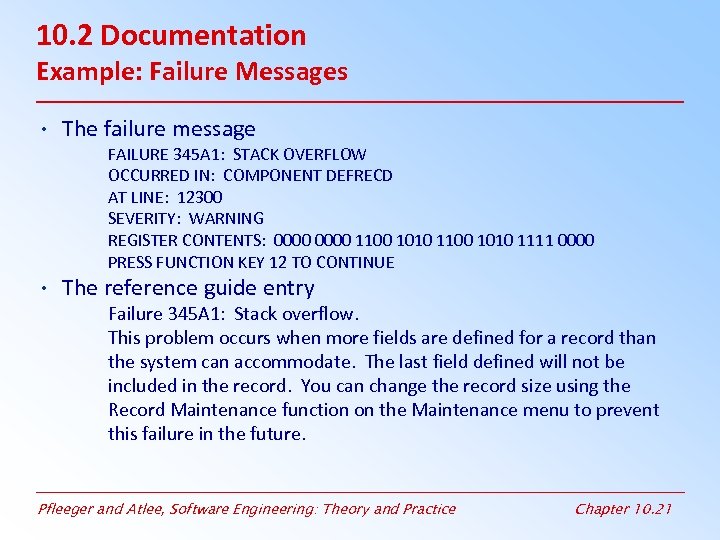 10. 2 Documentation Example: Failure Messages • The failure message FAILURE 345 A 1: STACK OVERFLOW OCCURRED IN: COMPONENT DEFRECD AT LINE: 12300 SEVERITY: WARNING REGISTER CONTENTS: 0000 1100 1010 1111 0000 PRESS FUNCTION KEY 12 TO CONTINUE • The reference guide entry Failure 345 A 1: Stack overflow. This problem occurs when more fields are defined for a record than the system can accommodate. The last field defined will not be included in the record. You can change the record size using the Record Maintenance function on the Maintenance menu to prevent this failure in the future. Pfleeger and Atlee, Software Engineering: Theory and Practice Chapter 10. 21
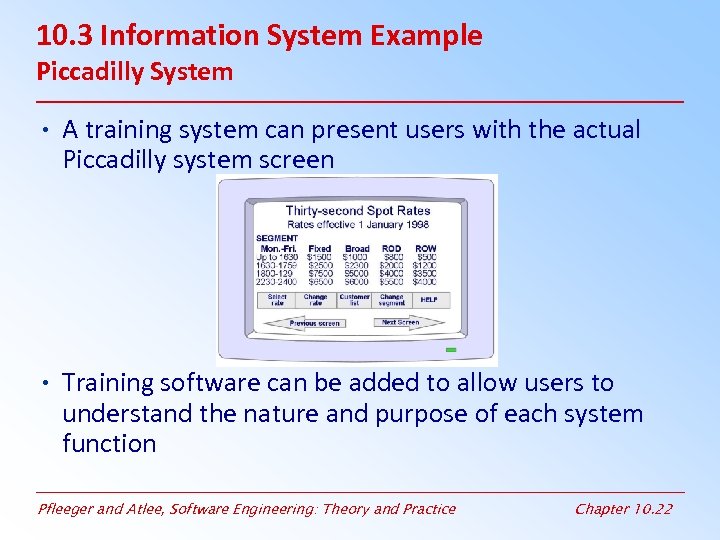 10. 3 Information System Example Piccadilly System • A training system can present users with the actual Piccadilly system screen • Training software can be added to allow users to understand the nature and purpose of each system function Pfleeger and Atlee, Software Engineering: Theory and Practice Chapter 10. 22
 10. 4 Real-Time Example Ariene-5 • Some of the assumptions about the reused Ariane-4 software were not present in the documentation – The designers of Ariene-5 should have been able to read all of the underlying assumptions inherent in the code Pfleeger and Atlee, Software Engineering: Theory and Practice Chapter 10. 23
 10. 5 What This Chapter Means for You • Training and documentation should be planned and tracked from the project’s beginning • Training and documentation software should be integrated with the regular system software • All training and documentation modules and documents should take into account the varying needs of different audiences Pfleeger and Atlee, Software Engineering: Theory and Practice Chapter 10. 24