


 Скачать презентацию Chapter 10 Defining Classes Copyright 2018 Pearson
6883c8e1006ec84da5ce4cd360354810.ppt
- Количество слайдов: 97
 Chapter 10 Defining Classes Copyright © 2018 Pearson Addison-Wesley. All rights reserved.
 Overview 10. 1 Structures 10. 2 Classes 10. 3 Abstract Data Types 10. 4 Introduction to Inheritance Copyright © 2018 Pearson Addison-Wesley. All rights reserved. Slide 10 - 3
 10. 1 Structures Copyright © 2018 Pearson Addison-Wesley. All rights reserved.
 What Is a Class? n n A class is a data type whose variables are objects Some pre-defined data types you have used are n int n char A pre-defined class you have used is n ifstream You can define your own classes as well Copyright © 2018 Pearson Addison-Wesley. All rights reserved. Slide 10 - 5
 Class Definitions n n A class definition includes n A description of the kinds of values the variable can hold n A description of the member functions We will start by defining structures as a first step toward defining classes Copyright © 2018 Pearson Addison-Wesley. All rights reserved. Slide 10 - 6
 Structures n A structure can be viewed as an object n Contains no member functions (The structures used here have no member functions) n Contains multiple values of possibly different types n n The multiple values are logically related as a single item Example: A bank Certificate of Deposit (CD) has the following values: a balance an interest rate a term (months to maturity) Copyright © 2018 Pearson Addison-Wesley. All rights reserved. Slide 10 - 7
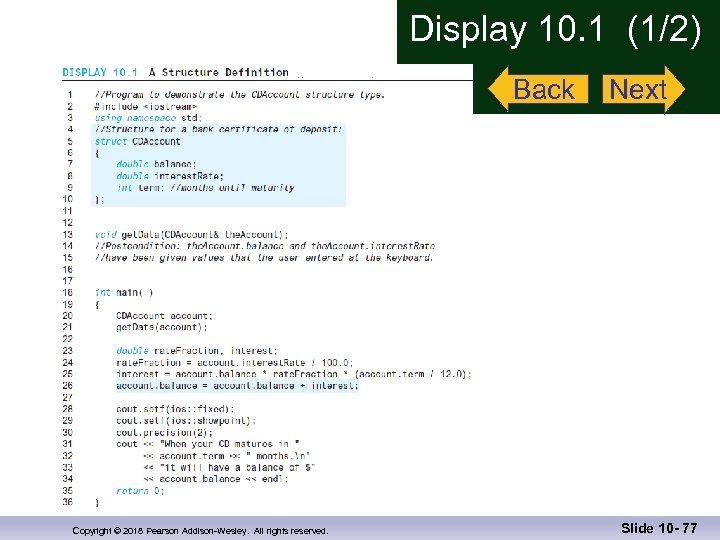
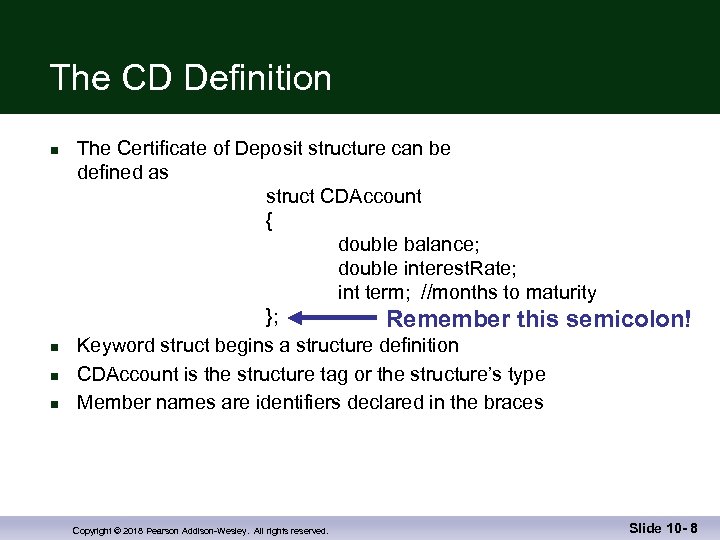 The CD Definition n n The Certificate of Deposit structure can be defined as struct CDAccount { double balance; double interest. Rate; int term; //months to maturity }; Remember this semicolon! Keyword struct begins a structure definition CDAccount is the structure tag or the structure’s type Member names are identifiers declared in the braces Copyright © 2018 Pearson Addison-Wesley. All rights reserved. Slide 10 - 8
 Using the Structure n n Structure definition is generally placed outside any function definition n This makes the structure type available to all code that follows the structure definition To declare two variables of type CDAccount: CDAccount my. Account, your. Account; n my. Account and your. Account contain distinct member variables balance, interest. Rate, and term Copyright © 2018 Pearson Addison-Wesley. All rights reserved. Slide 10 - 9
 The Structure Value n n The Structure Value n Consists of the values of the member variables The value of an object of type CDAccount n Consists of the values of the member variables balance interest. Rate term Copyright © 2018 Pearson Addison-Wesley. All rights reserved. Slide 10 - 10
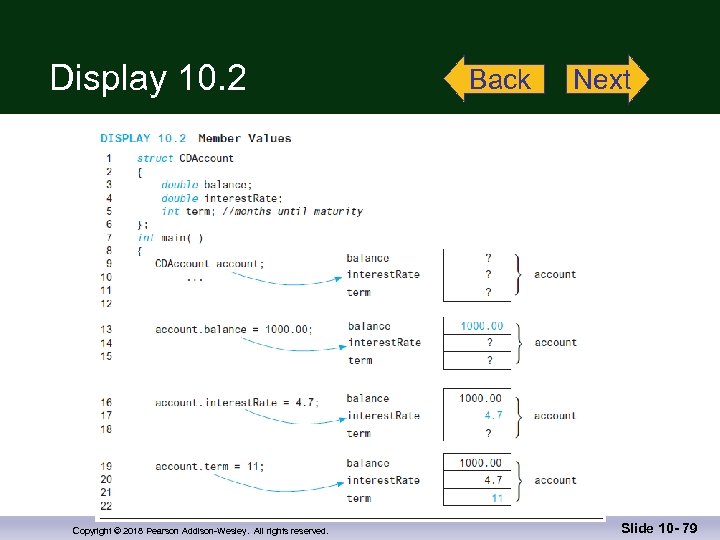
 Specifying Member Variables n Member variables are specific to the structure variable in which they are declared n n Syntax to specify a member variable: Structure_Variable_Name. Member_Variable_Name Given the declaration: CDAccount my. Account, your. Account; n Use the dot operator to specify a member variable my. Account. balance my. Account. interest. Rate my. Account. term Copyright © 2018 Pearson Addison-Wesley. All rights reserved. Slide 10 - 11
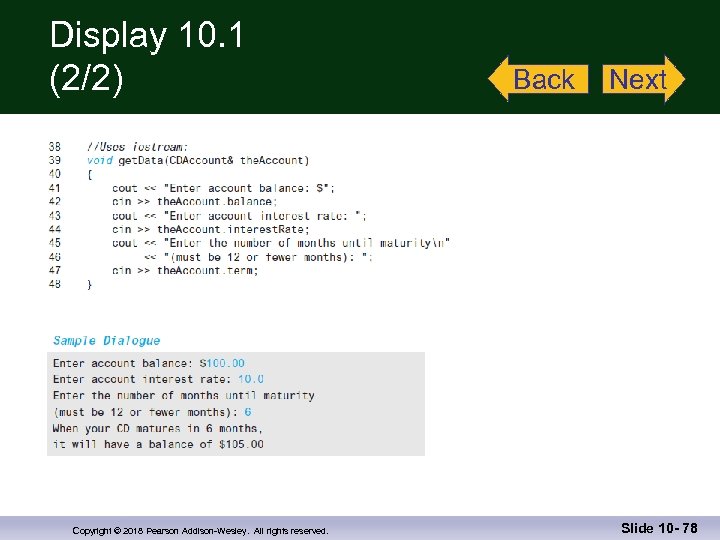
 Using Member Variables n Member variables can be used just as any other variable of the same type Display 10. 1 (1) n my. Account. balance = 1000; Display 10. 1 (2) your. Account. balance = 2500; n n Notice that my. Account. balance and your. Account. balance are different variables! my. Account. balance = my. Account. balance + interest; Display 10. 2 Copyright © 2018 Pearson Addison-Wesley. All rights reserved. Slide 10 - 12
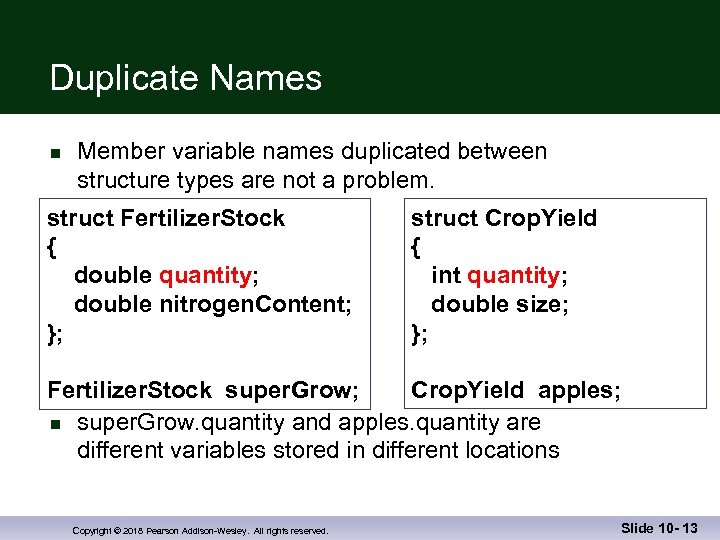 Duplicate Names n Member variable names duplicated between structure types are not a problem. struct Fertilizer. Stock { double quantity; double nitrogen. Content; }; struct Crop. Yield { int quantity; double size; }; Fertilizer. Stock super. Grow; Crop. Yield apples; n super. Grow. quantity and apples. quantity are different variables stored in different locations Copyright © 2018 Pearson Addison-Wesley. All rights reserved. Slide 10 - 13
 Structures as Arguments n n Structures can be arguments in function calls n The formal parameter can be call-by-value n The formal parameter can be call-by-reference Example: void get. Data(CDAccount& the. Account); n Uses the structure type CDAccount we saw earlier as the type for a call-by-reference parameter Copyright © 2018 Pearson Addison-Wesley. All rights reserved. Slide 10 - 14
 Structures as Return Types n n Structures can be the type of a value returned by a function Example: CDAccount shrink. Wrap(double the. Balance, double the. Rate, int the. Term) { CDAccount temp; temp. balance = the. Balance; temp. interest. Rate = the. Rate; temp. term = the. Term; return temp; } Copyright © 2018 Pearson Addison-Wesley. All rights reserved. Slide 10 - 15
 Using Function shrink. Wrap n n shrink. Wrap builds a complete structure value in temp, which is returned by the function We can use shrink. Wrap to give a variable of type CDAccount a value in this way: CDAccount new. Account; new. Account = shrink. Wrap(1000. 00, 5. 1, 11); Copyright © 2018 Pearson Addison-Wesley. All rights reserved. Slide 10 - 16
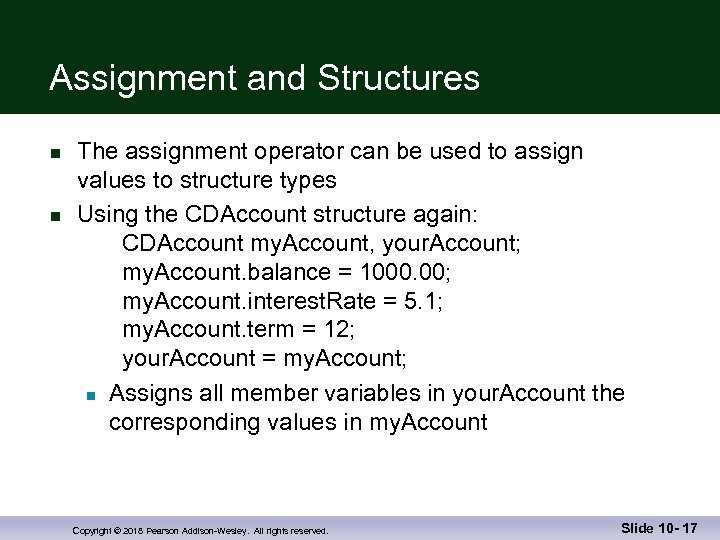 Assignment and Structures n n The assignment operator can be used to assign values to structure types Using the CDAccount structure again: CDAccount my. Account, your. Account; my. Account. balance = 1000. 00; my. Account. interest. Rate = 5. 1; my. Account. term = 12; your. Account = my. Account; n Assigns all member variables in your. Account the corresponding values in my. Account Copyright © 2018 Pearson Addison-Wesley. All rights reserved. Slide 10 - 17
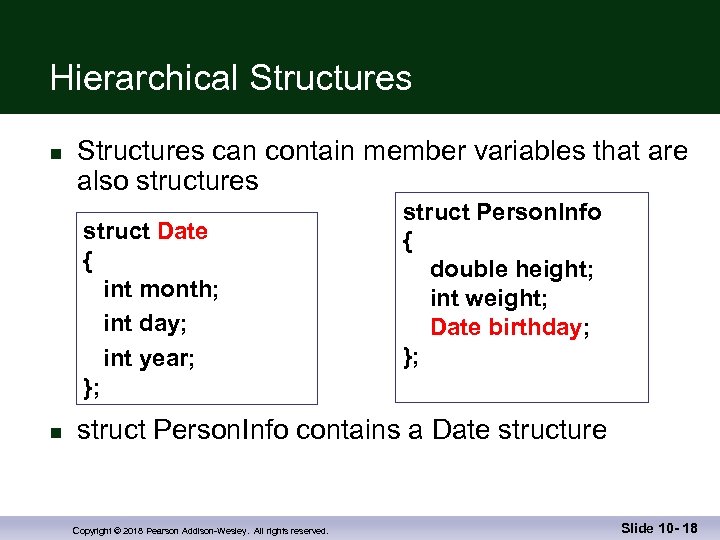 Hierarchical Structures n Structures can contain member variables that are also structures struct Date { int month; int day; int year; }; n struct Person. Info { double height; int weight; Date birthday; }; struct Person. Info contains a Date structure Copyright © 2018 Pearson Addison-Wesley. All rights reserved. Slide 10 - 18
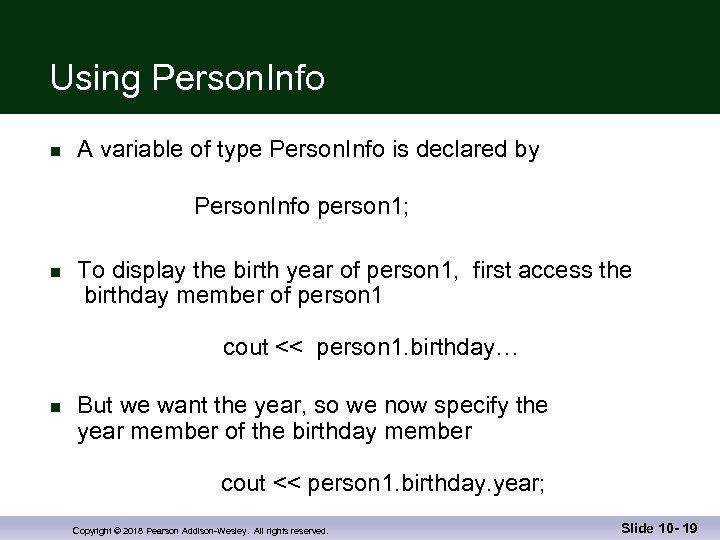 Using Person. Info n A variable of type Person. Info is declared by Person. Info person 1; n To display the birth year of person 1, first access the birthday member of person 1 cout << person 1. birthday… n But we want the year, so we now specify the year member of the birthday member cout << person 1. birthday. year; Copyright © 2018 Pearson Addison-Wesley. All rights reserved. Slide 10 - 19
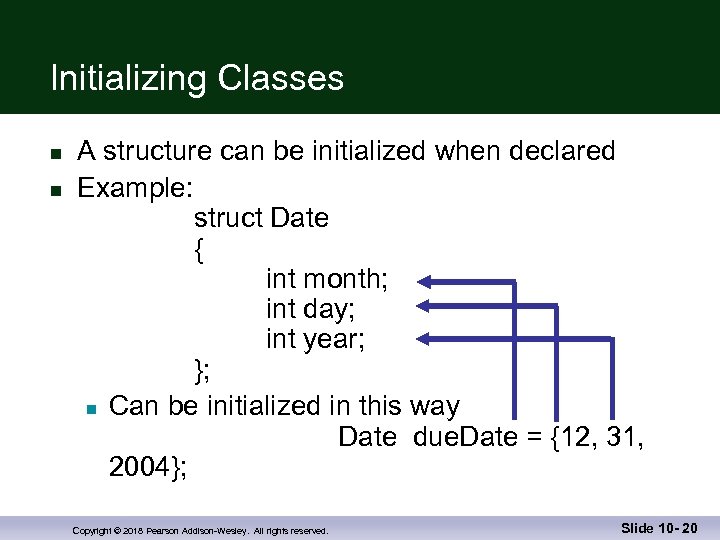 Initializing Classes n n A structure can be initialized when declared Example: struct Date { int month; int day; int year; }; n Can be initialized in this way Date due. Date = {12, 31, 2004}; Copyright © 2018 Pearson Addison-Wesley. All rights reserved. Slide 10 - 20
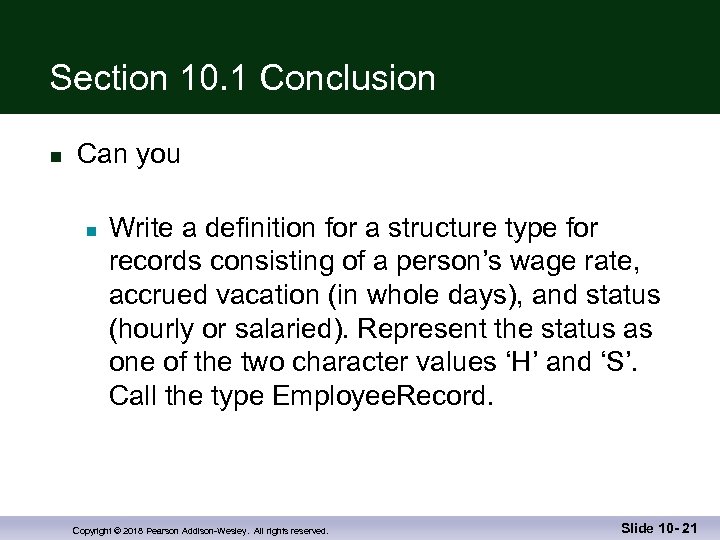 Section 10. 1 Conclusion n Can you n Write a definition for a structure type for records consisting of a person’s wage rate, accrued vacation (in whole days), and status (hourly or salaried). Represent the status as one of the two character values ‘H’ and ‘S’. Call the type Employee. Record. Copyright © 2018 Pearson Addison-Wesley. All rights reserved. Slide 10 - 21
 10. 2 Classes Copyright © 2018 Pearson Addison-Wesley. All rights reserved.
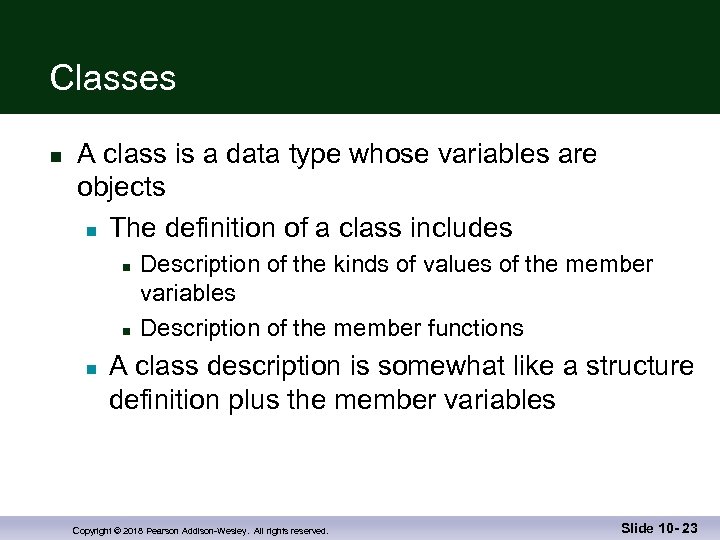 Classes n A class is a data type whose variables are objects n The definition of a class includes n n n Description of the kinds of values of the member variables Description of the member functions A class description is somewhat like a structure definition plus the member variables Copyright © 2018 Pearson Addison-Wesley. All rights reserved. Slide 10 - 23
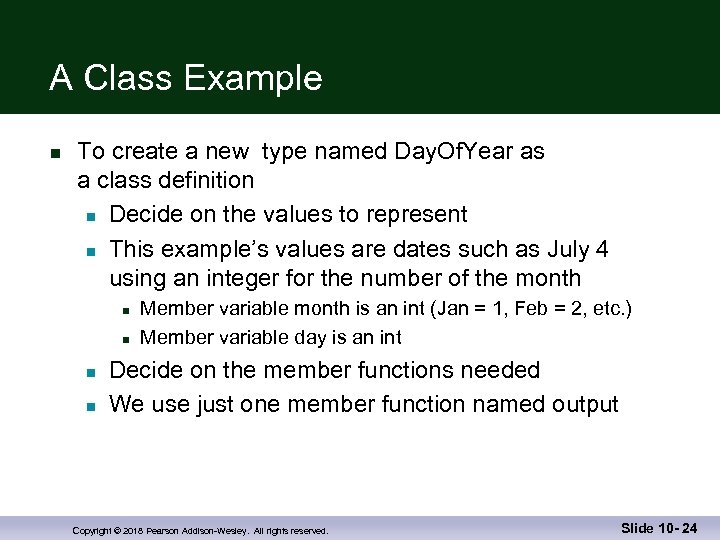 A Class Example n To create a new type named Day. Of. Year as a class definition n Decide on the values to represent n This example’s values are dates such as July 4 using an integer for the number of the month n n Member variable month is an int (Jan = 1, Feb = 2, etc. ) Member variable day is an int Decide on the member functions needed We use just one member function named output Copyright © 2018 Pearson Addison-Wesley. All rights reserved. Slide 10 - 24
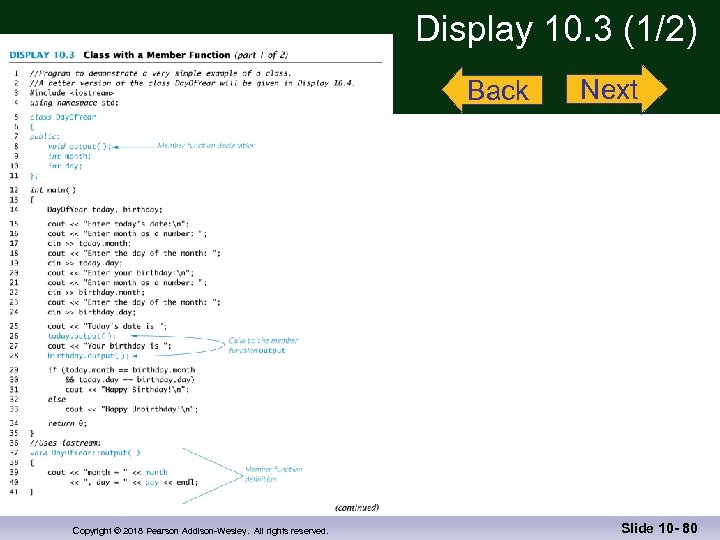
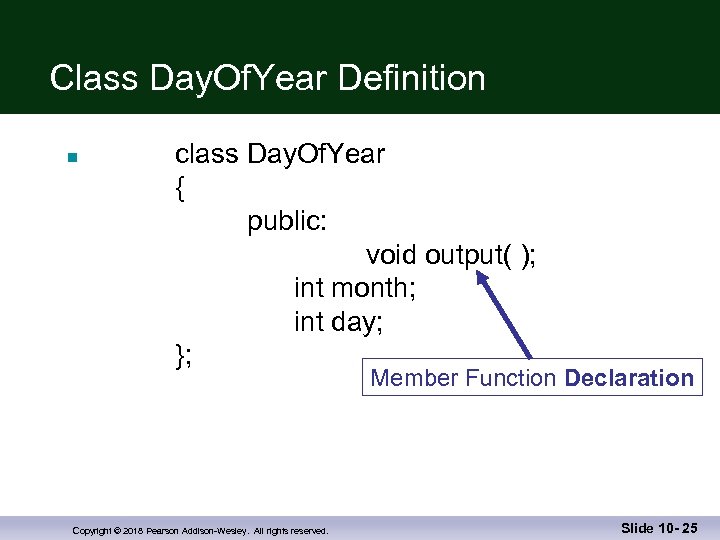 Class Day. Of. Year Definition n class Day. Of. Year { public: void output( ); int month; int day; }; Member Function Declaration Copyright © 2018 Pearson Addison-Wesley. All rights reserved. Slide 10 - 25
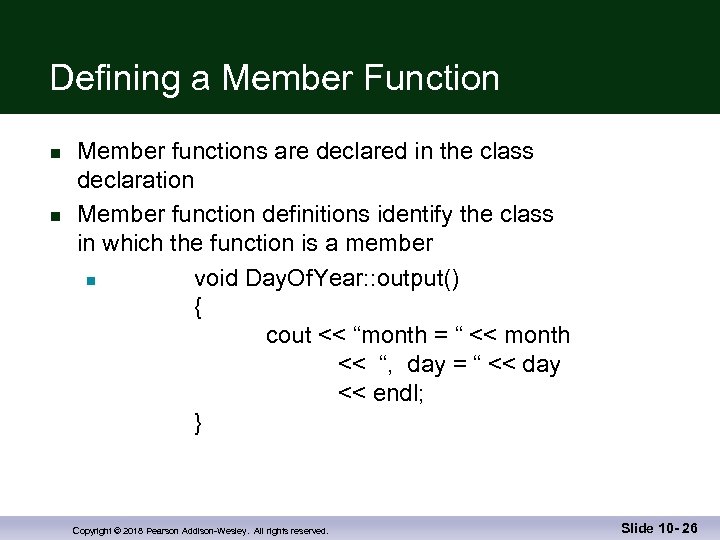 Defining a Member Function n n Member functions are declared in the class declaration Member function definitions identify the class in which the function is a member n void Day. Of. Year: : output() { cout << “month = “ << month << “, day = “ << day << endl; } Copyright © 2018 Pearson Addison-Wesley. All rights reserved. Slide 10 - 26
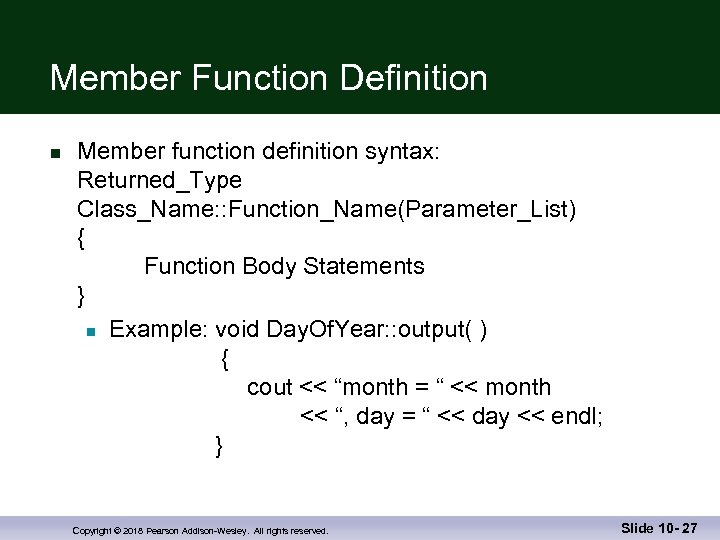 Member Function Definition n Member function definition syntax: Returned_Type Class_Name: : Function_Name(Parameter_List) { Function Body Statements } n Example: void Day. Of. Year: : output( ) { cout << “month = “ << month << “, day = “ << day << endl; } Copyright © 2018 Pearson Addison-Wesley. All rights reserved. Slide 10 - 27
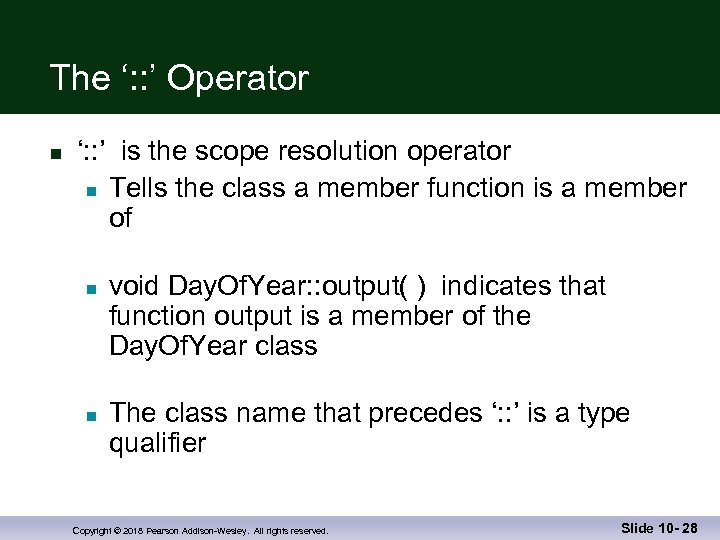 The ‘: : ’ Operator n ‘: : ’ is the scope resolution operator n Tells the class a member function is a member of n n void Day. Of. Year: : output( ) indicates that function output is a member of the Day. Of. Year class The class name that precedes ‘: : ’ is a type qualifier Copyright © 2018 Pearson Addison-Wesley. All rights reserved. Slide 10 - 28
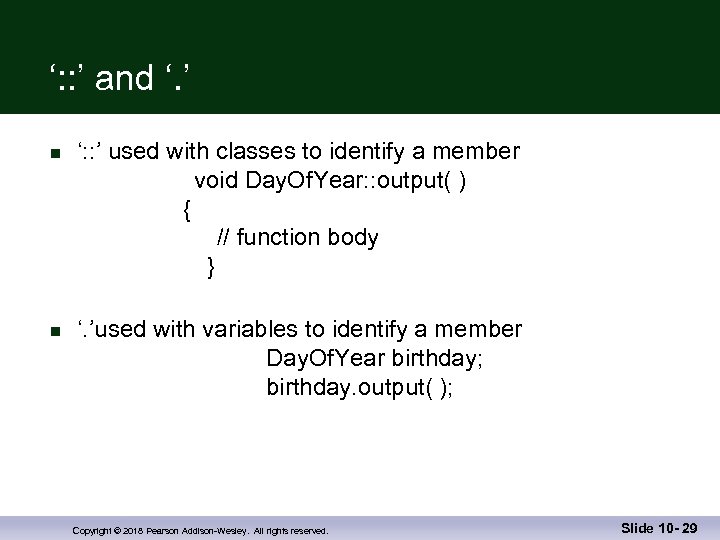 ‘: : ’ and ‘. ’ n n ‘: : ’ used with classes to identify a member void Day. Of. Year: : output( ) { // function body } ‘. ’used with variables to identify a member Day. Of. Year birthday; birthday. output( ); Copyright © 2018 Pearson Addison-Wesley. All rights reserved. Slide 10 - 29
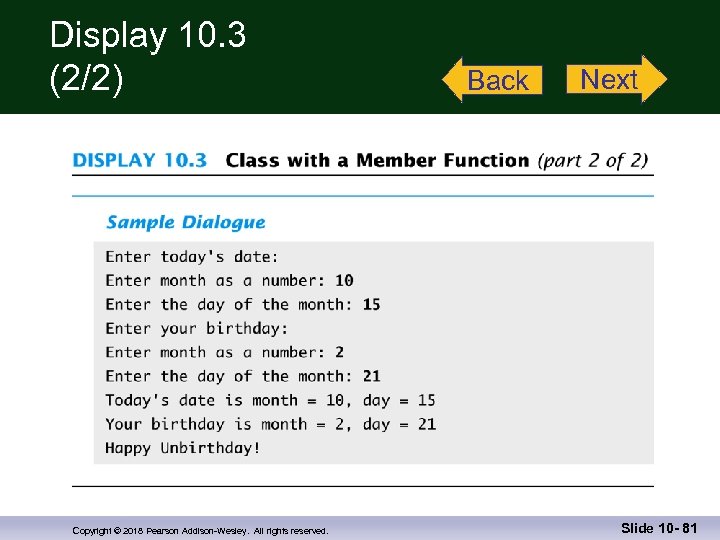
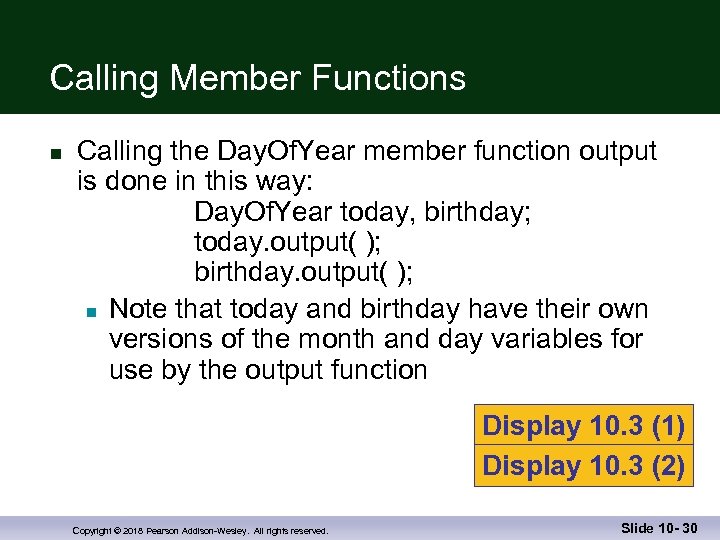 Calling Member Functions n Calling the Day. Of. Year member function output is done in this way: Day. Of. Year today, birthday; today. output( ); birthday. output( ); n Note that today and birthday have their own versions of the month and day variables for use by the output function Display 10. 3 (1) Display 10. 3 (2) Copyright © 2018 Pearson Addison-Wesley. All rights reserved. Slide 10 - 30
 Encapsulation n Encapsulation is n Combining a number of items, such as variables and functions, so that the program using the object of the class will not be able to access those items directly Copyright © 2018 Pearson Addison-Wesley. All rights reserved. Slide 10 - 31
 Problems With Day. Of. Year n n Changing how the month is stored in the class Day. Of. Year requires changes to the program If we decide to store the month as three characters (JAN, FEB, etc. ) instead of an int (the following will apply when c-string is used) n cin >> today. month will no longer work because we now have three character variables to read n if(today. month == birthday. month) will no longer work to compare months n The member function “output” no longer works Copyright © 2018 Pearson Addison-Wesley. All rights reserved. Slide 10 - 32
 Ideal Class Definitions n n Changing the implementation of Day. Of. Year requires changes to the program that uses Day. Of. Year An ideal class definition of Day. Of. Year could be changed without requiring changes to the program that uses Day. Of. Year (This is for design issues, it’s very similar to the concept of abstract data type in slide #61) Copyright © 2018 Pearson Addison-Wesley. All rights reserved. Slide 10 - 33
 Fixing Day. Of. Year n To fix Day. Of. Year n We need to add member functions to use when changing or accessing the member variables n n If the program never directly references the member variables, changing how the variables are stored will not require changing the program We need to be sure that the program does not ever directly reference the member variables Copyright © 2018 Pearson Addison-Wesley. All rights reserved. Slide 10 - 34
 Public Or Private? n C++ helps us restrict the program from directly referencing member variables n private members of a class can only be referenced within the definitions of member functions n n If the program (not the same class) tries to access a private member, the compiler gives an error message Private members can be variables or functions Copyright © 2018 Pearson Addison-Wesley. All rights reserved. Slide 10 - 35
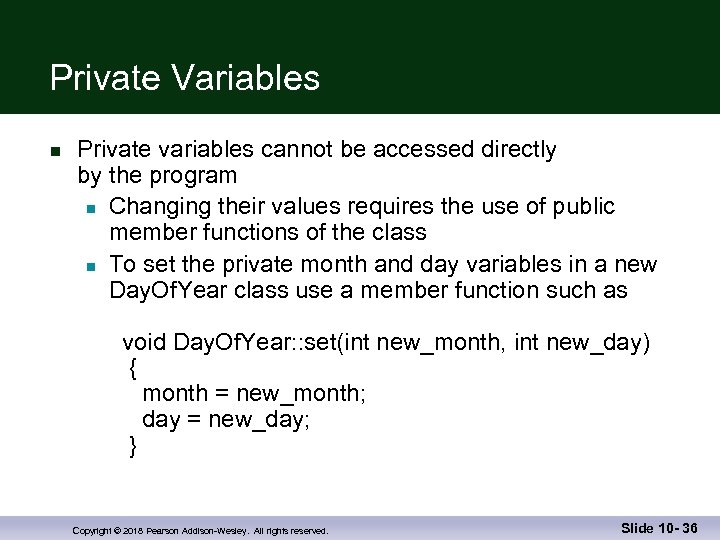 Private Variables n Private variables cannot be accessed directly by the program n Changing their values requires the use of public member functions of the class n To set the private month and day variables in a new Day. Of. Year class use a member function such as void Day. Of. Year: : set(int new_month, int new_day) { month = new_month; day = new_day; } Copyright © 2018 Pearson Addison-Wesley. All rights reserved. Slide 10 - 36
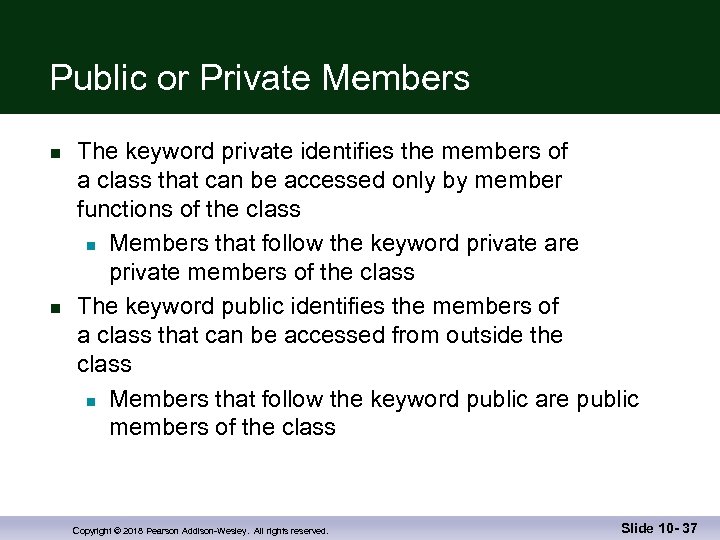 Public or Private Members n n The keyword private identifies the members of a class that can be accessed only by member functions of the class n Members that follow the keyword private are private members of the class The keyword public identifies the members of a class that can be accessed from outside the class n Members that follow the keyword public are public members of the class Copyright © 2018 Pearson Addison-Wesley. All rights reserved. Slide 10 - 37
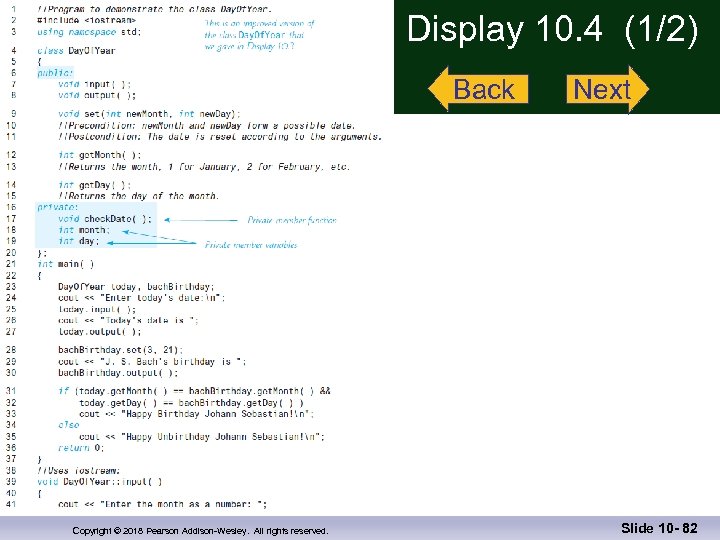
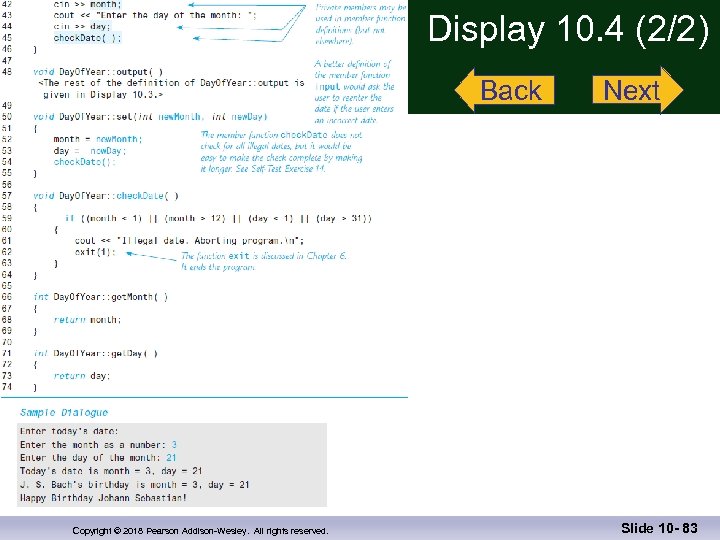
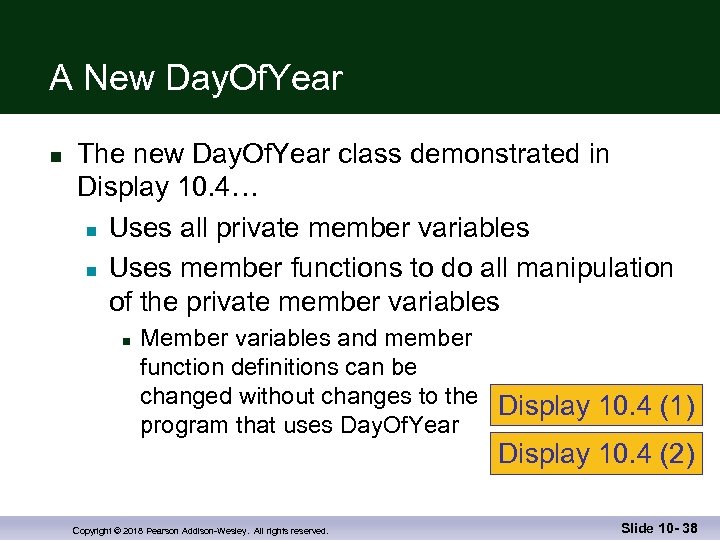 A New Day. Of. Year n The new Day. Of. Year class demonstrated in Display 10. 4… n Uses all private member variables n Uses member functions to do all manipulation of the private member variables n Member variables and member function definitions can be changed without changes to the Display 10. 4 (1) program that uses Day. Of. Year Display 10. 4 (2) Copyright © 2018 Pearson Addison-Wesley. All rights reserved. Slide 10 - 38
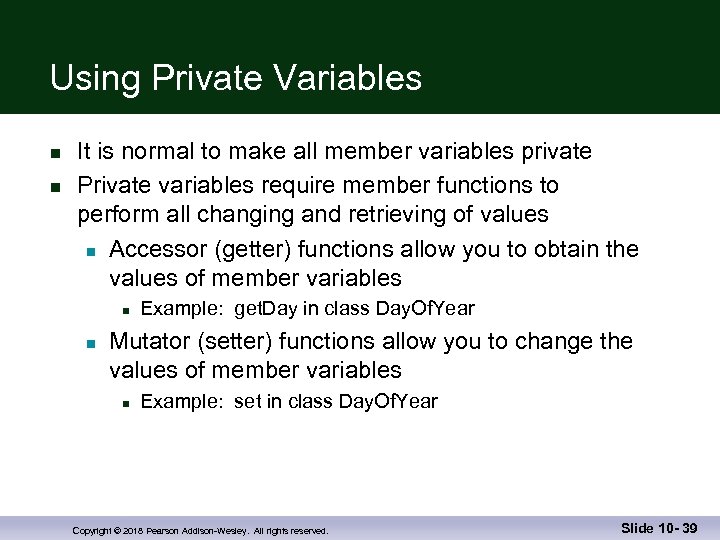 Using Private Variables n n It is normal to make all member variables private Private variables require member functions to perform all changing and retrieving of values n Accessor (getter) functions allow you to obtain the values of member variables n n Example: get. Day in class Day. Of. Year Mutator (setter) functions allow you to change the values of member variables n Example: set in class Day. Of. Year Copyright © 2018 Pearson Addison-Wesley. All rights reserved. Slide 10 - 39
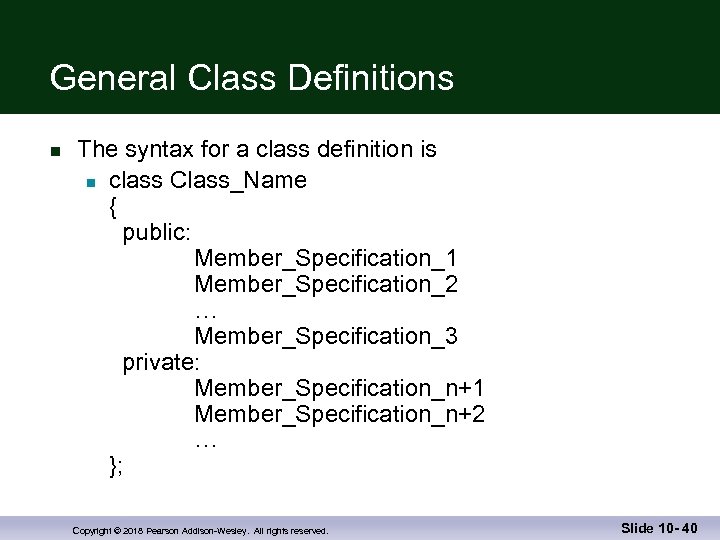 General Class Definitions n The syntax for a class definition is n class Class_Name { public: Member_Specification_1 Member_Specification_2 … Member_Specification_3 private: Member_Specification_n+1 Member_Specification_n+2 … }; Copyright © 2018 Pearson Addison-Wesley. All rights reserved. Slide 10 - 40
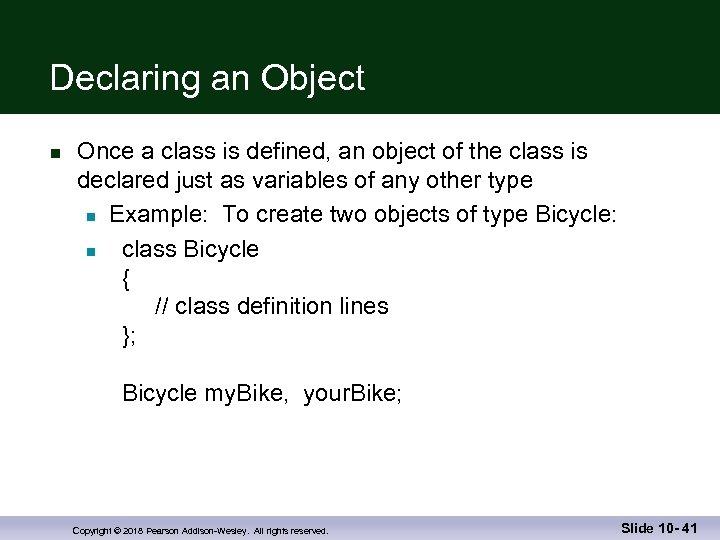 Declaring an Object n Once a class is defined, an object of the class is declared just as variables of any other type n Example: To create two objects of type Bicycle: n class Bicycle { // class definition lines }; Bicycle my. Bike, your. Bike; Copyright © 2018 Pearson Addison-Wesley. All rights reserved. Slide 10 - 41
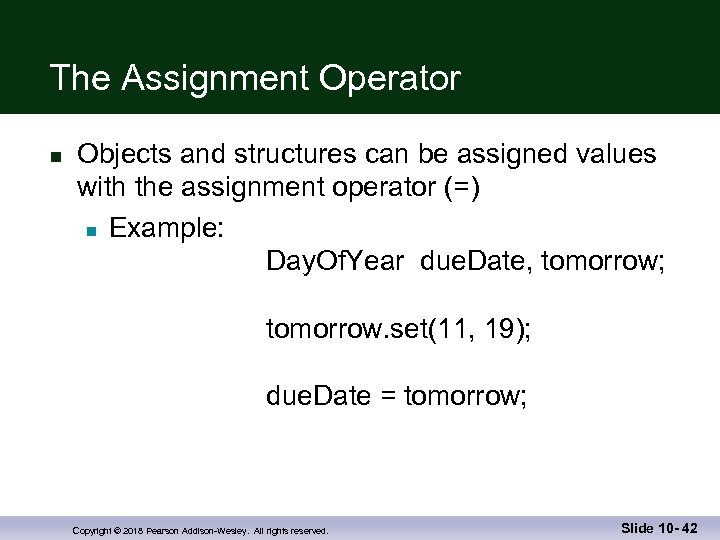 The Assignment Operator n Objects and structures can be assigned values with the assignment operator (=) n Example: Day. Of. Year due. Date, tomorrow; tomorrow. set(11, 19); due. Date = tomorrow; Copyright © 2018 Pearson Addison-Wesley. All rights reserved. Slide 10 - 42
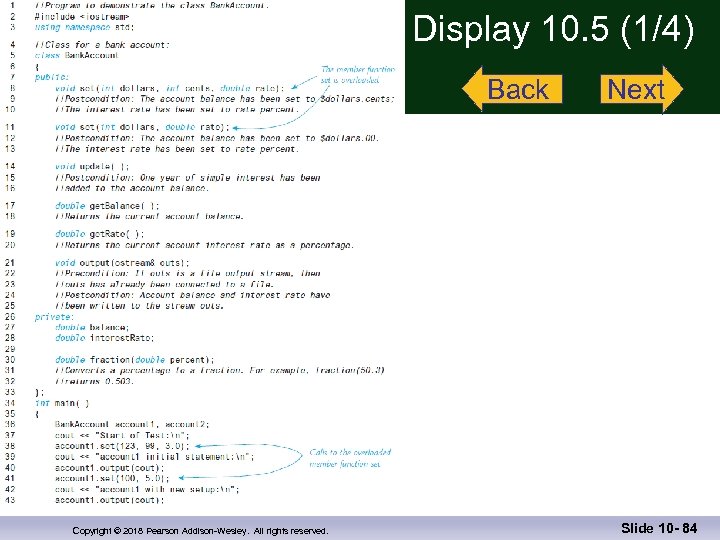
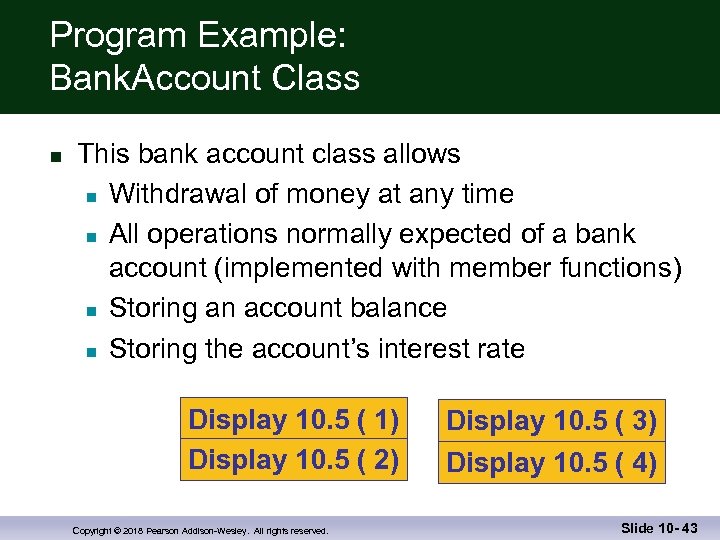 Program Example: Bank. Account Class n This bank account class allows n Withdrawal of money at any time n All operations normally expected of a bank account (implemented with member functions) n Storing an account balance n Storing the account’s interest rate Display 10. 5 ( 1) Display 10. 5 ( 2) Copyright © 2018 Pearson Addison-Wesley. All rights reserved. Display 10. 5 ( 3) Display 10. 5 ( 4) Slide 10 - 43
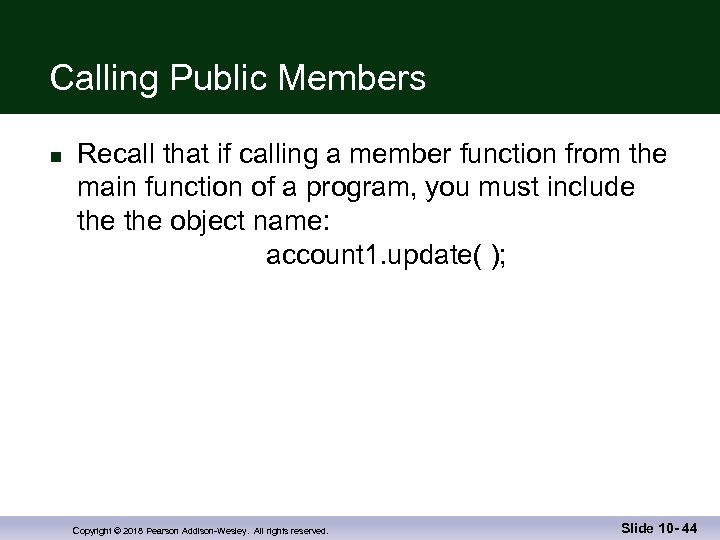 Calling Public Members n Recall that if calling a member function from the main function of a program, you must include the object name: account 1. update( ); Copyright © 2018 Pearson Addison-Wesley. All rights reserved. Slide 10 - 44
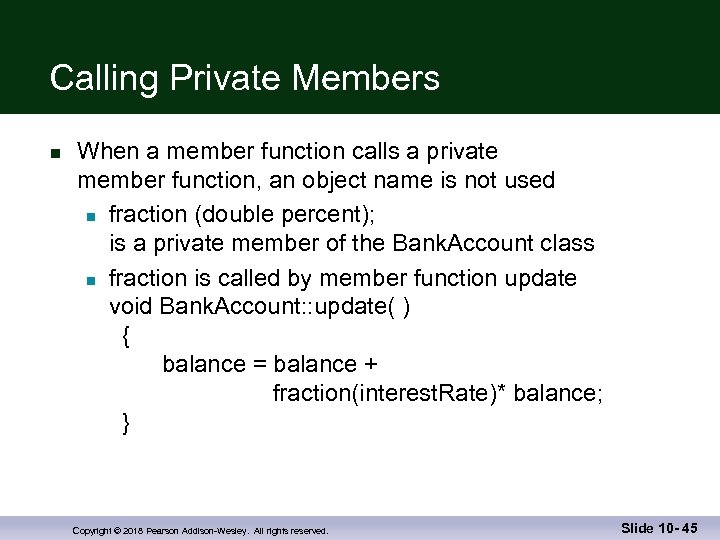 Calling Private Members n When a member function calls a private member function, an object name is not used n fraction (double percent); is a private member of the Bank. Account class n fraction is called by member function update void Bank. Account: : update( ) { balance = balance + fraction(interest. Rate)* balance; } Copyright © 2018 Pearson Addison-Wesley. All rights reserved. Slide 10 - 45
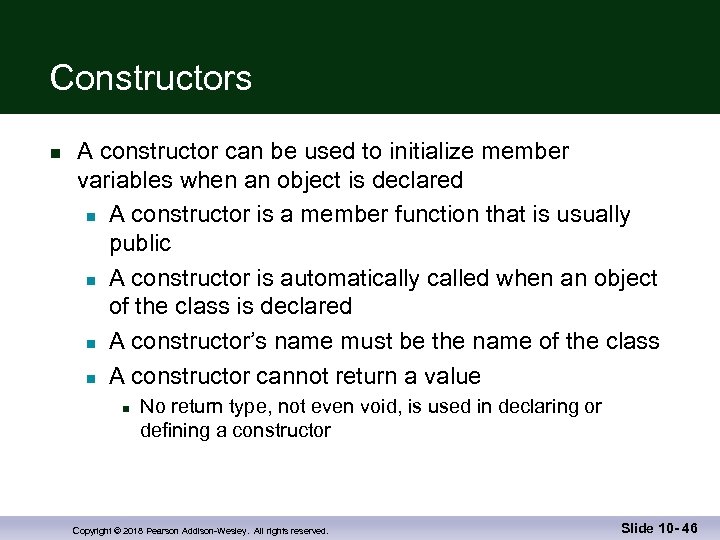 Constructors n A constructor can be used to initialize member variables when an object is declared n A constructor is a member function that is usually public n A constructor is automatically called when an object of the class is declared n A constructor’s name must be the name of the class n A constructor cannot return a value n No return type, not even void, is used in declaring or defining a constructor Copyright © 2018 Pearson Addison-Wesley. All rights reserved. Slide 10 - 46
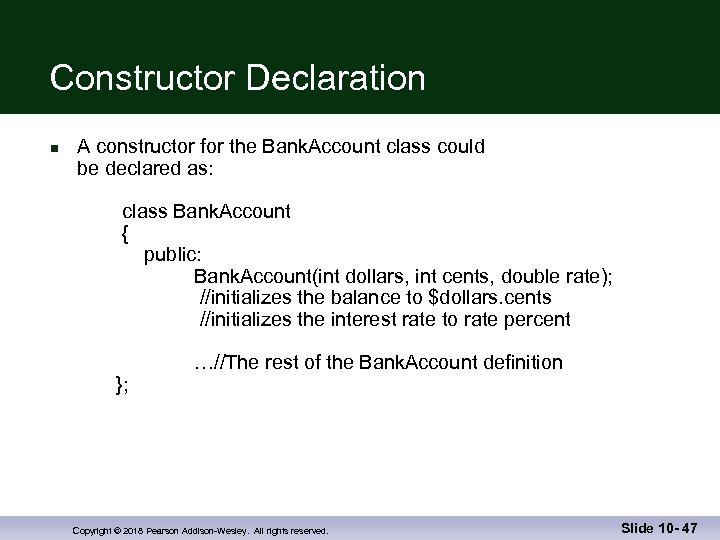 Constructor Declaration n A constructor for the Bank. Account class could be declared as: class Bank. Account { public: Bank. Account(int dollars, int cents, double rate); //initializes the balance to $dollars. cents //initializes the interest rate to rate percent }; …//The rest of the Bank. Account definition Copyright © 2018 Pearson Addison-Wesley. All rights reserved. Slide 10 - 47
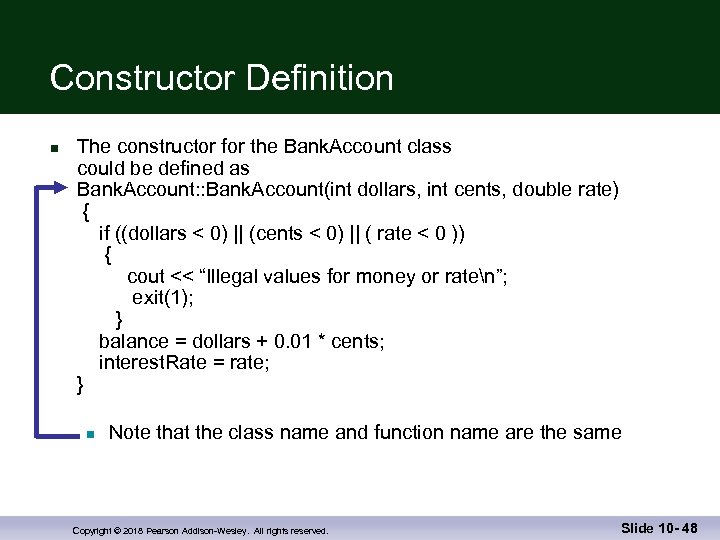 Constructor Definition n The constructor for the Bank. Account class could be defined as Bank. Account: : Bank. Account(int dollars, int cents, double rate) { if ((dollars < 0) || (cents < 0) || ( rate < 0 )) { cout << “Illegal values for money or raten”; exit(1); } balance = dollars + 0. 01 * cents; interest. Rate = rate; } n Note that the class name and function name are the same Copyright © 2018 Pearson Addison-Wesley. All rights reserved. Slide 10 - 48
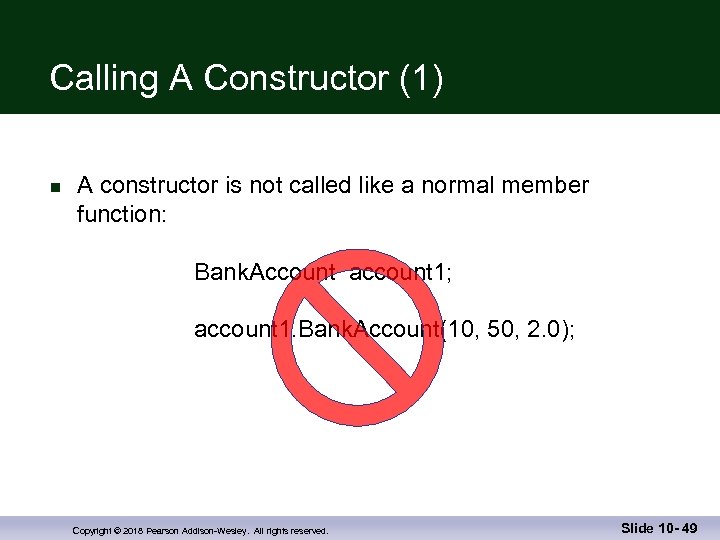 Calling A Constructor (1) n A constructor is not called like a normal member function: Bank. Account account 1; account 1. Bank. Account(10, 50, 2. 0); Copyright © 2018 Pearson Addison-Wesley. All rights reserved. Slide 10 - 49
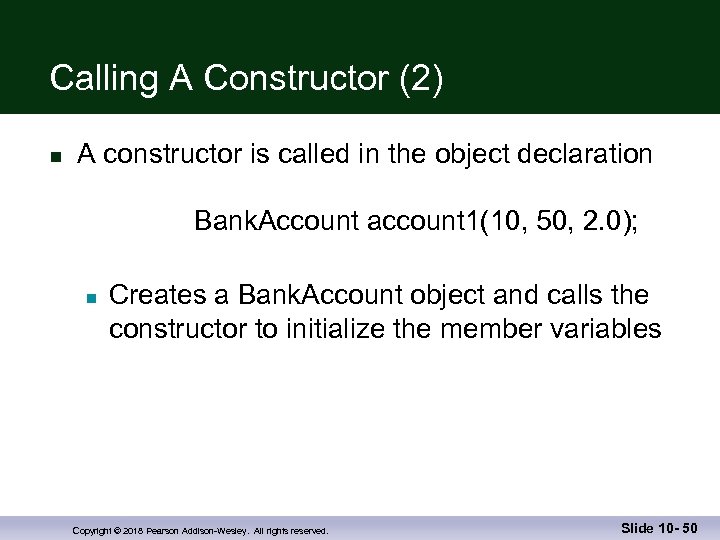 Calling A Constructor (2) n A constructor is called in the object declaration Bank. Account account 1(10, 50, 2. 0); n Creates a Bank. Account object and calls the constructor to initialize the member variables Copyright © 2018 Pearson Addison-Wesley. All rights reserved. Slide 10 - 50
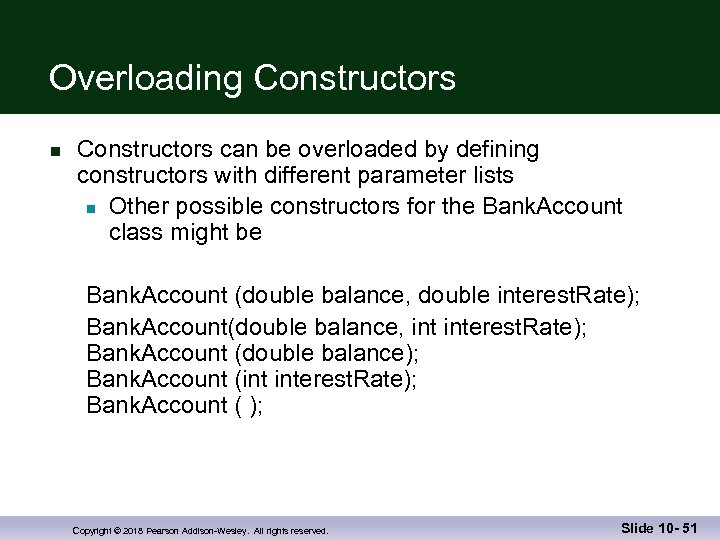 Overloading Constructors n Constructors can be overloaded by defining constructors with different parameter lists n Other possible constructors for the Bank. Account class might be Bank. Account (double balance, double interest. Rate); Bank. Account(double balance, interest. Rate); Bank. Account (double balance); Bank. Account (int interest. Rate); Bank. Account ( ); Copyright © 2018 Pearson Addison-Wesley. All rights reserved. Slide 10 - 51
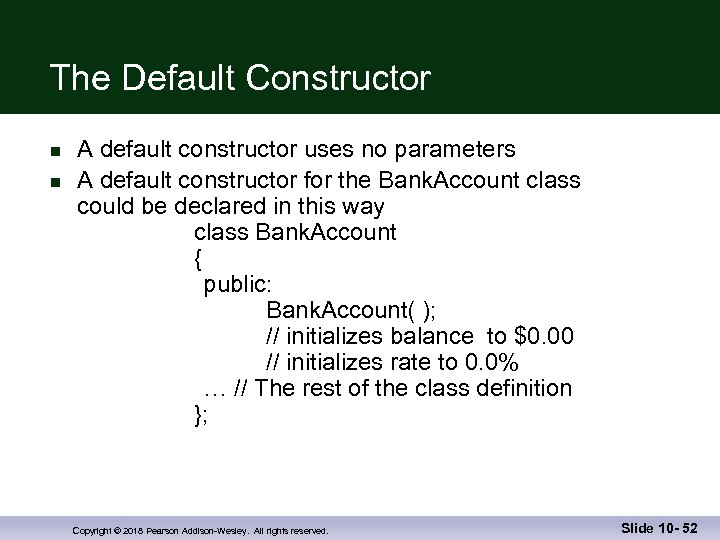 The Default Constructor n n A default constructor uses no parameters A default constructor for the Bank. Account class could be declared in this way class Bank. Account { public: Bank. Account( ); // initializes balance to $0. 00 // initializes rate to 0. 0% … // The rest of the class definition }; Copyright © 2018 Pearson Addison-Wesley. All rights reserved. Slide 10 - 52
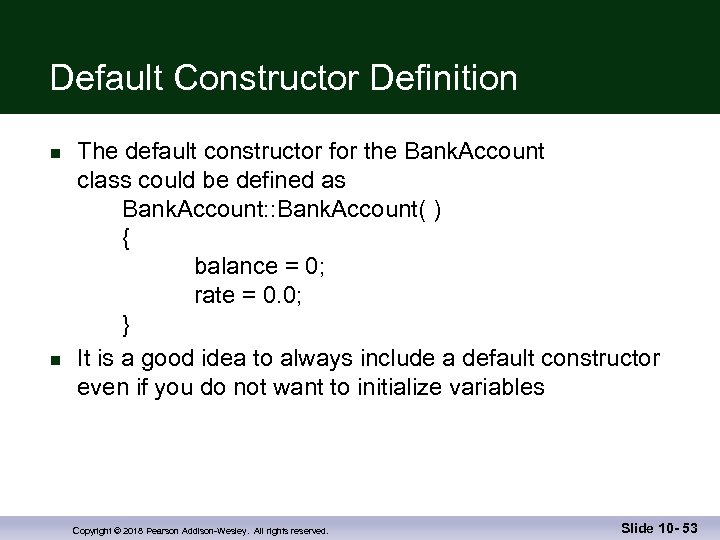 Default Constructor Definition n n The default constructor for the Bank. Account class could be defined as Bank. Account: : Bank. Account( ) { balance = 0; rate = 0. 0; } It is a good idea to always include a default constructor even if you do not want to initialize variables Copyright © 2018 Pearson Addison-Wesley. All rights reserved. Slide 10 - 53
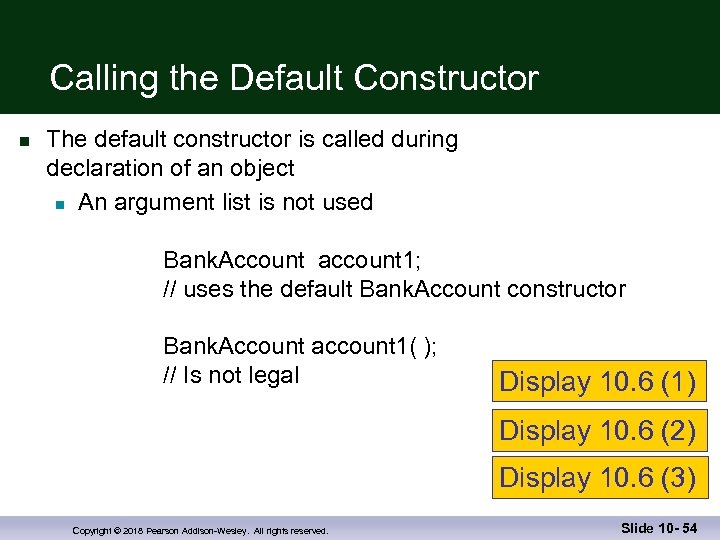 Calling the Default Constructor n The default constructor is called during declaration of an object n An argument list is not used Bank. Account account 1; // uses the default Bank. Account constructor Bank. Account account 1( ); // Is not legal Display 10. 6 (1) Display 10. 6 (2) Display 10. 6 (3) Copyright © 2018 Pearson Addison-Wesley. All rights reserved. Slide 10 - 54
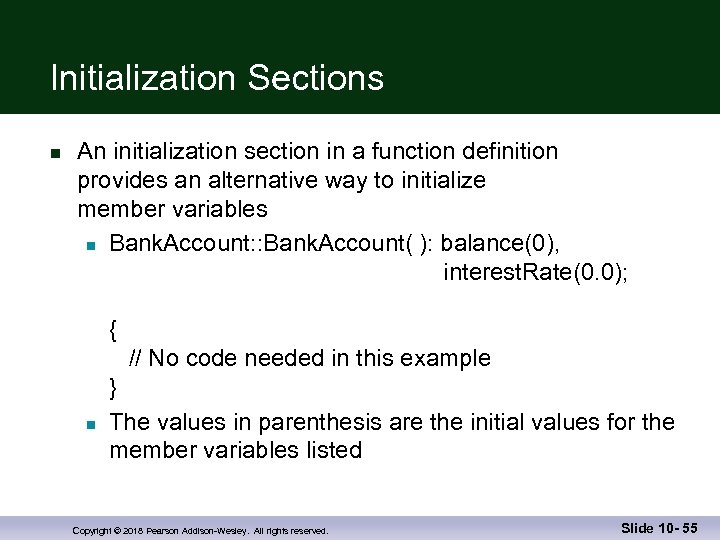 Initialization Sections n An initialization section in a function definition provides an alternative way to initialize member variables n Bank. Account: : Bank. Account( ): balance(0), interest. Rate(0. 0); { // No code needed in this example n } The values in parenthesis are the initial values for the member variables listed Copyright © 2018 Pearson Addison-Wesley. All rights reserved. Slide 10 - 55
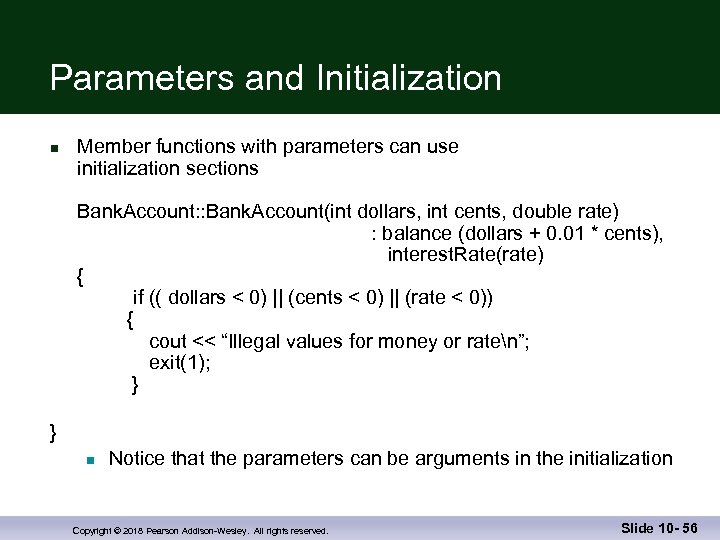 Parameters and Initialization n Member functions with parameters can use initialization sections Bank. Account: : Bank. Account(int dollars, int cents, double rate) : balance (dollars + 0. 01 * cents), interest. Rate(rate) { if (( dollars < 0) || (cents < 0) || (rate < 0)) { cout << “Illegal values for money or raten”; exit(1); } } n Notice that the parameters can be arguments in the initialization Copyright © 2018 Pearson Addison-Wesley. All rights reserved. Slide 10 - 56
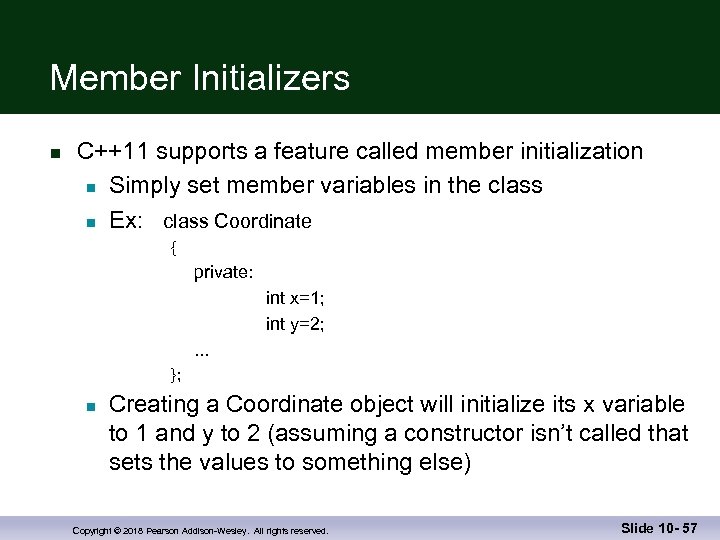 Member Initializers n C++11 supports a feature called member initialization n Simply set member variables in the class n Ex: class Coordinate { private: int x=1; int y=2; . . . }; n Creating a Coordinate object will initialize its x variable to 1 and y to 2 (assuming a constructor isn’t called that sets the values to something else) Copyright © 2018 Pearson Addison-Wesley. All rights reserved. Slide 10 - 57
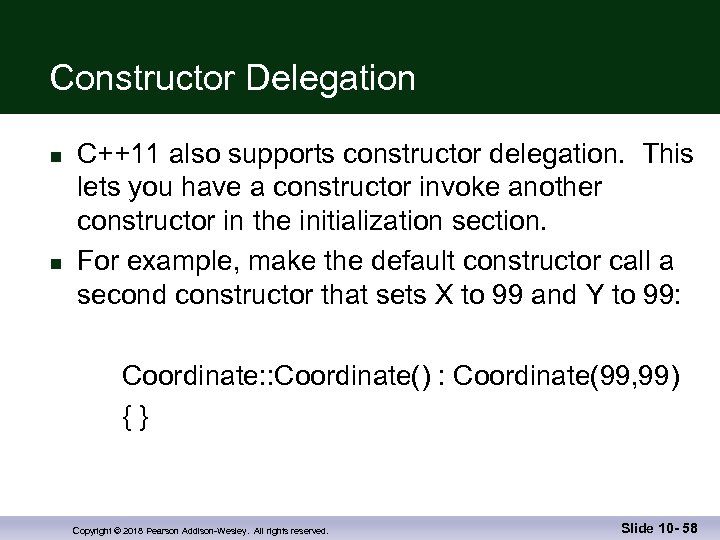 Constructor Delegation n n C++11 also supports constructor delegation. This lets you have a constructor invoke another constructor in the initialization section. For example, make the default constructor call a second constructor that sets X to 99 and Y to 99: Coordinate: : Coordinate() : Coordinate(99, 99) {} Copyright © 2018 Pearson Addison-Wesley. All rights reserved. Slide 10 - 58
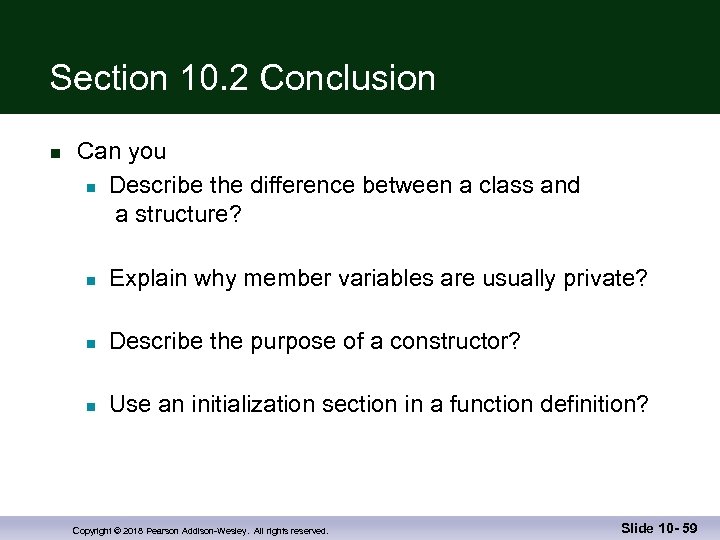 Section 10. 2 Conclusion n Can you n Describe the difference between a class and a structure? n Explain why member variables are usually private? n Describe the purpose of a constructor? n Use an initialization section in a function definition? Copyright © 2018 Pearson Addison-Wesley. All rights reserved. Slide 10 - 59
 10. 3 Abstract Data Types Copyright © 2018 Pearson Addison-Wesley. All rights reserved.
 Abstract Data Types n n A data type consists of a collection of values together with a set of basic operations defined on the values A data type is an Abstract Data Type (ADT) if programmers using the type do not have access to the details of how the values and operations are implemented Copyright © 2018 Pearson Addison-Wesley. All rights reserved. Slide 10 - 61
 Classes To Produce ADTs n To define a class so it is an ADT n Separate the specification of how the type is used by a programmer from the details of how the type is implemented n Make all member variables private members n Basic operations a programmer needs should be public member functions n Fully specify how to use each public function n Helper functions should be private members Copyright © 2018 Pearson Addison-Wesley. All rights reserved. Slide 10 - 62
 ADT Interface n The ADT interface tells how to use the ADT in a program n The interface consists of n n n The public member functions The comments that explain how to use the functions The interface should be all that is needed to know how to use the ADT in a program Copyright © 2018 Pearson Addison-Wesley. All rights reserved. Slide 10 - 63
 ADT Implementation n The ADT implementation tells how the interface is realized in C++ n The implementation consists of n n The private members of the class The definitions of public and private member functions The implementation is needed to run a program The implementation is not needed to write the main part of a program or any non-member functions Copyright © 2018 Pearson Addison-Wesley. All rights reserved. Slide 10 - 64
 ADT Benefits n n n Changing an ADT implementation does require changing a program that uses the ADT’s make it easier to divide work among different programmers n One or more can write the ADT n One or more can write code that uses the ADT Writing and using ADTs breaks the larger programming task into smaller tasks Copyright © 2018 Pearson Addison-Wesley. All rights reserved. Slide 10 - 65
 Program Example The Bank. Account ADT n In this version of the Bank. Account ADT n Data is stored as three member variables n n n The dollars part of the account balance The cents part of the account balance The interest rate This version stores the interest rate as a fraction The public portion of the class definition remains unchanged from the version of Display 10. 6 Display 10. 7 (1) Display 10. 7 (2) Copyright © 2018 Pearson Addison-Wesley. All rights reserved. Display 10. 7 (3) Slide 10 - 66
 Interface Preservation n To preserve the interface of an ADT so that programs using it do not need to be changed n Public member declarations cannot be changed n Public member definitions can be changed n Private member functions can be added, deleted, or changed Copyright © 2018 Pearson Addison-Wesley. All rights reserved. Slide 10 - 67
 Information Hiding n n Information hiding was refered to earlier as writing functions so they can be used like black boxes ADT’s implement information hiding because n The interface is all that is needed to use the ADT n Implementation details of the ADT are not needed to know how to use the ADT n Implementation details of the data values are not needed to know how to use the ADT Copyright © 2018 Pearson Addison-Wesley. All rights reserved. Slide 10 - 68
 Section 10. 3 Conclusion n Can you n Describe an ADT? n Describe how to implement an ADT in C++? n Define the interface of an ADT? n Define the implementation of an ADT? Copyright © 2018 Pearson Addison-Wesley. All rights reserved. Slide 10 - 69
 10. 4 Introduction to Inheritance Copyright © 2018 Pearson Addison-Wesley. All rights reserved.
 Inheritance n Inheritance refers to derived classes n Derived classes are obtained from another class by adding features n A derived class inherits the member functions and variables from its parent class without having to rewrite them n Example n n In Chapter 6 we saw that the class of input-file streams is derived from the class of all input streams by adding member functions such as open and close cin belongs to the class of all input streams, but not the class of input-file streams Copyright © 2018 Pearson Addison-Wesley. All rights reserved. Slide 10 - 71
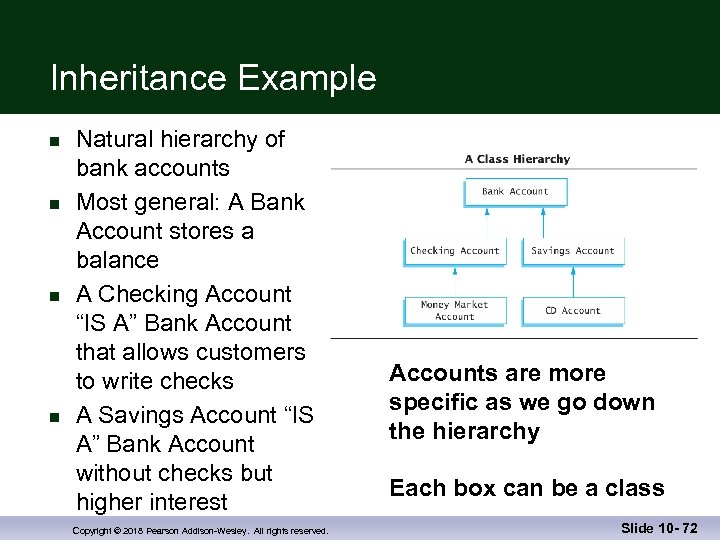 Inheritance Example n n Natural hierarchy of bank accounts Most general: A Bank Account stores a balance A Checking Account “IS A” Bank Account that allows customers to write checks A Savings Account “IS A” Bank Account without checks but higher interest Copyright © 2018 Pearson Addison-Wesley. All rights reserved. Accounts are more specific as we go down the hierarchy Each box can be a class Slide 10 - 72
 Inheritance Relationships n n n The more specific class is a derived or child class The more general class is the base, super, or parent class If class B is derived from class A n Class B is a derived class of class A n Class B is a child of class A n Class A is the parent of class B n Class B inherits the member functions and variables of class A Copyright © 2018 Pearson Addison-Wesley. All rights reserved. Slide 10 - 73
 Defining Derived Classes n Give the class name as normal, but add a colon and then the name of the base class Savings. Account : public Bank. Account { … } n Objects of type Savings. Account can access member functions defined in Savings. Account or Bank. Account Display 10. 9 (1 -3) Copyright © 2018 Pearson Addison-Wesley. All rights reserved. Slide 10 - 74
 Section 10. 4 Conclusion n Can you n Define object? n Define class? n Describe the relationship between parent and child classes? n Describe the benefit of inheritance? Copyright © 2018 Pearson Addison-Wesley. All rights reserved. Slide 10 - 75
 Chapter 10 -- End Copyright © 2018 Pearson Addison-Wesley. All rights reserved. Slide 10 - 76
 Display 10. 1 (1/2) Back Copyright © 2018 Pearson Addison-Wesley. All rights reserved. Next Slide 10 - 77
 Display 10. 1 (2/2) Copyright © 2018 Pearson Addison-Wesley. All rights reserved. Back Next Slide 10 - 78
 Display 10. 2 Copyright © 2018 Pearson Addison-Wesley. All rights reserved. Back Next Slide 10 - 79
 Display 10. 3 (1/2) Back Copyright © 2018 Pearson Addison-Wesley. All rights reserved. Next Slide 10 - 80
 Display 10. 3 (2/2) Copyright © 2018 Pearson Addison-Wesley. All rights reserved. Back Next Slide 10 - 81
 Display 10. 4 (1/2) Back Copyright © 2018 Pearson Addison-Wesley. All rights reserved. Next Slide 10 - 82
 Display 10. 4 (2/2) Back Copyright © 2018 Pearson Addison-Wesley. All rights reserved. Next Slide 10 - 83
 Display 10. 5 (1/4) Back Copyright © 2018 Pearson Addison-Wesley. All rights reserved. Next Slide 10 - 84
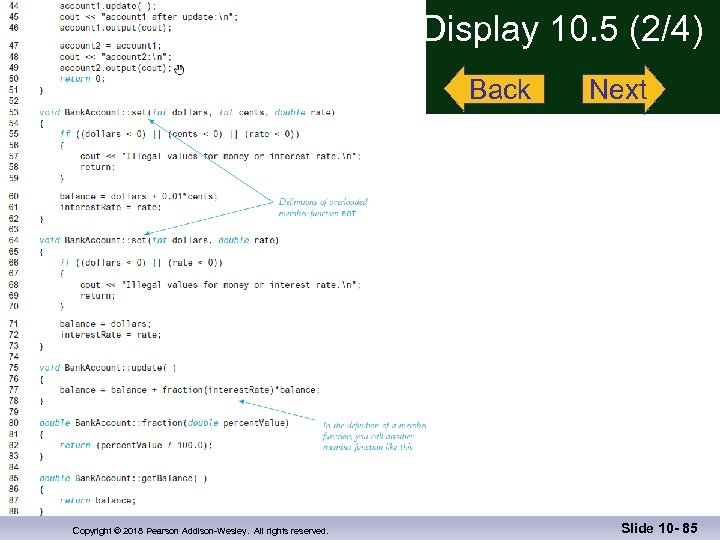 Display 10. 5 (2/4) Back Copyright © 2018 Pearson Addison-Wesley. All rights reserved. Next Slide 10 - 85
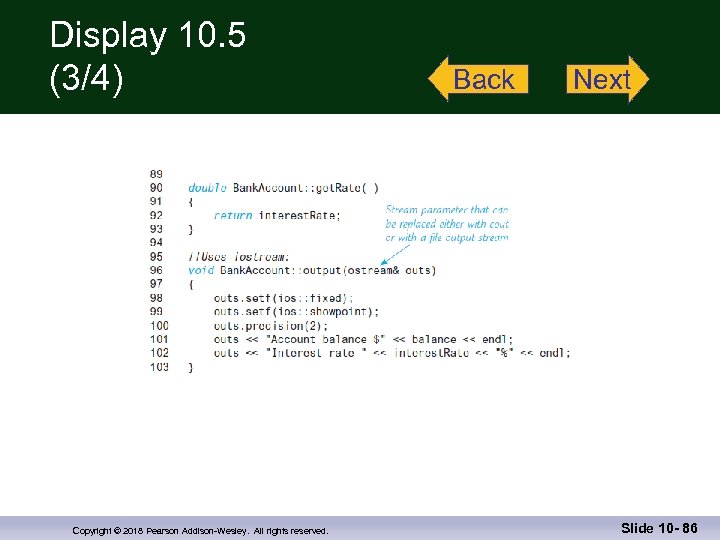 Display 10. 5 (3/4) Copyright © 2018 Pearson Addison-Wesley. All rights reserved. Back Next Slide 10 - 86
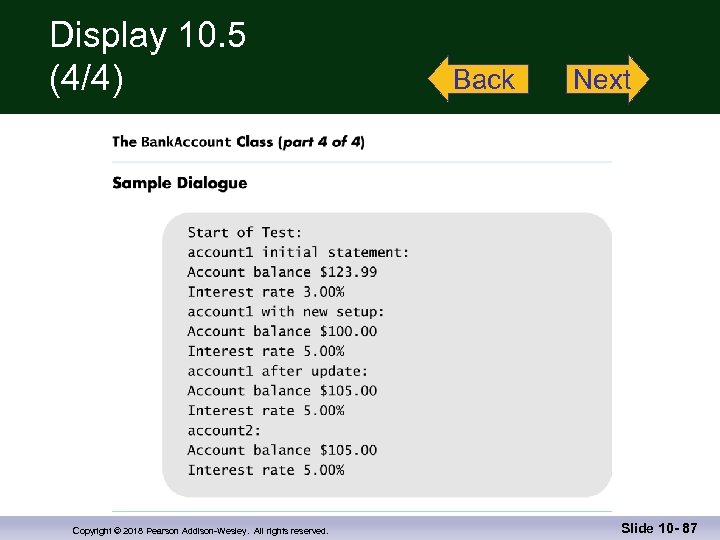 Display 10. 5 (4/4) Copyright © 2018 Pearson Addison-Wesley. All rights reserved. Back Next Slide 10 - 87
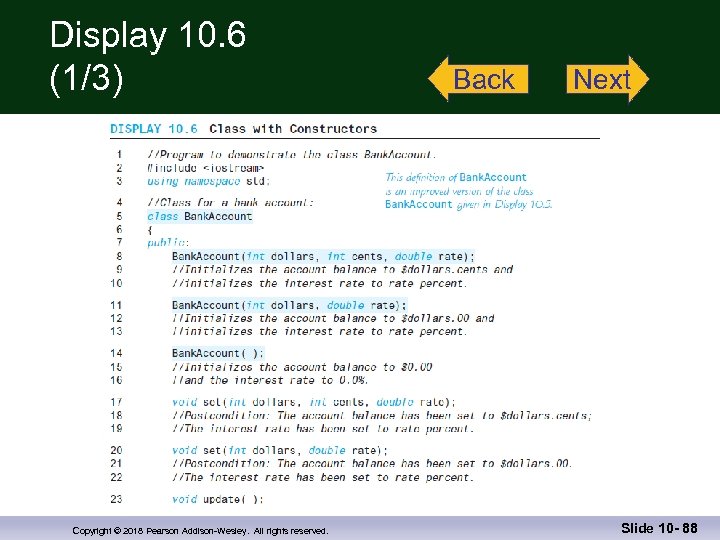 Display 10. 6 (1/3) Copyright © 2018 Pearson Addison-Wesley. All rights reserved. Back Next Slide 10 - 88
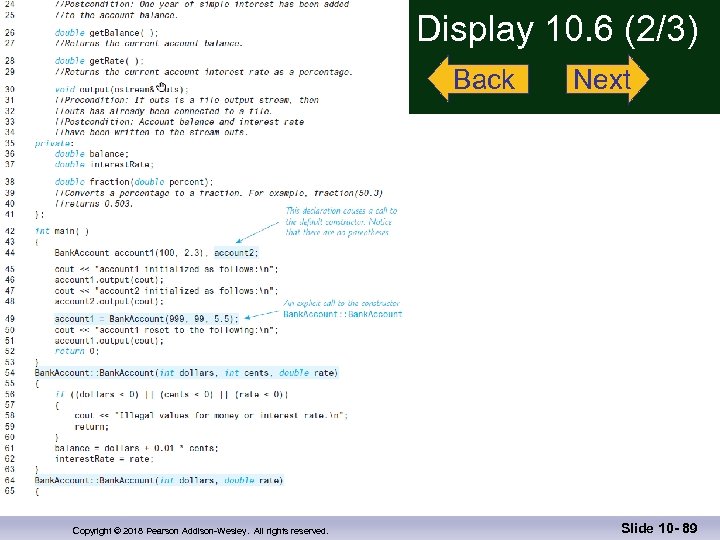 Display 10. 6 (2/3) Back Copyright © 2018 Pearson Addison-Wesley. All rights reserved. Next Slide 10 - 89
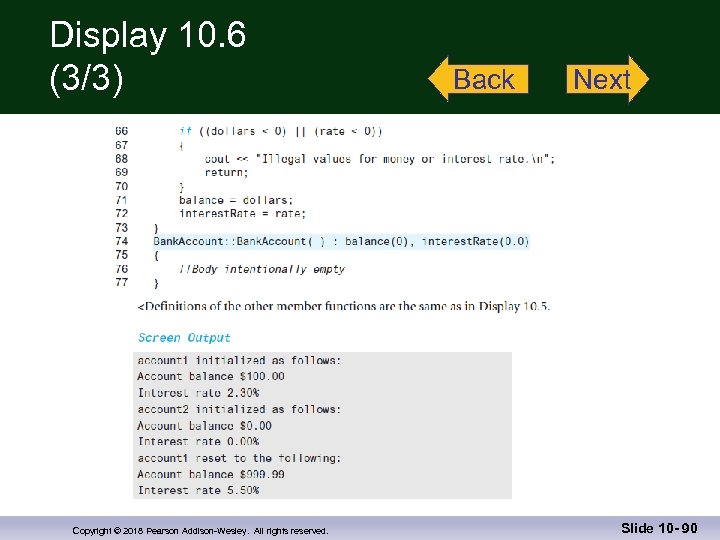 Display 10. 6 (3/3) Copyright © 2018 Pearson Addison-Wesley. All rights reserved. Back Next Slide 10 - 90
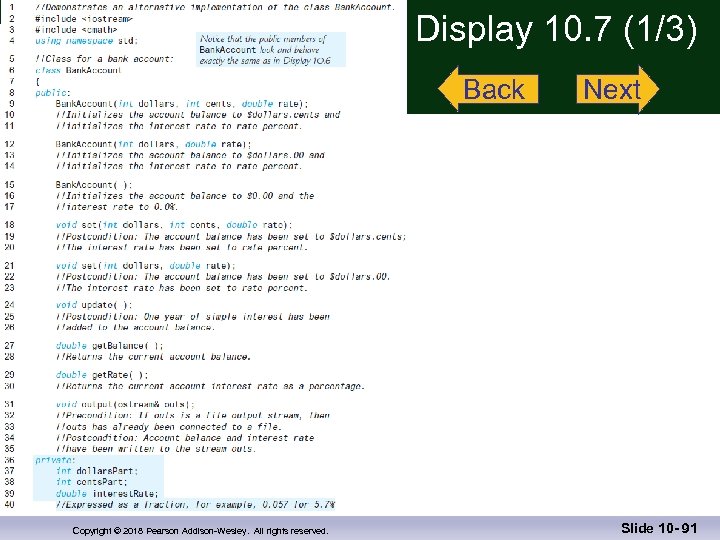 Display 10. 7 (1/3) Back Copyright © 2018 Pearson Addison-Wesley. All rights reserved. Next Slide 10 - 91
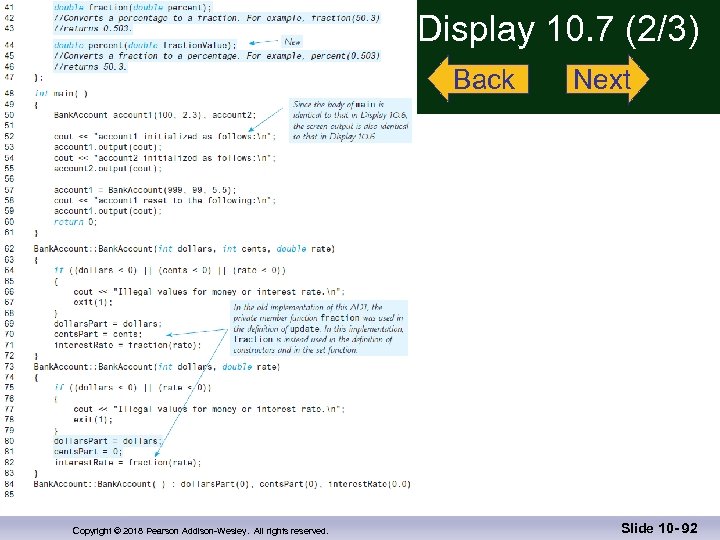 Display 10. 7 (2/3) Back Copyright © 2018 Pearson Addison-Wesley. All rights reserved. Next Slide 10 - 92
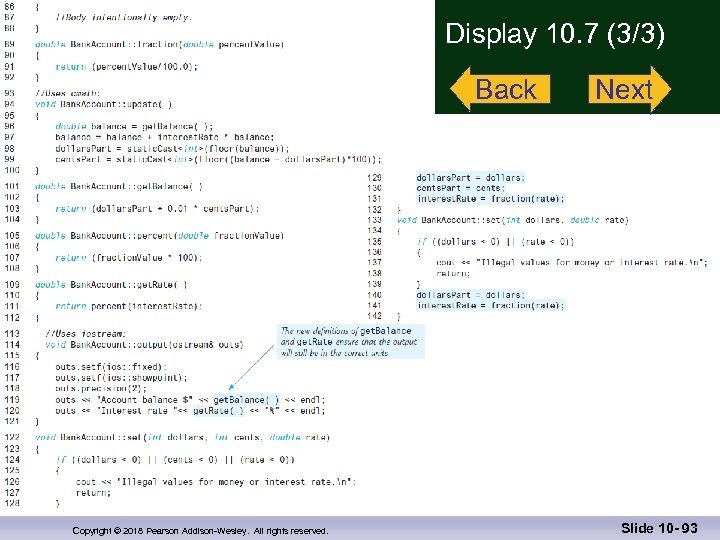 Display 10. 7 (3/3) Back Copyright © 2018 Pearson Addison-Wesley. All rights reserved. Next Slide 10 - 93
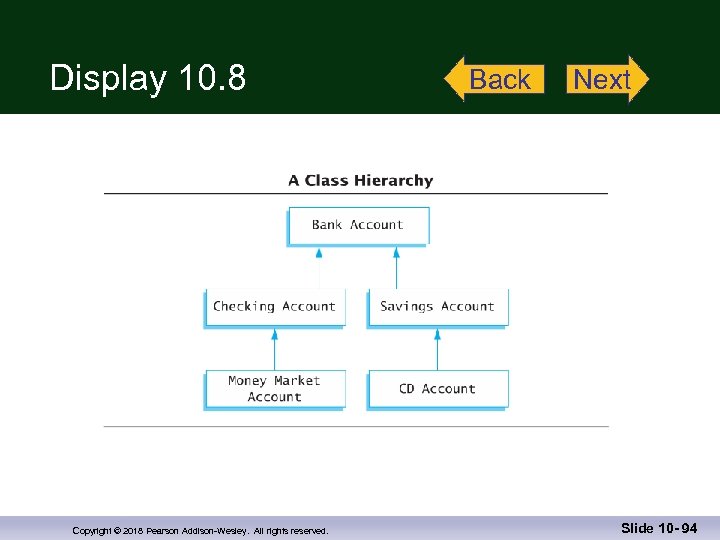 Display 10. 8 Copyright © 2018 Pearson Addison-Wesley. All rights reserved. Back Next Slide 10 - 94
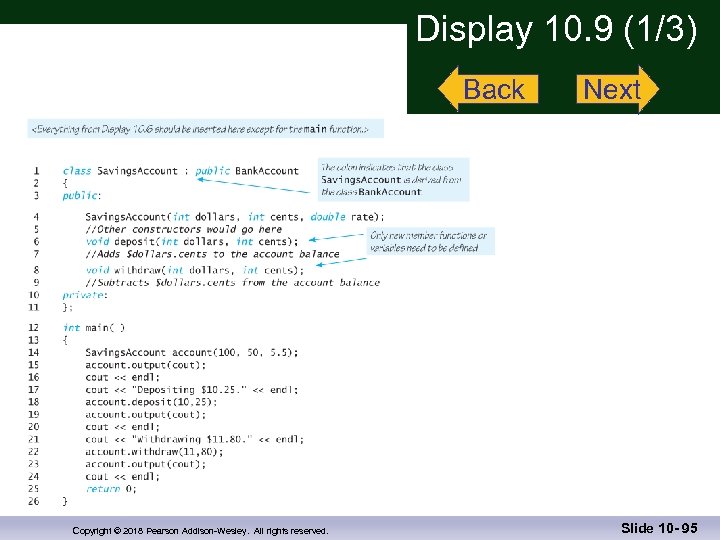 Display 10. 9 (1/3) Back Copyright © 2018 Pearson Addison-Wesley. All rights reserved. Next Slide 10 - 95
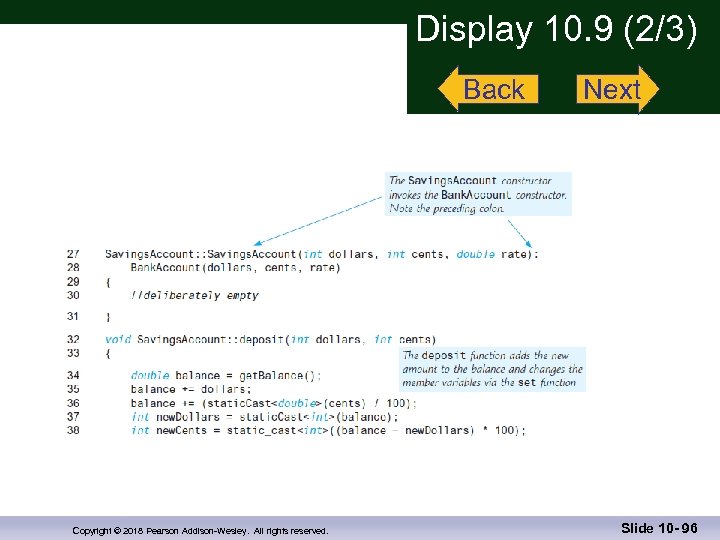 Display 10. 9 (2/3) Back Copyright © 2018 Pearson Addison-Wesley. All rights reserved. Next Slide 10 - 96
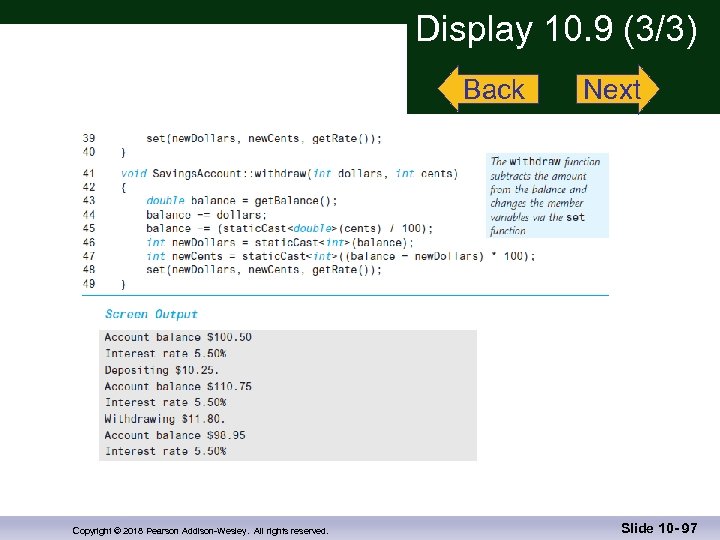 Display 10. 9 (3/3) Back Copyright © 2018 Pearson Addison-Wesley. All rights reserved. Next Slide 10 - 97