


 Скачать презентацию Chapter 10 Congress Congress Where Things Get
c981413201edef1a5c16652ac82ff671.ppt
- Количество слайдов: 84
 Chapter 10 Congress
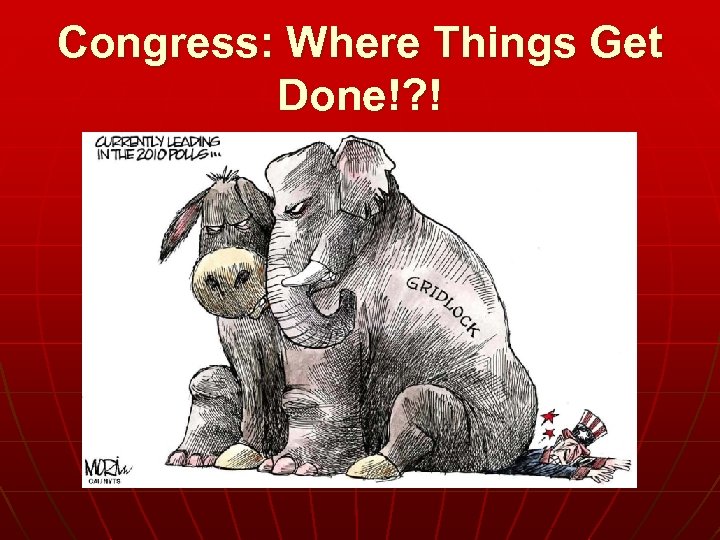 Congress: Where Things Get Done!? !
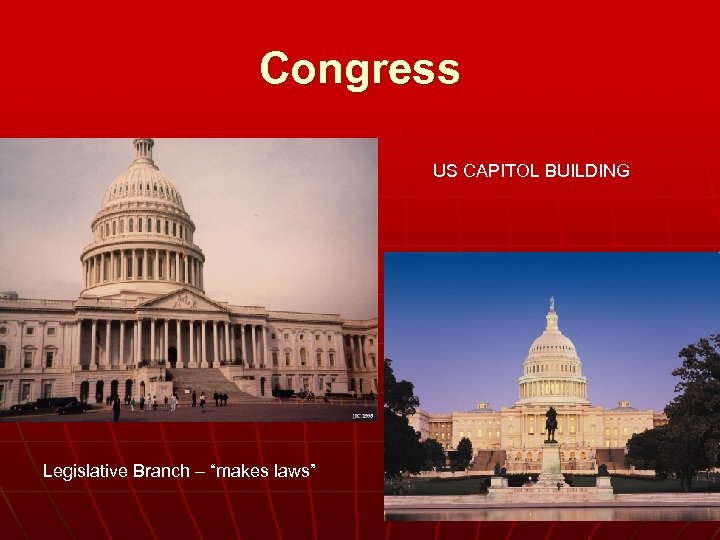 Congress US CAPITOL BUILDING Legislative Branch – “makes laws”
 n WHO GOVERNS? 1. Are members of Congress representative of the American people? 2. Does Congress normally do what most citizens want it to do? n TO WHAT ENDS? 1. Should Congress run under strong leadership? 2. Should Congress act more quickly? Copyright © 2011 Cengage
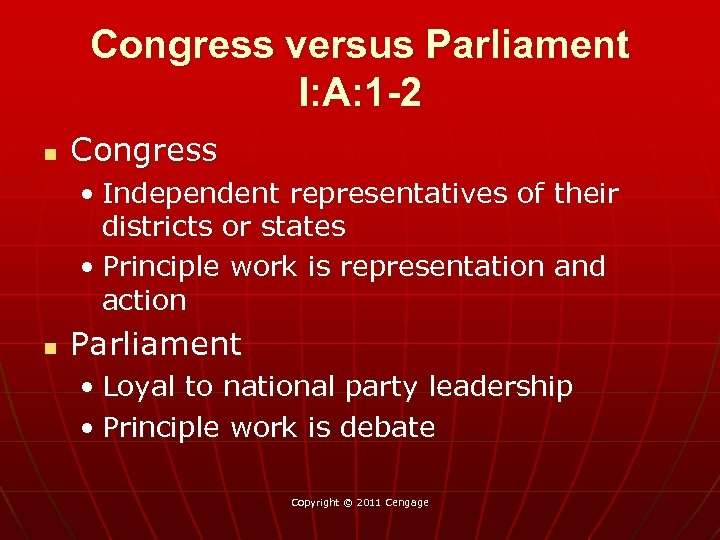 Congress versus Parliament I: A: 1 -2 n Congress • Independent representatives of their districts or states • Principle work is representation and action n Parliament • Loyal to national party leadership • Principle work is debate Copyright © 2011 Cengage
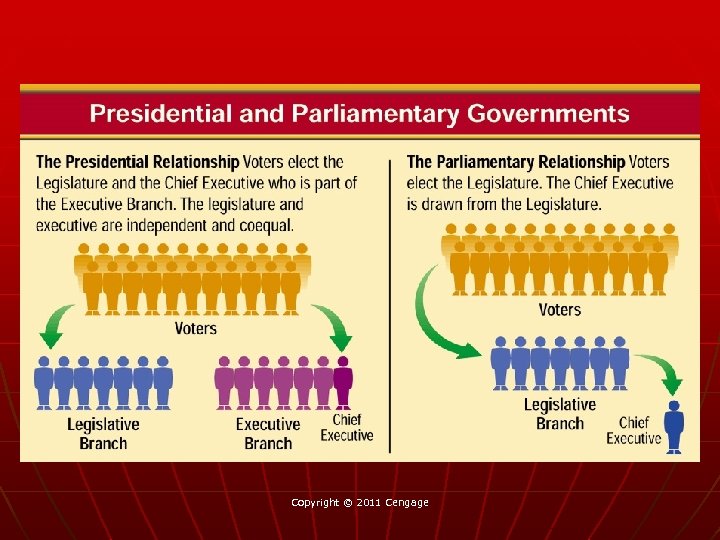 Copyright © 2011 Cengage
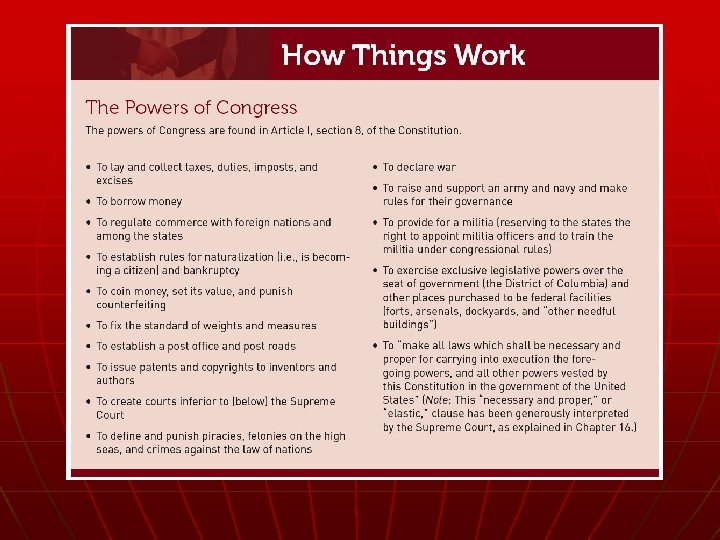
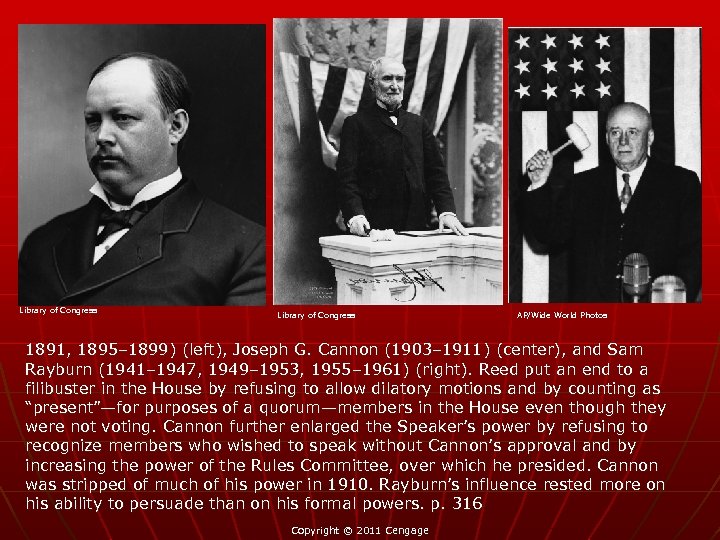 Library of Congress AP/Wide World Photos 1891, 1895– 1899) (left), Joseph G. Cannon (1903– 1911) (center), and Sam Rayburn (1941– 1947, 1949– 1953, 1955– 1961) (right). Reed put an end to a filibuster in the House by refusing to allow dilatory motions and by counting as “present”—for purposes of a quorum—members in the House even though they were not voting. Cannon further enlarged the Speaker’s power by refusing to recognize members who wished to speak without Cannon’s approval and by increasing the power of the Rules Committee, over which he presided. Cannon was stripped of much of his power in 1910. Rayburn’s influence rested more on his ability to persuade than on his formal powers. p. 316 Copyright © 2011 Cengage
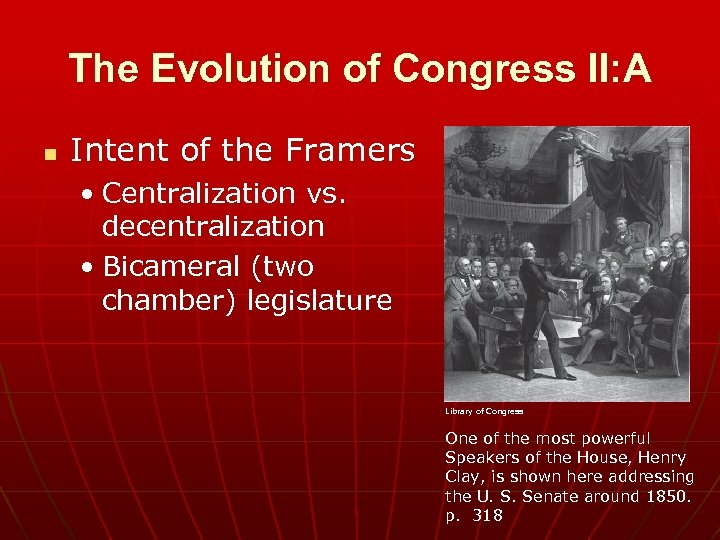 The Evolution of Congress II: A n Intent of the Framers • Centralization vs. decentralization • Bicameral (two chamber) legislature Library of Congress One of the most powerful Speakers of the House, Henry Clay, is shown here addressing the U. S. Senate around 1850. p. 318
 Congress in the Constitution n n n Checked and balanced by Executive and Judiciary Bi-cameral Congress – Senate and House check each other House member – elected every 2 years Senator – elected every 6 years House members directly elected Senators directly elected after 17 th Amend.
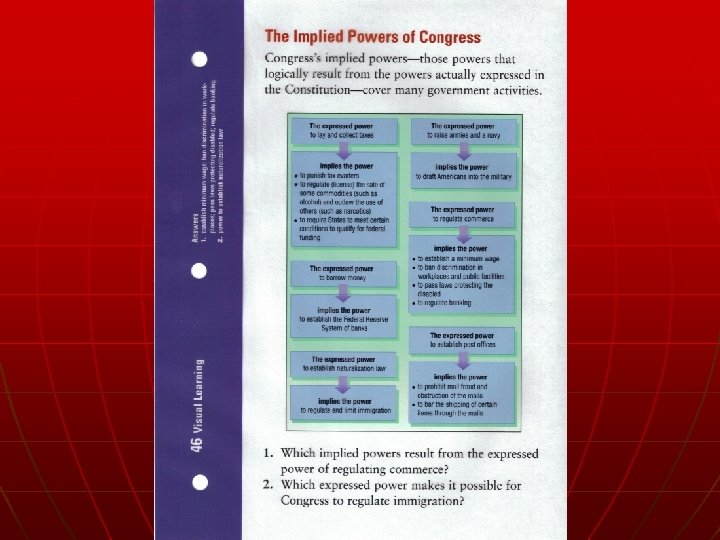
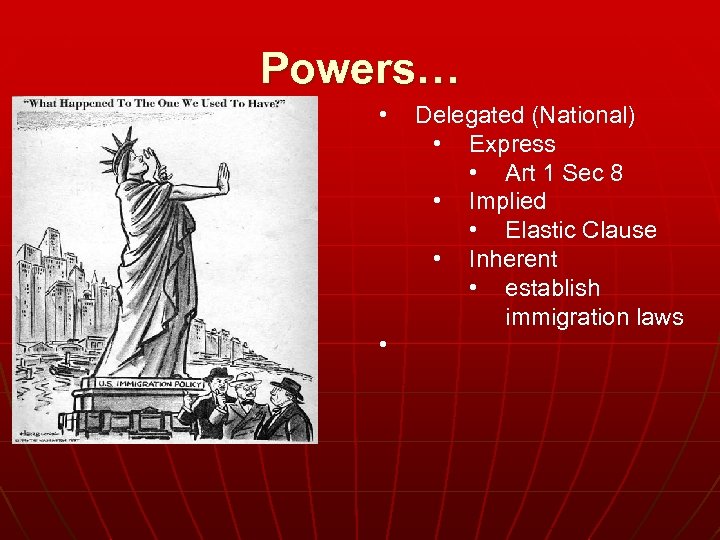 Powers… • • Delegated (National) • Express • Art 1 Sec 8 • Implied • Elastic Clause • Inherent • establish immigration laws
 Copyright © 2011 Cengage
 Evolution of Powers Elastic clause has extended Congress powers n Oversight of budget – restricts the annual budget prepared by executive branch n Appropriations – amount of money made available for various activity in a fiscal year n Investigation – Congress can launch investigations (Watergate, Clinton. Lewinski hearings, Steroids in baseball)
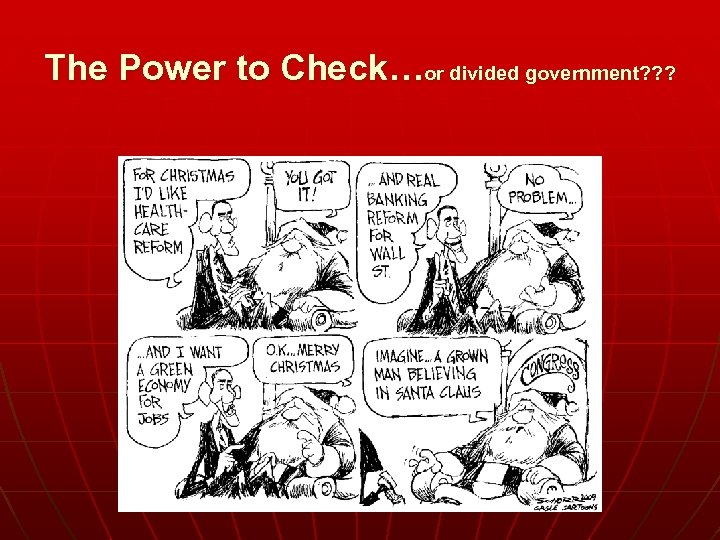 The Power to Check…or divided government? ? ?
 Divided Government n n n One political party controls the White House The other political party controls at least on house of Congress Problems: • longer confirmation process • slowed legislative action • gridlock
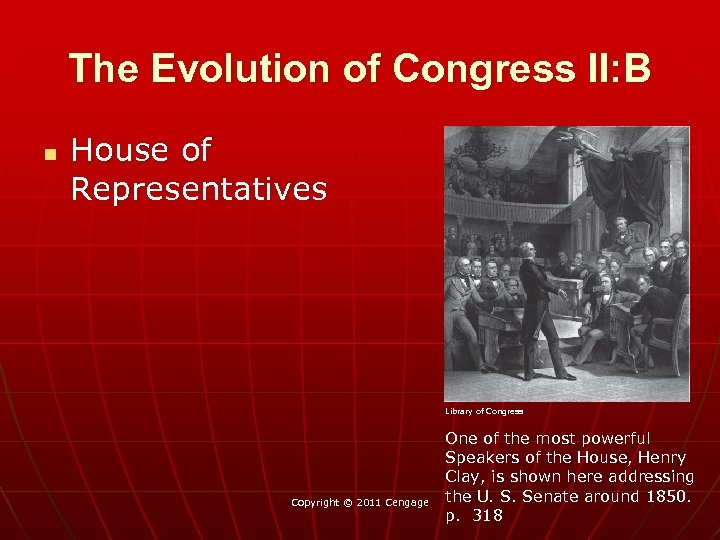 The Evolution of Congress II: B n House of Representatives Library of Congress Copyright © 2011 Cengage One of the most powerful Speakers of the House, Henry Clay, is shown here addressing the U. S. Senate around 1850. p. 318
 One Person, One Vote n To apportion representatives • based on census • power delegated to state legislatures to redraw district lines • party in control of the state draws the new lines to enhance its political future • Gerrymandering-named for Elbridge Gerry, in which the party in power manipulates district lines so they appear unreasonably strange
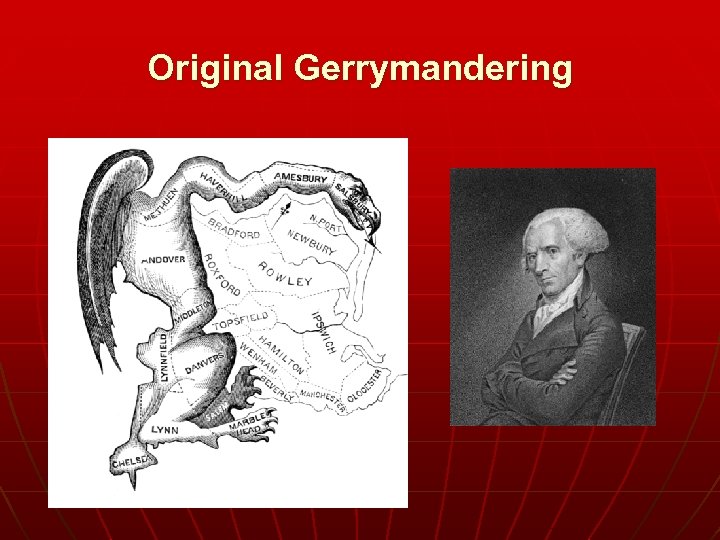 Original Gerrymandering
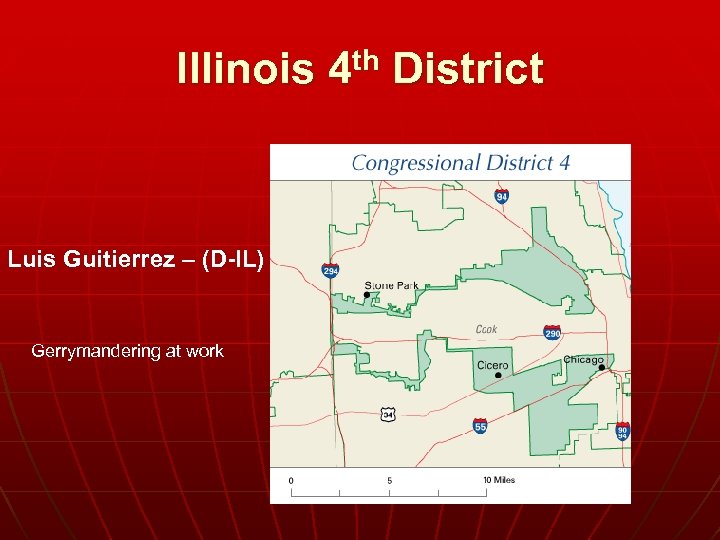 Illinois 4 th District Luis Guitierrez – (D-IL) Gerrymandering at work
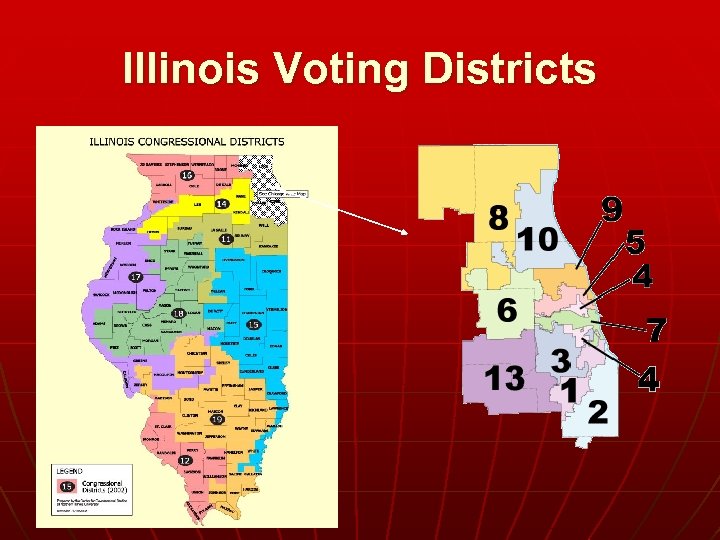 Illinois Voting Districts
 Copyright © 2011 Cengage
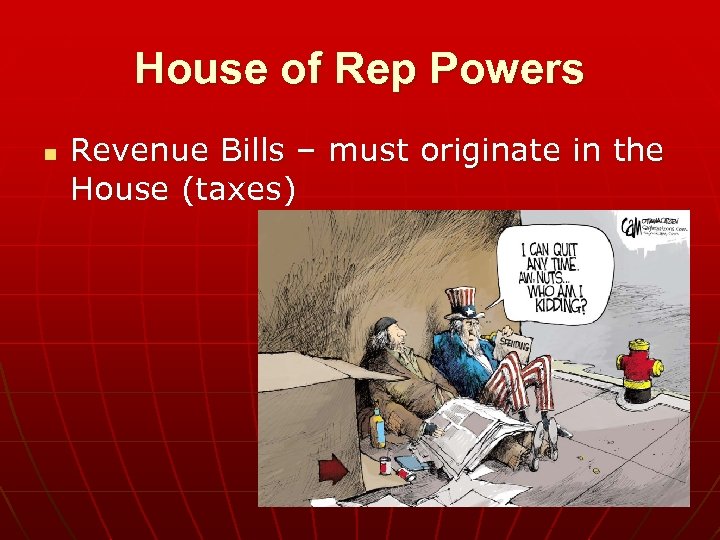 House of Rep Powers n Revenue Bills – must originate in the House (taxes)
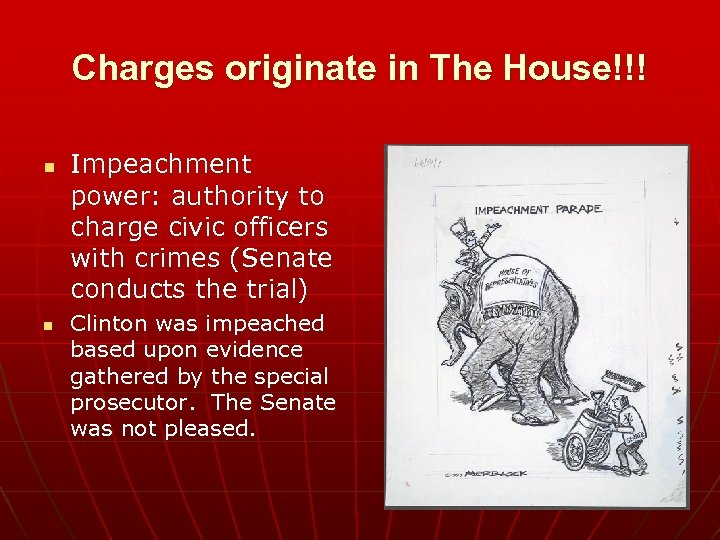 Charges originate in The House!!! n n Impeachment power: authority to charge civic officers with crimes (Senate conducts the trial) Clinton was impeached based upon evidence gathered by the special prosecutor. The Senate was not pleased.
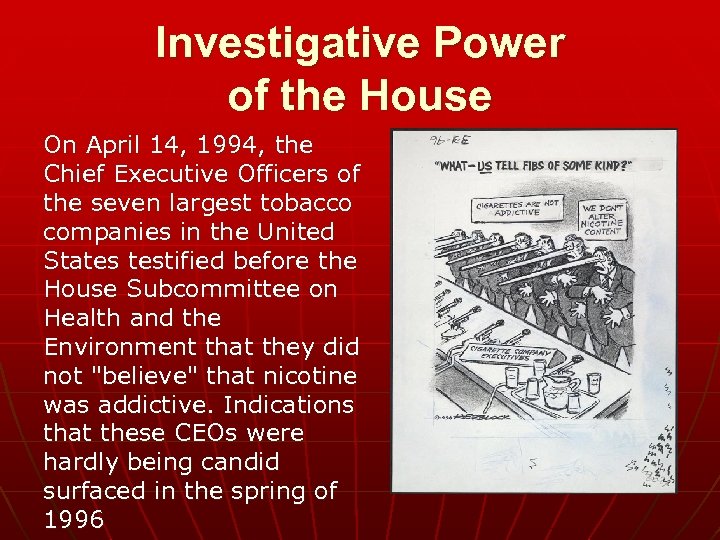 Investigative Power of the House On April 14, 1994, the Chief Executive Officers of the seven largest tobacco companies in the United States testified before the House Subcommittee on Health and the Environment that they did not "believe" that nicotine was addictive. Indications that these CEOs were hardly being candid surfaced in the spring of 1996
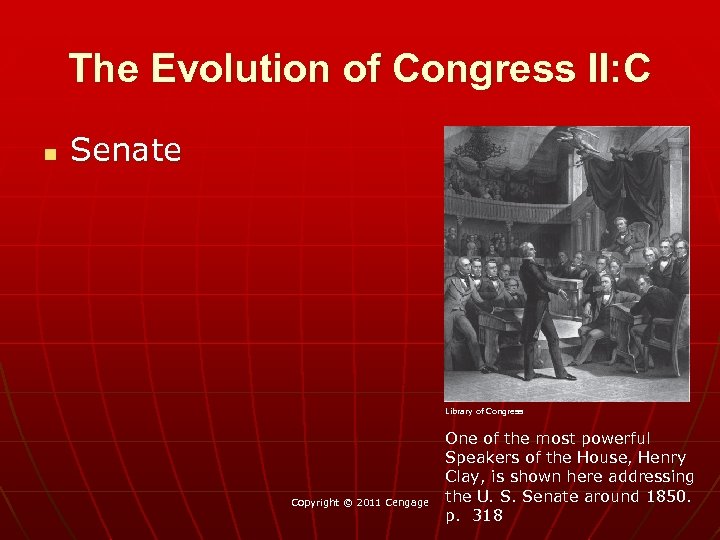 The Evolution of Congress II: C n Senate Library of Congress Copyright © 2011 Cengage One of the most powerful Speakers of the House, Henry Clay, is shown here addressing the U. S. Senate around 1850. p. 318
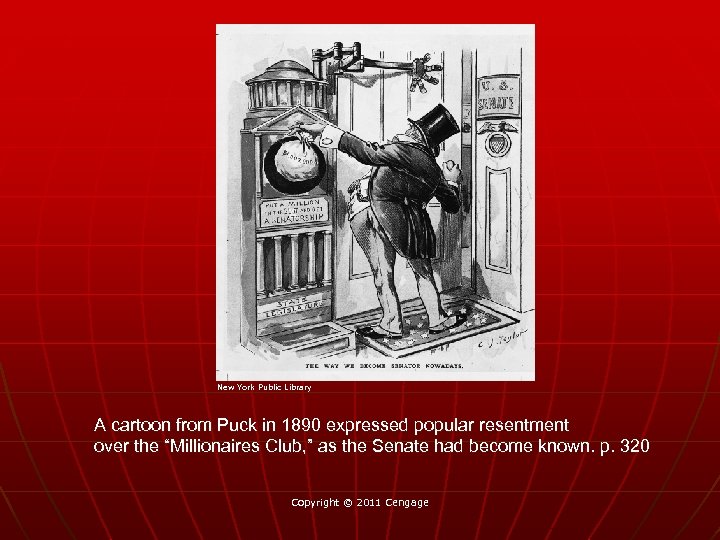 New York Public Library A cartoon from Puck in 1890 expressed popular resentment over the “Millionaires Club, ” as the Senate had become known. p. 320 Copyright © 2011 Cengage
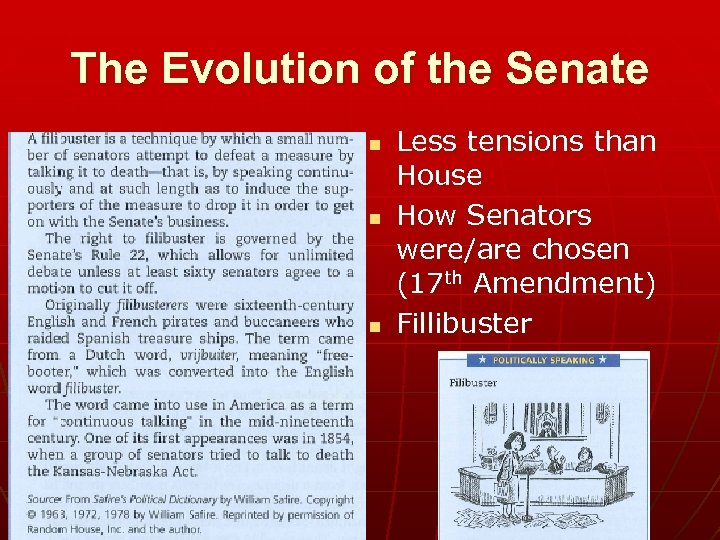 The Evolution of the Senate n n n Less tensions than House How Senators were/are chosen (17 th Amendment) Fillibuster
 Senate Powers n n n Presidential appointment confirmation – Senate must approve Foreign Treaty approval – Must approve Presidential treaty by 2/3 vote Senate acts as an investigative unit Senate acts as a judicial court Senate tries individuals charged by the House (Impeachment)
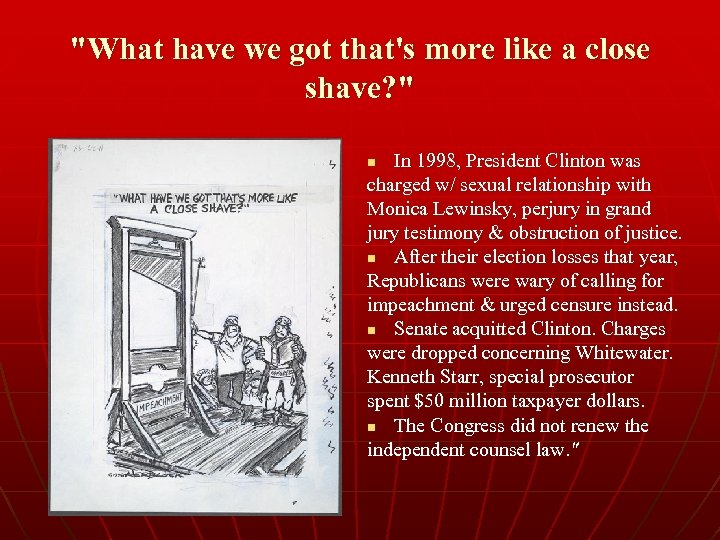 "What have we got that's more like a close shave? " In 1998, President Clinton was charged w/ sexual relationship with Monica Lewinsky, perjury in grand jury testimony & obstruction of justice. n After their election losses that year, Republicans were wary of calling for impeachment & urged censure instead. n Senate acquitted Clinton. Charges were dropped concerning Whitewater. Kenneth Starr, special prosecutor spent $50 million taxpayer dollars. n The Congress did not renew the independent counsel law. " n
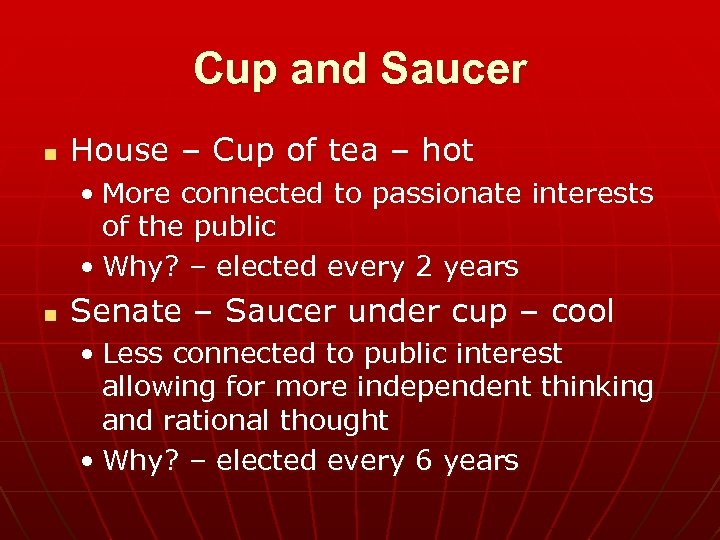 Cup and Saucer n House – Cup of tea – hot • More connected to passionate interests of the public • Why? – elected every 2 years n Senate – Saucer under cup – cool • Less connected to public interest allowing for more independent thinking and rational thought • Why? – elected every 6 years
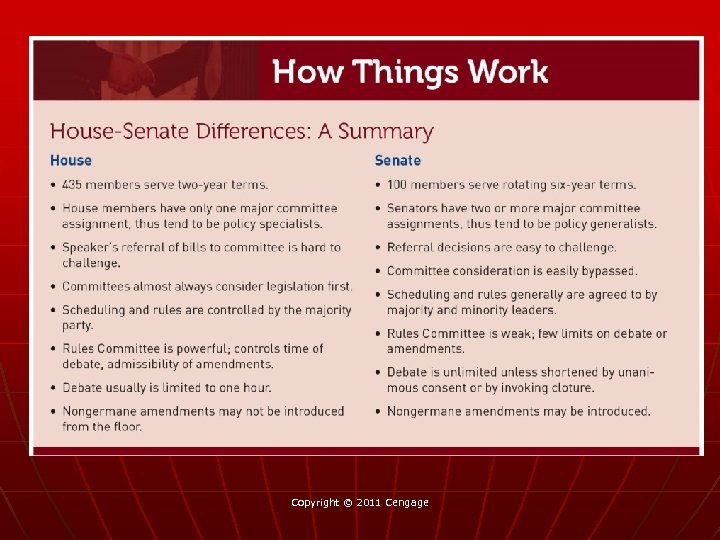
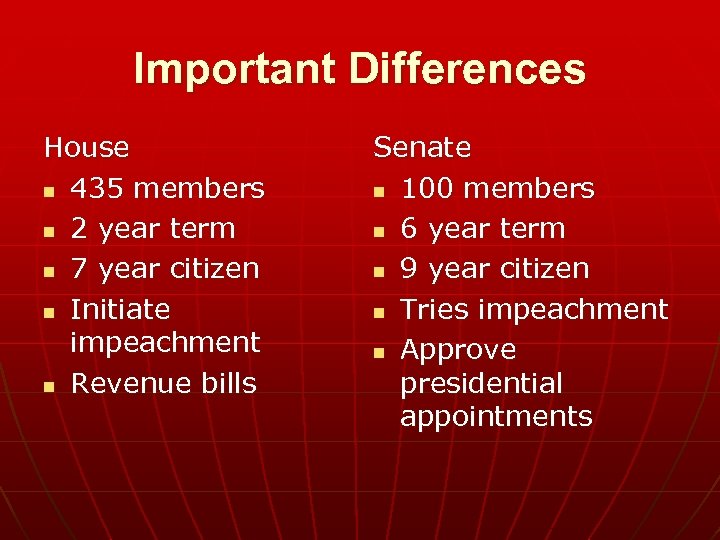 Important Differences House n 435 members n 2 year term n 7 year citizen n Initiate impeachment n Revenue bills Senate n 100 members n 6 year term n 9 year citizen n Tries impeachment n Approve presidential appointments
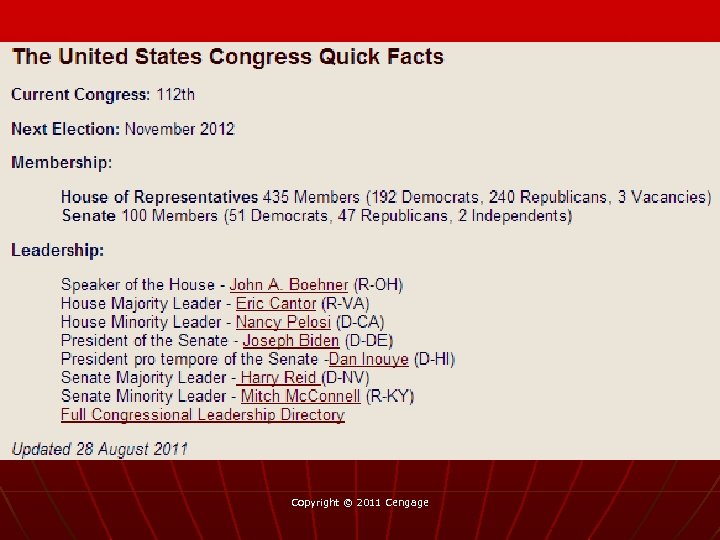
 Leadership n n n Political parties very important Majority vs. Minority Majority party controls holds the most significant leadership positions
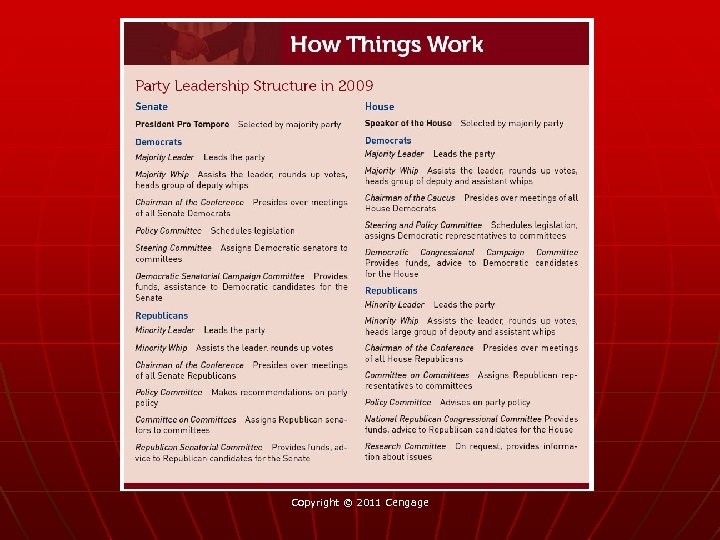
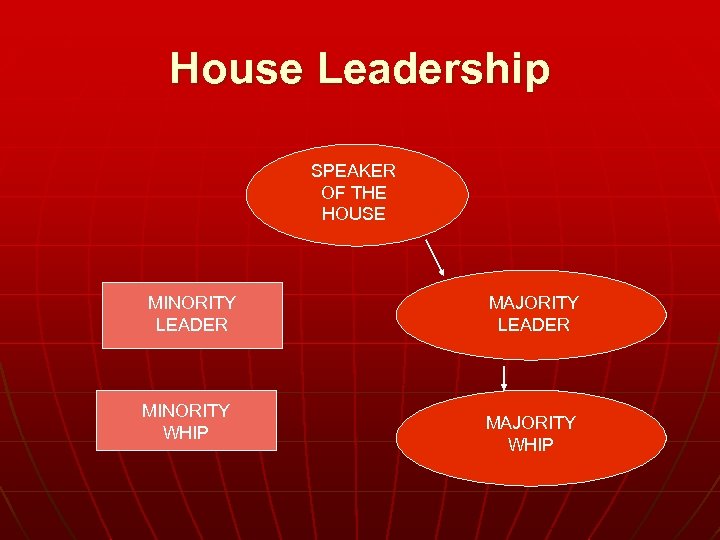 House Leadership SPEAKER OF THE HOUSE MINORITY LEADER MINORITY WHIP MAJORITY LEADER MAJORITY WHIP
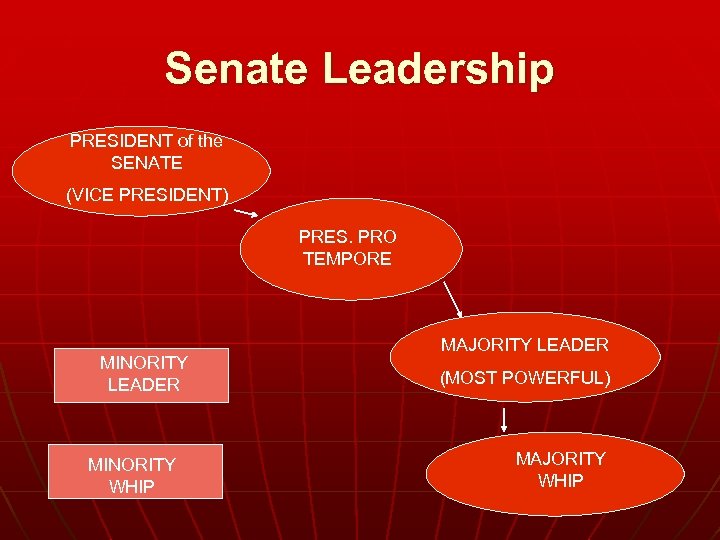 Senate Leadership PRESIDENT of the SENATE (VICE PRESIDENT) PRES. PRO TEMPORE MINORITY LEADER MINORITY WHIP MAJORITY LEADER (MOST POWERFUL) MAJORITY WHIP
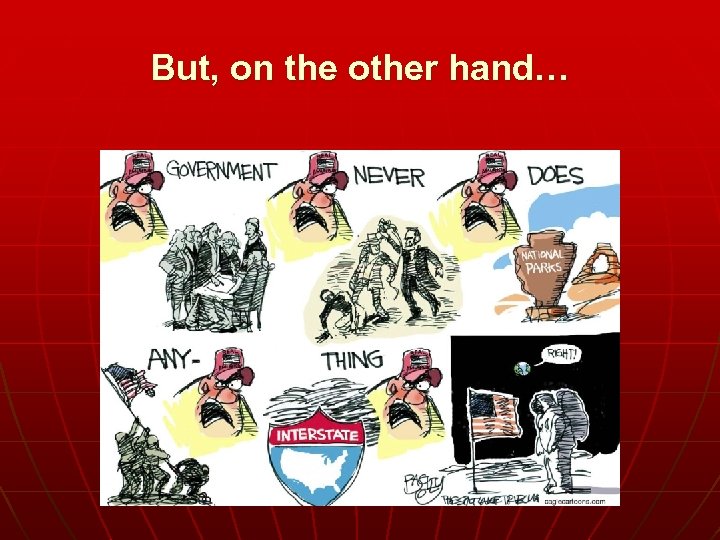 But, on the other hand…
 Who is in Congress? III: A-D n n Sex and Race Incumbency • Marginal districts • Safe districts Copyright © 2011 Cengage
 Copyright © 2011 Cengage
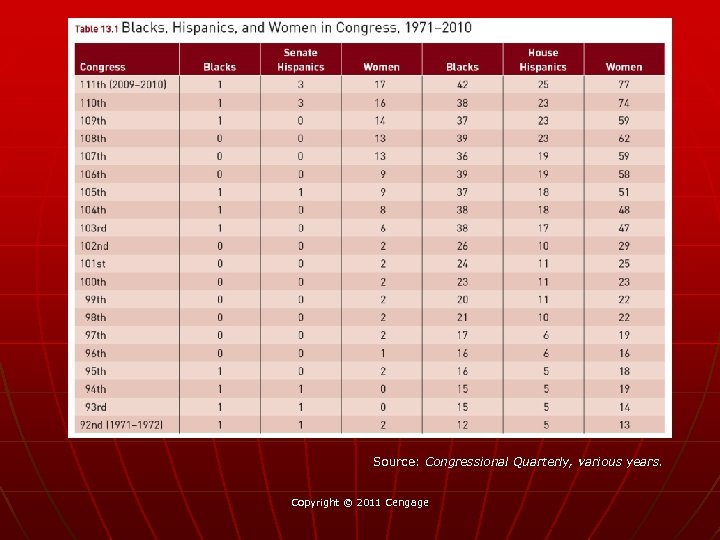 Source: Congressional Quarterly, various years. Copyright © 2011 Cengage
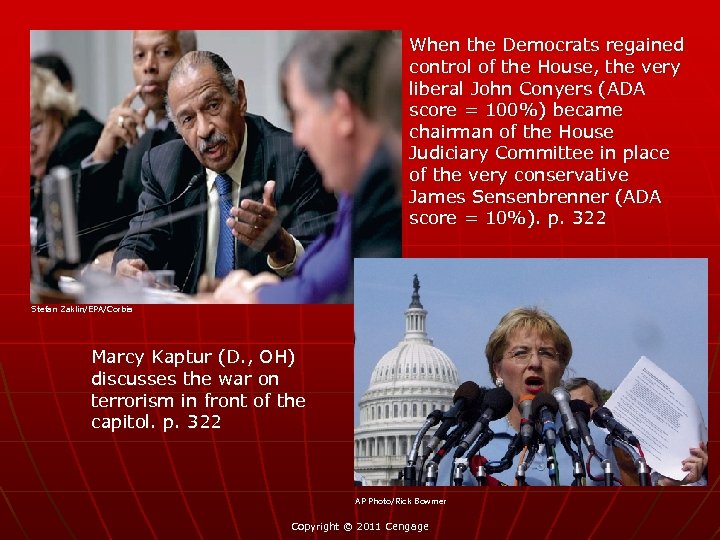 When the Democrats regained control of the House, the very liberal John Conyers (ADA score = 100%) became chairman of the House Judiciary Committee in place of the very conservative James Sensenbrenner (ADA score = 10%). p. 322 Stefan Zaklin/EPA/Corbis Marcy Kaptur (D. , OH) discusses the war on terrorism in front of the capitol. p. 322 AP Photo/Rick Bowmer Copyright © 2011 Cengage
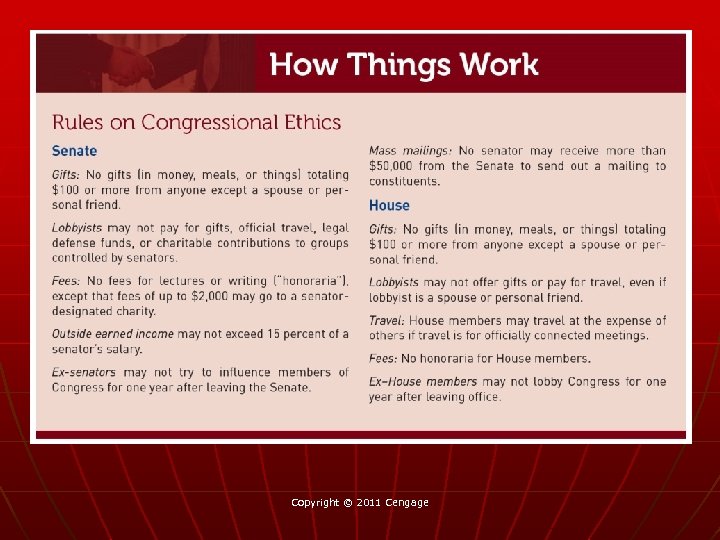
 Advantage: Incumbents III: C: 3 n n n Career politicians, office holders in elections Name recognition Franking privileges – free mailing
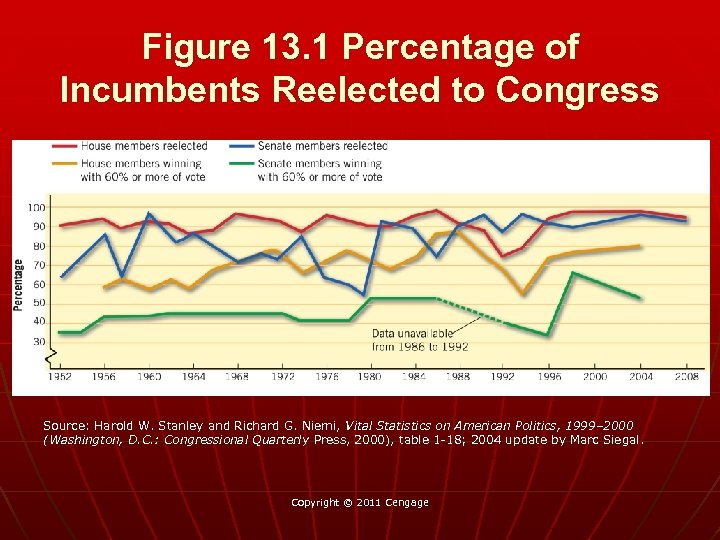 Figure 13. 1 Percentage of Incumbents Reelected to Congress Source: Harold W. Stanley and Richard G. Niemi, Vital Statistics on American Politics, 1999– 2000 (Washington, D. C. : Congressional Quarterly Press, 2000), table 1 -18; 2004 update by Marc Siegal. Copyright © 2011 Cengage
 Party III: D: 1 -4 n n Dems beneficiaries of incumbency Gap between votes and seats Electoral convulsions do periodically alter membership Conservative coalition of southern Democrats and Republicans has less influence. Copyright © 2011 Cengage
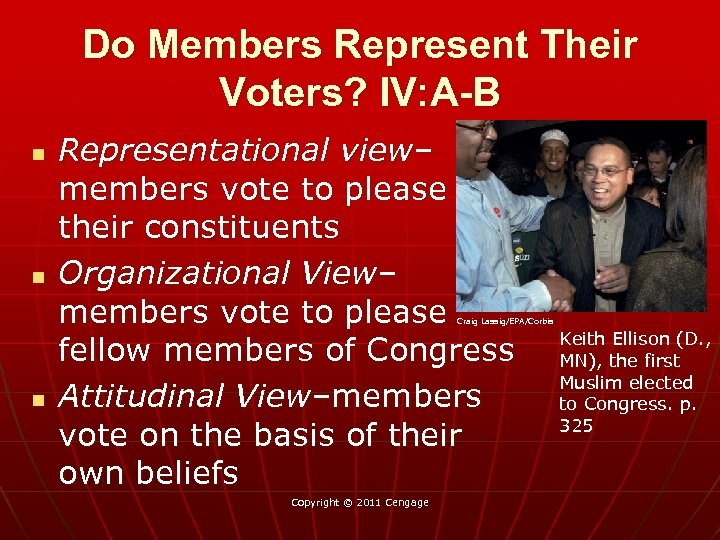 Do Members Represent Their Voters? IV: A-B n n Representational view– members vote to please their constituents Organizational View– members vote to please fellow members of Congress Attitudinal View–members vote on the basis of their own beliefs Craig Lassig/EPA/Corbis n Copyright © 2011 Cengage Keith Ellison (D. , MN), the first Muslim elected to Congress. p. 325
 Representatives of the People Senators and representatives are elected to represent people. As legislators, they have four voting options: n Trustees believe that each question they face must be decided on its merits. • (DW) Conscience and independent judgment are their guides to make decisions regardless of the beliefs of the constituency. n Delegates see themselves as agents of the people who elected them, AKA the constituency. • (DW) They vote they way they think “folks back home would vote”.
 n Partisans are lawmakers who owe their first allegiance to their political party. • (DW) They feel duty bound to vote in line with the party platform and the wishes of their party’s leaders. n Politicos attempt to combine the basic elements of the trustee, delegate, and partisan roles. • (DW) They understand the duel roles of congress and know how to play the game.
 A Polarized Congress IV: C n n A more ideological perspective has been brought to Congress’ most liberal members are Democrats. Congress’ most conservative members are Republicans. Voters are closer to the center of political spectrum. Copyright © 2011 Cengage
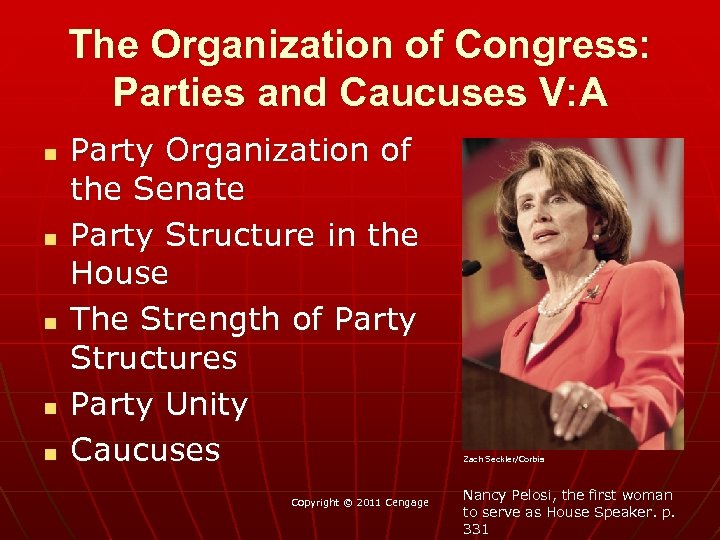 The Organization of Congress: Parties and Caucuses V: A n n n Party Organization of the Senate Party Structure in the House The Strength of Party Structures Party Unity Caucuses Copyright © 2011 Cengage Zach Seckler/Corbis Nancy Pelosi, the first woman to serve as House Speaker. p. 331
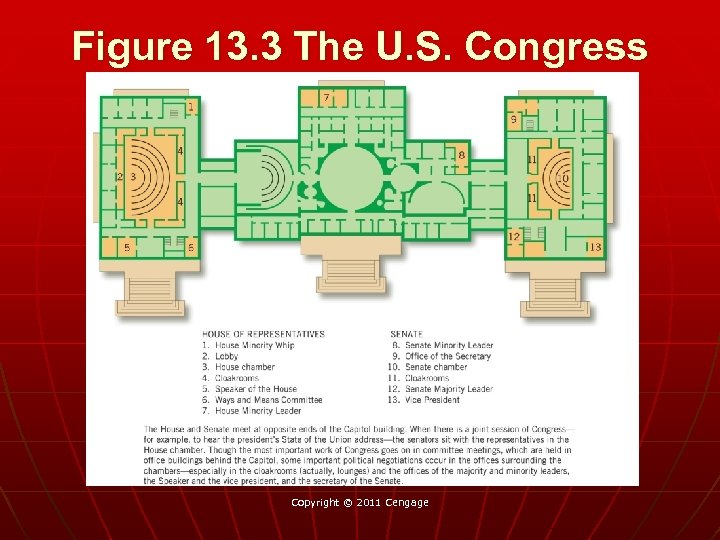 Figure 13. 3 The U. S. Congress Copyright © 2011 Cengage
 Copyright © 2011 Cengage
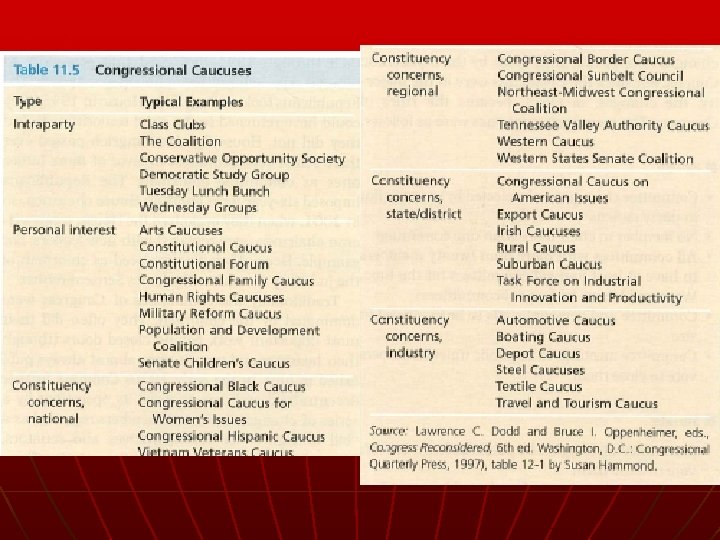
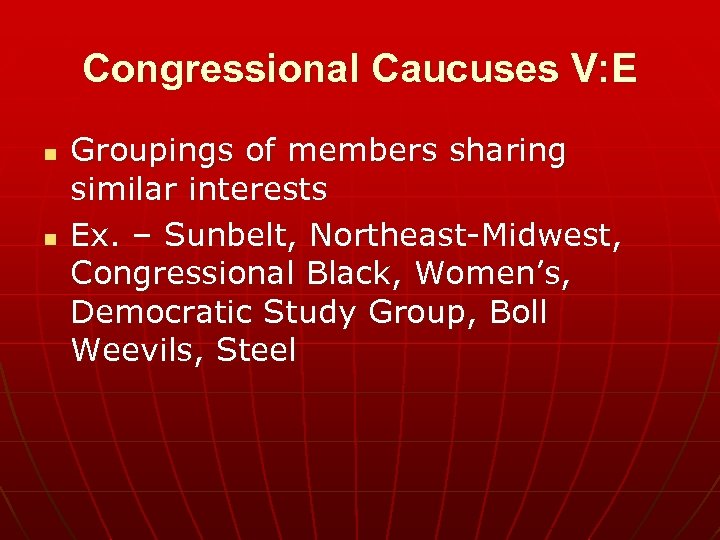 Congressional Caucuses V: E n n Groupings of members sharing similar interests Ex. – Sunbelt, Northeast-Midwest, Congressional Black, Women’s, Democratic Study Group, Boll Weevils, Steel
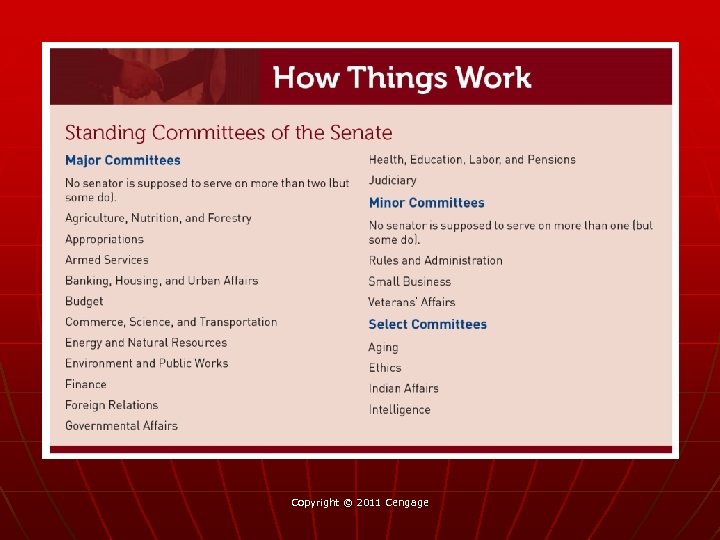
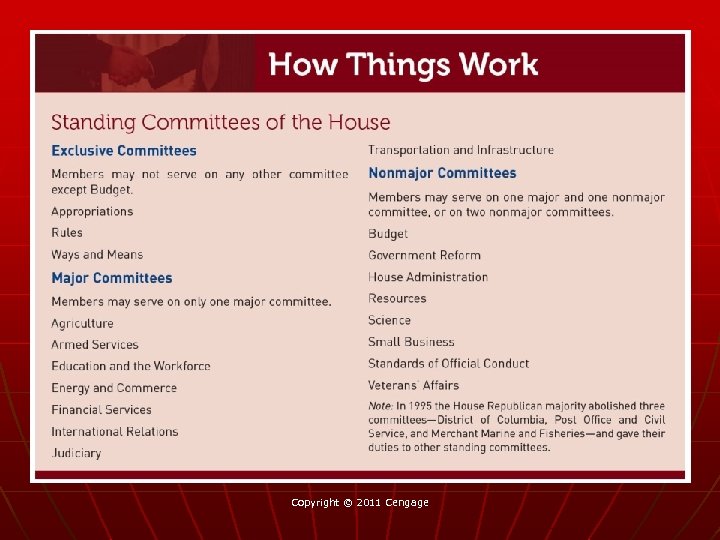
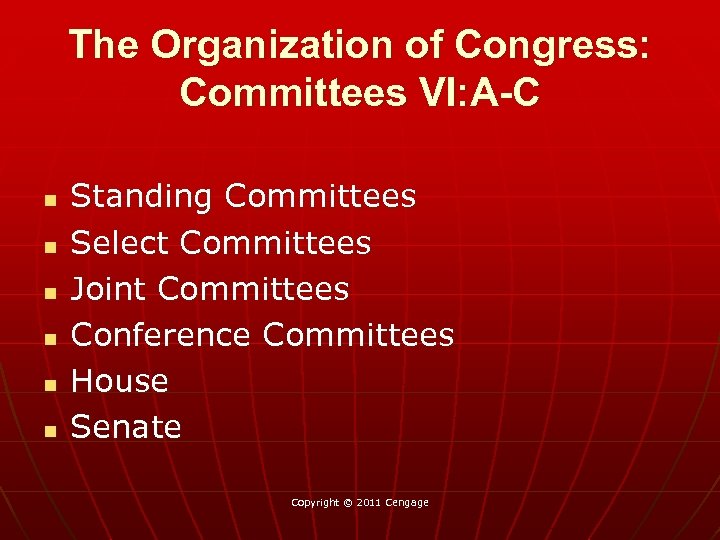 The Organization of Congress: Committees VI: A-C n n n Standing Committees Select Committees Joint Committees Conference Committees House Senate Copyright © 2011 Cengage
 Copyright © 2011 Cengage
 Copyright © 2011 Cengage
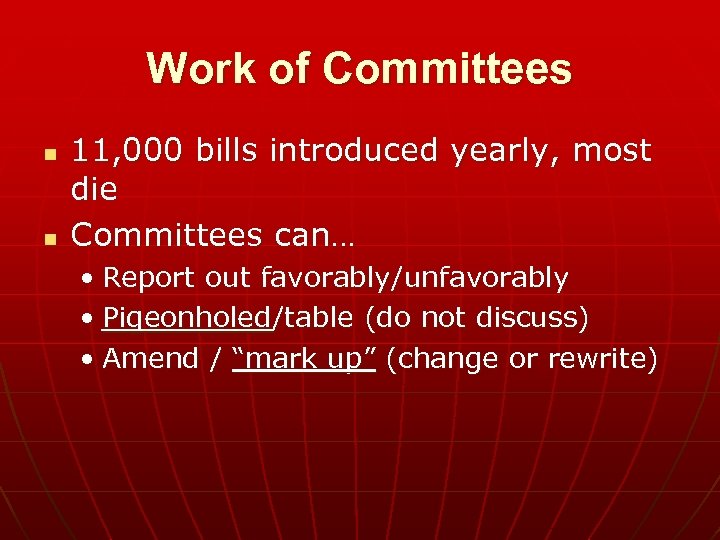 Work of Committees n n 11, 000 bills introduced yearly, most die Committees can… • Report out favorably/unfavorably • Pigeonholed/table (do not discuss) • Amend / “mark up” (change or rewrite)
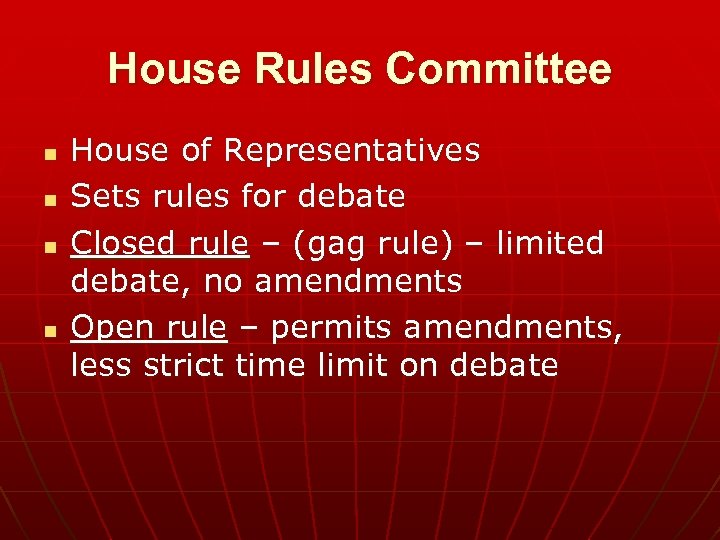 House Rules Committee n n House of Representatives Sets rules for debate Closed rule – (gag rule) – limited debate, no amendments Open rule – permits amendments, less strict time limit on debate
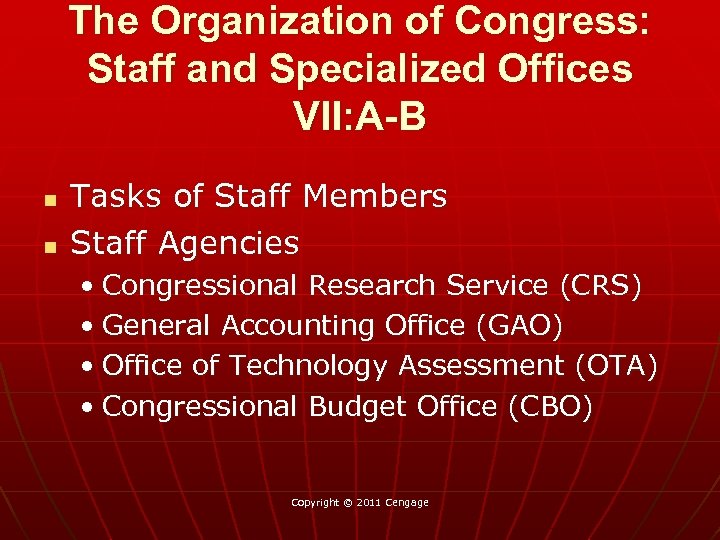 The Organization of Congress: Staff and Specialized Offices VII: A-B n n Tasks of Staff Members Staff Agencies • Congressional Research Service (CRS) • General Accounting Office (GAO) • Office of Technology Assessment (OTA) • Congressional Budget Office (CBO) Copyright © 2011 Cengage
 How a Bill Becomes a Law VIII n n n Introducing a Bill Legislative Productivity Study by Committee Floor Debate – The House Floor Debate – The Senate Methods of Voting Copyright © 2011 Cengage
 Federalist 53 Copyright © 2011 Cengage
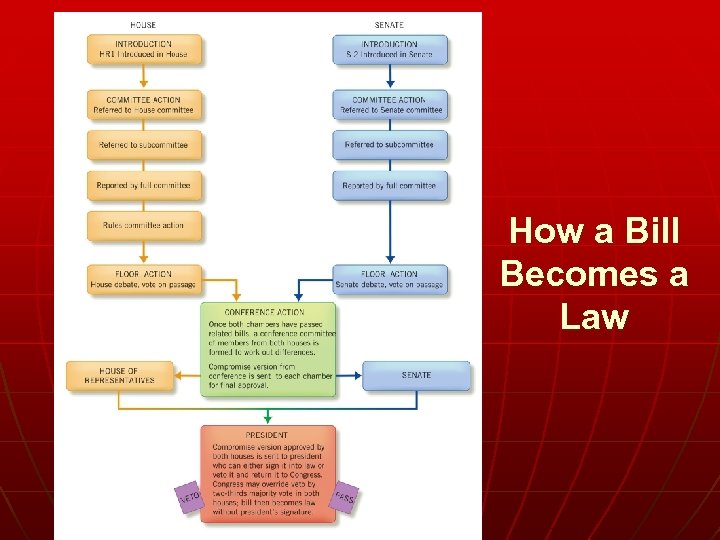
 How A Bill Becomes a Law • Create legislation, make laws • Founders believed in a SLOW process • Founders believed efficiency was a trait of an oppressive government
 Step 1 – Introduce Bill VII: B n n Introduced in Senate or House (except tax) Single or multiple reps can introduce bill
 Step 2 – Committee VII: C n n Bill is assigned to a particular committee in its category (Ex. Tax bill – Ways and Means Committee, Farm bill – Agriculture Committee) Most bills die in committee
 Step 3–Rules Committee n Before bill can go to floor in House, it must first set time limits and amendment regulations.
 Step 4 – Floor Debate VII: D, E Senate Debate n Less formal, no speaking limit n Filibuster – practice of talking a bill to death n Cloture – 3/5 of the Senate vote to stop debate House Debate n More formal, no filibuster, strict rules
 The “Nuclear Option” n n n In 2005, Bush trying to nominate judges to Supreme Court Dems filibustered nominee debate as position remained unfulfilled GOP threatened to change Senate rules to make filibuster illegal
 Step 5 – Voting VII: F n n Majority passes If the bill passes, it must go through the same process in the opposite chamber with a sponsor If the bill passes one house and fails the other, it must start over If the Senate and House cannot come to agreement over two versions, it goes to Conference Committee to fix it and resubmit the bill
 Presidential Action n n Sign – bill becomes law Veto – bill returns to origin Override – 2/3 vote in both houses can override veto Pocket Veto – President has 10 days to act on a piece of legislation. If he receives the bill within 10 days of the end of the Congressional session, and doesn’t sign, it dies
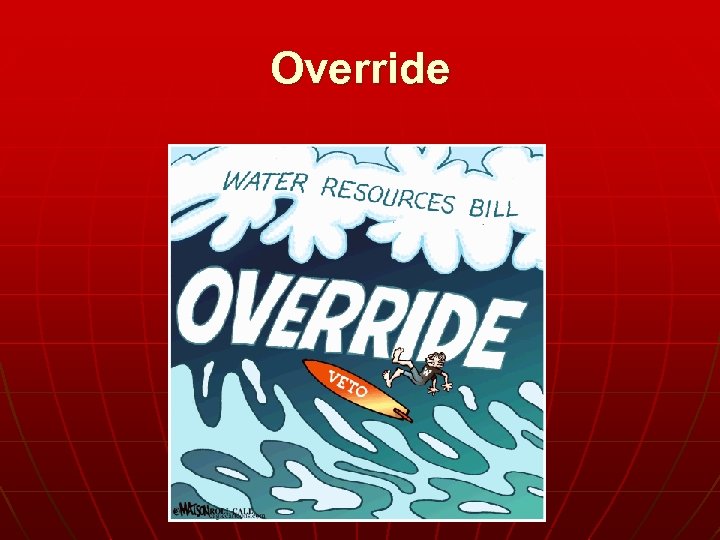 Override
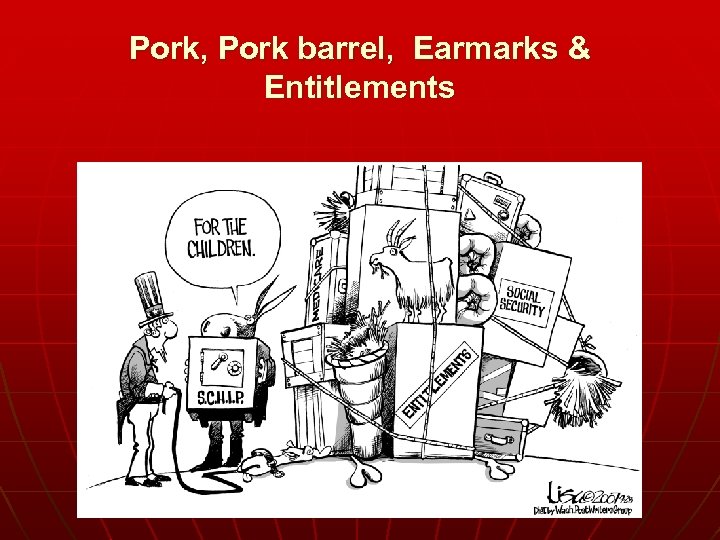 Pork, Pork barrel, Earmarks & Entitlements
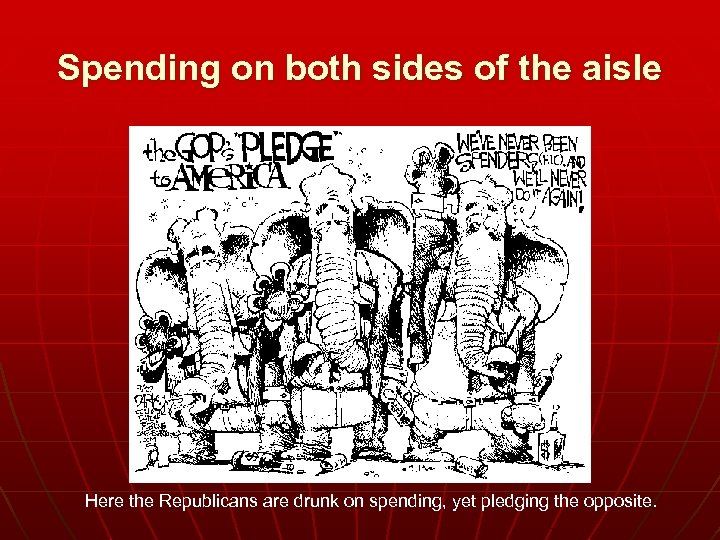 Spending on both sides of the aisle Here the Republicans are drunk on spending, yet pledging the opposite.
 Criticisms of Congress n n n “Pork” – aka “pork-barrel legislation” – bills to benefit constituents in hope of gaining their votes Logrolling – Congress members exchange votes, bills might pass for frivolous reasons Christmas-tree bill –bill with many riders (pork) • in Senate, no limit exists on amendments, so Senators try to attach riders that will
 Criticisms of Congress n Revolving Door – the growing problem of members of Congress becoming lobbiests once they have left office They know how to negotiate the “red tape”, they have friends still in Congress and they understand how the government works, so they know the short cuts.
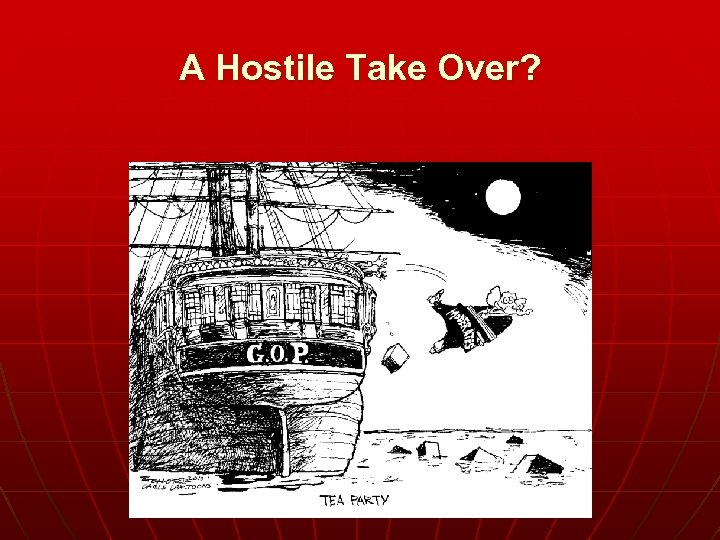 A Hostile Take Over?
 Term-limits Debate n 1. 2. No current limit on how many terms members of Congress can serve Some argue this has weakened popular control of Congress, reps might be unresponsive to their constituents Some argue most experienced reps have the expertise to bring home more benefits (pork, riders, etc. )
 How a Bill Becomes a Law Copyright © 2011 Cengage
 Copyright © 2011 Cengage
 Copyright © 2011 Cengage
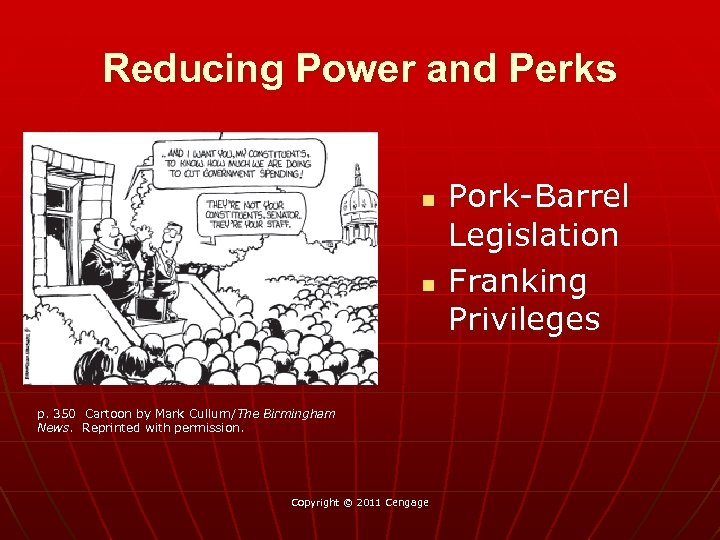 Reducing Power and Perks n n p. 350 Cartoon by Mark Cullum/The Birmingham News. Reprinted with permission. Copyright © 2011 Cengage Pork-Barrel Legislation Franking Privileges
 Copyright © 2011 Cengage
 Copyright © 2011 Cengage
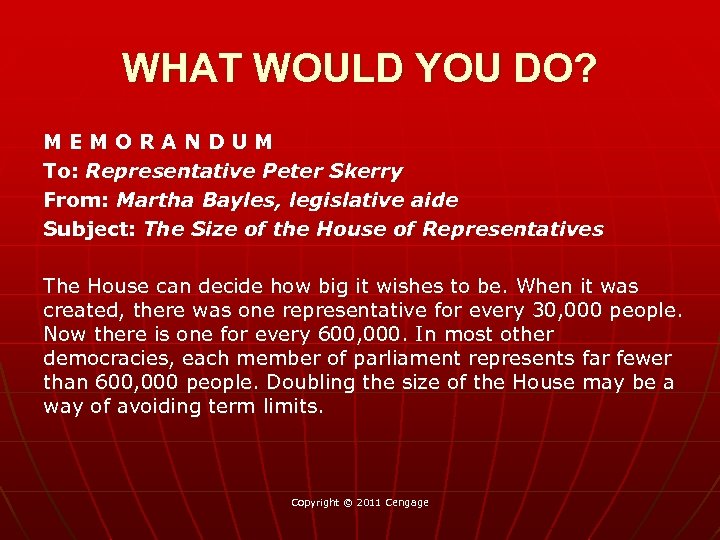 WHAT WOULD YOU DO? MEMORANDUM To: Representative Peter Skerry From: Martha Bayles, legislative aide Subject: The Size of the House of Representatives The House can decide how big it wishes to be. When it was created, there was one representative for every 30, 000 people. Now there is one for every 600, 000. In most other democracies, each member of parliament represents far fewer than 600, 000 people. Doubling the size of the House may be a way of avoiding term limits. Copyright © 2011 Cengage
 WHAT WOULD YOU DO? Arguments for: 1. Doubling the size of the House would reduce the huge demand for constituent services each member now faces. 2. A bigger House would represent more shades of opinion more fairly. 3. Each member could raise less campaign money because his or her campaign would be smaller. Copyright © 2011 Cengage
 WHAT WOULD YOU DO? Arguments against: 1. A bigger House would be twice as hard to manage, and it would take even longer to pass legislation. 2. Campaigns in districts of 300, 000 people would cost as much as ones in districts with 600, 000 people. 3. Interest groups do a better job of representing public opinion than would a House with more members. Copyright © 2011 Cengage
 WHAT WOULD YOU DO? Your decision: Increase size of House? Do not increase size of House? Copyright © 2011 Cengage