


 Скачать презентацию Chapter 10 Cognition and Language What is
1c4ff231cf83860b7e1b5969053e9607.ppt
- Количество слайдов: 39
 Chapter 10 Cognition and Language
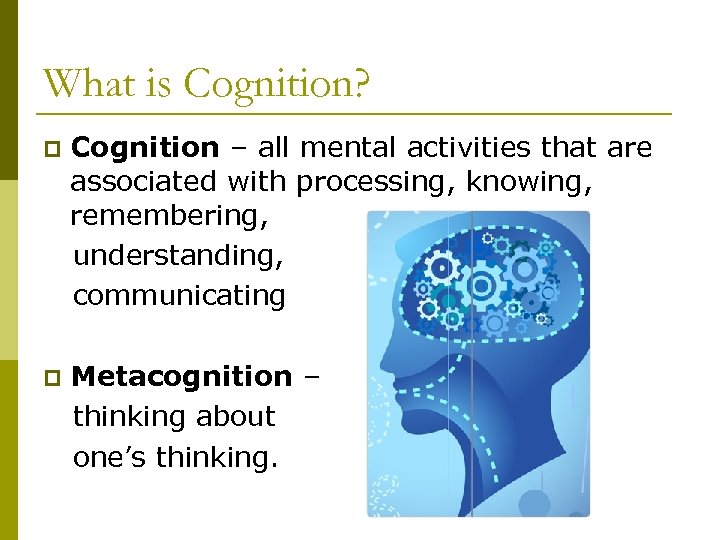 What is Cognition? Cognition – all mental activities that are associated with processing, knowing, remembering, understanding, communicating p Metacognition – thinking about one’s thinking. p
 Metacognition p Q. During what stage of Piaget’s cognitive development would one be in if they are able to engage in metacognition.
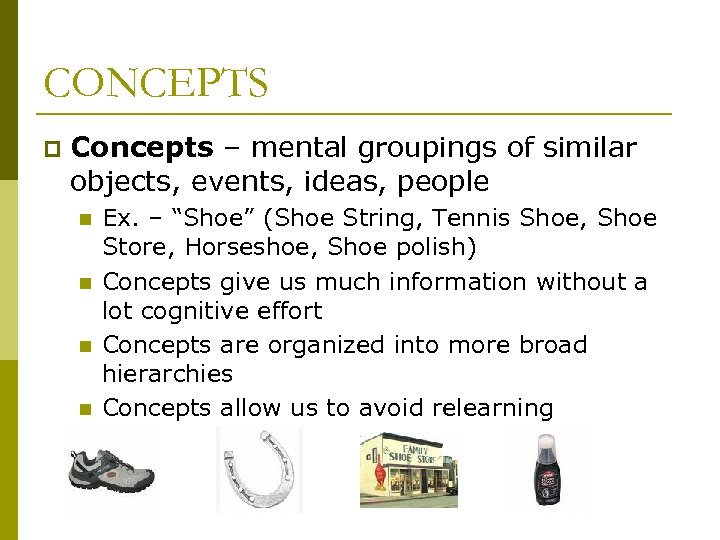 CONCEPTS p Concepts – mental groupings of similar objects, events, ideas, people n n Ex. – “Shoe” (Shoe String, Tennis Shoe, Shoe Store, Horseshoe, Shoe polish) Concepts give us much information without a lot cognitive effort Concepts are organized into more broad hierarchies Concepts allow us to avoid relearning
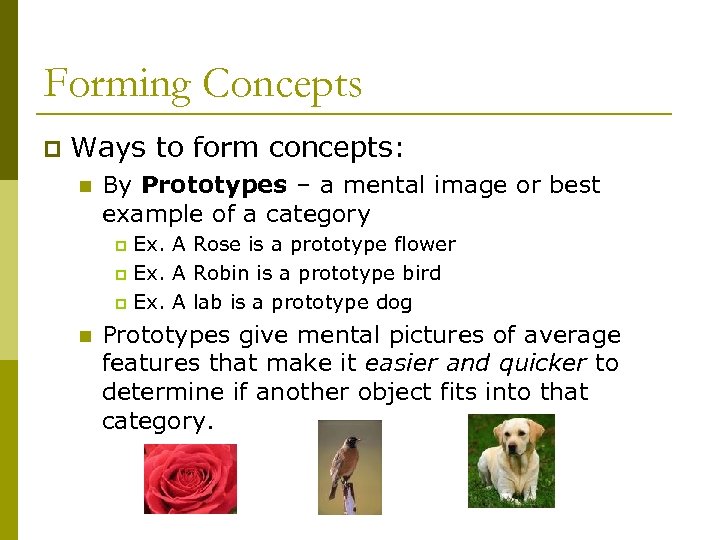 Forming Concepts p Ways to form concepts: n By Prototypes – a mental image or best example of a category Ex. A Rose is a prototype flower p Ex. A Robin is a prototype bird p Ex. A lab is a prototype dog p n Prototypes give mental pictures of average features that make it easier and quicker to determine if another object fits into that category.
 PROBLEM SOLVING p Algorithm – a step-by-step procedure or logical rule that guarantees solving a particular problem Algorithms oftentimes consume large amounts of time n Ex. Unscrambling the word SPLOYOCHYG you place each letter in every possible position. n Ex. Solving 10 x 2 can be determined by adding 2 + 2 + 2 + 2 n Ex. Computer chess may use algorithms to determine its next move n How could you use an algorithm to find toothpicks at Harris Teeter? n
 PROBLEM SOLVING p Heuristic – a simple thinking strategy (rule of thumb, shortcut) that often allows us to make judgments and solve problems efficiently. Heuristics are speedier but also more error prone than algorithms Ex. Unscramble the word SPLOYOCHYG but eliminating various possibilities like placing the two Ys Together n Ex. Work backwards – hypothesize an answer and see what you find n How could you use a heuristic to find toothpicks at Harris Teeter? n
 Using/Misusing Heuristics could cause us to make quick /poor decisions. p Representative heuristic – judging the likelihood of things in terms of how well they seem to match particular prototypes. p n A person is short, slim and likes poetry? Would you guess that this person is an ivy league professor or a truck driver? (pg. 401)
 Using/Misusing Heuristics p Availability Heuristic – we base our judgments on the availability of information in our memories. We assume information and experiences that are readily available in our minds are common. n n n Do more words in the English language begin with k or have k as their third letter? (page 402) Availability heuristics can affect our social judgments 9/11, Virginia Tech/Columbine/Sandy Hook, Insurance agents, Politicians (Daisy commercial), presidential elections and the October surprise…Al Gore 2000. . DWI, John
 PROBLEM SOLVING p p During problem solving we often experience insight… Insight – a sudden realization of the solutions to a problem (Aha. . ) n Insight contrasts with strategy based solutions. – The answer just comes to us!
 Obstacles to Problem Solving sometimes we are mislead as we search for solutions to problems p Confirmation Bias – tendency to search for information that confirms our preconceptions p n Peter Wason’s Confirmation Bias experiment Pg. 399 – Can you guess the rule? 2 – 4 – 6 p Give more examples that confirm your hypothesis p The actual rule…. Any three ascending numbers p
 Confirmation Bias in American Life p Ex. Watching MSNBC (Progressives)OR FOX News (Conservatives)strengthens this obstacle to problem (truth seeking) solving. Media watchdog groups find misinformation or disinformation all the time within these networks.
 Confirmation Bias and the decision to invade Iraq p US launched war in Iraq on false assumption that they had Weapons of Mass Destruction (WMD). A bipartisan committee found that the officials that made the decision to go to war “had a tendency to accept information which supported their assumption more readily than information which contradicted that”.
 Obstacles to Problem Solving p Fixation – the inability to see a problem from a new perspective n Using a box of matches, thumbtacks, and a candle – think of how to mount the candle on a bulletin board. The candle must be able to be lit in a certain way without falling over
 Obstacles to Problem Solving p Mental Set – continuing to use problem solving strategies that have worked in the past rather than trying new ones. n n O-T-T-F…. what are the next 3 letters? F (Five), S(Six), S(Seven) Try this one… J-F-M-A. what are the next 3 letters? (M, J, J)
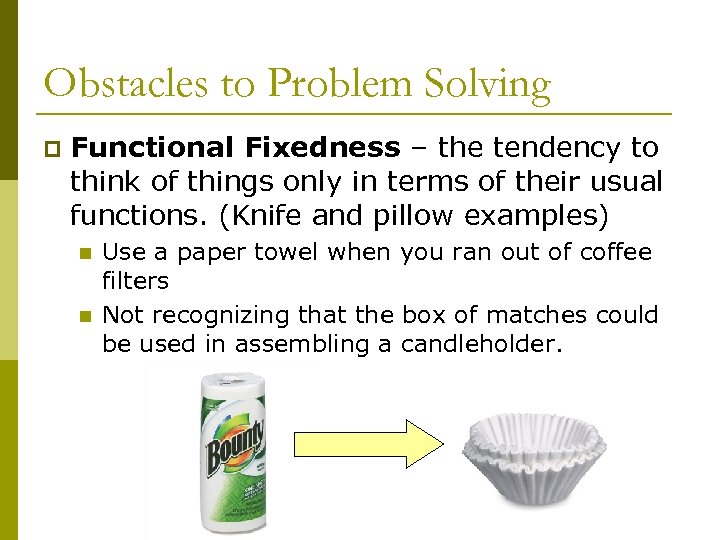 Obstacles to Problem Solving p Functional Fixedness – the tendency to think of things only in terms of their usual functions. (Knife and pillow examples) n n Use a paper towel when you ran out of coffee filters Not recognizing that the box of matches could be used in assembling a candleholder.
 Availability Heuristic Activity p Crime rates and cause of death activity
 We have the tendency to be overconfident… – our tendency to overestimate the accuracy of our knowledge and judgments p One of the causes of Stock Markets crashes of 1929 and 2007. People that speculate on the Stock Market are more likely to be arrogant and overconfident. p Overconfident people are looked up to in society but should be viewed with skepticism as they are more wrong than they think p
 Framing p Framing – the way an issue is posed Framing can greatly affect our decisions and judgments. n Ex. Which ground beef would you most likely buy – 75% lean or 25% fat? n Q. Are you in favor of death panels that decide whether or not grandma lives or dies. Politicians frame issues in a way that manipulates voters minds all the time. Congressman that vote against background checks at gun shows are pre-death. n
 Framing p Bush Tax Cuts – 25% of our deficit comes from these cuts which almost exclusively were given to those in top 1% of wealth. Tax Cuts expired 3 years ago. Obama extended them backed by 100% Republicans. “extend the tax cuts” OR “ 800 Billion dollar spending package”. p NC income tax cuts from 7% to 5. 25%. Many tax “breaks for middle and lower income people were removed”. Our tax accountant says, “most lower and middle income people are paying a bit more”. . most upper class taxpayers are paying less.
 Belief Bias
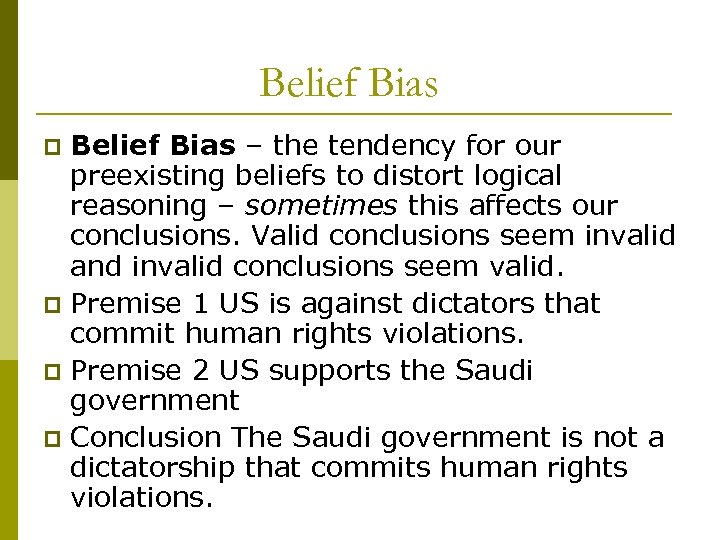 Belief Bias – the tendency for our preexisting beliefs to distort logical reasoning – sometimes this affects our conclusions. Valid conclusions seem invalid and invalid conclusions seem valid. p Premise 1 US is against dictators that commit human rights violations. p Premise 2 US supports the Saudi government p Conclusion The Saudi government is not a dictatorship that commits human rights violations. p
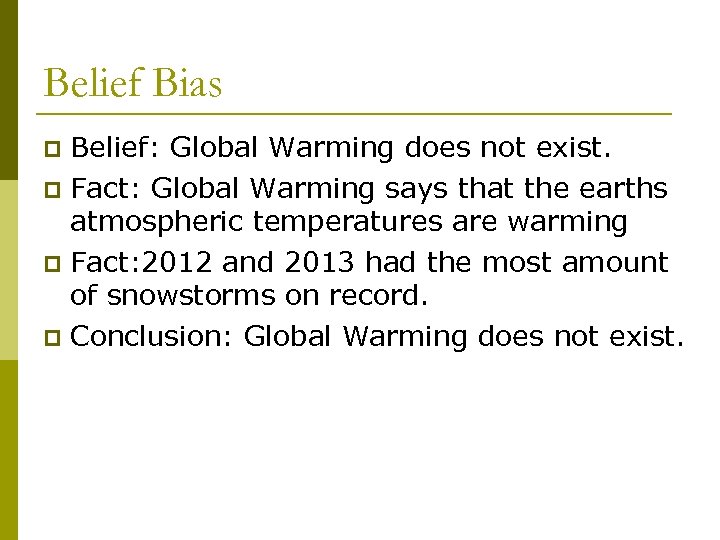 Belief Bias Belief: Global Warming does not exist. p Fact: Global Warming says that the earths atmospheric temperatures are warming p Fact: 2012 and 2013 had the most amount of snowstorms on record. p Conclusion: Global Warming does not exist. p
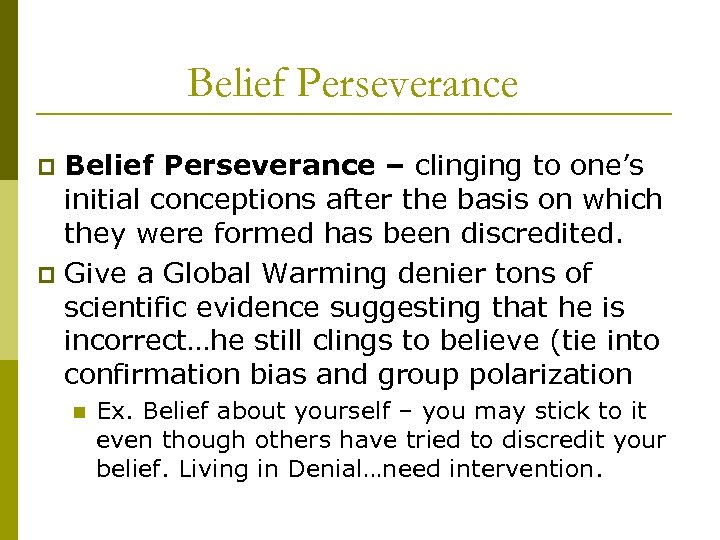 Belief Perseverance – clinging to one’s initial conceptions after the basis on which they were formed has been discredited. p Give a Global Warming denier tons of scientific evidence suggesting that he is incorrect…he still clings to believe (tie into confirmation bias and group polarization p n Ex. Belief about yourself – you may stick to it even though others have tried to discredit your belief. Living in Denial…need intervention.
 Belief Perserverance n n Ex. Parents that believe that there child is a lot smarter than they really are. As one ages they have difficulty adapting to a changing world.
 Ethnocentrism The belief that one’s nation and/or culture is superior to all others p View Human Experience- Video # 32? p Ethnocentrism can distort our judgments of world events. Americans rank high in the ethnocentrism scale. p p
 Causes of Americans high degree of Ethnocentrism p Media (TV, movies and news) bias Q: Explain how this might take place? Glorification of our history in textbooks. (views of negative historical events like the invasions of Vietnam or Panama or the internment of Japanese-Americans). p p
 American Ethnocentrism p Normative Social Influence (desire for social approval). Not being ethnocentric is interpreted by some people as being anti-American or antipatriotic. Example includes those opposed to the Iraq war. p Lack of Proximity to other cultures/nations increase ignorance which is correlated with ethnocentrism. Example rural
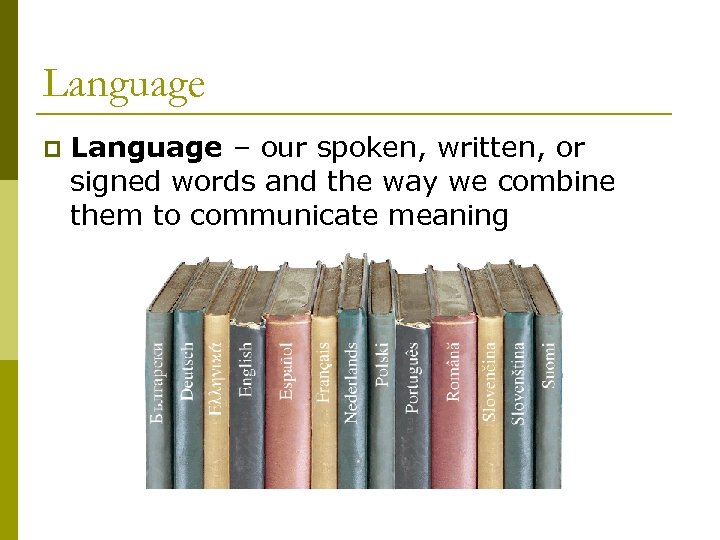 Language p Language – our spoken, written, or signed words and the way we combine them to communicate meaning
 Components of Language p Phonemes – the smallest distinctive sound unit in spoken language n n n English language has about 40 See phoneme handout Changes in phonemes = changes in meaning Ex. Wall, Well, Will p But in and of themselves, phonemes do not mean anything p
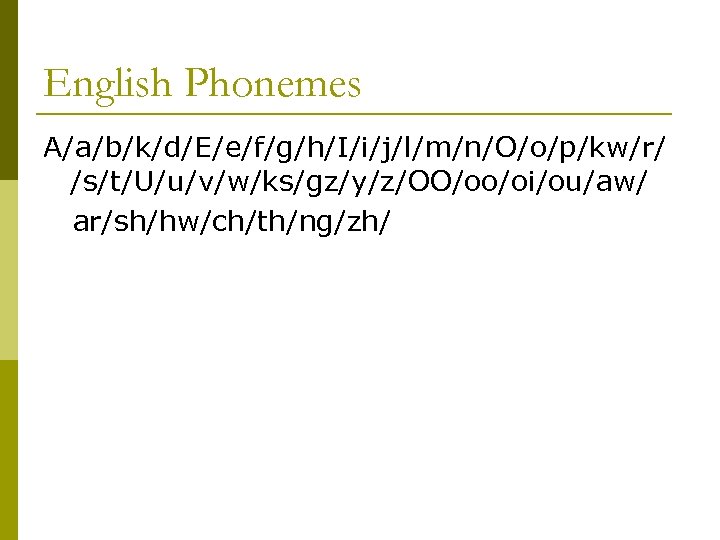 English Phonemes A/a/b/k/d/E/e/f/g/h/I/i/j/l/m/n/O/o/p/kw/r/ /s/t/U/u/v/w/ks/gz/y/z/OO/oo/oi/ou/aw/ ar/sh/hw/ch/th/ng/zh/
 Components of Language p Morpheme – the smallest unit in language that carries meaning; may be a word or part of a word n In English, there are only a few phonemes that are also morphemes p n Ex. “A” or “I” A morpheme could be a complete word or part of a word (Prefix/Suffix) p Ex. “post” or “pre”, “ed” or “ing”
 Grammar – rules that enable communication n Semantics – set of rules by which we derive meaning from morphemes, words, and sentences Add –ed for the past tense p Limb – arm? Or a tree branch? p § Context can affect meaning n Syntax – the rules for combining words into grammatically sensible sentences. Ex. Adjectives before nouns p Ex. I am happy instead of Happy am I p
 Language Development p Children’s language development moves from simple to complex n By age 4 months – p Babbling stage – infants spontaneously utter sounds at age 3 -4 months § At first, these sounds are unlike household language § Cannot distinguish between Chinese babies babbling and English babies babbling § Nature vs. Nurture § Nature allows us to create consonant-vowel pairs (ma, da, goo, ba) § Nurture eventually molds our language § Eventually, babbling begins to resemble the household language
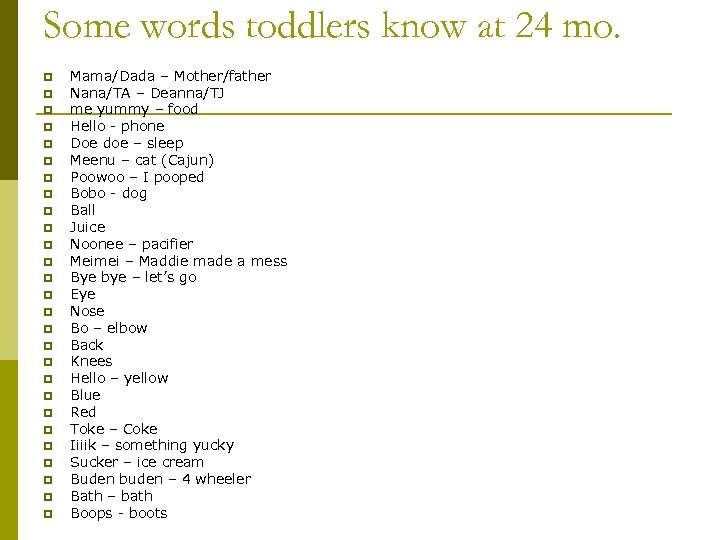 Some words toddlers know at 24 mo. p p p p p p p Mama/Dada – Mother/father Nana/TA – Deanna/TJ me yummy – food Hello - phone Doe doe – sleep Meenu – cat (Cajun) Poowoo – I pooped Bobo - dog Ball Juice Noonee – pacifier Meimei – Maddie made a mess Bye bye – let’s go Eye Nose Bo – elbow Back Knees Hello – yellow Blue Red Toke – Coke Iiiik – something yucky Sucker – ice cream Buden buden – 4 wheeler Bath – bath Boops - boots
 Language Development n n 10 months – phoneme sounds outside the infant’s household language begin to disappear One year old – child enters the one-word stage p n “juice” – I am thirsty Two years old – child enters the two-word stage (combination of a verb and noun) “want sleep” – I am ready to go to bed p Telegraphic speech – two word sentences that contain the most necessary words p n Older than two years old – begin to form complete sentences
 Explaining language development p BF Skinner – operant learning n Children learn to speak through imitation, association, and reinforcement Imitation – saying words as mom and dad say them p Association – associating sound with pictures p Reinforcement – hugs, smiles, high fives p
 Explaining language development p Noam Chomsky – language is almost entirely inborn, children are “prewired” to learn language n n n Children acquire untaught words and grammar rules quickly. Critical period and Learning a second language including muscle movements. Video – Scientific American Frontier – “Born to Talk” p Ex. – incorrectly adding –ed (Cindy hitted me) § Overgeneralization – the misapplication of grammar rules p Children have a Language Acquisition Device (LAD) that allows them to extract the basic rules of grammar. (aka language acquisition or the nativist
 Language and Thinking p Linguistic determinism hypothesis (aka linguistic relativity hypothesis)– Benjamin Whorf theorized that language can control or limit our thinking n n n Hopi Indians have no past tense verbs. This affects their ability to a Hopi’s ability the think in the past tense. English is a language of many self-focus emotions whereas Japanese has many words for interpersonal emotions (sympathy) Bilinguals report having a different sense of self when speaking two different languages