 Скачать презентацию Chapter 10 Binomial Option Pricing Copyright
cf5682ce402a0113f26c80dba01fc1b4.ppt
- Количество слайдов: 73



Chapter 10 • Binomial Option Pricing Copyright © 2009 Pearson Prentice Hall. All rights reserved.
Introduction to Binomial Option Pricing • Binomial option pricing enables us to determine the price of an option, given the characteristics of the stock or other underlying asset • The binomial option pricing model assumes that the price of the underlying asset follows a binomial distribution—that is, the asset price in each period can move only up or down by a specified amount • The binomial model is often referred to as the “Cox-Ross. Rubinstein pricing model” Copyright © 2009 Pearson Prentice Hall. All rights reserved. 2
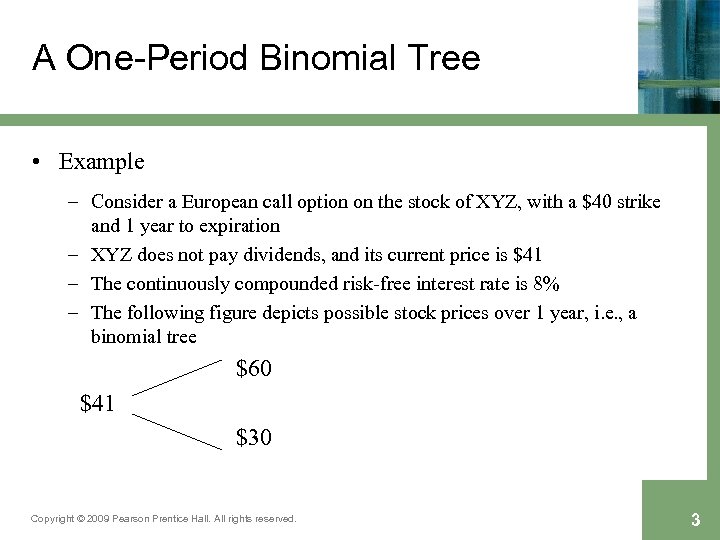
A One-Period Binomial Tree • Example – Consider a European call option on the stock of XYZ, with a $40 strike and 1 year to expiration – XYZ does not pay dividends, and its current price is $41 – The continuously compounded risk-free interest rate is 8% – The following figure depicts possible stock prices over 1 year, i. e. , a binomial tree $60 $41 $30 Copyright © 2009 Pearson Prentice Hall. All rights reserved. 3
Computing the Option Price • Next, consider two portfolios – Portfolio A: buy one call option – Portfolio B: buy 2/3 shares of XYZ and borrow $18. 462 at the risk-free rate • Costs – Portfolio A: the call premium, which is unknown – Portfolio B: 2/3 $41 – $18. 462 = $8. 871 Copyright © 2009 Pearson Prentice Hall. All rights reserved. 4
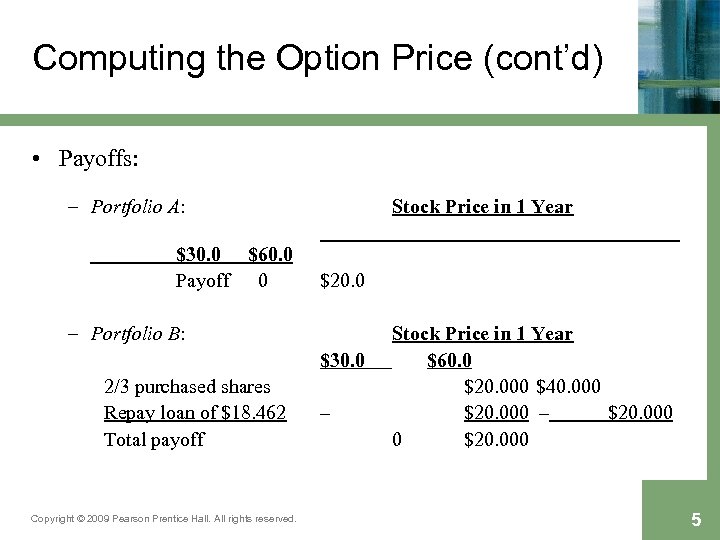
Computing the Option Price (cont’d) • Payoffs: – Portfolio A: $30. 0 $60. 0 Payoff 0 Stock Price in 1 Year $20. 0 – Portfolio B: $30. 0 2/3 purchased shares Repay loan of $18. 462 Total payoff Copyright © 2009 Pearson Prentice Hall. All rights reserved. – Stock Price in 1 Year $60. 0 $20. 000 $40. 000 $20. 000 – $20. 000 0 $20. 000 5
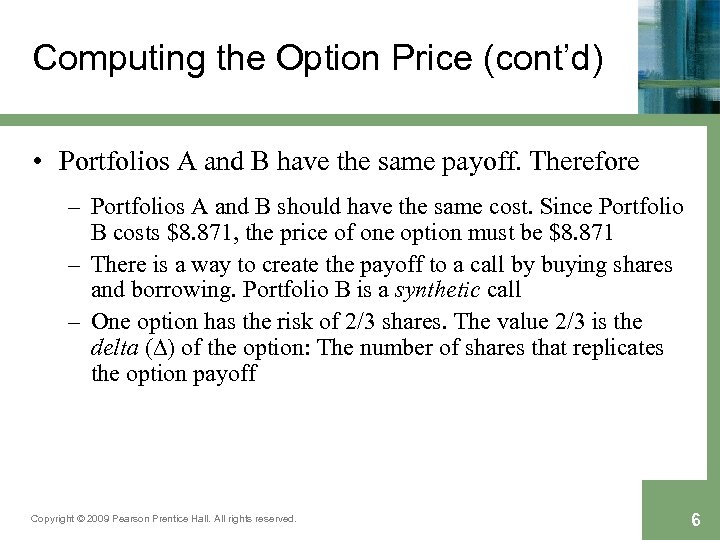
Computing the Option Price (cont’d) • Portfolios A and B have the same payoff. Therefore – Portfolios A and B should have the same cost. Since Portfolio B costs $8. 871, the price of one option must be $8. 871 – There is a way to create the payoff to a call by buying shares and borrowing. Portfolio B is a synthetic call – One option has the risk of 2/3 shares. The value 2/3 is the delta ( ) of the option: The number of shares that replicates the option payoff Copyright © 2009 Pearson Prentice Hall. All rights reserved. 6
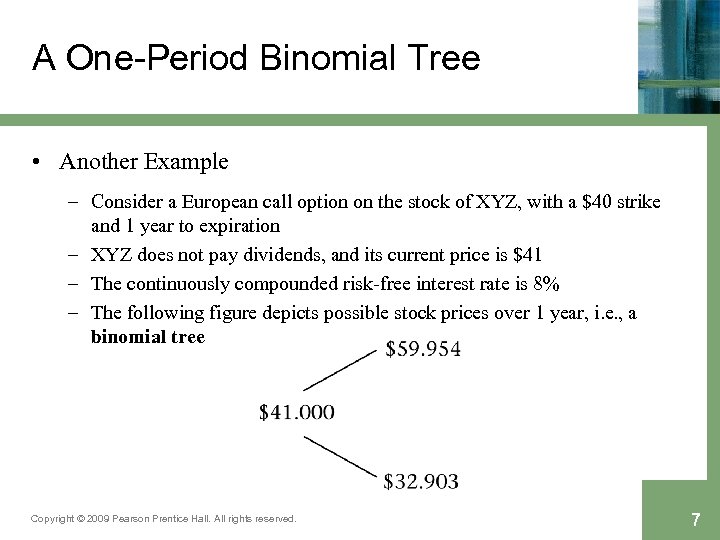
A One-Period Binomial Tree • Another Example – Consider a European call option on the stock of XYZ, with a $40 strike and 1 year to expiration – XYZ does not pay dividends, and its current price is $41 – The continuously compounded risk-free interest rate is 8% – The following figure depicts possible stock prices over 1 year, i. e. , a binomial tree Copyright © 2009 Pearson Prentice Hall. All rights reserved. 7
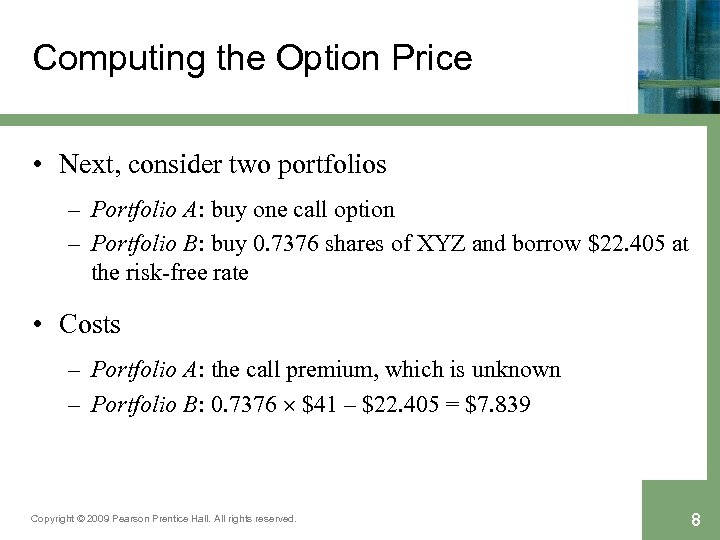
Computing the Option Price • Next, consider two portfolios – Portfolio A: buy one call option – Portfolio B: buy 0. 7376 shares of XYZ and borrow $22. 405 at the risk-free rate • Costs – Portfolio A: the call premium, which is unknown – Portfolio B: 0. 7376 $41 – $22. 405 = $7. 839 Copyright © 2009 Pearson Prentice Hall. All rights reserved. 8
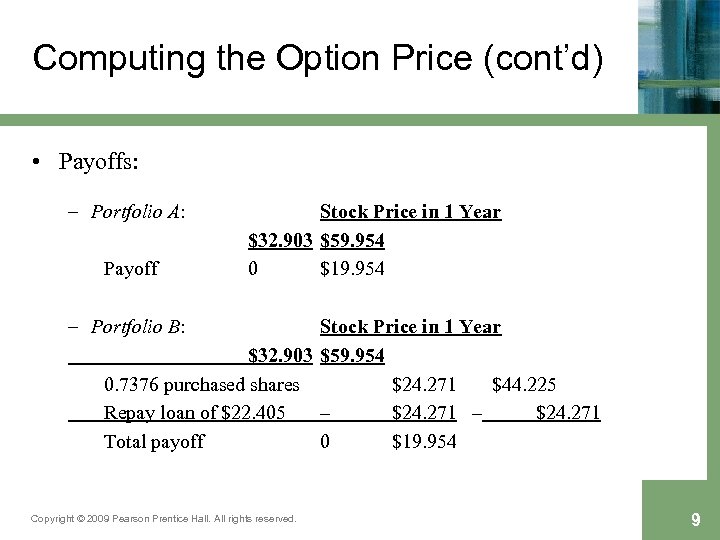
Computing the Option Price (cont’d) • Payoffs: – Portfolio A: Payoff Stock Price in 1 Year $32. 903 $59. 954 0 $19. 954 – Portfolio B: Stock Price in 1 Year $32. 903 $59. 954 0. 7376 purchased shares $24. 271 $44. 225 Repay loan of $22. 405 – $24. 271 Total payoff 0 $19. 954 Copyright © 2009 Pearson Prentice Hall. All rights reserved. 9
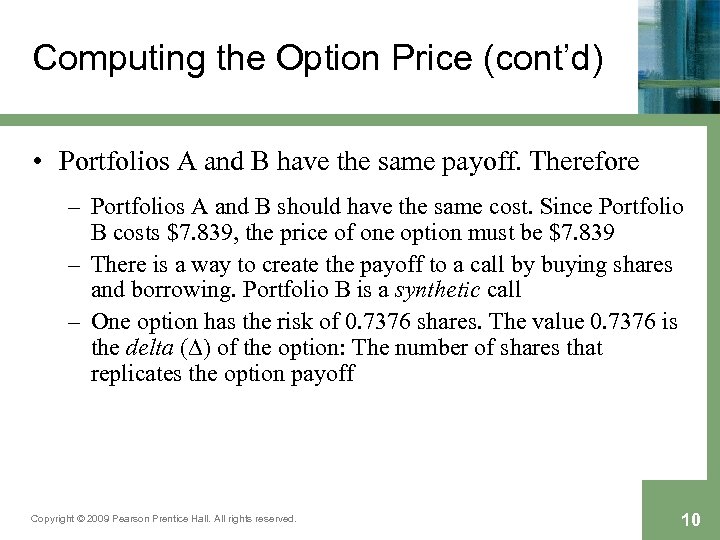
Computing the Option Price (cont’d) • Portfolios A and B have the same payoff. Therefore – Portfolios A and B should have the same cost. Since Portfolio B costs $7. 839, the price of one option must be $7. 839 – There is a way to create the payoff to a call by buying shares and borrowing. Portfolio B is a synthetic call – One option has the risk of 0. 7376 shares. The value 0. 7376 is the delta ( ) of the option: The number of shares that replicates the option payoff Copyright © 2009 Pearson Prentice Hall. All rights reserved. 10
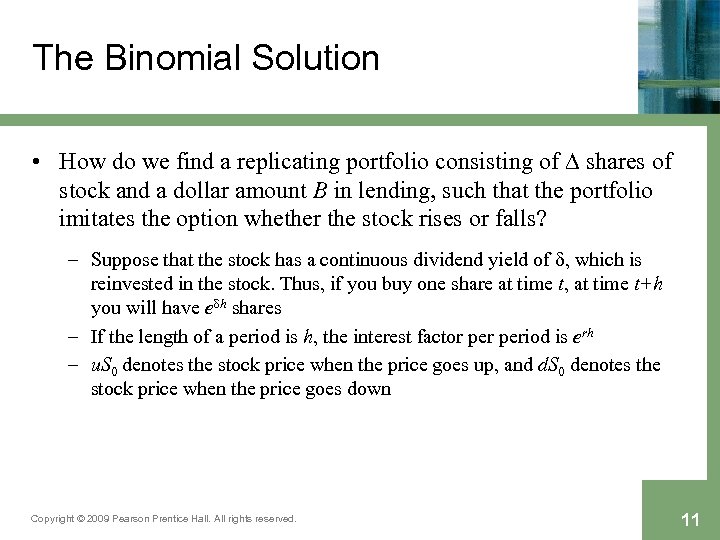
The Binomial Solution • How do we find a replicating portfolio consisting of shares of stock and a dollar amount B in lending, such that the portfolio imitates the option whether the stock rises or falls? – Suppose that the stock has a continuous dividend yield of , which is reinvested in the stock. Thus, if you buy one share at time t, at time t+h you will have e h shares – If the length of a period is h, the interest factor period is erh – u. S 0 denotes the stock price when the price goes up, and d. S 0 denotes the stock price when the price goes down Copyright © 2009 Pearson Prentice Hall. All rights reserved. 11
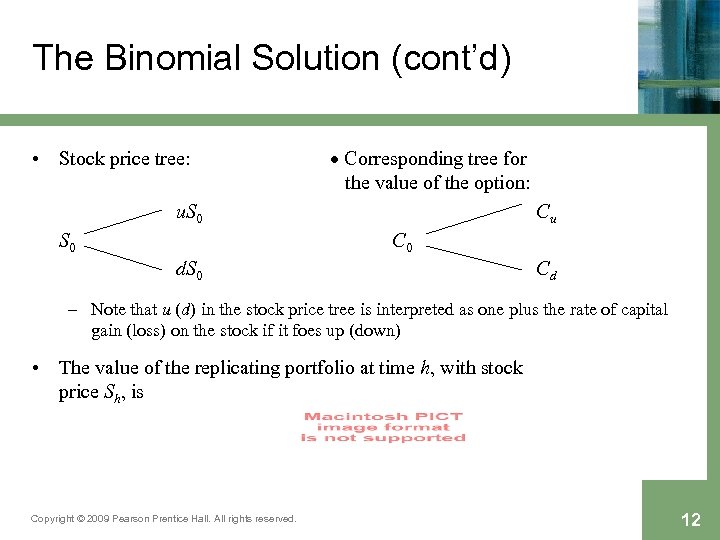
The Binomial Solution (cont’d) • Stock price tree: Corresponding tree for the value of the option: u. S 0 Cu C 0 d. S 0 Cd – Note that u (d) in the stock price tree is interpreted as one plus the rate of capital gain (loss) on the stock if it foes up (down) • The value of the replicating portfolio at time h, with stock price Sh, is Copyright © 2009 Pearson Prentice Hall. All rights reserved. 12
The Binomial Solution (cont’d) • At the prices Sh = u. S and Sh = d. S, a replicating portfolio will satisfy • Solving for and B gives (10. 1) (10. 2) Copyright © 2009 Pearson Prentice Hall. All rights reserved. 13
The Binomial Solution (cont’d) • The cost of creating the option is the cash flow required to buy the shares and bonds. Thus, the cost of the option is S+B (10. 3) • The no-arbitrage condition is (10. 4) Copyright © 2009 Pearson Prentice Hall. All rights reserved. 14
Arbitraging a Mispriced Option • If the observed option price differs from its theoretical price, arbitrage is possible – If an option is overpriced, we can sell the option. However, the risk is that the option will be in the money at expiration, and we will be required to deliver the stock. To hedge this risk, we can buy a synthetic option at the same time we sell the actual option – If an option is underpriced, we buy the option. To hedge the risk associated with the possibility of the stock price falling at expiration, we sell a synthetic option at the same time Copyright © 2009 Pearson Prentice Hall. All rights reserved. 15
A Graphical Interpretation of the Binomial Formula • The portfolio describes a line with the formula – Where Ch and Sh are the option and stock value after one binomial period, and supposing = 0 • We can control the slope of a payoff diagram by varying the number of shares, , and its height by varying the number of bonds, B • Any line replicating a call will have a positive slope ( > 0) and negative intercept (B < 0). (For a put, < 0 and B > 0) Copyright © 2009 Pearson Prentice Hall. All rights reserved. 16
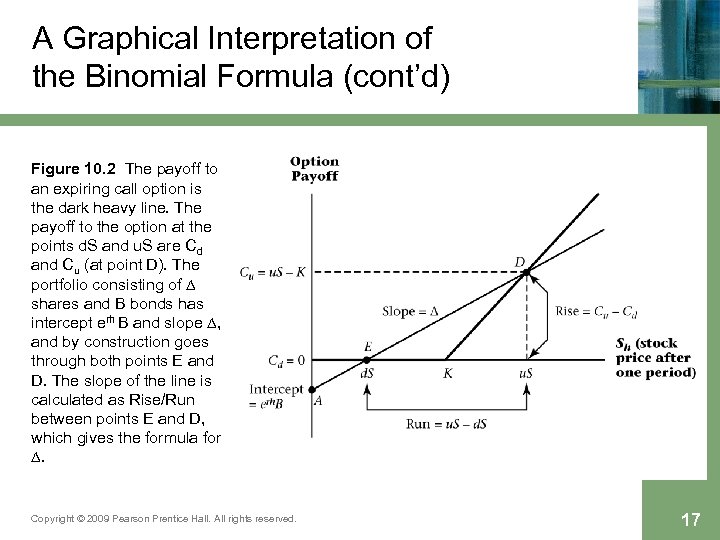
A Graphical Interpretation of the Binomial Formula (cont’d) Figure 10. 2 The payoff to an expiring call option is the dark heavy line. The payoff to the option at the points d. S and u. S are Cd and Cu (at point D). The portfolio consisting of ∆ shares and B bonds has intercept erh B and slope ∆, and by construction goes through both points E and D. The slope of the line is calculated as Rise/Run between points E and D, which gives the formula for ∆. Copyright © 2009 Pearson Prentice Hall. All rights reserved. 17
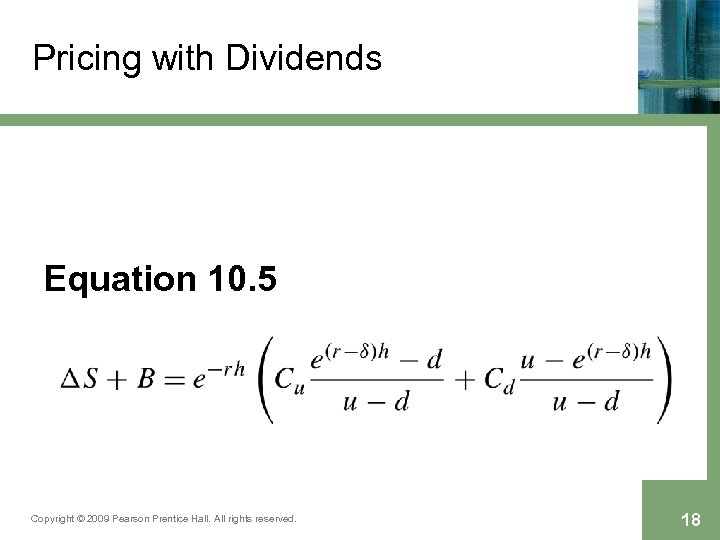
Pricing with Dividends Equation 10. 5 Copyright © 2009 Pearson Prentice Hall. All rights reserved. 18
Risk-Neutral Pricing • We can interpret the terms (e(r– )h – d )/(u – d) and (u – e(r– )h )/(u – d) as probabilities • Let (10. 6) • Then equation (10. 3) can then be written as (10. 7) – Where p* is the risk-neutral probability of an increase in the stock price Copyright © 2009 Pearson Prentice Hall. All rights reserved. 19
Constructing a Binomial Tree • In the absence of uncertainty, a stock must appreciate at the risk-free rate less the dividend yield. Thus, from time t to time t+h, we have (10. 9) • The price next period equals the forward price Copyright © 2009 Pearson Prentice Hall. All rights reserved. 20
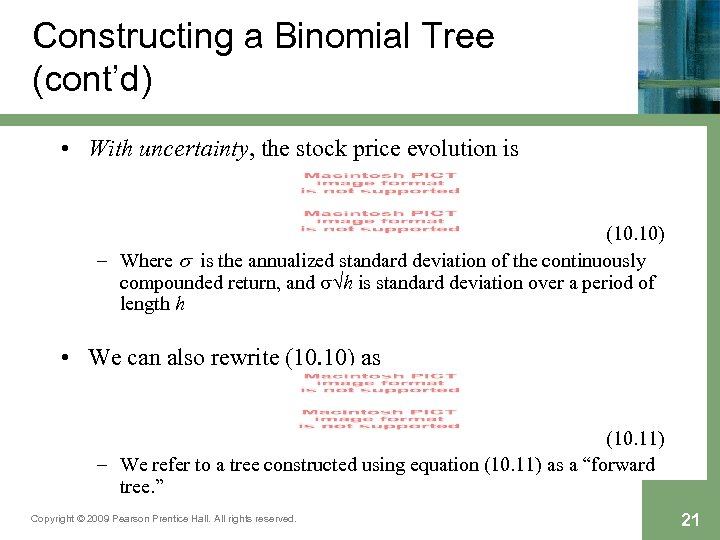
Constructing a Binomial Tree (cont’d) • With uncertainty, the stock price evolution is (10. 10) – Where is the annualized standard deviation of the continuously compounded return, and h is standard deviation over a period of length h • We can also rewrite (10. 10) as (10. 11) – We refer to a tree constructed using equation (10. 11) as a “forward tree. ” Copyright © 2009 Pearson Prentice Hall. All rights reserved. 21
Summary • In order to price an option, we need to know – – – Stock price Strike price Standard deviation of returns on the stock Dividend yield Risk-free rate • Using the risk-free rate and , we can approximate the future distribution of the stock by creating a binomial tree using equation (10. 11) • Once we have the binomial tree, it is possible to price the option using equation (10. 2) Copyright © 2009 Pearson Prentice Hall. All rights reserved. 22
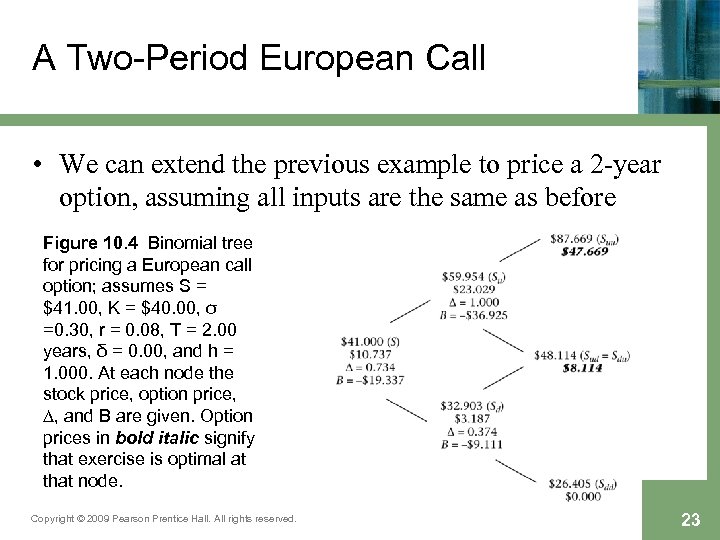
A Two-Period European Call • We can extend the previous example to price a 2 -year option, assuming all inputs are the same as before Figure 10. 4 Binomial tree for pricing a European call option; assumes S = $41. 00, K = $40. 00, σ =0. 30, r = 0. 08, T = 2. 00 years, δ = 0. 00, and h = 1. 000. At each node the stock price, option price, ∆, and B are given. Option prices in bold italic signify that exercise is optimal at that node. Copyright © 2009 Pearson Prentice Hall. All rights reserved. 23
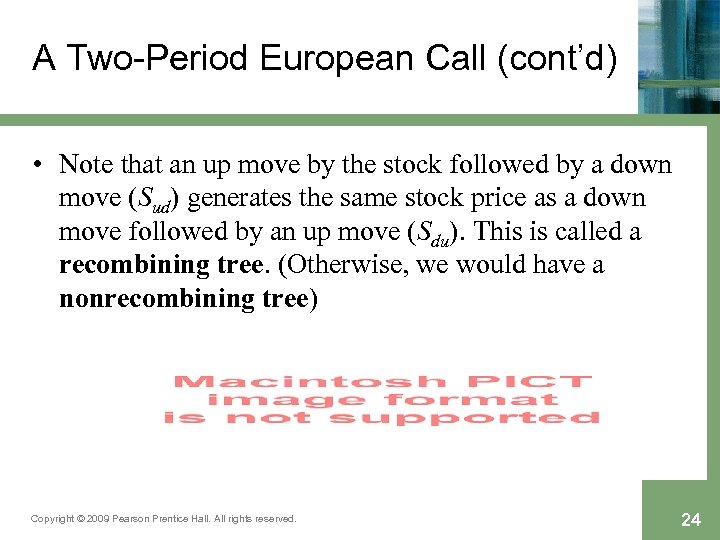
A Two-Period European Call (cont’d) • Note that an up move by the stock followed by a down move (Sud) generates the same stock price as a down move followed by an up move (Sdu). This is called a recombining tree. (Otherwise, we would have a nonrecombining tree) Copyright © 2009 Pearson Prentice Hall. All rights reserved. 24
Pricing the Call Option • To price an option with two binomial periods, we work backward through the tree – Year 2, Stock Price=$87. 669: since we are at expiration, the option value is max (0, S – K) = $47. 669 – Year 2, Stock Price=$48. 114: similarly, the option value is $8. 114 – Year 2, Stock Price=$26. 405: since the option is out of the money, the value is 0 Copyright © 2009 Pearson Prentice Hall. All rights reserved. 25
Pricing the Call Option (cont’d) • Year 1, Stock Price=$59. 954: at this node, we compute the option value using equation (10. 3), where u. S is $87. 669 and d. S is $48. 114 • Year 1, Stock Price=$32. 903: again using equation (10. 3), the option value is $3. 187 • Year 0, Stock Price = $41: similarly, the option value is computed to be $10. 737 Copyright © 2009 Pearson Prentice Hall. All rights reserved. 26
Pricing the Call Option (cont’d) • Notice that – The option was priced by working backward through the binomial tree – The option price is greater for the 2 -year than for the 1 year option – The option’s and B are different at different nodes. At a given point in time, increases to 1 as we go further into the money – Permitting early exercise would make no difference. At every node prior to expiration, the option price is greater than S – K; thus, we would not exercise even if the option was American Copyright © 2009 Pearson Prentice Hall. All rights reserved. 27
Many Binomial Periods • Dividing the time to expiration into more periods allows us to generate a more realistic tree with a larger number of different values at expiration – Consider the previous example of the 1 -year European call option – Let there be three binomial periods. Since it is a 1 -year call, this means that the length of a period is h = 1/3 – Assume that other inputs are the same as before (so, r = 0. 08 and = 0. 3) Copyright © 2009 Pearson Prentice Hall. All rights reserved. 28
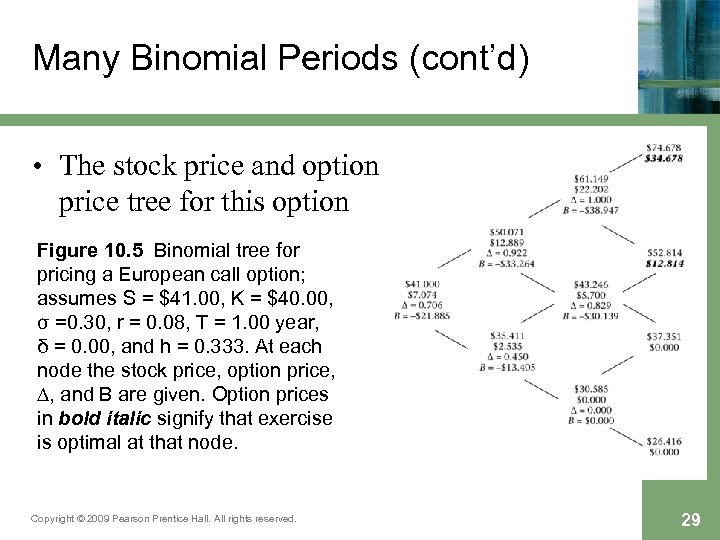
Many Binomial Periods (cont’d) • The stock price and option price tree for this option Figure 10. 5 Binomial tree for pricing a European call option; assumes S = $41. 00, K = $40. 00, σ =0. 30, r = 0. 08, T = 1. 00 year, δ = 0. 00, and h = 0. 333. At each node the stock price, option price, ∆, and B are given. Option prices in bold italic signify that exercise is optimal at that node. Copyright © 2009 Pearson Prentice Hall. All rights reserved. 29
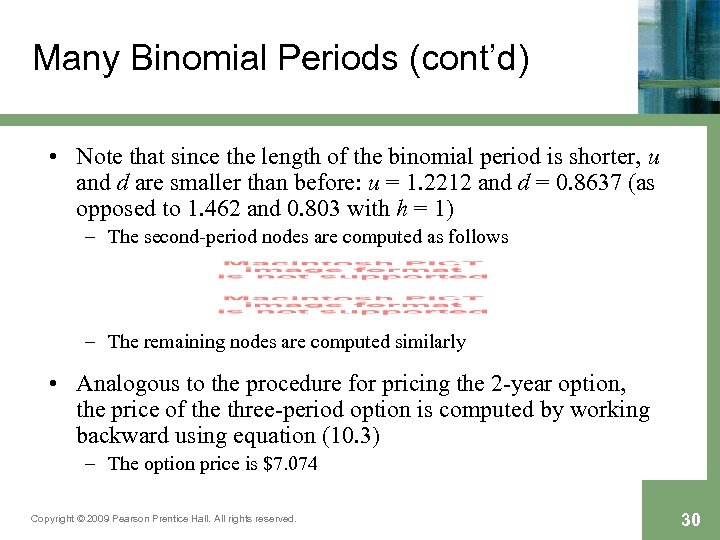
Many Binomial Periods (cont’d) • Note that since the length of the binomial period is shorter, u and d are smaller than before: u = 1. 2212 and d = 0. 8637 (as opposed to 1. 462 and 0. 803 with h = 1) – The second-period nodes are computed as follows – The remaining nodes are computed similarly • Analogous to the procedure for pricing the 2 -year option, the price of the three-period option is computed by working backward using equation (10. 3) – The option price is $7. 074 Copyright © 2009 Pearson Prentice Hall. All rights reserved. 30
Put Options • We compute put option prices using the same stock price tree and in the same way as call option prices • The only difference with a European put option occurs at expiration – Instead of computing the price as max (0, S – K), we use max (0, K – S) Copyright © 2009 Pearson Prentice Hall. All rights reserved. 31
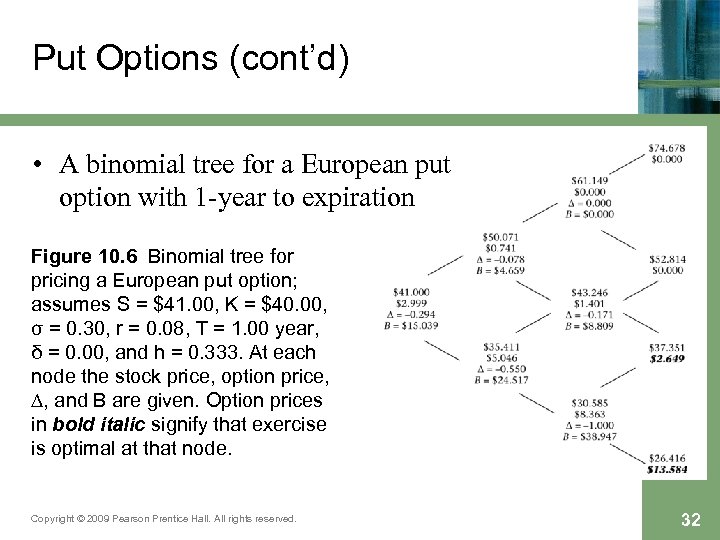
Put Options (cont’d) • A binomial tree for a European put option with 1 -year to expiration Figure 10. 6 Binomial tree for pricing a European put option; assumes S = $41. 00, K = $40. 00, σ = 0. 30, r = 0. 08, T = 1. 00 year, δ = 0. 00, and h = 0. 333. At each node the stock price, option price, ∆, and B are given. Option prices in bold italic signify that exercise is optimal at that node. Copyright © 2009 Pearson Prentice Hall. All rights reserved. 32
American Options • The value of the option if it is left “alive” (i. e. , unexercised) is given by the value of holding it for another period, equation (10. 3) • The value of the option if it is exercised is given by max (0, S – K) if it is a call and max (0, K – S) if it is a put • For an American call, the value of the option at a node is given by Copyright © 2009 Pearson Prentice Hall. All rights reserved. 33
American Options (cont’d) • The valuation of American options proceeds as follows – At each node, we check for early exercise – If the value of the option is greater when exercised, we assign that value to the node. Otherwise, we assign the value of the option unexercised – We work backward through the three as usual Copyright © 2009 Pearson Prentice Hall. All rights reserved. 34
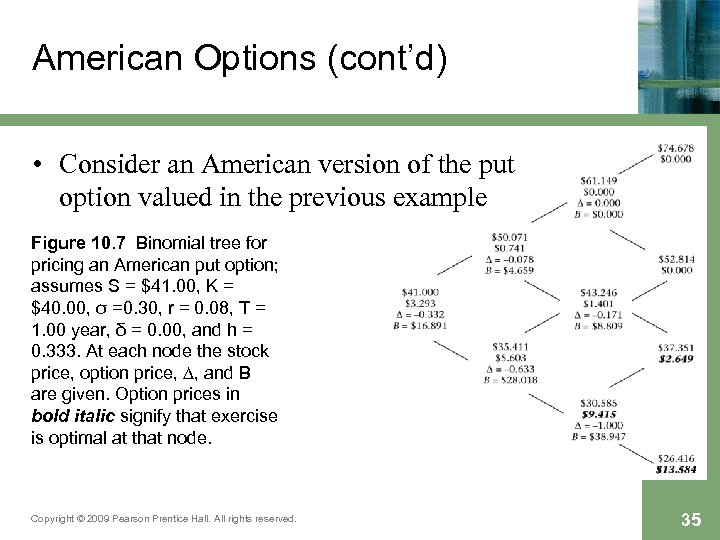
American Options (cont’d) • Consider an American version of the put option valued in the previous example Figure 10. 7 Binomial tree for pricing an American put option; assumes S = $41. 00, K = $40. 00, σ =0. 30, r = 0. 08, T = 1. 00 year, δ = 0. 00, and h = 0. 333. At each node the stock price, option price, ∆, and B are given. Option prices in bold italic signify that exercise is optimal at that node. Copyright © 2009 Pearson Prentice Hall. All rights reserved. 35
American Options (cont’d) • The only difference in the binomial tree occurs at the Sdd node, where the stock price is $30. 585. The American option at that point is worth $40 – $30. 585 = $9. 415, its early-exercise value (as opposed to $8. 363 if unexercised). The greater value of the option at that node ripples back through the tree • Thus, an American option is more valuable than the otherwise equivalent European option Copyright © 2009 Pearson Prentice Hall. All rights reserved. 36
Options on Other Assets • The model developed thus far can be modified easily to price options on underlying assets other than nondividend-paying stocks • The difference for different underlying assets is the construction of the binomial tree and the risk-neutral probability • We examine options on – – – Stock indexes Commodities Currencies Bonds Futures contracts Copyright © 2009 Pearson Prentice Hall. All rights reserved. 37
Options on a Stock Index • Suppose a stock index pays continuous dividends at the rate • The procedure for pricing this option is equivalent to that of the first example, which was used for our derivation. Specifically – – the up and down index moves are given by equation (10. 10) the replicating portfolio by equation (10. 1) and (10. 2) the option price by equation (10. 3) the risk-neutral probability by equation (10. 5) Copyright © 2009 Pearson Prentice Hall. All rights reserved. 38
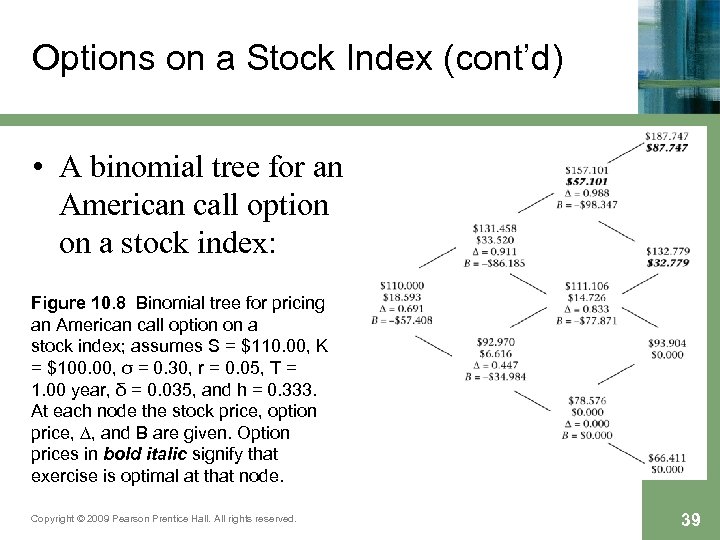
Options on a Stock Index (cont’d) • A binomial tree for an American call option on a stock index: Figure 10. 8 Binomial tree for pricing an American call option on a stock index; assumes S = $110. 00, K = $100. 00, σ = 0. 30, r = 0. 05, T = 1. 00 year, δ = 0. 035, and h = 0. 333. At each node the stock price, option price, ∆, and B are given. Option prices in bold italic signify that exercise is optimal at that node. Copyright © 2009 Pearson Prentice Hall. All rights reserved. 39
Options on Currency • With a currency with spot price x 0, the forward price is – Where rf is the foreign interest rate • Thus, we construct the binomial tree using Copyright © 2009 Pearson Prentice Hall. All rights reserved. 40
Options on Currency (cont’d) • Investing in a “currency” means investing in a money-market fund or fixed income obligation denominated in that currency • Taking into account interest on the foreign-currency denominated obligation, the two equations are • The risk-neutral probability of an up move is (10. 13) Copyright © 2009 Pearson Prentice Hall. All rights reserved. 41
Options on Currency (cont’d) • Consider a dollar-denominated American put option on the euro, where – The current exchange rate is $1. 05/€ – The strike is $1. 10/€ – The euro-denominated interest rate is 3. 1% – The dollar-denominated rate is 5. 5% Copyright © 2009 Pearson Prentice Hall. All rights reserved. 42
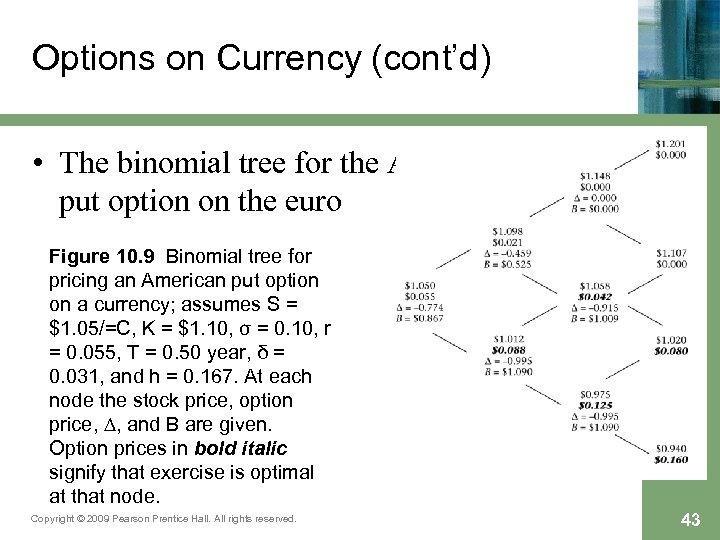
Options on Currency (cont’d) • The binomial tree for the American put option on the euro Figure 10. 9 Binomial tree for pricing an American put option on a currency; assumes S = $1. 05/=C, K = $1. 10, σ = 0. 10, r = 0. 055, T = 0. 50 year, δ = 0. 031, and h = 0. 167. At each node the stock price, option price, ∆, and B are given. Option prices in bold italic signify that exercise is optimal at that node. Copyright © 2009 Pearson Prentice Hall. All rights reserved. 43
Options on Futures Contracts • Assume the forward price is the same as the futures price • The nodes are constructed as • We need to find the number of futures contracts, , and the lending, B, that replicates the option – A replicating portfolio must satisfy Copyright © 2009 Pearson Prentice Hall. All rights reserved. 44
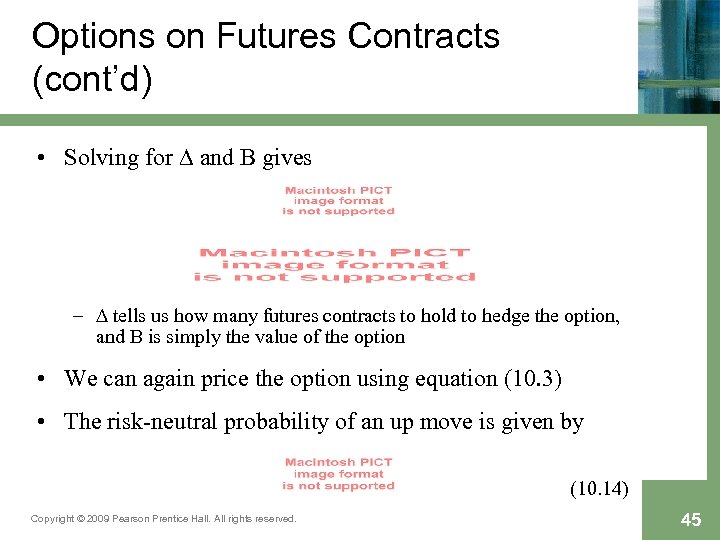
Options on Futures Contracts (cont’d) • Solving for and B gives – tells us how many futures contracts to hold to hedge the option, and B is simply the value of the option • We can again price the option using equation (10. 3) • The risk-neutral probability of an up move is given by (10. 14) Copyright © 2009 Pearson Prentice Hall. All rights reserved. 45
Options on Futures Contracts (cont’d) • The motive for early-exercise of an option on a futures contract is the ability to earn interest on the mark-to-market proceeds – When an option is exercised, the option holder pays nothing, is entered into a futures contract, and receives mark-to-market proceeds of the difference between the strike price and the futures price Copyright © 2009 Pearson Prentice Hall. All rights reserved. 46
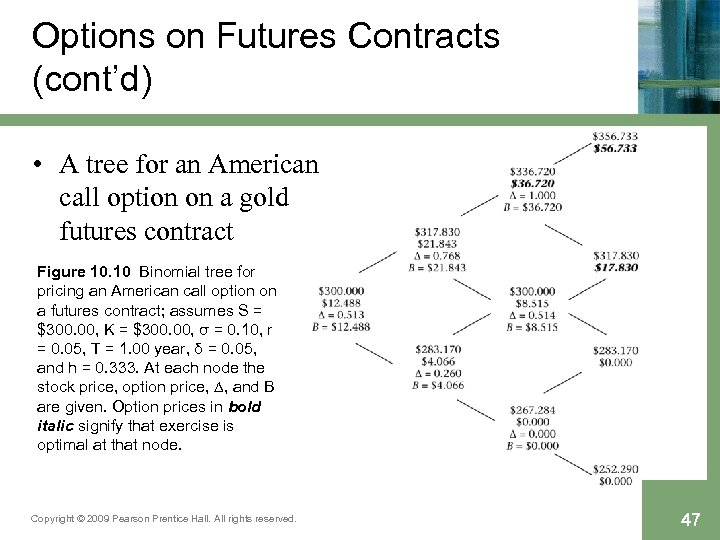
Options on Futures Contracts (cont’d) • A tree for an American call option on a gold futures contract Figure 10. 10 Binomial tree for pricing an American call option on a futures contract; assumes S = $300. 00, K = $300. 00, σ = 0. 10, r = 0. 05, T = 1. 00 year, δ = 0. 05, and h = 0. 333. At each node the stock price, option price, ∆, and B are given. Option prices in bold italic signify that exercise is optimal at that node. Copyright © 2009 Pearson Prentice Hall. All rights reserved. 47
Chapter 10 • Additional Art Copyright © 2009 Pearson Prentice Hall. All rights reserved.
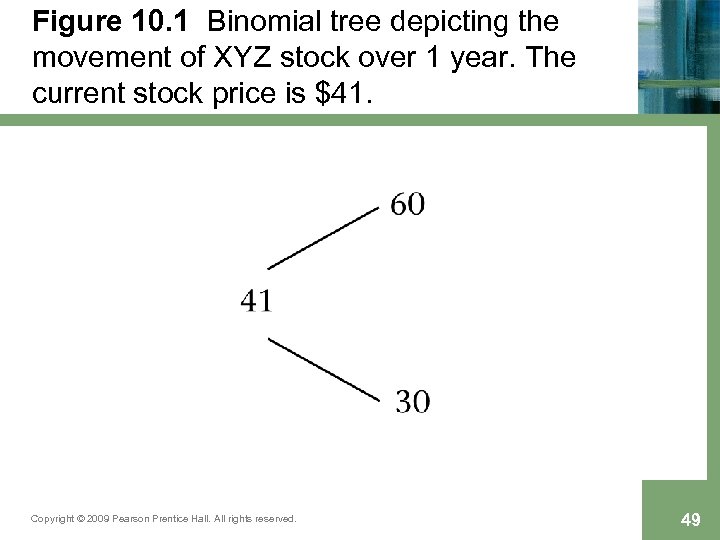
Figure 10. 1 Binomial tree depicting the movement of XYZ stock over 1 year. The current stock price is $41. Copyright © 2009 Pearson Prentice Hall. All rights reserved. 49
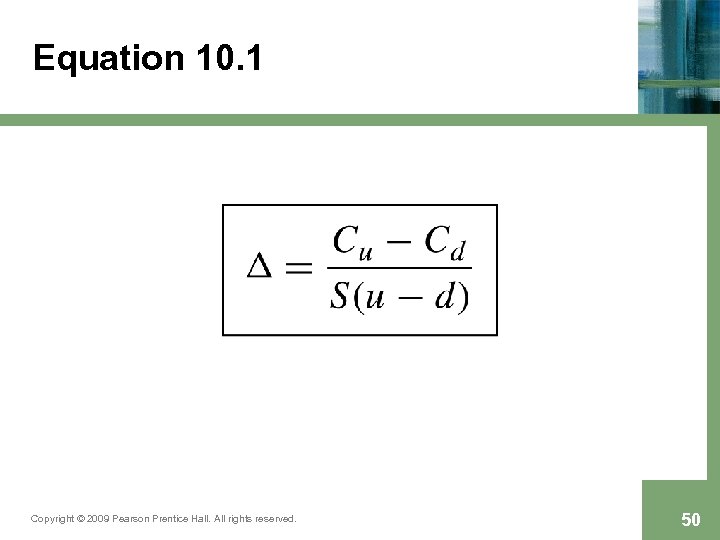
Equation 10. 1 Copyright © 2009 Pearson Prentice Hall. All rights reserved. 50
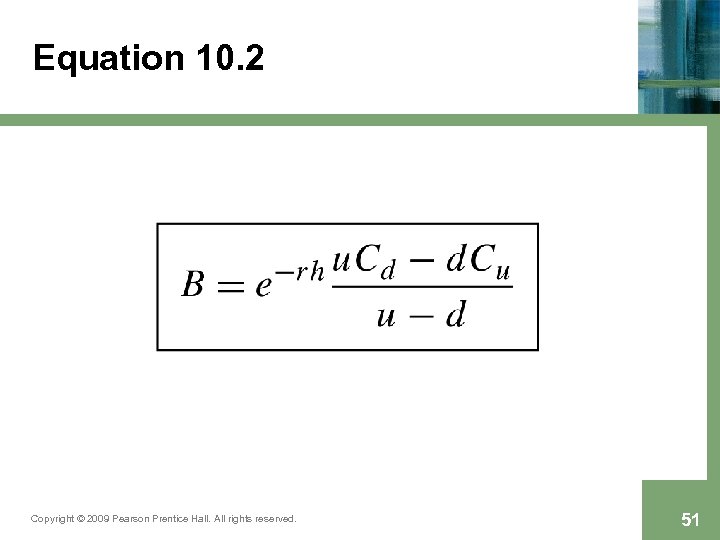
Equation 10. 2 Copyright © 2009 Pearson Prentice Hall. All rights reserved. 51
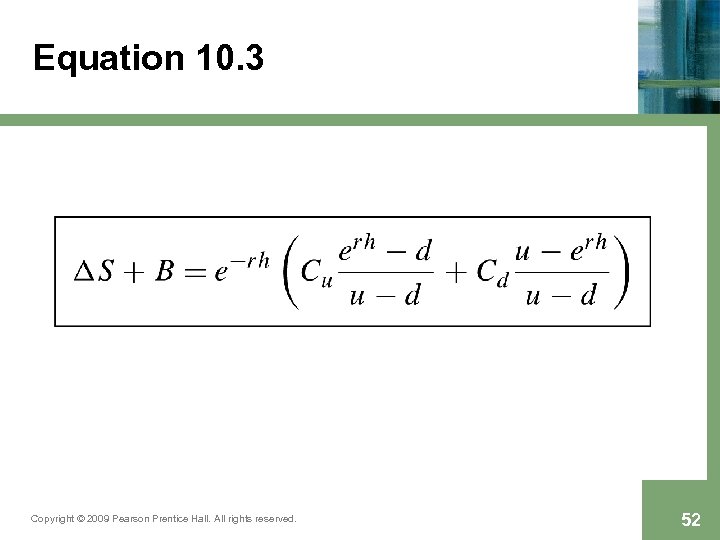
Equation 10. 3 Copyright © 2009 Pearson Prentice Hall. All rights reserved. 52
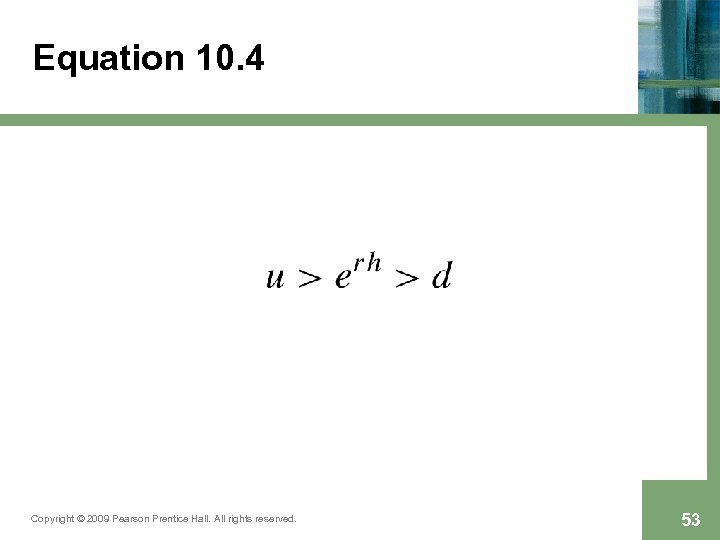
Equation 10. 4 Copyright © 2009 Pearson Prentice Hall. All rights reserved. 53
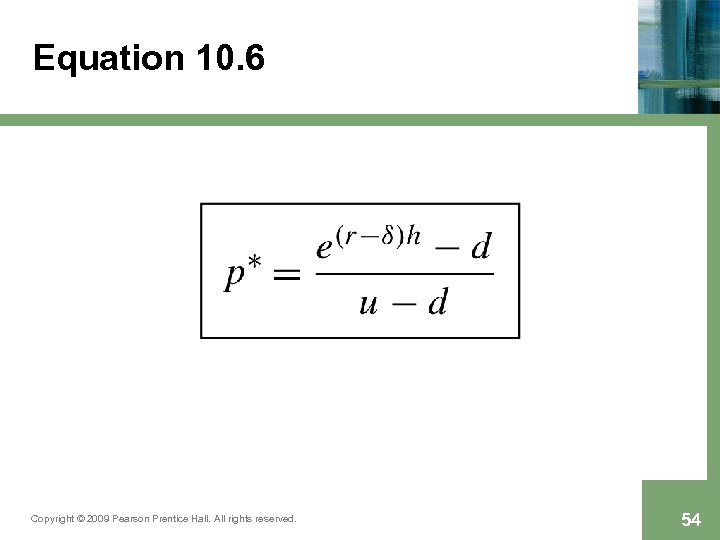
Equation 10. 6 Copyright © 2009 Pearson Prentice Hall. All rights reserved. 54
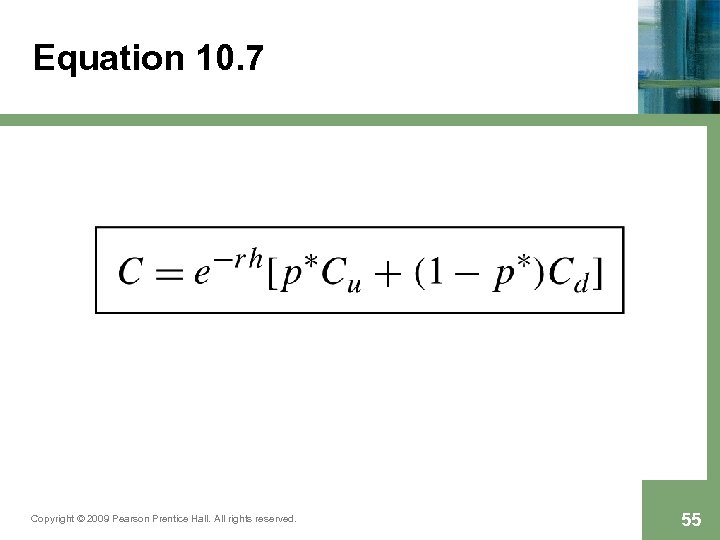
Equation 10. 7 Copyright © 2009 Pearson Prentice Hall. All rights reserved. 55
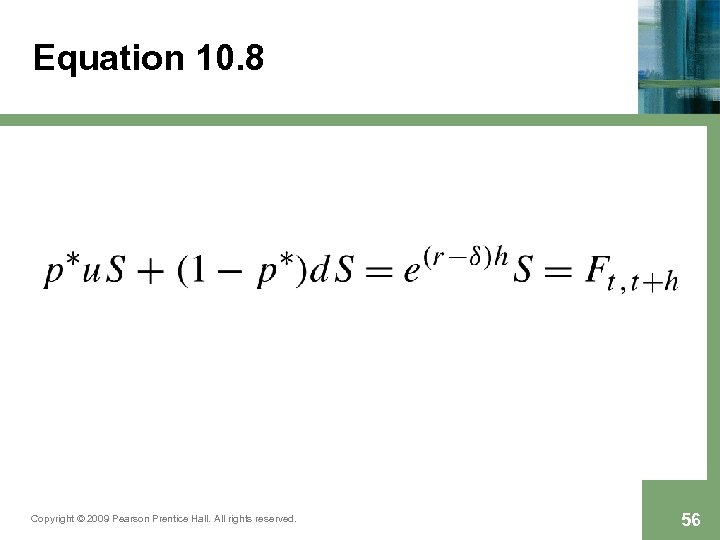
Equation 10. 8 Copyright © 2009 Pearson Prentice Hall. All rights reserved. 56
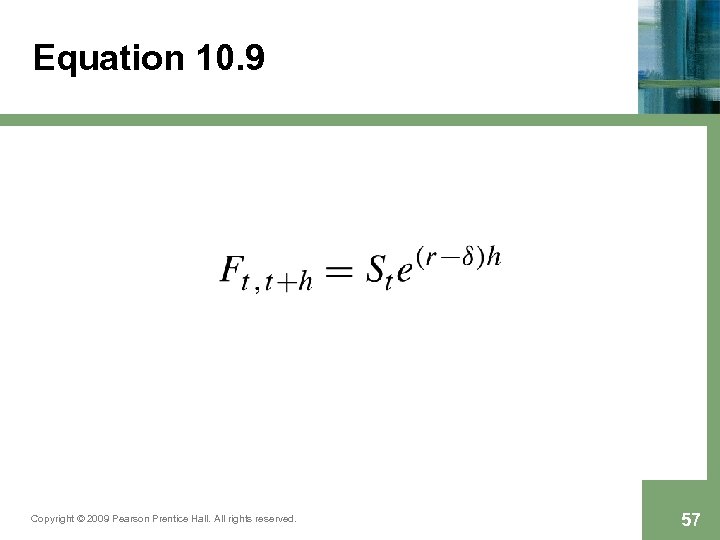
Equation 10. 9 Copyright © 2009 Pearson Prentice Hall. All rights reserved. 57
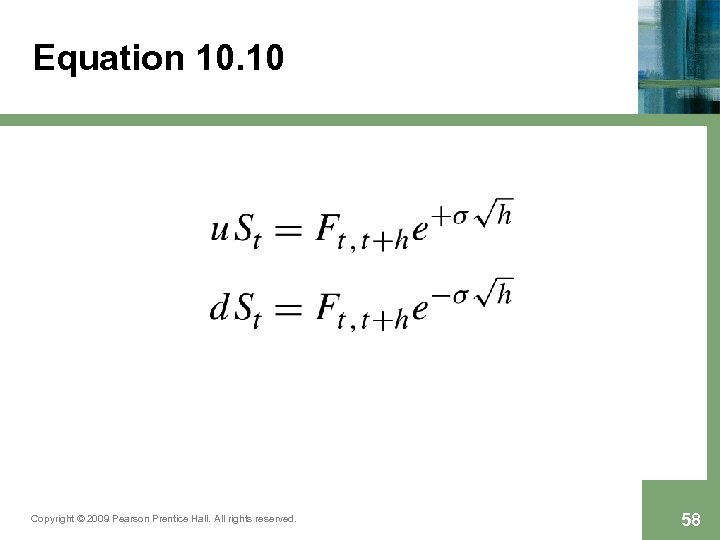
Equation 10. 10 Copyright © 2009 Pearson Prentice Hall. All rights reserved. 58
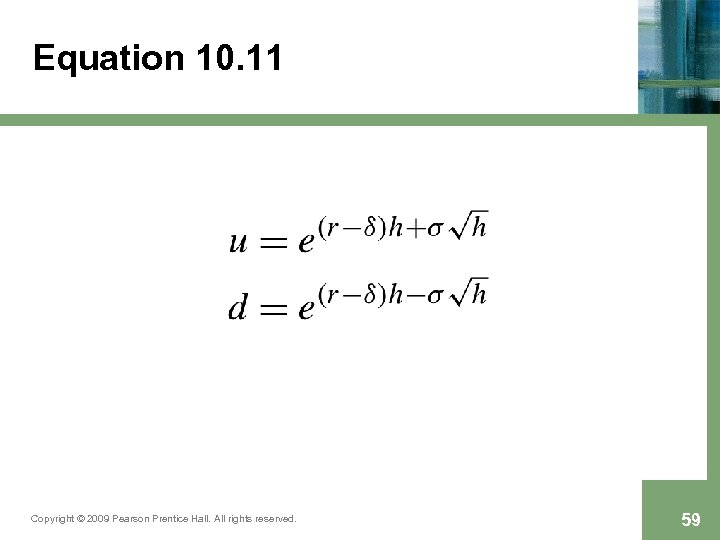
Equation 10. 11 Copyright © 2009 Pearson Prentice Hall. All rights reserved. 59
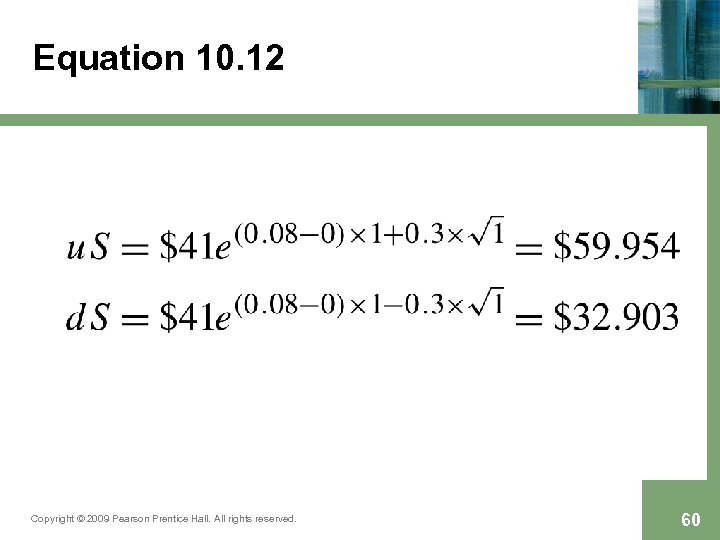
Equation 10. 12 Copyright © 2009 Pearson Prentice Hall. All rights reserved. 60
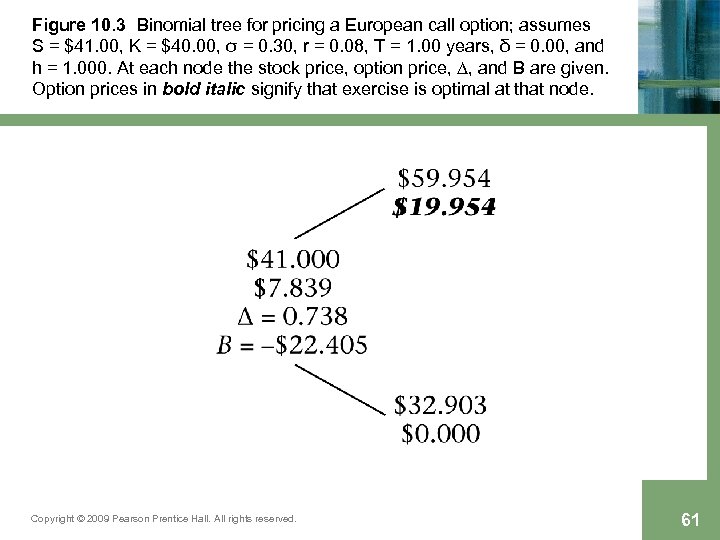
Figure 10. 3 Binomial tree for pricing a European call option; assumes S = $41. 00, K = $40. 00, σ = 0. 30, r = 0. 08, T = 1. 00 years, δ = 0. 00, and h = 1. 000. At each node the stock price, option price, ∆, and B are given. Option prices in bold italic signify that exercise is optimal at that node. Copyright © 2009 Pearson Prentice Hall. All rights reserved. 61
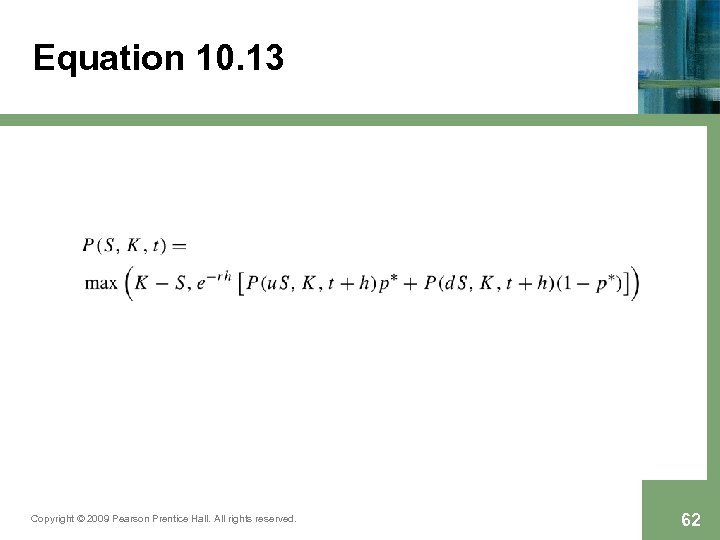
Equation 10. 13 Copyright © 2009 Pearson Prentice Hall. All rights reserved. 62
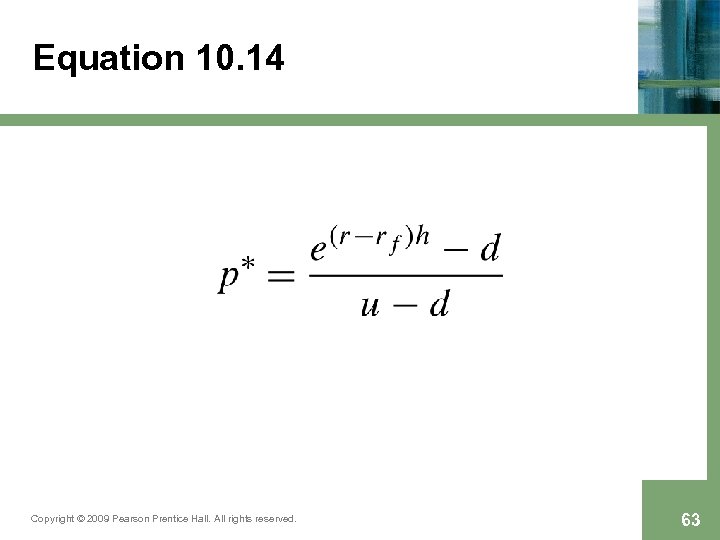
Equation 10. 14 Copyright © 2009 Pearson Prentice Hall. All rights reserved. 63
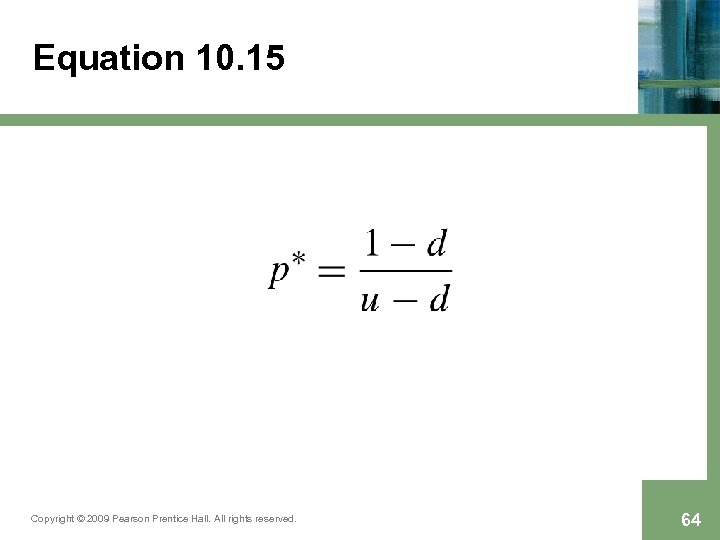
Equation 10. 15 Copyright © 2009 Pearson Prentice Hall. All rights reserved. 64
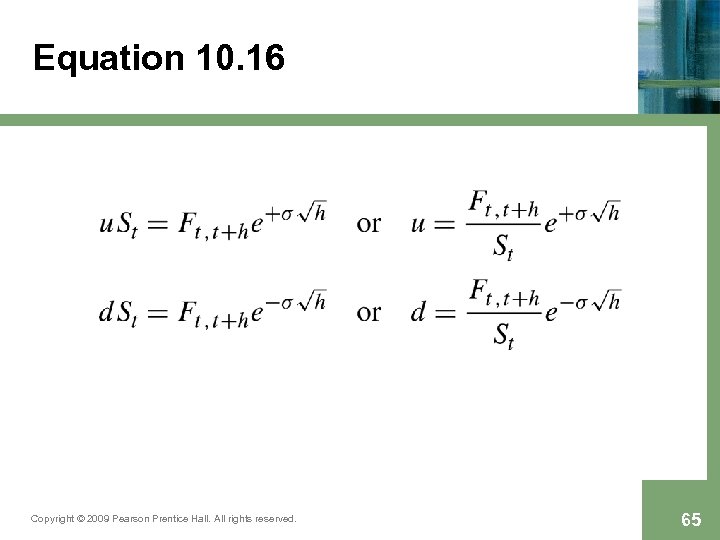
Equation 10. 16 Copyright © 2009 Pearson Prentice Hall. All rights reserved. 65
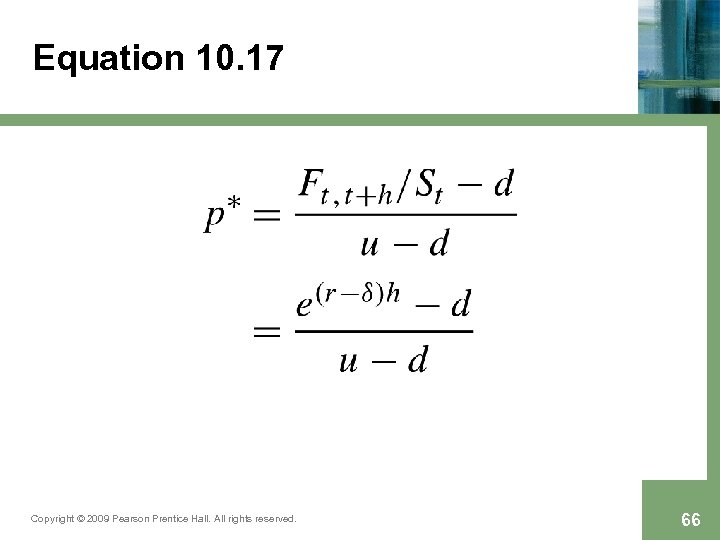
Equation 10. 17 Copyright © 2009 Pearson Prentice Hall. All rights reserved. 66
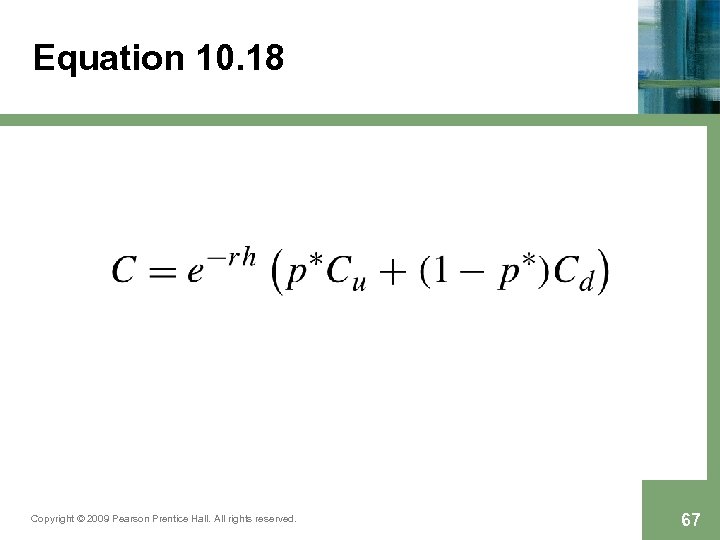
Equation 10. 18 Copyright © 2009 Pearson Prentice Hall. All rights reserved. 67
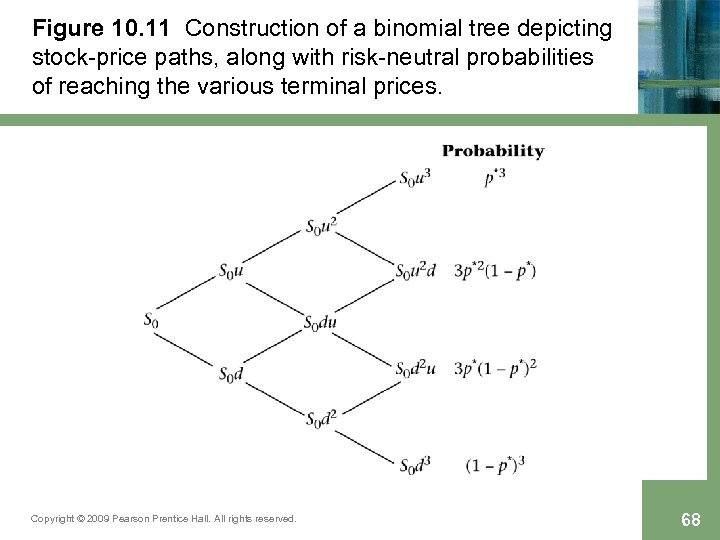
Figure 10. 11 Construction of a binomial tree depicting stock-price paths, along with risk-neutral probabilities of reaching the various terminal prices. Copyright © 2009 Pearson Prentice Hall. All rights reserved. 68
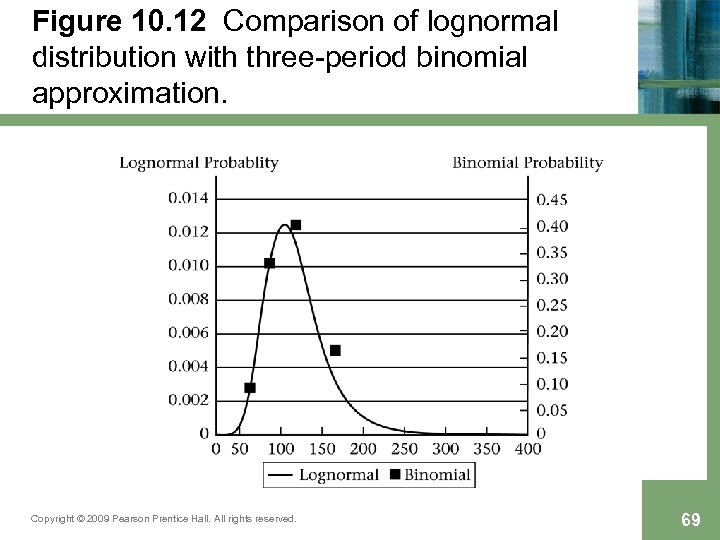
Figure 10. 12 Comparison of lognormal distribution with three-period binomial approximation. Copyright © 2009 Pearson Prentice Hall. All rights reserved. 69
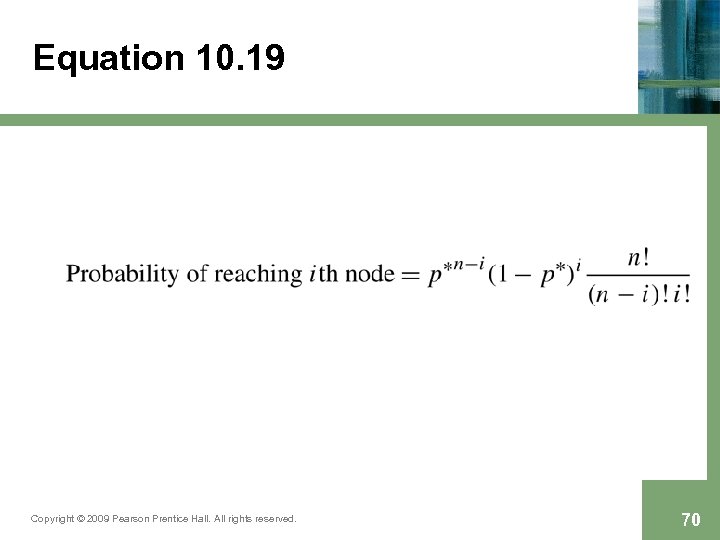
Equation 10. 19 Copyright © 2009 Pearson Prentice Hall. All rights reserved. 70
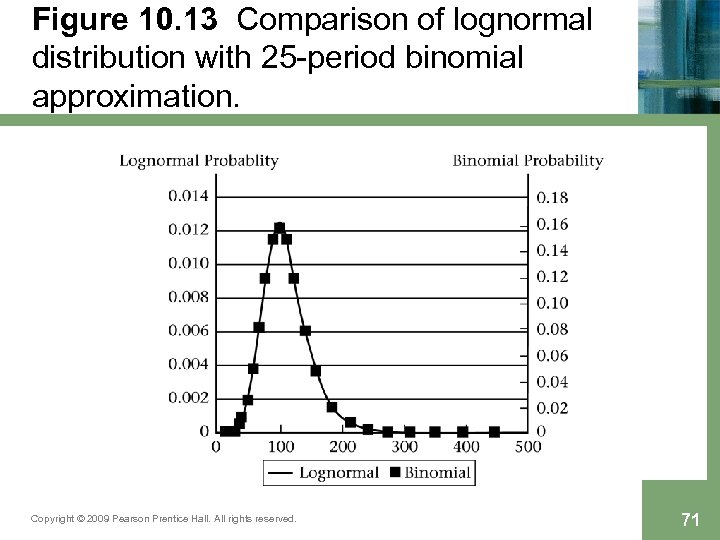
Figure 10. 13 Comparison of lognormal distribution with 25 -period binomial approximation. Copyright © 2009 Pearson Prentice Hall. All rights reserved. 71
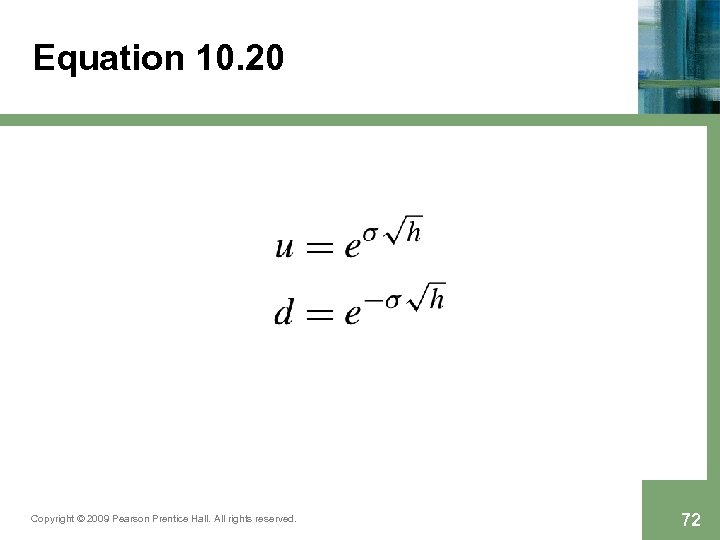
Equation 10. 20 Copyright © 2009 Pearson Prentice Hall. All rights reserved. 72
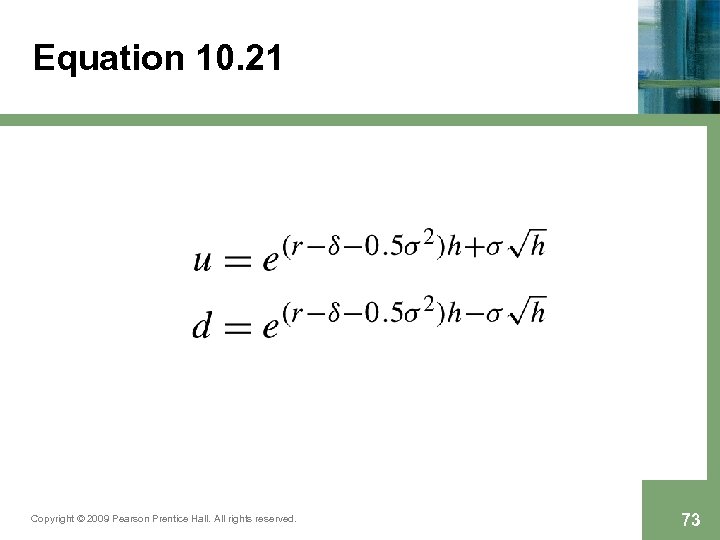
Equation 10. 21 Copyright © 2009 Pearson Prentice Hall. All rights reserved. 73
Скачать презентацию Chapter 10 Binomial Option Pricing Copyright
cf5682ce402a0113f26c80dba01fc1b4.ppt