


 Скачать презентацию Chapter 10 11 Special Journals Accounting Is
d359ae6d4acba911cf8866fb0ab738c4.ppt
- Количество слайдов: 69
 Chapter 10 & 11 Special Journals Accounting Is Fun! 1
 Chapter 10 & 11 Performance objectives: 1. New accounts for merchandising business 2. Invoices 3. Cash discounts, credit card expense and notes payable 4. Sales journal 5. Purchase journal 6. Schedule of accounts receivable 7. Schedule of accounts payable 8. Sales returns and allowances 9. Purchase returns and allowances 10. Cash receipts journal 11. Cash payments journal Accounting Is Fun! n 2
 Reminder n Contra accounts: n n Attached to another account Opposite “+” & “-” Accounting Is Fun! 3
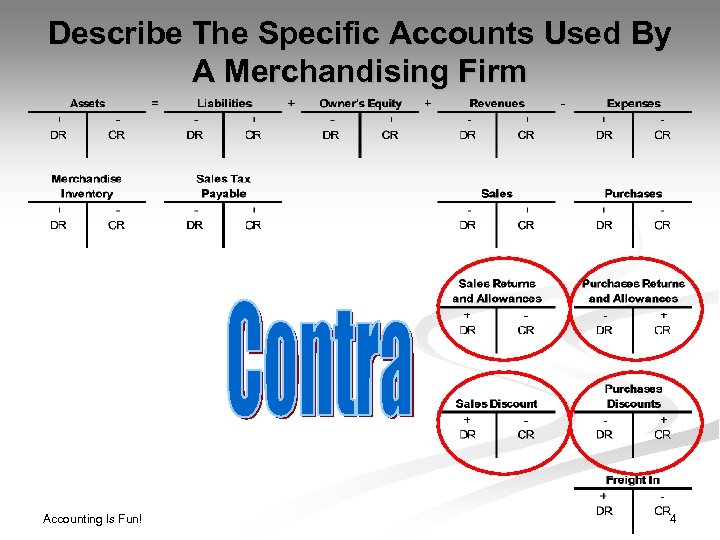 Describe The Specific Accounts Used By A Merchandising Firm Accounting Is Fun! 4
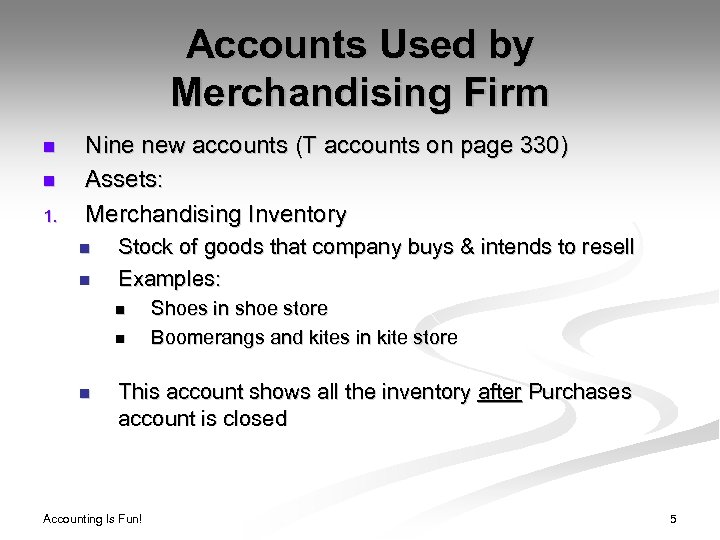 Accounts Used by Merchandising Firm n n 1. Nine new accounts (T accounts on page 330) Assets: Merchandising Inventory n n Stock of goods that company buys & intends to resell Examples: n n n Shoes in shoe store Boomerangs and kites in kite store This account shows all the inventory after Purchases account is closed Accounting Is Fun! 5
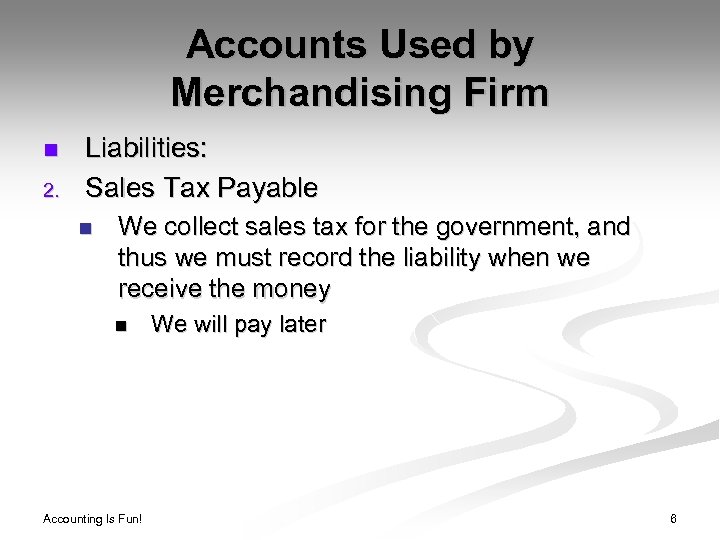 Accounts Used by Merchandising Firm n 2. Liabilities: Sales Tax Payable n We collect sales tax for the government, and thus we must record the liability when we receive the money n Accounting Is Fun! We will pay later 6
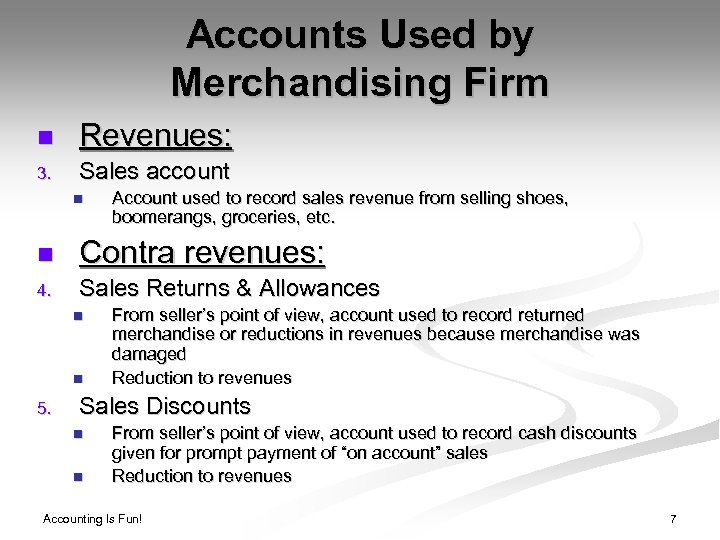 Accounts Used by Merchandising Firm n Revenues: 3. Sales account n Account used to record sales revenue from selling shoes, boomerangs, groceries, etc. n Contra revenues: 4. Sales Returns & Allowances n n 5. From seller’s point of view, account used to record returned merchandise or reductions in revenues because merchandise was damaged Reduction to revenues Sales Discounts n n From seller’s point of view, account used to record cash discounts given for prompt payment of “on account” sales Reduction to revenues Accounting Is Fun! 7
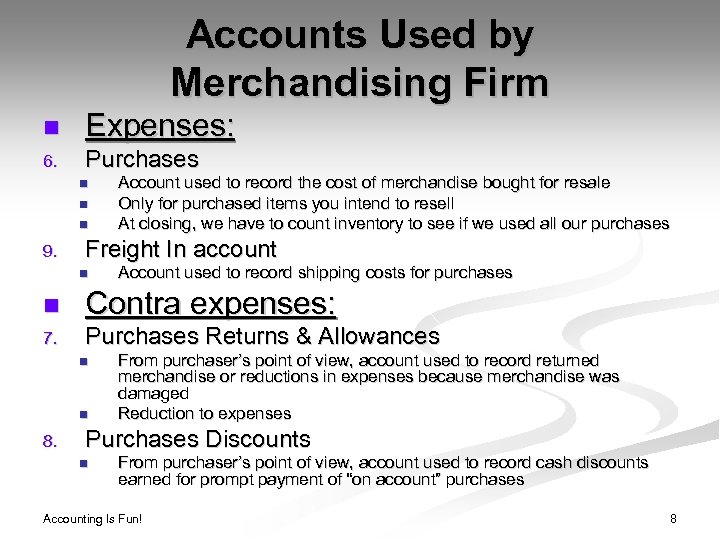 Accounts Used by Merchandising Firm n Expenses: 6. Purchases n n n 9. Account used to record the cost of merchandise bought for resale Only for purchased items you intend to resell At closing, we have to count inventory to see if we used all our purchases Freight In account n Account used to record shipping costs for purchases n Contra expenses: 7. Purchases Returns & Allowances n n 8. From purchaser’s point of view, account used to record returned merchandise or reductions in expenses because merchandise was damaged Reduction to expenses Purchases Discounts n From purchaser’s point of view, account used to record cash discounts earned for prompt payment of “on account” purchases Accounting Is Fun! 8
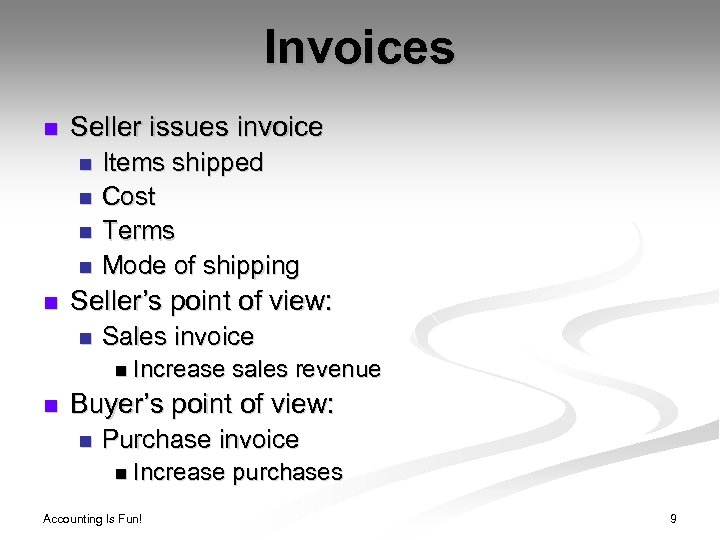 Invoices n Seller issues invoice n n n Items shipped Cost Terms Mode of shipping Seller’s point of view: n Sales invoice n Increase n sales revenue Buyer’s point of view: n Purchase invoice n Increase Accounting Is Fun! purchases 9
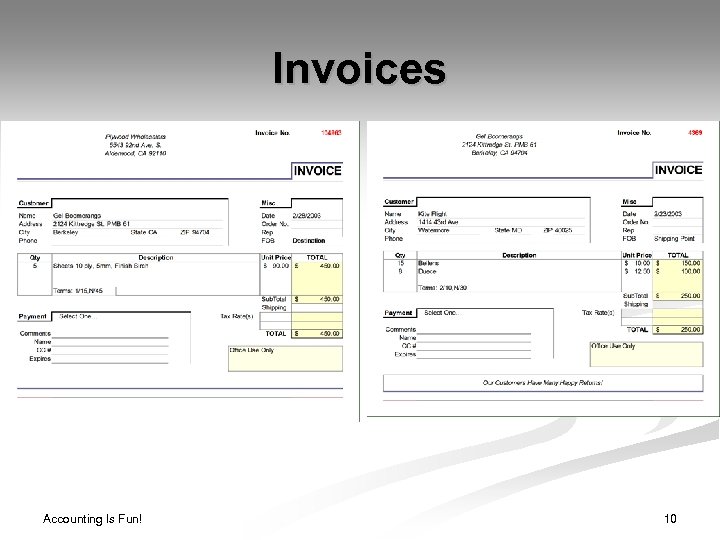 Invoices Accounting Is Fun! 10
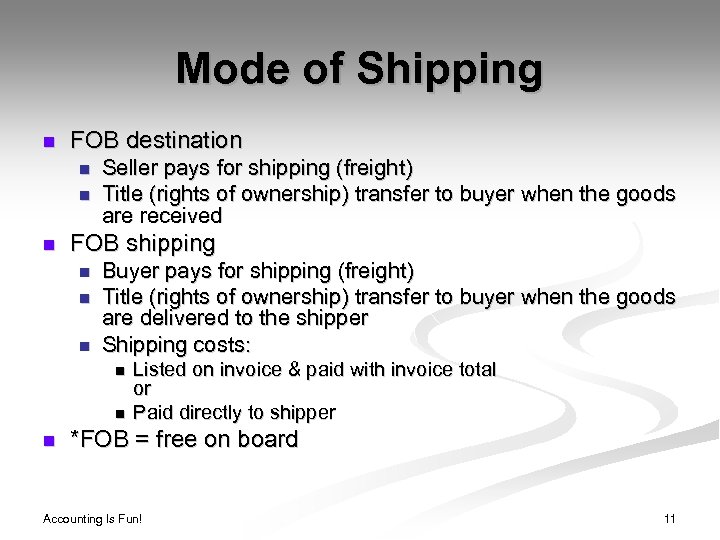 Mode of Shipping n FOB destination n Seller pays for shipping (freight) Title (rights of ownership) transfer to buyer when the goods are received FOB shipping n n n Buyer pays for shipping (freight) Title (rights of ownership) transfer to buyer when the goods are delivered to the shipper Shipping costs: n n n Listed on invoice & paid with invoice total or Paid directly to shipper *FOB = free on board Accounting Is Fun! 11
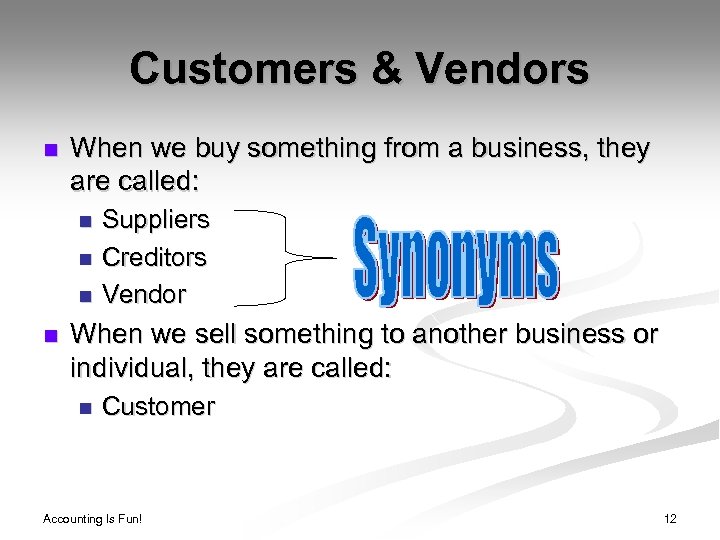 Customers & Vendors n When we buy something from a business, they are called: n n Suppliers Creditors Vendor When we sell something to another business or individual, they are called: n Customer Accounting Is Fun! 12
 Cash Discounts n n n Discounts given as an incentive to pay the bill early Why? Cash is king! n Or, “Cash is Queen! (Why not? ) Seller records as a “Sales Discount” n Reduction in sales Buyer records as a “Purchase Discount” n Reduction in purchases Not all sellers offer cash discounts Accounting Is Fun! 13
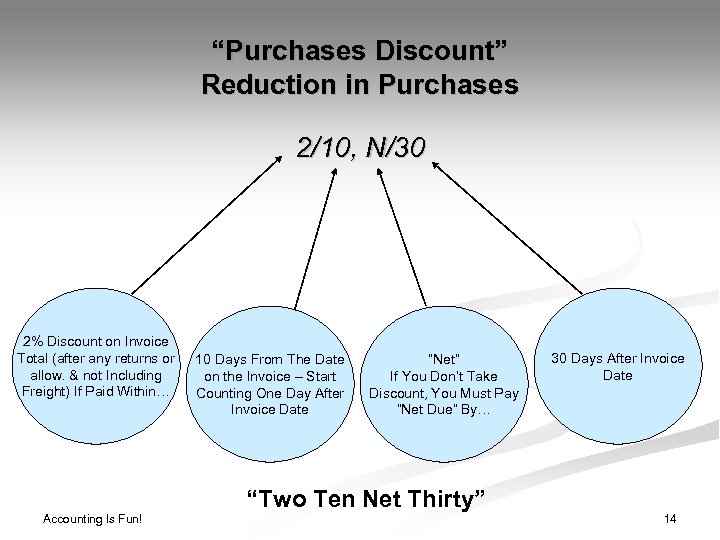 “Purchases Discount” Reduction in Purchases 2/10, N/30 2% Discount on Invoice Total (after any returns or allow. & not Including Freight) If Paid Within… 10 Days From The Date on the Invoice – Start Counting One Day After Invoice Date “Net” If You Don’t Take Discount, You Must Pay “Net Due” By… 30 Days After Invoice Date “Two Ten Net Thirty” Accounting Is Fun! 14
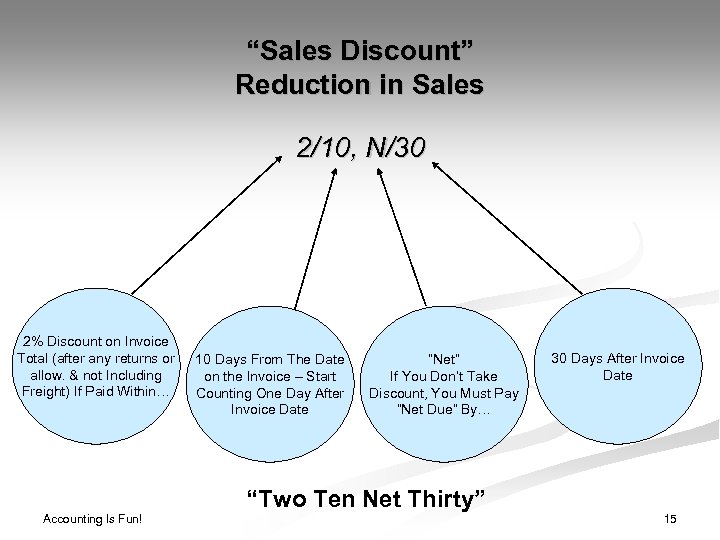 “Sales Discount” Reduction in Sales 2/10, N/30 2% Discount on Invoice Total (after any returns or allow. & not Including Freight) If Paid Within… 10 Days From The Date on the Invoice – Start Counting One Day After Invoice Date “Net” If You Don’t Take Discount, You Must Pay “Net Due” By… 30 Days After Invoice Date “Two Ten Net Thirty” Accounting Is Fun! 15
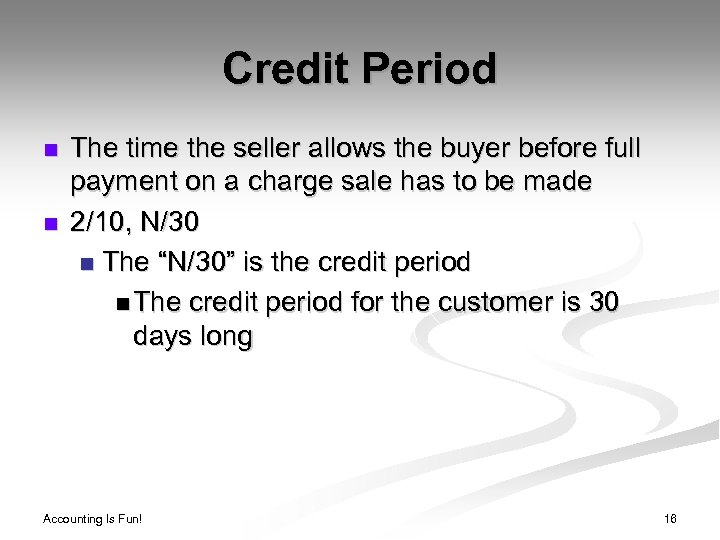 Credit Period n n The time the seller allows the buyer before full payment on a charge sale has to be made 2/10, N/30 n The “N/30” is the credit period n The credit period for the customer is 30 days long Accounting Is Fun! 16
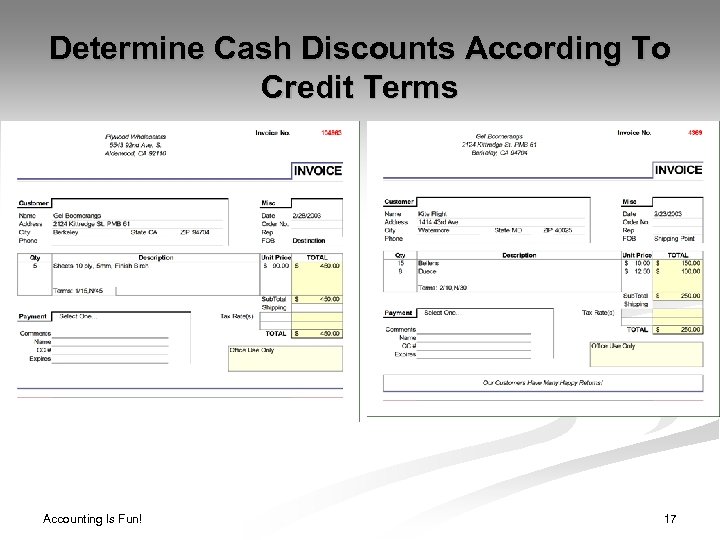 Determine Cash Discounts According To Credit Terms Accounting Is Fun! 17
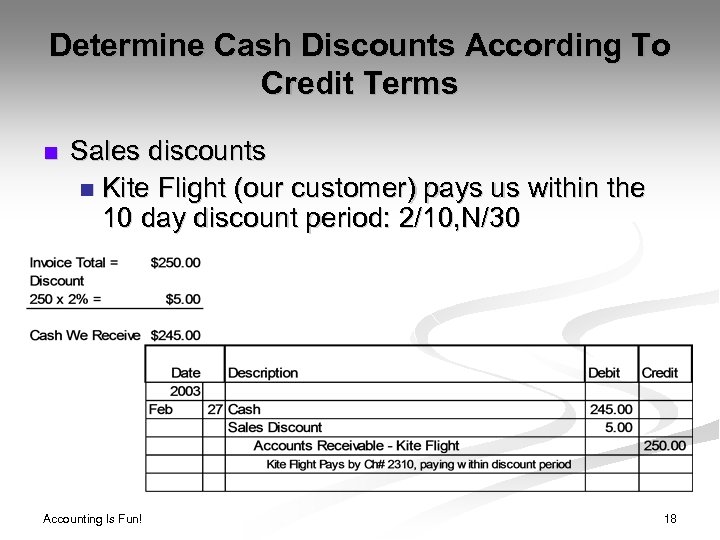 Determine Cash Discounts According To Credit Terms n Sales discounts n Kite Flight (our customer) pays us within the 10 day discount period: 2/10, N/30 Accounting Is Fun! 18
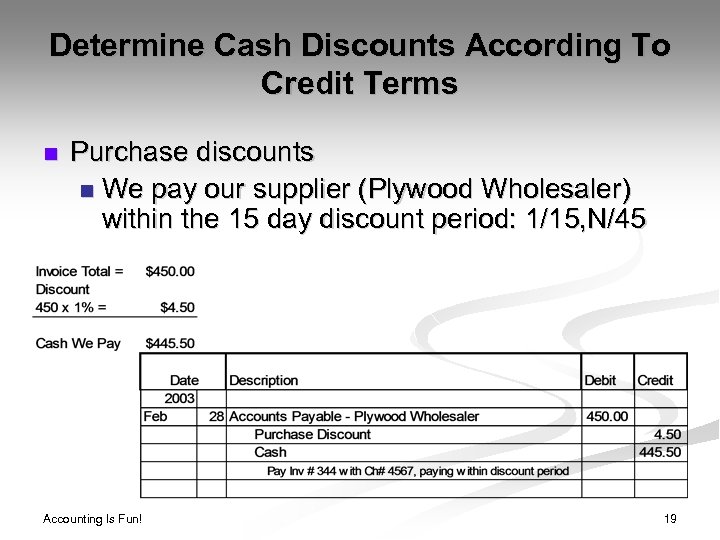 Determine Cash Discounts According To Credit Terms n Purchase discounts n We pay our supplier (Plywood Wholesaler) within the 15 day discount period: 1/15, N/45 Accounting Is Fun! 19
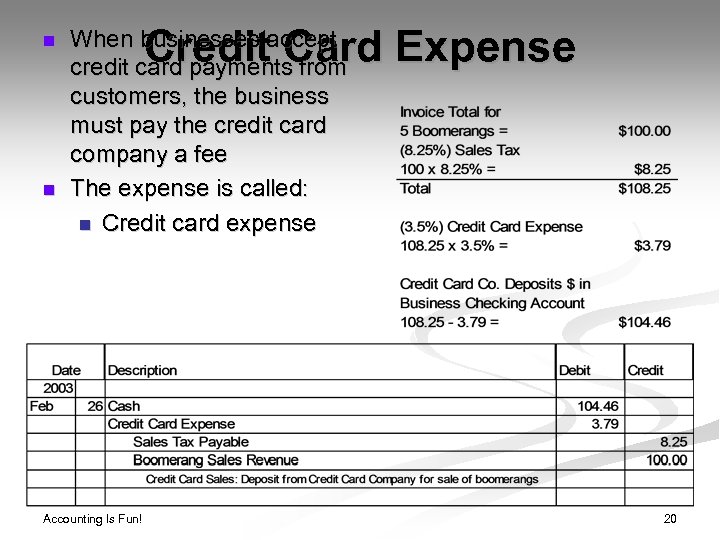 n n Credit Card Expense When businesses accept credit card payments from customers, the business must pay the credit card company a fee The expense is called: n Credit card expense Accounting Is Fun! 20
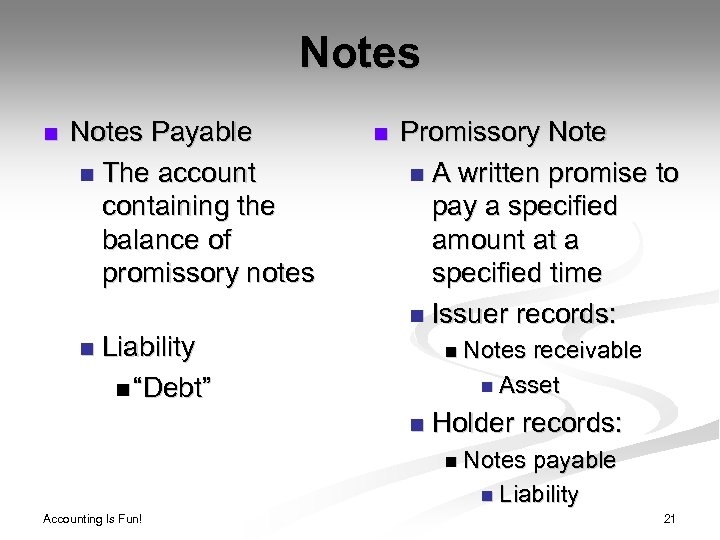 Notes n Notes Payable n The account containing the balance of promissory notes n n Promissory Note n A written promise to pay a specified amount at a specified time n Issuer records: Liability n “Debt” n Notes receivable n Asset n Holder records: n Notes payable n Liability Accounting Is Fun! 21
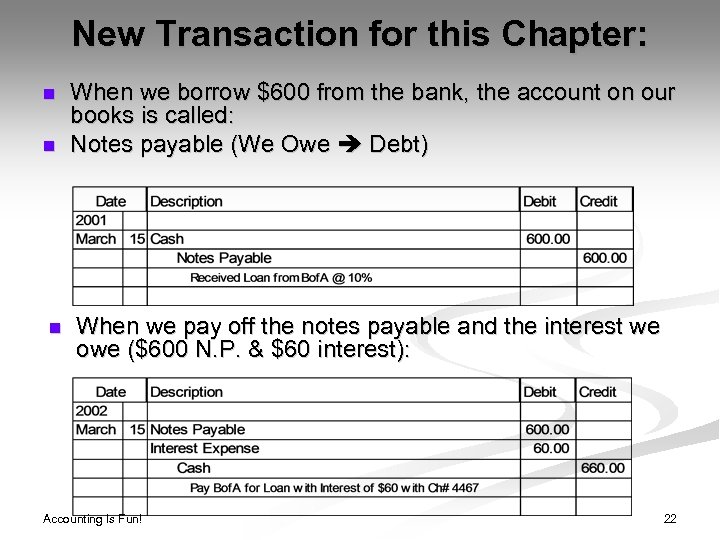 New Transaction for this Chapter: n n n When we borrow $600 from the bank, the account on our books is called: Notes payable (We Owe Debt) When we pay off the notes payable and the interest we owe ($600 N. P. & $60 interest): Accounting Is Fun! 22
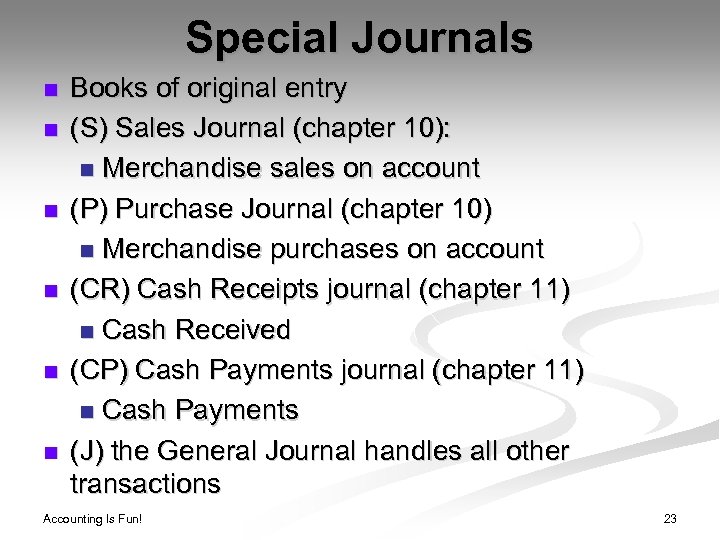 Special Journals n n n Books of original entry (S) Sales Journal (chapter 10): n Merchandise sales on account (P) Purchase Journal (chapter 10) n Merchandise purchases on account (CR) Cash Receipts journal (chapter 11) n Cash Received (CP) Cash Payments journal (chapter 11) n Cash Payments (J) the General Journal handles all other transactions Accounting Is Fun! 23
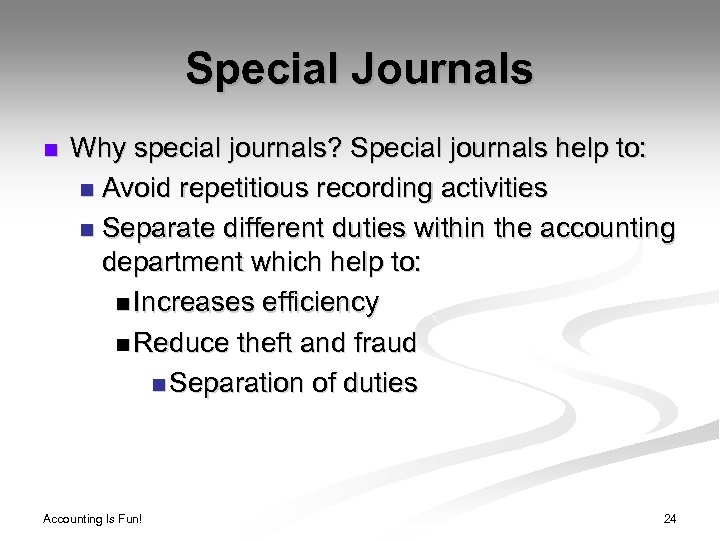 Special Journals n Why special journals? Special journals help to: n Avoid repetitious recording activities n Separate different duties within the accounting department which help to: n Increases efficiency n Reduce theft and fraud n Separation of duties Accounting Is Fun! 24
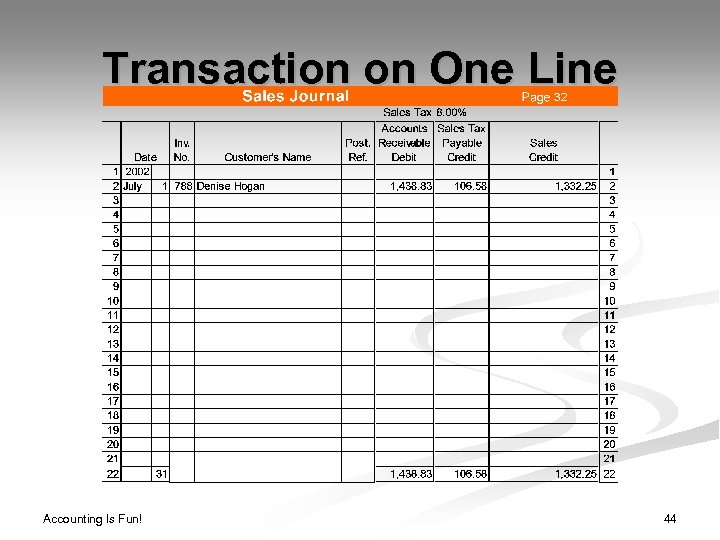
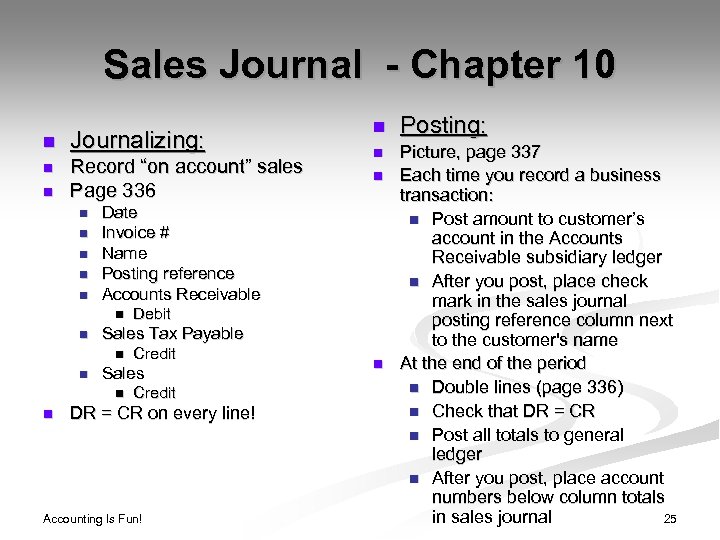 Sales Journal - Chapter 10 n Journalizing: n Record “on account” sales Page 336 n n n Picture, page 337 Each time you record a business transaction: n Post amount to customer’s account in the Accounts Receivable subsidiary ledger n After you post, place check mark in the sales journal posting reference column next to the customer's name At the end of the period n Double lines (page 336) n Check that DR = CR n Post all totals to general ledger n After you post, place account numbers below column totals in sales journal 25 n Debit Credit Sales n n n Sales Tax Payable n n Posting: Date Invoice # Name Posting reference Accounts Receivable n n n Credit DR = CR on every line! Accounting Is Fun! n
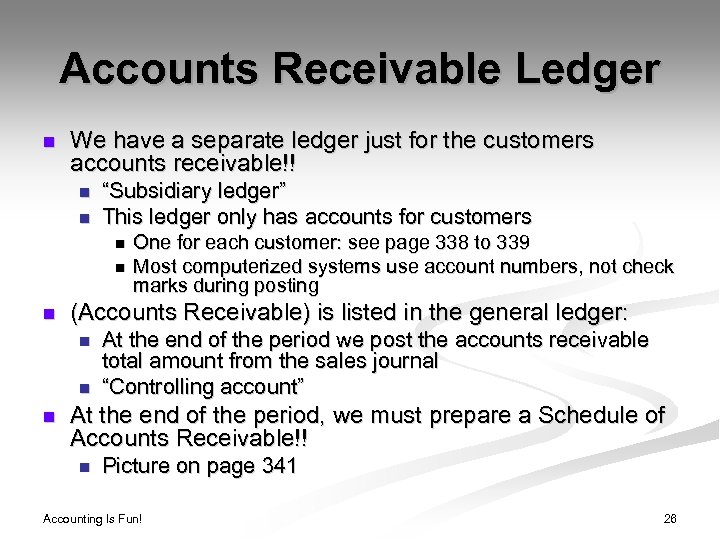 Accounts Receivable Ledger n We have a separate ledger just for the customers accounts receivable!! n n “Subsidiary ledger” This ledger only has accounts for customers n n n (Accounts Receivable) is listed in the general ledger: n n n One for each customer: see page 338 to 339 Most computerized systems use account numbers, not check marks during posting At the end of the period we post the accounts receivable total amount from the sales journal “Controlling account” At the end of the period, we must prepare a Schedule of Accounts Receivable!! n Picture on page 341 Accounting Is Fun! 26
 Purchase Journal - Chapter 10 n n n The Purchase Journal is the flip-side of the Sales Journal The company selling uses the Sales Journal (chapter 10) The company buying uses the Purchase Journal (chapter 10) Do companies use both? Yes! Accounting Is Fun! 27
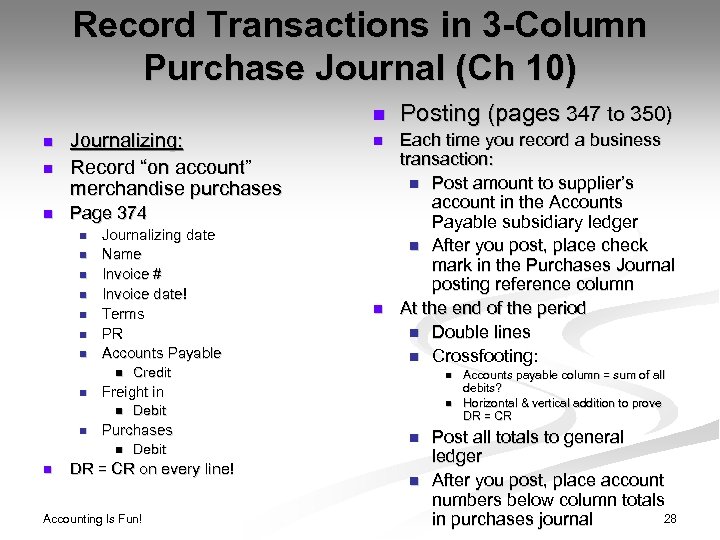 Record Transactions in 3 -Column Purchase Journal (Ch 10) n n Journalizing: Record “on account” merchandise purchases n Posting (pages 347 to 350) n Each time you record a business transaction: n Post amount to supplier’s account in the Accounts Payable subsidiary ledger n After you post, place check mark in the Purchases Journal posting reference column At the end of the period n Double lines n Crossfooting: Page 374 n n n n Journalizing date Name Invoice # Invoice date! Terms PR Accounts Payable n n n Debit Purchases n n n Freight in n n Credit n Debit DR = CR on every line! Accounting Is Fun! n n Accounts payable column = sum of all debits? Horizontal & vertical addition to prove DR = CR Post all totals to general ledger After you post, place account numbers below column totals 28 in purchases journal
 Accounts Payable Ledger n We have a separate ledger just for the suppliers’ accounts payable! n n “Subsidiary ledger” This ledger only has accounts for suppliers n n n (Accounts Payable) is listed in the general ledger: n n n One for each supplier: see page 349 to 350 Most computerized systems use account numbers, not check marks during posting At the end of the period we post the accounts payable total amount from the purchase journal “Controlling account” At the end of the period, we must prepare a Schedule of Accounts Payable! n Picture on page 350 Accounting Is Fun! 29
 Journalize “Sales Returns & Allowances” n n n “Sales Returns & Allowances” n Contra revenue n Reduces the sales revenue account Credit memorandums (example page 342) n “Written statement indicating a seller’s willingness to reduce the amount of the buyer’s debt. ” Seller says to customer: “I'll reduce the amount you owe us. ” Dodson Plumbing Supply tells Barlow that they will reduce the amount he owns them by $54. 00 Journal entry: credit Accounts Receivable, debit “Sales Returns & Allowances” Why is it called “credit” memorandum? n Because it’s from the seller’s point of view n Credit to Accounts Receivable! Accounting Is Fun! 30
 Post “Sales Returns & Allowances” n Post “Sales Returns & Allowances” to “Sales Returns & Allowances” account Then post twice to the Account Receivable accounts What do you mean I have to post twice? Page 343 n Because we have to post once to the Account Receivable in the General Ledger & once to the customer’s individual Accounts Receivable in the Accounts Receivable subsidiary ledger 113/√ n n Accounting Is Fun! 31
 Journalize and Post “Sales Returns & Allowances” n n Returns involving sales tax Page 344 Accounting Is Fun! 32
 Journalize Transactions Involving “Purchase Returns & Allowances” in General Journal n Flip side of Sales Returns & Allowances n n The buyer receives a credit memorandum n n n Page 351 – good t-account example Journalizing & posting – page 352 Must post to both: n n n Excellent note left upper corner page 351 Accounts Payable (control account) in General Ledger Individual’s Accounts Payable in Accounts Payable subsidiary ledger 221/√ Accounting Is Fun! 33
 Cash Receipts Journal (Ch 11) n n Contains all transactions in which cash is received All debits to cash! If you receive cash, you must put it here! Example on page 384 n Each line represents a transaction where we receive cash n DR = CR for each line n All the way at the end: n n n At the end of the period: n Date for last day n Single line before totaling n Double line after totals n Post all the column totals n n n After posting, place account # under column totals Place “X” under “other accounts” to indicate that you already posted these amounts Make sure that DR = CR Cash debit Credit card debit All the rest are credits Post after each journal entry: n Accounts Receivable (PR = √) n “other accounts” (PR = # for that account) n n Accounting Is Fun! 34
 Cash Payments Journal (Ch 11) n n n Contains all transactions in which cash goes out, or is paid out All credits to cash! If you pay cash, you must put it here! Remember rule about cash: n Always pay with a check! Example on page 391 n Each line represents a transaction where we write a check to pay cash n Date n List checks in consecutive order (even void checks) n Name of account debited n All the way at the end n Cash credit n Purchase discount credit n All the rest are debits n DR = CR for each line Accounting Is Fun! n n Post after each journal entry: Accounts Payable (PR = √) “other accounts” (PR = # for that account) At the end of the period: n Date for last day n Single line before totaling n Double line after totals n Post all the column totals n After posting, place account # under column totals n Place “X” under “other accounts” to indicate that you already posted these amounts n Make sure that DR = CR 35
 Check & Deposit Register n When we do Spa Magic, in addition to the cash receipts and cash payments journals, we will have to record all checking account activity in a checkbook register Accounting Is Fun! 36
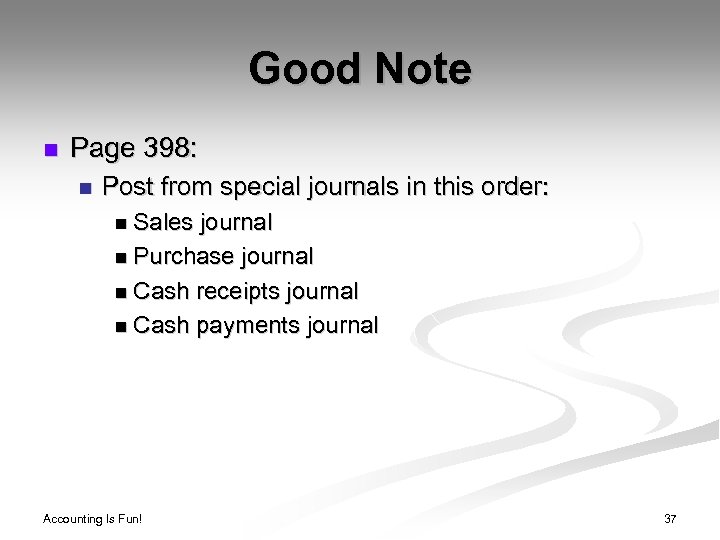 Good Note n Page 398: n Post from special journals in this order: n Sales journal n Purchase journal n Cash receipts journal n Cash payments journal Accounting Is Fun! 37
 Review Of Chapter 10 & 11 n Sales Journal n Purchase Journal n Cash Receipts Journal n Cash Payments Journal Accounting Is Fun! 38
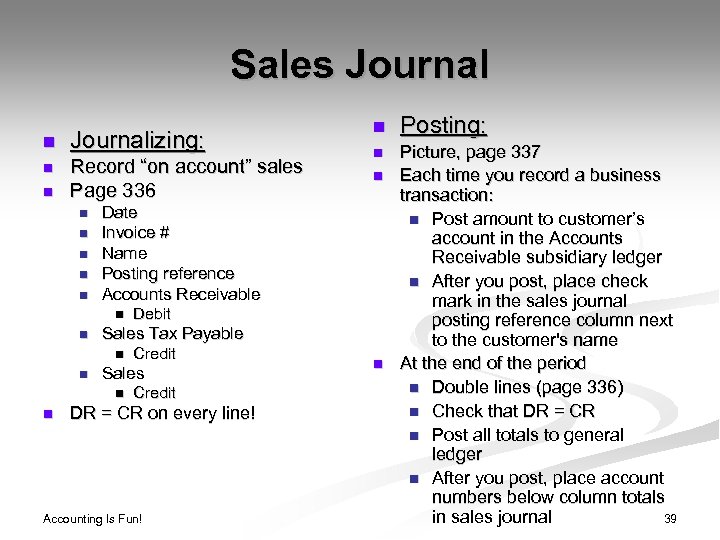 Sales Journal n Journalizing: n Record “on account” sales Page 336 n n n Picture, page 337 Each time you record a business transaction: n Post amount to customer’s account in the Accounts Receivable subsidiary ledger n After you post, place check mark in the sales journal posting reference column next to the customer's name At the end of the period n Double lines (page 336) n Check that DR = CR n Post all totals to general ledger n After you post, place account numbers below column totals in sales journal 39 n Debit Credit Sales n n n Sales Tax Payable n n Posting: Date Invoice # Name Posting reference Accounts Receivable n n n Credit DR = CR on every line! Accounting Is Fun! n
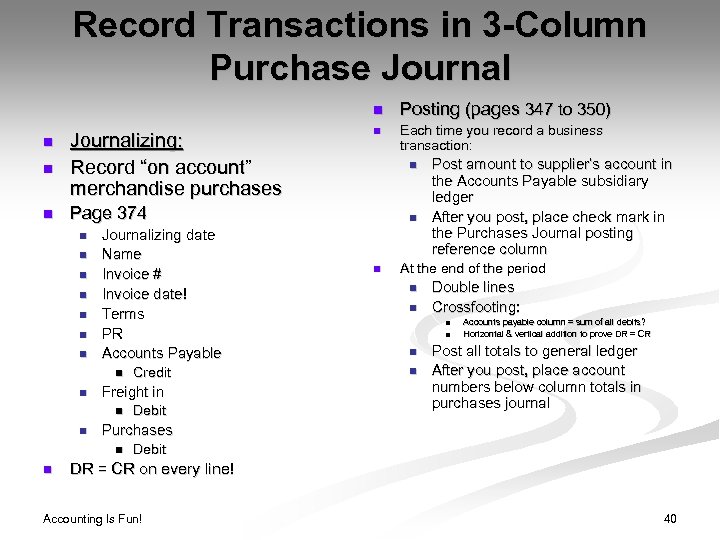 Record Transactions in 3 -Column Purchase Journal n n Journalizing: Record “on account” merchandise purchases n Posting (pages 347 to 350) n Each time you record a business transaction: Page 374 n n n n Journalizing date Name Invoice # Invoice date! Terms PR Accounts Payable n n Freight in n n Debit n n Post amount to supplier’s account in the Accounts Payable subsidiary ledger After you post, place check mark in the Purchases Journal posting reference column At the end of the period n n Double lines Crossfooting: n n Accounts payable column = sum of all debits? Horizontal & vertical addition to prove DR = CR Post all totals to general ledger After you post, place account numbers below column totals in purchases journal Purchases n n Credit n Debit DR = CR on every line! Accounting Is Fun! 40
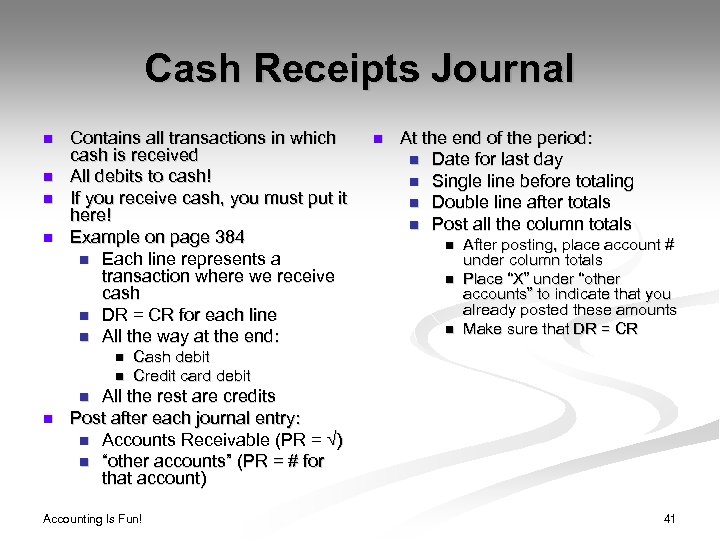 Cash Receipts Journal n n Contains all transactions in which cash is received All debits to cash! If you receive cash, you must put it here! Example on page 384 n Each line represents a transaction where we receive cash n DR = CR for each line n All the way at the end: n n n At the end of the period: n Date for last day n Single line before totaling n Double line after totals n Post all the column totals n n n After posting, place account # under column totals Place “X” under “other accounts” to indicate that you already posted these amounts Make sure that DR = CR Cash debit Credit card debit All the rest are credits Post after each journal entry: n Accounts Receivable (PR = √) n “other accounts” (PR = # for that account) n n Accounting Is Fun! 41
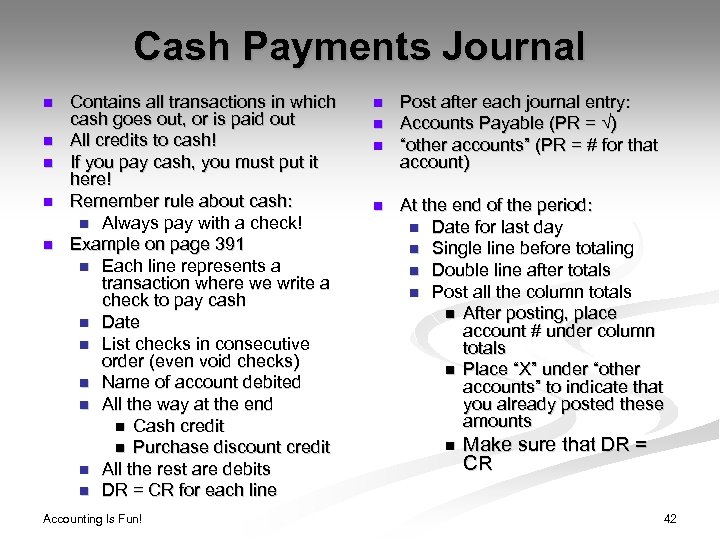 Cash Payments Journal n n n Contains all transactions in which cash goes out, or is paid out All credits to cash! If you pay cash, you must put it here! Remember rule about cash: n Always pay with a check! Example on page 391 n Each line represents a transaction where we write a check to pay cash n Date n List checks in consecutive order (even void checks) n Name of account debited n All the way at the end n Cash credit n Purchase discount credit n All the rest are debits n DR = CR for each line Accounting Is Fun! n n Post after each journal entry: Accounts Payable (PR = √) “other accounts” (PR = # for that account) At the end of the period: n Date for last day n Single line before totaling n Double line after totals n Post all the column totals n After posting, place account # under column totals n Place “X” under “other accounts” to indicate that you already posted these amounts n Make sure that DR = CR 42
 Demonstration Problem n n Journalize and post one transaction in the sales journal Look at a schedule of accounts receivable Accounting Is Fun! 43
 Transaction on One Line Accounting Is Fun! 44
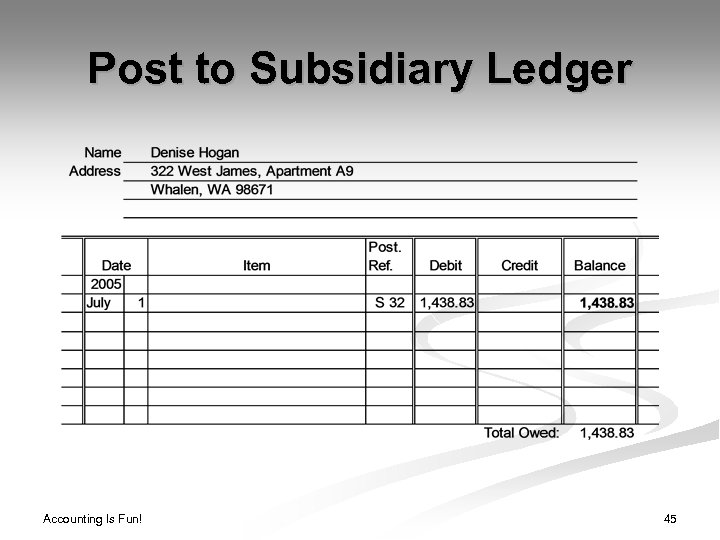 Post to Subsidiary Ledger Accounting Is Fun! 45
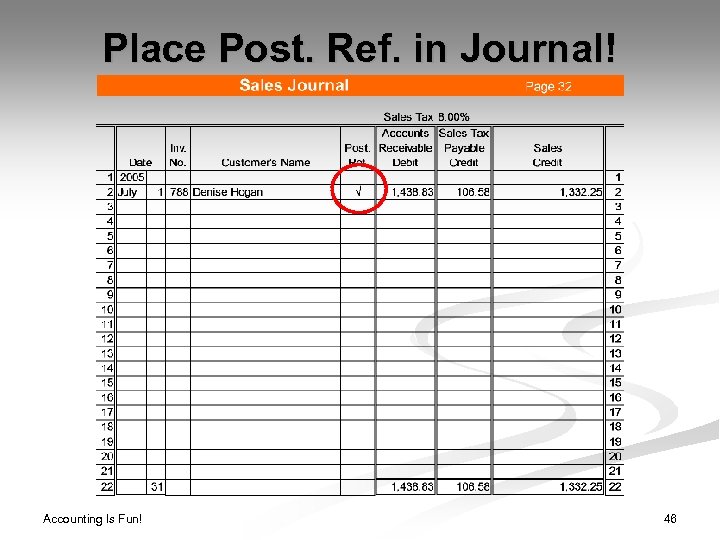 Place Post. Ref. in Journal! Accounting Is Fun! 46
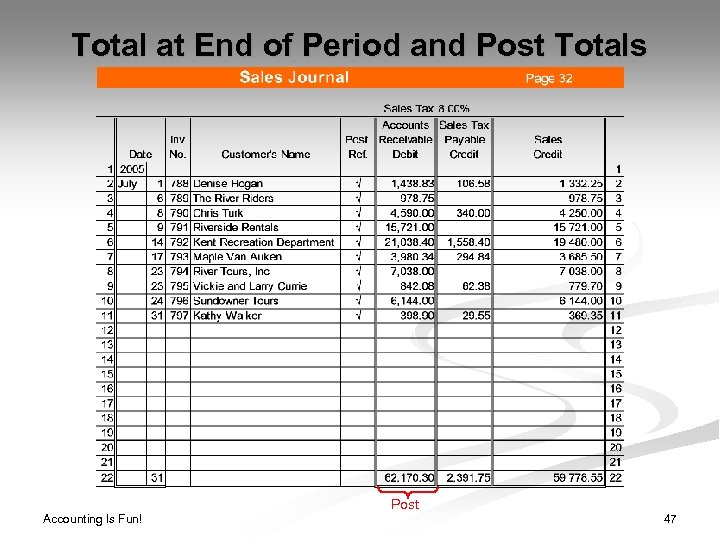 Total at End of Period and Post Totals Post Accounting Is Fun! 47
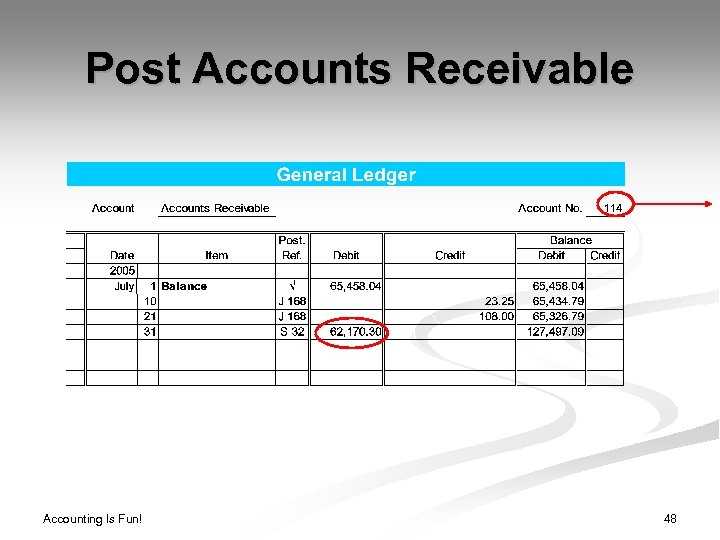 Post Accounts Receivable Accounting Is Fun! 48
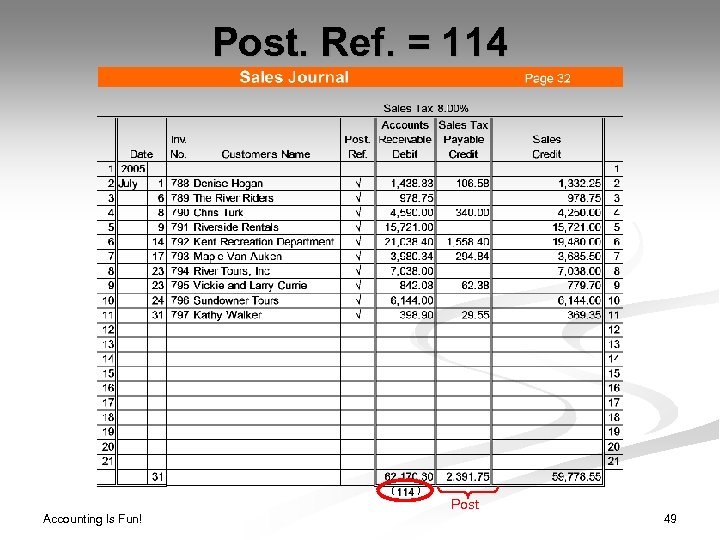 Post. Ref. = 114 ( ) Post Accounting Is Fun! 49
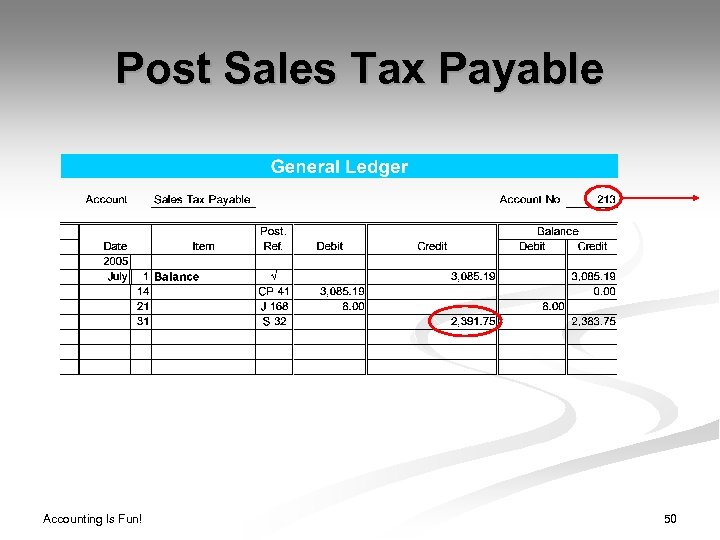 Post Sales Tax Payable Accounting Is Fun! 50
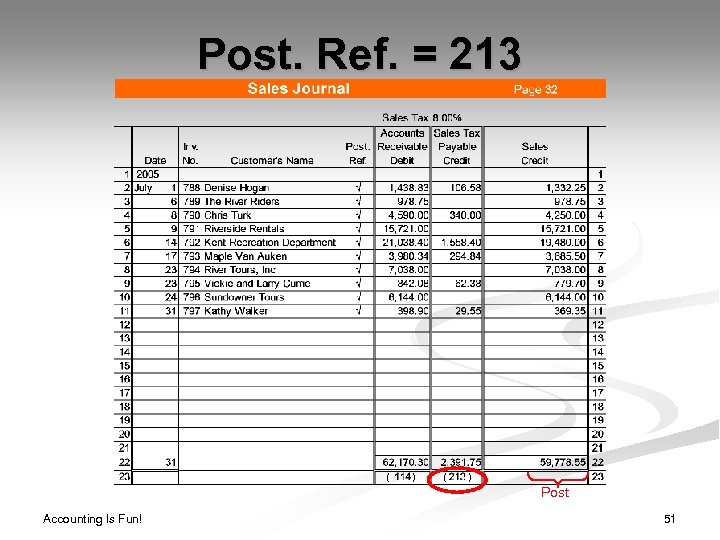 Post. Ref. = 213 ( ) Post Accounting Is Fun! 51
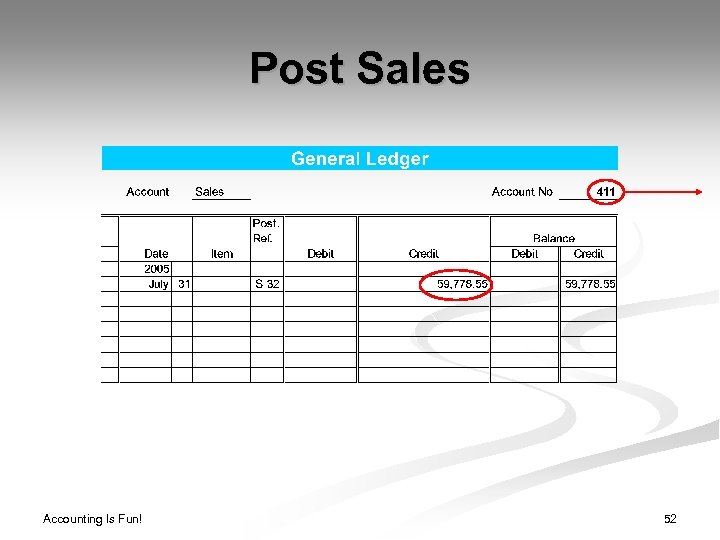 Post Sales Accounting Is Fun! 52
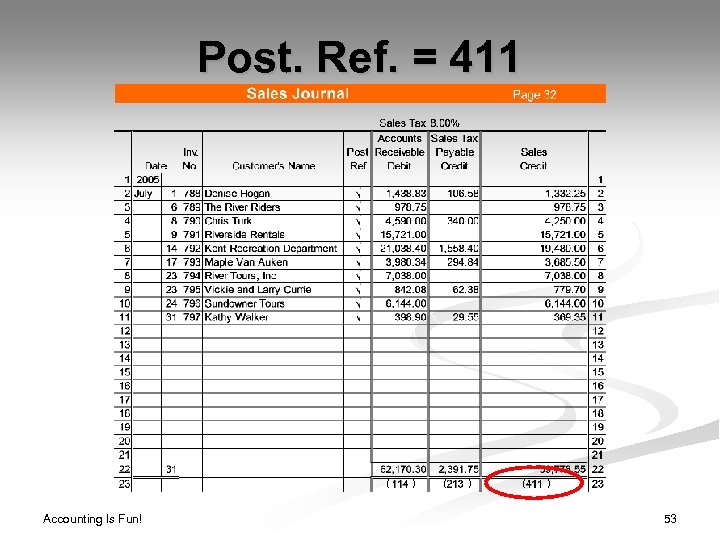 Post. Ref. = 411 ( Accounting Is Fun! ) ( ) 53
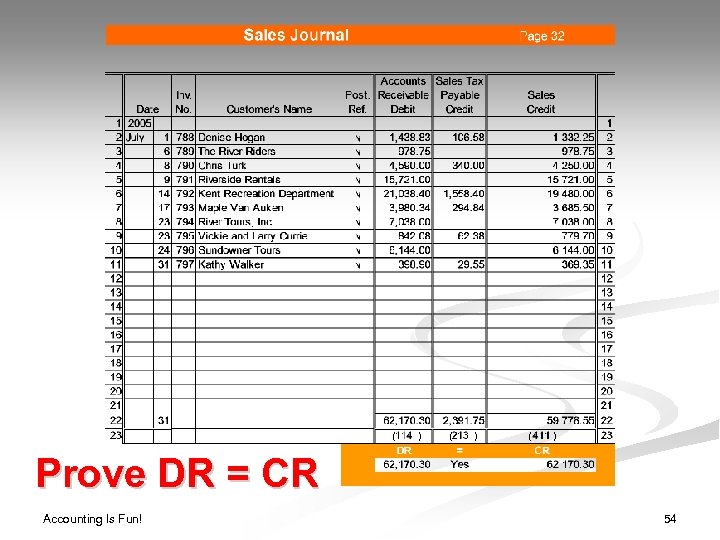 ( ) ( ) Prove DR = CR Accounting Is Fun! 54
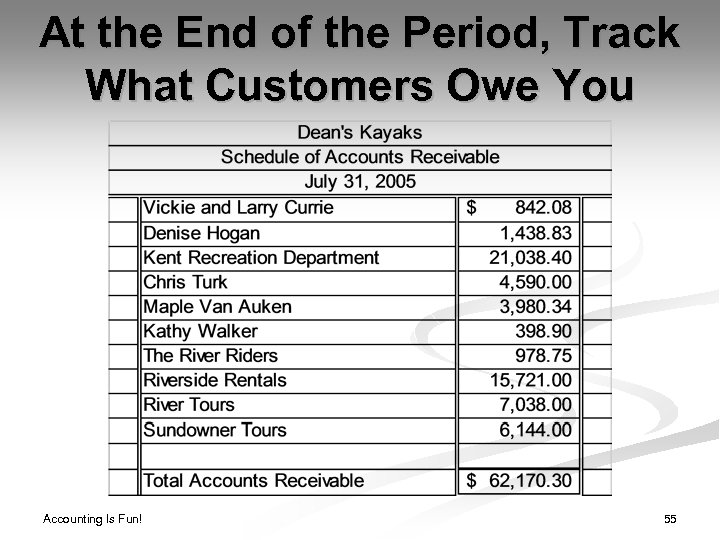 At the End of the Period, Track What Customers Owe You Accounting Is Fun! 55
 Demonstration Problem n We will journalize and post a transaction in the cash payments journal Accounting Is Fun! 56
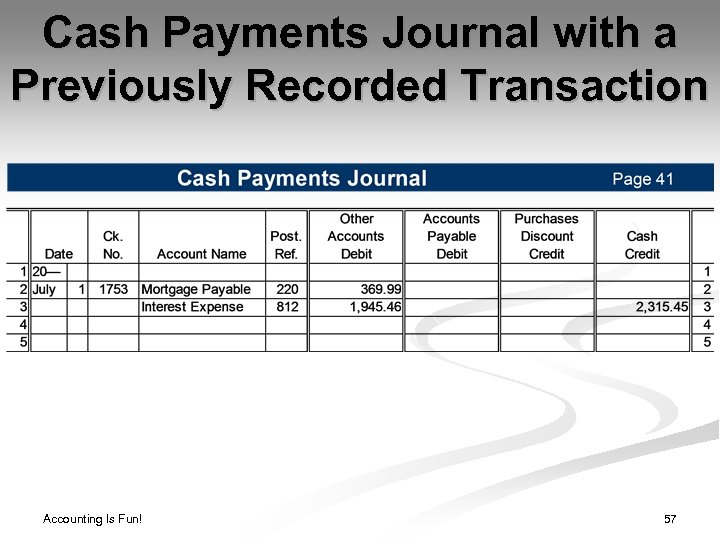 Cash Payments Journal with a Previously Recorded Transaction Accounting Is Fun! 57
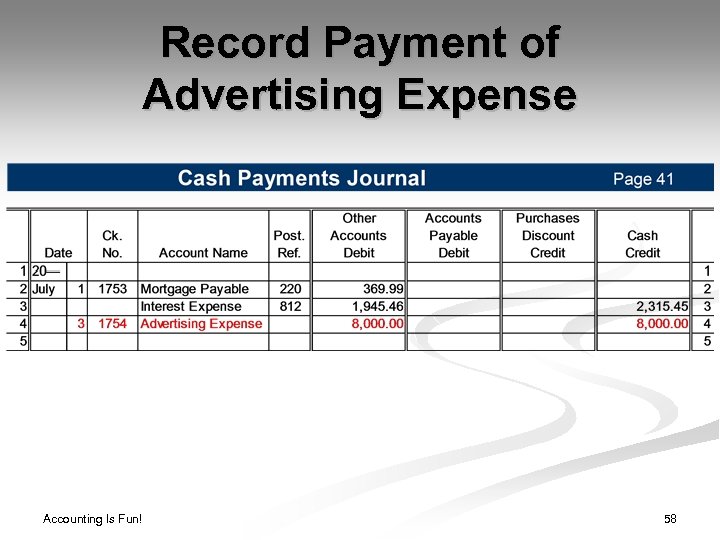 Record Payment of Advertising Expense Accounting Is Fun! 58
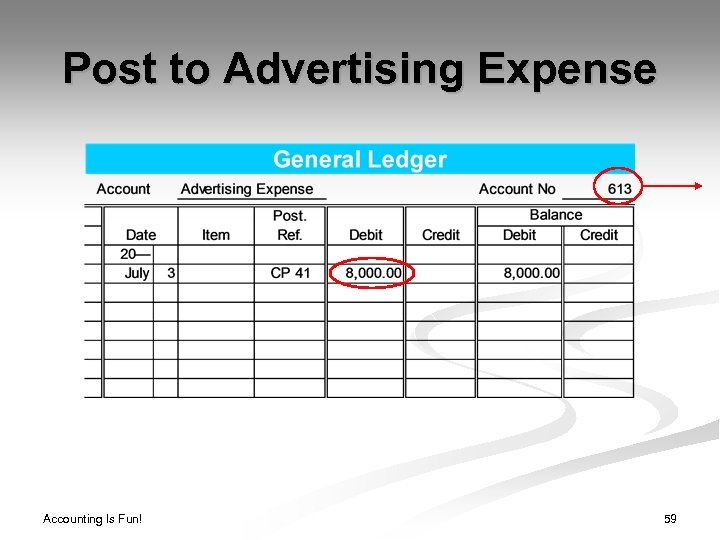 Post to Advertising Expense Accounting Is Fun! 59
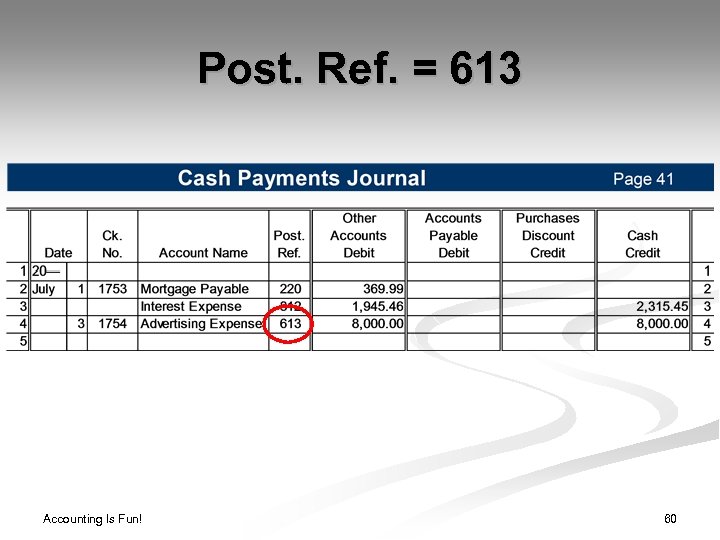 Post. Ref. = 613 Accounting Is Fun! 60
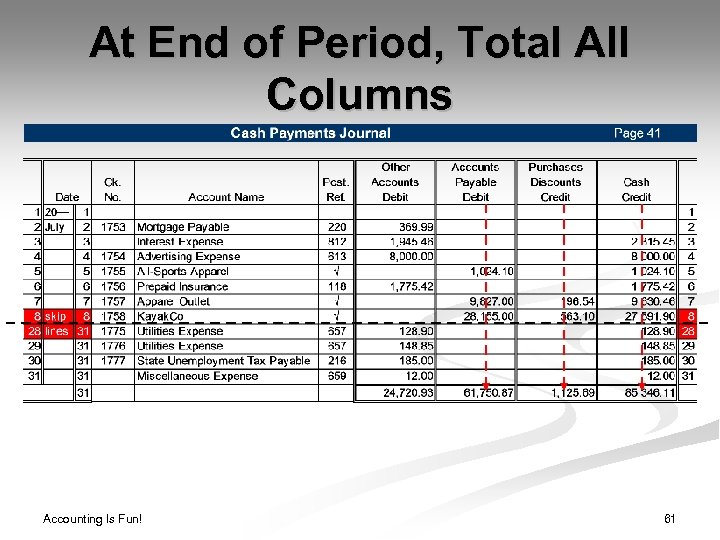 At End of Period, Total All Columns Accounting Is Fun! 61
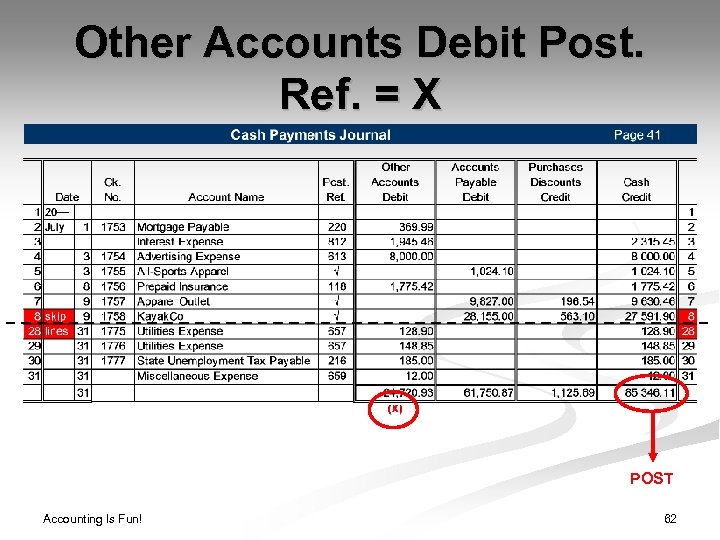 Other Accounts Debit Post. Ref. = X POST Accounting Is Fun! 62
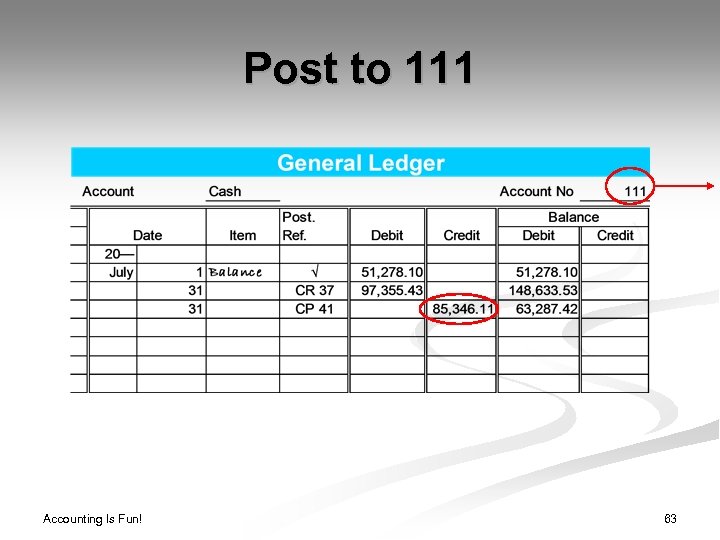 Post to 111 Accounting Is Fun! 63
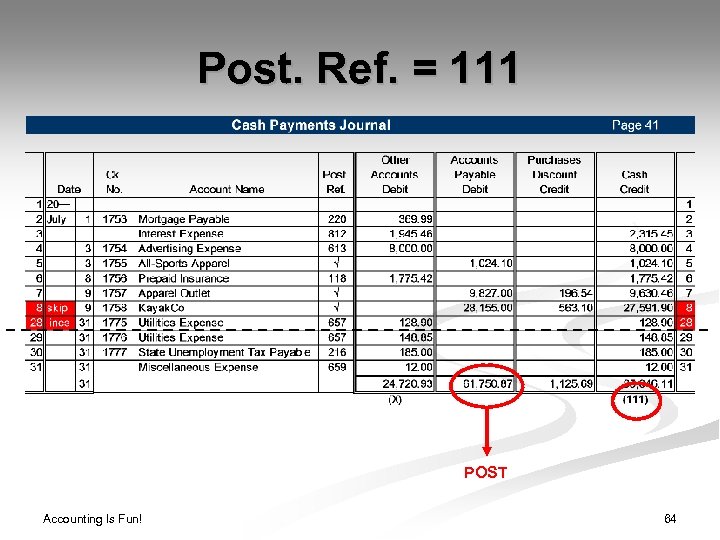 Post. Ref. = 111 POST Accounting Is Fun! 64
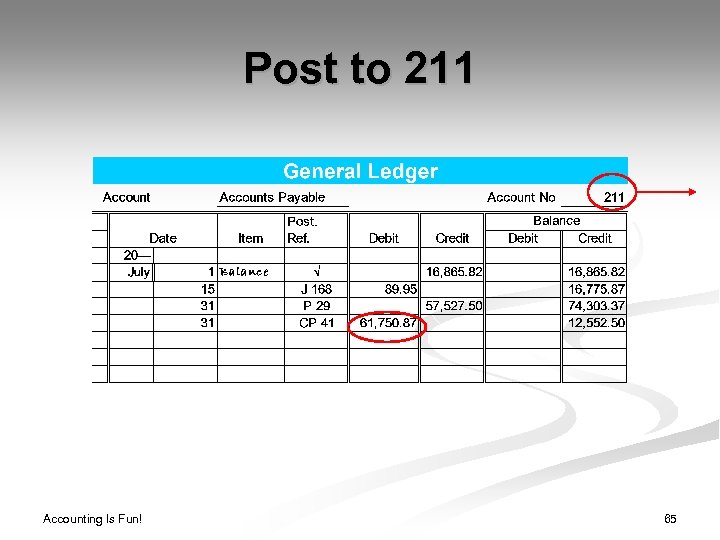 Post to 211 Accounting Is Fun! 65
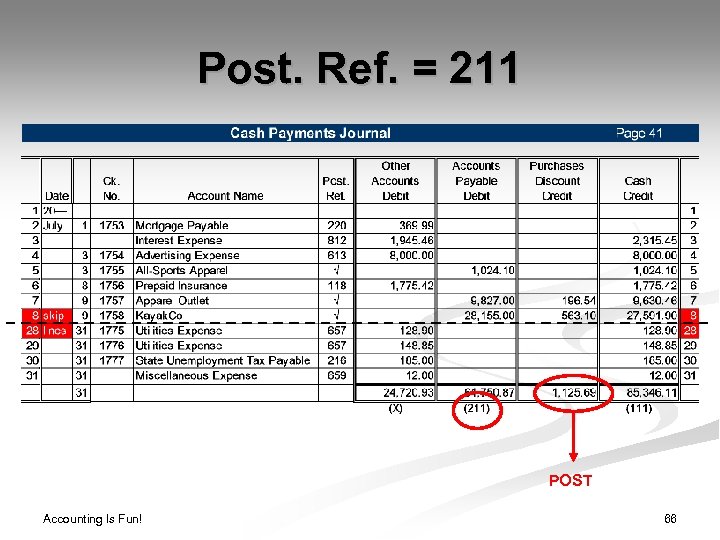 Post. Ref. = 211 POST Accounting Is Fun! 66
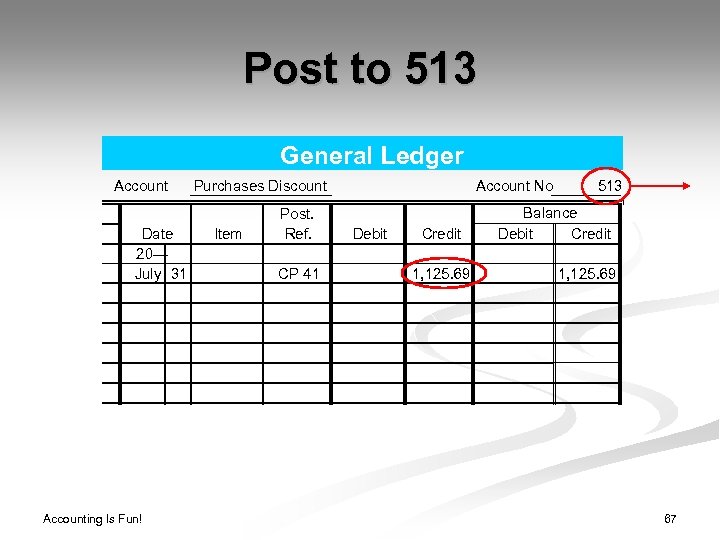 Post to 513 General Ledger Account Date 20— July 31 Accounting Is Fun! Purchases Discount Item Post. Ref. CP 41 Account No Debit Credit 1, 125. 69 513 Balance Debit Credit 1, 125. 69 67
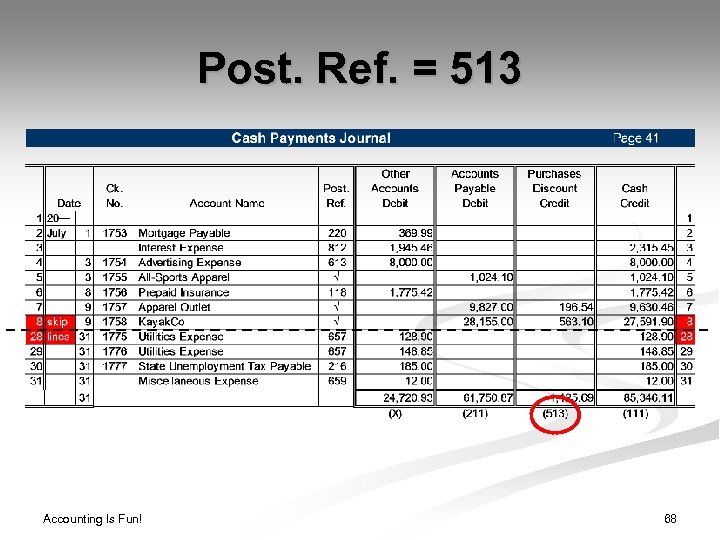 Post. Ref. = 513 Accounting Is Fun! 68
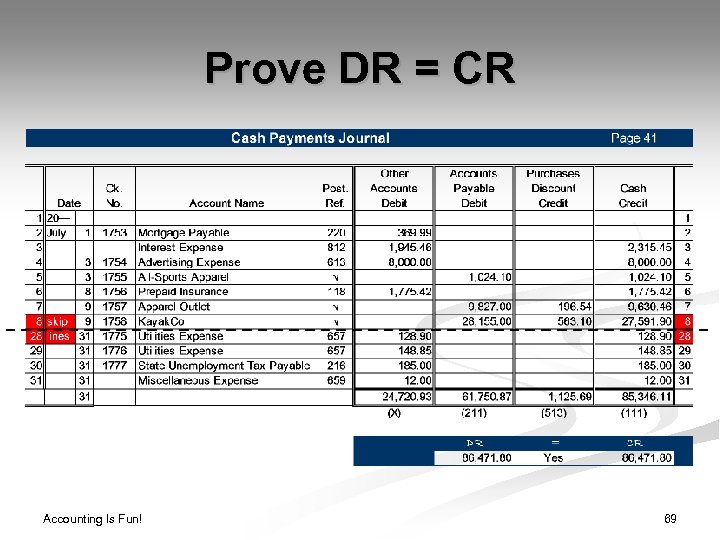 Prove DR = CR Accounting Is Fun! 69