


 Скачать презентацию Chapter 1 What is strategy and why do
d96ecb4dc72b00919c9655a96e8eda80.ppt
- Количество слайдов: 38
 Chapter 1 What is strategy and why do you have it?
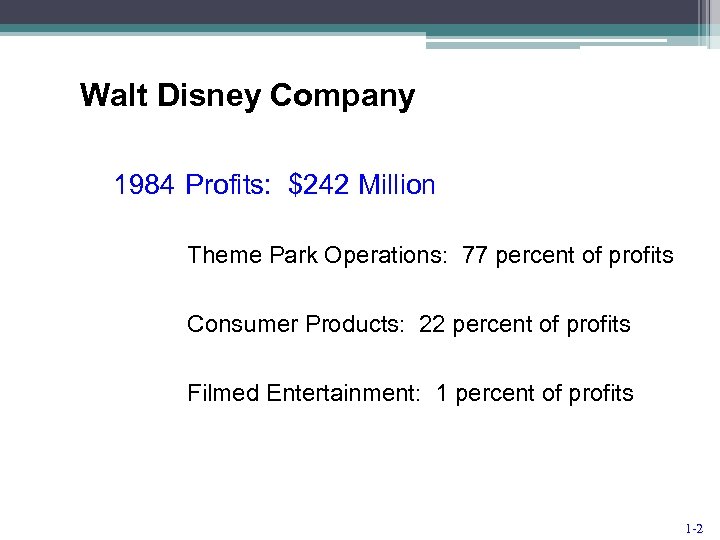 Walt Disney Company 1984 Profits: $242 Million Theme Park Operations: 77 percent of profits Consumer Products: 22 percent of profits Filmed Entertainment: 1 percent of profits 1 -2
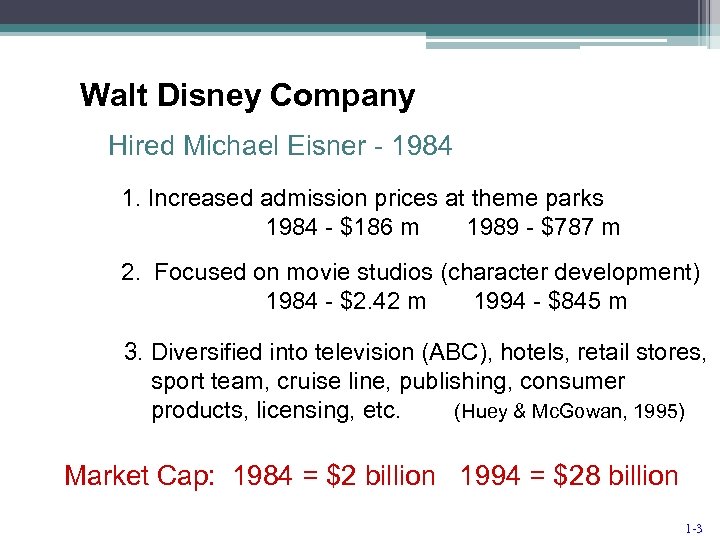 Walt Disney Company Hired Michael Eisner - 1984 1. Increased admission prices at theme parks 1984 - $186 m 1989 - $787 m 2. Focused on movie studios (character development) 1984 - $2. 42 m 1994 - $845 m 3. Diversified into television (ABC), hotels, retail stores, sport team, cruise line, publishing, consumer products, licensing, etc. (Huey & Mc. Gowan, 1995) Market Cap: 1984 = $2 billion 1994 = $28 billion 1 -3
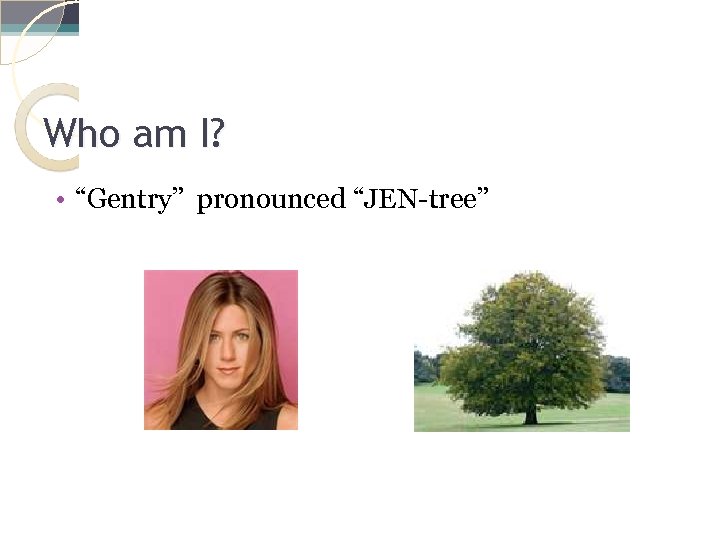 Who am I? • “Gentry” pronounced “JEN-tree” 1 -4
 Experience • I have been studying Strategic Management/Entrepreneurship for the last 10 (cough) years both as a Ph. D and an MBA. • I have studied in Holland as well as UF. • I have also lectured in Nigeria, London, and various domestic conference. • I am a Kauffman Entrepreneurship Fellow 1 -5
 Definition of Strategy: A firm’s theory about how to gain competitive advantages Eisner’s theory may have been: People will pay a premium price for extraordinary entertainment. We have the necessary resources to create extraordinary entertainment. Therefore, let’s redeploy our resources in a different way and offer something extraordinary to people. 1 -6
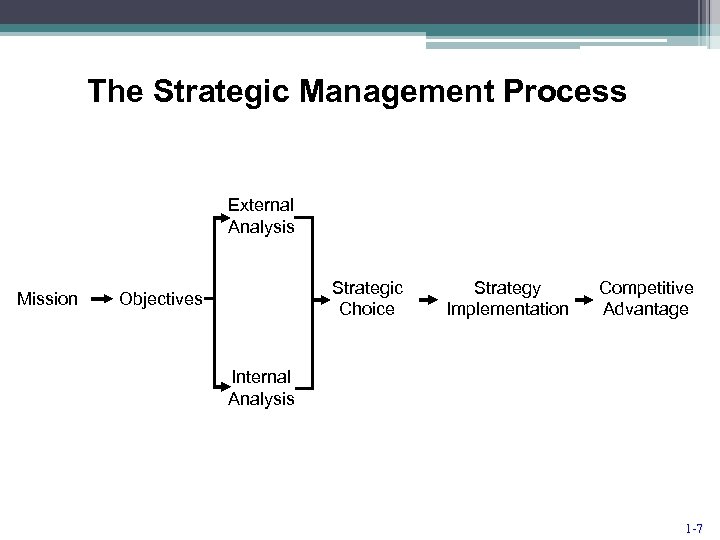 The Strategic Management Process External Analysis Mission Strategic Choice Objectives Strategy Implementation Competitive Advantage Internal Analysis 1 -7
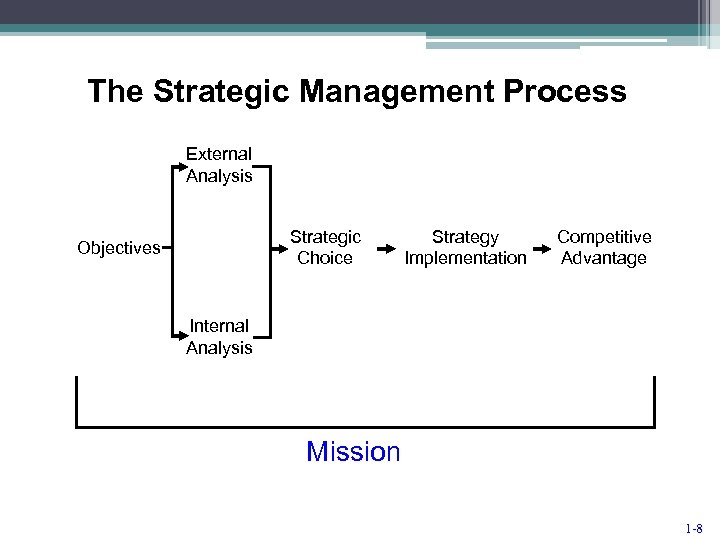 The Strategic Management Process External Analysis Strategic Choice Objectives Strategy Implementation Competitive Advantage Internal Analysis Mission 1 -8
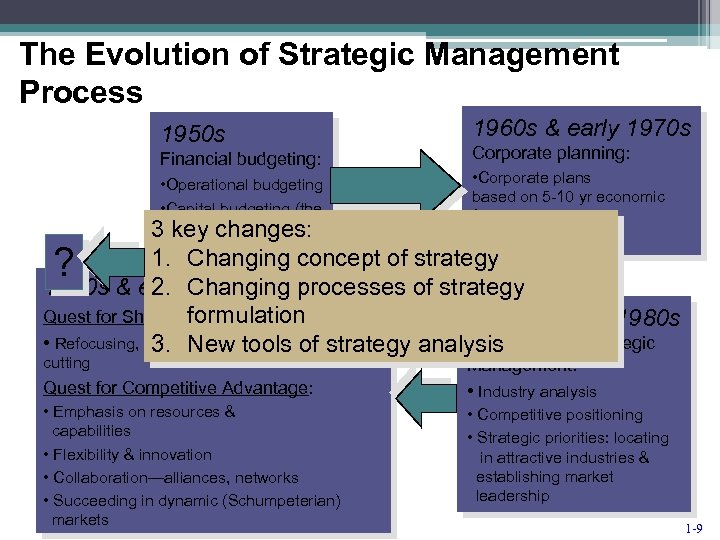 The Evolution of Strategic Management Process 1950 s Financial budgeting: • Operational budgeting • Capital budgeting (the 3 wonders of DCF) key changes: 1960 s & early 1970 s Corporate planning: • Corporate plans based on 5 -10 yr economic forecasts • Diversification 1. strategy ? & early. Changing concept of of strategy 2. Changing processes 1990 s 2000 s Quest for Shareholder Value: formulation • Refocusing, outsourcing, delayering, cost 3. New tools of strategy cutting Quest for Competitive Advantage: • Emphasis on resources & capabilities • Flexibility & innovation • Collaboration—alliances, networks • Succeeding in dynamic (Schumpeterian) markets Late 1970 s & 1980 s Emergence of Strategic analysis Management: • Industry analysis • Competitive positioning • Strategic priorities: locating in attractive industries & establishing market leadership 1 -9
 Segment 2 Where are we headed? 1 -11
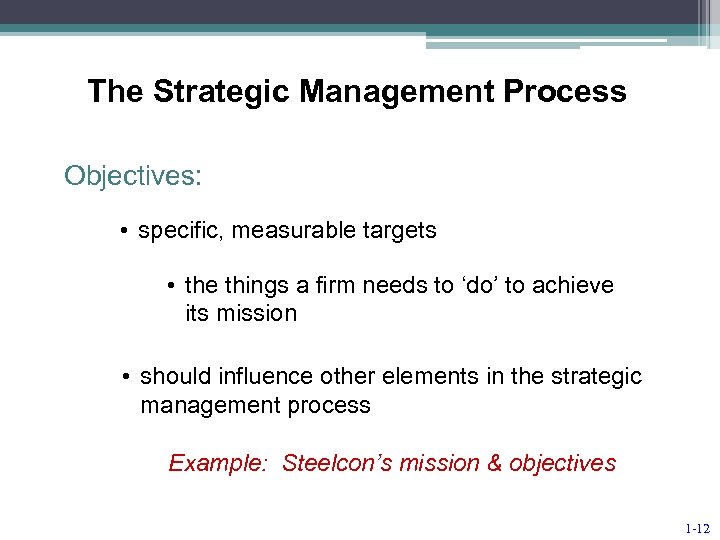 The Strategic Management Process Objectives: • specific, measurable targets • the things a firm needs to ‘do’ to achieve its mission • should influence other elements in the strategic management process Example: Steelcon’s mission & objectives 1 -12
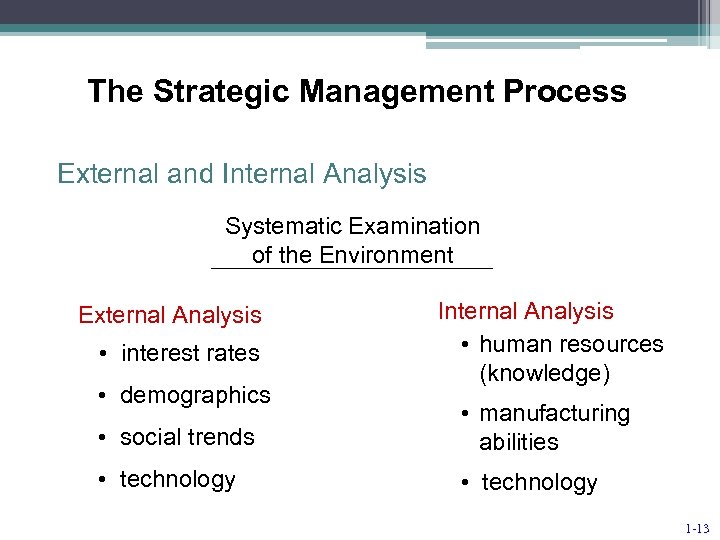 The Strategic Management Process External and Internal Analysis Systematic Examination of the Environment External Analysis • interest rates • demographics Internal Analysis • human resources (knowledge) • social trends • manufacturing abilities • technology 1 -13
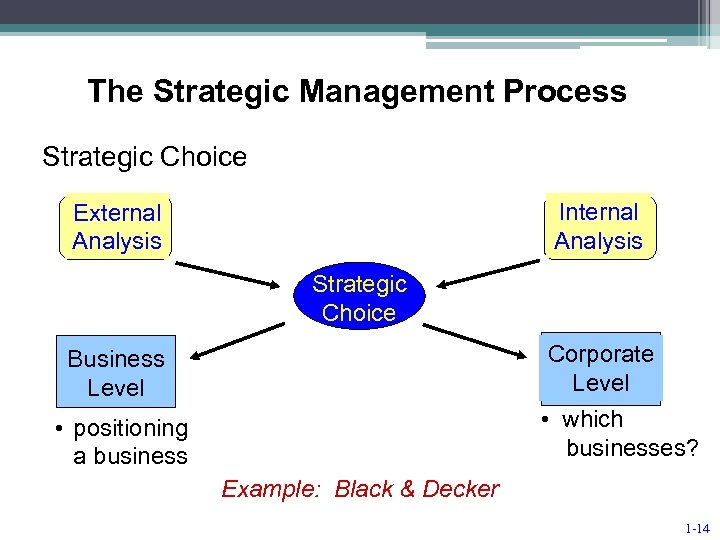 The Strategic Management Process Strategic Choice Internal Analysis External Analysis Strategic Choice Corporate Level Business Level • which businesses? • positioning a business Example: Black & Decker 1 -14
 The Strategic Management Process Strategy Implementation • how strategies are carried out • who will do what • organizational structure and control • who reports to whom • how does the firm hire, promote, pay, etc. 1 -15
 The Strategic Management Process Strategy Implementation • every strategic choice has strategy implementation implications • strategy implementation is just as important as strategy formulation A Strategy Is Only As Good As Its Implementation Example: Gen. Lee at Gettysburg 1 -16
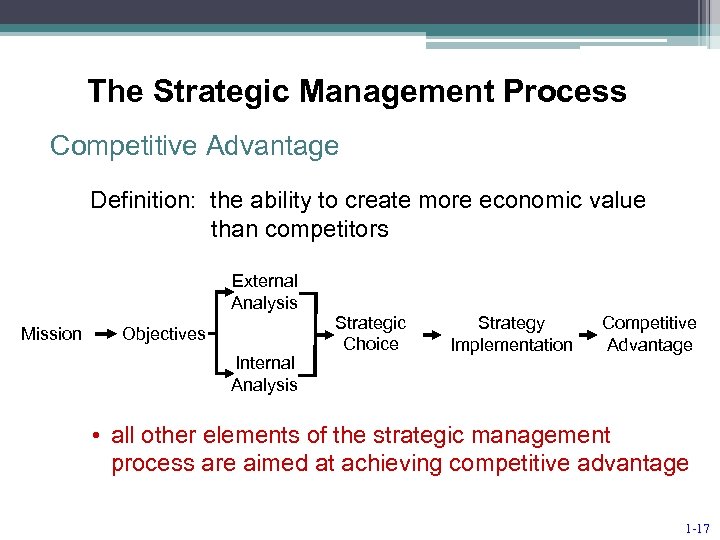 The Strategic Management Process Competitive Advantage Definition: the ability to create more economic value than competitors External Analysis Mission Objectives Internal Analysis Strategic Choice Strategy Implementation Competitive Advantage • all other elements of the strategic management process are aimed at achieving competitive advantage 1 -17
 Competitive Advantage The Ability to Create More Economic Value Than Competitors • there must be something different about a firm’s offering vis-à-vis competitors’ offerings • if all firms’ strategies were the same, no firm would have a competitive advantage • competitive advantage is the result of doing something different and/or better than competitors 1 -18
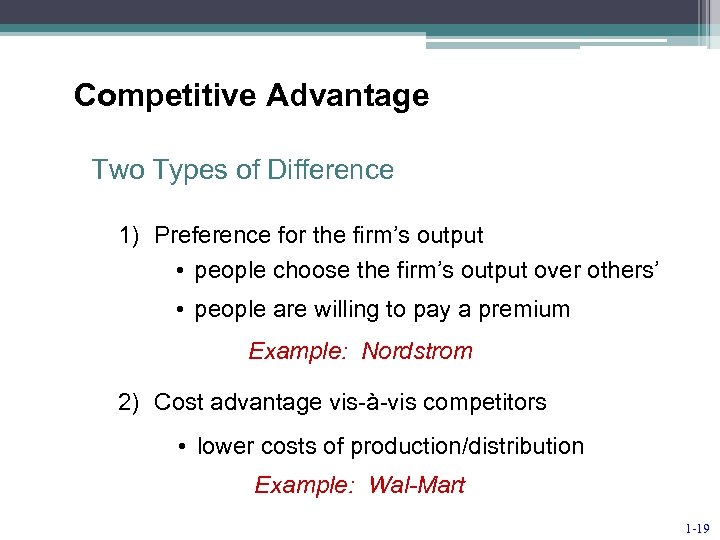 Competitive Advantage Two Types of Difference 1) Preference for the firm’s output • people choose the firm’s output over others’ • people are willing to pay a premium Example: Nordstrom 2) Cost advantage vis-à-vis competitors • lower costs of production/distribution Example: Wal-Mart 1 -19
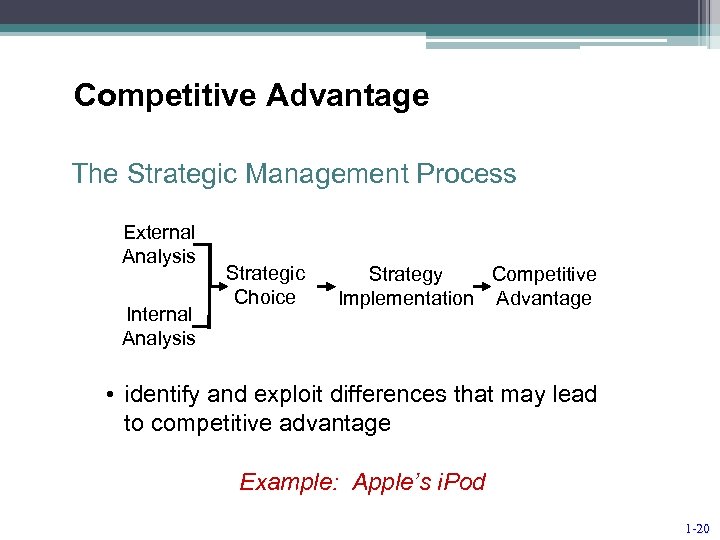 Competitive Advantage The Strategic Management Process External Analysis Internal Analysis Strategic Choice Strategy Competitive Implementation Advantage • identify and exploit differences that may lead to competitive advantage Example: Apple’s i. Pod 1 -20
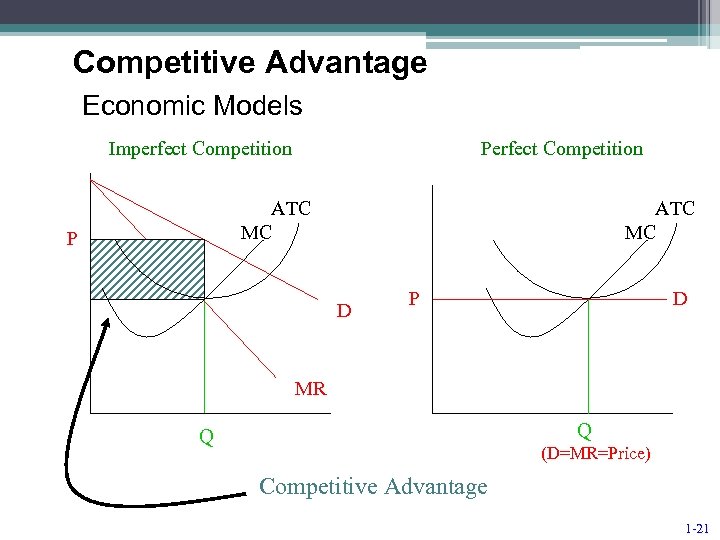 Competitive Advantage Economic Models Imperfect Competition Perfect Competition ATC MC P ATC MC D P D MR Q Q (D=MR=Price) Competitive Advantage 1 -21
 Competitive Advantage Temporary & Sustainable • competitive advantage typically results in high profits • profits attract competition • competition limits the duration of competitive advantage in most cases Therefore, • most competitive advantage is temporary • competitors imitate the advantage or offer something better 1 -22
 Competitive Advantage Temporary & Sustainable Some competitive advantages are sustainable if: • competitors are unable to imitate the source of advantage • no one conceives of a better offering Of course, • in time, even sustainable competitive advantage may be lost 1 -23
 Competitive Advantage Competitive Parity • the firm’s offerings are ‘average’ • people do not have a preference for the firm’s offering • the firm does not have a cost advantage over others • some things that may lead to competitive parity may still be critical to success (e. g. , telephones) 1 -24
 Competitive Advantage Competitive Disadvantage • people may have an aversion to the firm’s offering • the firm may have a cost disadvantage • a firm may have outdated technology/equipment • a firm may have a negative reputation Example: Wal-Mart’s Labor & Location Policies 1 -25
 Competitive Advantage Measuring Competitive Advantage Superior Economic Performance Is Viewed as Evidence of Competitive Advantage • it is rather easy to see the evidence of competitive advantage • measuring the source of the advantage per se is typically impossible • it’s difficult to ‘measure’ technology 1 -26
 Competitive Advantage Measuring Competitive Advantage Two Classes of Measures: 1) Accounting Measures • ROA, ROS, ROE, etc. that exceed industry averages 2) Economic Measures • earning a return in excess of the cost of capital 1 -27
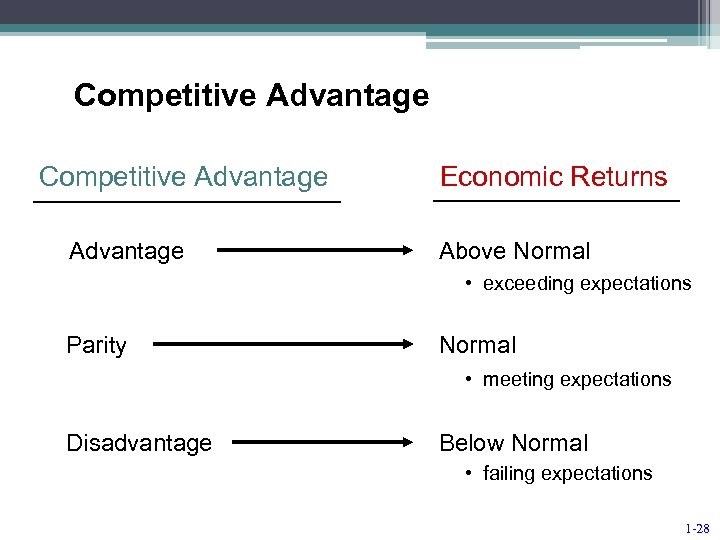 Competitive Advantage Economic Returns Above Normal • exceeding expectations Parity Normal • meeting expectations Disadvantage Below Normal • failing expectations 1 -28
 End Segment 2 1 -29
 Segment 3 Emergent Strategies vs. Explicit 1 -30
 Competitive Advantage & The Strategic Management Process Emergent vs. Intended Strategies • the strategic management process leads managers to intended strategies However, • conditions often change or new information becomes available • managers respond adopt emergent strategies Example: Honda Motorcycles 1 -31
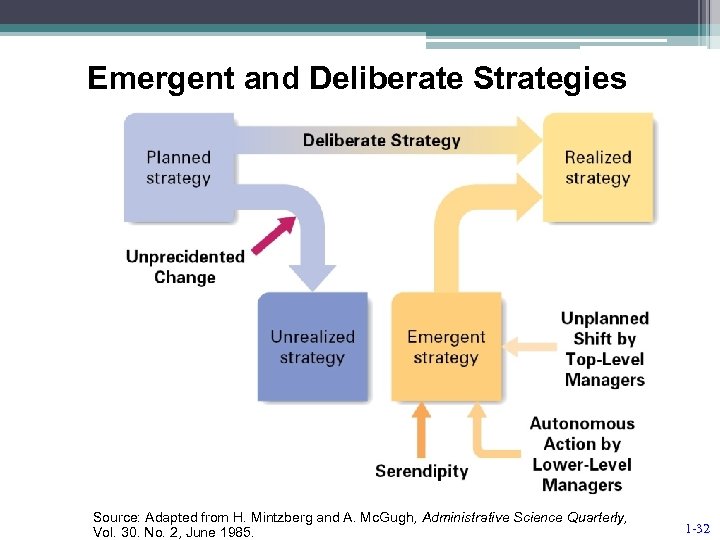 Emergent and Deliberate Strategies Source: Adapted from H. Mintzberg and A. Mc. Gugh, Administrative Science Quarterly, Vol. 30. No. 2, June 1985. 1 -32
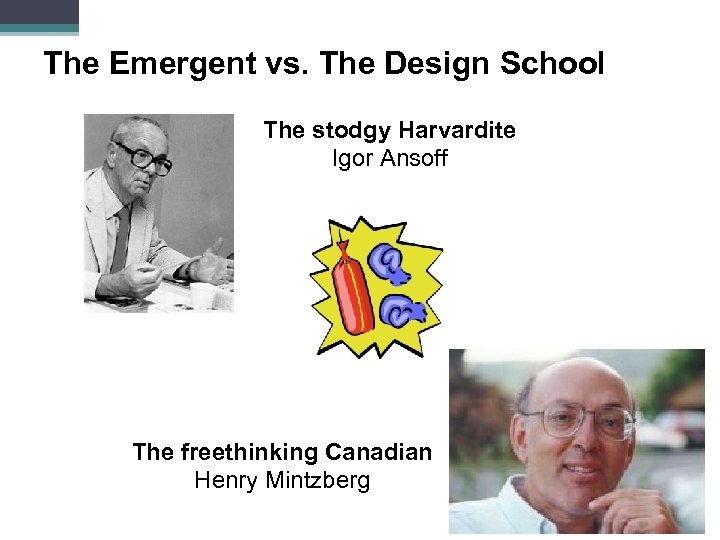 The Emergent vs. The Design School The stodgy Harvardite Igor Ansoff The freethinking Canadian Henry Mintzberg 1 -33
 Emergent is messy Chucky Schwab, the Web, and good employees 1 -34
 The Strategic Management Process Summary Firms could achieve competitive parity and survive • they would face a flat demand curve • their cost structure would be the industry average • they would need to adapt their strategy over time just to survive • they would fail if they didn’t adapt their strategy 1 -35
 The Strategic Management Process Summary This course is not about mere survival, it is about thriving—achieving competitive advantage • the strategic management process helps managers achieve competitive advantage • competitive advantage depends on differences • strategy is about discovering and exploiting these differences 1 -36
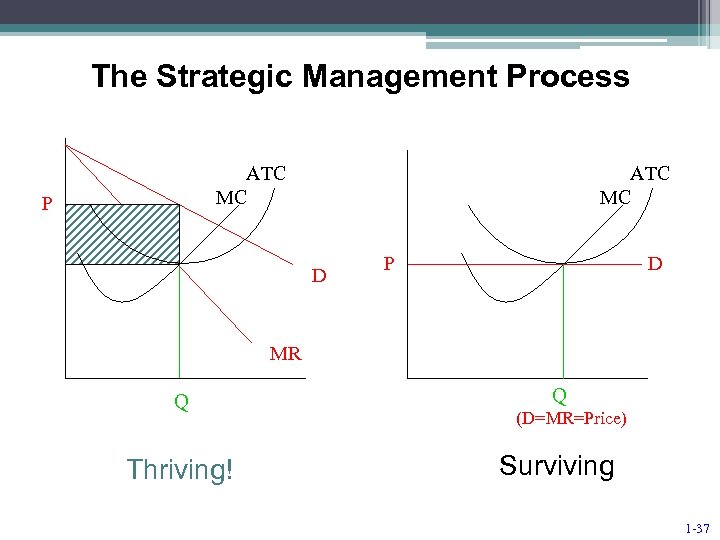 The Strategic Management Process ATC MC P ATC MC D P D MR Q Thriving! Q (D=MR=Price) Surviving 1 -37
 The Strategic Management Process Applying Strategy to Your Career • a solid understanding of strategy concepts will help set you apart from other job candidates • you can use the process to identify and exploit difference between you and others • you can use the process to determine if you want to stay with a company 1 -38
 The Strategic Management Process & Competitive Advantage Strategy Matters! Strategy is often the difference between: • success and failure, between mediocrity and excellence • a great manager and average managers • stumbling through life and moving ahead with purpose 1 -39