


 Скачать презентацию Chapter 1 What is Software Engineering Shari L
ad4e068da3edbe6b41759c16ebd25705.ppt
- Количество слайдов: 48
 Chapter 1 What is Software Engineering Shari L. Pfleeger Joanne M. Atlee 4 th Edition
 Contents 1. 1 1. 2 1. 3 1. 4 1. 5 1. 6 1. 7 1. 8 1. 9 1. 10 1. 11 What is Software Engineering? How Successful Have We Been? What Is Good Software? Who Does Software Engineering? A System Approach An Engineering Approach Members of the Development Team How Has Software Engineering Changed? Information System Example Real Time Example What this Chapter Means for You Pfleeger and Atlee, Software Engineering: Theory and Practice Chapter 1. 2
 Objectives • • • What we mean by software engineering Software engineering’s track record What we mean by good software Why a system approach is important How software engineering has changed since the 1970 s Pfleeger and Atlee, Software Engineering: Theory and Practice Chapter 1. 3
 1. 1 What is Software Engineering Solving Problems • Software products are large and complex • Development requires analysis and synthesis – Analysis: decompose a large problem into smaller, understandable pieces • abstraction is the key – Synthesis: build (compose) a software from smaller building blocks • composition is challenging Pfleeger and Atlee, Software Engineering: Theory and Practice Chapter 1. 4
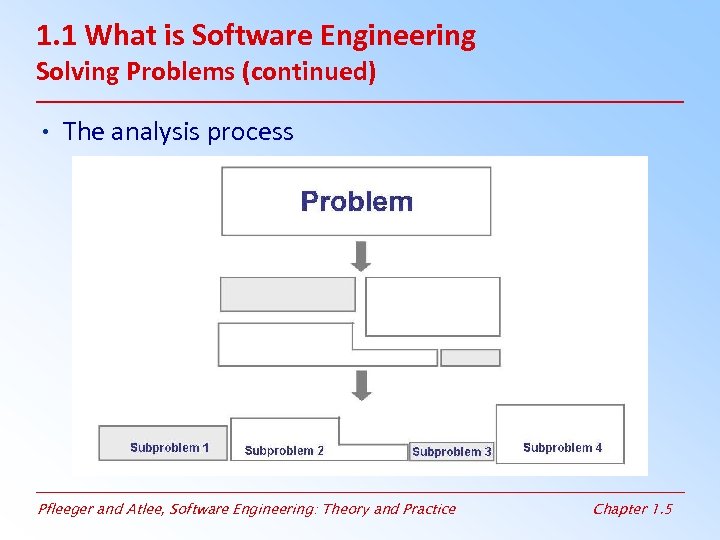 1. 1 What is Software Engineering Solving Problems (continued) • The analysis process Pfleeger and Atlee, Software Engineering: Theory and Practice Chapter 1. 5
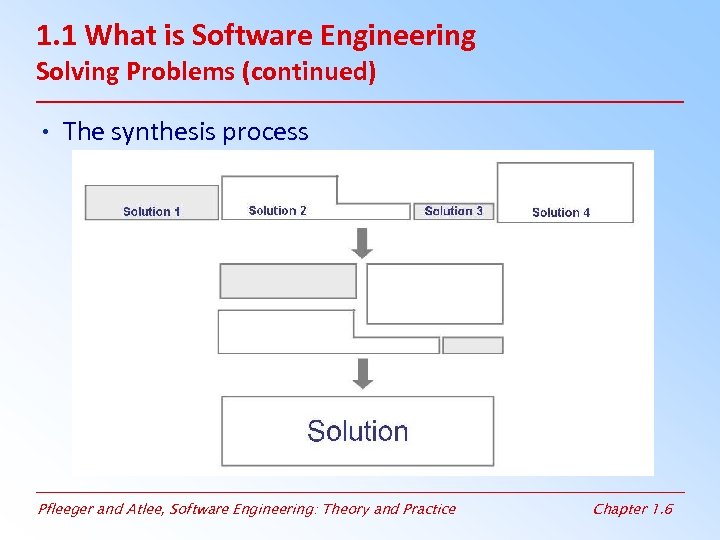 1. 1 What is Software Engineering Solving Problems (continued) • The synthesis process Pfleeger and Atlee, Software Engineering: Theory and Practice Chapter 1. 6
 1. 1 What is Software Engineering Solving Problems (continued) • Method: refers to a formal procedure; a formal “recipe” for accomplishing a goal that is typically independent of the tools used • Tool: an instrument or automated system for accomplishing something in a better way • Procedure: a combination of tools and techniques to produce a product • Paradigm: philosophy or approach for building a product (e. g. , OO vs structured approaches) Pfleeger and Atlee, Software Engineering: Theory and Practice Chapter 1. 7
 1. 1 What is Software Engineering Where Does the Software Engineer Fit In? • Computer science: focusing on computer hardware, compilers, operating systems, and programming languages • Software engineering: a discipline that uses computer and software technologies as problem-solving tools Pfleeger and Atlee, Software Engineering: Theory and Practice Chapter 1. 8
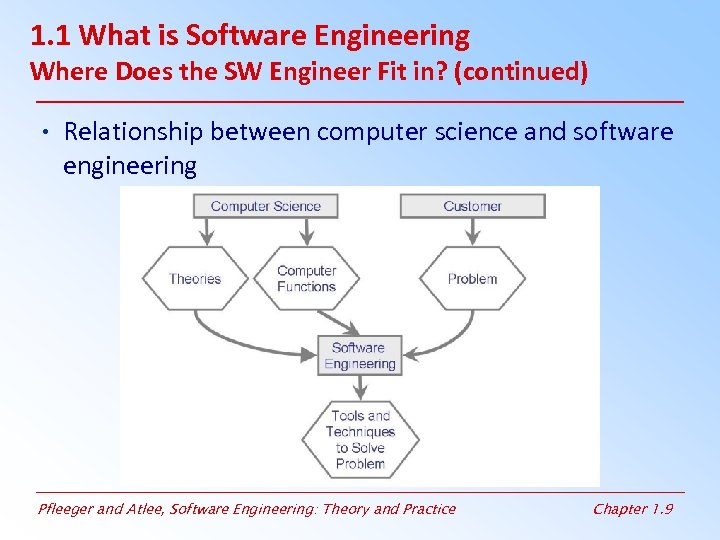 1. 1 What is Software Engineering Where Does the SW Engineer Fit in? (continued) • Relationship between computer science and software engineering Pfleeger and Atlee, Software Engineering: Theory and Practice Chapter 1. 9
 1. 2 How Successful Have We Been? • Perform tasks more quickly and effectively – Word processing, spreadsheets, e-mail • Support advances in medicine, agriculture, transportation, multimedia education, and most other industries • Many good stories • However, software is not without problems Pfleeger and Atlee, Software Engineering: Theory and Practice Chapter 1. 10
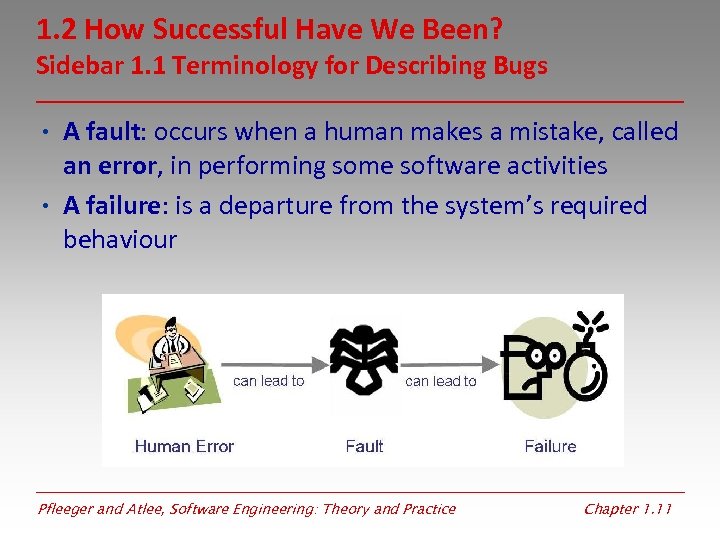 1. 2 How Successful Have We Been? Sidebar 1. 1 Terminology for Describing Bugs • A fault: occurs when a human makes a mistake, called an error, in performing some software activities • A failure: is a departure from the system’s required behaviour Pfleeger and Atlee, Software Engineering: Theory and Practice Chapter 1. 11
 1. 2 How Successful Have We Been? Examples of Software Failure • The IRS hired Sperry Corporation to build an automated federal income tax form processing process – An extra $90 M was needed to enhance the original $103 product – The IRS lost $40. 2 M on interests and $22. 3 M in overtime wages because refunds were not returned on time • Malfunctioning code in Therac-25 killed several people • Reliability constraints have caused cancellation of many safety critical systems – Safety-critical: something whose failure poses a threat to life or health Pfleeger and Atlee, Software Engineering: Theory and Practice Chapter 1. 12
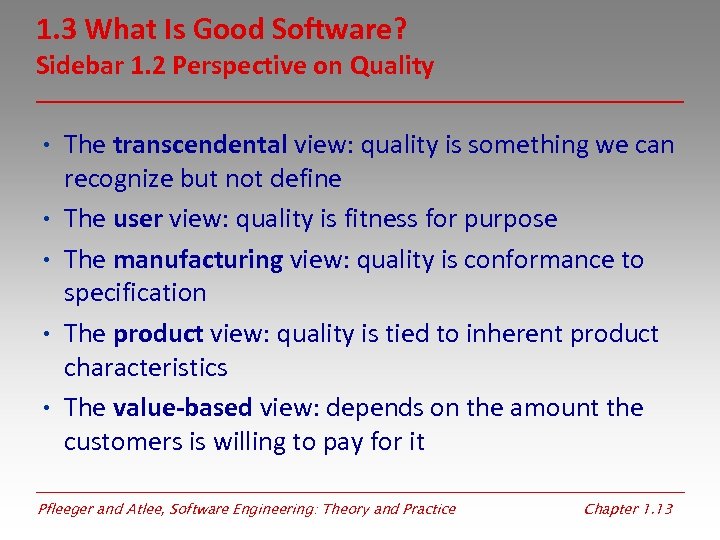 1. 3 What Is Good Software? Sidebar 1. 2 Perspective on Quality • The transcendental view: quality is something we can recognize but not define • The user view: quality is fitness for purpose • The manufacturing view: quality is conformance to specification • The product view: quality is tied to inherent product characteristics • The value-based view: depends on the amount the customers is willing to pay for it Pfleeger and Atlee, Software Engineering: Theory and Practice Chapter 1. 13
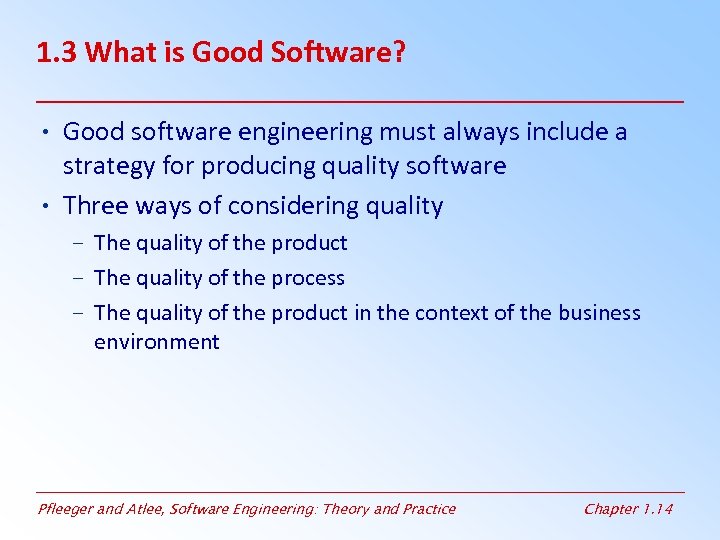 1. 3 What is Good Software? • Good software engineering must always include a strategy for producing quality software • Three ways of considering quality – The quality of the product – The quality of the process – The quality of the product in the context of the business environment Pfleeger and Atlee, Software Engineering: Theory and Practice Chapter 1. 14
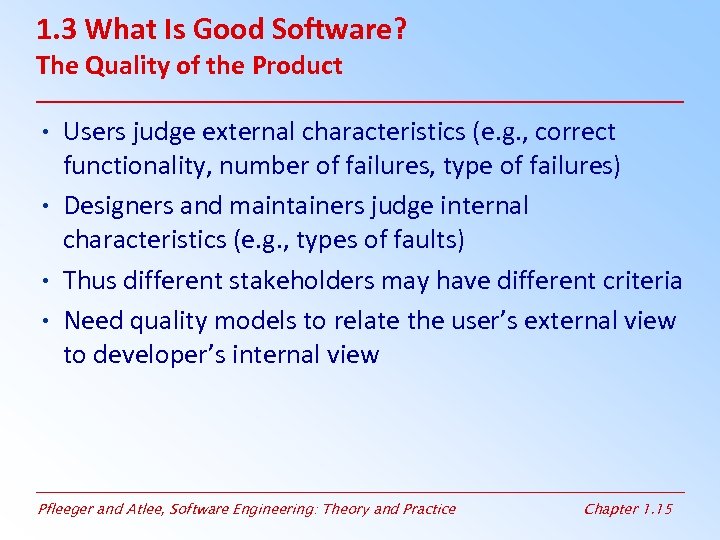 1. 3 What Is Good Software? The Quality of the Product • Users judge external characteristics (e. g. , correct functionality, number of failures, type of failures) • Designers and maintainers judge internal characteristics (e. g. , types of faults) • Thus different stakeholders may have different criteria • Need quality models to relate the user’s external view to developer’s internal view Pfleeger and Atlee, Software Engineering: Theory and Practice Chapter 1. 15
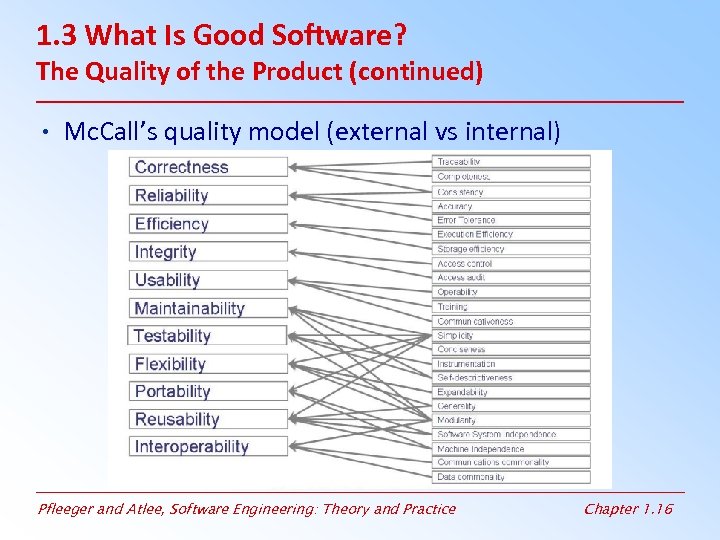 1. 3 What Is Good Software? The Quality of the Product (continued) • Mc. Call’s quality model (external vs internal) Pfleeger and Atlee, Software Engineering: Theory and Practice Chapter 1. 16
 1. 3 What Is Good Software? The Quality of the Process • Quality of the development and maintenance process is as important as the product quality • The development process needs to be modeled • Modeling will address questions such as – – Where to find a particular kind of fault How to find faults early How to build in fault tolerance What are alternative activities Pfleeger and Atlee, Software Engineering: Theory and Practice Chapter 1. 17
 1. 3 What Is Good Software? The Quality of the Process (continued) • Models for process improvement – SEI’s Capability Maturity Model (CMM) – ISO 9000 – Software Process Improvement and Capability d. Etermination (SPICE) Pfleeger and Atlee, Software Engineering: Theory and Practice Chapter 1. 18
 1. 3 What Is Good Software? The Quality in the Context of the Business Environment • Business value is as important as technical value • Business value (in relationship to technical value) must be quantified • A common approach: return on investment (ROI) – what is given up for other purposes • ROI is interpreted in different terms: reducing costs, predicting savings, improving productivity, and costs (efforts and resources) Pfleeger and Atlee, Software Engineering: Theory and Practice Chapter 1. 19
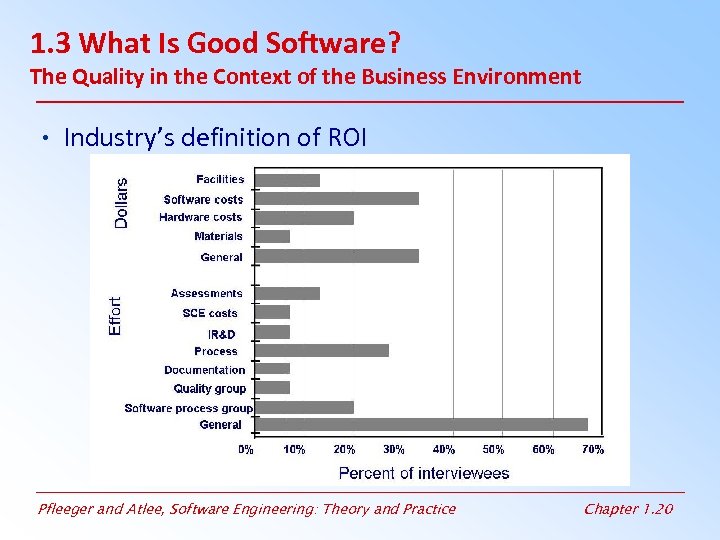 1. 3 What Is Good Software? The Quality in the Context of the Business Environment • Industry’s definition of ROI Pfleeger and Atlee, Software Engineering: Theory and Practice Chapter 1. 20
 1. 4 Who Does Software Engineering? • Customer: the company, organization, or person who pays for the software system • Developer: the company, organization, or person who is building the software system • User: the person or people who will actually use the system Pfleeger and Atlee, Software Engineering: Theory and Practice Chapter 1. 21
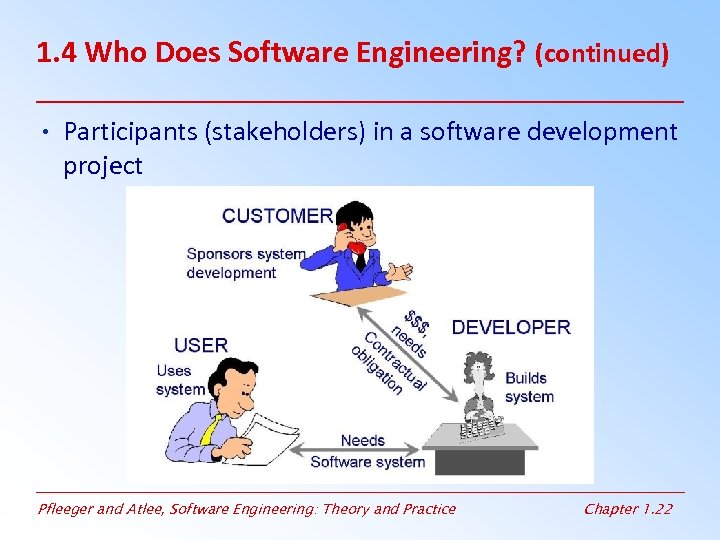 1. 4 Who Does Software Engineering? (continued) • Participants (stakeholders) in a software development project Pfleeger and Atlee, Software Engineering: Theory and Practice Chapter 1. 22
 1. 5 System Approach • • Hardware, software, interaction with people Identify activities and objects Define the system boundary Consider nested systems, systems’ interrelationship Pfleeger and Atlee, Software Engineering: Theory and Practice Chapter 1. 23
 1. 5 System Approach The Element of a System • Activities and objects – An activity is an event initiated by a trigger – Objects or entities are the elements involved in the activities • Relationships and the system boundaries – A relationship defines the interaction among entities and activities – System boundaries determine the origin of input and destinations of the output Pfleeger and Atlee, Software Engineering: Theory and Practice Chapter 1. 24
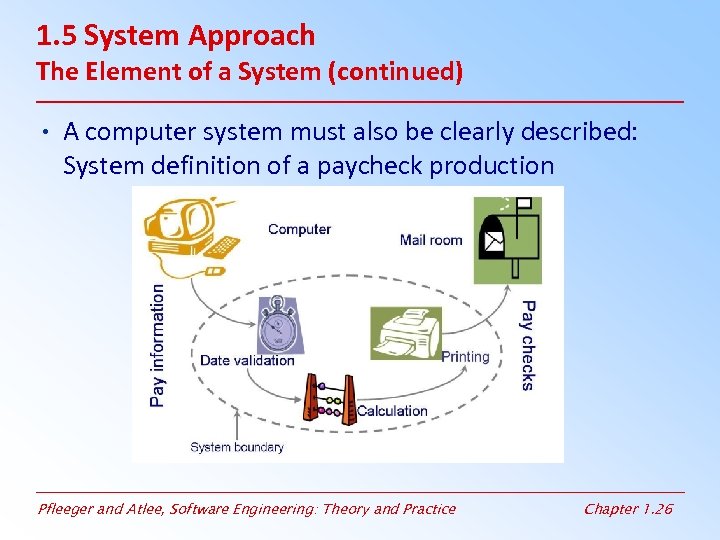 1. 5 System Approach The Element of a System (continued) • A computer system must also be clearly described: System definition of a paycheck production Pfleeger and Atlee, Software Engineering: Theory and Practice Chapter 1. 26
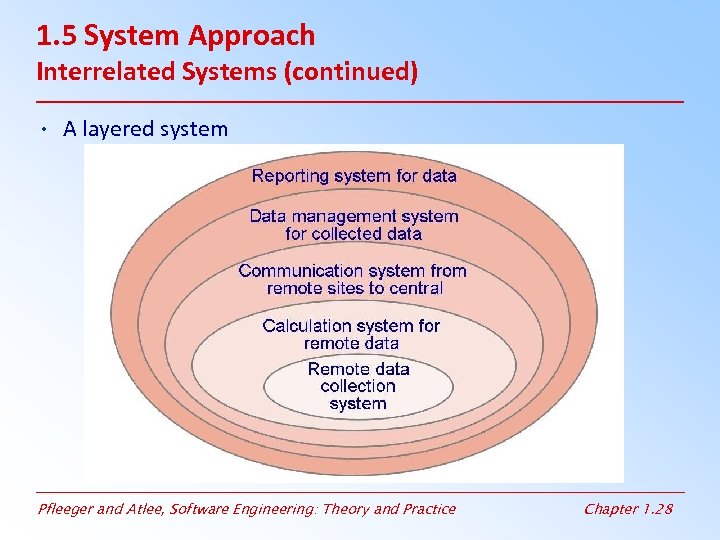 1. 5 System Approach Interrelated Systems (continued) • A layered system Pfleeger and Atlee, Software Engineering: Theory and Practice Chapter 1. 28
 1. 6 Engineering Approach Building a System • • • Requirement analysis and definition System design Program design Writing the programs Unit testing Integration testing System delivery Maintenance Pfleeger and Atlee, Software Engineering: Theory and Practice Chapter 1. 29
 1. 7 Members of the Development Team • Requirement analysts: work with the customers to identify and document the requirements • Designers: generate a system-level description of what the system is supposed to do • Programmers: write lines of code to implement the design • Testers: catch faults • Trainers: show users how to use the system • Maintenance team: fix faults that show up later • Librarians: prepare and store documents such as software requirements • Configuration management team: maintain correspondence among various artifacts Pfleeger and Atlee, Software Engineering: Theory and Practice Chapter 1. 30
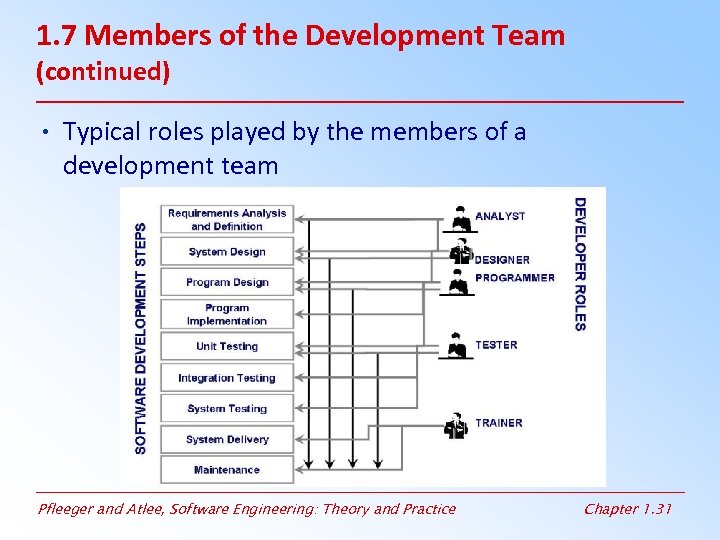 1. 7 Members of the Development Team (continued) • Typical roles played by the members of a development team Pfleeger and Atlee, Software Engineering: Theory and Practice Chapter 1. 31
 1. 8 How Has Software Engineering Changed? The Nature of the Change • Before the 1970 s – Single processors: mainframes – Designed in one of two ways • as a transformation: input was converted to output • as a transaction: input determined which function should be performed • After the 1970 s – Run on multiple systems – Perform multi-functions Pfleeger and Atlee, Software Engineering: Theory and Practice Chapter 1. 32
 1. 8 How Has SE Changed? Wasserman's Seven Key Factors 1. 2. 3. 4. 5. Critically of time-to-market Shifts in the economics of computing no need to optimize Availability of powerful desktop computing spread-sheets Extensive local- and wide-area networking Availability and adoption of object-oriented technology enhanced development tools 6. Graphical user interfaces friendly face on apps 7. Unpredictability of the waterfall model of software development Pfleeger and Atlee, Software Engineering: Theory and Practice Chapter 1. 33
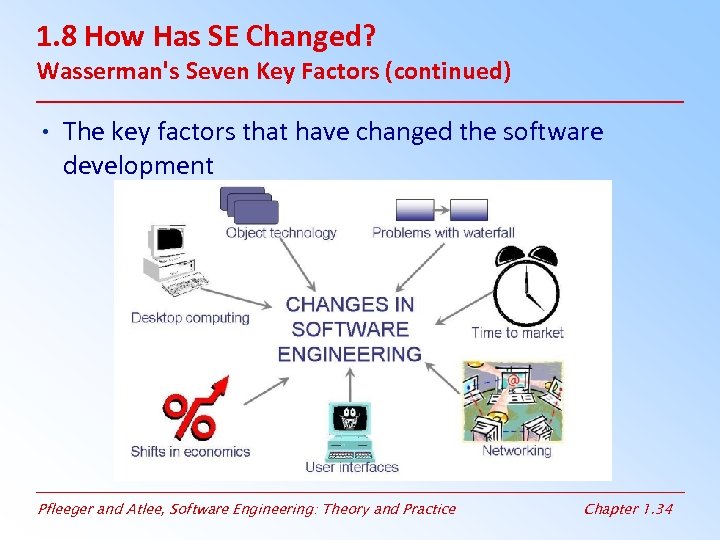 1. 8 How Has SE Changed? Wasserman's Seven Key Factors (continued) • The key factors that have changed the software development Pfleeger and Atlee, Software Engineering: Theory and Practice Chapter 1. 34
 1. 8 How Has SE Changed? Wasserman's Discipline of Software Engineering • • Abstractions Analysis and design methods and notations User interface prototyping Software architecture Software process Reuse Measurement Tools and integrated environments Pfleeger and Atlee, Software Engineering: Theory and Practice Chapter 1. 35
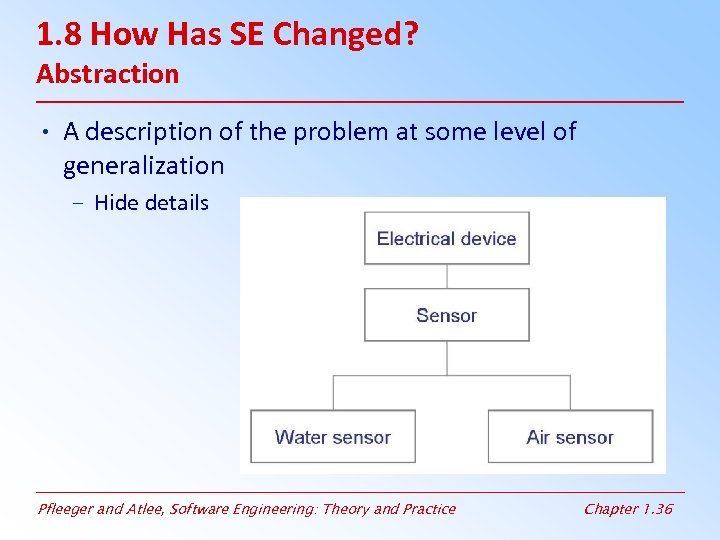 1. 8 How Has SE Changed? Abstraction • A description of the problem at some level of generalization – Hide details Pfleeger and Atlee, Software Engineering: Theory and Practice Chapter 1. 36
 1. 8 How Has SE Changed? Analysis and Design Methods and Notations • • Provide documentation Facilitate communication Offer multiple views Unify different views Pfleeger and Atlee, Software Engineering: Theory and Practice Chapter 1. 37
 1. 8 How Has SE Changed? User Interface Prototyping • Prototyping: building a small version of a system – Help users identify key requirements of a system – Demonstrate feasibility • Develop good user interface Pfleeger and Atlee, Software Engineering: Theory and Practice Chapter 1. 38
 1. 8 How Has SE Changed? Software Architecture • A system’s architecture describes the system in terms of a set of architectural units and relationships between these units • Architectural decomposition techniques – – – Modular decomposition Data-oriented decomposition Event-driven decomposition Outside-in-design decomposition: based on user input Object-oriented decomposition Pfleeger and Atlee, Software Engineering: Theory and Practice Chapter 1. 39
 1. 8 How Has SE Changed? Software Process • Many variations • Different types of software need different processes – Enterprise-wide applications need a great deal of control – Departmental applications can take advantage of rapid development Pfleeger and Atlee, Software Engineering: Theory and Practice Chapter 1. 40
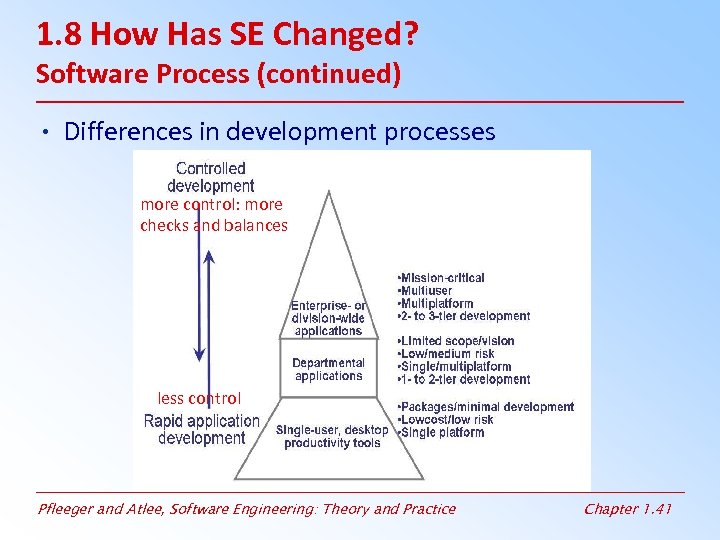 1. 8 How Has SE Changed? Software Process (continued) • Differences in development processes more control: more checks and balances less control Pfleeger and Atlee, Software Engineering: Theory and Practice Chapter 1. 41
 1. 8 How Has SE Changed? Software Reuse • Commonalities between applications may allow reusing artifacts from previous developments – Improve productivity – Reduce costs • Potential concerns – It may be faster to build a smaller application than searching for reusable components – Generalized components take more time to build – Must clarify who will be responsible for maintaining reusable components – Generality vs specificity: always a conflict Pfleeger and Atlee, Software Engineering: Theory and Practice Chapter 1. 42
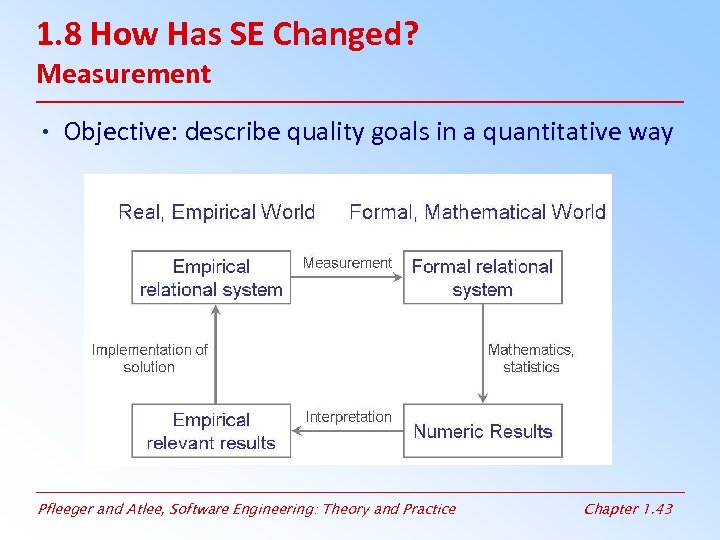 1. 8 How Has SE Changed? Measurement • Objective: describe quality goals in a quantitative way Pfleeger and Atlee, Software Engineering: Theory and Practice Chapter 1. 43
 1. 8 How Has SE Changed? Tools and Integrated Environments • Platform integration (on heterogeneous networks) • Presentation integration (commonality of user interface) • Process integration (linking tools and the development process) • Data integration (to share common data) • Control integration (the ability of one tool to initiate action in another one) Pfleeger and Atlee, Software Engineering: Theory and Practice Chapter 1. 44
 1. 9 Information Systems Example Piccadilly System • Piccadilly Television: regional British TV franchise • Advertising scheme has many constraints: – alcohol adverts only after 9 pm – if actor in show, no same actor in ads within 45 minutes – if an ad is in a class of products, no other ad in same class during same break – rates dependent on amount of time bought • Software to determine, track advertising time Pfleeger and Atlee, Software Engineering: Theory and Practice Chapter 1. 45
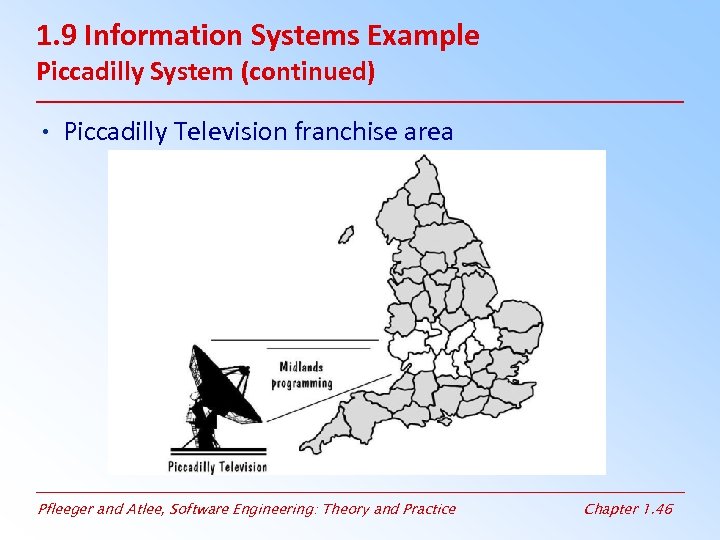 1. 9 Information Systems Example Piccadilly System (continued) • Piccadilly Television franchise area Pfleeger and Atlee, Software Engineering: Theory and Practice Chapter 1. 46
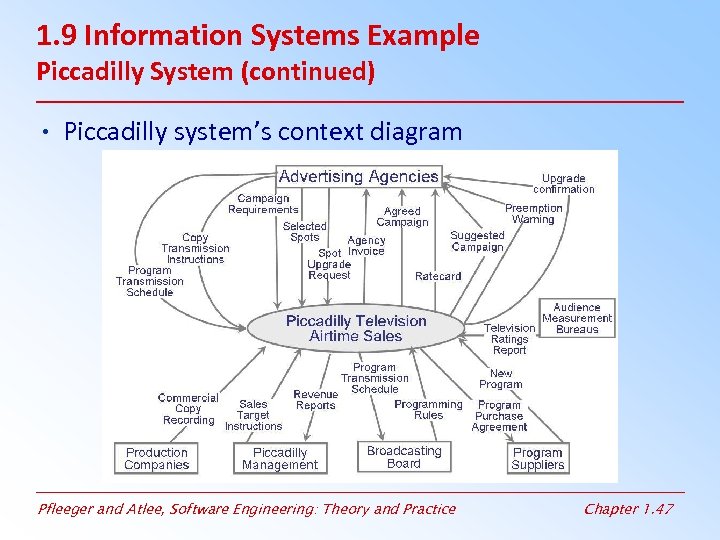 1. 9 Information Systems Example Piccadilly System (continued) • Piccadilly system’s context diagram Pfleeger and Atlee, Software Engineering: Theory and Practice Chapter 1. 47
 1. 10 Real Time Example • Ariane-5 rocket, from the European Space Agency • June 4, 1996: functioned well for 40 seconds, then veered off course and was destroyed • Contained four satellites: cost was $500 million • Reused code from Ariane-4 rocket Pfleeger and Atlee, Software Engineering: Theory and Practice Chapter 1. 48
 1. 10 Real Time Example Ariane-5 Definition of Quality • From the Lions et al report: – “… demonstrated the high quality of the Ariane-5 programme as regards engineering work in general and completeness and traceability of documents. ” – “… the supplier of the SRI … was only following the specification given to it. … The exception which occurred was not due to random failure but a design error. ” Pfleeger and Atlee, Software Engineering: Theory and Practice Chapter 1. 49
 1. 11 What this Chapter Means for You • Given a problem to solve – Analyze it – Synthesize a solution • Understand that requirements may change • Must view quality from several different perspectives • Use fundamental software engineering concepts (e. g. , abstractions and measurements) • Keep system boundary in mind Pfleeger and Atlee, Software Engineering: Theory and Practice Chapter 1. 50