 Скачать презентацию Chapter 1 The Power of Entrepreneurship Bygrave
2bacb60507600e335d0b149fd81d8489.ppt
- Количество слайдов: 17



Chapter 1 The Power of Entrepreneurship Bygrave & Zacharakis, 2007. Entrepreneurship, New York: Wiley. ©
Definition of entrepreneurship Schumpeter An entrepreneur is the person who destroys the existing economic order by introducing new products and services, by introducing new methods of production, by creating new forms of organization, or by exploiting new raw materials. Simpler An entrepreneur is the person who perceives an opportunity and creates an organization to pursue it. Bygrave & Zacharakis, 2007. Entrepreneurship, New York: Wiley. ©
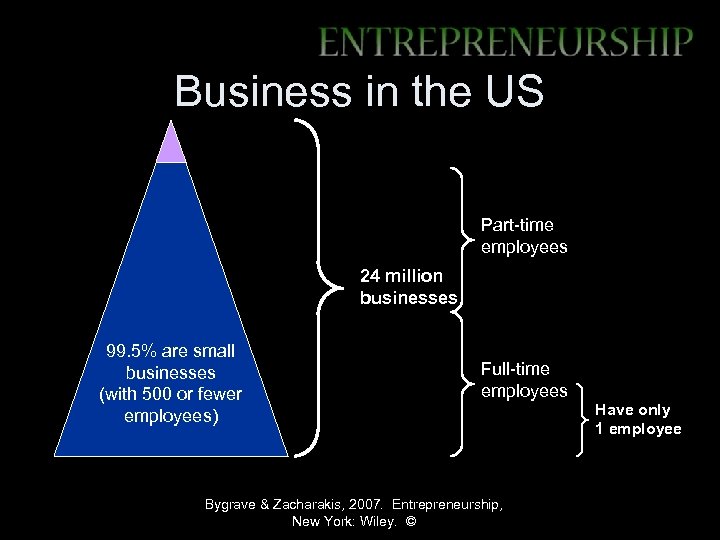
Business in the US Part-time employees 24 million businesses 99. 5% are small businesses (with 500 or fewer employees) Full-time employees Bygrave & Zacharakis, 2007. Entrepreneurship, New York: Wiley. © Have only 1 employee
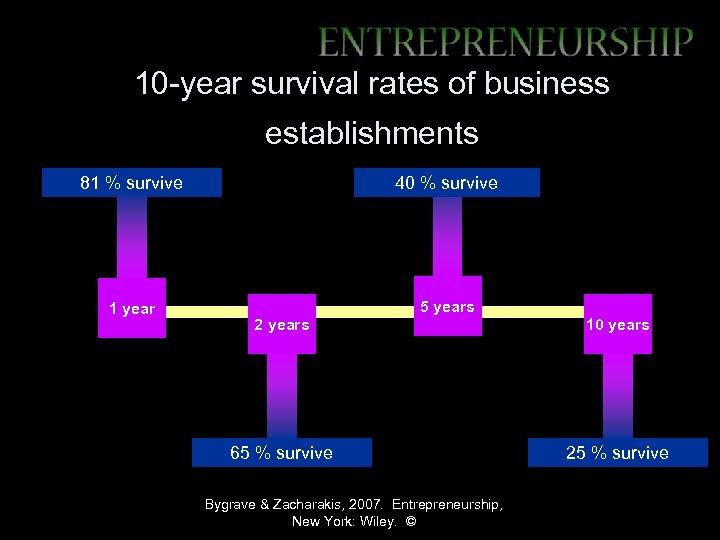
10 -year survival rates of business establishments 81 % survive 40 % survive 1 year 5 years 2 years 65 % survive Bygrave & Zacharakis, 2007. Entrepreneurship, New York: Wiley. © 10 years 25 % survive
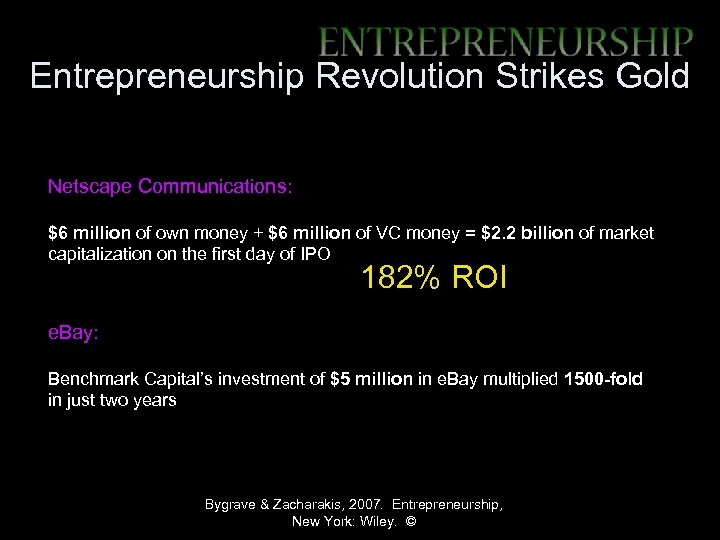
Entrepreneurship Revolution Strikes Gold Netscape Communications: $6 million of own money + $6 million of VC money = $2. 2 billion of market capitalization on the first day of IPO 182% ROI e. Bay: Benchmark Capital’s investment of $5 million in e. Bay multiplied 1500 -fold in just two years Bygrave & Zacharakis, 2007. Entrepreneurship, New York: Wiley. ©
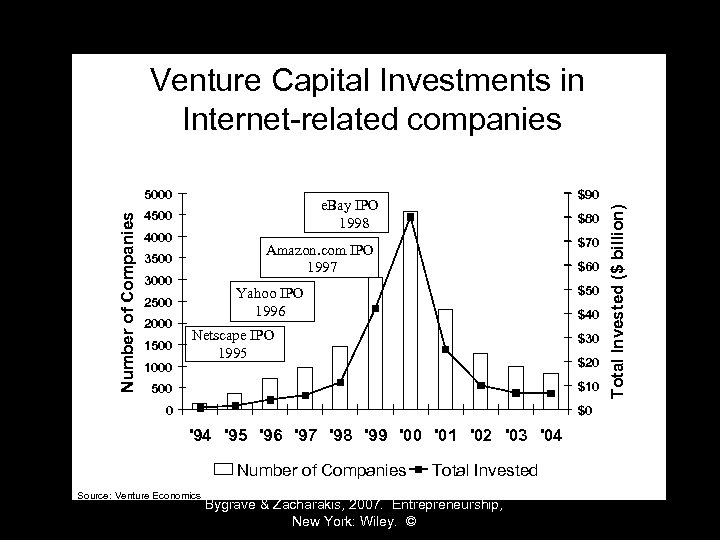
Venture Capital Investments in Internet-related companies 4500 4000 3000 1000 $70 $60 $50 Yahoo IPO 1996 2500 1500 $80 Amazon. com IPO 1997 3500 2000 $90 e. Bay IPO 1998 $40 Netscape IPO 1995 $30 $20 $10 500 0 $0 '94 '95 '96 '97 '98 '99 '00 '01 '02 '03 '04 Number of Companies Source: Venture Economics Total Invested Bygrave & Zacharakis, 2007. Entrepreneurship, New York: Wiley. © Total Invested ($ billion) Number of Companies 5000
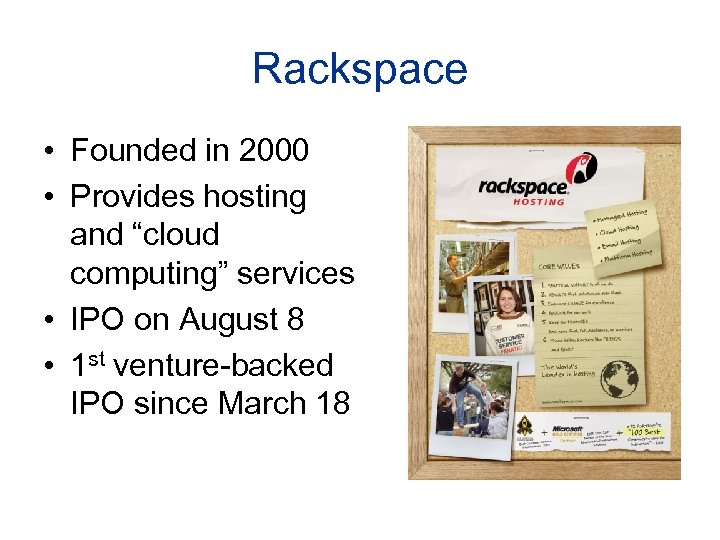
Rackspace • Founded in 2000 • Provides hosting and “cloud computing” services • IPO on August 8 • 1 st venture-backed IPO since March 18 Bygrave & Zacharakis, 2007. Entrepreneurship, New York: Wiley. ©
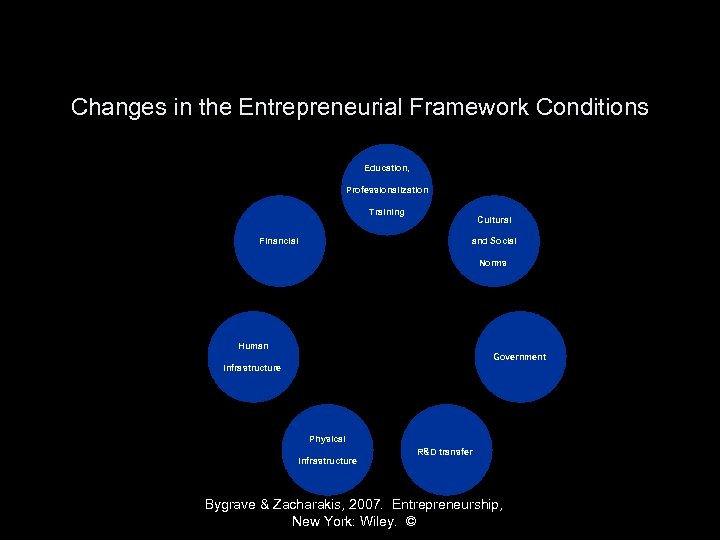
Changes in the Entrepreneurial Framework Conditions Education, Professionalization Training Cultural and Social Financial Norms Human Government Infrastructure Physical Infrastructure R&D transfer Bygrave & Zacharakis, 2007. Entrepreneurship, New York: Wiley. ©
R&D observations • Innovations don’t travel well within university communities without a significant investment in developing networks and marketing concepts • Innovators are rarely entrepreneurs – No one wants to run a business – No one uses the word “opportunity” – they solve problems Bygrave & Zacharakis, 2007. Entrepreneurship, New York: Wiley. ©
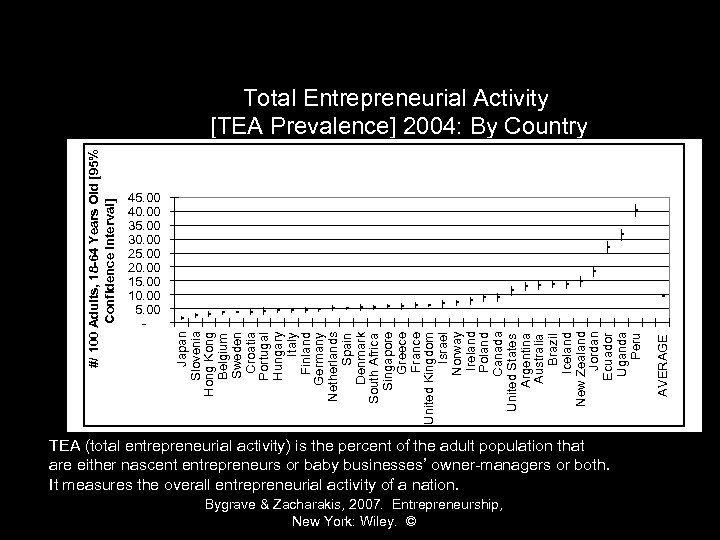
TEA (total entrepreneurial activity) is the percent of the adult population that are either nascent entrepreneurs or baby businesses’ owner-managers or both. It measures the overall entrepreneurial activity of a nation. Bygrave & Zacharakis, 2007. Entrepreneurship, New York: Wiley. © AVERAGE 45. 00 40. 00 35. 00 30. 00 25. 00 20. 00 15. 00 10. 00 5. 00 Japan Slovenia Hong Kong Belgium Sweden Croatia Portugal Hungary Italy Finland Germany Netherlands Spain Denmark South Africa Singapore Greece France United Kingdom Israel Norway Ireland Poland Canada United States Argentina Australia Brazil Iceland New Zealand Jordan Ecuador Uganda Peru #/ 100 Adults, 18 -64 Years Old [95% Confidence Interval] Total Entrepreneurial Activity [TEA Prevalence] 2004: By Country
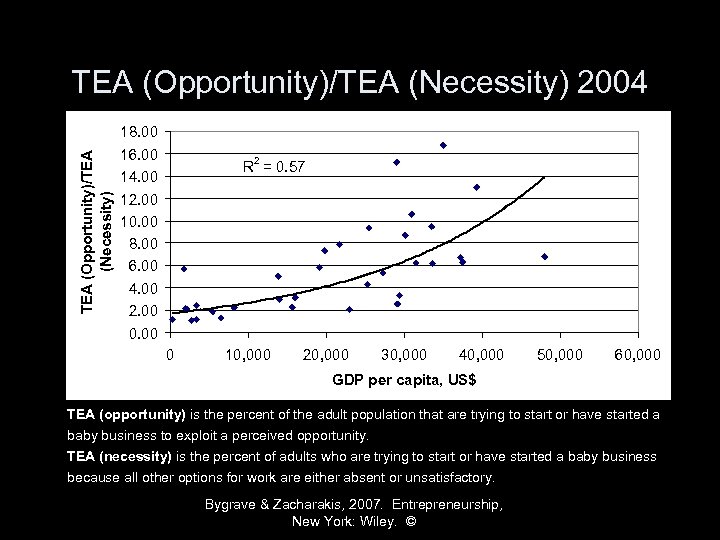
TEA (Opportunity)/TEA (Necessity) 2004 18. 00 16. 00 14. 00 12. 00 10. 00 8. 00 6. 00 4. 00 2. 00 0. 00 2 R = 0. 57 0 10, 000 20, 000 30, 000 40, 000 50, 000 60, 000 GDP per capita, US$ TEA (opportunity) is the percent of the adult population that are trying to start or have started a baby business to exploit a perceived opportunity. TEA (necessity) is the percent of adults who are trying to start or have started a baby business because all other options for work are either absent or unsatisfactory. Bygrave & Zacharakis, 2007. Entrepreneurship, New York: Wiley. ©
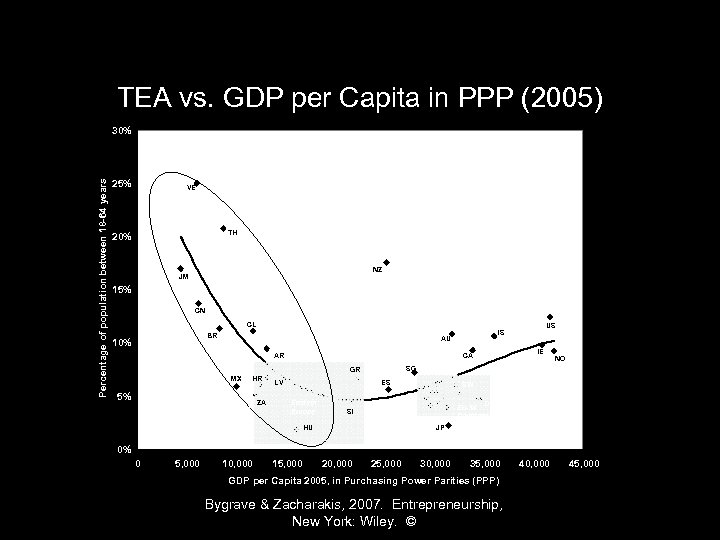
TEA vs. GDP per Capita in PPP (2005) 30% Percentage of population between 18 -64 years R 2 = 0. 49 25% VE TH 20% Middle Income Countries JM NZ 15% CN CL BR 10% AR CA SG GR MX HR 5% ZA LV IE NO UK ES Eastern Europe US IS AU SW DK EU-14 Countries SI HU JP 0% 0 5, 000 10, 000 15, 000 20, 000 25, 000 30, 000 35, 000 GDP per Capita 2005, in Purchasing Power Parities (PPP) Bygrave & Zacharakis, 2007. Entrepreneurship, New York: Wiley. © 40, 000 45, 000
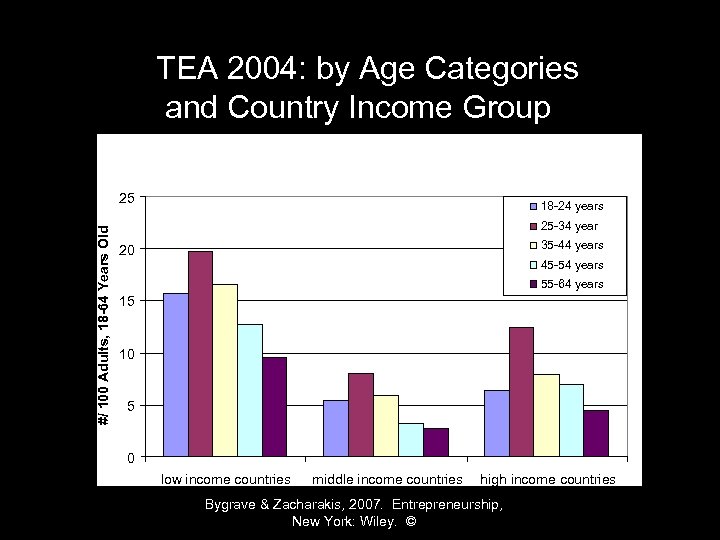
TEA 2004: by Age Categories and Country Income Group #/ 100 Adults, 18 -64 Years Old 25 18 -24 years 25 -34 year 35 -44 years 20 45 -54 years 55 -64 years 15 10 5 0 low income countries middle income countries high income countries Bygrave & Zacharakis, 2007. Entrepreneurship, New York: Wiley. ©
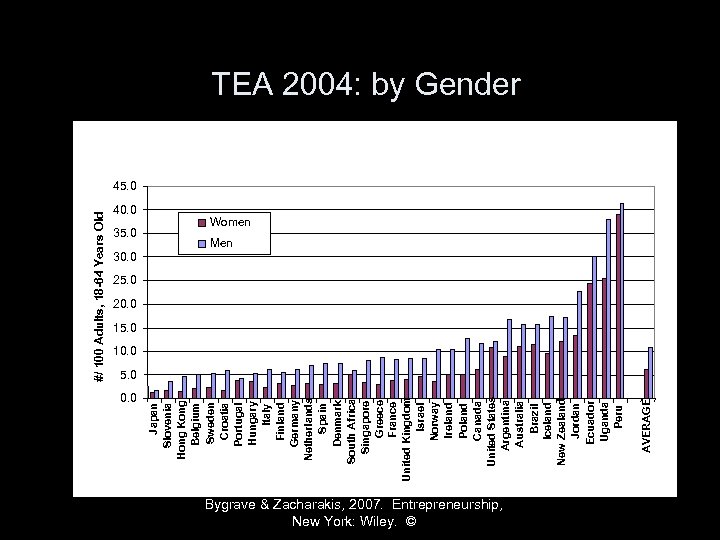
35. 0 0. 0 Bygrave & Zacharakis, 2007. Entrepreneurship, New York: Wiley. © AVERAGE 40. 0 Japan Slovenia Hong Kong Belgium Sweden Croatia Portugal Hungary Italy Finland Germany Netherlands Spain Denmark South Africa Singapore Greece France United Kingdom Israel Norway Ireland Poland Canada United States Argentina Australia Brazil Iceland New Zealand Jordan Ecuador Uganda Peru #/ 100 Adults, 18 -64 Years Old TEA 2004: by Gender 45. 0 Women Men 30. 0 25. 0 20. 0 15. 0 10. 0 5. 0
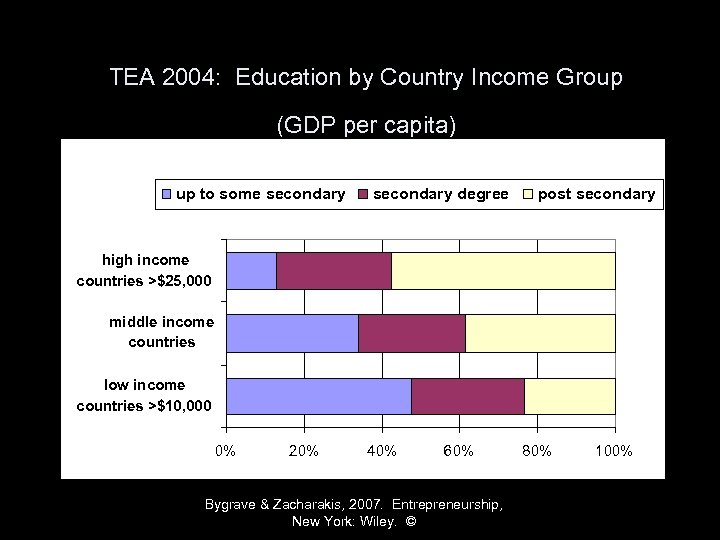
TEA 2004: Education by Country Income Group (GDP per capita) up to some secondary degree post secondary high income countries >$25, 000 middle income countries low income countries >$10, 000 0% 20% 40% 60% Bygrave & Zacharakis, 2007. Entrepreneurship, New York: Wiley. © 80% 100%
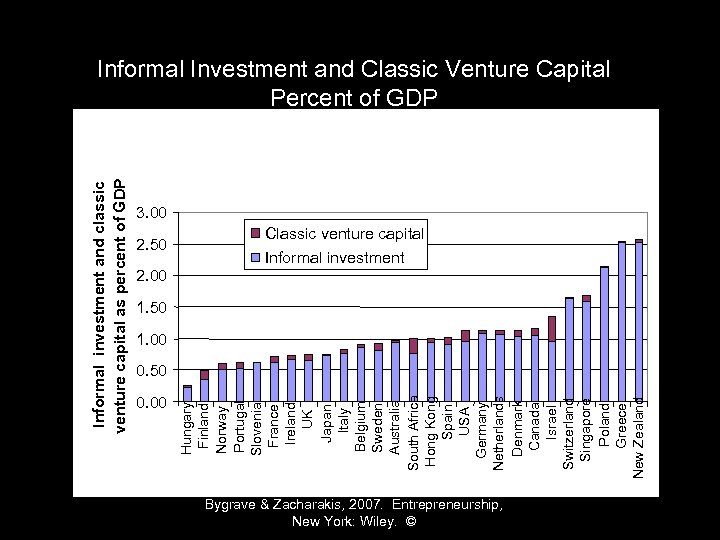
Informal investment and classic venture capital as percent of GDP 2. 50 2. 00 0. 00 Hungary Finland Norway Portugal Slovenia France Ireland UK Japan Italy Belgium Sweden Australia South Africa Hong Kong Spain USA Germany Netherlands Denmark Canada Israel Switzerland Singapore Poland Greece New Zealand Informal Investment and Classic Venture Capital Percent of GDP 3. 00 Classic venture capital Informal investment 1. 50 1. 00 0. 50 Bygrave & Zacharakis, 2007. Entrepreneurship, New York: Wiley. ©
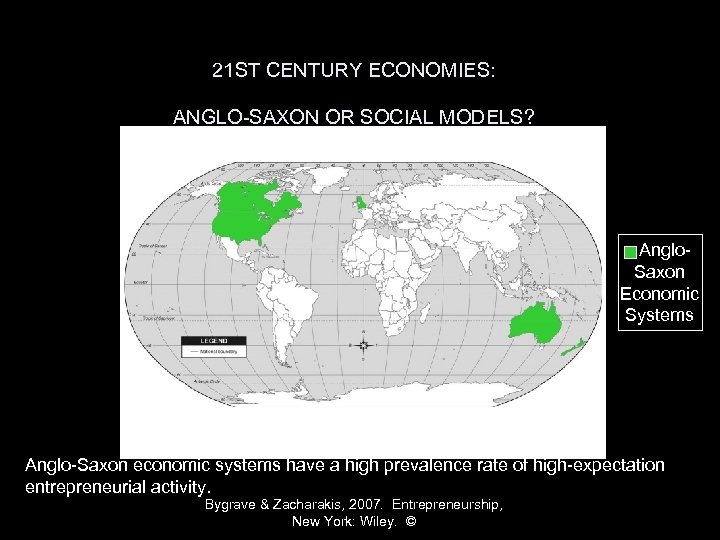
21 ST CENTURY ECONOMIES: ANGLO-SAXON OR SOCIAL MODELS? Anglo. Saxon Economic Systems Anglo-Saxon economic systems have a high prevalence rate of high-expectation entrepreneurial activity. Bygrave & Zacharakis, 2007. Entrepreneurship, New York: Wiley. ©
Скачать презентацию Chapter 1 The Power of Entrepreneurship Bygrave
2bacb60507600e335d0b149fd81d8489.ppt