


 Скачать презентацию Chapter 1 The Information Age in Which You
615498d2b677921415132d100e803b50.ppt
- Количество слайдов: 51
 Chapter 1 The Information Age in Which You Live © Mc. Graw-Hill Companies, Inc. , Mc. Graw-Hill/Irwin
 STUDENT LEARNING OUTCOMES 1. 2. 3. 4. Define MIS and describe three resources within it—people, information, and information technology. Describe how to use break-even analysis to assess the financial impact of IT. Describe how to use Porter’s Five Forces Model to evaluate an industry. Compare and contrast Porter’s three generic strategies and the RGT framework as approaches to the development of business strategy. © Mc. Graw-Hill Companies, Inc. , Mc. Graw-Hill/Irwin
 Cell Phones Doom Phone Revenues for Hotels © Mc. Graw-Hill Companies, Inc. , Mc. Graw-Hill/Irwin
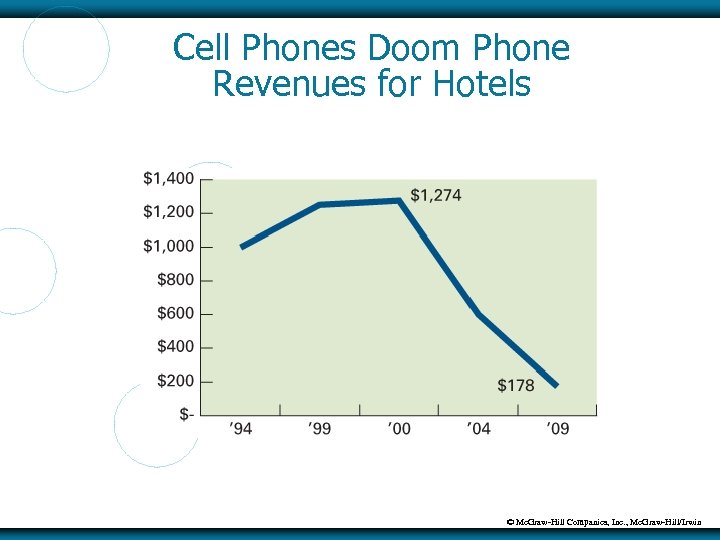
 Cell Phones Doom Phone Revenues for Hotels The year 2000 – typical hotel could budget annual revenue of $1, 274 per room for in-room phone charges The year 2009 – typical hotel could budget annual revenue of only $178 per room for in-room phone charges Cell phones and technologies of all kinds are transforming entire industries © Mc. Graw-Hill Companies, Inc. , Mc. Graw-Hill/Irwin
 Questions 1. 2. 3. When was the last time you used a pay phone? How often have you used a pay phone in the last year? If you needed to use a pay phone, would you know immediately where one was located? When was the last time you used your cell phone? How often have you used your cell phone in the last day? © Mc. Graw-Hill Companies, Inc. , Mc. Graw-Hill/Irwin
 INTRODUCTION You live in a digital age Average American relies on more than 250 computers per day According to Time magazine, 14% of cell phone users stopped having sex to take a phone call How much do you rely on technology in your daily life? © Mc. Graw-Hill Companies, Inc. , Mc. Graw-Hill/Irwin
 INTRODUCTION Management information systems (MIS) – planning for, development, management, and use of information technology to help people performs all tasks related to information processing and management. Important field of study Important business discipline © Mc. Graw-Hill Companies, Inc. , Mc. Graw-Hill/Irwin
 INTRODUCTION MIS deals with the coordination and use of 3 very important organizational resources 1. 2. 3. People Information Technology © Mc. Graw-Hill Companies, Inc. , Mc. Graw-Hill/Irwin
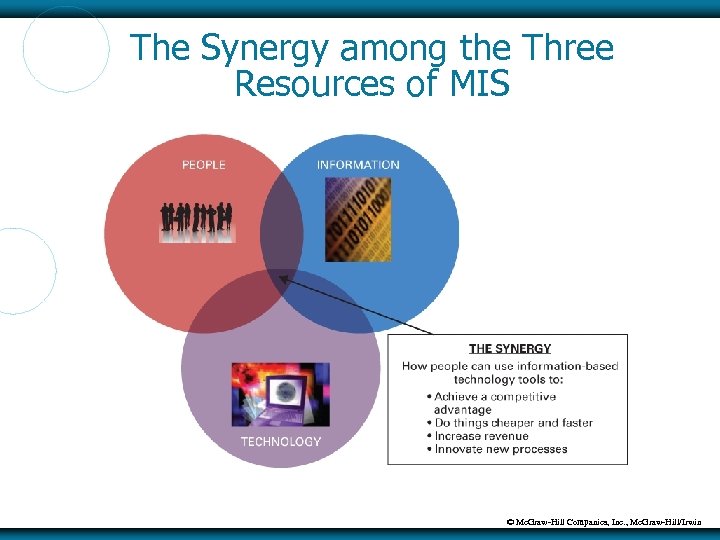 The Synergy among the Three Resources of MIS © Mc. Graw-Hill Companies, Inc. , Mc. Graw-Hill/Irwin
 CHAPTER ORGANIZATION MIS Resources: Information, People, and Information Technology 1. § Learning Outcome #1 Financial Impact of IT 2. § Learning Outcome #2 Industry Impact of IT 3. § Learning Outcome #3 Strategy Impact of IT 4. § Learning Outcome #4 © Mc. Graw-Hill Companies, Inc. , Mc. Graw-Hill/Irwin
 MIS RESOURCE #1: INFORMATION Intellectual asset hierarchy – data, information, and business intelligence Data – raw facts that describe a particular phenomenon such as the current temperature, the price of movie rental, or your age Information – data that have a particular meaning within a specific context © Mc. Graw-Hill Companies, Inc. , Mc. Graw-Hill/Irwin
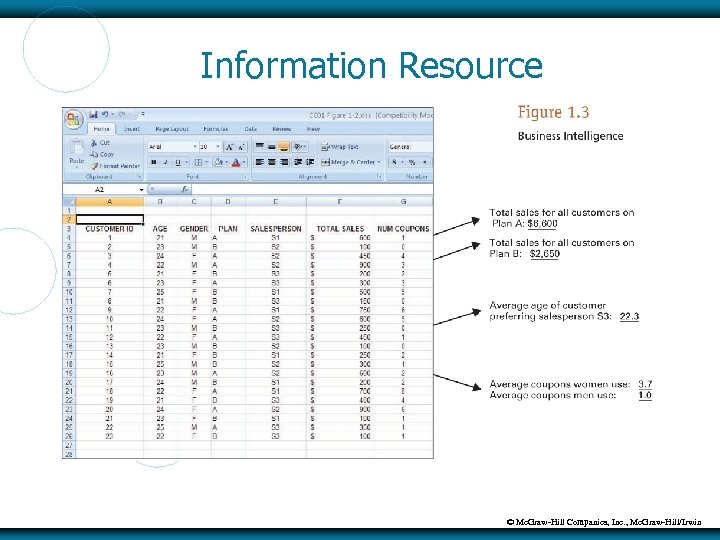
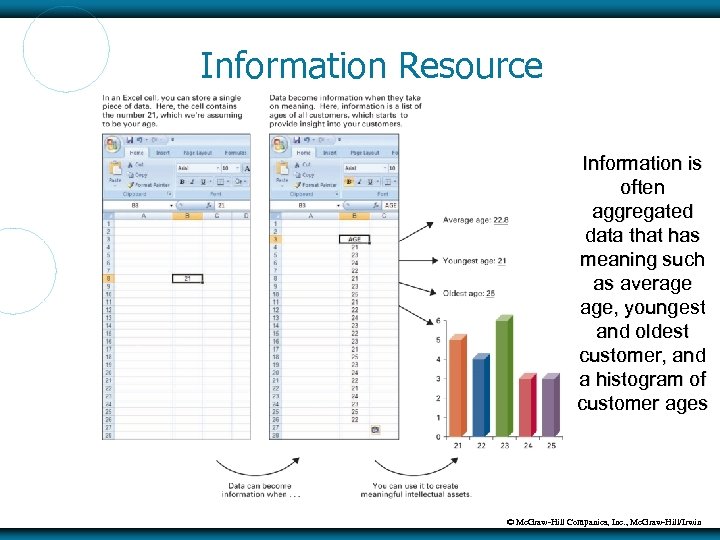 Information Resource Information is often aggregated data that has meaning such as average age, youngest and oldest customer, and a histogram of customer ages © Mc. Graw-Hill Companies, Inc. , Mc. Graw-Hill/Irwin
 Information Resource Business intelligence (BI) – collective information about… Customers Competitors Business partners Competitive environment BI is information on steroids BI can help you make important, strategic decisions © Mc. Graw-Hill Companies, Inc. , Mc. Graw-Hill/Irwin
 Information Resource © Mc. Graw-Hill Companies, Inc. , Mc. Graw-Hill/Irwin
 Information Resource – Quality Attributes Timeliness When you need it Describing the right time period Location (no matter where you are) Form (audio, text, animation, etc) Validity (credibility) Lack of any of the above can create GIGO (garbage-in, garbage-out) in a decision-making process © Mc. Graw-Hill Companies, Inc. , Mc. Graw-Hill/Irwin
 Information Resource – Organizational Perspective © Mc. Graw-Hill Companies, Inc. , Mc. Graw-Hill/Irwin
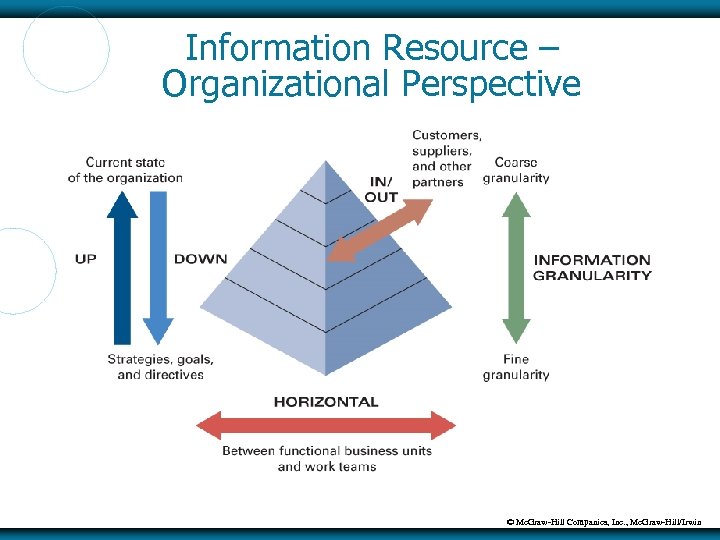
 Information Resource – Flows of Information Upward – describes state of the organization based on transactions Downward – strategies, goals, and directives that originate at a higher level and are passed to lower levels Horizontal – between functional business units and work teams Outward/inward – from and to customers, suppliers, etc © Mc. Graw-Hill Companies, Inc. , Mc. Graw-Hill/Irwin
 Information Resource – What It Describes Internal information – operational aspects of the organization External information – environment surrounding the organization Objective information – quantifiably describes something that is known Subjective information – describe something that is unknown © Mc. Graw-Hill Companies, Inc. , Mc. Graw-Hill/Irwin
 MIS RESOURCE #2: PEOPLE People are the most important resource in any organization, with a focus on Technology literacy Information literacy Ethical responsibilities © Mc. Graw-Hill Companies, Inc. , Mc. Graw-Hill/Irwin
 People Resource Technology-literate knowledge worker – knows how and when to apply technology Information-literate knowledge worker Can define information needs Knows how and where to obtain information Understands information Acts appropriately based on information Ethics – principles and standards that guide our behavior toward other people © Mc. Graw-Hill Companies, Inc. , Mc. Graw-Hill/Irwin
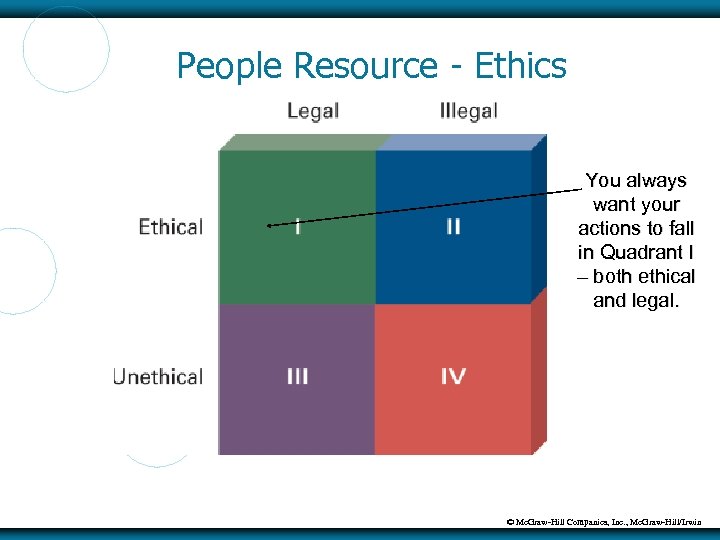 People Resource - Ethics You always want your actions to fall in Quadrant I – both ethical and legal. © Mc. Graw-Hill Companies, Inc. , Mc. Graw-Hill/Irwin
 MIS RESOURCE #3: INFORMATION TECHNOLOGY Information technology (IT) – computer-based tools that people use to work with information Hardware – physical devices that make up a computer Software – set of instructions that your hardware executes to carry out a specific task for you © Mc. Graw-Hill Companies, Inc. , Mc. Graw-Hill/Irwin
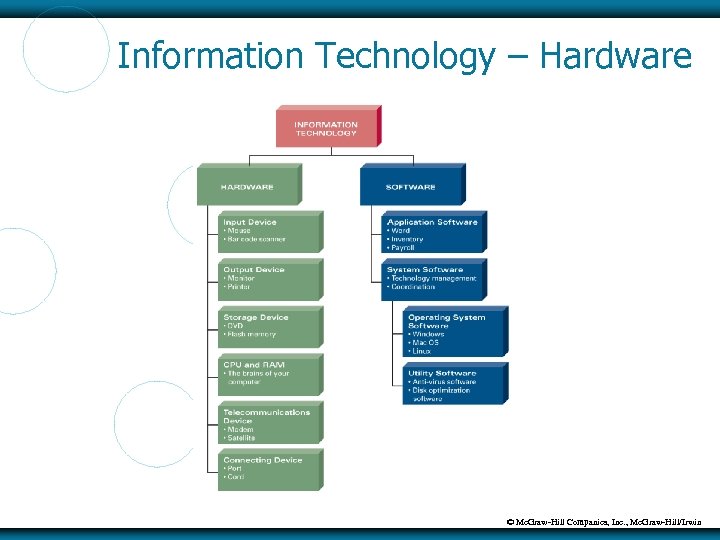 Information Technology – Hardware © Mc. Graw-Hill Companies, Inc. , Mc. Graw-Hill/Irwin
 Information Technology – Hardware 1. 2. 3. Input device – tool for entering information and commands Output device – tool for see or hearing results Storage device – tool for storing information © Mc. Graw-Hill Companies, Inc. , Mc. Graw-Hill/Irwin
 Information Technology – Hardware 4. 5. 6. CPU – hardware that interprets and executes instructions (RAM temporarily stores information and software for the CPU) Telecommunications device – for sending info Connecting devices – like cables, ports, etc. © Mc. Graw-Hill Companies, Inc. , Mc. Graw-Hill/Irwin
 Information Technology – Software Two types of software Application software – enables you to solve specific problems and perform specific tasks (Word, payroll, inventory management, etc) System software – handles tasks specific to technology management (operating system, anti-virus, etc) See Extended Learning Module A for a review of IT hardware and software © Mc. Graw-Hill Companies, Inc. , Mc. Graw-Hill/Irwin
 FINANCIAL IMPACT OF INFORMATION TECHNOLOGY Regardless of the resource, you must always assess its financial impact Many times, you will do so using break-even analysis IT can definitely impact break-even analysis © Mc. Graw-Hill Companies, Inc. , Mc. Graw-Hill/Irwin
 Break-Even Analysis Consider and chart the following financial information Fixed costs – costs you incur even if you don’t sell anything Variable costs – costs you incur when you sell something (COGS) Revenue – how much you sell one unit for © Mc. Graw-Hill Companies, Inc. , Mc. Graw-Hill/Irwin
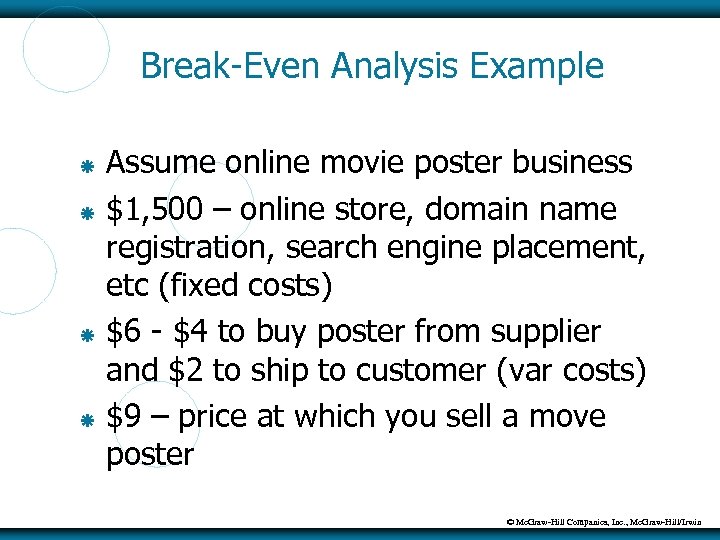 Break-Even Analysis Example Assume online movie poster business $1, 500 – online store, domain name registration, search engine placement, etc (fixed costs) $6 - $4 to buy poster from supplier and $2 to ship to customer (var costs) $9 – price at which you sell a move poster © Mc. Graw-Hill Companies, Inc. , Mc. Graw-Hill/Irwin
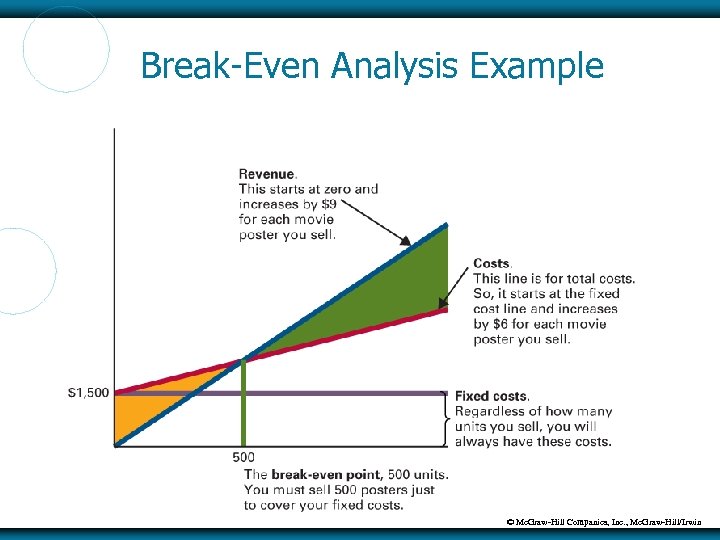 Break-Even Analysis Example © Mc. Graw-Hill Companies, Inc. , Mc. Graw-Hill/Irwin
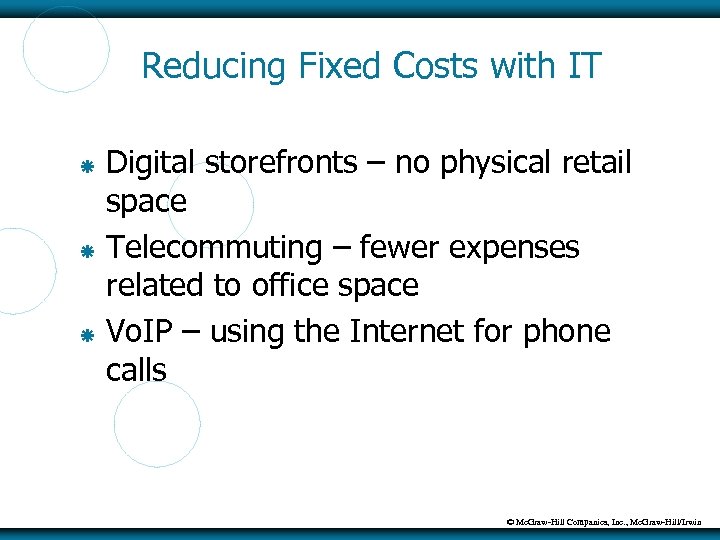 Reducing Fixed Costs with IT Digital storefronts – no physical retail space Telecommuting – fewer expenses related to office space Vo. IP – using the Internet for phone calls © Mc. Graw-Hill Companies, Inc. , Mc. Graw-Hill/Irwin
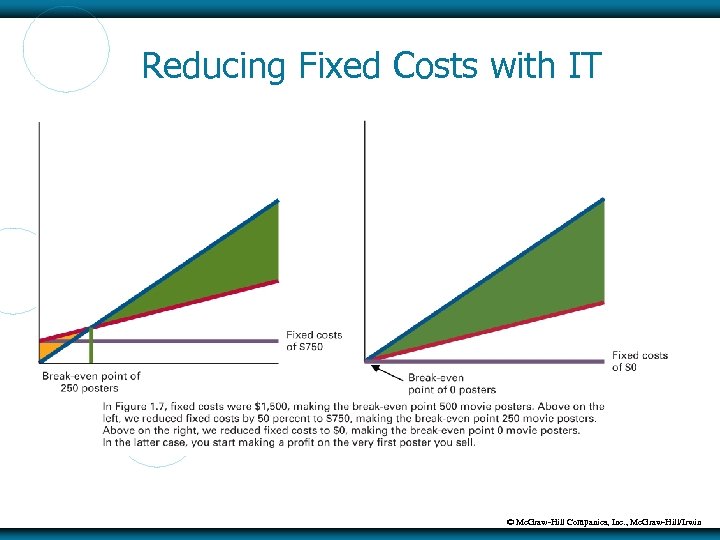 Reducing Fixed Costs with IT © Mc. Graw-Hill Companies, Inc. , Mc. Graw-Hill/Irwin
 Reducing Variable Costs with IT Virtual goods – because they are digital, there is no cost to duplicate and sell again and again Crowdsourcing – use non-paid nonemployees to create value © Mc. Graw-Hill Companies, Inc. , Mc. Graw-Hill/Irwin
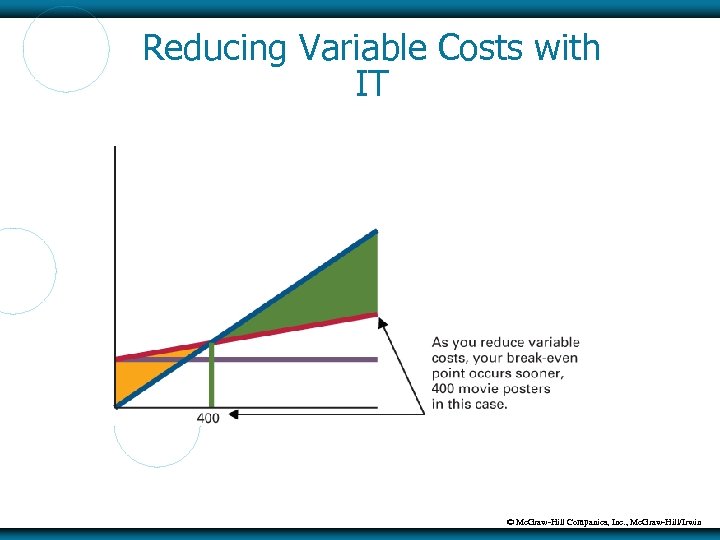 Reducing Variable Costs with IT © Mc. Graw-Hill Companies, Inc. , Mc. Graw-Hill/Irwin
 Increasing Revenue with IT Recommendation engines – to drive complementary sales Long-tail economics – to sell products/services that are too expensive for physical stores to carry Physical stores only carry what they can sell large amounts of Because of fixed costs © Mc. Graw-Hill Companies, Inc. , Mc. Graw-Hill/Irwin
 INDUSTRY IMPACT OF INFORMATION TECHNOLOGY Porter’s Five Forces Model helps business people understand the relative attractiveness of an industry and the industry’s competitive pressures in terms of 1. 2. 3. 4. 5. Buyer power Supplier power Threat of substitute products or services Threat of new entrants Rivalry among existing competitors © Mc. Graw-Hill Companies, Inc. , Mc. Graw-Hill/Irwin
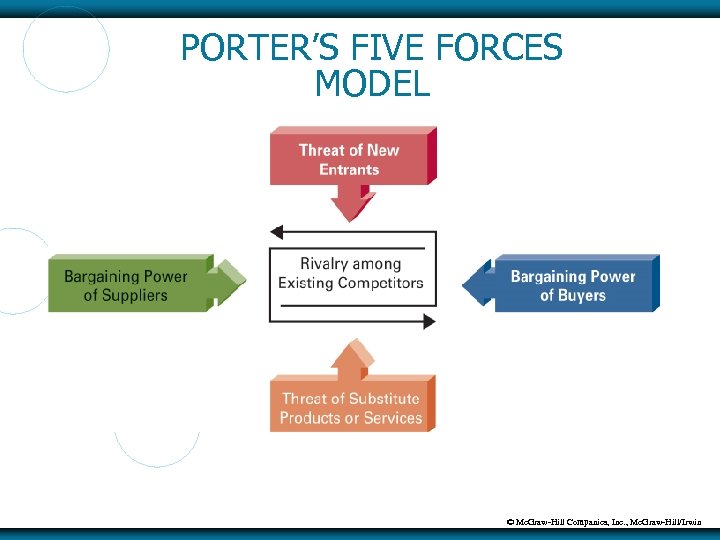 PORTER’S FIVE FORCES MODEL © Mc. Graw-Hill Companies, Inc. , Mc. Graw-Hill/Irwin
 Buyer Power Buyer power – high when buyers have many choices and low when their choices are few Competitive advantages are created to get buyers to stay with a given company Net. Flix – set up and maintain your movie list United Airlines – frequent flyer program Apple i. Tunes – buy/manage your music © Mc. Graw-Hill Companies, Inc. , Mc. Graw-Hill/Irwin
 Buyer Power Competitive advantage – providing a product or service in a way that customers value more than what the competition is able to do First-mover advantage – significant impact on gaining market share by being the first to market with a competitive advantage All competitive advantages are fleeting © Mc. Graw-Hill Companies, Inc. , Mc. Graw-Hill/Irwin
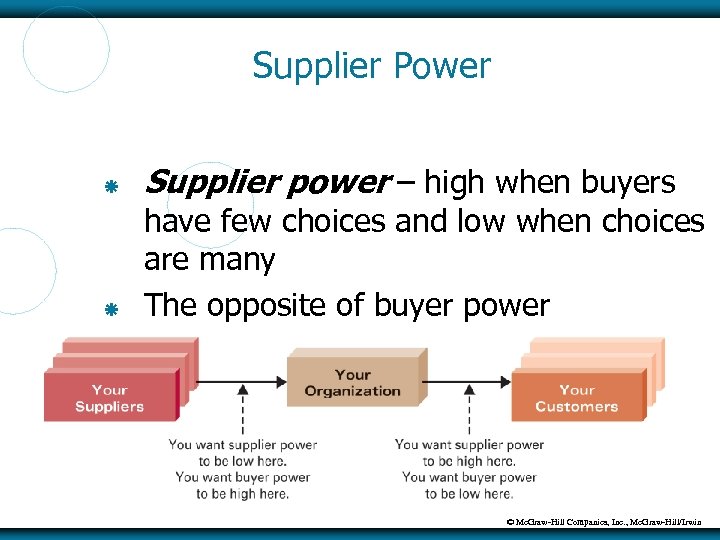 Supplier Power Supplier power – high when buyers have few choices and low when choices are many The opposite of buyer power © Mc. Graw-Hill Companies, Inc. , Mc. Graw-Hill/Irwin
 Threat of Substitute Products and Services Threat of substitute products and services – high when there are many alternatives for buyers and low when there are few alternatives Switching costs can reduce this threat Switching cost – a cost that makes buyers reluctant to switch to another product/service © Mc. Graw-Hill Companies, Inc. , Mc. Graw-Hill/Irwin
 Threat of New Entrants Threat of new entrants – high when it is easy for competitors to enter the market and low when entry barriers are significant Entry barrier – product or service feature that customers have come to expect and that must be offered by an entering organization Banking – ATMs, online bill pay, etc © Mc. Graw-Hill Companies, Inc. , Mc. Graw-Hill/Irwin
 Rivalry Among Existing Competitors Rivalry among existing competitors – high when competition is fierce and low when competition is more complacent General trend is toward more competition in almost all industries IT has certainly intensified competition in all sectors of business © Mc. Graw-Hill Companies, Inc. , Mc. Graw-Hill/Irwin
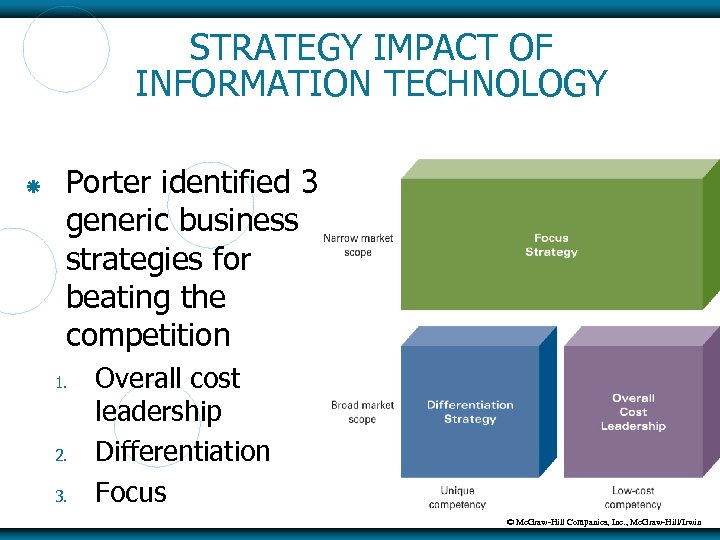 STRATEGY IMPACT OF INFORMATION TECHNOLOGY Porter identified 3 generic business strategies for beating the competition 1. 2. 3. Overall cost leadership Differentiation Focus © Mc. Graw-Hill Companies, Inc. , Mc. Graw-Hill/Irwin
 Overall Cost Leadership Overall cost leadership – offering the same or better quality product or service at a price that is less than what any of the competition is able to do Walmart (Always Low Prices, Every Day Low Prices) Dell – a computer the way you want it at an affordable price Hyundai and Kia – reliable low-cost cars Grocery stores – high-volume, low-margin © Mc. Graw-Hill Companies, Inc. , Mc. Graw-Hill/Irwin
 Differentiation – offering a product or service that is perceived as being “unique” in the marketplace Hummer – Like Nothing Else Audi and Michelin – safety Lund’s & Byerly’s – high-end grocery store Apple © Mc. Graw-Hill Companies, Inc. , Mc. Graw-Hill/Irwin
 Focus – focusing on offering products or services To a particular segment or buyer group Within a segment of a product line To a specific geographic market Examples Restaurants Physician offices Legal offices © Mc. Graw-Hill Companies, Inc. , Mc. Graw-Hill/Irwin
 Run-Grow-Transform (RGT) Framework Run-grow-transform (RGT) framework – the allocation in terms of percentages of IT dollars on various types of business strategies © Mc. Graw-Hill Companies, Inc. , Mc. Graw-Hill/Irwin
 RGT Framework How will you allocate IT dollars to Run – optimizing execution of existing processes Grow – increasing market share, products, and service offerings Transform – innovating business processes, products, and/or services © Mc. Graw-Hill Companies, Inc. , Mc. Graw-Hill/Irwin
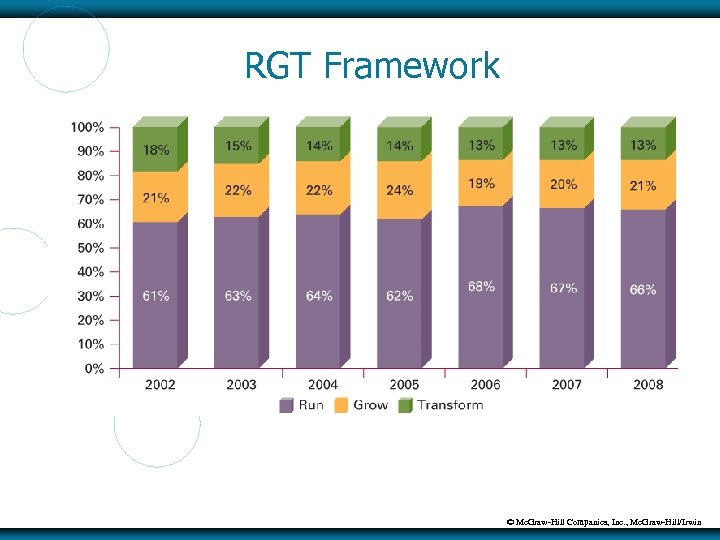 RGT Framework © Mc. Graw-Hill Companies, Inc. , Mc. Graw-Hill/Irwin
 Porter and RGT Run = overall cost leadership Grow = focus and differentiation Transform = (new) differentiation © Mc. Graw-Hill Companies, Inc. , Mc. Graw-Hill/Irwin