


 Скачать презентацию CHAPTER 1 SCOPE AND CHALLENGE OF INTERNATIONAL
f2fc874f157b3cced9dab77215522645.ppt
- Количество слайдов: 18
 CHAPTER 1 • SCOPE AND CHALLENGE OF INTERNATIONAL MARKETING
 Overview • Business activities are global. No business can escape the effect of globalization. • View three major global trends: • 1) Growth of free trade areas (EC, NAFTA, AFTA) • 2) Growth of the Free Market System • 3) Emergence and evolution of large markets (Brazil, China, India).
 Overview • All aspects of international business are global - financing, marketing, technological, production, pricing, accounting, communication. • All firms are affected by international events. Therefore business people need to be globally aware.
 Internationalization of US Business • Many US firms and some well-known brands are foreign controlled. • Some firms enter the US market via exporting and then built plants. • US firms also invest in foreign countries & foreign earnings contribute substantially to the overall profit position.
 Internationalization of US Business • US firms involved in international business out performed those not involved. They grow twice as fast and have significantly higher returns on assets and equity. • In many cases foreign sales prove to be more profitable than domestic sales and some firms earn a large share of their profits from foreign operations.
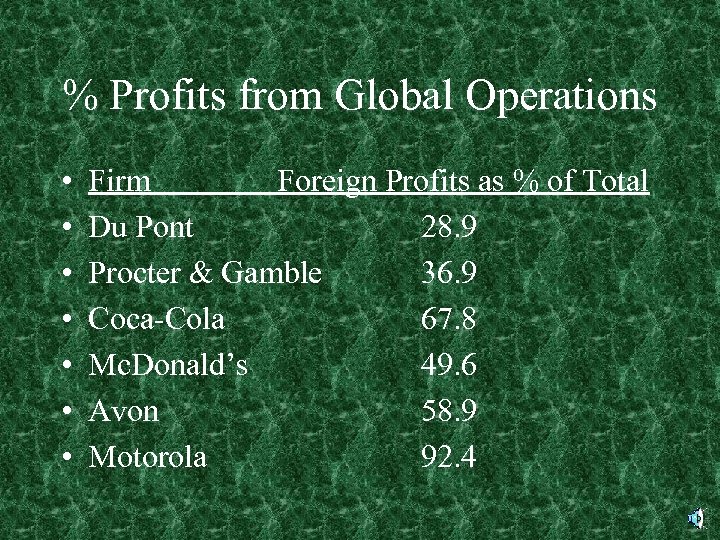 % Profits from Global Operations • • Firm Foreign Profits as % of Total Du Pont 28. 9 Procter & Gamble 36. 9 Coca-Cola 67. 8 Mc. Donald’s 49. 6 Avon 58. 9 Motorola 92. 4
 International Marketing Task • International marketing tasks more difficult than domestic marketing tasks because of the degree of environmental uncertainty. • International marketers face home and also foreign country environmental factors and this makes for greater uncertainty (controllable elements and TWO uncontrollable environments).
 Environmental Factors • All environments contain SEVEN (7) social institutions. These can be identified by the acronym PELFREC. These seven social institutions are present in ALL societies regardless of how advanced or underdeveloped the society. • If you eliminate any of the institutions the society as you know it dies.
 The Seven Social Institutions • • • Political - system of transferring power Economic - method of wealth distribution Legal - means of deciding right & wrong Family - unit of procreation Religious - - belief system Education - means of passing on information for preserving the society • Culture - way of life of a people
 Effect of Environmental Factors • Marketers must interpret the effect of environmental factors and adapt marketing strategy. • Marketers must be aware of the frame of reference that they use when making decisions. Differences in environments are known to cause embarrassing and costly misunderstandings.
 Avoiding Environmental Misunderstandings • Be aware of the principle of marketing relativism - people make judgements based upon their culture and experiences. Since international marketers may use their home country culture to judge things inappropriate strategies may be adopted.
 Self-Reference Criterion - An Obstacle • Successful in international marketing call for adapting to environmental differences across markets. This takes effort. • The main obstacle to success is a person’s self-reference criterion [SRC] in making decisions. • SRC is a persons unconscious references to their own cultural values, experiences, and knowledge in making a decision.
 Overcoming Self-Reference Criterion • The first step in overcoming SRC is to recognize the need to be sensitive to differences across cultures • Second, ask questions of people in the foreign culture.
 Isolating SRC Influences • Make a cross-cultural analysis to isolate SRC influences. • Define problem/goal in terms of home country cultural norms. • Define problem/goal in terms of foreign country cultural norms. • Isolate SRC influences • Redefine problem without SRC
 Developing Global Awareness • • To be globally aware is to have: Objectivity Tolerance of cultural differences Knowledge of history and PELFREC on a global scale.
 International Involvement • From a marketing perspective a firm may adopt one of FIVE involvement stance: • No Direct Foreign Marketing • Infrequent Foreign Marketing • Regular Foreign Marketing • International Marketing • Global marketing
 International marketing Concepts • Domestic Marketing Extension • Multi-domestic Marketing • Global Marketing
 Globalization of Markets • Is the world becoming a single market? • Can we sell the same product the same way every where? • Should marketers customize (adapt) or standardize marketing effort (4 P’s) - read Levitt’s article.