


 Скачать презентацию Chapter 1 Overview of Electronic Commerce Prentice Hall
6882cf7e1a2b16e229175cb9ff675ff9.ppt
- Количество слайдов: 49
 Chapter 1 Overview of Electronic Commerce Prentice Hall, 2002 1
 Learning Objectives Define electronic commerce (EC) and describe its various categories Distinguish between electronic markets and interorganizational systems Describe and discuss the content and framework of EC Prentice Hall, 2002 2
 Learning Objectives (cont. ) Understand the forces that drive the widespread use of EC Describe the benefits of EC to organizations, consumers, and society Describe the limitations of EC Discuss some major managerial issues regarding EC Prentice Hall, 2002 3
 Opening Vignette: Qantas Airways Business-to-business (B 2 B) E-marketplace member Business-to-customer (B 2 C): Online booking & wireless communications Business-to-employee (B 2 E): Online training & banking Prentice Hall, 2002 4
 Qantas Airways (cont. ) Business-tobusiness (B 2 B) E-marketplace member Joined Airnew Co. — links major airlines with suppliers Fuel services Light maintenance services Catering Prentice Hall, 2002 5
 Qantas Airways (cont. ) Business-to-customer (B 2 C): Online booking Wireless communications Prentice Hall, 2002 6
 Qantas Airways (cont. ) Business-to-employee (B 2 E): Online training Online banking Prentice Hall, 2002 7
 Definitions Business-to-business (B 2 B) Businesses make online transactions purchases with other business Business-to-consumer (B 2 C) Online transactions between businesses and consumers Business-to-employee (B 2 E) Information and services made available to employees online Prentice Hall, 2002 8
 Electronic Commerce Terms E-business EC defined from these perspectives Communications Business process Service Online Collaborations Community Prentice Hall, 2002 9
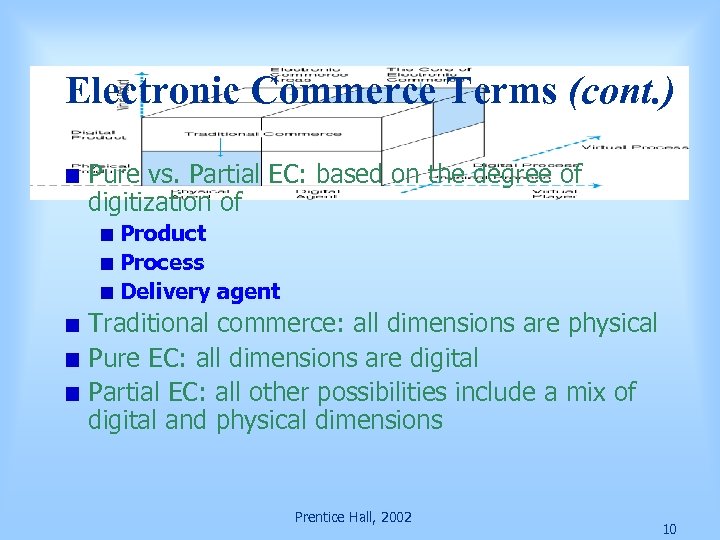 Electronic Commerce Terms (cont. ) Pure vs. Partial EC: based on the degree of digitization of Product Process Delivery agent Traditional commerce: all dimensions are physical Pure EC: all dimensions are digital Partial EC: all other possibilities include a mix of digital and physical dimensions Prentice Hall, 2002 10
 Electronic Commerce Terms (cont. ) Internet vs. Non-Internet EC VANs LANs Click and Mortar Prentice Hall, 2002 11
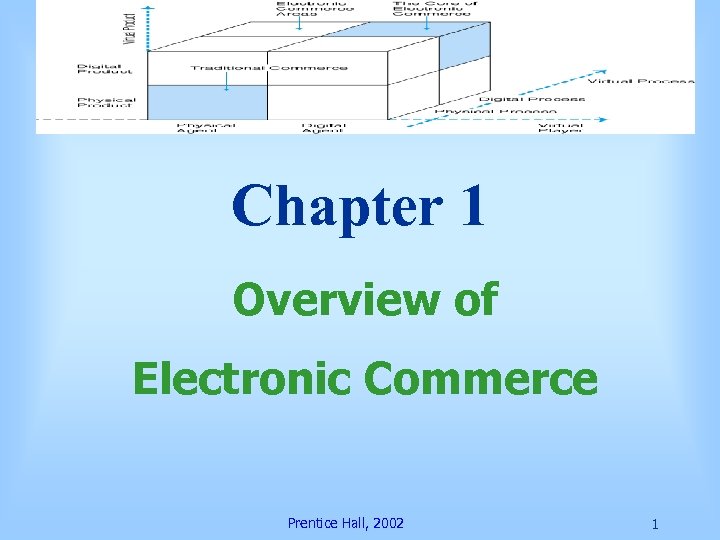
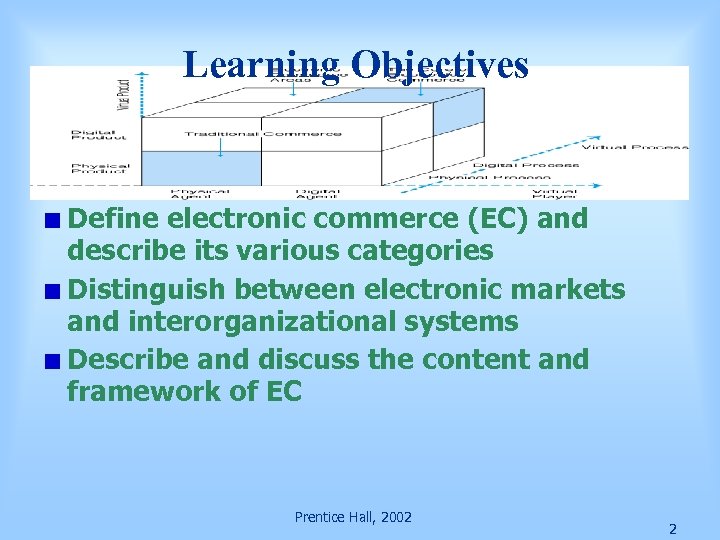
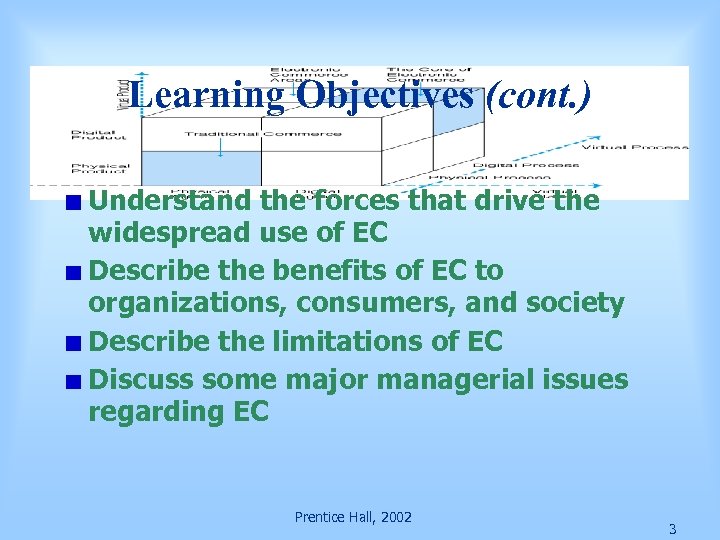
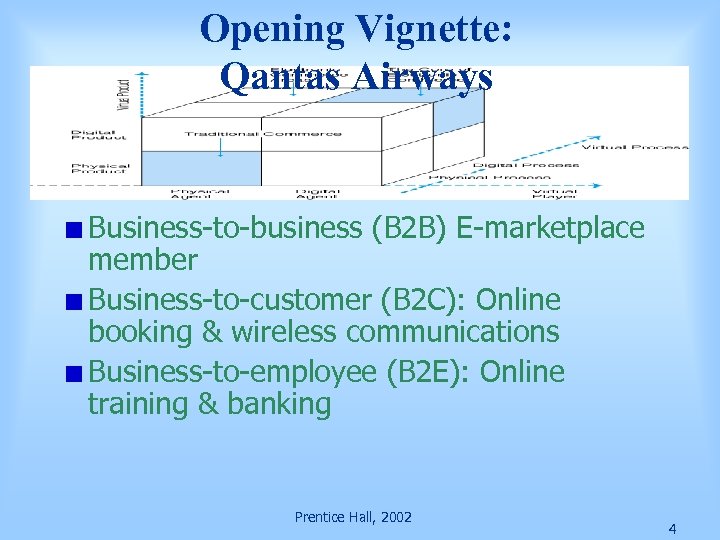
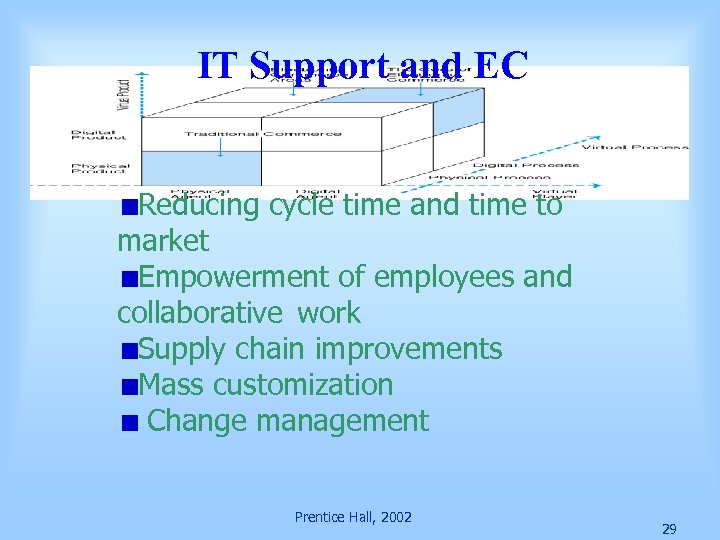
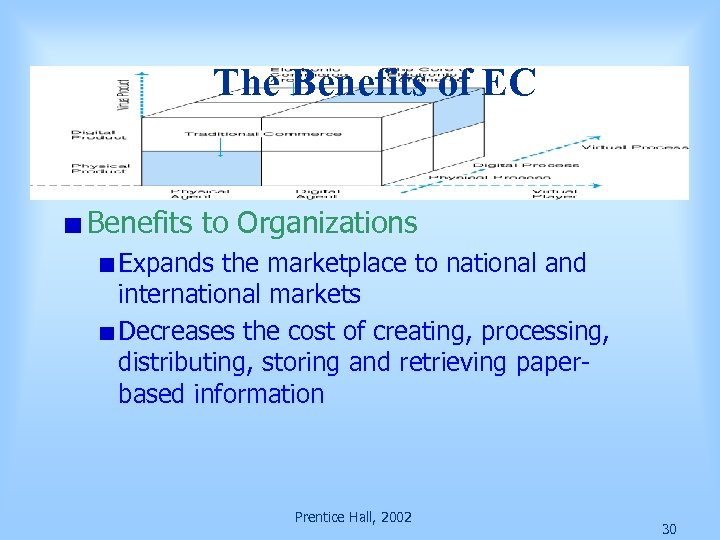
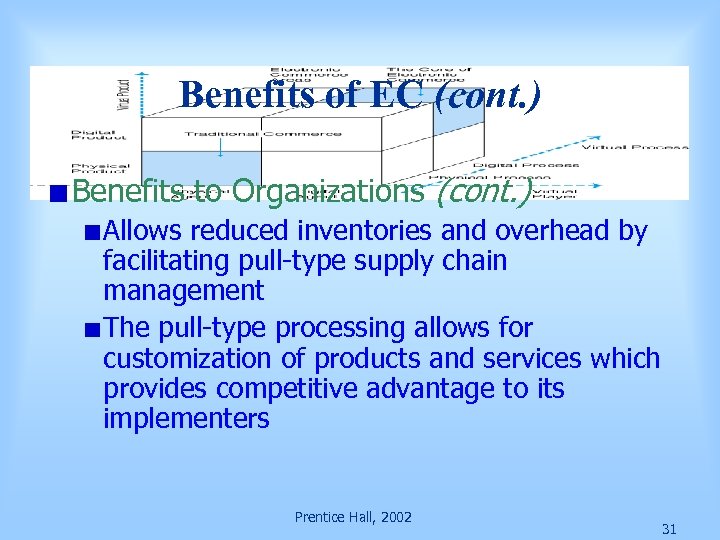
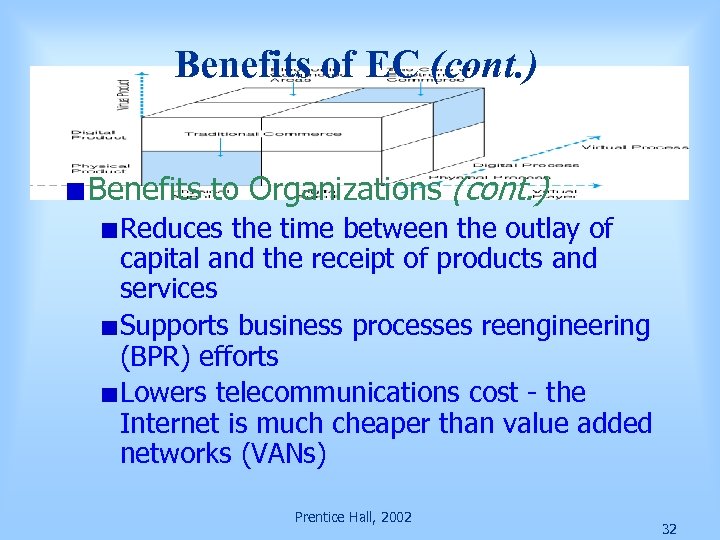
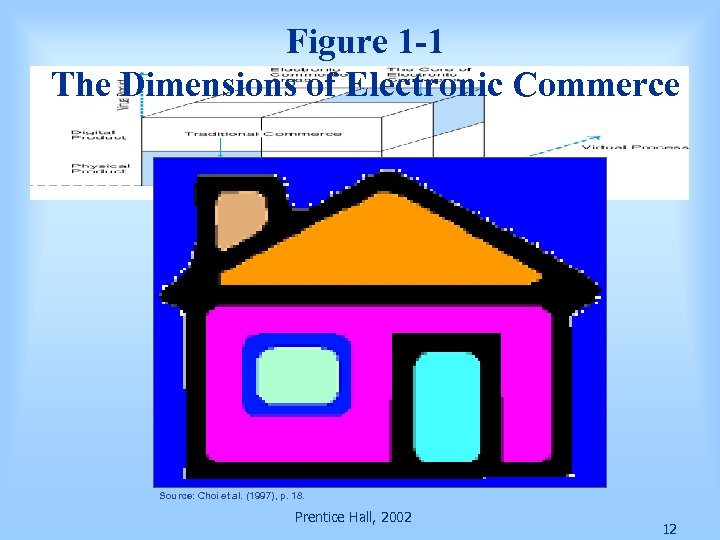 Figure 1 -1 The Dimensions of Electronic Commerce Source: Choi et al. (1997), p. 18. Prentice Hall, 2002 12
 Business Models A method of doing business by which a company can generate revenue to sustain itself. Examples: Name your price Find the best price Dynamic brokering Affiliate marketing Prentice Hall, 2002 13
 Business Models (cont. ) Group purchasing Electronic tendering systems Online auctions Customization and personalization Electronic marketplaces and exchanges Supply chain improvers Collaborative commerce Prentice Hall, 2002 14
 Business Models (cont. ) Orbis Corporation Prentice Hall, 2002 15
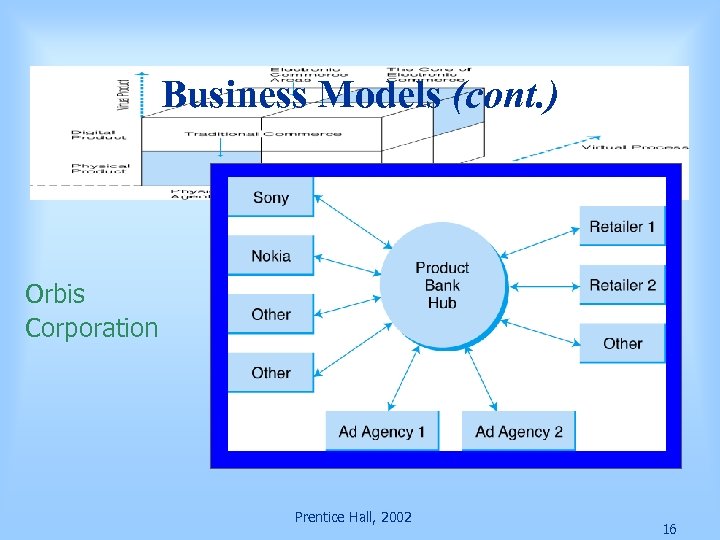 Business Models (cont. ) Orbis Corporation Prentice Hall, 2002 16
 Electronic Markets (E-marketplaces or E-marketspaces) A market is a network of interactions and relationships where information, products, services, and payments are exchanged. It handles all the necessary transactions It is a place where shoppers and sellers meet electronically Sellers and buyers negotiate, submit bids, agree on an order, and finish the execution on- or off-line Prentice Hall, 2002 17
 Figure 1 -2 Transactions in Electronic Markets Prentice Hall, 2002 18
 Electronic Exchanges Electronic exchanges provide dynamic pricing by matching real-time supply and demand Live auctions Stock exchanges Prentice Hall, 2002 19
 Interorganization Information Systems Interorganizational information system (IOS) involves information flow among two or more organizations Major objective is efficient routine transaction processing, such as transmitting orders, bills, and payments using EDI or extranets Scope: Unified system encompassing two or several business partners Typical IOS includes a company, its suppliers, and/or customers Prentice Hall, 2002 20
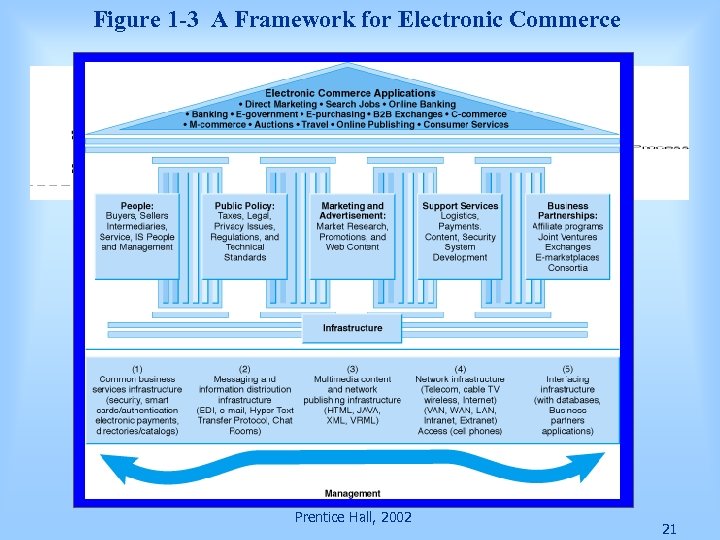 Figure 1 -3 A Framework for Electronic Commerce Prentice Hall, 2002 21
 Electronic Commerce is Interdisciplinary Marketing Computer sciences Consumer behavior and psychology Finance Economics Management information systems Accounting and auditing Management Business law and ethics Others Prentice Hall, 2002 22
 The Driving Forces of Electronic Commerce The New World of Business pressures Organizational responses The role of Information Technology (including electronic commerce) Prentice Hall, 2002 23
 Major Business Pressures Market and economic pressures Strong competition Global economy Regional trade agreements (e. g. NAFTA) Extremely low labor cost in some countries Frequent and significant changes in markets Increased power of consumers Prentice Hall, 2002 24
 Major Business Pressures (cont. ) Societal and environmental pressures Changing nature of workforce Government deregulation of banking and other services Shrinking government subsidies Increased importance of ethical and legal issues Increased social responsibility of organizations Rapid political changes Prentice Hall, 2002 25
 Major Business Pressures (cont. ) Technological pressures Rapid technological obsolescence Increase innovations and new technologies Information overload Rapid decline in technology cost vs. performance ratio Prentice Hall, 2002 26
 Organizational Responses Strategic systems Continuous improvement efforts Business process reengineering (BPR) Business Alliances Electronic commerce Prentice Hall, 2002 27
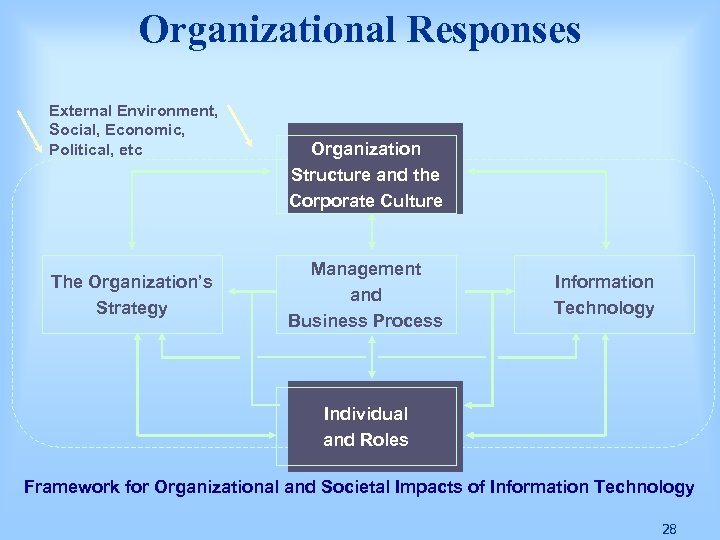 Organizational Responses External Environment, Social, Economic, Political, etc The Organization’s Strategy Organization Structure and the Corporate Culture Management and Business Process Information Technology Individual and Roles Framework for Organizational and Societal Impacts of Information Technology 28
 IT Support and EC Reducing cycle time and time to market Empowerment of employees and collaborative work Supply chain improvements Mass customization Change management Prentice Hall, 2002 29
 The Benefits of EC Benefits to Organizations Expands the marketplace to national and international markets Decreases the cost of creating, processing, distributing, storing and retrieving paperbased information Prentice Hall, 2002 30
 Benefits of EC (cont. ) Benefits to Organizations (cont. ) Allows reduced inventories and overhead by facilitating pull-type supply chain management The pull-type processing allows for customization of products and services which provides competitive advantage to its implementers Prentice Hall, 2002 31
 Benefits of EC (cont. ) Benefits to Organizations (cont. ) Reduces the time between the outlay of capital and the receipt of products and services Supports business processes reengineering (BPR) efforts Lowers telecommunications cost - the Internet is much cheaper than value added networks (VANs) Prentice Hall, 2002 32
 Benefits of EC (cont. ) Benefits to consumers Enables consumers to shop or do other transactions 24 hours a day, all year round from almost any location Provides consumers with more choices Provides consumers with less expensive products and services by allowing them to shop in many places and conduct quick comparisons Prentice Hall, 2002 33
 Benefits of EC (cont. ) Benefits to consumers (cont. ) Allows quick delivery of products and services (in some cases) especially with digitized products Consumers can receive relevant and detailed information in seconds, rather than in days or weeks Makes it possible to participate in virtual auctions Prentice Hall, 2002 34
 Benefits of EC (cont. ) Benefits to consumers (cont. ) Allows consumers to interact with other consumers n electronic communities and exchange ideas as well as compare experiences Facilitates competition, which results in substantial discounts Prentice Hall, 2002 35
 Benefits of EC (cont. ) Benefits to society Enables more individuals to work at home, and to do less traveling for shopping, resulting in less traffic on the roads, and lower air pollution Allows some merchandise to be sold at lower prices benefiting less affluent people Prentice Hall, 2002 36
 Benefits of EC (cont. ) Benefits to society (cont. ) Enables people in Third World countries and rural areas to enjoy products and services which otherwise are not available to them Facilitates delivery of public services at a reduced cost, increases effectiveness, and/or improves quality Prentice Hall, 2002 37
 The Limitations of EC Technical limitations of electronic commerce Lack of sufficient system’s security, reliability, standards, and communication protocols Insufficient telecommunication bandwidth The software development tools are still evolving and changing rapidly Prentice Hall, 2002 38
 The Limitations of EC (cont. ) Technical Limitations of EC (cont. ) Difficulties in integrating the Internet and electronic commerce software with some existing applications and databases The need for special Web servers and other infrastructures, in addition to the network servers (additional cost) Prentice Hall, 2002 39
 The Limitations of EC (cont. ) Technical Limitations of EC (cont. ) Possible problems of interoperability, meaning that some EC software does not fit with some hardware, or is incompatible with some operating systems or other components Prentice Hall, 2002 40
 Non-Technical Limitations Cost and justification The cost of developing an EC in house can be very high, and mistakes due to lack of experience may result in delays. There are many opportunities for outsourcing, but where and how to do it is not a simple issue In order to justify the system, one needs to deal with some intangible benefits which are difficult to quantify. Prentice Hall, 2002 41
 Non-Technical Limitations (cont. ) Security and Privacy These issues are especially important in the B 2 C area, but security concerns are not so serious from a technical standpoint Privacy measures are constantly improving too The EC industry has a very long and difficult task of convincing customers that online transactions and privacy are, in fact, very secure Prentice Hall, 2002 42
 Non-Technical Limitations (cont. ) Lack of trust and user resistance Customers do not trust: Unknown faceless sellers Paperless transactions Electronic money Switching from a physical to a virtual store may be difficult Prentice Hall, 2002 43
 Non-Technical Limitations (cont. ) Other limiting factors are: Lack of touch and feel online Many unresolved legal issues Rapidly evolving and changing EC Lack of support services Insufficiently large enough number of sellers and buyers Breakdown of human relationships Expensive and/or inconvenient accessibility to the Internet Prentice Hall, 2002 44
 Putting It All Together Major concern of today’s companies—how to transform themselves to take part in digital economy Example: Toys, Inc. Uses intranet for internal communications, collaboration, dissemination of information Networked to e-marketspaces and large corporations Corporate portal for communication and collaboration with business partners Prentice Hall, 2002 45
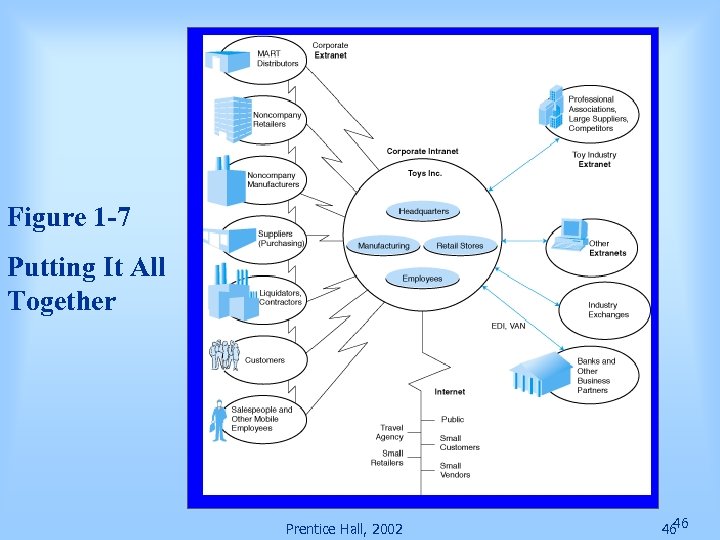 Figure 1 -7 Putting It All Together Prentice Hall, 2002 46 46
 Managerial Issues Is it real? How to evaluate the magnitude of the business pressures. What should be my company’s strategy towards EC? Prentice Hall, 2002 47
 Managerial Issues (cont. ) Why is the B 2 B area so attractive? What is the best way to learn about EC? What ethical issues exist? How can failures be avoided? Prentice Hall, 2002 48
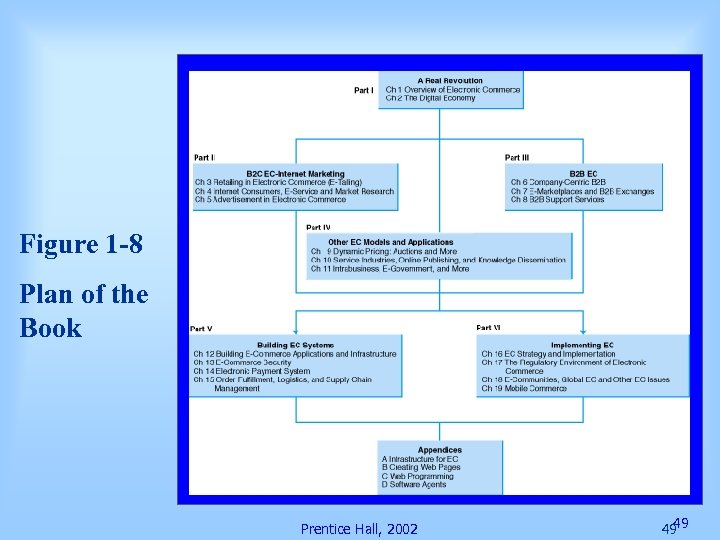 Figure 1 -8 Plan of the Book Prentice Hall, 2002 49 49