


 Скачать презентацию Chapter 1 New Perspectives on Marketing in the
d34a78c5423be971d3df5fb08206479b.ppt
- Количество слайдов: 49
 Chapter 1: New Perspectives on Marketing in the Service Economy Slide © 2007 by Christopher Lovelock and Jochen Wirtz Services Marketing 6/E Chapter 1 - 1
 Overview of Chapter 1 § Why Study Services? S. 1 -17 § What are Services? S. 18 -22 § The Marketing Challenges Posed by Services S. 23 - 29 § The Expanded Marketing Mix Required for Services S. 30 -48 Slide © 2007 by Christopher Lovelock and Jochen Wirtz Services Marketing 6/E Chapter 1 - 2
 Questions of Chapter 1 1. Why Study Services? 2. How important is the service sector in our economy, and what are its principal industries? 3. What exactly is a service, and how should it be conceptualized and defined? 4. What distinctive marketing challenges do services present relative goods? 5. Why do services need an expanded marketing mix, comprising 8 Ps rather than 4 Ps? Slide © 2007 by Christopher Lovelock and Jochen Wirtz Services Marketing 6/E Chapter 1 - 3
 Why Study Services? Slide © 2007 by Christopher Lovelock and Jochen Wirtz Services Marketing 6/E Chapter 1 - 4
 Why Study Services? (1) § Services dominate economy in most nations § Understanding services offers you personal competitive advantages § Importance of service sector in economy is growing rapidly: Ø Services account for more than 60 percent of GDP worldwide Ø Almost all economies have a substantial service sector Ø Most new employment is provided by services Ø Strongest growth area for marketing Ø GDP: the total market values of goods and services produced by workers and capital within a nation's borders during a given period (usually 1 year) Gross Domestic Product Slide © 2007 by Christopher Lovelock and Jochen Wirtz Services Marketing 6/E Chapter 1 - 5
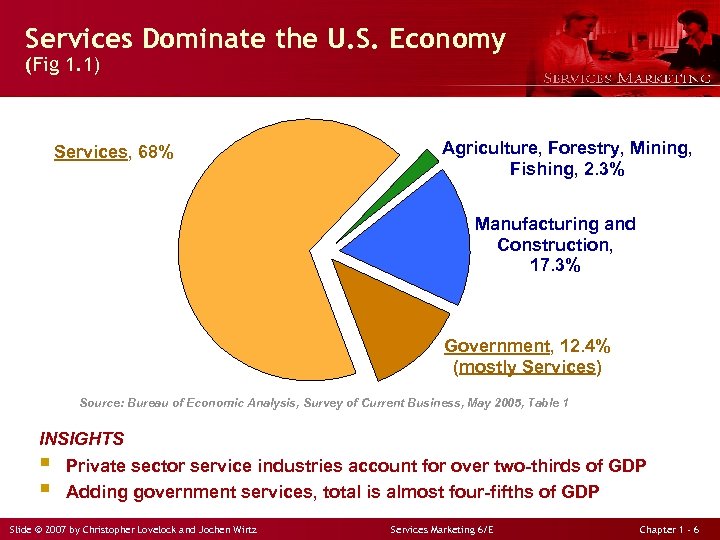 Services Dominate the U. S. Economy (Fig 1. 1) Services, 68% Agriculture, Forestry, Mining, Fishing, 2. 3% Manufacturing and Construction, 17. 3% Government, 12. 4% (mostly Services) Source: Bureau of Economic Analysis, Survey of Current Business, May 2005, Table 1 INSIGHTS § Private sector service industries account for over two-thirds of GDP § Adding government services, total is almost four-fifths of GDP Slide © 2007 by Christopher Lovelock and Jochen Wirtz Services Marketing 6/E Chapter 1 - 6
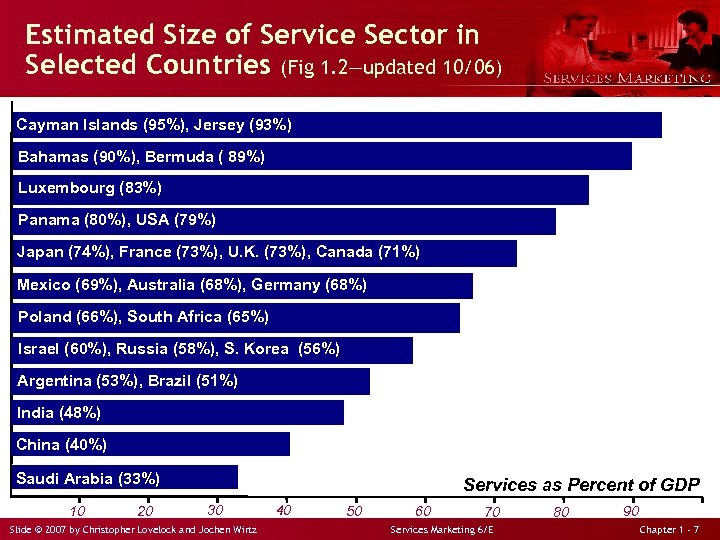 Estimated Size of Service Sector in Selected Countries (Fig 1. 2—updated 10/06) Cayman Islands (95%), Jersey (93%) Bahamas (90%), Bermuda ( 89%) Luxembourg (83%) Panama (80%), USA (79%) Japan (74%), France (73%), U. K. (73%), Canada (71%) Mexico (69%), Australia (68%), Germany (68%) Poland (66%), South Africa (65%) Israel (60%), Russia (58%), S. Korea (56%) Argentina (53%), Brazil (51%) India (48%) China (40%) Saudi Arabia (33%) 10 20 Services as Percent of GDP 30 Slide © 2007 by Christopher Lovelock and Jochen Wirtz 40 50 60 70 Services Marketing 6/E 80 90 Chapter 1 - 7
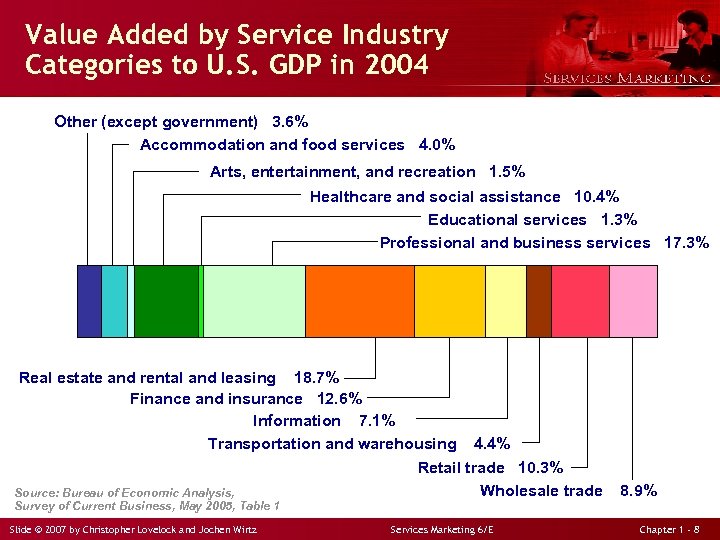 Value Added by Service Industry Categories to U. S. GDP in 2004 Other (except government) 3. 6% Accommodation and food services 4. 0% Arts, entertainment, and recreation 1. 5% Healthcare and social assistance 10. 4% Educational services 1. 3% Professional and business services 17. 3% Real estate and rental and leasing 18. 7% Finance and insurance 12. 6% Information 7. 1% Transportation and warehousing 4. 4% Retail trade 10. 3% Wholesale trade Source: Bureau of Economic Analysis, 8. 9% Survey of Current Business, May 2005, Table 1 Slide © 2007 by Christopher Lovelock and Jochen Wirtz Services Marketing 6/E Chapter 1 - 8
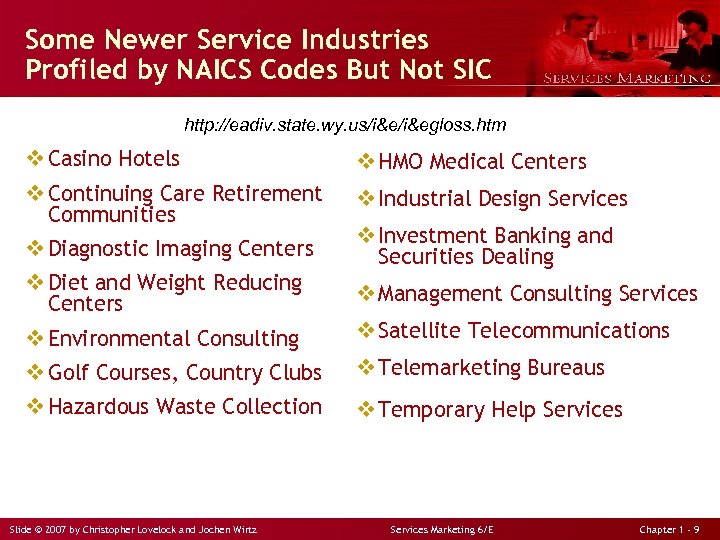 Some Newer Service Industries Profiled by NAICS Codes But Not SIC http: //eadiv. state. wy. us/i&egloss. htm v Casino Hotels v HMO Medical Centers v Continuing Care Retirement Communities v Industrial Design Services v Diagnostic Imaging Centers v Investment Banking and Securities Dealing v Diet and Weight Reducing Centers v Management Consulting Services v Environmental Consulting v Satellite Telecommunications v Golf Courses, Country Clubs v Telemarketing Bureaus v Hazardous Waste Collection v Temporary Help Services Slide © 2007 by Christopher Lovelock and Jochen Wirtz Services Marketing 6/E Chapter 1 - 9
 Why Study Services? (2) § Most new jobs are generated by services Ø Fastest growth expected in knowledge-based industries Ø Significant training and educational qualifications required, but employees will be more highly compensated Ø Will service jobs lost to lower-cost countries? Yes, some service jobs can be exported Slide © 2007 by Christopher Lovelock and Jochen Wirtz Services Marketing 6/E Chapter 1 -
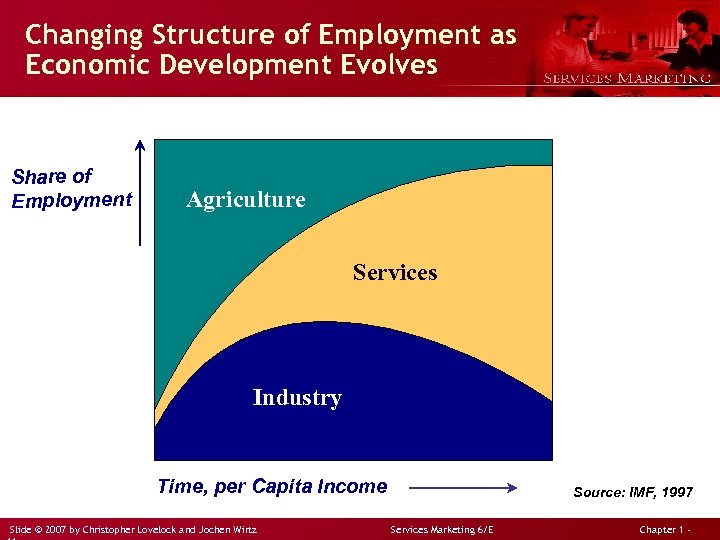 Changing Structure of Employment as Economic Development Evolves Share of Employment Agriculture Services Industry Time, per Capita Income Slide © 2007 by Christopher Lovelock and Jochen Wirtz Source: IMF, 1997 Services Marketing 6/E Chapter 1 -
 Why Study Services? (3) § Powerful forces are transforming service markets Ø Government policies, social changes, business trends, advances in IT, internationalization § These forces are reshaping Ø Demand Ø Supply Ø The competitive landscape Ø Customers’ choices, power, and decision making Slide © 2007 by Christopher Lovelock and Jochen Wirtz Services Marketing 6/E Chapter 1 -
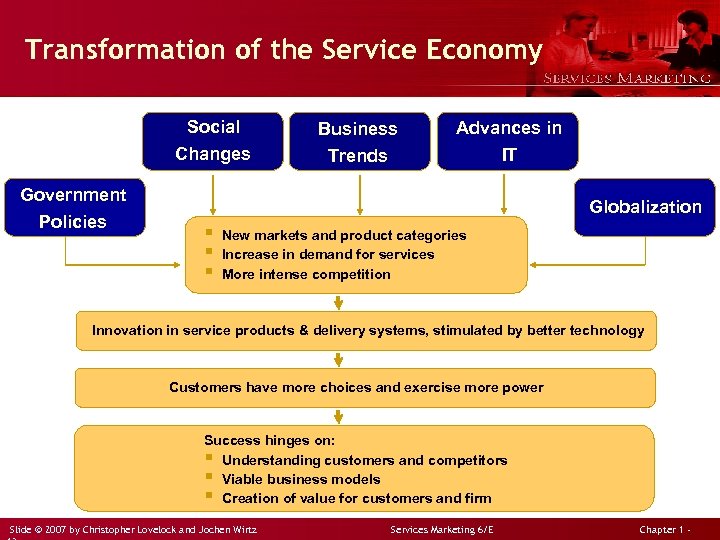 Transformation of the Service Economy Social Changes Government Policies Business Trends Advances in IT Globalization § § § New markets and product categories Increase in demand for services More intense competition Innovation in service products & delivery systems, stimulated by better technology Customers have more choices and exercise more power Success hinges on: § Understanding customers and competitors § Viable business models § Creation of value for customers and firm Slide © 2007 by Christopher Lovelock and Jochen Wirtz Services Marketing 6/E Chapter 1 -
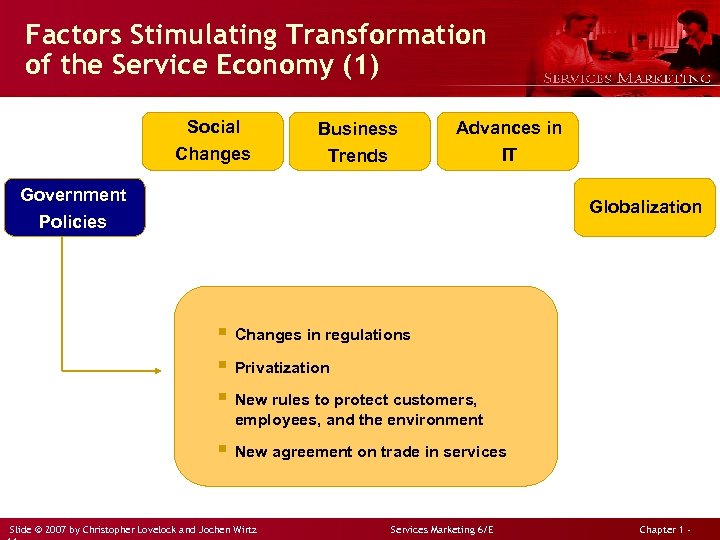 Factors Stimulating Transformation of the Service Economy (1) Social Changes Business Trends Advances in IT Government Policies Globalization § Changes in regulations § Privatization § New rules to protect customers, employees, and the environment § New agreement on trade in services Slide © 2007 by Christopher Lovelock and Jochen Wirtz Services Marketing 6/E Chapter 1 -
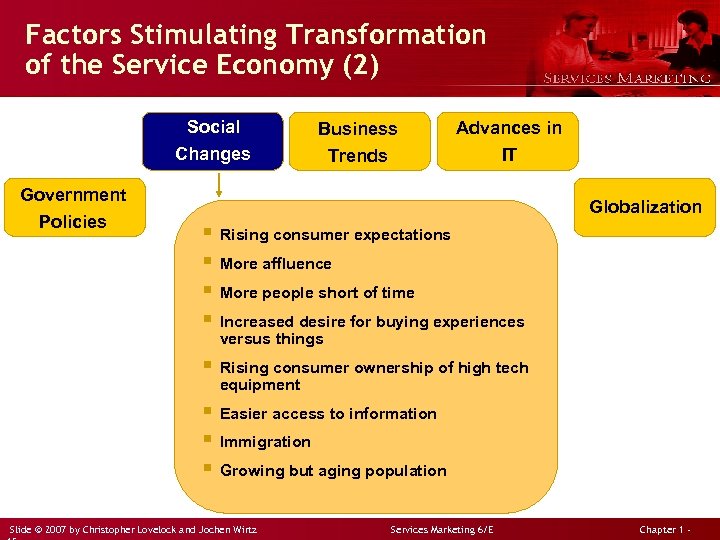 Factors Stimulating Transformation of the Service Economy (2) Social Changes Government Policies Business Trends Advances in IT Globalization § Rising consumer expectations § More affluence § More people short of time § Increased desire for buying experiences versus things § Rising consumer ownership of high tech equipment § Easier access to information § Immigration § Growing but aging population Slide © 2007 by Christopher Lovelock and Jochen Wirtz Services Marketing 6/E Chapter 1 -
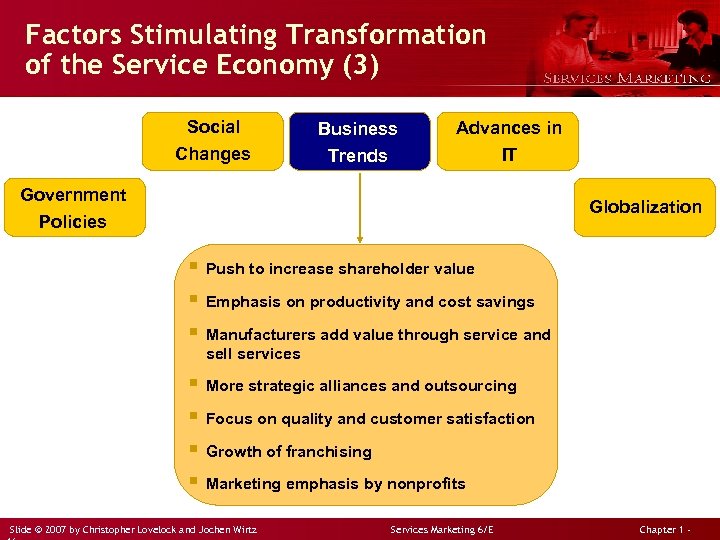 Factors Stimulating Transformation of the Service Economy (3) Social Changes Business Trends Advances in IT Government Policies Globalization § Push to increase shareholder value § Emphasis on productivity and cost savings § Manufacturers add value through service and sell services § More strategic alliances and outsourcing § Focus on quality and customer satisfaction § Growth of franchising § Marketing emphasis by nonprofits Slide © 2007 by Christopher Lovelock and Jochen Wirtz Services Marketing 6/E Chapter 1 -
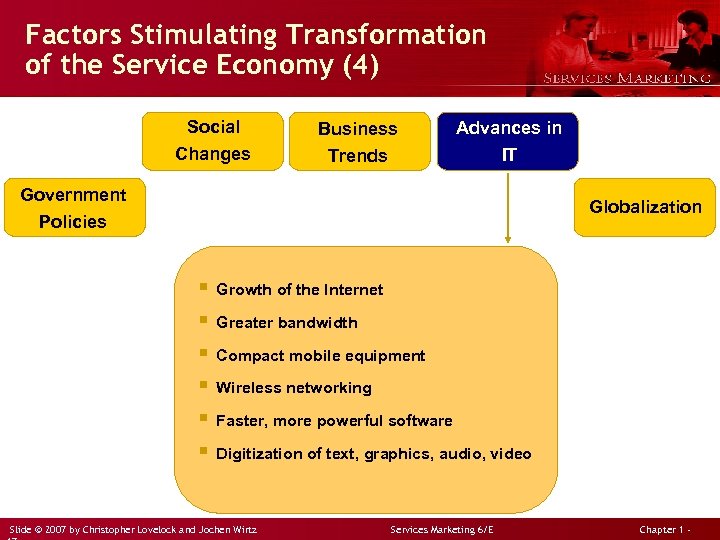 Factors Stimulating Transformation of the Service Economy (4) Social Changes Business Trends Advances in IT Government Policies Globalization § Growth of the Internet § Greater bandwidth § Compact mobile equipment § Wireless networking § Faster, more powerful software § Digitization of text, graphics, audio, video Slide © 2007 by Christopher Lovelock and Jochen Wirtz Services Marketing 6/E Chapter 1 -
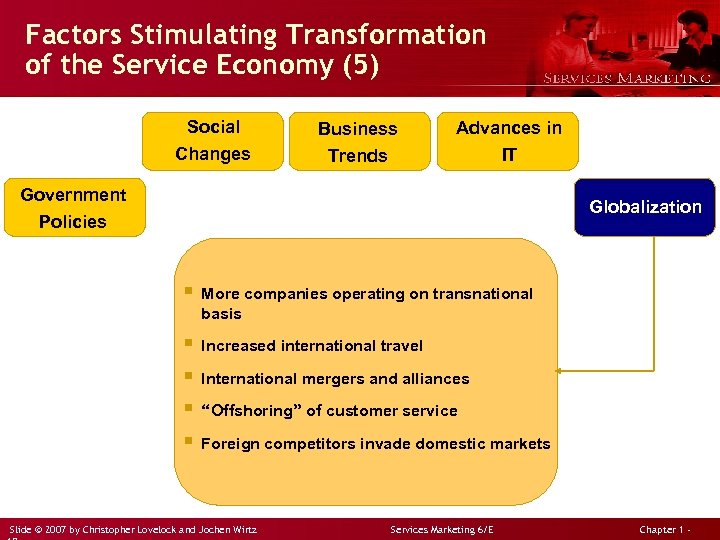 Factors Stimulating Transformation of the Service Economy (5) Social Changes Business Trends Advances in IT Government Policies Globalization § More companies operating on transnational basis § Increased international travel § International mergers and alliances § “Offshoring” of customer service § Foreign competitors invade domestic markets Slide © 2007 by Christopher Lovelock and Jochen Wirtz Services Marketing 6/E Chapter 1 -
 What Are Services? Slide © 2007 by Christopher Lovelock and Jochen Wirtz Services Marketing 6/E Chapter 1 -
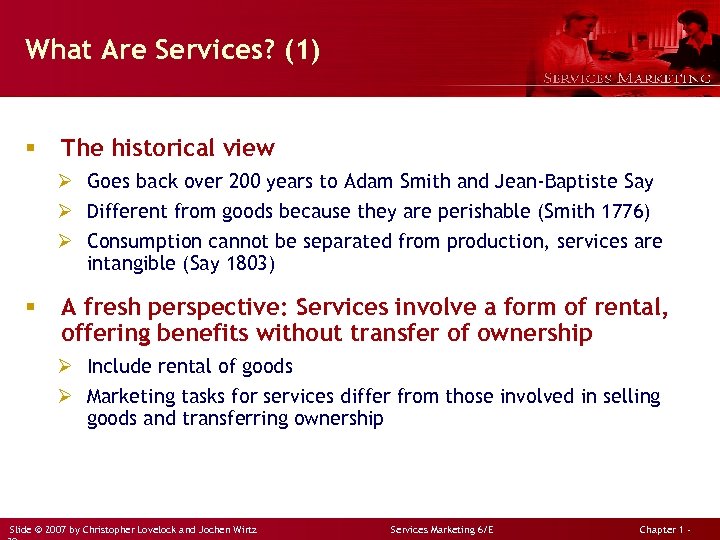 What Are Services? (1) § The historical view Ø Goes back over 200 years to Adam Smith and Jean-Baptiste Say Ø Different from goods because they are perishable (Smith 1776) Ø Consumption cannot be separated from production, services are intangible (Say 1803) § A fresh perspective: Services involve a form of rental, offering benefits without transfer of ownership Ø Include rental of goods Ø Marketing tasks for services differ from those involved in selling goods and transferring ownership Slide © 2007 by Christopher Lovelock and Jochen Wirtz Services Marketing 6/E Chapter 1 -
 What Are Services? (2) § Five broad categories within non-ownership framework: 1. 2. 3. 4. 5. § Rented goods services Defined space and place rentals Labor and expertise rentals Access to shared physical environments Systems and networks: access and usage Implications of renting versus owning (Service Perspectives 1. 1) Ø Markets exist for renting durable goods rather than selling them Ø Renting portions of larger physical entity (e. g. , office space, apartment) can form basis for service Ø Customers more closely engaged with service suppliers Ø Time plays central role in most services Ø Customer choice criteria may differ between rentals and outright purchases Ø Services offer opportunities for resource sharing Slide © 2007 by Christopher Lovelock and Jochen Wirtz Services Marketing 6/E Chapter 1 -
 Defining Services § Services Ø Are economic activities offered by one party to another Ø Most commonly employ time-based performances to bring about desired results in: ― recipients themselves ― objects or other assets for which purchasers have responsibility § In exchange for their money, time, and effort, service customers expect to obtain value from Ø Access to goods, labor, facilities, environments, professional skills, networks, and systems Ø But they do not normally take ownership of any of the physical elements involved Slide © 2007 by Christopher Lovelock and Jochen Wirtz Services Marketing 6/E Chapter 1 -
 Service Products versus Customer Service and After-Sales Service § A firm’s market offerings are divided into core product elements and supplementary service elements § Is everyone in service? Need to distinguish between: Ø Marketing of services Ø Marketing goods through added-value service § Good service increases the value of a core physical good § After-sales service is as important as pre-sales service for many physical goods § Manufacturing firms are reformulating and enhancing existing added-value services to market them as standalone core products Slide © 2007 by Christopher Lovelock and Jochen Wirtz Services Marketing 6/E Chapter 1 -
 Challenges Posed by Services Slide © 2007 by Christopher Lovelock and Jochen Wirtz Services Marketing 6/E Chapter 1 -
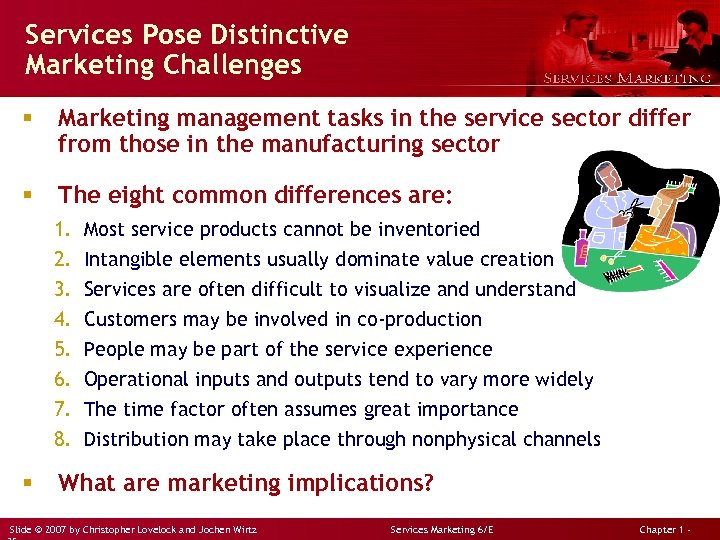 Services Pose Distinctive Marketing Challenges § Marketing management tasks in the service sector differ from those in the manufacturing sector § The eight common differences are: 1. 2. 3. 4. 5. 6. 7. 8. § Most service products cannot be inventoried Intangible elements usually dominate value creation Services are often difficult to visualize and understand Customers may be involved in co-production People may be part of the service experience Operational inputs and outputs tend to vary more widely The time factor often assumes great importance Distribution may take place through nonphysical channels What are marketing implications? Slide © 2007 by Christopher Lovelock and Jochen Wirtz Services Marketing 6/E Chapter 1 -
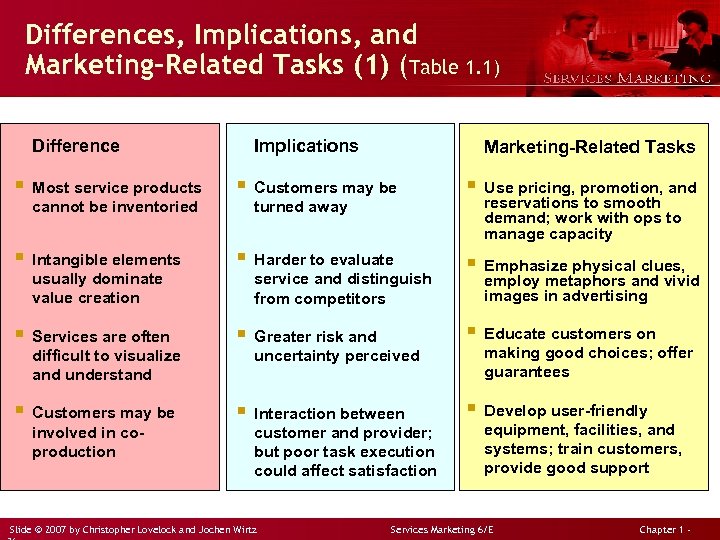 Differences, Implications, and Marketing-Related Tasks (1) (Table 1. 1) Difference Implications Marketing-Related Tasks § Most service products § Customers may be § Use pricing, promotion, and § Intangible elements § Harder to evaluate § Emphasize physical clues, cannot be inventoried usually dominate value creation turned away service and distinguish from competitors reservations to smooth demand; work with ops to manage capacity employ metaphors and vivid images in advertising § Services are often § Greater risk and § Educate customers on § Customers may be § Interaction between § Develop user-friendly difficult to visualize and understand involved in coproduction uncertainty perceived customer and provider; but poor task execution could affect satisfaction Slide © 2007 by Christopher Lovelock and Jochen Wirtz making good choices; offer guarantees equipment, facilities, and systems; train customers, provide good support Services Marketing 6/E Chapter 1 -
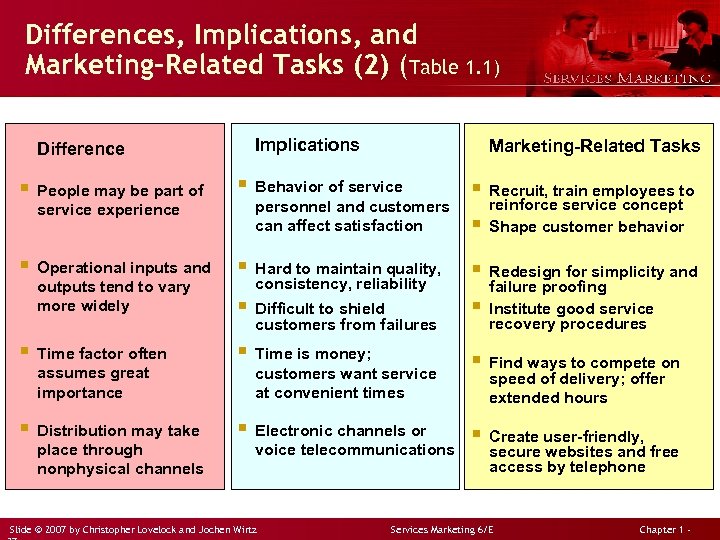 Differences, Implications, and Marketing-Related Tasks (2) (Table 1. 1) Difference Implications Marketing-Related Tasks § People may be part of § Behavior of service § Recruit, train employees to reinforce service concept § Shape customer behavior § Operational inputs and § Hard to maintain quality, § Redesign for simplicity and § Difficult to shield § § Time is money; § Find ways to compete on service experience outputs tend to vary more widely personnel and customers can affect satisfaction consistency, reliability customers from failures § Time factor often assumes great importance § Distribution may take place through nonphysical channels customers want service at convenient times § Electronic channels or voice telecommunications Slide © 2007 by Christopher Lovelock and Jochen Wirtz failure proofing Institute good service recovery procedures speed of delivery; offer extended hours § Create user-friendly, secure websites and free access by telephone Services Marketing 6/E Chapter 1 -
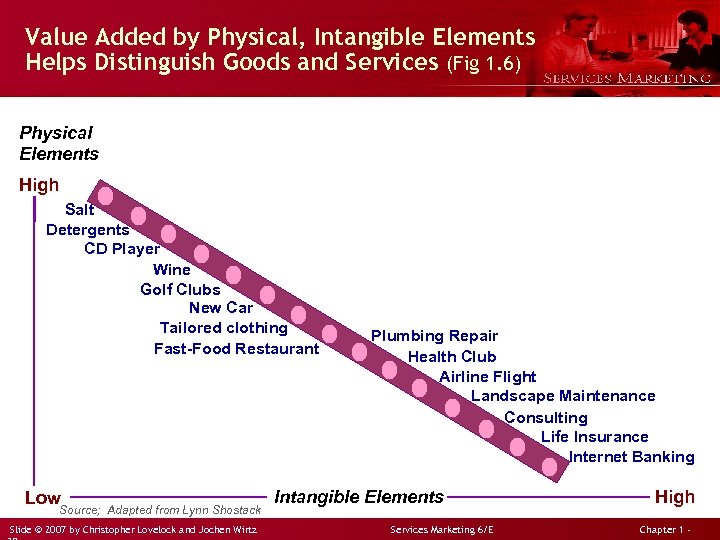 Value Added by Physical, Intangible Elements Helps Distinguish Goods and Services (Fig 1. 6) Physical Elements High Salt Detergents CD Player Wine Golf Clubs New Car Tailored clothing Fast-Food Restaurant Low Source; Adapted from Lynn Shostack Slide © 2007 by Christopher Lovelock and Jochen Wirtz Plumbing Repair Health Club Airline Flight Landscape Maintenance Consulting Life Insurance Internet Banking Intangible Elements Services Marketing 6/E High Chapter 1 -
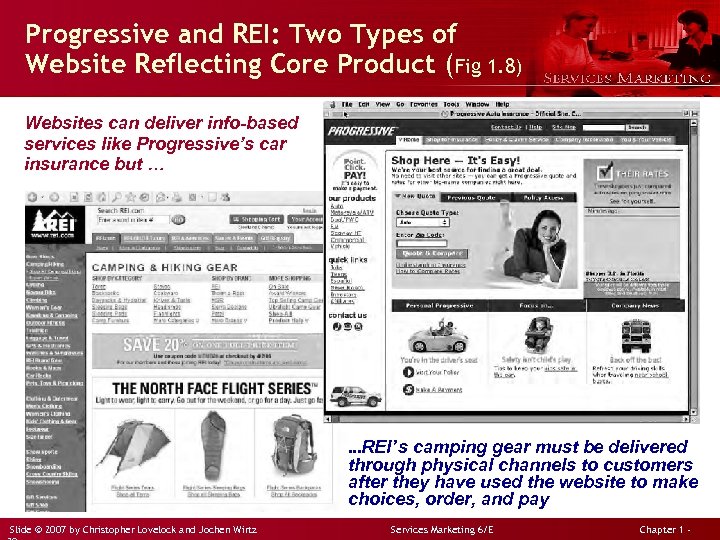 Progressive and REI: Two Types of Website Reflecting Core Product (Fig 1. 8) Websites can deliver info-based services like Progressive’s car insurance but … …REI’s camping gear must be delivered through physical channels to customers after they have used the website to make choices, order, and pay Slide © 2007 by Christopher Lovelock and Jochen Wirtz Services Marketing 6/E Chapter 1 -
 Expanded Marketing Mix for Services Slide © 2007 by Christopher Lovelock and Jochen Wirtz Services Marketing 6/E Chapter 1 -
 Services Require An Expanded Marketing Mix § Marketing can be viewed as: Ø A strategic and competitive thrust pursued by top management Ø A set of functional activities performed by line managers Ø A customer-driven orientation for the entire organization § Marketing is the only function to bring operating revenues into a business; all other functions are cost centers § The “ 8 Ps” of services marketing are needed to create viable strategies for meeting customer needs profitably in a competitive marketplace Slide © 2007 by Christopher Lovelock and Jochen Wirtz Services Marketing 6/E Chapter 1 -
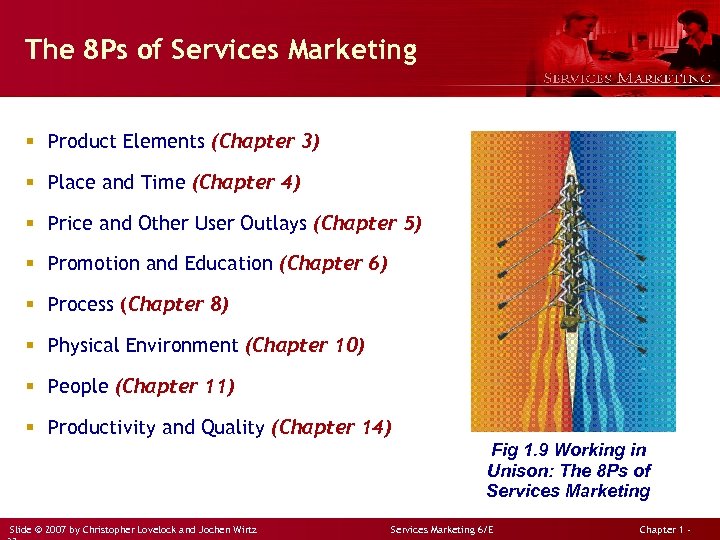 The 8 Ps of Services Marketing § Product Elements (Chapter 3) § Place and Time (Chapter 4) § Price and Other User Outlays (Chapter 5) § Promotion and Education (Chapter 6) § Process (Chapter 8) § Physical Environment (Chapter 10) § People (Chapter 11) § Productivity and Quality (Chapter 14) Fig 1. 9 Working in Unison: The 8 Ps of Services Marketing Slide © 2007 by Christopher Lovelock and Jochen Wirtz Services Marketing 6/E Chapter 1 -
 The 8 Ps of Services Marketing: (1) Product Elements § Embrace all aspects of service performance that create value § Core product responds to customer’s primary need § Array of supplementary service elements Ø Help customer use core product effectively Ø Add value through useful enhancements § Planning marketing mix begins with creating a service concept that: Ø Will offer value to target customers Ø Satisfy their needs better than competing alternatives Slide © 2007 by Christopher Lovelock and Jochen Wirtz Services Marketing 6/E Chapter 1 -
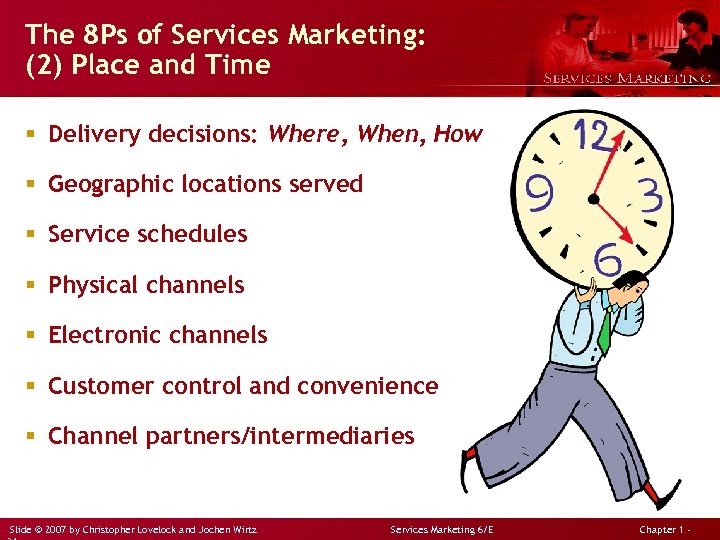 The 8 Ps of Services Marketing: (2) Place and Time § Delivery decisions: Where, When, How § Geographic locations served § Service schedules § Physical channels § Electronic channels § Customer control and convenience § Channel partners/intermediaries Slide © 2007 by Christopher Lovelock and Jochen Wirtz Services Marketing 6/E Chapter 1 -
 The 8 Ps of Services Marketing: (3) Price and Other User Outlays § Marketers must recognize that customer outlays involve more than price paid to seller § Traditional pricing tasks: Ø Selling price, discounts, premiums Ø Margins for intermediaries (if any) Ø Credit terms § Identify and minimize other costs incurred by users: Ø Additional monetary costs associated with service usage (e. g. , travel to service location, parking, phone, babysitting, etc. ) Ø Time expenditures, especially waiting Ø Unwanted mental and physical effort Ø Negative sensory experiences Slide © 2007 by Christopher Lovelock and Jochen Wirtz Services Marketing 6/E Chapter 1 -
 The 8 Ps of Services Marketing: (4) Promotion and Education § Informing, educating, persuading, reminding customers § Marketing communication tools Ø Ø Media elements (print, broadcast, outdoor, retail, the Internet, etc. ) Personal selling, customer service Sales promotion Publicity/PR § Imagery and recognition Ø Branding Ø Corporate design § Content Ø Information, advice Ø Persuasive messages Ø Customer education/training Slide © 2007 by Christopher Lovelock and Jochen Wirtz Services Marketing 6/E Chapter 1 -
 The 8 Ps of Services Marketing: (5) Process § How firm does things may be as important as what it does § Customers often actively involved in processes, especially when acting as co-producers of service § Process involves choices of method and sequence in service creation and delivery Ø Design of activity flows Ø Number and sequence of actions for customers Ø Nature of customer involvement Ø Role of contact personnel Ø Role of technology, degree of automation § Badly designed processes waste time, create poor experiences, and disappoint customers Slide © 2007 by Christopher Lovelock and Jochen Wirtz Services Marketing 6/E Chapter 1 -
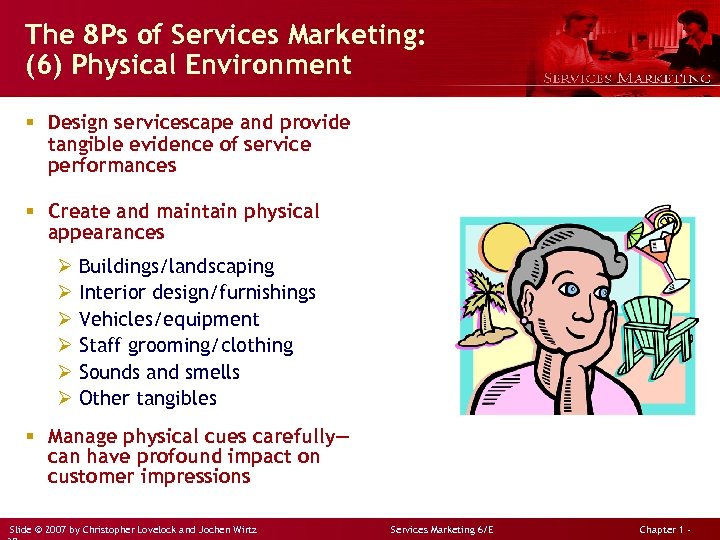 The 8 Ps of Services Marketing: (6) Physical Environment § Design servicescape and provide tangible evidence of service performances § Create and maintain physical appearances Ø Buildings/landscaping Ø Interior design/furnishings Ø Vehicles/equipment Ø Staff grooming/clothing Ø Sounds and smells Ø Other tangibles § Manage physical cues carefully— can have profound impact on customer impressions Slide © 2007 by Christopher Lovelock and Jochen Wirtz Services Marketing 6/E Chapter 1 -
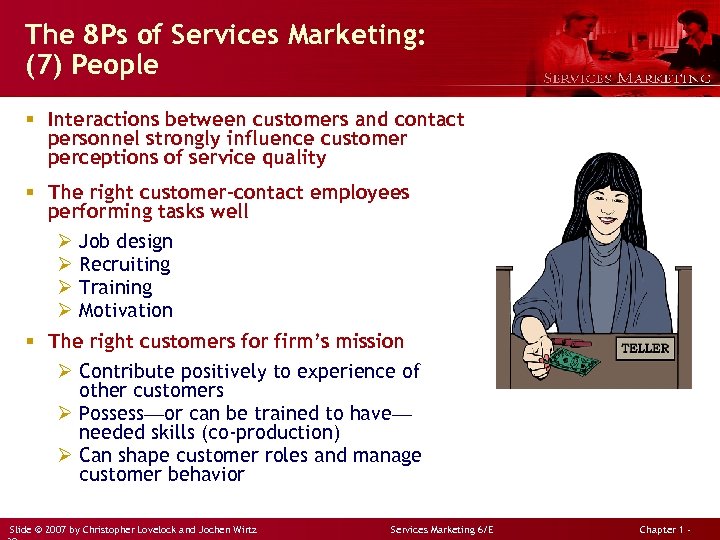 The 8 Ps of Services Marketing: (7) People § Interactions between customers and contact personnel strongly influence customer perceptions of service quality § The right customer-contact employees performing tasks well Ø Job design Ø Recruiting Ø Training Ø Motivation § The right customers for firm’s mission Ø Contribute positively to experience of other customers Ø Possess—or can be trained to have— needed skills (co-production) Ø Can shape customer roles and manage customer behavior Slide © 2007 by Christopher Lovelock and Jochen Wirtz Services Marketing 6/E Chapter 1 -
 The 8 Ps of Services Marketing: (8) Productivity and Quality § Productivity and quality must work hand in hand § Improving productivity key to reducing costs § Improving and maintaining quality essential for building customer satisfaction and loyalty § Ideally, strategies should be sought to improve both productivity and quality simultaneously—technology often the key Ø Technology-based innovations have potential to create high payoffs Ø But, must be user friendly and deliver valued customer benefits Slide © 2007 by Christopher Lovelock and Jochen Wirtz Services Marketing 6/E Chapter 1 -
 Marketing Must Be Integrated with Other Management Functions Slide © 2007 by Christopher Lovelock and Jochen Wirtz Services Marketing 6/E Chapter 1 -
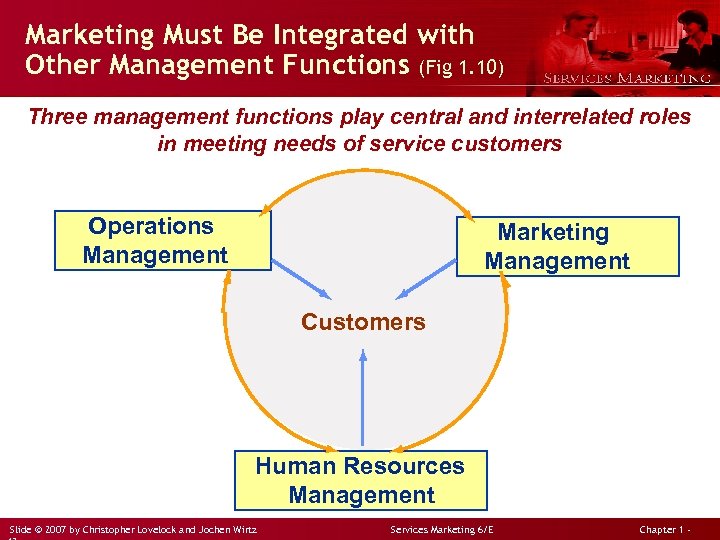 Marketing Must Be Integrated with Other Management Functions (Fig 1. 10) Three management functions play central and interrelated roles in meeting needs of service customers Operations Management Marketing Management Customers Human Resources Management Slide © 2007 by Christopher Lovelock and Jochen Wirtz Services Marketing 6/E Chapter 1 -
 A Framework for Developing Effective Service Marketing Strategies (Fig 1. 11) Slide © 2007 by Christopher Lovelock and Jochen Wirtz Services Marketing 6/E Chapter 1 -
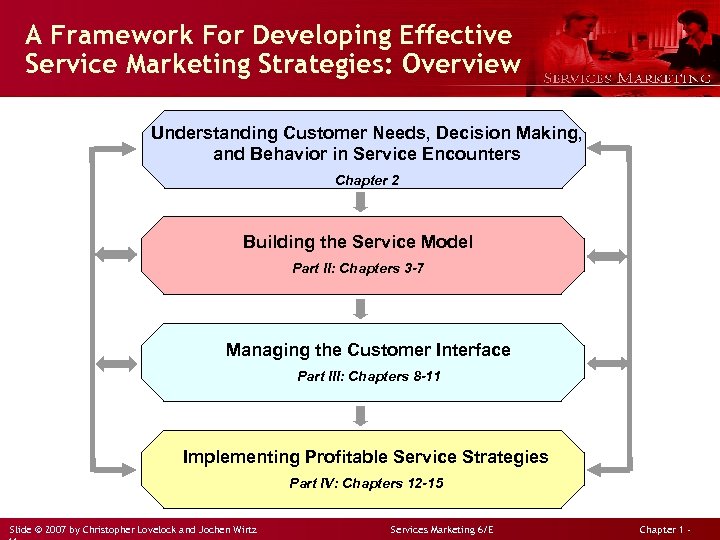 A Framework For Developing Effective Service Marketing Strategies: Overview Understanding Customer Needs, Decision Making, and Behavior in Service Encounters Chapter 2 Building the Service Model Part II: Chapters 3 -7 Managing the Customer Interface Part III: Chapters 8 -11 Implementing Profitable Service Strategies Part IV: Chapters 12 -15 Slide © 2007 by Christopher Lovelock and Jochen Wirtz Services Marketing 6/E Chapter 1 -
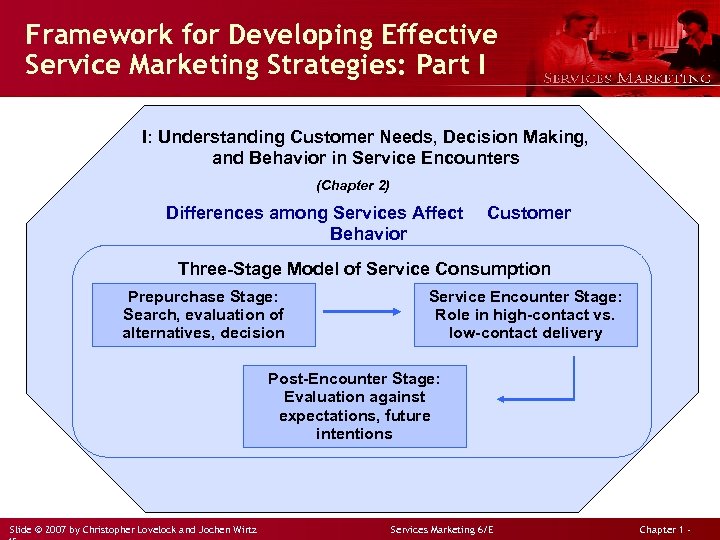 Framework for Developing Effective Service Marketing Strategies: Part I I: Understanding Customer Needs, Decision Making, and Behavior in Service Encounters (Chapter 2) Differences among Services Affect Behavior Customer Three-Stage Model of Service Consumption Prepurchase Stage: Search, evaluation of alternatives, decision Service Encounter Stage: Role in high-contact vs. low-contact delivery Post-Encounter Stage: Evaluation against expectations, future intentions Slide © 2007 by Christopher Lovelock and Jochen Wirtz Services Marketing 6/E Chapter 1 -
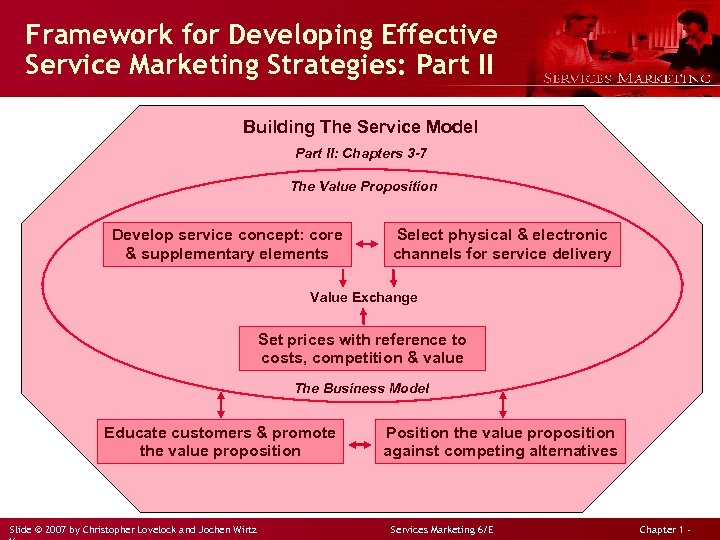 Framework for Developing Effective Service Marketing Strategies: Part II Building The Service Model Part II: Chapters 3 -7 The Value Proposition Develop service concept: core & supplementary elements Select physical & electronic channels for service delivery Value Exchange Set prices with reference to costs, competition & value The Business Model Educate customers & promote the value proposition Slide © 2007 by Christopher Lovelock and Jochen Wirtz Position the value proposition against competing alternatives Services Marketing 6/E Chapter 1 -
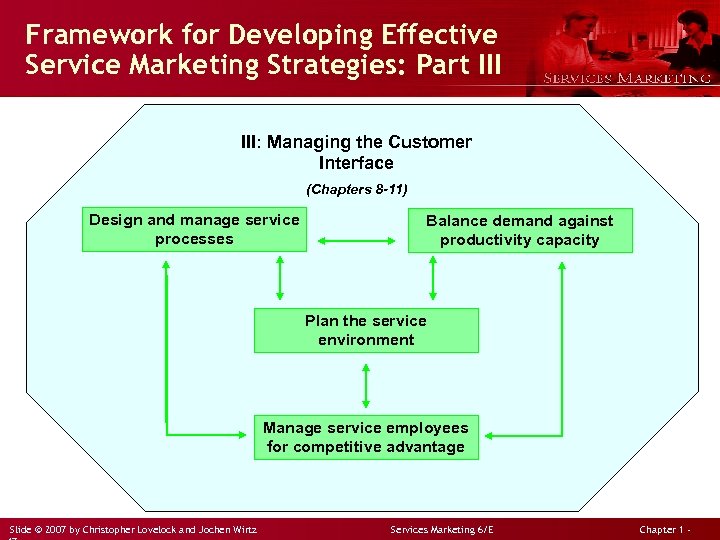 Framework for Developing Effective Service Marketing Strategies: Part III: Managing the Customer Interface (Chapters 8 -11) Design and manage service processes Balance demand against productivity capacity Plan the service environment Manage service employees for competitive advantage Slide © 2007 by Christopher Lovelock and Jochen Wirtz Services Marketing 6/E Chapter 1 -
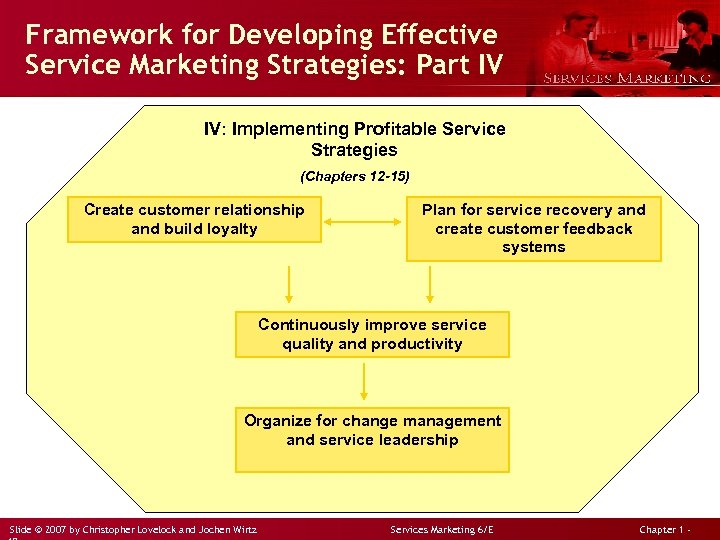 Framework for Developing Effective Service Marketing Strategies: Part IV IV: Implementing Profitable Service Strategies (Chapters 12 -15) Create customer relationship and build loyalty Plan for service recovery and create customer feedback systems Continuously improve service quality and productivity Organize for change management and service leadership Slide © 2007 by Christopher Lovelock and Jochen Wirtz Services Marketing 6/E Chapter 1 -
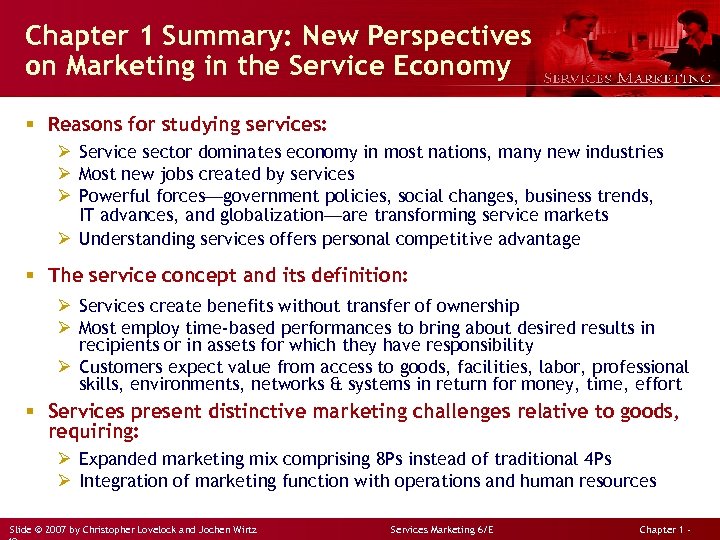 Chapter 1 Summary: New Perspectives on Marketing in the Service Economy § Reasons for studying services: Ø Service sector dominates economy in most nations, many new industries Ø Most new jobs created by services Ø Powerful forces—government policies, social changes, business trends, IT advances, and globalization—are transforming service markets Ø Understanding services offers personal competitive advantage § The service concept and its definition: Ø Services create benefits without transfer of ownership Ø Most employ time-based performances to bring about desired results in recipients or in assets for which they have responsibility Ø Customers expect value from access to goods, facilities, labor, professional skills, environments, networks & systems in return for money, time, effort § Services present distinctive marketing challenges relative to goods, requiring: Ø Expanded marketing mix comprising 8 Ps instead of traditional 4 Ps Ø Integration of marketing function with operations and human resources Slide © 2007 by Christopher Lovelock and Jochen Wirtz Services Marketing 6/E Chapter 1 -