


 Скачать презентацию Chapter 1 Multinational Management in a Changing World
b4a990015adf679192c4964d8bc4bea5.ppt
- Количество слайдов: 41
 Chapter 1 Multinational Management in a Changing World Copyright© 2007 Thomson Learning All rights
 Learning Objectives • Define multinational management • Understand the characteristics of a multinational company • Understand the nature of the global economy and the key forces that drive globalization • Know the basic classification of the world’s economies • Identify the characteristics of the next generation of multinational managers Copyright© 2007 South-Western/Thomson Learning All rights
 Multinational Management • Formulation of strategies and management systems to take advantage of international opportunities and respond to international threats Copyright© 2007 South-Western/Thomson Learning All rights
 The Nature of The Multinational Company • Any company that engages in business functions beyond its domestic borders • Includes both large and small companies Copyright© 2007 South-Western/Thomson Learning All rights
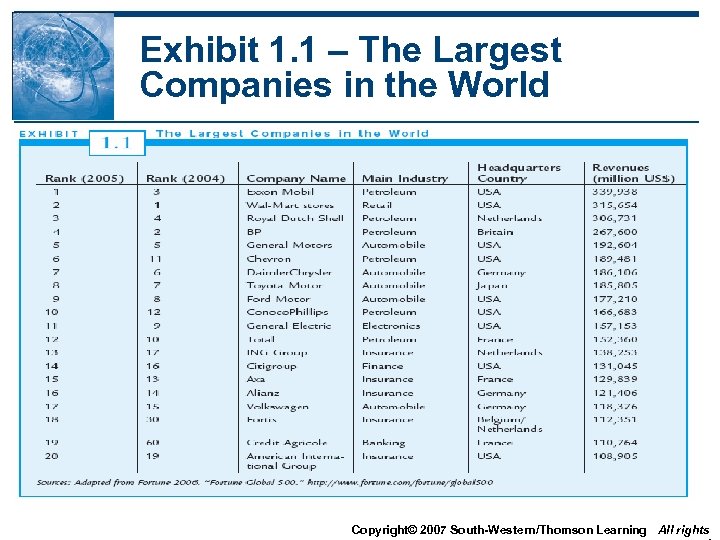 Exhibit 1. 1 – The Largest Companies in the World Copyright© 2007 South-Western/Thomson Learning All rights
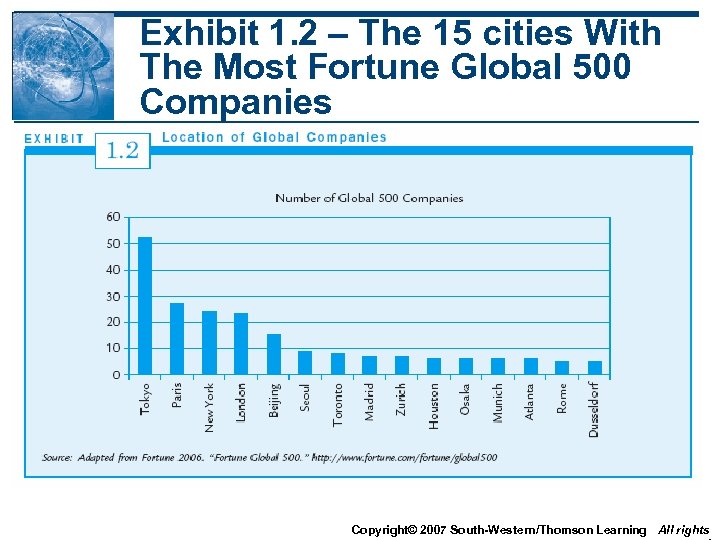 Exhibit 1. 2 – The 15 cities With The Most Fortune Global 500 Companies Copyright© 2007 South-Western/Thomson Learning All rights
 The Globalizing Economy • Globalization: the worldwide trend of the economies of the world becoming borderless and interlinked. Copyright© 2007 South-Western/Thomson Learning All rights
 Negatives of Globalization • Not all economies of the world are benefiting equally or participating equally in the process. • Terrorism, wars, and a worldwide economic stagnation have limited or reversed some aspects of globalization. • Producing negative effects such as scarcity of natural resources, environmental pollution, negative social impacts, and increased interdependence of the world’s economies. • Widening the gap between rich and poor Copyright© 2007 South-Western/Thomson Learning All rights
 The Benefits of Globalization • Resulting in lower prices in many countries as multinationals are becoming more efficient. • Benefiting many emerging markets such as India and China as these countries enjoy greater availability of jobs and better access to technology. • Major reason why many new companies from Mexico, Brazil, China, India, and South Korea are the new dominant global competitors. Copyright© 2007 South-Western/Thomson Learning All rights
 The Globalizing Economy: 7 Key Trends • Disintegrating borders • Growing cross-border trade and investment • The rise of global products and global customers • The internet and information technology • Privatizations • New competitors in the world market • The rise of global standards of quality and production Copyright© 2007 South-Western/Thomson Learning All rights
 Countries of the World: The Arrived, The Coming, and The Struggling • Developed countries: mature economies with substantial per capita Gross Domestic Product, international trade and investments. • Developing countries: economies that have grown extensively over past two decades • E. g. , Hong Kong, Singapore, South Korea. Copyright© 2007 South-Western/Thomson Learning All rights
 Countries of the World: The Arrived, The Coming, and The Struggling • Transition economies: countries that have changed from mostly communist systems to market/capitalistic systems • E. g. , Czech republic, Hungary, Poland. • Emerging markets: those countries that are currently between developed and developing countries and are rapidly growing • E. g. , India, China, Brazil, and Russia. Copyright© 2007 South-Western/Thomson Learning All rights
 Countries of the World: The Arrived, The Coming, and the Struggling • Less developed countries: have yet to show much progress in the global economy • Most are located in Central and South America and Africa. Copyright© 2007 South-Western/Thomson Learning All rights
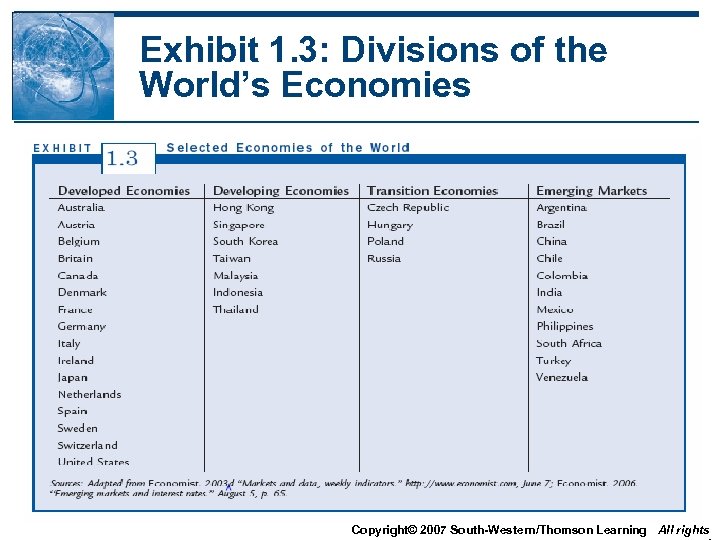 Exhibit 1. 3: Divisions of the World’s Economies Copyright© 2007 South-Western/Thomson Learning All rights
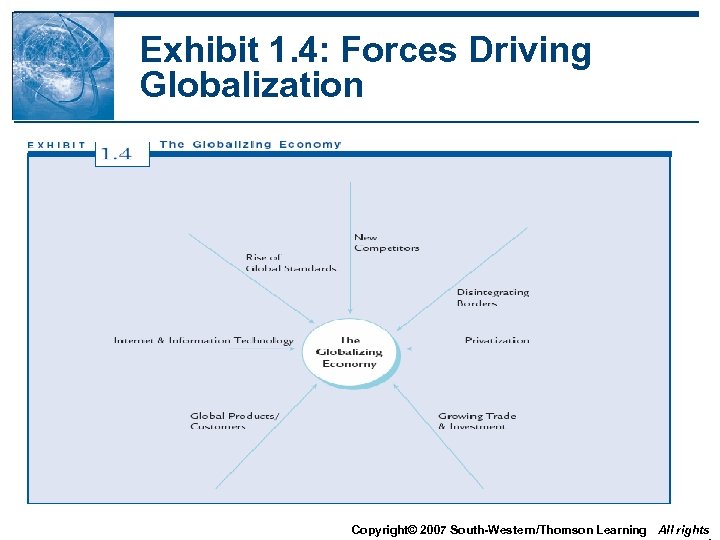 Exhibit 1. 4: Forces Driving Globalization Copyright© 2007 South-Western/Thomson Learning All rights
 Borders are Disintegrating: The World Trade Organization • Formal structure for continued negotiations and for settling trade disputes among nations. • 1947 Nations met to reduce tariffs from 45% to less than 7% - resulted in the General Agreement on Tariffs and Trade (GATT). • 1986 Negotiations began in Uruguay to continue reducing tariffs. Copyright© 2007 South-Western/Thomson Learning All rights
 World Trade Organization • 1997 – Trade ministers from countries representing 92 % of world trade agreed to eliminate tariffs on software, computer chips, telecommunication equipment and computers. • WTO has some critics. • Not all countries are participating equally in WTO. Copyright© 2007 South-Western/Thomson Learning All rights
 Regional Trade Agreements • Regional Trade Agreements - agreements among nations to reduce tariffs and develop similar technical and economic standards. • European Union (EU) - includes a large number of European countries. • Allows free movement of goods and services and a common currency. Copyright© 2007 South-Western/Thomson Learning All rights
 Regional Trade Agreements • The North American Free Trade Agreement (NAFTA): links United States, Canada, and Mexico in an economic bloc. • Allows freer exchange of goods and services • The Asia-Pacific-Economic Cooperation (APEC): looser confederation of 19 Asian nations with less specific agreements on trade facilitation. Copyright© 2007 South-Western/Thomson Learning All rights
 Sell Anywhere, Locate Anywhere • World trade growth: average of 6. 5% per year between 1990 and 2000. • Nearly half of the over $5 trillion in world trade is among the European union, the U. S. , and Japan – the TRIAD. Copyright© 2007 South-Western/Thomson Learning All rights
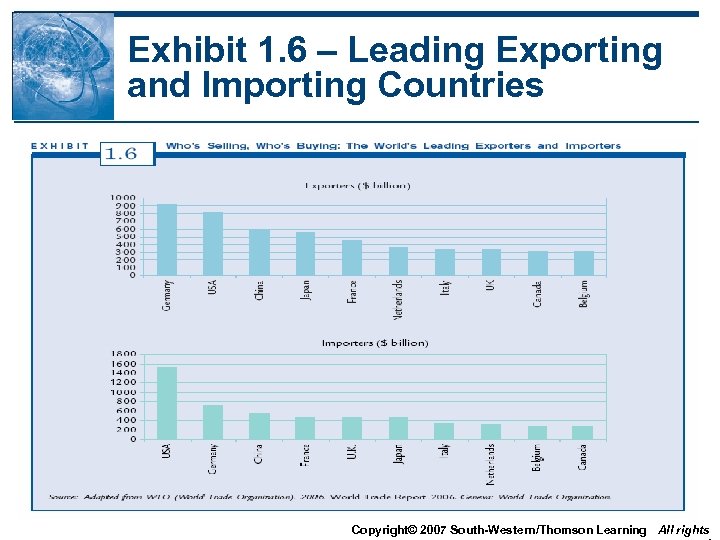 Exhibit 1. 6 – Leading Exporting and Importing Countries Copyright© 2007 South-Western/Thomson Learning All rights
 Sell Anywhere, Locate Anywhere • Foreign Direct Investment (FDI) : occurs when a multinational company from one country has an ownership position located in another country. • FDI increased by more that 36% between 1996 and 2000. • Post 9/11 has seen a decline in FDI. • Nevertheless, it remains a significant factor. Copyright© 2007 South-Western/Thomson Learning All rights
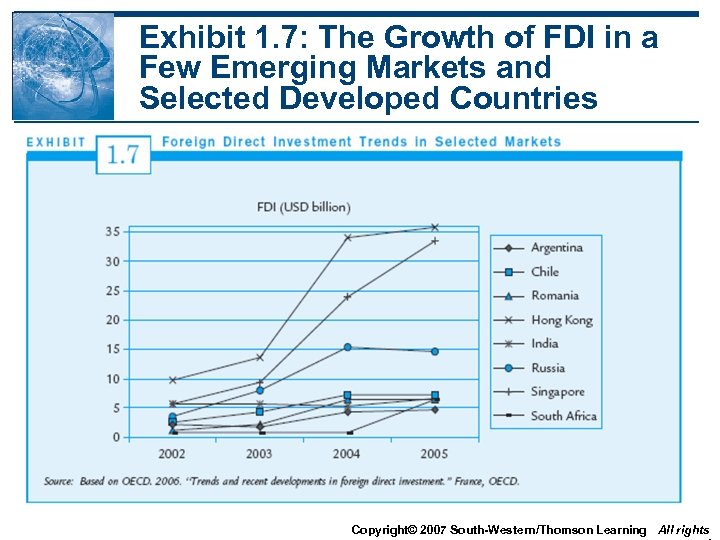 Exhibit 1. 7: The Growth of FDI in a Few Emerging Markets and Selected Developed Countries Copyright© 2007 South-Western/Thomson Learning All rights
 Foreign Direct Investment • Developed countries get the bulk of FDI (69%) while developing countries get around 30%. • Least developed countries get minimal FDI. • Implications for managers - significant opportunities around the world. • Multinational managers should look at risk rating of countries. Copyright© 2007 South-Western/Thomson Learning All rights
 Two Types of Risks • Economic risk: considers all factors of a nation’s economic climate that may affect a foreign investor. • Political risk: anything a government might do or not do that might adversely affect a company. Copyright© 2007 South-Western/Thomson Learning All rights
 Factors Outside of The Control of The Multinational • The recent increases in oil prices have the potential to slow down global trade • Natural disasters • International terrorism Copyright© 2007 South-Western/Thomson Learning All rights
 The Internet and Information Technology • Electronic Communication - E-mail, World Wide Web, etc. • Allows multinationals to communicate with company locations throughout the world. • Multinationals can also monitor worldwide operations. • Information technology is spurring a borderless financial market. Copyright© 2007 South-Western/Thomson Learning All rights
 The Internet and Information Technology • Information technologies make available many new tools that facilitate business operations • E. g. , Voice-Over-Internet Protocol (VOIP) such as Skype, MSN Messenger and AOL, WIKIs Copyright© 2007 South-Western/Thomson Learning All rights
 The Rise of Global Products and Global Customers • The needs of customers for many products and services are growing more similar • E. g. , Mc. Donald’s, Boeing, Toyota. • Global customers search the world for their supplies without regard for national boundaries. Copyright© 2007 South-Western/Thomson Learning All rights
 Privatization • Sale of government-owned businesses to private investors, • usually through stock or direct sale to other companies. • Two types of privatization contribute to the global economy – the developed world and the developing world. Copyright© 2007 South-Western/Thomson Learning All rights
 Privatization - Types • The Developed Countries • Use privatization to make formerly government-controlled enterprises more competitive in the global economy. • The Developing Countries • Use privatization to jump-start their economies or to speed the transition from a communist to a capitalist system. Copyright© 2007 South-Western/Thomson Learning All rights
 New Competitors • Free market reforms are creating a potential group of new competitors. • Korean, Russian, Taiwanese, and Mexican companies are all emerging. • Chinese companies are also on the move. Copyright© 2007 South-Western/Thomson Learning All rights
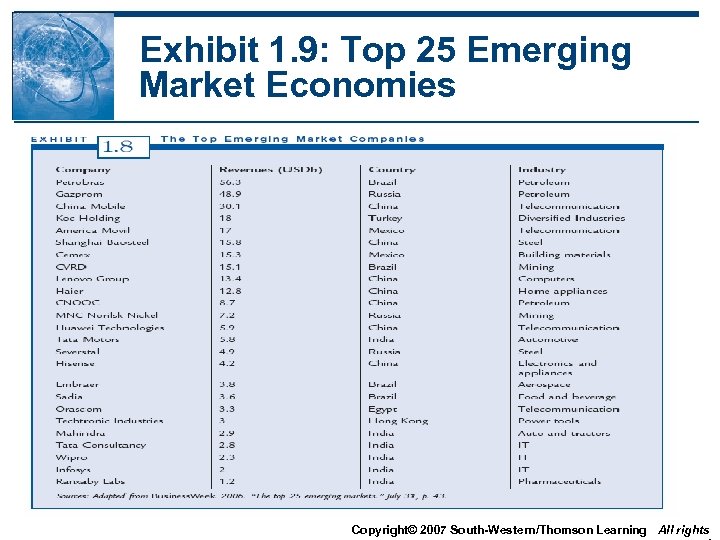 Exhibit 1. 9: Top 25 Emerging Market Economies Copyright© 2007 South-Western/Thomson Learning All rights
 New Competitors are Emerging • Global trade has two important effects in developing new competitors: • When developing countries are used as low-wage platforms for high-tech assembly, multinationals facilitate the transfer of technology. • Aggressive multinationals are also expanding beyond their own borders. Copyright© 2007 South-Western/Thomson Learning All rights
 The Rise of Global Standards • Companies can make 1 or only a few versions of product for the world market. • This is cheaper than making different versions for different countries. • Drive to develop common standards to save money. Copyright© 2007 South-Western/Thomson Learning All rights
 Global Standards • Consistency in quality also an important requirement of doing business in many countries. • International organization for standardization (ISO) in Geneva, Switzerland • Developed a set of technical standards (ISO 9001: 2000 series). Copyright© 2007 South-Western/Thomson Learning All rights
 Next Generation of Multinational Managers: Characteristics • Global mindset • Ability to work with people from diverse backgrounds • Long-range perspective • Ability to manage change and transition • Ability to create systems for learning and changing organizations Copyright© 2007 South-Western/Thomson Learning All rights
 Next Generation of Multinational Managers: Characteristics • Talent to motivate all employees to achieve excellence • Accomplished negotiation skills • Willingness to seek overseas assignments • Understanding of national cultures Copyright© 2007 South-Western/Thomson Learning All rights
 Multinational Management: A Strategic Approach • Considers how managers formulate and implement strategies to compete successfully in the global economy. • Strategies are the maneuvers or activities used to increase and sustain organizational performance. • Multinational strategies must include maneuvers that deal with operating in more than one country and culture. Copyright© 2007 South-Western/Thomson Learning All rights
 Trends Shaping Future Business Environment • • • Blurring of industry boundaries Flexibility matters more than size Focusing on niche Hyper-competition Emphasis on innovation and the learning organization Copyright© 2007 South-Western/Thomson Learning All rights
 Conclusion • Chapter provides key background information to support study of multinational management • Chapter also provides the foundation to understand the latest challenges and practices of multinational management • Field is dynamic and learning never stops Copyright© 2007 South-Western/Thomson Learning All rights