


 Скачать презентацию Chapter 1 Macroeconomics and Microeconomics Chapter 1 —
53fedbb1d83e38677f1ca89742887f2d.ppt
- Количество слайдов: 39
 Chapter 1 Macroeconomics and Microeconomics Chapter 1 - 1 © 2011 Pearson Education Canada Inc.
 Are Your Smart Choices Smart for All? Macroeconomics & Microeconomics Chapter 1 - 2 © 2011 Pearson Education Canada Inc.
 LEARNING OBJECTIVES 1. 1 Explain the differences between microeconomics and macroeconomics 1. 2 Describe the hands-off and hands-on views on government policy and connect each to the fundamental macroeconomic question 1. 3 Define three key measures of macroeconomic performance, and identify good outcomes for each Chapter 1 - 3 © 2011 Pearson Education Canada Inc. continued…
 1. 4 Identify five groups of macroeconomic players and their choices 1. 5 Explain three MAPS for focusing your thinking like a macroeconomist Chapter 1 - 4 © 2011 Pearson Education Canada Inc.
 RECONCILING MACRO AND MICRO: IS THE WHOLE GREATER THAN THE SUM OF THE PARTS? Smart microeconomic choices by individuals may or may not add up to smart macroeconomic outcomes for the economy as a whole. “If left alone, do markets quickly self-adjust? ” Chapter 1 - 5 © 2011 Pearson Education Canada Inc.
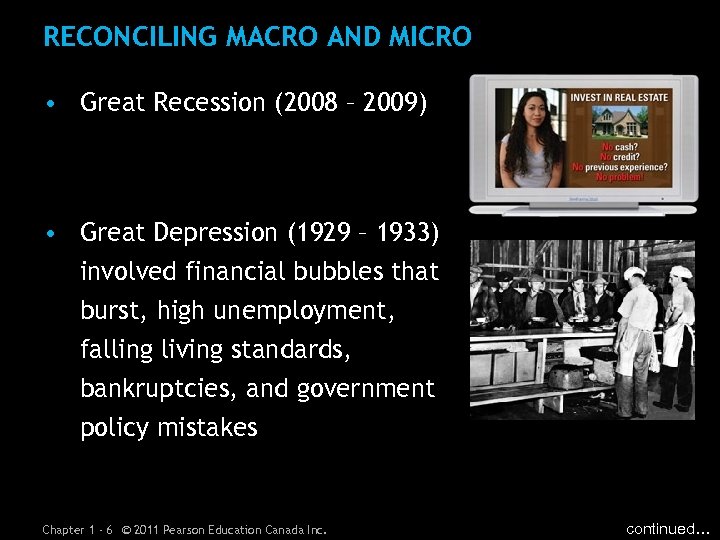 RECONCILING MACRO AND MICRO • Great Recession (2008 – 2009) • Great Depression (1929 – 1933) involved financial bubbles that burst, high unemployment, falling living standards, bankruptcies, and government policy mistakes Chapter 1 - 6 © 2011 Pearson Education Canada Inc. continued…
 • Business cycles ups and downs of overall economic activity • Macroeconomics analyzes the performance of the whole Canadian economy and global economy — the combined outcomes of all individual microeconomic choices • Microeconomics analyzes choices that individuals in households, individual businesses, and governments make, and how those choices interact in markets Chapter 1 - 7 © 2011 Pearson Education Canada Inc. continued…
 • Fallacy of composition what is true for one is not true for all; whole is greater than the sum of the parts • Paradox of thrift attempts to increase savings cause aggregate savings to decrease due to falling incomes Chapter 1 - 8 © 2011 Pearson Education Canada Inc. continued…
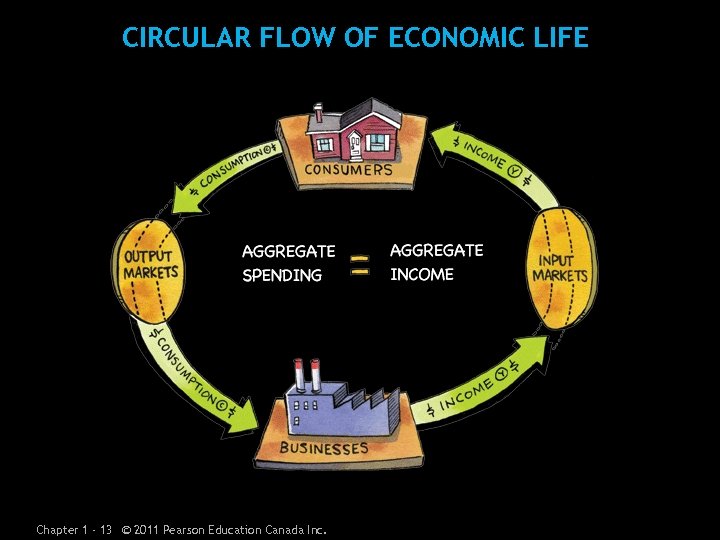
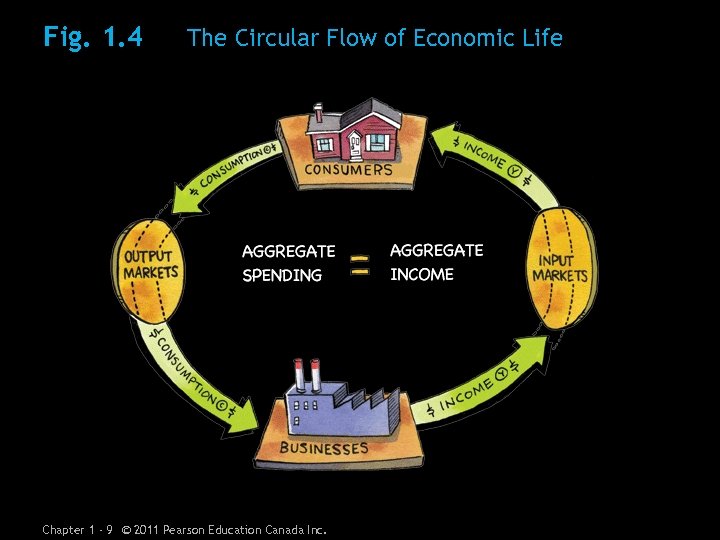 Fig. 1. 4 The Circular Flow of Economic Life Chapter 1 - 9 © 2011 Pearson Education Canada Inc.
 • Circular flow diagram reduces complexity of Canadian economy to three players — households, businesses, and governments – input markets determine incomes; households are sellers, businesses are buyers – output markets determine value of products sold; households are buyers, businesses are sellers Chapter 1 - 10 © 2011 Pearson Education Canada Inc. continued…
 • Fundamental Macroeconomic Question If left alone by government, do the price mechanisms of market economies adjust quickly to maintain steady growth in living standards, full employment, stable prices? or If left alone, do markets quickly self-adjust? • “Yes” Say’s Law “supply creates its own demand” • “No” Keynes rejected Say’s Law Chapter 1 - 11 © 2011 Pearson Education Canada Inc.
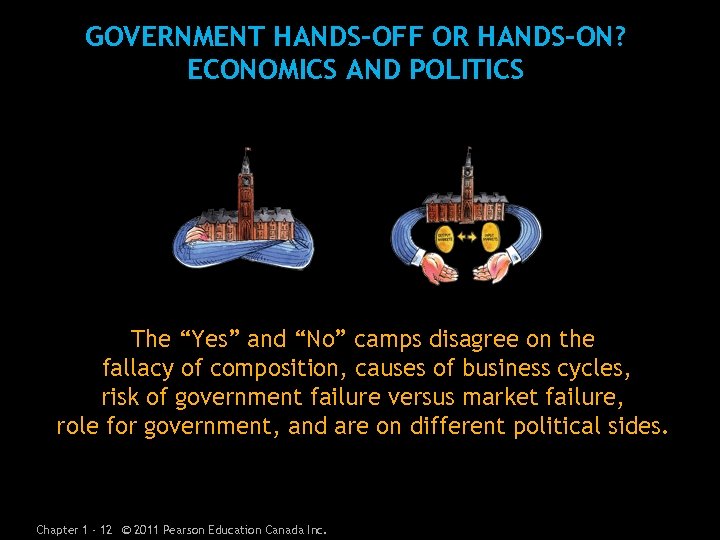 GOVERNMENT HANDS-OFF OR HANDS-ON? ECONOMICS AND POLITICS The “Yes” and “No” camps disagree on the fallacy of composition, causes of business cycles, risk of government failure versus market failure, role for government, and are on different political sides. Chapter 1 - 12 © 2011 Pearson Education Canada Inc.
 CIRCULAR FLOW OF ECONOMIC LIFE Chapter 1 - 13 © 2011 Pearson Education Canada Inc.
 • The fundamental macroeconomic question — “If left alone by government, do the price mechanisms of market economies adjust quickly to maintain steady growth in living standards, full employment, and stable prices? ” – “Yes” answer based on Say’s Law — supply creates its own demand – “No” answer from John Maynard Keynes, founder of macroeconomics in 1930 s Chapter 1 - 14 © 2011 Pearson Education Canada Inc.
 MARKET FAILURE VS. GOVERNMENT FAILURE • Like J. B. Say and J. M. Keynes, economists and politicians today still disagree about the fundamental macroeconomic question, “If left alone, do markets quickly self-adjust? ” • Market failure market outcomes fail to serve the public interest • Government failure government policy fails to serve the public interest Chapter 1 - 15 © 2011 Pearson Education Canada Inc. continued…
 COMPARING CAMPS • YES — Left Alone, Markets Quickly Self-Adjust – no fallacy of composition so micro = macro – business cycles due to external causes or government policy mistakes – government failure is worse than market failure – hands-off role for government – political right Chapter 1 - 16 © 2011 Pearson Education Canada Inc. continued…
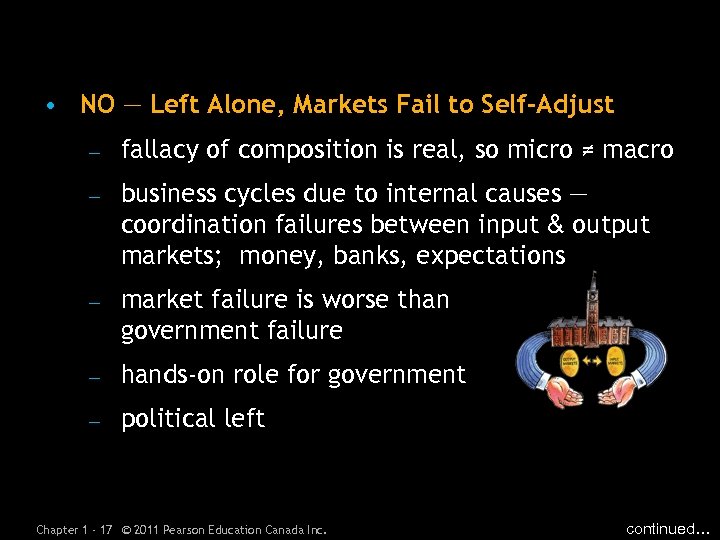 • NO — Left Alone, Markets Fail to Self-Adjust – fallacy of composition is real, so micro ≠ macro – business cycles due to internal causes — coordination failures between input & output markets; money, banks, expectations – market failure is worse than government failure – hands-on role for government – political left Chapter 1 - 17 © 2011 Pearson Education Canada Inc. continued…
 • Government failure government policy fails to serve the public interest • “Yes — Left Alone, Markets Quickly Self-Adjust” camp believes – macroeconomic and microeconomic outcomes are the same – external events or government policy cause business cycles – government failure is worse than market failure – government should be hands-off Chapter 1 - 18 © 2011 Pearson Education Canada Inc. continued…
 • “No — Left Alone, Markets Fail to Quickly Self-Adjust” camp believes – fallacy of composition — macroeconomic and microeconomic outcomes are different – markets cause business cycles through coordination failures, roles of money, banking, and expectations – market failure is worse than government failure – government should be hands-on Chapter 1 - 19 © 2011 Pearson Education Canada Inc. continued…
 • Politicians on the right tend to be in “Yes” camp, government as hands-off • Politicians on the left tend to be in “No” camp, government as hands-on Chapter 1 - 20 © 2011 Pearson Education Canada Inc.
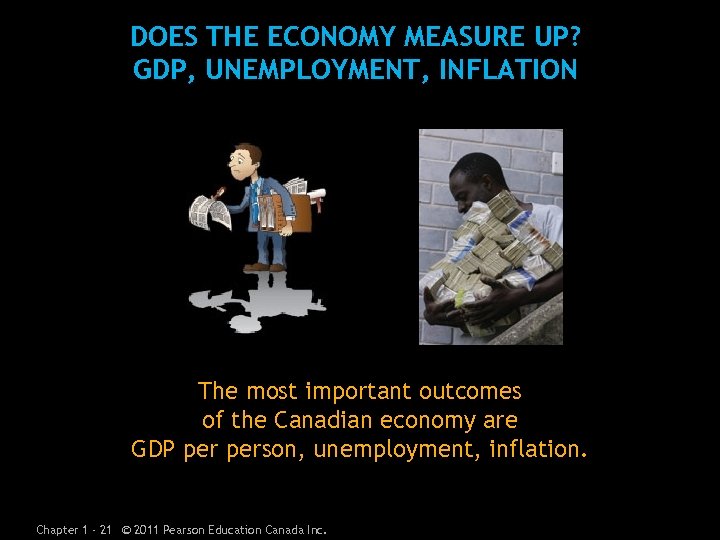 DOES THE ECONOMY MEASURE UP? GDP, UNEMPLOYMENT, INFLATION The most important outcomes of the Canadian economy are GDP person, unemployment, inflation. Chapter 1 - 21 © 2011 Pearson Education Canada Inc.
 MEASURING GDP, UNEMPLOYMENT, INFLATION • Gross Domestic Product (GDP) value of all final products and services produced annually in a country • Unemployment not employed and actively seeking work • Inflation rising average prices and falling value of money Chapter 1 - 22 © 2011 Pearson Education Canada Inc.
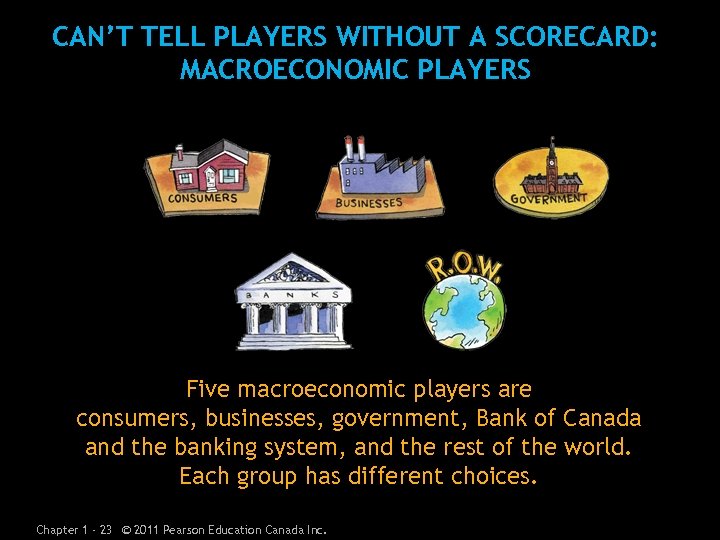 CAN’T TELL PLAYERS WITHOUT A SCORECARD: MACROECONOMIC PLAYERS Five macroeconomic players are consumers, businesses, government, Bank of Canada and the banking system, and the rest of the world. Each group has different choices. Chapter 1 - 23 © 2011 Pearson Education Canada Inc.
 CHOICES FOR MACROECONOMIC PLAYERS • Consumer choices – spend income or save – buy Canadian products/services or imports • Business choices – investment spending business purchases of new factories and equipment, domestic or imports – hiring workers or not – buying inputs, domestic or imports – selling outputs, domestic or exports Chapter 1 - 24 © 2011 Pearson Education Canada Inc. continued…
 • Government choices – purchases of products/services – taxes and transfer payments – fiscal policy changes in government purchases, taxes/transfers to achieve macroeconomic outcomes • Bank of Canada and Banking System choices – monetary policy Bank of Canada changes interest rates and supply of money to achieve macroeconomic outcomes – making loans or not Chapter 1 - 25 © 2011 Pearson Education Canada Inc. continued…
 • Rest of World (R. O. W. ) choices – buying Canadian exports, selling imports to Canada – investing money in Canada or accepting Canadian investments – demanding Canadian dollars Chapter 1 - 26 © 2011 Pearson Education Canada Inc.
 FOCUSING ON YOUR FUTURE: LIVING STANDARDS, VOTING & MACROECONOMICS Macroeconomics affects your future — GDP person, unemployment, and inflation. Macroeconomics also informs your vote for politicians and policies influencing economic performance. Chapter 1 - 27 © 2011 Pearson Education Canada Inc.
 SUCCESS, VOTING, AND MAPS • Your personal economic success depends on – GDP higher GDP person = higher living standards – Unemployment affects odds of finding jobs – Inflation reduces living standards if income not rising as fast as prices of what you buy • Understanding macroeconomics informs your vote for politicians whose economic policy choices influence economic performance and your economic success Chapter 1 - 28 © 2011 Pearson Education Canada Inc. continued…
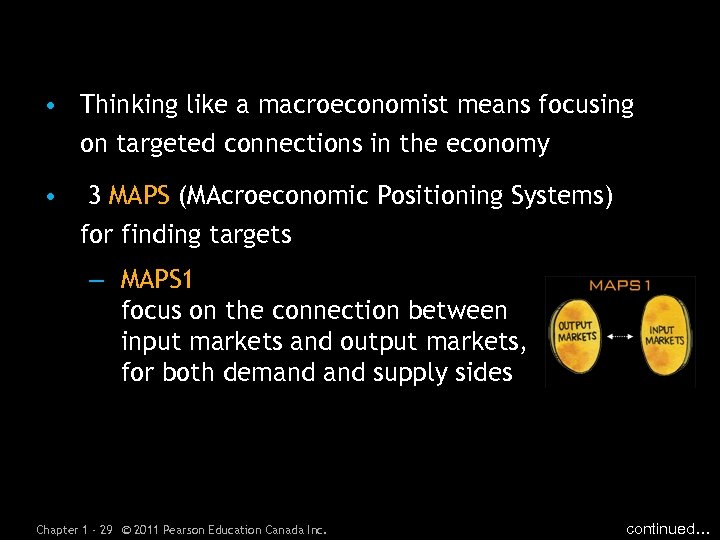 • Thinking like a macroeconomist means focusing on targeted connections in the economy • 3 MAPS (MAcroeconomic Positioning Systems) for finding targets – MAPS 1 focus on the connection between input markets and output markets, for both demand supply sides Chapter 1 - 29 © 2011 Pearson Education Canada Inc. continued…
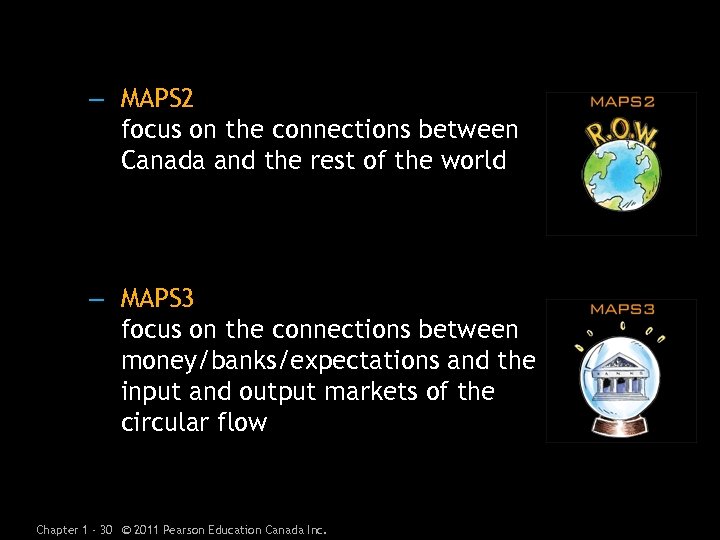 – MAPS 2 focus on the connections between Canada and the rest of the world – MAPS 3 focus on the connections between money/banks/expectations and the input and output markets of the circular flow Chapter 1 - 30 © 2011 Pearson Education Canada Inc.
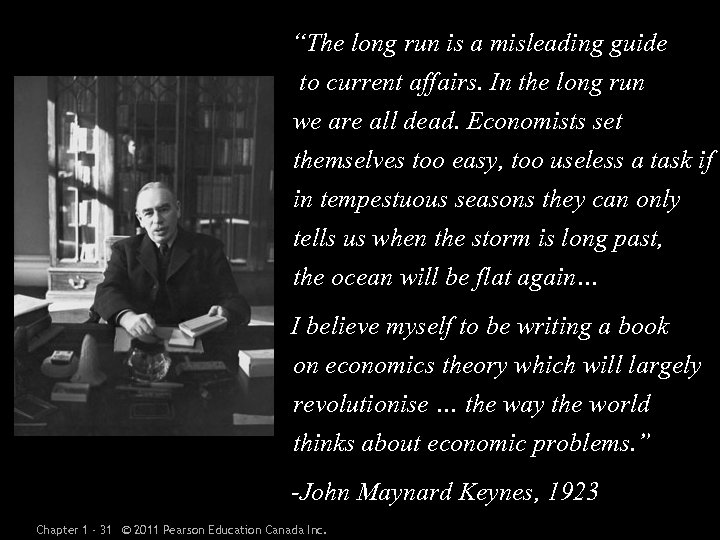 “The long run is a misleading guide to current affairs. In the long run we are all dead. Economists set themselves too easy, too useless a task if in tempestuous seasons they can only tells us when the storm is long past, the ocean will be flat again… I believe myself to be writing a book on economics theory which will largely revolutionise … the way the world thinks about economic problems. ” -John Maynard Keynes, 1923 Chapter 1 - 31 © 2011 Pearson Education Canada Inc.
 Chapter 1 Refresh Slides Chapter 1 - 32 © 2011 Pearson Education Canada Inc.
 RECONCILING MACRO & MICRO 1. What is a fallacy of composition? 2. Use the fundamental macroeconomic question on page 10 to explain conflicts between the predictions of microeconomics and macroeconomics. Chapter 1 - 33 © 2011 Pearson Education Canada Inc. continued…
 3. What media explanations have you seen about the recession of 2008– 2009? Where do those explanations fit into the categories of fallacy of composition, connections between input and output markets, and the roles of money/banks/expectations? Chapter 1 - 34 © 2011 Pearson Education Canada Inc.
 HANDS-OFF OR HANDS-ON? 1. What is the fundamental macroeconomic question? 2. In your own words, list the key arguments for each side of the hands-off versus hands-on debate. 3. Ask your instructor which side of the debate she/he tends to support. From your own current experience and economic understanding, which side do you tend to support? Explain why. Chapter 1 - 35 © 2011 Pearson Education Canada Inc.
 MEASURING GDP, UNEMPLOYMENT, INFLATION 1. In your own words, define GDP, the unemployment rate, inflation, and deflation. 2. Explain how the value of your money is connected to inflation. 3. Use three measures in this section to describe what a healthy economy would look like. Chapter 1 - 36 © 2011 Pearson Education Canada Inc.
 MACROECONOMIC PLAYERS 1. List the five key macroeconomic players and the macro-related choices they can make. 2. Can any one of the macroeconomic players be considered more important than the others? Explain your answer. 3. Create a simple cause-and-effect diagram that illustrates how a decision of one macroeconomic player affects you directly. Chapter 1 - 37 © 2011 Pearson Education Canada Inc.
 SUCCESS, VOTING, AND MAPS 1. List the three key measures of macroeconomic performance. In a sentence for each, explain how understanding them could help you make better choices for your own future. 2. Review the three MAPS developed in this section. In your own words (point form is fine), explain what each means. Chapter 1 - 38 © 2011 Pearson Education Canada Inc. continued…
 3. Over the next week, make a note each time you see, hear, or read about the three key measures of macroeconomic performance. Include where it occurred and to what it was referring. Chapter 1 - 39 © 2011 Pearson Education Canada Inc.