


 Скачать презентацию Chapter 1 Lesson 1 The HTS and
da8dc17dce343c632676f75454de44e7.ppt
- Количество слайдов: 71
 Chapter 1 – Lesson 1 The HTS and Risk Management
 What does HTS stand for? § Highway Transportation System
 What are three parts to HTS? § § § Motor Vehicles Roadways People/Pedestrians
 Who regulates the highway transportation system? § Federal, State, and local governments work together.
 What does the Highway Safety Act control? § The regulations for vehicle registration, road construction, and maintenance, and driver licensing.
 Although each state has its own laws and governing the use of motor vehicles, the federal government has also set national highway and driving standards. § Tell me by marking S or F next to the provision whether it is State or Federal Law.
 Establishes 70 MPH as the maximum speed that may be driven anywhere. F
 Sets national standards for all motor vehicle equipment. F
 Regulates vehicle inspection. S Enforces traffic laws. S
 Tells what highway maintenance the state must provide F Regulates vehicle registration. S
 Instructs automobile manufacturers about what safety devices they must provide. F
 Assigns points to driver’s record for traffic violations. S Regulates driver licensing. S
 Requires the vehicle manufacturer to recall a vehicle and correct any defects, discovered after a vehicle is sold. F
 What are some ways that you can reduce driving risk when using the HTS? § § Keeping your vehicle in top condition Anticipate the actions of others Take steps to protect yourself and others Drive only when you are in sound physical and mental condition § Make an effort to develop driving skills
 The way highways in the HTS are numbered can tell you something about the road on which you’re traveling. § If the number on the highway sign is odd, it means that the road goes__. § North and south § An even numbered sign means the road goes__. § East and West § Interstate numbers range from 4 to 99. the greater the number, the father __ you are. § North § The greater the odd number, the farther __ you are. § East § Margin of Space § The space between your vehicle and other vehicles which allows you room to maneuver. ALWAYS LEAVE YOURSELF AN OUT!
 § http: //www. onlineatlas. us/interstatehighways. htm
 Chapter 1 – Lesson 2 Understanding and Applying the SIPDE Process
 The SIPDE process is an organized system to help you make sound decisions and reduce driving risk. Name the elements of the SIPDE process, and write a brief description. § SEARCH the roadway and off-road areas 20 to 30 seconds ahead for information that can help you select a planned path of travel. § IDENTIFY objects or conditions 12 to 15 seconds ahead that could interfere with planned path. § PREDICT any actions or changes in conditions that could increase the level of risk. § DECIDE what action to take 4 to 5 seconds ahead to reduce the level of risk. § EXECUTE what you have decided to do.
 True or False § You should look ahead 20 to 30 seconds on the roadway for information that can help you select your path of travel. § True § Using the SIPDE process makes you a less safe driver because you are concentrating on the process, not on driving. § False -Using the SIPDE process make you a safer driver.
 True of False § Using the SIPDE process trains you to identify possible problems in the roadway at least 6 -8 seconds ahead. § False. Using the SIPDE process trains you to identify problems in the roadway 12 to 15 seconds ahead.
 True or False § The final step in the SIPDE process usually involves making a routine maneuver § True § The most important part in the SIPDE process is to practice applying it in your driving. § True
 Chapter 1 – Lesson 3 Understanding and Using the Smith System
 What is the importance of the Smith System? § A series of principles designed to help you drive safely and defensively.
 What are the Five Smith System habits? What will you be specifically looking for and doing in each? 1. Aim high and look ahead not down – look ahead for curves, intersections, stop signs, stop lights, brake lights indicating traffic slowing, lanes closing ahead, traffic merging. 2. Keep your eyes moving – continually changing what your eyes are looking at, from the road far ahead to close by, to the mirrors, to the off-road areas, and back to the road.
 3. Get the big picture – look at the whole scene: the flow of traffic, the pedestrian traffic, school buses, children, heavy traffic, weather conditions, signs. 4. Make sure that others can see you – Drive with low-beam headlights on, stay out of other drivers’ blind spots, tap your brake lights when slowing, signal intention to turn well in advance. 5. Leave yourself an out – Keep aware of all space around you. Have lanes to left or right open in case you have to move to avoid a collision, and enough space in front to stop safely.
 Chapter 1 – Lesson 4 The Value of Taking a Driver Education Course
 How can a driver education course be of value to you? Provide you with knowledge of vehicles; develop your ability to make sound driving decisions; provide awareness of emotional and physical factors that can impede driving ability; provide knowledge about vehicle maintenance and traffic laws.
 What factors might interfere with your ability to drive safely? Your emotional state; effects of illness or injury; side effects of medications; effects of alcohol and other drugs; the feeling that there is little or no risk involved in driving.
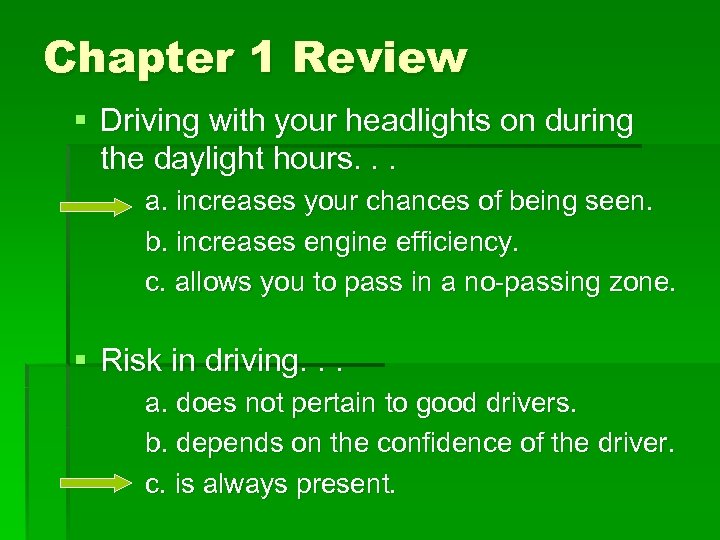 Chapter 1 Review § Driving with your headlights on during the daylight hours. . . a. increases your chances of being seen. b. increases engine efficiency. c. allows you to pass in a no-passing zone. § Risk in driving. . . a. does not pertain to good drivers. b. depends on the confidence of the driver. c. is always present.
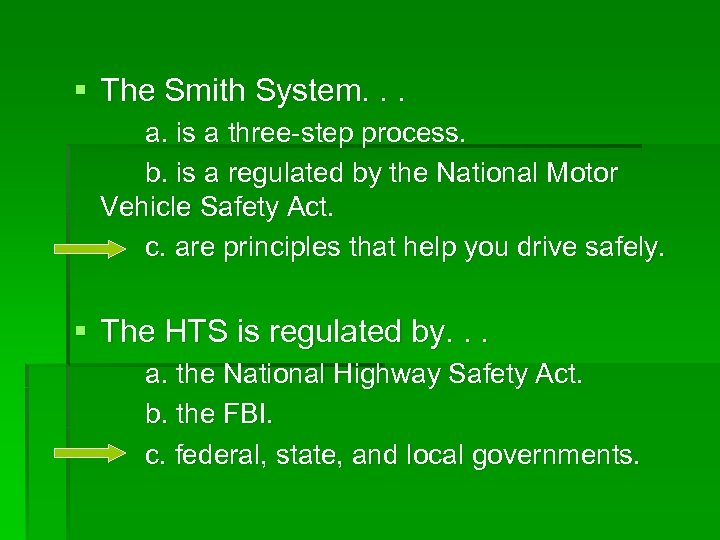 § The Smith System. . . a. is a three-step process. b. is a regulated by the National Motor Vehicle Safety Act. c. are principles that help you drive safely. § The HTS is regulated by. . . a. the National Highway Safety Act. b. the FBI. c. federal, state, and local governments.
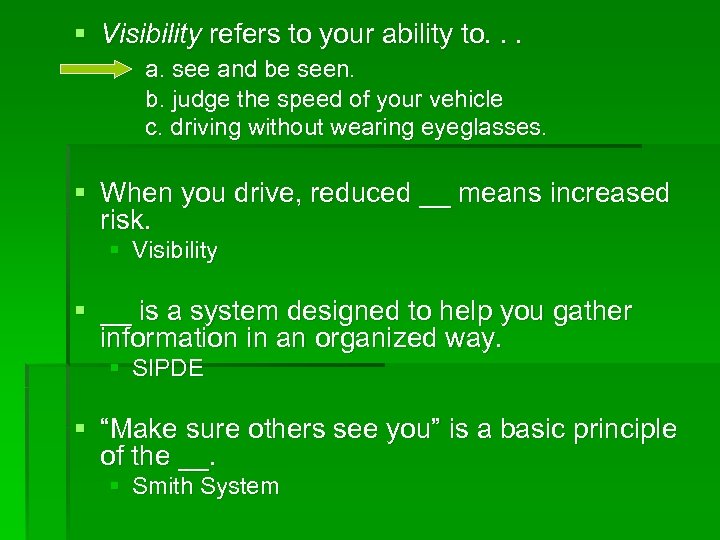 § Visibility refers to your ability to. . . a. see and be seen. b. judge the speed of your vehicle c. driving without wearing eyeglasses. § When you drive, reduced __ means increased risk. § Visibility § __ is a system designed to help you gather information in an organized way. § SIPDE § “Make sure others see you” is a basic principle of the __. § Smith System
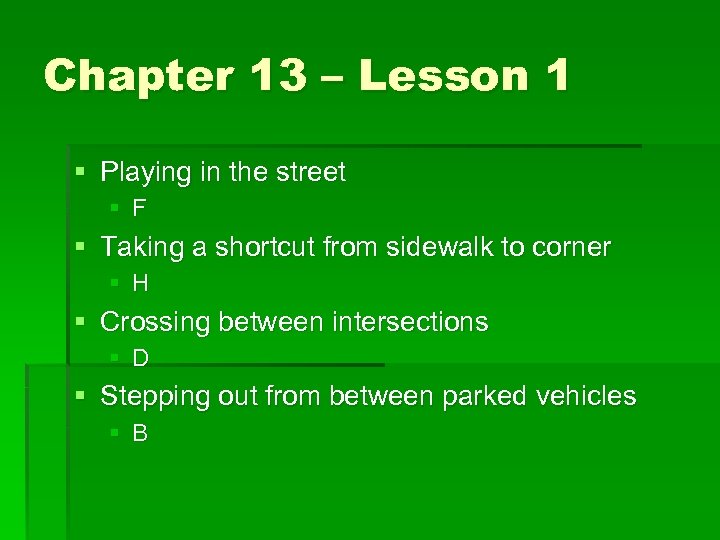 Chapter 13 – Lesson 1 § Playing in the street § F § Taking a shortcut from sidewalk to corner § H § Crossing between intersections § D § Stepping out from between parked vehicles § B
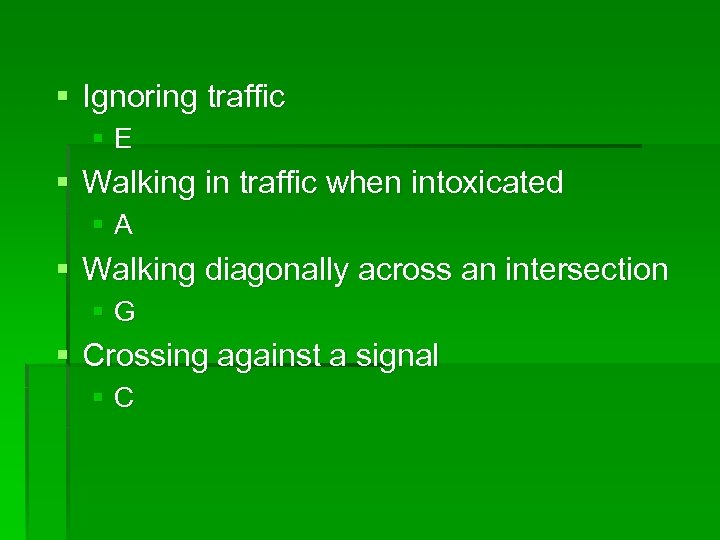 § Ignoring traffic §E § Walking in traffic when intoxicated §A § Walking diagonally across an intersection §G § Crossing against a signal §C
 What are some pedestrian behaviors that lead to collisions with vehicles? § Jaywalking, darting into the street between parked vehicles, playing in the street, rushing to beat a changing light.
 What precautions can drivers take to avoid collisions with children? § Use the SIPDE process; be alert for signs of children; position the vehicle for maximum visibility; reduce speed; scan continuously; take special care when backing the vehicle up.
 What are some of the basic safety rules pedestrians should follow? § Obey all rules, signals, and signs; never assume drivers will see you; don’t step off the curb while waiting for a light to turn green; before crossing a street, look and listen for vehicles; take young children by the hand when crossing streets.
 If you can’t avoid hitting a large animal, what steps should you take to minimize the damage to your vehicle? § Brake firmly; steer to strike the animal at an angle.
 Chapter 13 – Lesson 2 Sharing the Roadway with Motorcycles and Bicycles
 True or False § On the roadway, motorcycles are less visible than cars. § True § When driving behind a cyclist, reduce your following distance. § False, when driving behind a cyclist, increase your following distance.
 True or False § The risk of a serious or fatal injury to a driver of a motorcycle involved in a collision is low. § False, the risk of a fatal injury to a driver of a motorcycle involved in a collision is high. § Since a motorcycle is smaller than a car, it is safe to pass one in a tight space. § False, it is dangerous to pass a motorcycle in a tight space.
 True or False § Two-wheeled vehicles are most difficult to spot when they approach from behind on a highway. § True
 Describe problems that cyclists can cause for a driver: Explain how you would manage risk in each circumstance. § Cyclists are difficult to see: search the roadway and check blind spots. § Cyclists may fail to obey traffic laws: be alert and ready to take evasive action. § Cyclists may have difficulty coping with road conditions: allow them extra space to maneuver, and try to anticipate adjustments they may have to make.
 What should motorcyclists do to avoid risks on the roadway? § Cyclists should keep out of the drivers’ blind spots, avoid weaving in and out of lanes, and obey all traffic laws. § Most cyclists are hit by vehicles turning left.
 Chapter 13 – Lesson 3 Sharing the Roadway with Other Vehicles
 True or False § Trucks on the roadway today can be up to 60 feet long. § False, Trucks on the roadway can be up to 120 feet long. § Truck drivers have excellent visibility ahead. § True § A truck tends to lose speed when going downhill. § False, a truck tends to gain speed going downhill.
 True or False § You should decrease your following distance when driving behind a truck. § False, you should increase your following distance when following a truck. § You should pass a truck on the right side of the roadway. § False, never pass a truck on the right side of the roadway. § You should use the 2 -second rule when following a bus. § False, you should use the 4 -second rule when following a bus.
 True or False § When driving a small, low-powered vehicle, you should allow extra space and time to pass another vehicle § true § If you see an emergency vehicle with its lights flashing, you should allow extra space and time to pass another vehicle. § False- you should pull to the right to let an emergency vehicle pass if its lights are flashing. § When you are sharing the roadway with a slow-moving vehicle, what are three precautions you should take? § § § Reduce speed Follow at a safe distance Before passing, try to anticipate the driver’s actions.
 Chapter 13 – lesson 4 § Safe driving procedures at railroad crossing
 True or False § When you come to any railroad crossing, you should always slow down § True § You should stop no closer than 5 feet from a railroad crossing. § False- you should stop no closer than 15 feet from a railroad crossing § If the lights at a railroad crossing are flashing, you can cross the tracks only if you do not see a train and after looking carefully. § False- if the lights at a railroad crossing are flashing, you must stop.
 True or False § A railroad crossing with no lights flashing does not necessarily mean that it is safe to cross without looking first. § True § You should stop on railroad tracks only if the vehicle ahead of you has stopped. § False- you should never stop on railroad tracks § As soon as a train has passed, you should look and listen to see if there is another train before moving. § True
 Chapter 13 review § What must you do to negotiate a railroad crossing safely? § Slow down and look for warning lights, signals, or lowered gates. Before crossing the tracks, stop, look and listen for trains in both directions § What would you do if your vehicle stalled on railroad tracks? § Check fro approaching trains § If a train is coming, leave your vehicle, move away from the tracks, walking in the direction the train is coming from. § If you can’t start the vehicle and no train is coming, try to push the vehicle off the tracks.
 Chapter 13 Review § When driving behind a tractor-trailer, § A. Allow at least a 4 -second following distance. § Collisions with pedestrians occur most often § A. At intersections § Drivers who travel the same route every day § B. Pay less attention to their surroundings. § Drivers use ground viewing to § B. Search beneath parked vehicles for signs of movement.
 Chapter 13 Review cont. § Because truck drivers sit high above the surface of the roadway, they § B. Have great visibility of the road ahead § When driving behind a cyclist, you should § A. Increase your following distance. § If you approach a railroad crossing when a train is coming, you should § A. Stop at least 15 feet from the crossing.
 Chapter 13 Review cont. § Crossing a street without regard for traffic rules or signals is called § Jaywalking § Cyclists often squeeze between vehicles traveling in lanes. § Parallel
 Chapter 16 - lesson 1 Determining personal need when considering buying a vehicle.
 § How can you tell if you really need a vehicle? Consider how much travel you do, how can you get to the places you need to get to, and whether you have access to a family vehicle. Can you afford a vehicle? § How should passenger comfort and maintenance costs influence the kind of vehicle you buy? Passenger comfort influences your decisions about vehicle size and number of doors; maintenance costs influence your decision about the age and condition of the vehicle you choose.
 Chapter 16 -section 2 How to obtain financing for a new or used vehicle.
 § Since most fatalities in head on collisions occur when the driver hits the steering wheel, a good safety device to prevent this from happening is …. AN AIR BAG § If you are evaluating a vehicle and discover that this particular make and model has a death rate of 4 per 10, 000 registered vehicles, you should… NOT BUY THE VEHICLE § Examples of low visibility colors are… BLUE, BROWN and BLACK
 § The death rate in small vehicles is almost …. As in the largest vehicles. TWICE AS MUCH § As vehicles increase in weight, their safety usually …. INCREASES § The number of times the drive shaft revolves to make the wheels turn once is called the …. § A vehicle with 6 cylinders uses… fuel than a vehicle with 4 cylinders. MORE
 § How can information from the insurance institute for highway safety help you evaluate a vehicle’s safety? The institute provides data on death rates in crashes by make and model. § Describe how test driving a vehicle can help you evaluate how comfortable it is. You can see whether switches, controls, and dials are within easy reach and whether the seat feels comfortable; you can judge how smoothly the vehicle rides. § How does the type of engine a vehicle has affect its fuel efficiency? The more engine cylinders, the more fuel consumed. § What should you check when you select a used vehicle? Paint condition, presence of rust, tire condition, tailpipe, radiator, transmission, engine, lights, turn indicators, windows and door locks, service stickers, safety belts, airbags, and head restraints.
 Chapter 16 - lesson 3 How to obtain financing for a new or used vehicle.
 § Where would you go to get financing for a vehicle? A bank, credit union, the dealer, financing company. § What advice would you give someone about financing a vehicle? Check various financing sources to find the best terms know what your monthly payments will be. q Lending agencies lend money to make money. Different sources of financing often charge different interest rates.
 § What is the amount of the loan based on? The amount of the loan is based on the cost of the vehicle and the amount of time you have to pay back the loan which is based on whether the vehicle is new or used.
 Chapter 16 - lesson 4 Choosing and purchasing insurance for a vehicle.
 § What is liability insurance? Insurance that protects you against claims if you are at fault in a collision and helps pay for any injury or property damage you caused § What is comprehensive insurance? Insurance that covers the cost of repairs for vehicle damage caused by anything other than a collision, such as theft, fire, explosions, natural disasters, falling objects, or vandalism. § What is medical payment insurance? Insurance that covers medical, hospital, or funeral costs regardless of who is at fault. It also pays if you or a member of your family is injured or killed while riding in someone else's vehicle.
 § What is collision insurance? Insurance that covers the cost of repairs to your vehicle even if you are at fault in a crash or are involved with an uninsured driver. It also covers repairs to your vehicle if it is damaged in a parking lot or in a parking space on the street. § What is uninsured motorist insurance? Protection from financing losses resulting from a collision involving a driver who does not have insurance protection or from a hit and run driver, also protects you in states where no liability insurance is required.
 § What is no fault insurance? A system in which ones insurance company pays ones medical bills, and any other costs resulting from a collision related injury regardless of who is at fault. § What is towing insurance? Towing insurance covers the cost of on road repairs and the cost of having your vehicle towed.
 read each description below. Fill in the blank with the letters of any type or types of insurance you think will cover each accident. You may have to list more than one type of insurance. LI= liability CM= comprehensive MP= Medical payment CL=collision § … you see a red light ahead and begin to slow down. A driver behind you does not realize your stopping. The vehicle hits your car and damages a fender. The other driver admits to not having watched the road carefully. CL, LI § … you are driving on a county road at night. Suddenly you hear a loud noise and feel a jolt. You stop the vehicle and find that a large tree limb has fallen onto your roof leaving a big dent. CM
 § …You are driving along the street, your worried that a carton of groceries on the back seat is about to slide onto the floor. Reaching back to steady it, you take your eyes off the road for a moment. You hit a vehicle that is parked on the side of the street. You have made a big dent in the other vehicles side. Your vehicle has a broken light and a collapsed fender. In addition your left are hurts- the jolt of the accident has wrenched your left shoulder. LI, CL, MP
 § … you look for your vehicle one morning and discover that it is not where you left it. Your sure that you parked it in front of you house. Someone has stolen your vehicle. CM
 § _____ insurance pays for loses with out determining who is to blame for an accident. NO FAULT § _____ insurance covers damage to your vehicle by a tornado. COMPREHENSIVE § _____ insurance covers victims of a hit and run. UN INSURED MOTORIST § _____ insurance pays for damages you have caused. PROPERTY DAMAGE LIABILITY § _____ insurance will pay if your vehicle is damaged while parked on the road. COLLISION