


 Скачать презентацию Chapter 1 Introduction to Operations and Competitiveness Copyright
3907c13cb1921c8151e2818d7d83acd0.ppt
- Количество слайдов: 141
 Chapter 1 Introduction to Operations and Competitiveness Copyright 2006 John Wiley To Accompany Russell and Taylor, Operations Management, 4 th Edition, 2003 Prentice-Hall, Inc. All rights reserved. & Sons, Inc.
 Welcome to ISQS 5343 Instructor: Dr. Burns Summer II 2013 SEMESTER Telephone: 834 -1547 Email: jburns@ba. ttu. edu Off hrs: 9: 30 -10: 00 Tues. , Th. And by appointment Website: burns. ba. ttu. edu Copyright 2010 John Wiley & Sons, Inc.
 My web site http: //burns. ba. ttu. edu Copyright 2011 John Wiley & Sons, Inc. 1 -3
 Prerequisites w STATISTICS n ISQS 5345: Basic Statistical Concepts w COMPUTER LITERACY n n MS Excel MS Word Copyright 2011 John Wiley & Sons, Inc. 1 -4
 Seating w The seat you sit in on the second session of class will be your seat for the duration of the class w A seating chart will be ‘made-up’ then Copyright 2006 John Wiley & Sons, Inc. 1 -5
 Survey w I will hand it out… Copyright 2006 John Wiley & Sons, Inc. 1 -6
 Copyright 2006 John Wiley & Sons, Inc. 1 -7
 Requirements/Pedagogy w 4 homework sets n n Collected the day before we do our review TO GET US READY TO TAKE THE EXAMS w 3 EXAMS and a FINAL w Term Project Copyright 2006 John Wiley & Sons, Inc. 1 -8
 Term Project--Consists of six parts w Part 1 is due 7 -15 -2013 w Part 2 is due 7 -17 -2013 w Part 3 is due 7 -19 -2013 w Part 4 is due 7 -30 -2013 w Part 5 is due 8 -5 -2013 w Part 6 is due 8 -9 -2013 w PROJECT IN TOTAL IS due 8 -9 -2013 1 -9
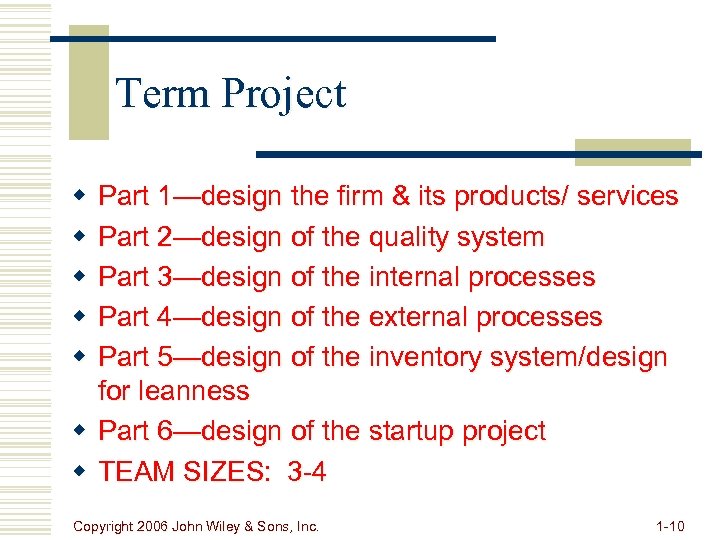 Term Project w w w Part 1—design the firm & its products/ services Part 2—design of the quality system Part 3—design of the internal processes Part 4—design of the external processes Part 5—design of the inventory system/design for leanness w Part 6—design of the startup project w TEAM SIZES: 3 -4 Copyright 2006 John Wiley & Sons, Inc. 1 -10
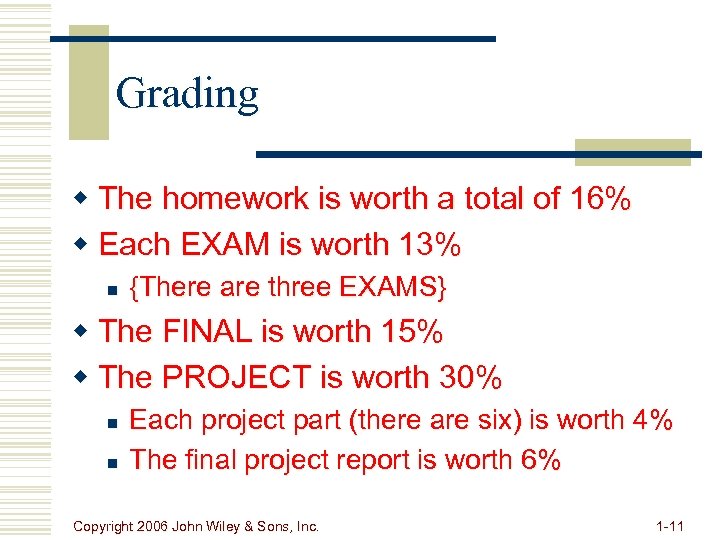 Grading w The homework is worth a total of 16% w Each EXAM is worth 13% n {There are three EXAMS} w The FINAL is worth 15% w The PROJECT is worth 30% n n Each project part (there are six) is worth 4% The final project report is worth 6% Copyright 2006 John Wiley & Sons, Inc. 1 -11
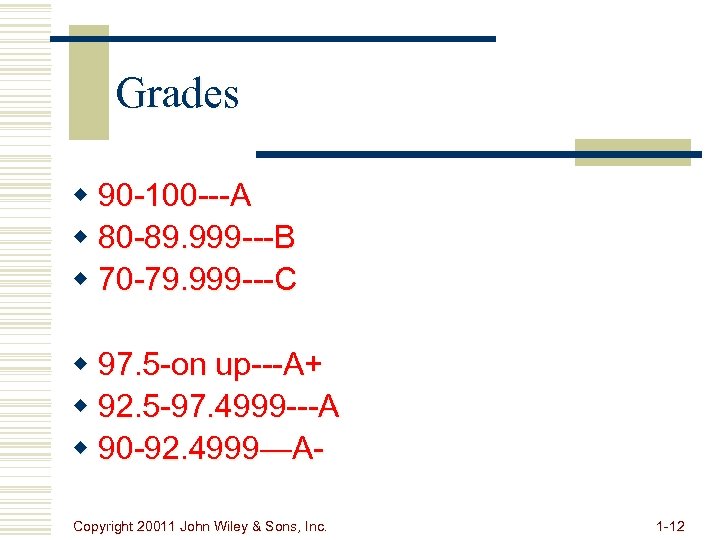 Grades w 90 -100 ---A w 80 -89. 999 ---B w 70 -79. 999 ---C w 97. 5 -on up---A+ w 92. 5 -97. 4999 ---A w 90 -92. 4999—ACopyright 20011 John Wiley & Sons, Inc. 1 -12
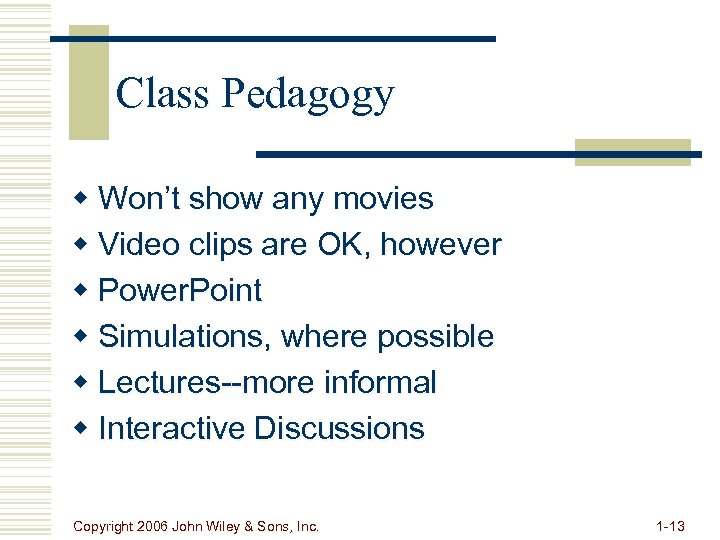 Class Pedagogy w Won’t show any movies w Video clips are OK, however w Power. Point w Simulations, where possible w Lectures--more informal w Interactive Discussions Copyright 2006 John Wiley & Sons, Inc. 1 -13
 How Long does it take you to do stuff? w Do you know? w Suppose your employer assigns a task to you and asks you how long it will take you to do it? Could you tell him/her? w For your benefit, I want you to estimate how long its going to take you to do each project step and then record how long it actually took you Copyright 2006 John Wiley & Sons, Inc. 1 -14
 Five ‘hot’ jobs right now— according to Yahoo. w http: //hotjobs. yahoo. com/career-articlesfive_hot_business_careers_no_mba_needed 276 w Event Planning--$20 --$40/hr w Public Relations--$43, 830/yr (median) w Advertising--$40, 300/yr (median) w Web Designer--$60, 000/yr (median) w Search Engine Optimization--$40, 000 (med. ) w Project manager--$50, 000 to $80, 000 to start Copyright 2006 John Wiley & Sons, Inc. 1 -15
 Questions w How big is the U. S. economy in terms of GDP? What is the world-wide GDP? w How big is the U. S. population in relation to the rest of the world? w What percentage of worldwide nonrenewable resources are consumed just in the U. S. alone? Copyright 2006 John Wiley & Sons, Inc. 1 -16
 More questions w Is the U. S. leadership in terms of material standard of living sustainable? n What does it take to make it sustainable? w What is causing the devaluation of the dollar? Will that devaluation continue? w Is there anything good that comes from devaluation of the dollar? w What’s bad about the $ devaluation? Copyright 2006 John Wiley & Sons, Inc. 1 -17
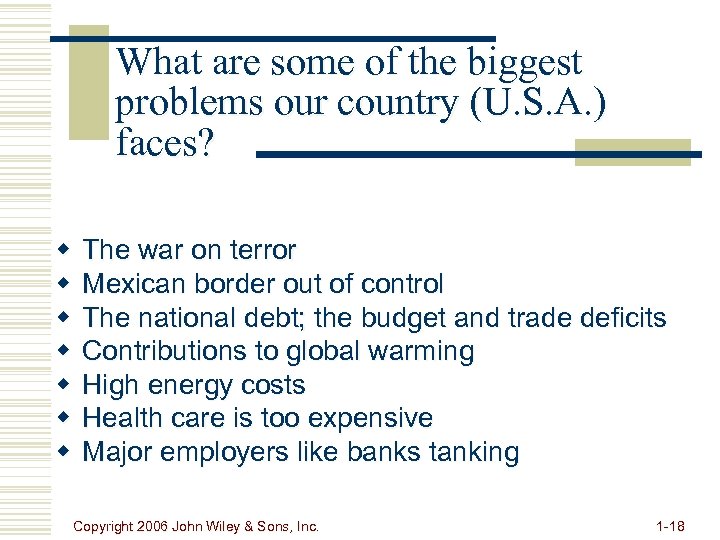 What are some of the biggest problems our country (U. S. A. ) faces? w w w w The war on terror Mexican border out of control The national debt; the budget and trade deficits Contributions to global warming High energy costs Health care is too expensive Major employers like banks tanking Copyright 2006 John Wiley & Sons, Inc. 1 -18
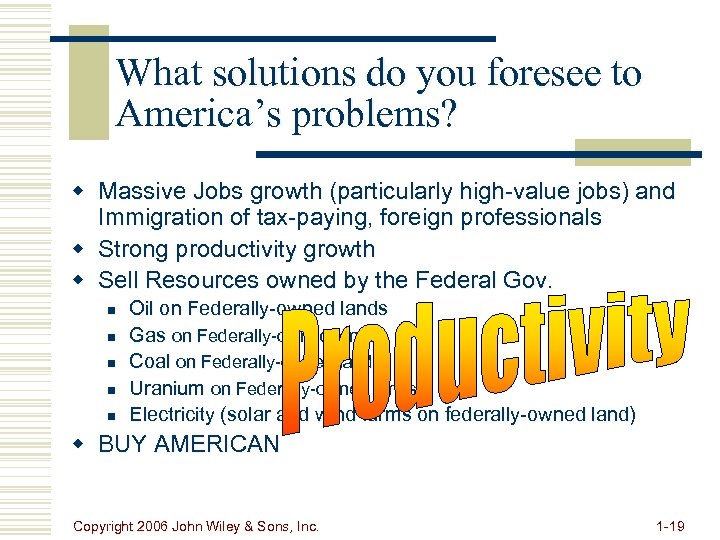 What solutions do you foresee to America’s problems? w Massive Jobs growth (particularly high-value jobs) and Immigration of tax-paying, foreign professionals w Strong productivity growth w Sell Resources owned by the Federal Gov. n n n Oil on Federally-owned lands Gas on Federally-owned lands Coal on Federally-owned lands Uranium on Federally-owned lands Electricity (solar and wind farms on federally-owned land) w BUY AMERICAN Copyright 2006 John Wiley & Sons, Inc. 1 -19
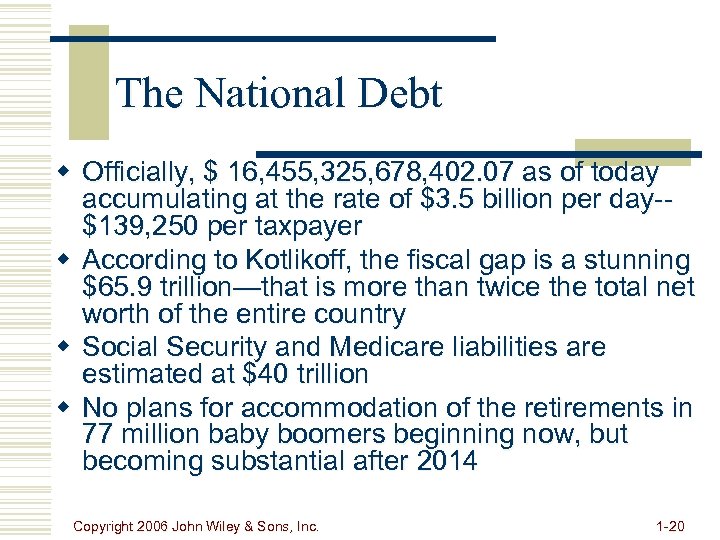 The National Debt w Officially, $ 16, 455, 325, 678, 402. 07 as of today accumulating at the rate of $3. 5 billion per day-$139, 250 per taxpayer w According to Kotlikoff, the fiscal gap is a stunning $65. 9 trillion—that is more than twice the total net worth of the entire country w Social Security and Medicare liabilities are estimated at $40 trillion w No plans for accommodation of the retirements in 77 million baby boomers beginning now, but becoming substantial after 2014 Copyright 2006 John Wiley & Sons, Inc. 1 -20
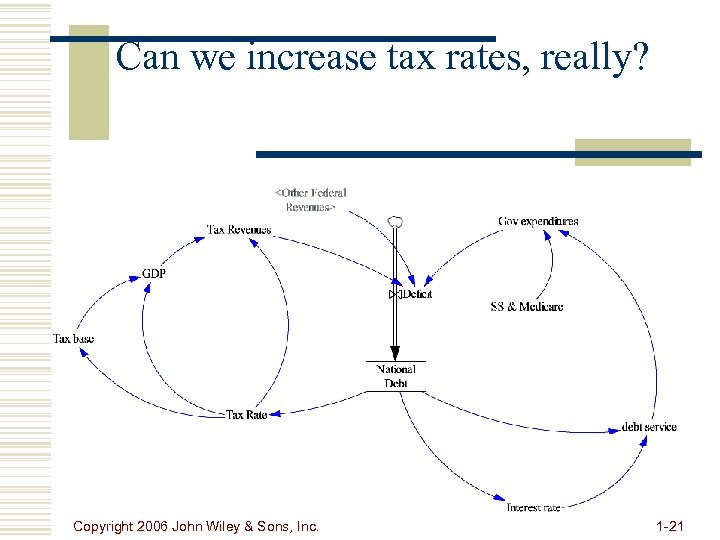 Can we increase tax rates, really? Copyright 2006 John Wiley & Sons, Inc. 1 -21
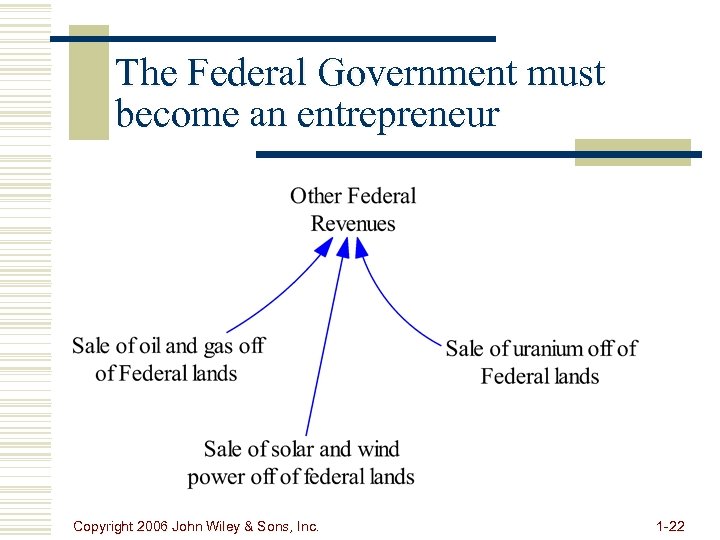 The Federal Government must become an entrepreneur Copyright 2006 John Wiley & Sons, Inc. 1 -22
 Solutions--Kotlikoff Copyright 2006 John Wiley & Sons, Inc. 1 -23
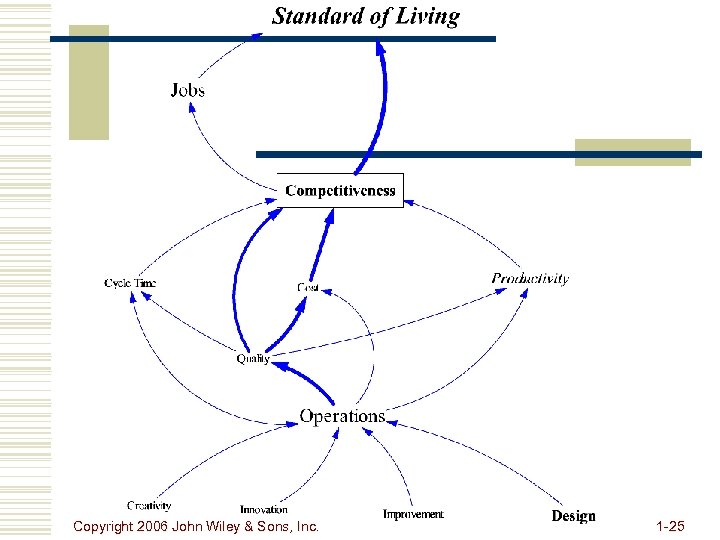
 Competitiveness w The opportunities are huge w There will be massive change w You can exploit that change to create wealth Copyright 2006 John Wiley & Sons, Inc. 1 -24
 Copyright 2006 John Wiley & Sons, Inc. 1 -25
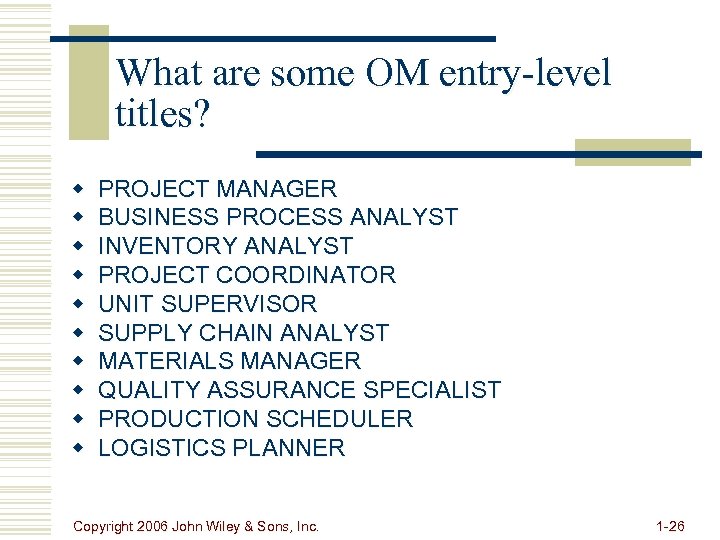 What are some OM entry-level titles? w w w w w PROJECT MANAGER BUSINESS PROCESS ANALYST INVENTORY ANALYST PROJECT COORDINATOR UNIT SUPERVISOR SUPPLY CHAIN ANALYST MATERIALS MANAGER QUALITY ASSURANCE SPECIALIST PRODUCTION SCHEDULER LOGISTICS PLANNER Copyright 2006 John Wiley & Sons, Inc. 1 -26
 Competitiveness, Productivity, Leanness, Agility and Maturity w That’s what this course is about w Creating wealth through production of goods and services Copyright 2006 John Wiley & Sons, Inc. 1 -27
 Potential Project Topics w Products/services that help us conserve energy/water n n Residential Commercial w Products that help the retiring baby boom generation— 77 million of them in the U. S. alone w Products/processes that reduce the cost of health care? w Products/services that help us become GREEN AND Copyright 2006 John Wiley & Sons, Inc. 1 -28
 Copyright 2006 John Wiley & Sons, Inc. 1 -29
 Copyright 2006 John Wiley & Sons, Inc. 1 -30
 Lecture Outline w What Operations and Supply Chain Managers Do w Operations Function w Evolution of Operations and Supply Chain Management w Globalization and Competitiveness w Operations w Learning Objectives for This Course Copyright 2006 John Wiley & Sons, Inc. 1 -32
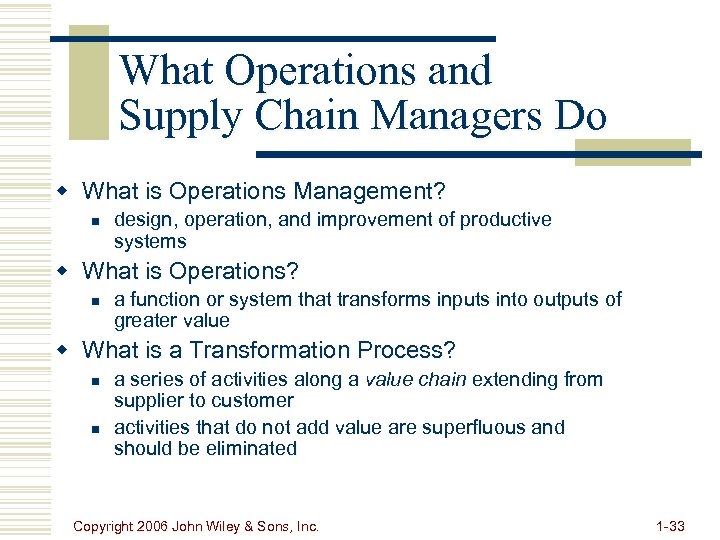 What Operations and Supply Chain Managers Do w What is Operations Management? n design, operation, and improvement of productive systems w What is Operations? n a function or system that transforms inputs into outputs of greater value w What is a Transformation Process? n n a series of activities along a value chain extending from supplier to customer activities that do not add value are superfluous and should be eliminated Copyright 2006 John Wiley & Sons, Inc. 1 -33
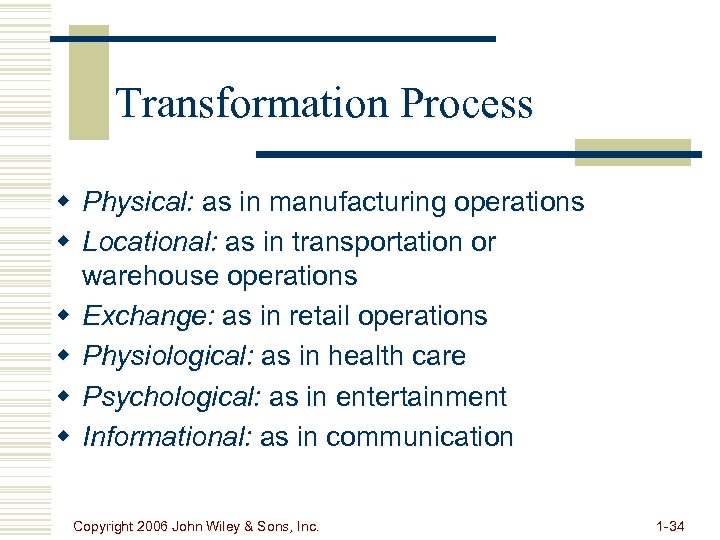 Transformation Process w Physical: as in manufacturing operations w Locational: as in transportation or warehouse operations w Exchange: as in retail operations w Physiological: as in health care w Psychological: as in entertainment w Informational: as in communication Copyright 2006 John Wiley & Sons, Inc. 1 -34
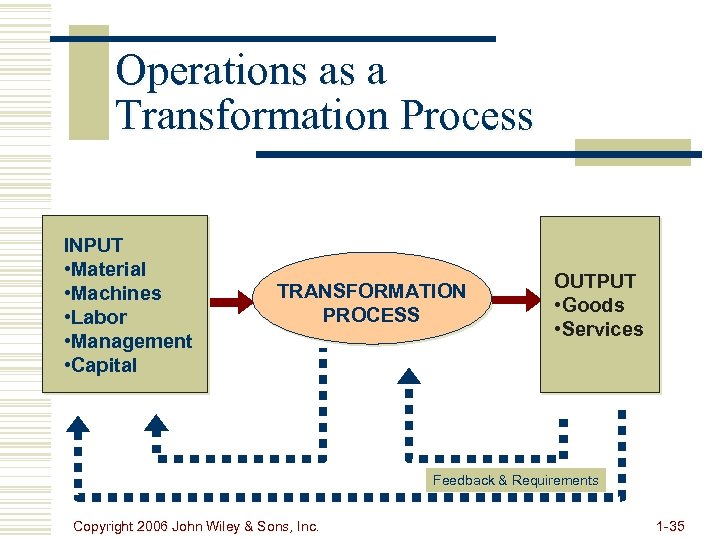 Operations as a Transformation Process INPUT • Material • Machines • Labor • Management • Capital TRANSFORMATION PROCESS OUTPUT • Goods • Services Feedback & Requirements Copyright 2006 John Wiley & Sons, Inc. 1 -35
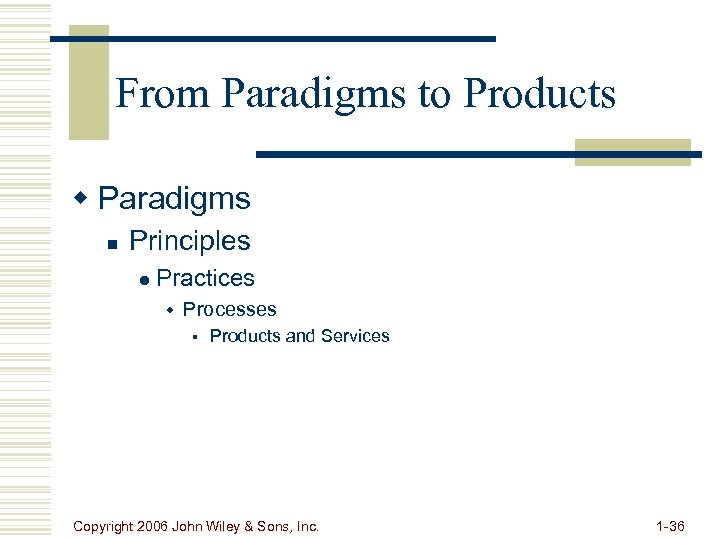 From Paradigms to Products w Paradigms n Principles l Practices w Processes § Products and Services Copyright 2006 John Wiley & Sons, Inc. 1 -36
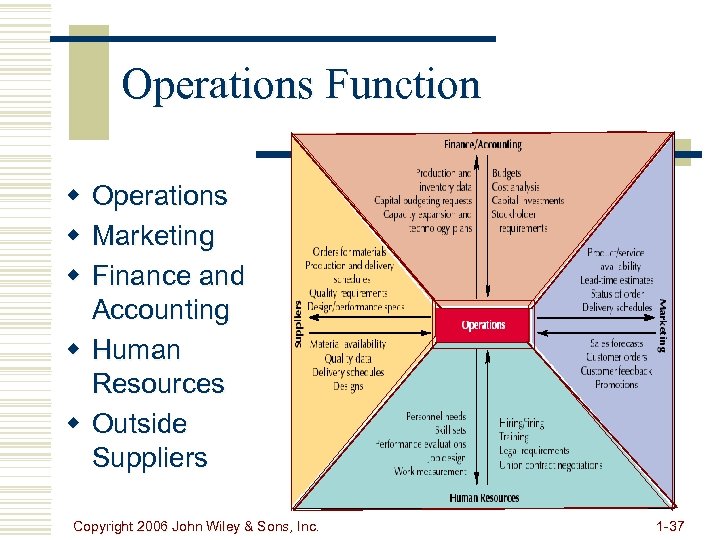 Operations Function w Operations w Marketing w Finance and Accounting w Human Resources w Outside Suppliers Copyright 2006 John Wiley & Sons, Inc. 1 -37
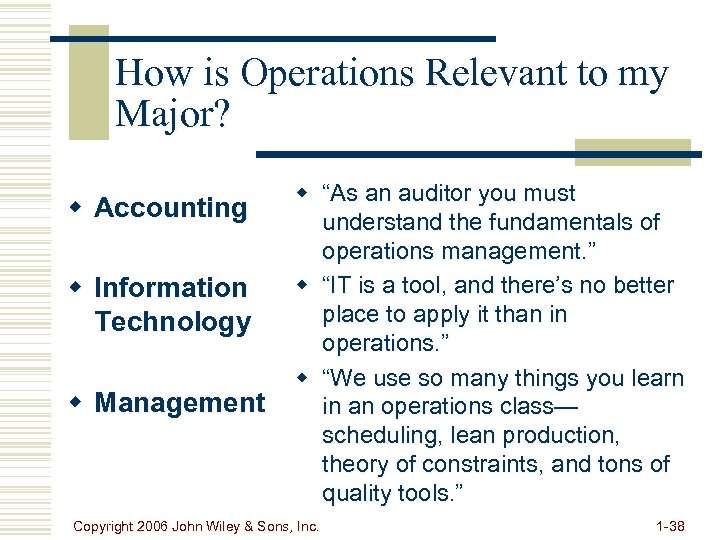 How is Operations Relevant to my Major? w Accounting w Information Technology w Management w “As an auditor you must understand the fundamentals of operations management. ” w “IT is a tool, and there’s no better place to apply it than in operations. ” w “We use so many things you learn in an operations class— scheduling, lean production, theory of constraints, and tons of quality tools. ” Copyright 2006 John Wiley & Sons, Inc. 1 -38
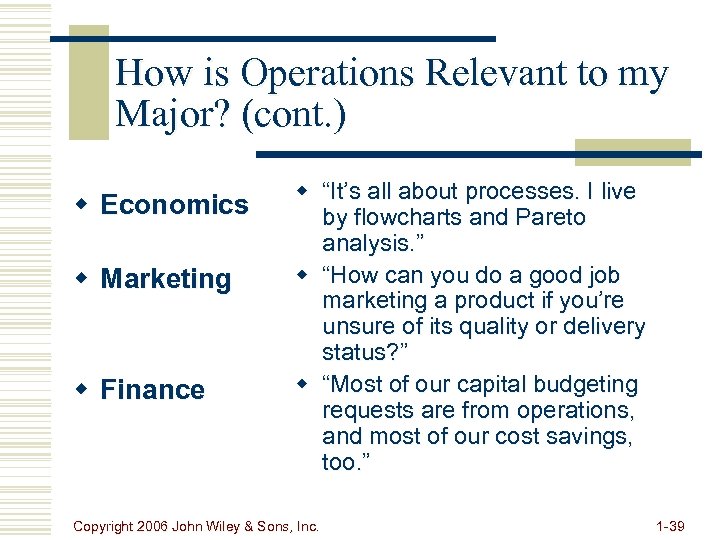 How is Operations Relevant to my Major? (cont. ) w Economics w Marketing w Finance w “It’s all about processes. I live by flowcharts and Pareto analysis. ” w “How can you do a good job marketing a product if you’re unsure of its quality or delivery status? ” w “Most of our capital budgeting requests are from operations, and most of our cost savings, too. ” Copyright 2006 John Wiley & Sons, Inc. 1 -39
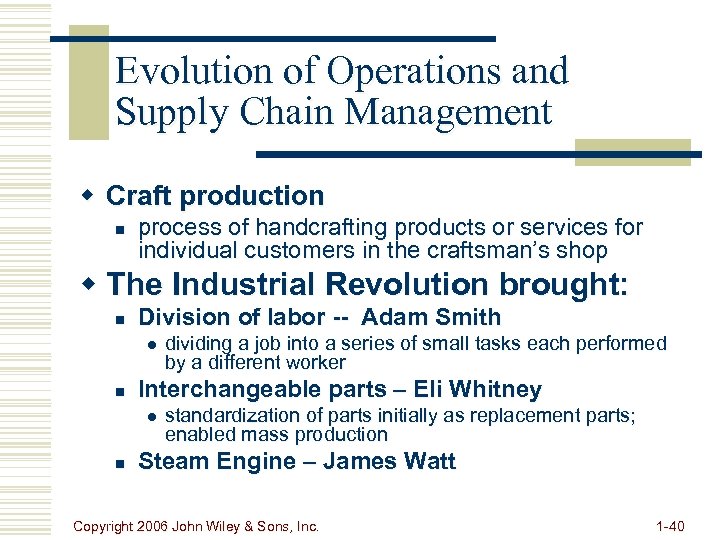 Evolution of Operations and Supply Chain Management w Craft production n process of handcrafting products or services for individual customers in the craftsman’s shop w The Industrial Revolution brought: n Division of labor -- Adam Smith l n Interchangeable parts – Eli Whitney l n dividing a job into a series of small tasks each performed by a different worker standardization of parts initially as replacement parts; enabled mass production Steam Engine – James Watt Copyright 2006 John Wiley & Sons, Inc. 1 -40
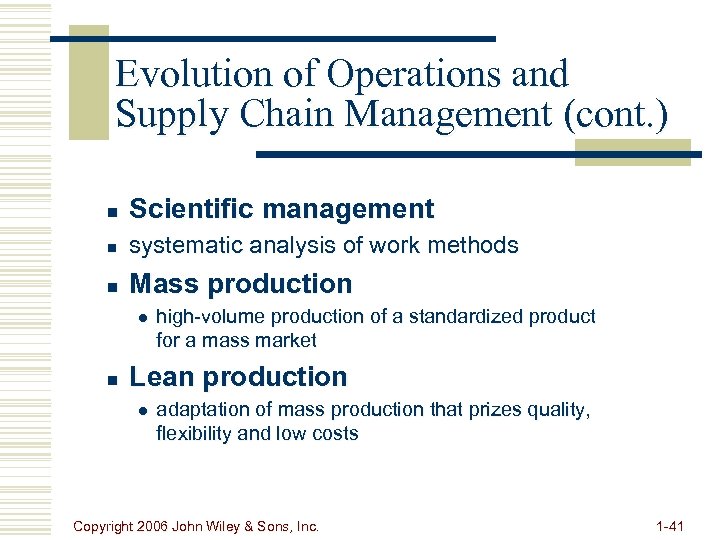 Evolution of Operations and Supply Chain Management (cont. ) n Scientific management n systematic analysis of work methods n Mass production l n high-volume production of a standardized product for a mass market Lean production l adaptation of mass production that prizes quality, flexibility and low costs Copyright 2006 John Wiley & Sons, Inc. 1 -41
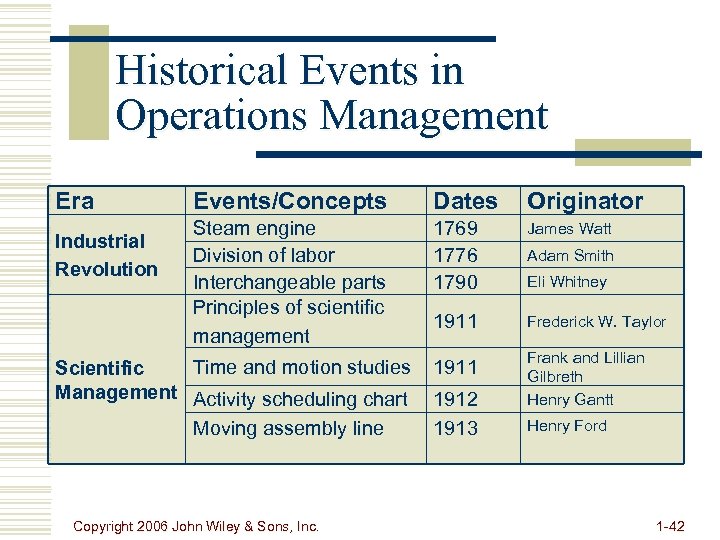 Historical Events in Operations Management Era Industrial Revolution Events/Concepts Dates Originator Steam engine Division of labor Interchangeable parts Principles of scientific management 1769 1776 1790 James Watt 1911 Frederick W. Taylor 1911 Frank and Lillian Gilbreth Henry Gantt Time and motion studies Scientific Management Activity scheduling chart Moving assembly line Copyright 2006 John Wiley & Sons, Inc. 1912 1913 Adam Smith Eli Whitney Henry Ford 1 -42
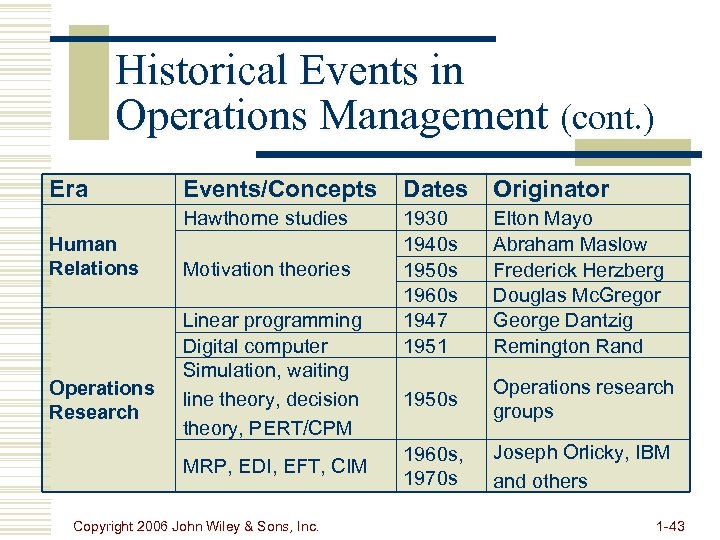 Historical Events in Operations Management (cont. ) Era Operations Research Dates Originator Hawthorne studies Human Relations Events/Concepts 1930 1940 s 1950 s 1960 s 1947 1951 Elton Mayo Abraham Maslow Frederick Herzberg Douglas Mc. Gregor George Dantzig Remington Rand 1950 s Operations research groups 1960 s, 1970 s Joseph Orlicky, IBM and others Motivation theories Linear programming Digital computer Simulation, waiting line theory, decision theory, PERT/CPM MRP, EDI, EFT, CIM Copyright 2006 John Wiley & Sons, Inc. 1 -43
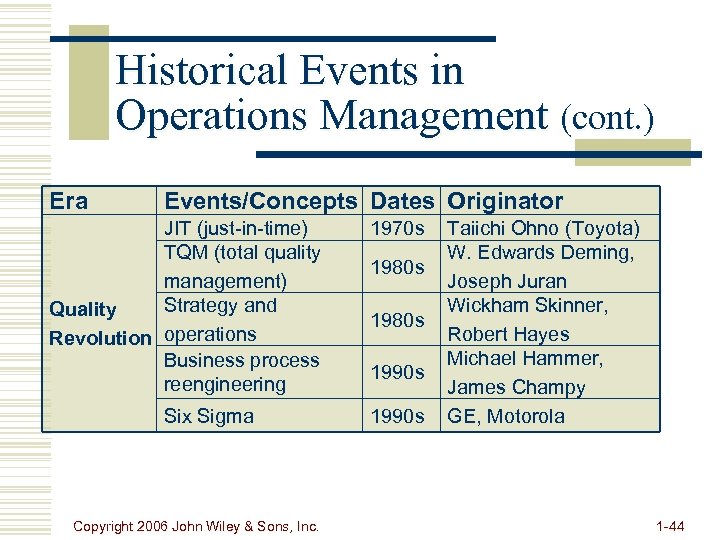 Historical Events in Operations Management (cont. ) Era Events/Concepts Dates Originator JIT (just-in-time) TQM (total quality management) Strategy and Quality Revolution operations Business process reengineering Six Sigma Copyright 2006 John Wiley & Sons, Inc. 1970 s 1980 s 1990 s Taiichi Ohno (Toyota) W. Edwards Deming, Joseph Juran Wickham Skinner, Robert Hayes Michael Hammer, James Champy GE, Motorola 1 -44
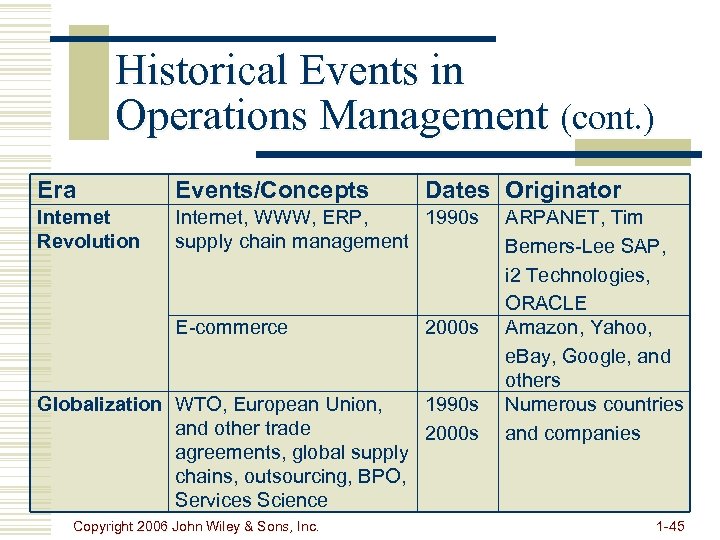 Historical Events in Operations Management (cont. ) Era Events/Concepts Internet Revolution Internet, WWW, ERP, 1990 s supply chain management E-commerce Dates Originator 2000 s Globalization WTO, European Union, 1990 s and other trade 2000 s agreements, global supply chains, outsourcing, BPO, Services Science Copyright 2006 John Wiley & Sons, Inc. ARPANET, Tim Berners-Lee SAP, i 2 Technologies, ORACLE Amazon, Yahoo, e. Bay, Google, and others Numerous countries and companies 1 -45
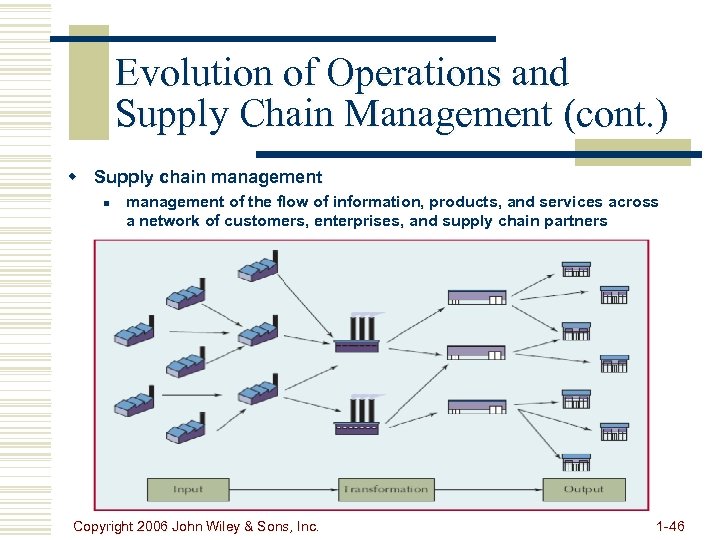 Evolution of Operations and Supply Chain Management (cont. ) w Supply chain management of the flow of information, products, and services across a network of customers, enterprises, and supply chain partners Copyright 2006 John Wiley & Sons, Inc. 1 -46
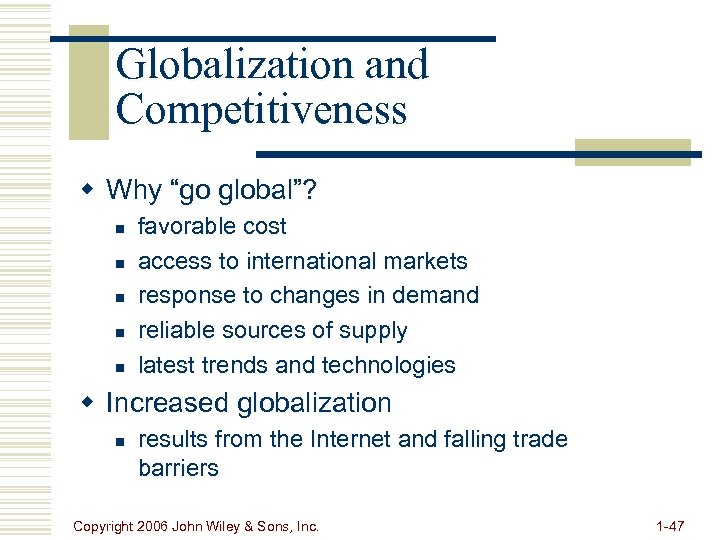 Globalization and Competitiveness w Why “go global”? n n n favorable cost access to international markets response to changes in demand reliable sources of supply latest trends and technologies w Increased globalization n results from the Internet and falling trade barriers Copyright 2006 John Wiley & Sons, Inc. 1 -47
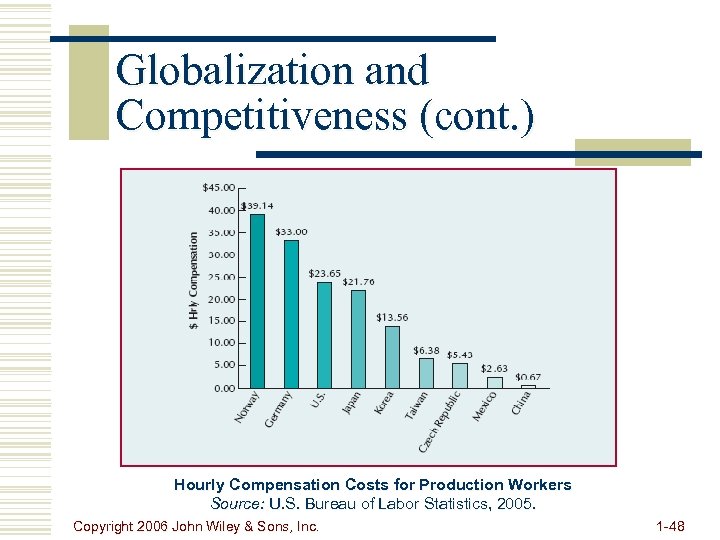 Globalization and Competitiveness (cont. ) Hourly Compensation Costs for Production Workers Source: U. S. Bureau of Labor Statistics, 2005. Copyright 2006 John Wiley & Sons, Inc. 1 -48
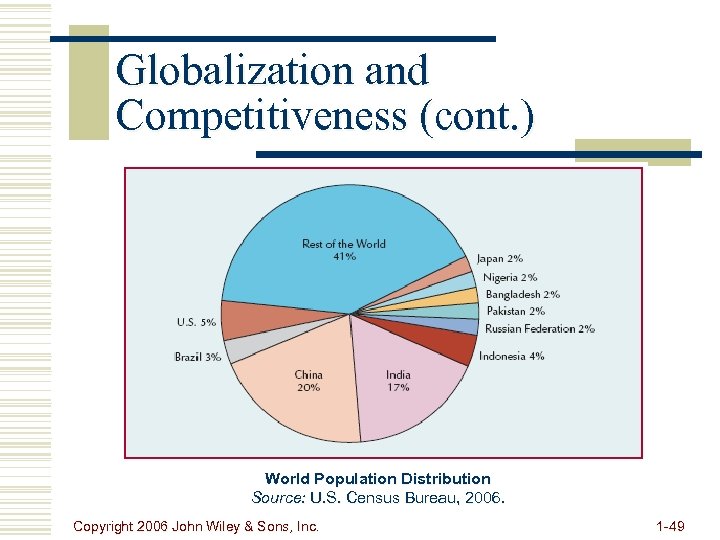 Globalization and Competitiveness (cont. ) World Population Distribution Source: U. S. Census Bureau, 2006. Copyright 2006 John Wiley & Sons, Inc. 1 -49
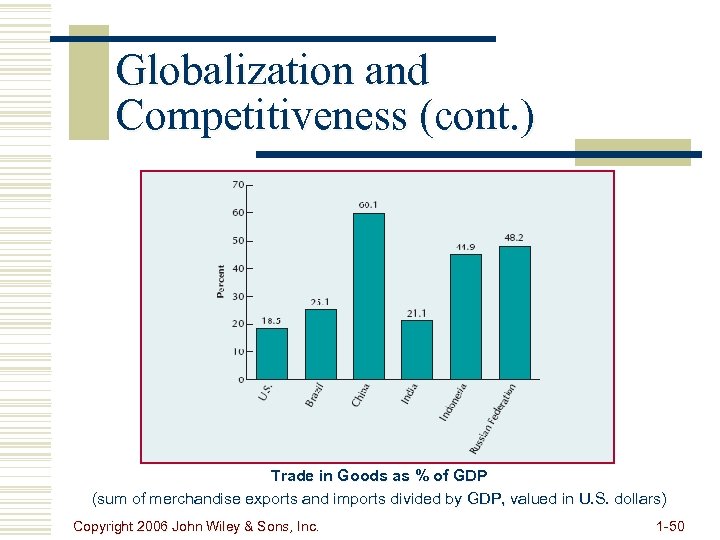 Globalization and Competitiveness (cont. ) Trade in Goods as % of GDP (sum of merchandise exports and imports divided by GDP, valued in U. S. dollars) Copyright 2006 John Wiley & Sons, Inc. 1 -50
 Productivity and Competitiveness w Competitiveness n degree to which a nation can produce goods and services that meet the test of international markets w Productivity – THE MEASURE OF COMPETITIVENESS n ratio of output to input w Output n sales made, products produced, customers served, meals delivered, or calls answered w Input n labor hours, investment in equipment, material usage, or square footage Copyright 2006 John Wiley & Sons, Inc. 1 -51
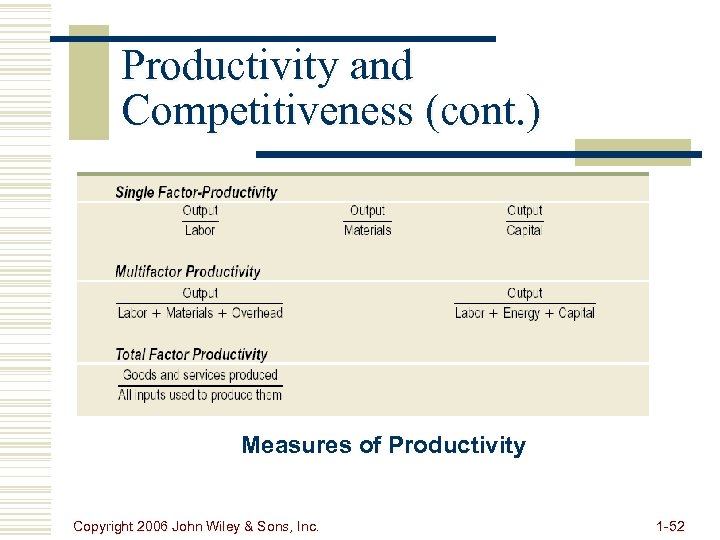 Productivity and Competitiveness (cont. ) Measures of Productivity Copyright 2006 John Wiley & Sons, Inc. 1 -52
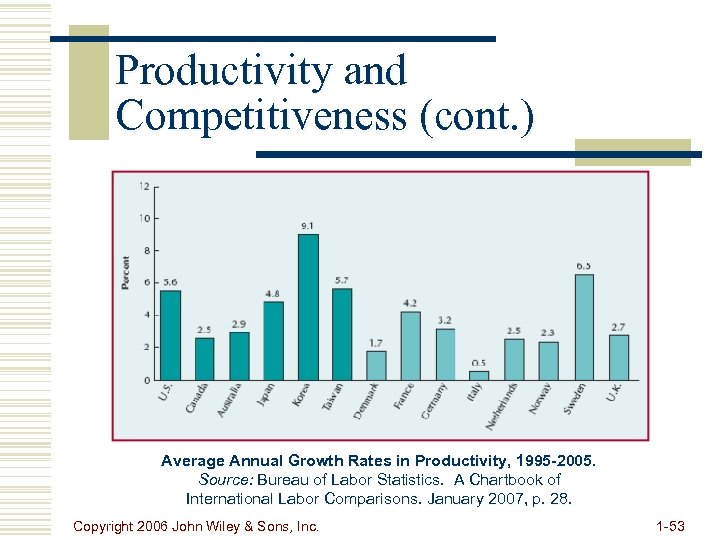 Productivity and Competitiveness (cont. ) Average Annual Growth Rates in Productivity, 1995 -2005. Source: Bureau of Labor Statistics. A Chartbook of International Labor Comparisons. January 2007, p. 28. Copyright 2006 John Wiley & Sons, Inc. 1 -53
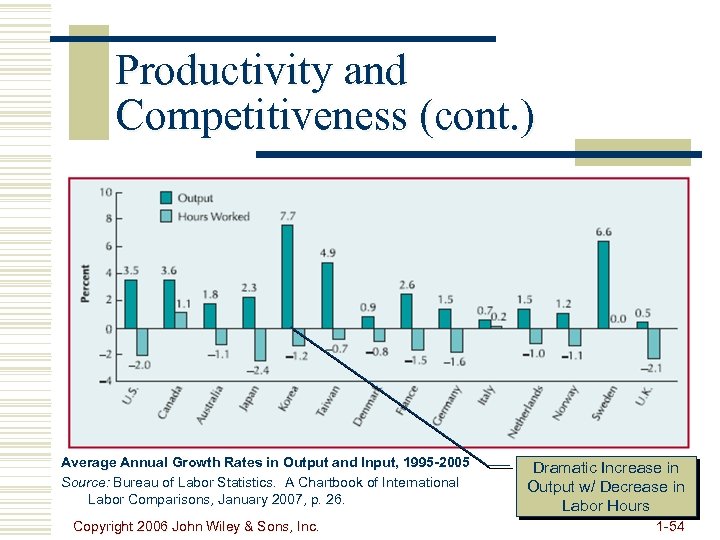 Productivity and Competitiveness (cont. ) Average Annual Growth Rates in Output and Input, 1995 -2005 Source: Bureau of Labor Statistics. A Chartbook of International Labor Comparisons, January 2007, p. 26. Copyright 2006 John Wiley & Sons, Inc. Dramatic Increase in Output w/ Decrease in Labor Hours 1 -54
 Productivity and Competitiveness (cont. ) w Retrenching n productivity is increasing, but both output and input decrease with input decreasing at a faster rate w Assumption that more input would cause output to increase at the same rate n n certain limits to the amount of output may not be considered output produced is emphasized, not output sold; increased inventories Copyright 2006 John Wiley & Sons, Inc. 1 -55
 Strategy and Operations w Strategy n Provides direction for achieving a mission w Five Steps for Strategy Formulation n Defining a primary task l n Assessing core competencies l n l What qualifies an item to be considered for purchase? What wins the order? Positioning the firm l n What does the firm do better than anyone else? Determining order winners and order qualifiers l n What is the firm in the business of doing? How will the firm compete? Deploying the strategy Copyright 2006 John Wiley & Sons, Inc. 1 -56
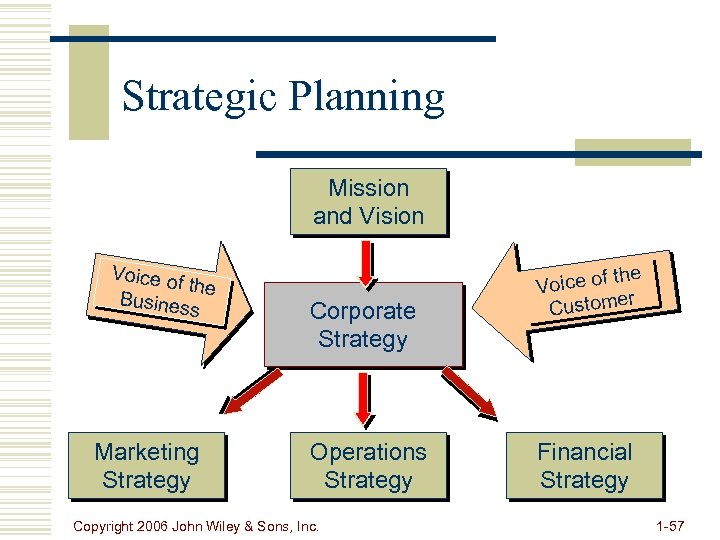 Strategic Planning Mission and Vision Voice o f the Busines s Marketing Strategy Corporate Strategy Operations Strategy Copyright 2006 John Wiley & Sons, Inc. the Voice of r Custome Financial Strategy 1 -57
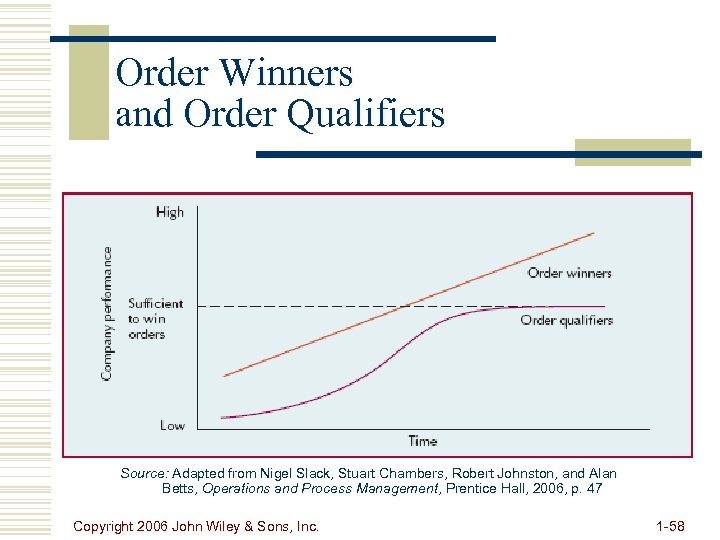 Order Winners and Order Qualifiers Source: Adapted from Nigel Slack, Stuart Chambers, Robert Johnston, and Alan Betts, Operations and Process Management, Prentice Hall, 2006, p. 47 Copyright 2006 John Wiley & Sons, Inc. 1 -58
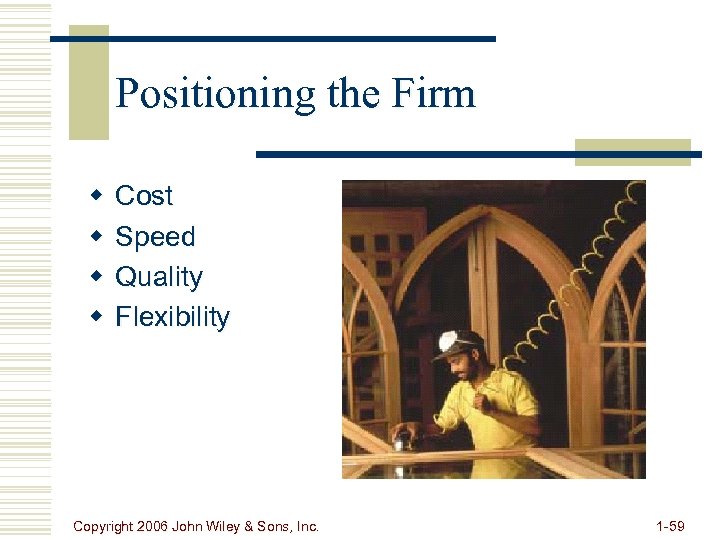 Positioning the Firm w w Cost Speed Quality Flexibility Copyright 2006 John Wiley & Sons, Inc. 1 -59
 Positioning the Firm: Cost w Waste elimination n relentlessly pursuing the removal of all waste w Examination of cost structure n looking at the entire cost structure for reduction potential w Lean production n providing low costs through disciplined operations Copyright 2006 John Wiley & Sons, Inc. 1 -60
 Positioning the Firm: Speed w fast moves, fast adaptations, tight linkages w Internet n conditioned customers to expect immediate responses w Service organizations n always competed on speed (Mc. Donald’s, Lens. Crafters, and Federal Express) w Manufacturers n time-based competition: build-to-order production and efficient supply chains w Fashion industry n two-week design-to-rack lead time of Spanish retailer, Zara Copyright 2006 John Wiley & Sons, Inc. 1 -61
 Positioning the Firm: Quality w Minimizing defect rates or conforming to design specifications; please the customer w Ritz-Carlton - one customer at a time n n Service system is designed to “move heaven and earth” to satisfy customer Every employee is empowered to satisfy a guest’s wish Teams at all levels set objectives and devise quality action plans Each hotel has a quality leader Copyright 2006 John Wiley & Sons, Inc. 1 -62
 Positioning the Firm: Flexibility w ability to adjust to changes in product mix, production volume, or design w National Bicycle Industrial Company n n n offers 11, 231, 862 variations delivers within two weeks at costs only 10% above standard models mass customization: the mass production of customized parts Copyright 2006 John Wiley & Sons, Inc. 1 -63
 Policy Deployment w Policy deployment n translates corporate strategy into measurable objectives w Hoshins n action plans (small projects) generated from the policy deployment process Copyright 2006 John Wiley & Sons, Inc. 1 -64
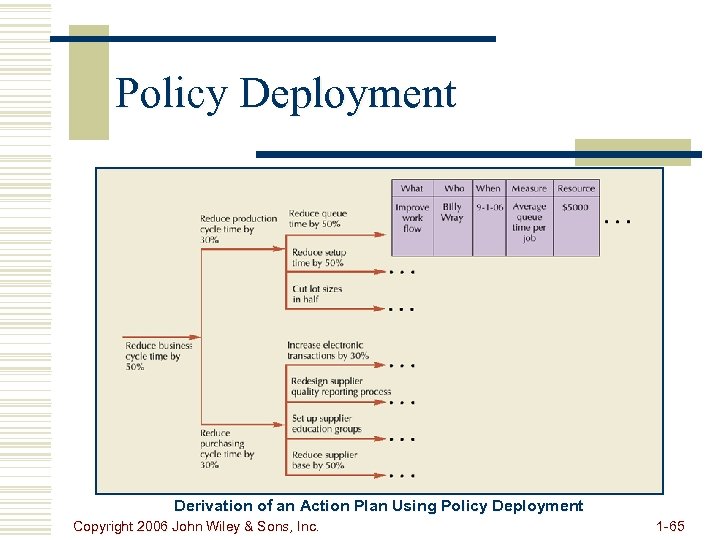 Policy Deployment Derivation of an Action Plan Using Policy Deployment Copyright 2006 John Wiley & Sons, Inc. 1 -65
 Balanced Scorecard w Balanced scorecard n measuring more than financial performance l l finances customers processes learning and growing w Key performance indicators n a set of measures that help managers evaluate performance in critical areas Copyright 2006 John Wiley & Sons, Inc. 1 -66
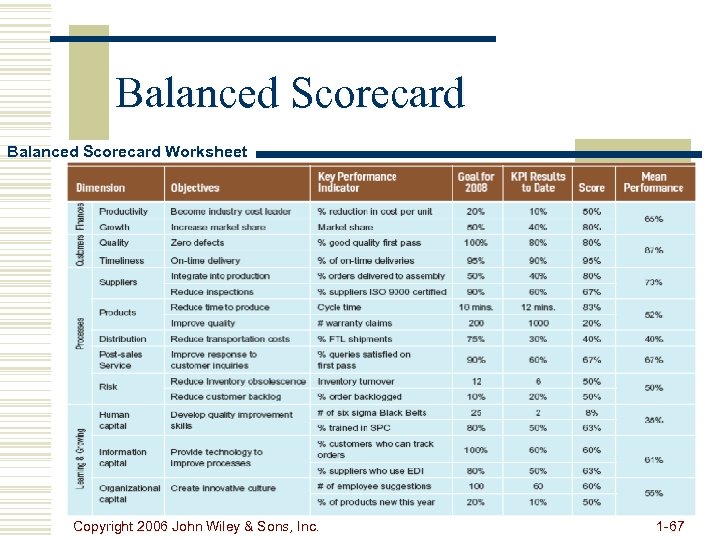 Balanced Scorecard Worksheet Copyright 2006 John Wiley & Sons, Inc. 1 -67
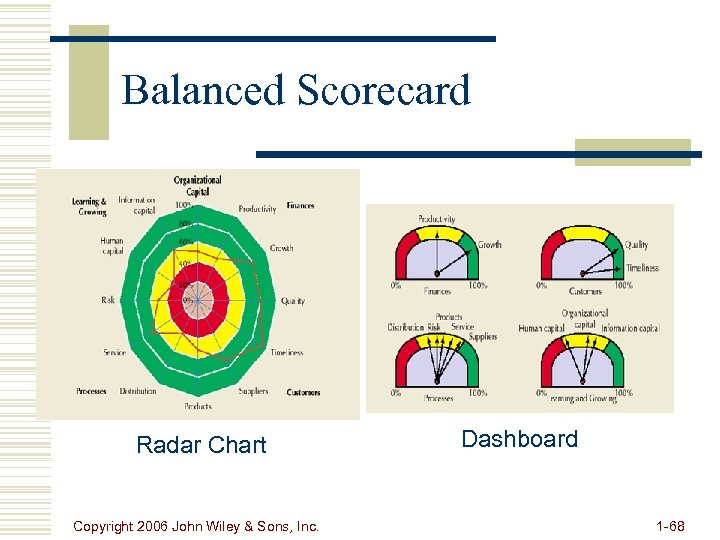 Balanced Scorecard Radar Chart Copyright 2006 John Wiley & Sons, Inc. Dashboard 1 -68
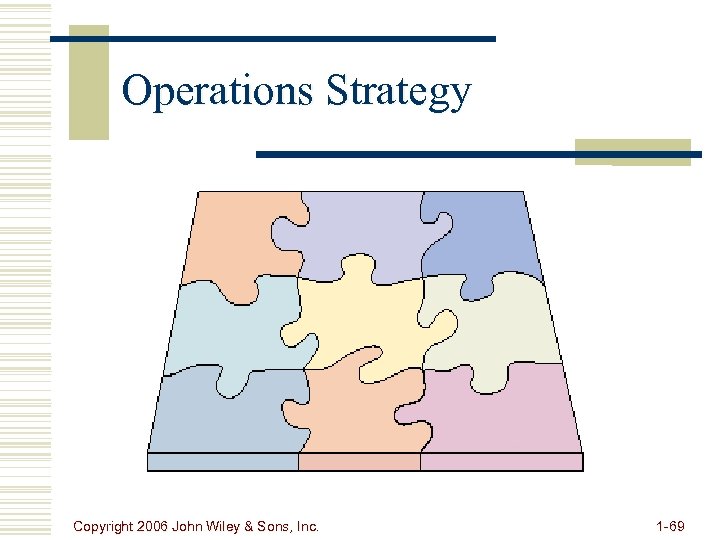 Operations Strategy Services Products Human Resources Capacity Facilities Sourcing Copyright 2006 John Wiley & Sons, Inc. Process and Technology Quality Operating Systems 1 -69
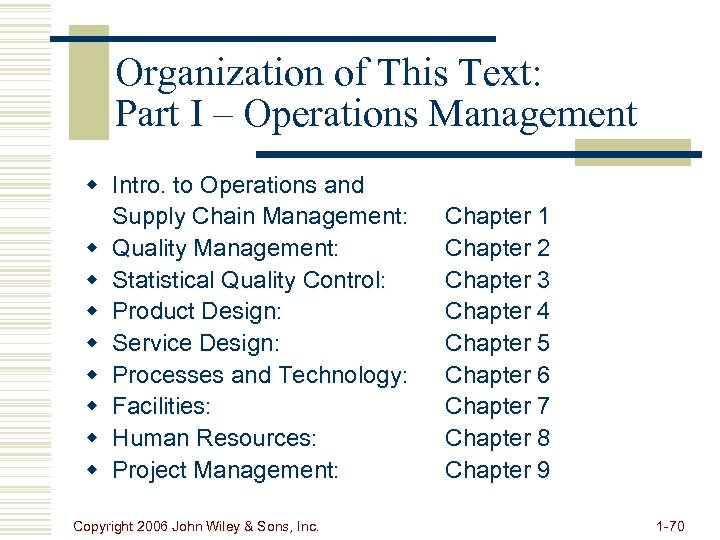 Organization of This Text: Part I – Operations Management w Intro. to Operations and Supply Chain Management: w Quality Management: w Statistical Quality Control: w Product Design: w Service Design: w Processes and Technology: w Facilities: w Human Resources: w Project Management: Copyright 2006 John Wiley & Sons, Inc. Chapter 1 Chapter 2 Chapter 3 Chapter 4 Chapter 5 Chapter 6 Chapter 7 Chapter 8 Chapter 9 1 -70
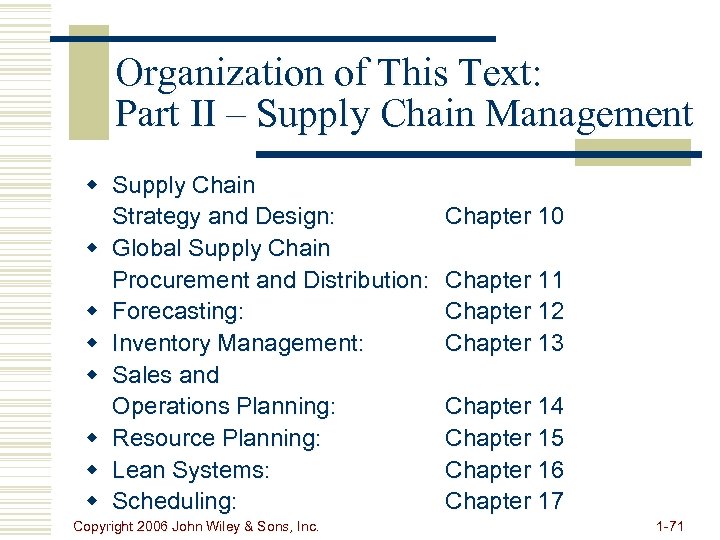 Organization of This Text: Part II – Supply Chain Management w Supply Chain Strategy and Design: w Global Supply Chain Procurement and Distribution: w Forecasting: w Inventory Management: w Sales and Operations Planning: w Resource Planning: w Lean Systems: w Scheduling: Copyright 2006 John Wiley & Sons, Inc. Chapter 10 Chapter 11 Chapter 12 Chapter 13 Chapter 14 Chapter 15 Chapter 16 Chapter 17 1 -71
 Learning Objectives of this Course w Gain an appreciation of strategic importance of operations and supply chain management in a global business environment w Understand how operations relates to other business functions w Develop a working knowledge of concepts and methods related to designing and managing operations and supply chains w Develop a skill set for quality and process improvement Copyright 2006 John Wiley & Sons, Inc. 1 -72
 Copyright 2009 John Wiley & Sons, Inc. All rights reserved. Reproduction or translation of this work beyond that permitted in section 117 of the 1976 United States Copyright Act without express permission of the copyright owner is unlawful. Request for further information should be addressed to the Permission Department, John Wiley & Sons, Inc. The purchaser may make back-up copies for his/her own use only and not for distribution or resale. The Publisher assumes no responsibility for errors, omissions, or damages caused by the use of these programs or from the use of the information herein. Copyright 2006 John Wiley & Sons, Inc. 1 -73
 THIS IS AS FAR AS YOU NEED TO GO!! Copyright 2006 John Wiley & Sons, Inc. 1 -74
 Lecture Outline w w w w What Do Operations Managers Do? Operations Function Evolution of Operations Management and E–Business Globalization and Competitiveness Primary Topics in Operations Management Learning Objectives for this Course Copyright 2006 John Wiley & Sons, Inc. 1 -75
 What Do Operations Managers Do? w What are Operations? n a function, process or system that transforms inputs into outputs of greater value w What is a Transformation Process? n n a series of activities along a value chain extending from supplier to customer activities that do not add value are superfluous and should be eliminated w What is Operations Management? n design, operation, and improvement of productive systems Copyright 2006 John Wiley & Sons, Inc. 1 -76
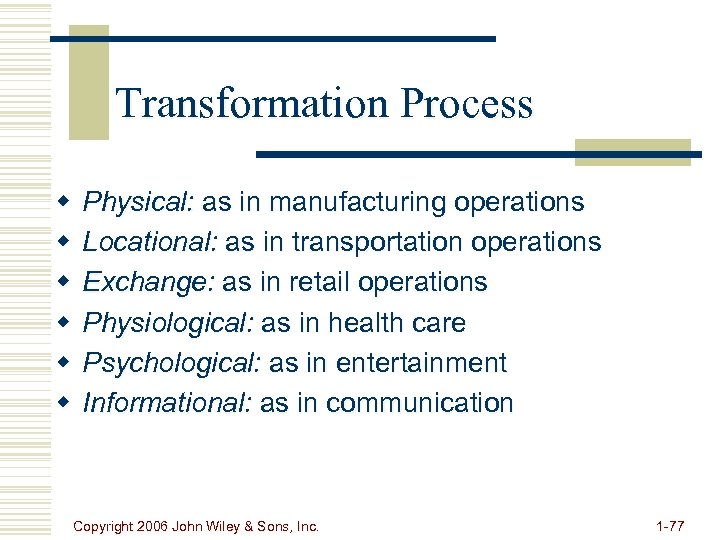 Transformation Process w w w Physical: as in manufacturing operations Locational: as in transportation operations Exchange: as in retail operations Physiological: as in health care Psychological: as in entertainment Informational: as in communication Copyright 2006 John Wiley & Sons, Inc. 1 -77
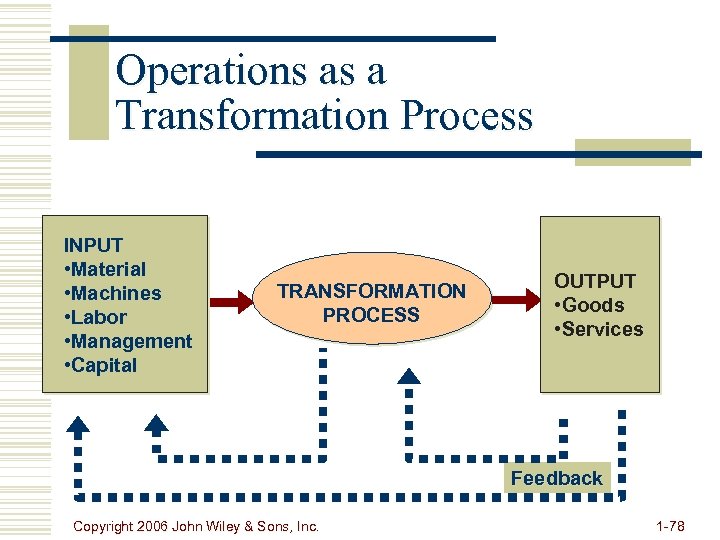 Operations as a Transformation Process INPUT • Material • Machines • Labor • Management • Capital TRANSFORMATION PROCESS OUTPUT • Goods • Services Feedback Copyright 2006 John Wiley & Sons, Inc. 1 -78
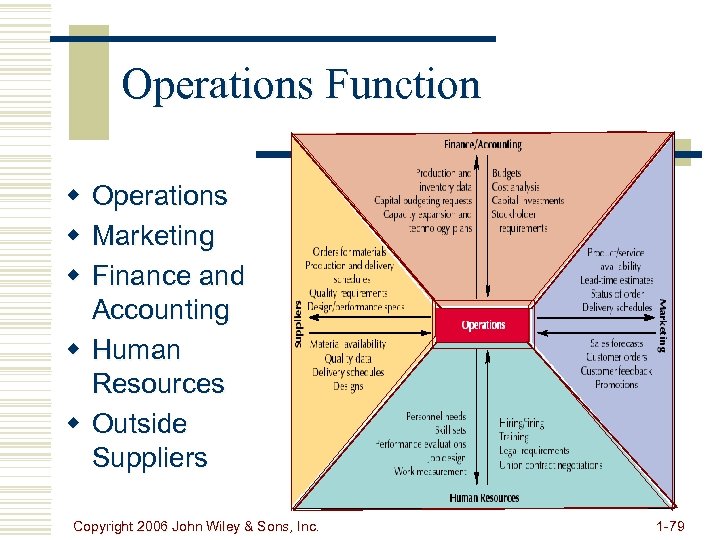 Operations Function w Operations w Marketing w Finance and Accounting w Human Resources w Outside Suppliers Copyright 2006 John Wiley & Sons, Inc. 1 -79
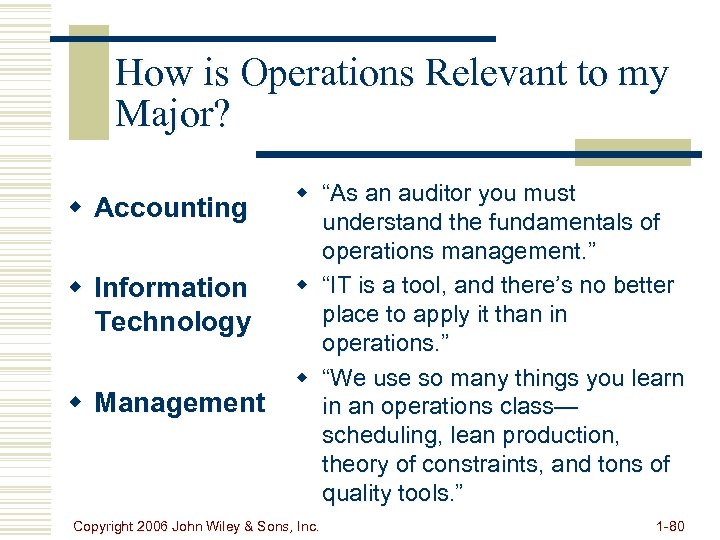 How is Operations Relevant to my Major? w Accounting w Information Technology w Management w “As an auditor you must understand the fundamentals of operations management. ” w “IT is a tool, and there’s no better place to apply it than in operations. ” w “We use so many things you learn in an operations class— scheduling, lean production, theory of constraints, and tons of quality tools. ” Copyright 2006 John Wiley & Sons, Inc. 1 -80
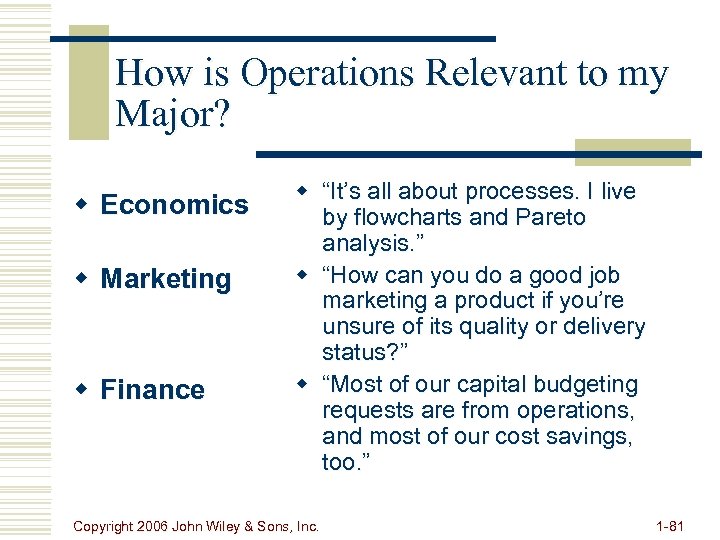 How is Operations Relevant to my Major? w Economics w Marketing w Finance w “It’s all about processes. I live by flowcharts and Pareto analysis. ” w “How can you do a good job marketing a product if you’re unsure of its quality or delivery status? ” w “Most of our capital budgeting requests are from operations, and most of our cost savings, too. ” Copyright 2006 John Wiley & Sons, Inc. 1 -81
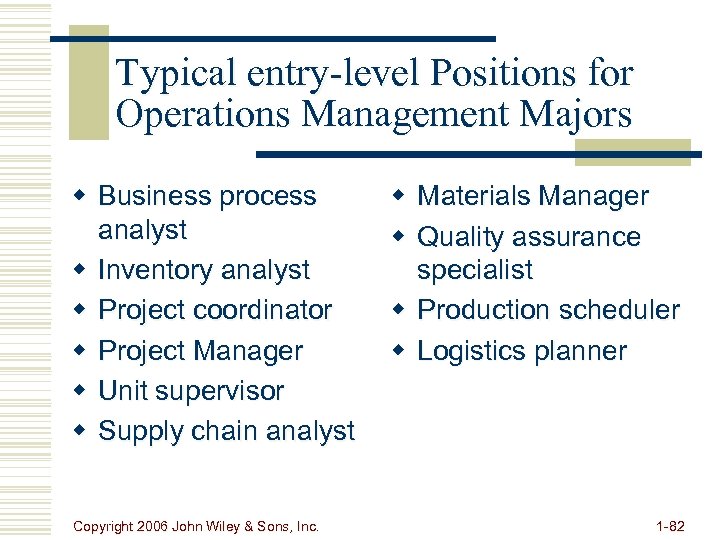 Typical entry-level Positions for Operations Management Majors w Business process analyst w Inventory analyst w Project coordinator w Project Manager w Unit supervisor w Supply chain analyst Copyright 2006 John Wiley & Sons, Inc. w Materials Manager w Quality assurance specialist w Production scheduler w Logistics planner 1 -82
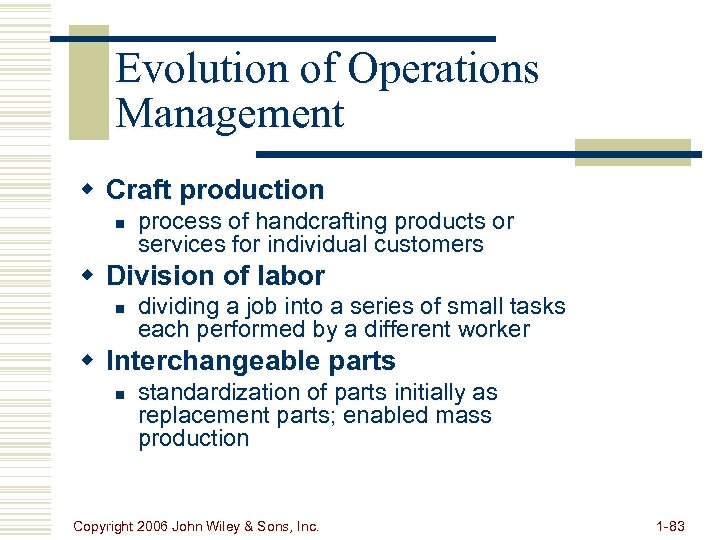 Evolution of Operations Management w Craft production n process of handcrafting products or services for individual customers w Division of labor n dividing a job into a series of small tasks each performed by a different worker w Interchangeable parts n standardization of parts initially as replacement parts; enabled mass production Copyright 2006 John Wiley & Sons, Inc. 1 -83
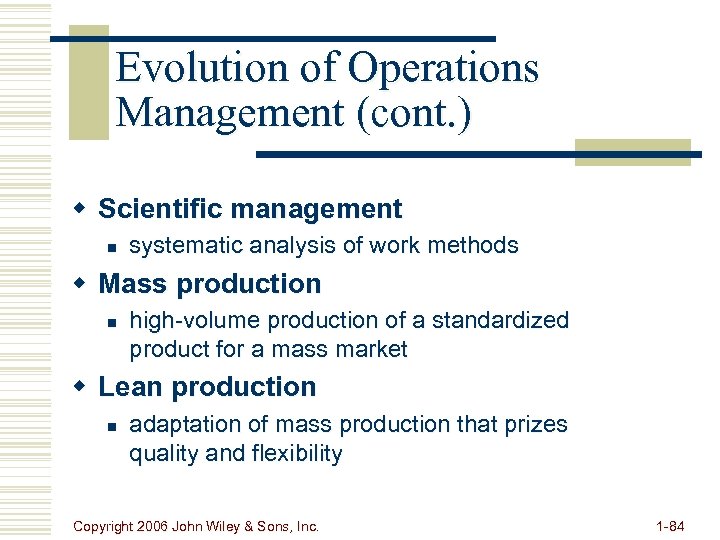 Evolution of Operations Management (cont. ) w Scientific management n systematic analysis of work methods w Mass production n high-volume production of a standardized product for a mass market w Lean production n adaptation of mass production that prizes quality and flexibility Copyright 2006 John Wiley & Sons, Inc. 1 -84
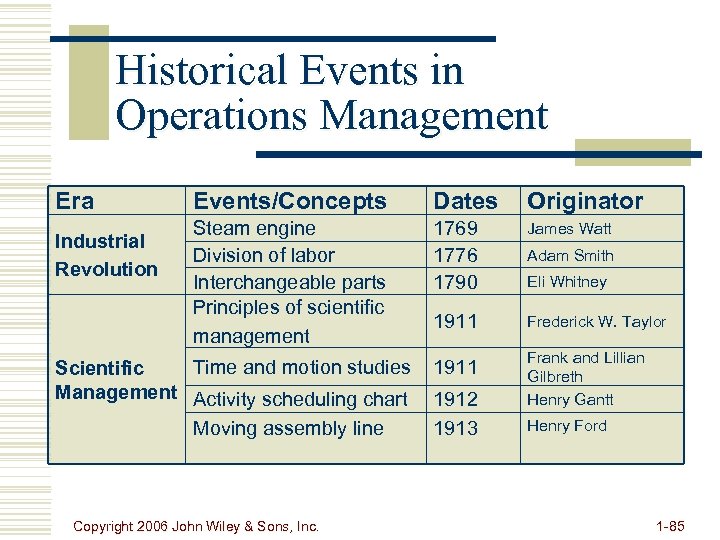 Historical Events in Operations Management Era Industrial Revolution Events/Concepts Dates Originator Steam engine Division of labor Interchangeable parts Principles of scientific management 1769 1776 1790 James Watt 1911 Frederick W. Taylor 1911 Frank and Lillian Gilbreth Henry Gantt Time and motion studies Scientific Management Activity scheduling chart Moving assembly line Copyright 2006 John Wiley & Sons, Inc. 1912 1913 Adam Smith Eli Whitney Henry Ford 1 -85
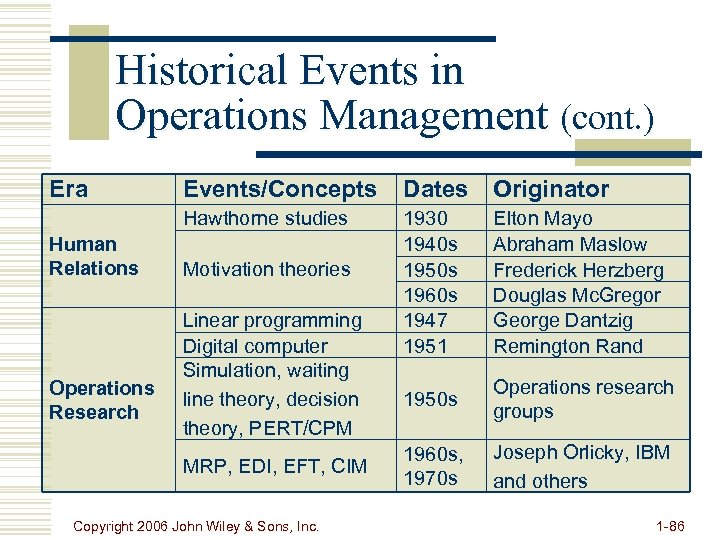 Historical Events in Operations Management (cont. ) Era Operations Research Dates Originator Hawthorne studies Human Relations Events/Concepts 1930 1940 s 1950 s 1960 s 1947 1951 Elton Mayo Abraham Maslow Frederick Herzberg Douglas Mc. Gregor George Dantzig Remington Rand 1950 s Operations research groups 1960 s, 1970 s Joseph Orlicky, IBM and others Motivation theories Linear programming Digital computer Simulation, waiting line theory, decision theory, PERT/CPM MRP, EDI, EFT, CIM Copyright 2006 John Wiley & Sons, Inc. 1 -86
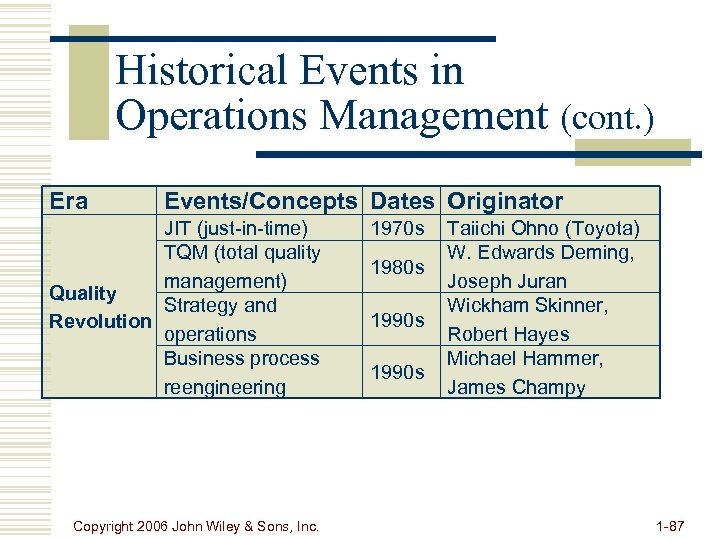 Historical Events in Operations Management (cont. ) Era Events/Concepts Dates Originator JIT (just-in-time) TQM (total quality management) Quality Strategy and Revolution operations Business process reengineering Copyright 2006 John Wiley & Sons, Inc. 1970 s 1980 s 1990 s Taiichi Ohno (Toyota) W. Edwards Deming, Joseph Juran Wickham Skinner, Robert Hayes Michael Hammer, James Champy 1 -87
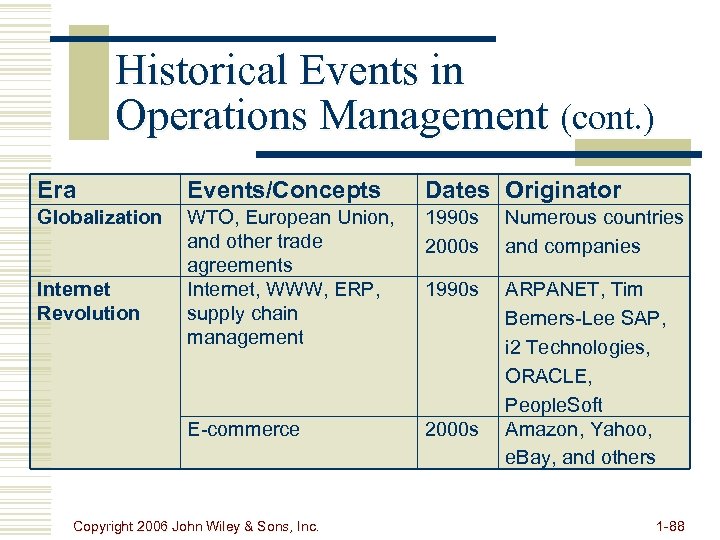 Historical Events in Operations Management (cont. ) Era Events/Concepts Dates Originator Globalization WTO, European Union, and other trade agreements Internet, WWW, ERP, supply chain management 1990 s 2000 s Numerous countries and companies 1990 s E-commerce 2000 s ARPANET, Tim Berners-Lee SAP, i 2 Technologies, ORACLE, People. Soft Amazon, Yahoo, e. Bay, and others Internet Revolution Copyright 2006 John Wiley & Sons, Inc. 1 -88
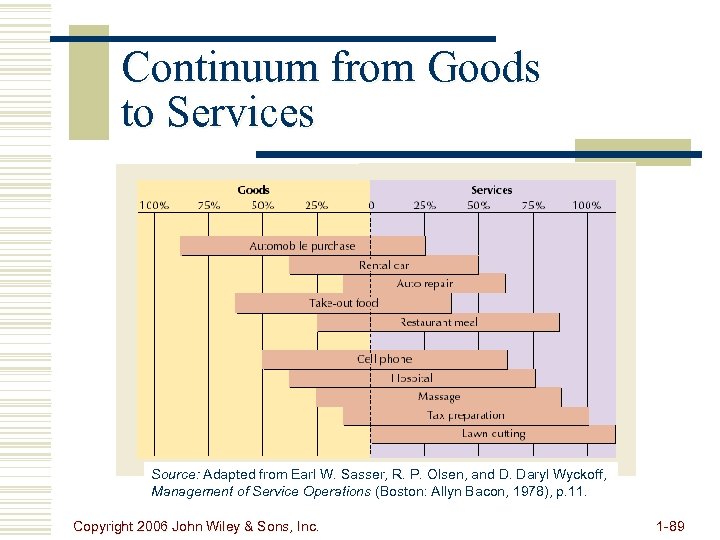 Continuum from Goods to Services Source: Adapted from Earl W. Sasser, R. P. Olsen, and D. Daryl Wyckoff, Management of Service Operations (Boston: Allyn Bacon, 1978), p. 11. Copyright 2006 John Wiley & Sons, Inc. 1 -89
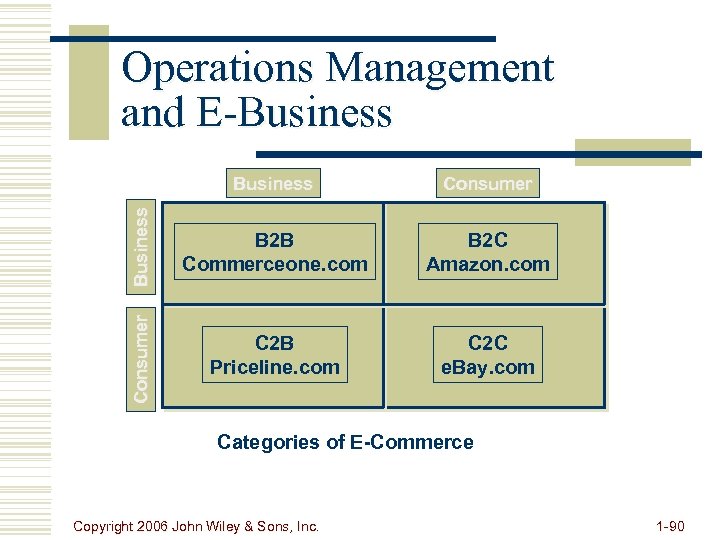 Business Consumer Business B 2 B Commerceone. com B 2 C Amazon. com Consumer Operations Management and E-Business C 2 B Priceline. com C 2 C e. Bay. com Categories of E-Commerce Copyright 2006 John Wiley & Sons, Inc. 1 -90
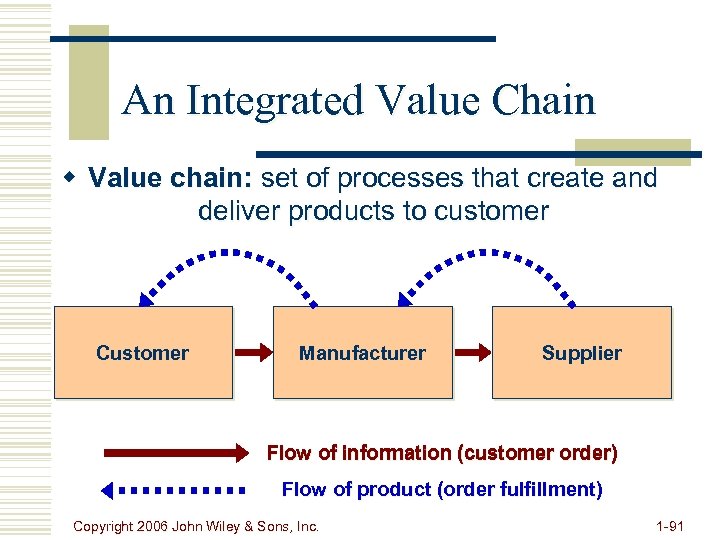 An Integrated Value Chain w Value chain: set of processes that create and deliver products to customer Customer Manufacturer Supplier Flow of information (customer order) Flow of product (order fulfillment) Copyright 2006 John Wiley & Sons, Inc. 1 -91
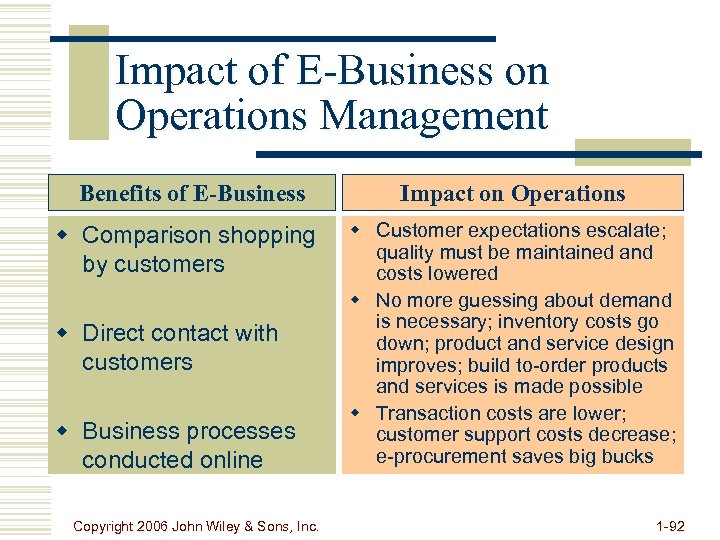 Impact of E-Business on Operations Management Benefits of E-Business w Comparison shopping by customers w Direct contact with customers w Business processes conducted online Copyright 2006 John Wiley & Sons, Inc. Impact on Operations w Customer expectations escalate; quality must be maintained and costs lowered w No more guessing about demand is necessary; inventory costs go down; product and service design improves; build to-order products and services is made possible w Transaction costs are lower; customer support costs decrease; e-procurement saves big bucks 1 -92
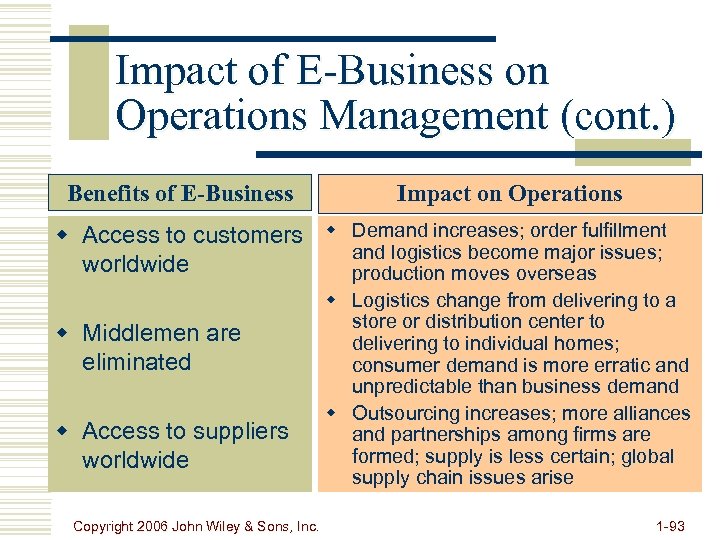 Impact of E-Business on Operations Management (cont. ) Benefits of E-Business Impact on Operations w Access to customers w Demand increases; order fulfillment and logistics become major issues; worldwide production moves overseas w Middlemen are eliminated w Access to suppliers worldwide Copyright 2006 John Wiley & Sons, Inc. w Logistics change from delivering to a store or distribution center to delivering to individual homes; consumer demand is more erratic and unpredictable than business demand w Outsourcing increases; more alliances and partnerships among firms are formed; supply is less certain; global supply chain issues arise 1 -93
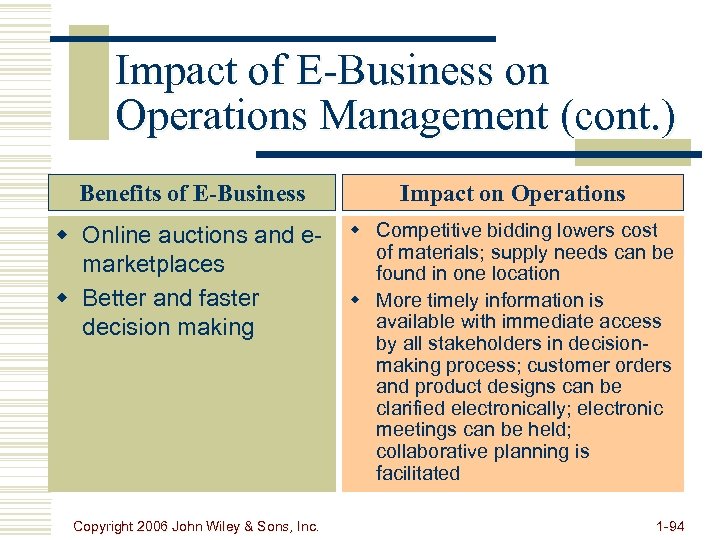 Impact of E-Business on Operations Management (cont. ) Benefits of E-Business Impact on Operations w Online auctions and emarketplaces w Better and faster decision making w Competitive bidding lowers cost of materials; supply needs can be found in one location w More timely information is available with immediate access by all stakeholders in decisionmaking process; customer orders and product designs can be clarified electronically; electronic meetings can be held; collaborative planning is facilitated Copyright 2006 John Wiley & Sons, Inc. 1 -94
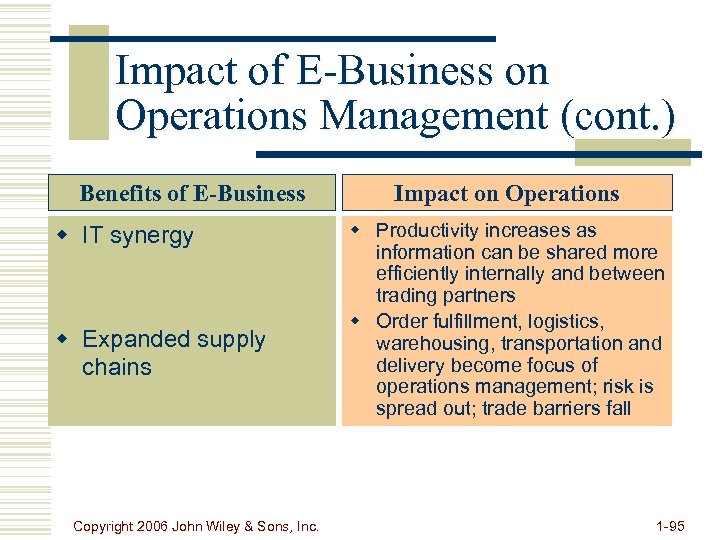 Impact of E-Business on Operations Management (cont. ) Benefits of E-Business w IT synergy w Expanded supply chains Copyright 2006 John Wiley & Sons, Inc. Impact on Operations w Productivity increases as information can be shared more efficiently internally and between trading partners w Order fulfillment, logistics, warehousing, transportation and delivery become focus of operations management; risk is spread out; trade barriers fall 1 -95
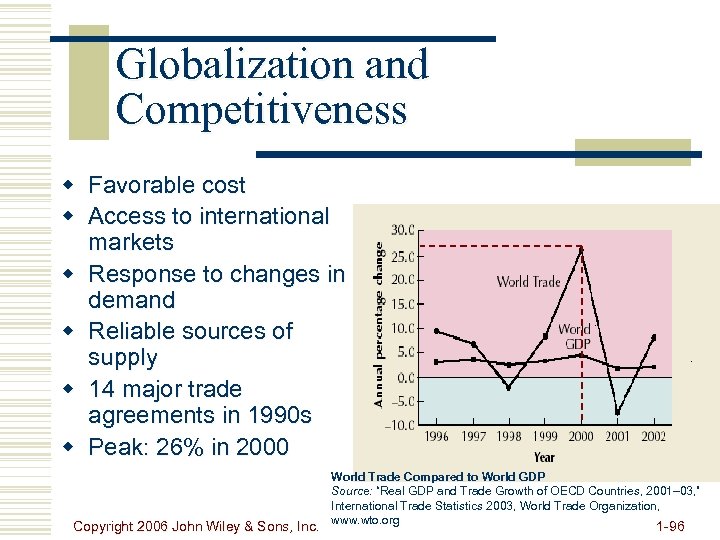 Globalization and Competitiveness w Favorable cost w Access to international markets w Response to changes in demand w Reliable sources of supply w 14 major trade agreements in 1990 s w Peak: 26% in 2000 Copyright 2006 John Wiley & Sons, Inc. World Trade Compared to World GDP Source: “Real GDP and Trade Growth of OECD Countries, 2001– 03, ” International Trade Statistics 2003, World Trade Organization, www. wto. org 1 -96
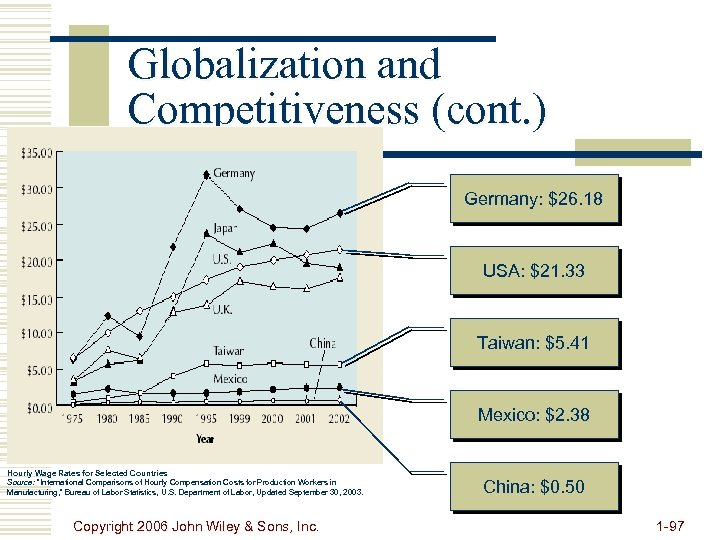 Globalization and Competitiveness (cont. ) Germany: $26. 18 USA: $21. 33 Taiwan: $5. 41 Mexico: $2. 38 Hourly Wage Rates for Selected Countries Source: “International Comparisons of Hourly Compensation Costs for Production Workers in Manufacturing, ” Bureau of Labor Statistics, U. S. Department of Labor, Updated September 30, 2003. Copyright 2006 John Wiley & Sons, Inc. China: $0. 50 1 -97
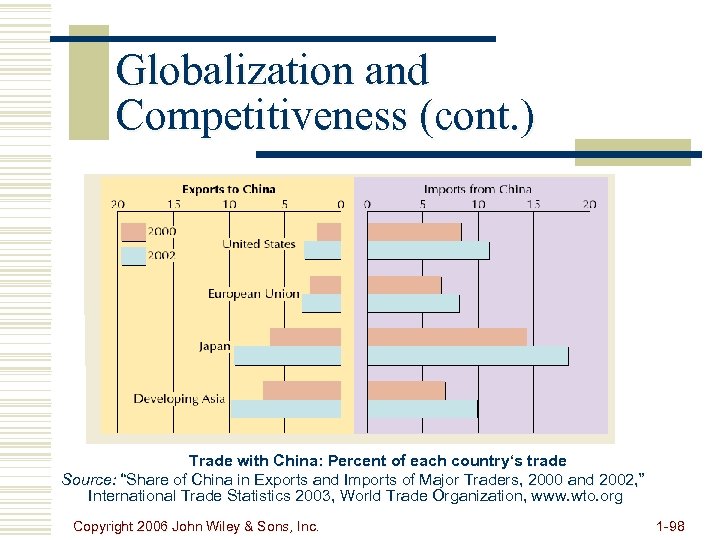 Globalization and Competitiveness (cont. ) Trade with China: Percent of each country‘s trade Source: “Share of China in Exports and Imports of Major Traders, 2000 and 2002, ” International Trade Statistics 2003, World Trade Organization, www. wto. org Copyright 2006 John Wiley & Sons, Inc. 1 -98
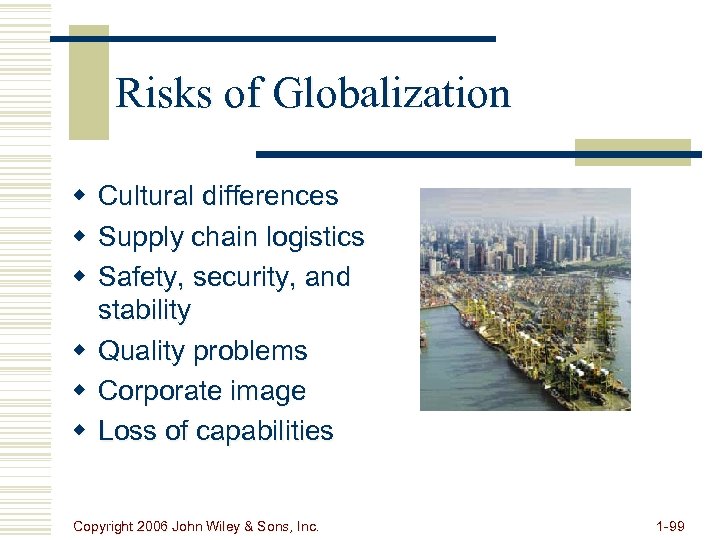 Risks of Globalization w Cultural differences w Supply chain logistics w Safety, security, and stability w Quality problems w Corporate image w Loss of capabilities Copyright 2006 John Wiley & Sons, Inc. 1 -99
 Competitiveness and Productivity w Competitiveness n degree to which a nation can produce goods and services that meet the test of international markets w Productivity n ratio of output to input w Output n sales made, products produced, customers served, meals delivered, or calls answered w Input n labor hours, investment in equipment, material usage, or square footage Copyright 2006 John Wiley & Sons, Inc. 1 -100
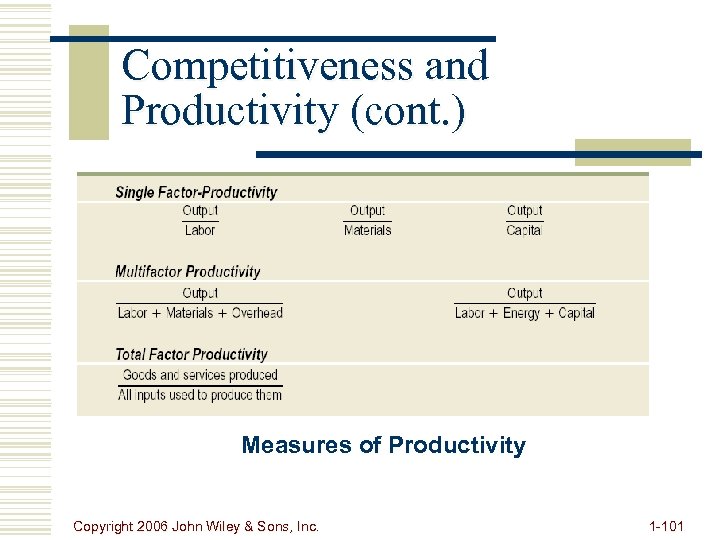 Competitiveness and Productivity (cont. ) Measures of Productivity Copyright 2006 John Wiley & Sons, Inc. 1 -101
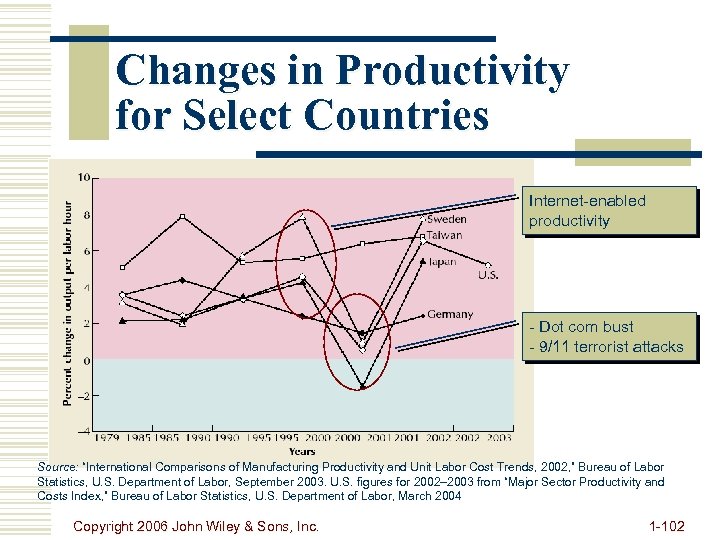 Changes in Productivity for Select Countries Internet-enabled productivity - Dot com bust - 9/11 terrorist attacks Source: “International Comparisons of Manufacturing Productivity and Unit Labor Cost Trends, 2002, ” Bureau of Labor Statistics, U. S. Department of Labor, September 2003. U. S. figures for 2002– 2003 from “Major Sector Productivity and Costs Index, ” Bureau of Labor Statistics, U. S. Department of Labor, March 2004 Copyright 2006 John Wiley & Sons, Inc. 1 -102
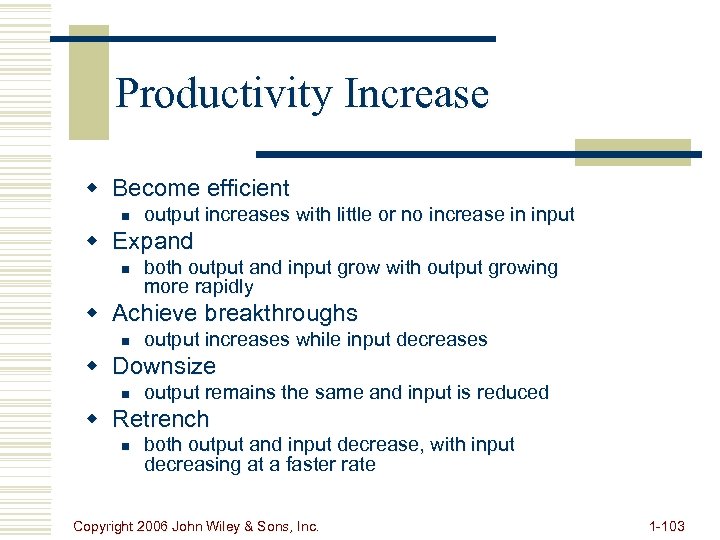 Productivity Increase w Become efficient n output increases with little or no increase in input w Expand n both output and input grow with output growing more rapidly w Achieve breakthroughs n output increases while input decreases w Downsize n output remains the same and input is reduced w Retrench n both output and input decrease, with input decreasing at a faster rate Copyright 2006 John Wiley & Sons, Inc. 1 -103
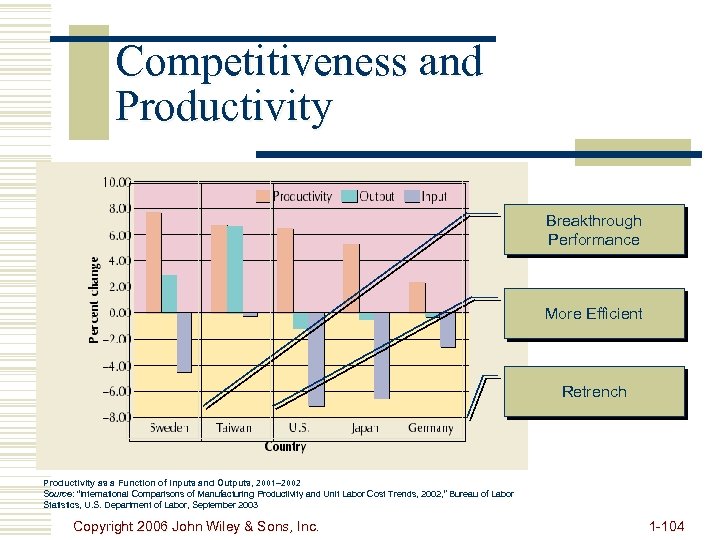 Competitiveness and Productivity Breakthrough Performance More Efficient Retrench Productivity as a Function of Inputs and Outputs, 2001– 2002 Source: “International Comparisons of Manufacturing Productivity and Unit Labor Cost Trends, 2002, ” Bureau of Labor Statistics, U. S. Department of Labor, September 2003 Copyright 2006 John Wiley & Sons, Inc. 1 -104
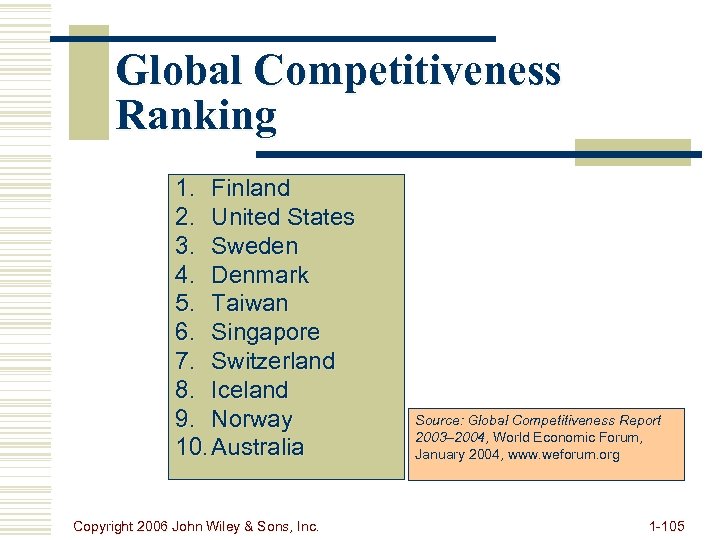 Global Competitiveness Ranking 1. Finland 2. United States 3. Sweden 4. Denmark 5. Taiwan 6. Singapore 7. Switzerland 8. Iceland 9. Norway 10. Australia Copyright 2006 John Wiley & Sons, Inc. Source: Global Competitiveness Report 2003– 2004, World Economic Forum, January 2004, www. weforum. org 1 -105
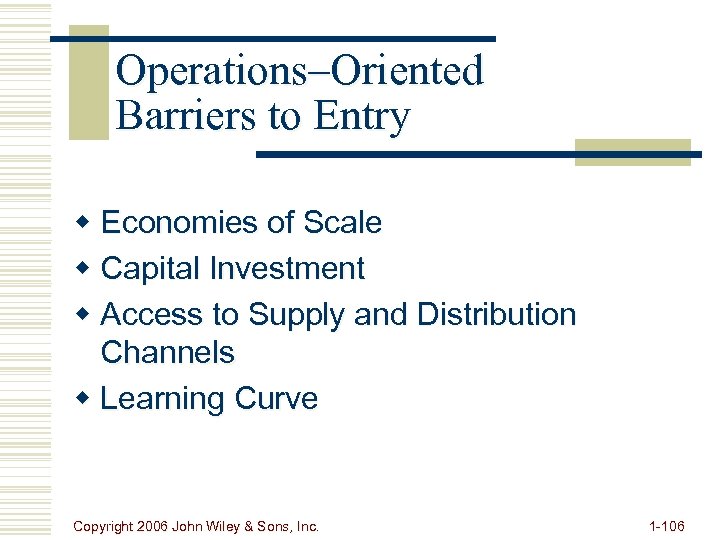 Operations–Oriented Barriers to Entry w Economies of Scale w Capital Investment w Access to Supply and Distribution Channels w Learning Curve Copyright 2006 John Wiley & Sons, Inc. 1 -106
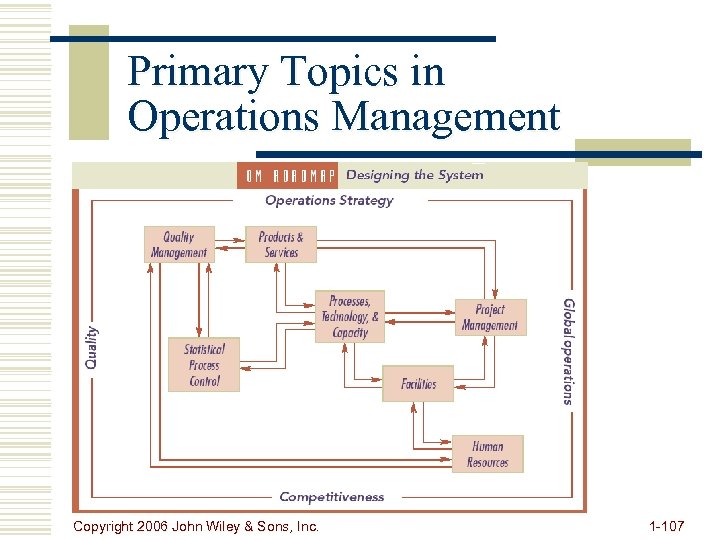 Primary Topics in Operations Management Copyright 2006 John Wiley & Sons, Inc. 1 -107
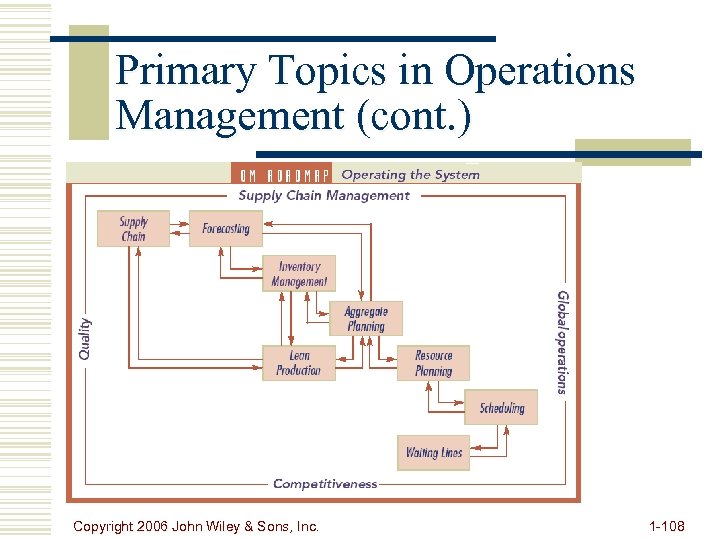 Primary Topics in Operations Management (cont. ) Copyright 2006 John Wiley & Sons, Inc. 1 -108
 Learning Objectives of this Course w Gain an appreciation of strategic importance of operations in a global business environment w Understand how operations relates to other business functions w Develop a working knowledge of concepts and methods related to designing and managing operations w Develop a skill set for quality and process improvement Copyright 2006 John Wiley & Sons, Inc. 1 -109
 Copyright 2006 John Wiley & Sons, Inc. All rights reserved. Reproduction or translation of this work beyond that permitted in section 117 of the 1976 United States Copyright Act without express permission of the copyright owner is unlawful. Request for further information should be addressed to the Permission Department, John Wiley & Sons, Inc. The purchaser may make back-up copies for his/her own use only and not for distribution or resale. The Publisher assumes no responsibility for errors, omissions, or damages caused by the use of these programs or from the use of the information herein. Copyright 2006 John Wiley & Sons, Inc. 1 -110
 Copyright 2006 John Wiley & Sons, Inc. 1 -111
 Copyright 2006 John Wiley & Sons, Inc. 1 -112
 Copyright 2006 John Wiley & Sons, Inc. 1 -113
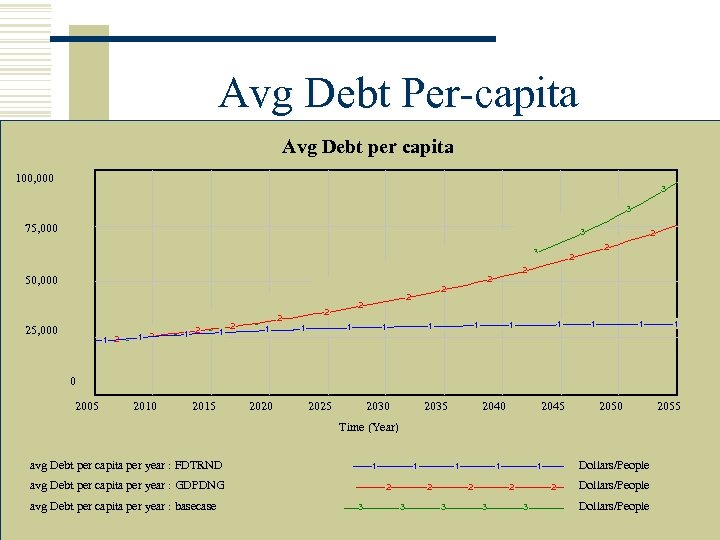
 Introduction: The Growing Federal Deficit—is it a real Problem? w Current deficit stands at 8. 25 trillion dollars w This does not take into account the amount the government owes to Social Security and Medicare w Taking this into account the real federal debt is nearly $30 trillion or $100, 000 for every man woman and child in the country. w If you are head of a household of four, you owe the government $400, 000 Copyright 2006 John Wiley & Sons, Inc. 1 -114
 An Assessment using a methodology that Assimilates Three World Views w Statistics/Forecasting w Dynamic modeling/simulation w Systems Thinking Copyright 2006 John Wiley & Sons, Inc. 1 -115
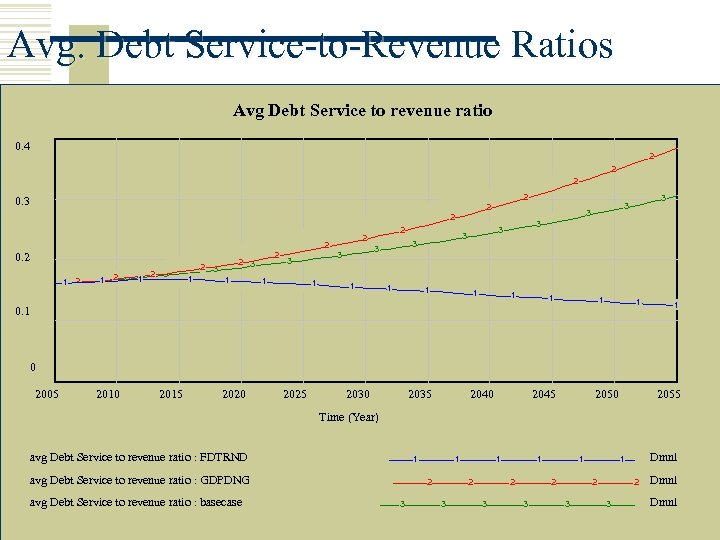
 A System Dynamics Model: Purpose w To address the question “Is our debt serviceable over the long haul? ” w To discern that, we constructed a model that was able to forecast debt service and annual revenues to come up with a ratio of debt service to revenues Copyright 2006 John Wiley & Sons, Inc. 1 -116
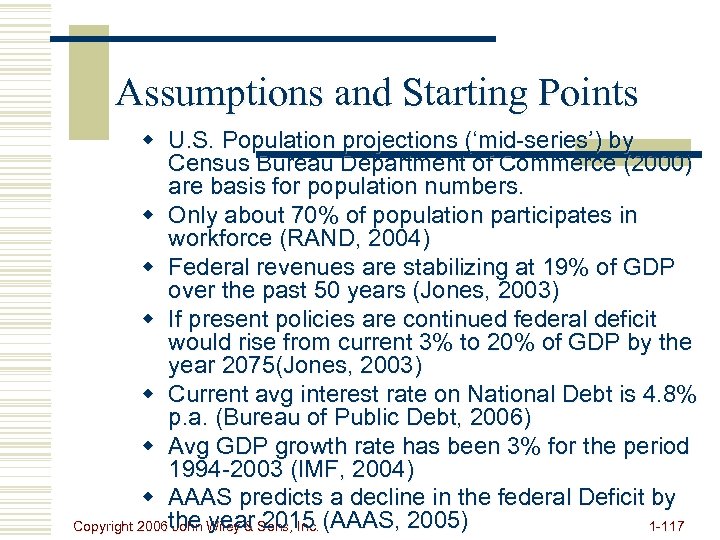 Assumptions and Starting Points w U. S. Population projections (‘mid-series’) by Census Bureau Department of Commerce (2000) are basis for population numbers. w Only about 70% of population participates in workforce (RAND, 2004) w Federal revenues are stabilizing at 19% of GDP over the past 50 years (Jones, 2003) w If present policies are continued federal deficit would rise from current 3% to 20% of GDP by the year 2075(Jones, 2003) w Current avg interest rate on National Debt is 4. 8% p. a. (Bureau of Public Debt, 2006) w Avg GDP growth rate has been 3% for the period 1994 -2003 (IMF, 2004) w AAAS predicts a decline in the federal Deficit by Copyright 2006 the Wiley & Sons, Inc. (AAAS, 2005) John year 2015 1 -117
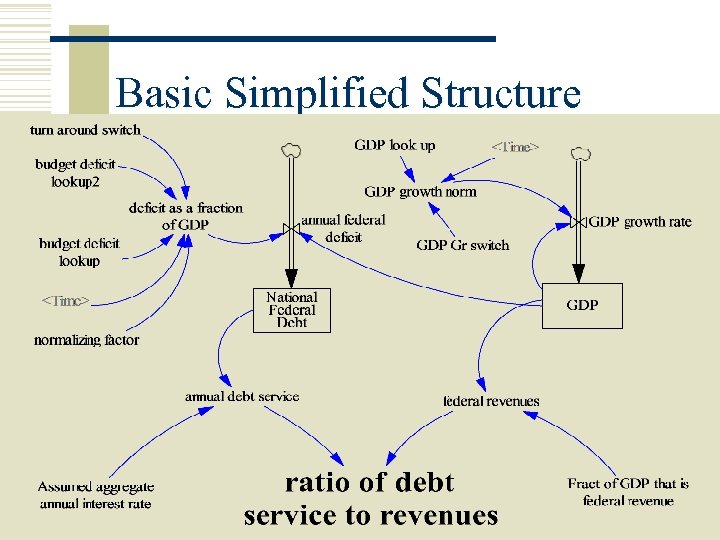 Basic Simplified Structure Copyright 2006 John Wiley & Sons, Inc. 1 -118
 About the Structure Above w Obviously, persistent Federal deficits are accumulated within the National Debt w The model starts on January 1, 2005 with an assumed national debt of 7. 596 trillions (Bureau of Public Debt, 2006) Copyright 2006 John Wiley & Sons, Inc. 1 -119
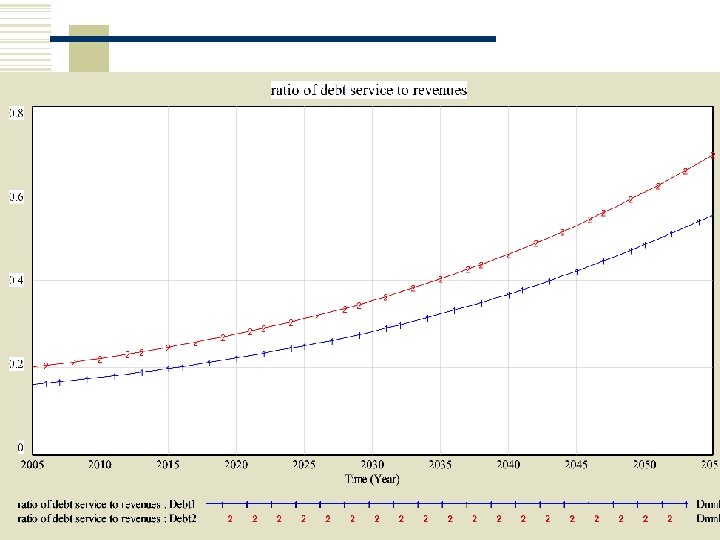 Debt Service to Federal Revenues Copyright 2006 John Wiley & Sons, Inc. 1 -120
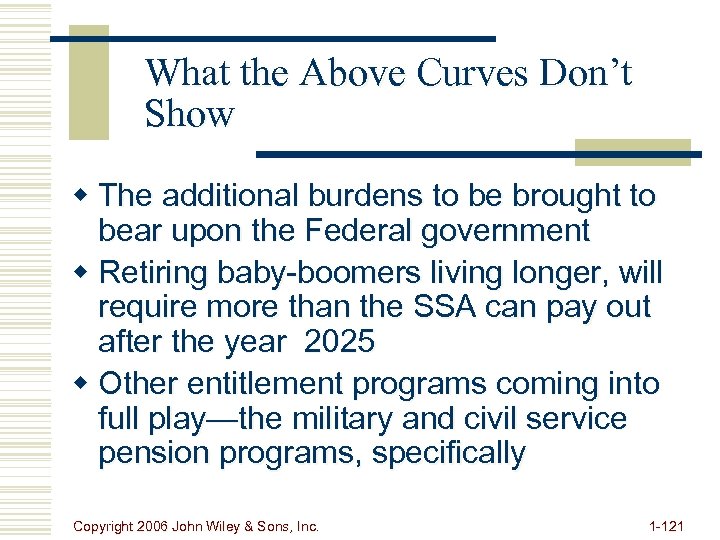 What the Above Curves Don’t Show w The additional burdens to be brought to bear upon the Federal government w Retiring baby-boomers living longer, will require more than the SSA can pay out after the year 2025 w Other entitlement programs coming into full play—the military and civil service pension programs, specifically Copyright 2006 John Wiley & Sons, Inc. 1 -121
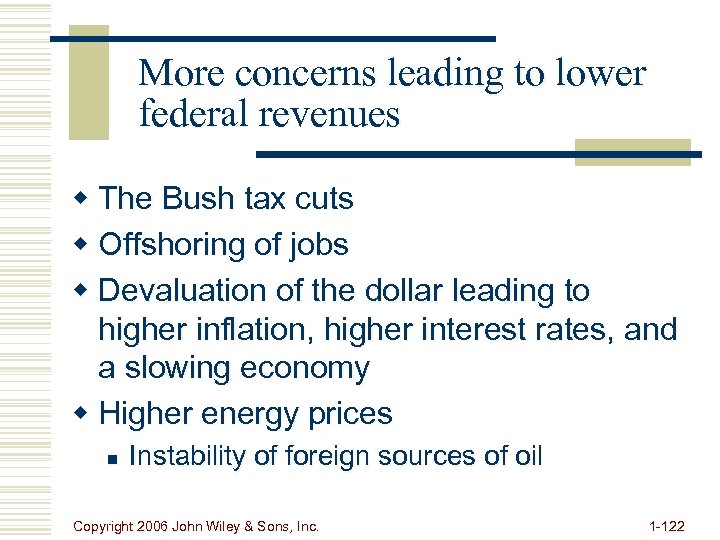 More concerns leading to lower federal revenues w The Bush tax cuts w Offshoring of jobs w Devaluation of the dollar leading to higher inflation, higher interest rates, and a slowing economy w Higher energy prices n Instability of foreign sources of oil Copyright 2006 John Wiley & Sons, Inc. 1 -122
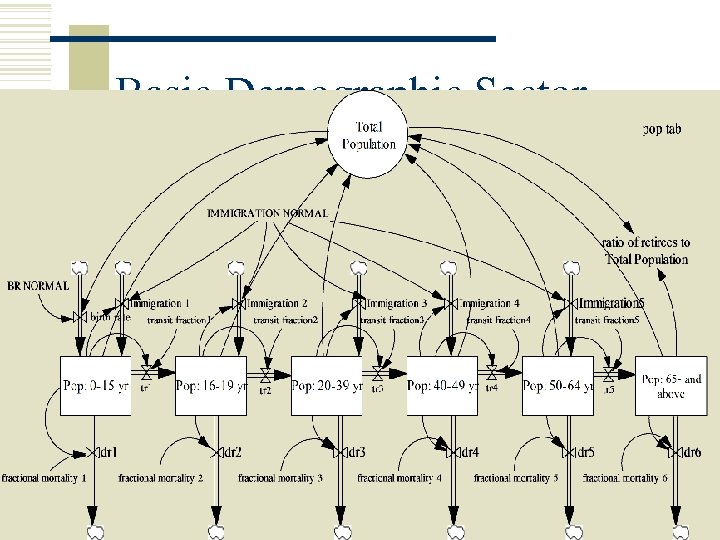 Basic Demographic Sector Copyright 2006 John Wiley & Sons, Inc. 1 -123
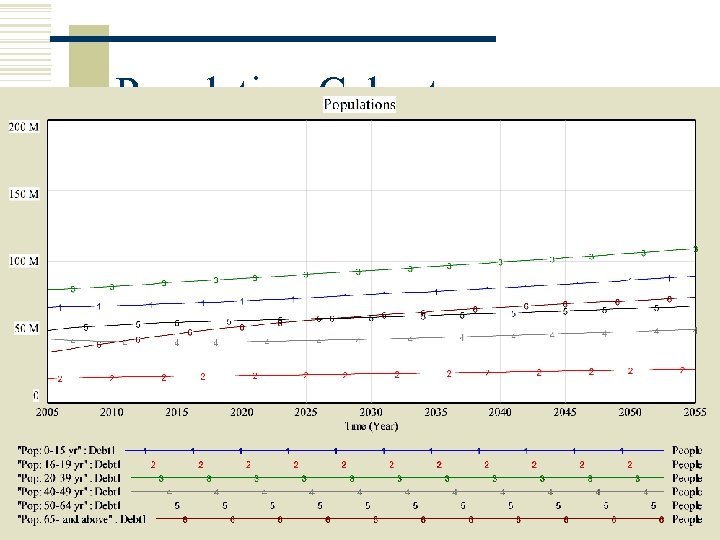 Population Cohorts Copyright 2006 John Wiley & Sons, Inc. 1 -124
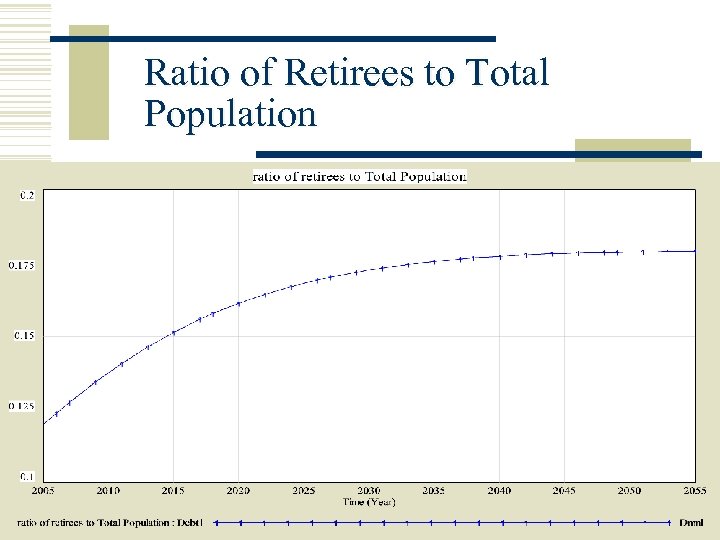 Ratio of Retirees to Total Population Copyright 2006 John Wiley & Sons, Inc. 1 -125
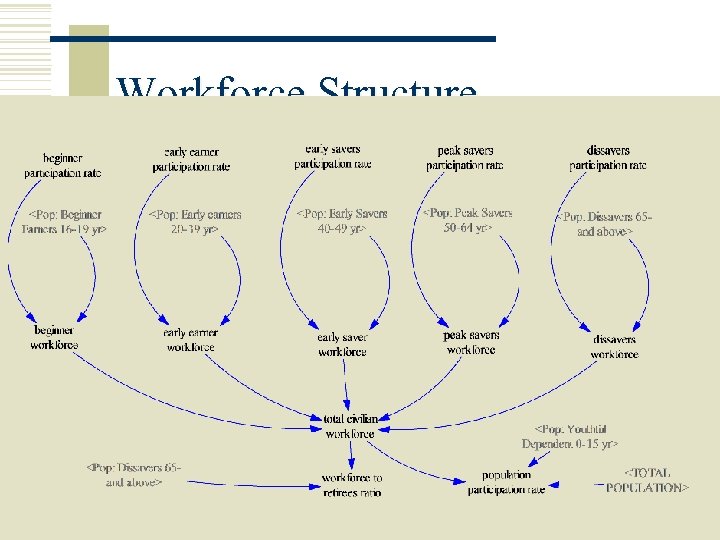 Workforce Structure Copyright 2006 John Wiley & Sons, Inc. 1 -126
 Basic Demographics w What happens when we increase the average lifespan from 83 years to 90 years? n This puts an even greater drain on Social Security and Medicare Copyright 2006 John Wiley & Sons, Inc. 1 -127
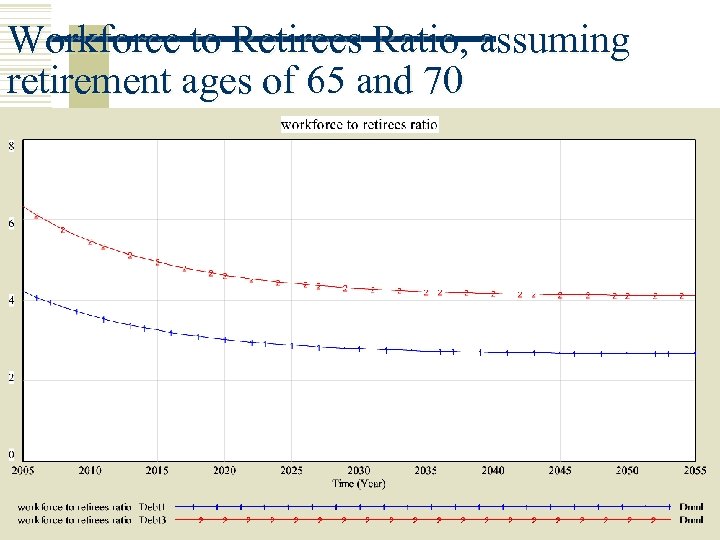 Workforce to Retirees Ratio, assuming retirement ages of 65 and 70 Copyright 2006 John Wiley & Sons, Inc. 1 -128
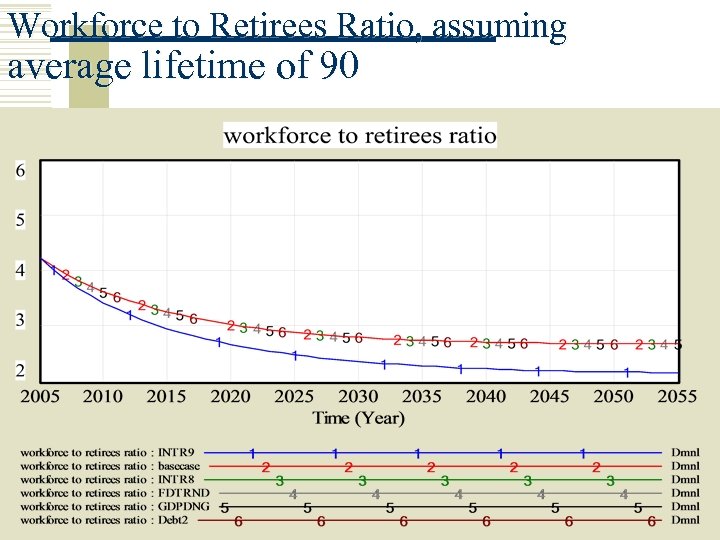 Workforce to Retirees Ratio, assuming average lifetime of 90 Copyright 2006 John Wiley & Sons, Inc. 1 -129
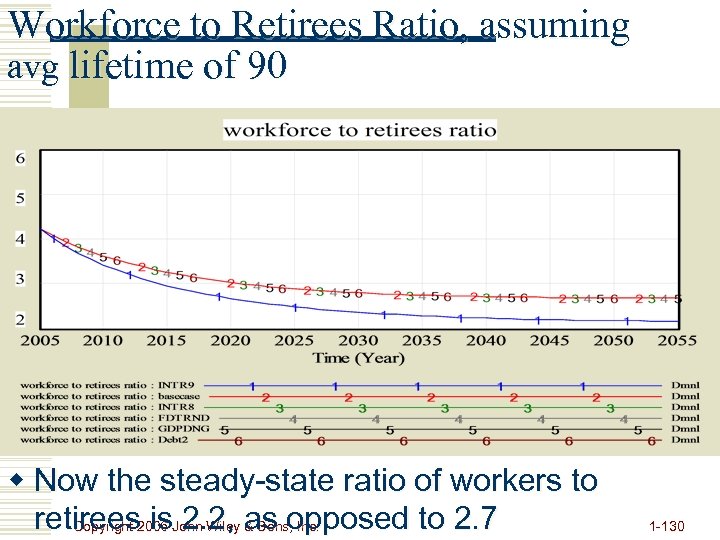 Workforce to Retirees Ratio, assuming avg lifetime of 90 w Now the steady-state ratio of workers to retirees 2006 John Wiley as opposed to 2. 7 Copyright is 2. 2, & Sons, Inc. 1 -130
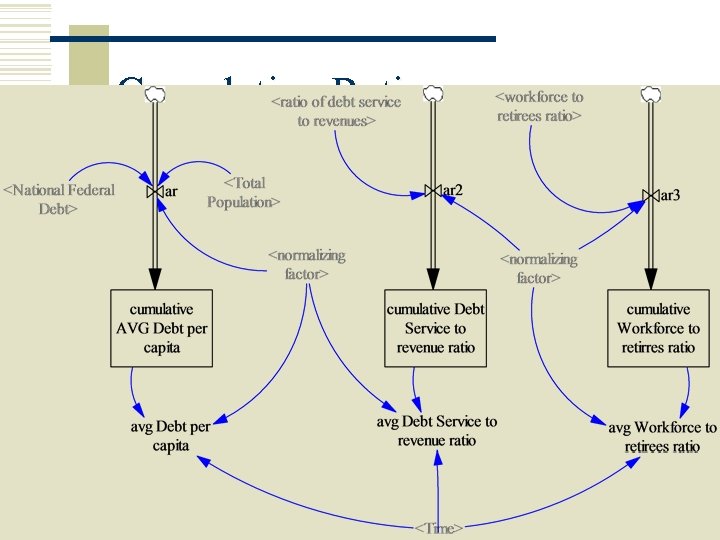 Cumulative Ratios Copyright 2006 John Wiley & Sons, Inc. 1 -131
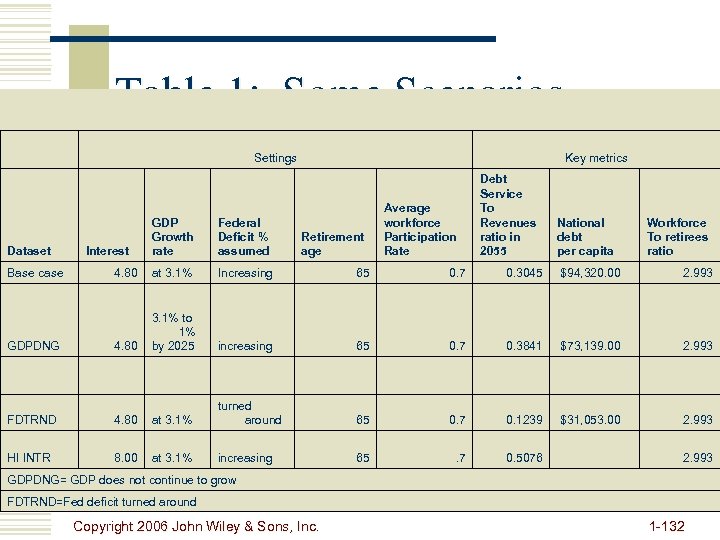 Table 1: Some Scenarios Settings Dataset Base case GDPDNG Key metrics Average workforce Participation Rate Debt Service To Revenues ratio in 2055 GDP Growth rate Federal Deficit % assumed 4. 80 at 3. 1% Increasing 65 0. 7 0. 3045 $94, 320. 00 2. 993 4. 80 3. 1% to 1% by 2025 increasing 65 0. 7 0. 3841 $73, 139. 00 2. 993 65 0. 7 0. 1239 $31, 053. 00 2. 993 65 . 7 0. 5076 Interest FDTRND 4. 80 at 3. 1% turned around HI INTR 8. 00 at 3. 1% Retirement age increasing National debt per capita Workforce To retirees ratio 2. 993 GDPDNG= GDP does not continue to grow FDTRND=Fed deficit turned around Copyright 2006 John Wiley & Sons, Inc. 1 -132
 Avg. Debt Service-to-Revenue Ratios Avg Debt Service to revenue ratio 0. 4 2 2 0. 3 2 2 0. 2 2 3 1 1 2 3 1 2 3 1 1 2 2 3 3 1 1 3 3 1 1 1 0 2005 2010 2015 2020 2025 2030 2035 2040 2045 2050 2055 Time (Year) avg Debt Service to revenue ratio : FDTRND 1 avg Debt Service to revenue ratio : GDPDNG avg Debt Service to revenue ratio : basecase Copyright 2006 John Wiley & Sons, Inc. 1 2 3 2 3 Dmnl 1 -133
 Avg Debt Per-capita Avg Debt per capita 100, 000 3 3 75, 000 3 3 3 50, 000 25, 000 2 1 2 3 1 3 2 3 1 2 2 3 1 1 2 3 3 2 3 1 2 2 2 1 1 1 1 1 0 2005 2010 2015 2020 2025 2030 2035 2040 2045 2050 2055 Time (Year) avg Debt per capita per year : FDTRND 1 avg Debt per capita per year : GDPDNG avg Debt per capita per year : basecase Copyright 2006 John Wiley & Sons, Inc. 1 2 3 Dollars/People 1 2 3 Dollars/People 1 -134
 THE PROBLEM Revisited w Reduce the outflow (federal expenditures) to a minimum w Increase the inflow (federal revenues) to a maximum, without raising taxes w As some optimists predict (AAAS, 2005) federal deficits must register a turn around in the trend and start to decline from the current 3+% of GDP down to a healthy 1% Copyright 2006 John Wiley & Sons, Inc. 1 -135
 Possible Solutions to the Growing Deficit and National Debt w Open up federal lands in Colorado, Wyoming, Utah, Nevada and Alaska to oil exploration and production w Open up the outer continental shelf to aggressive oil exploration w Export our hugely abundant uranium resources for energy usage Copyright 2006 John Wiley & Sons, Inc. 1 -136
 Action items w Write your Congressperson and Senator w Inform your friends that reducing the deficit and the national debt should be our country’s highest priority Copyright 2006 John Wiley & Sons, Inc. 1 -137
 Summary w Debt service is growing; revenues aren’t w Our highest priority as a country should be the reduction and pay-down of the national debt w To pay down the national debt, we must stay focused on that national priority w The citizenry of a country are NOT FREE if that country is deeply in debt Copyright 2006 John Wiley & Sons, Inc. 1 -138
 Ignore slides below this point Copyright 2006 John Wiley & Sons, Inc. 1 -139
 Copyright 2006 John Wiley & Sons, Inc. 1 -140
 Copyright 2006 John Wiley & Sons, Inc. 1 -141