 Скачать презентацию Chapter 1 Introduction to Accounting and Business Financial
058c633e5b2019ce17b5f9106da36fad.ppt
- Количество слайдов: 42



Chapter 1 Introduction to Accounting and Business Financial and Managerial Accounting 8 th Edition Warren Reeve Fess
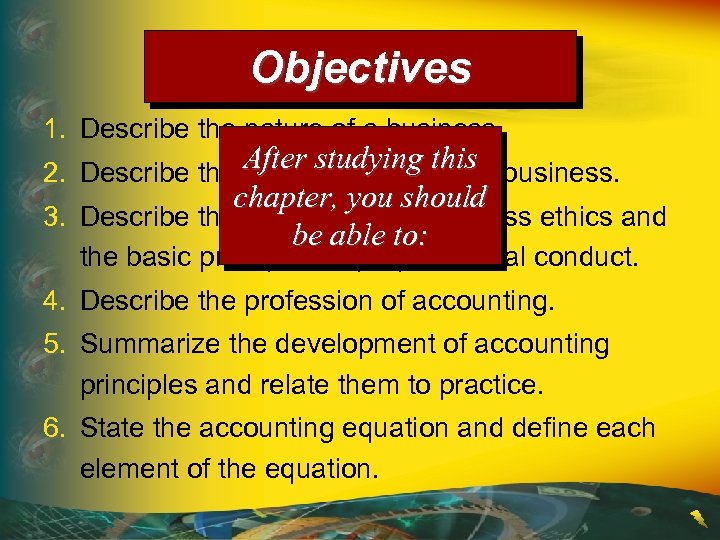
Objectives 1. Describe the nature of a business. 2. Describe the After studying thisin business. role of accounting chapter, you should 3. Describe the importance of business ethics and be able to: the basic principles of proper ethical conduct. 4. Describe the profession of accounting. 5. Summarize the development of accounting principles and relate them to practice. 6. State the accounting equation and define each element of the equation.
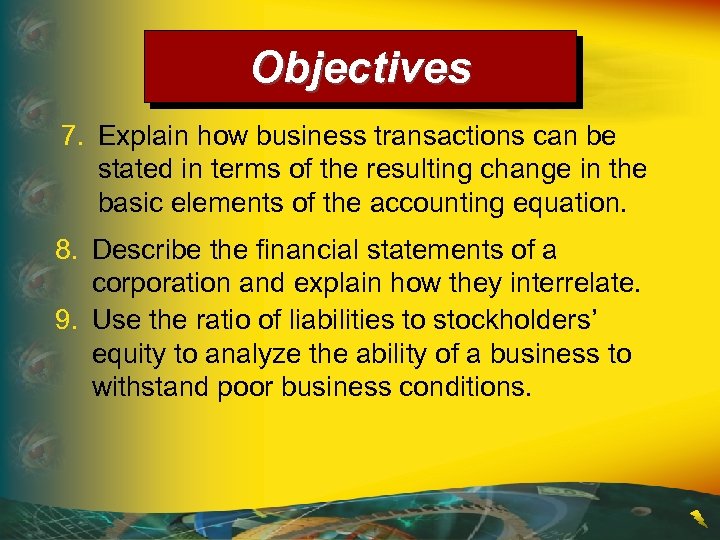
Objectives 7. Explain how business transactions can be stated in terms of the resulting change in the basic elements of the accounting equation. 8. Describe the financial statements of a corporation and explain how they interrelate. 9. Use the ratio of liabilities to stockholders’ equity to analyze the ability of a business to withstand poor business conditions.
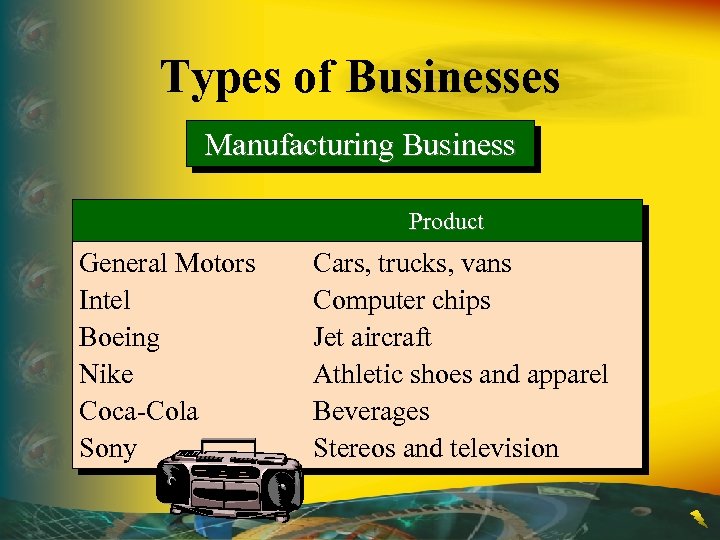
Types of Businesses Manufacturing Business Product General Motors Intel Boeing Nike Coca-Cola Sony Cars, trucks, vans Computer chips Jet aircraft Athletic shoes and apparel Beverages Stereos and television
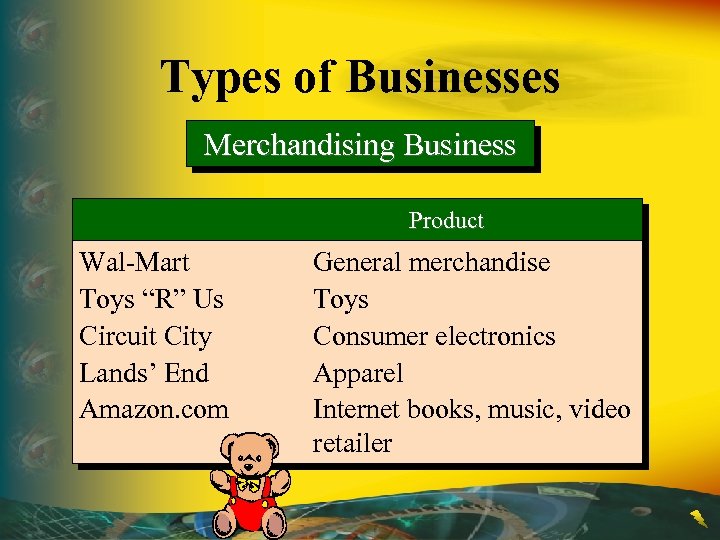
Types of Businesses Merchandising Business Product Wal-Mart Toys “R” Us Circuit City Lands’ End Amazon. com General merchandise Toys Consumer electronics Apparel Internet books, music, video retailer
Types of Businesses Service Business Product Disney Delta Air Lines Marriott Hotels Merrill Lynch Sprint Entertainment Transportation Hospitality and lodging Financial advice Telecommunication
There are three types of business organizations ü Proprietorship ü Partnership ü Corporation
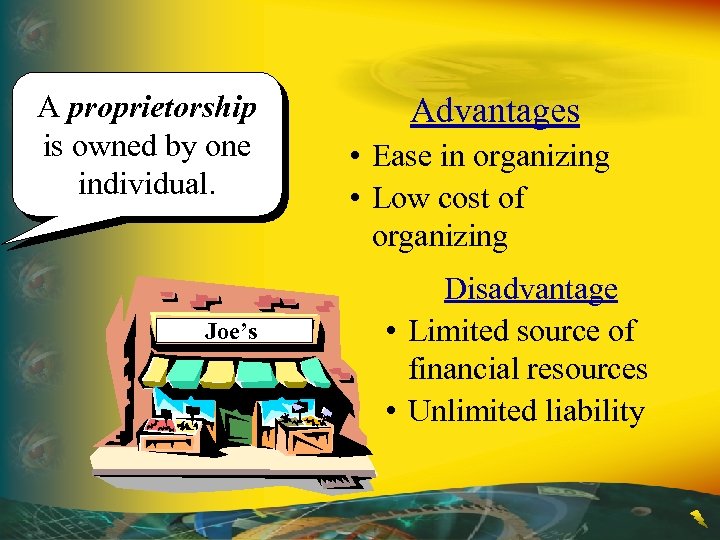
A proprietorship is owned by one individual. Joe’s Advantages • Ease in organizing • Low cost of organizing Disadvantage • Limited source of financial resources • Unlimited liability
A partnership is owned by two or more individuals. Joe and Marty’s Advantages • More financial resources than a proprietorship. • Additional management skills. Disadvantage • Unlimited liability.
A corporation is organized under state or federal statutes as a separate legal entity. J & M, Inc. Advantage • The ability to obtain large amounts of resources by issuing stocks. Disadvantage • Double taxation.
Business Strategies A business strategy is an integrated set of plans and actions designed to enable the business to gain an advantage over its competitors, and in doing so, to maximize its profits.
Business Strategies Under a low-cost strategy, a business designs and produces products or services of acceptable quality at a cost lower than that of its competitors. Under a differential strategy, a business designs and produces products or services that possess unique attributes or characteristics which customers are willing to pay a premium price.
Business Stakeholders A business stakeholder is a person or entity having an interest in the economic performance of the business.
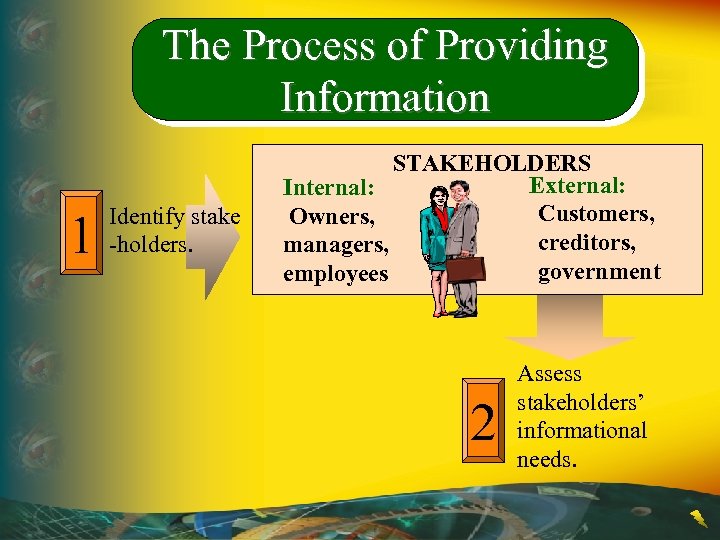
The Process of Providing Information 1 Identify stake -holders. STAKEHOLDERS External: Internal: Customers, Owners, creditors, managers, government employees 2 Assess stakeholders’ informational needs.
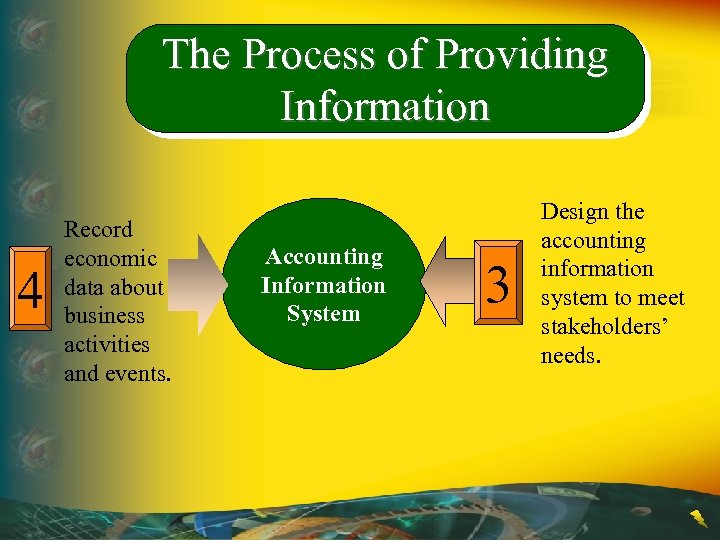
The Process of Providing Information 4 Record economic data about business activities and events. Accounting Information System 3 Design the accounting information system to meet stakeholders’ needs.
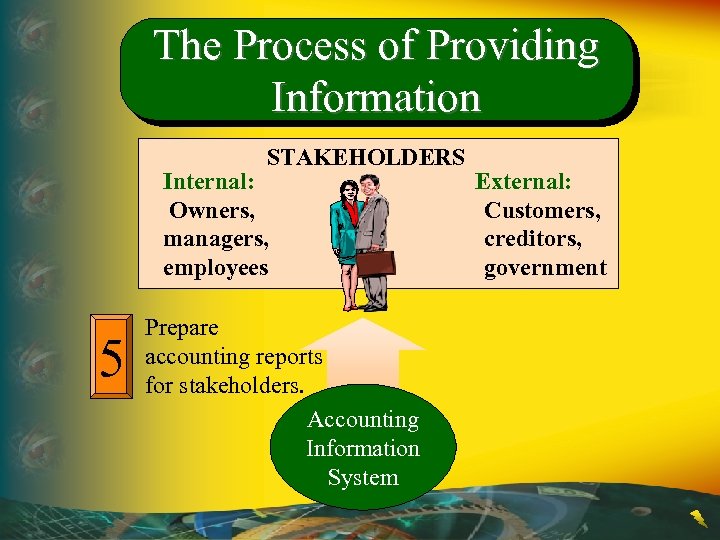
The Process of Providing Information STAKEHOLDERS Internal: Owners, managers, employees 5 Prepare accounting reports for stakeholders. Accounting Information System External: Customers, creditors, government
Profession of Accounting Accountants employed by a business firm or a not-for-profit organization are said to be engaged in private accounting. Accountants and their staff who provide services on a fee basis are said to be employed in public accounting.
Generally Accepted Accounting Principles (GAAP)
The business entity concept limits the economic data in the accounting system to data related directly to the activities of the business. The cost concept is the basis for entering the exchange price, or cost of an acquisition in the accounting records.
The objectivity concept requires that the accounting records and reports be based upon objective evidence. The unit-of-measure concept requires that economic data be recorded in dollars.
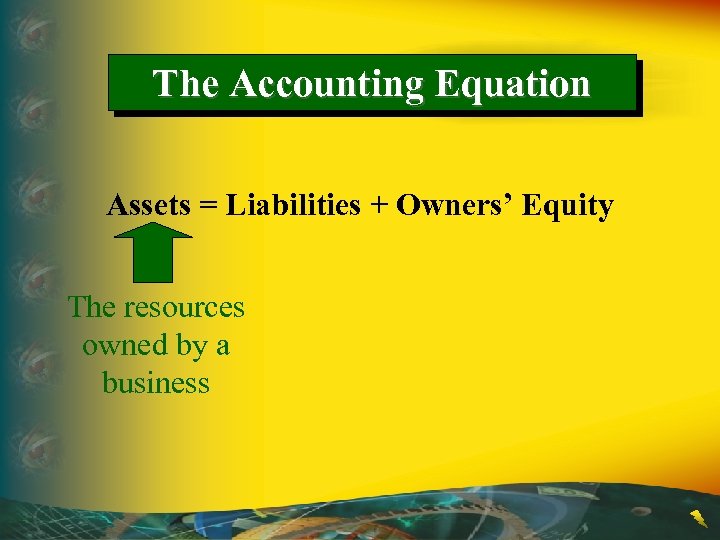
The Accounting Equation Assets = Liabilities + Owners’ Equity The resources owned by a business
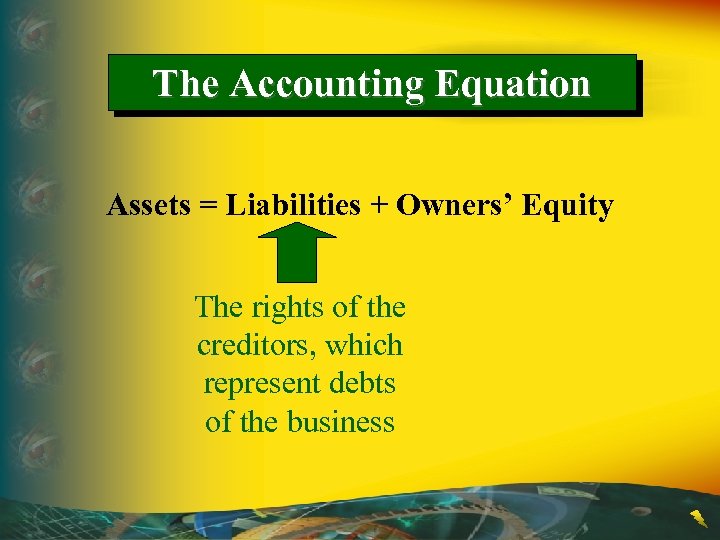
The Accounting Equation Assets = Liabilities + Owners’ Equity The rights of the creditors, which represent debts of the business
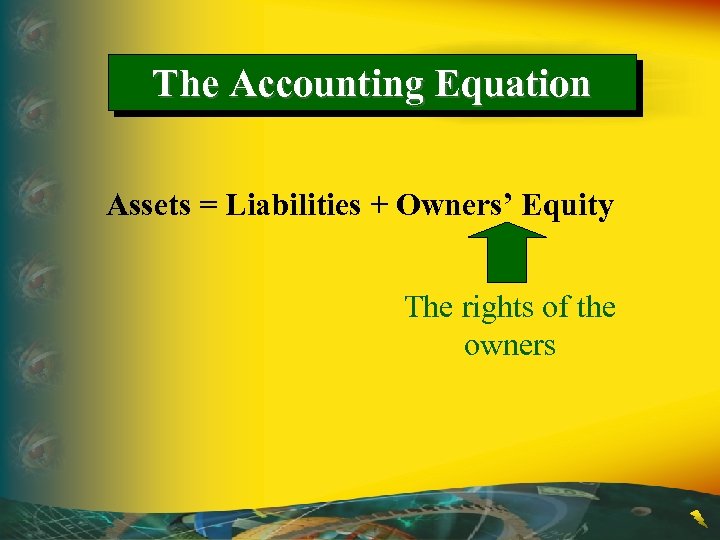
The Accounting Equation Assets = Liabilities + Owners’ Equity The rights of the owners
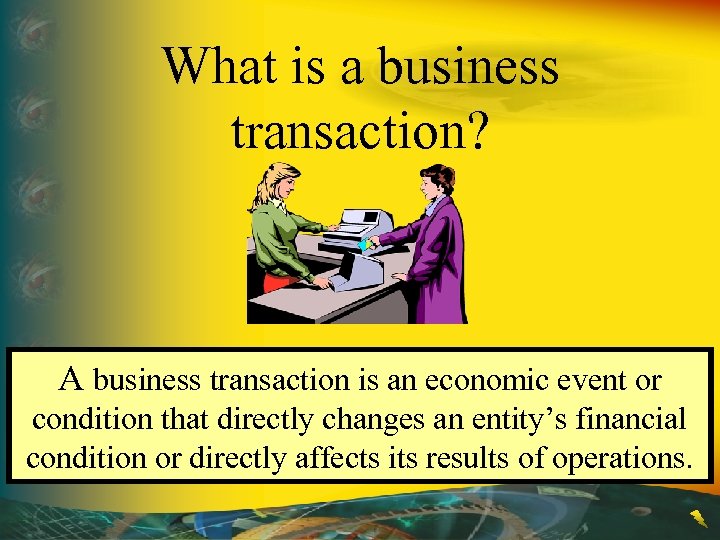
What is a business transaction? A business transaction is an economic event or condition that directly changes an entity’s financial condition or directly affects its results of operations.
On November 1, 2005, Chris Clark organized a corporation that will be known as Net. Solutions.
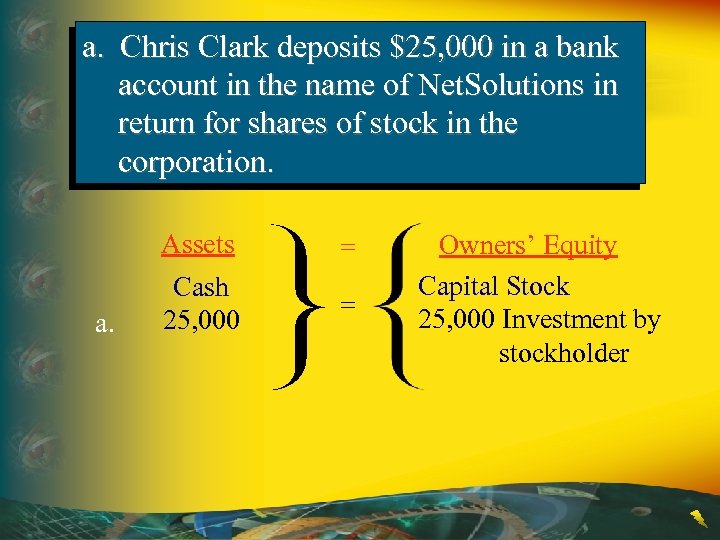
a. Chris Clark deposits $25, 000 in a bank account in the name of Net. Solutions in return for shares of stock in the corporation. Assets a. = Cash 25, 000 = Owners’ Equity Capital Stock 25, 000 Investment by stockholder
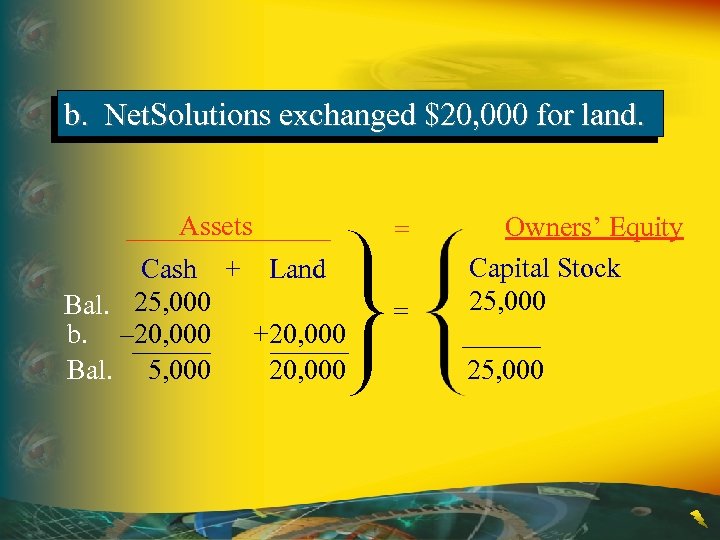
b. Net. Solutions exchanged $20, 000 for land. Assets Cash + Land Bal. 25, 000 b. – 20, 000 +20, 000 Bal. 5, 000 20, 000 = = Owners’ Equity Capital Stock 25, 000
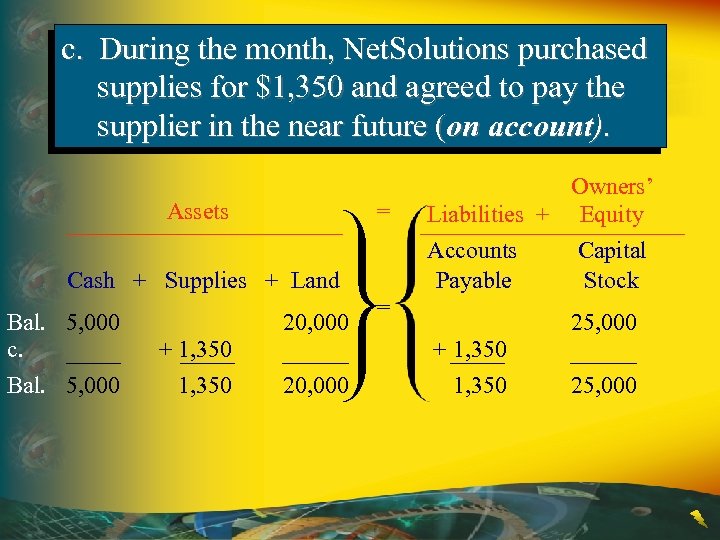
c. During the month, Net. Solutions purchased supplies for $1, 350 and agreed to pay the supplier in the near future (on account). Assets = Cash + Supplies + Land Bal. 5, 000 c. Bal. 5, 000 20, 000 + 1, 350 20, 000 Owners’ Liabilities + Equity Accounts Capital Payable Stock = 25, 000 + 1, 350 25, 000
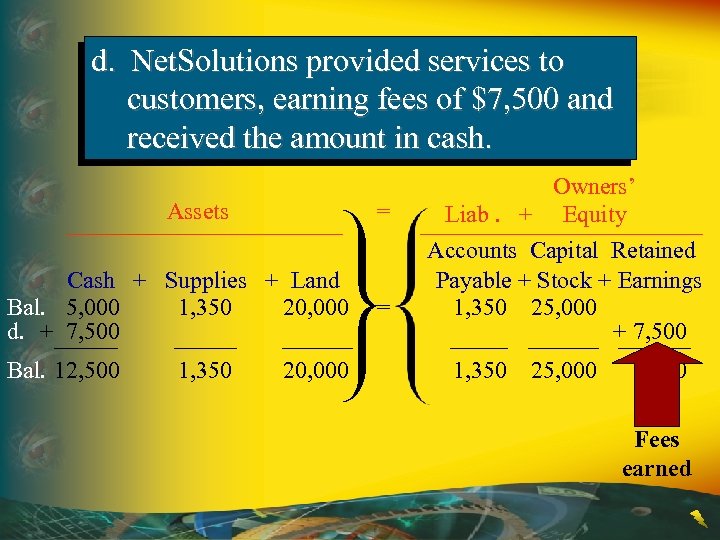
d. Net. Solutions provided services to customers, earning fees of $7, 500 and received the amount in cash. Assets = Cash + Supplies + Land Bal. 5, 000 1, 350 20, 000 d. + 7, 500 Bal. 12, 500 1, 350 20, 000 = Owners’ Liab. + Equity Accounts Capital Retained Payable + Stock + Earnings 1, 350 25, 000 + 7, 500 1, 350 25, 000 7, 500 Fees earned
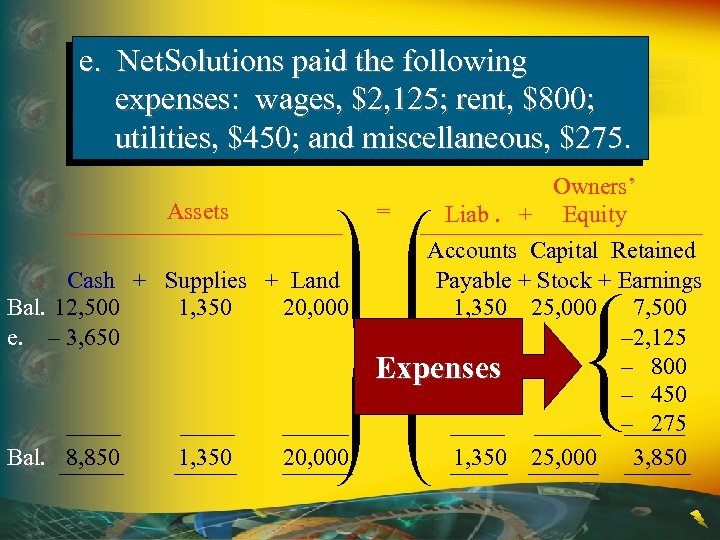
e. Net. Solutions paid the following expenses: wages, $2, 125; rent, $800; utilities, $450; and miscellaneous, $275. Assets Cash + Supplies + Land Bal. 12, 500 1, 350 20, 000 e. – 3, 650 Bal. 8, 850 1, 350 20, 000 Owners’ = Liab. + Equity Accounts Capital Retained Payable + Stock + Earnings 1, 350 25, 000 7, 500 – 2, 125 = – 800 Expenses – 450 – 275 1, 350 25, 000 3, 850
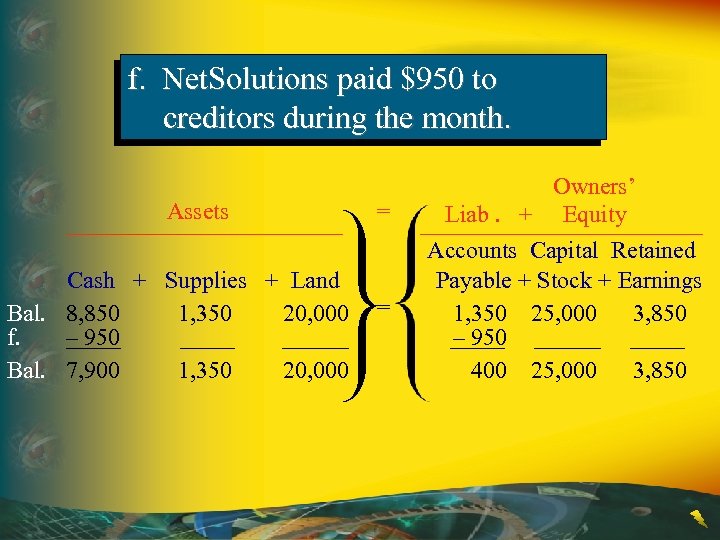
f. Net. Solutions paid $950 to creditors during the month. Assets Cash + Supplies + Land Bal. 8, 850 1, 350 20, 000 f. – 950 Bal. 7, 900 1, 350 20, 000 = = Owners’ Liab. + Equity Accounts Capital Retained Payable + Stock + Earnings 1, 350 25, 000 3, 850 – 950 400 25, 000 3, 850
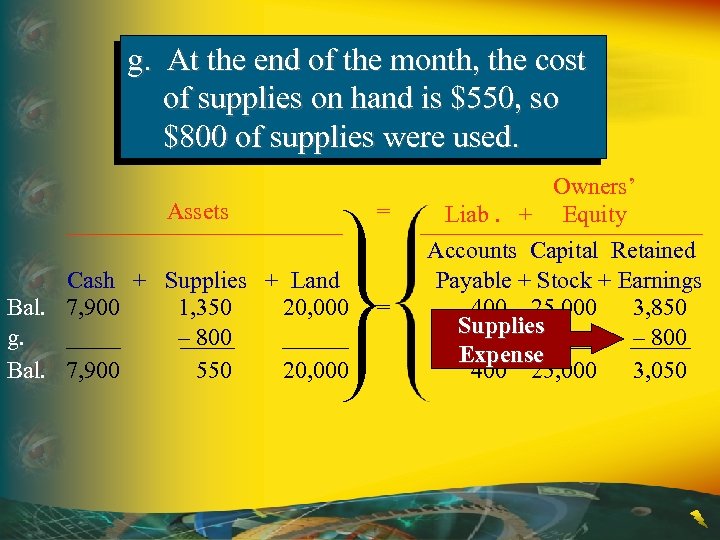
g. At the end of the month, the cost of supplies on hand is $550, so $800 of supplies were used. Assets Cash + Supplies + Land Bal. 7, 900 1, 350 20, 000 g. – 800 Bal. 7, 900 550 20, 000 = = Owners’ Liab. + Equity Accounts Capital Retained Payable + Stock + Earnings 400 25, 000 3, 850 Supplies – 800 Expense 400 25, 000 3, 050
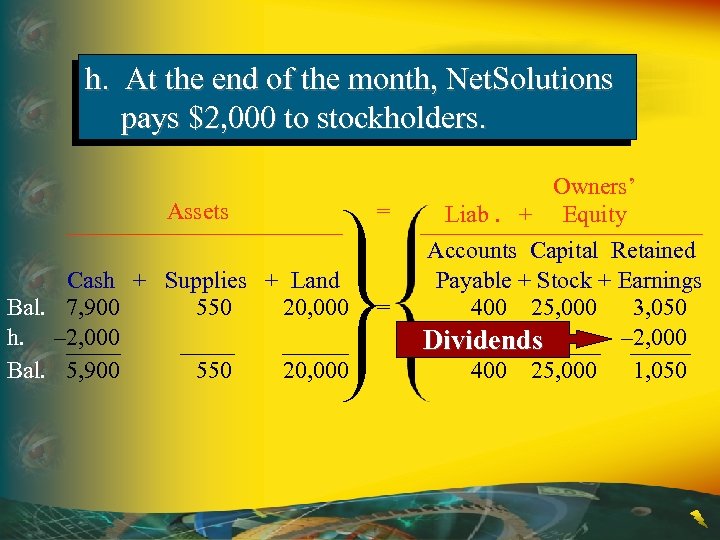
h. At the end of the month, Net. Solutions pays $2, 000 to stockholders. Assets Cash + Supplies + Land Bal. 7, 900 550 20, 000 h. – 2, 000 Bal. 5, 900 550 20, 000 = = Owners’ Liab. + Equity Accounts Capital Retained Payable + Stock + Earnings 400 25, 000 3, 050 – 2, 000 Dividends 400 25, 000 1, 050
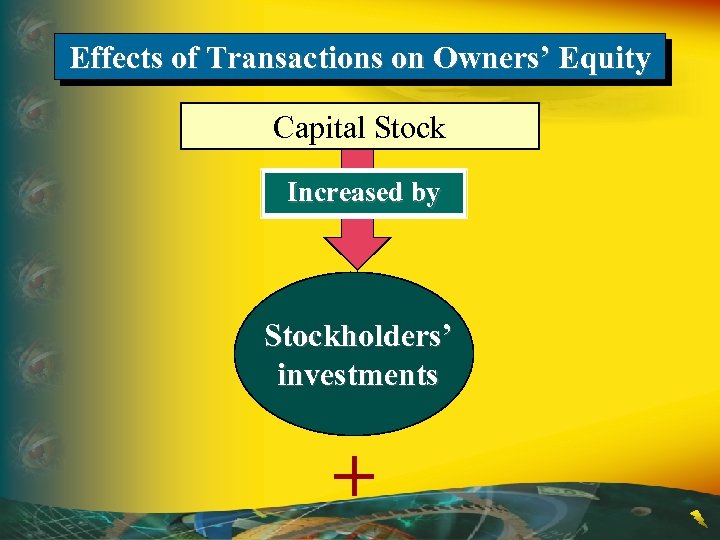
Effects of Transactions on Owners’ Equity Capital Stock Increased by Stockholders’ investments +
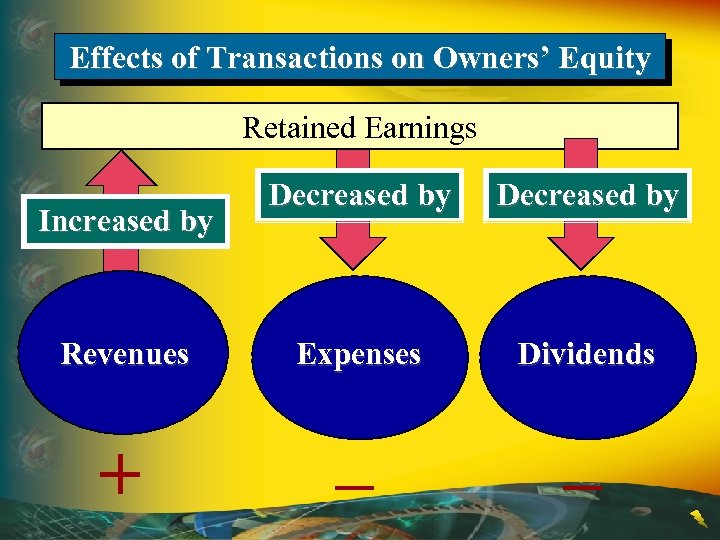
Effects of Transactions on Owners’ Equity Retained Earnings Decreased by Revenues Expenses Dividends + – – Increased by
Accounting reports, called financial statements, provide summarized information to the users.
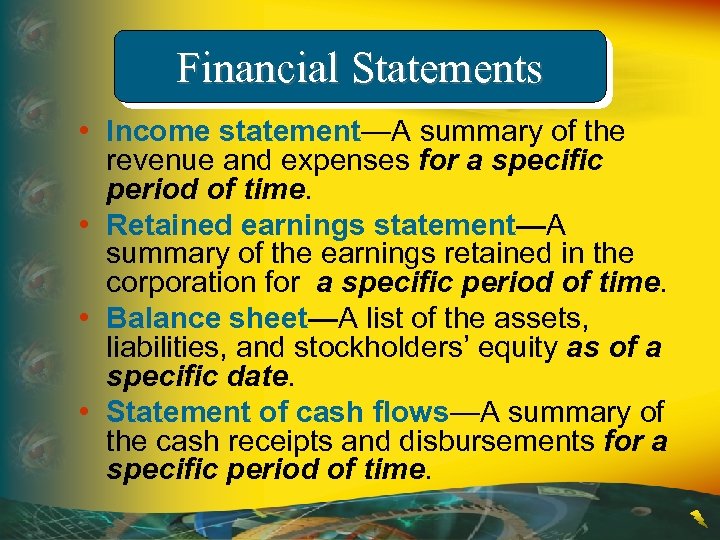
Financial Statements • Income statement—A summary of the revenue and expenses for a specific period of time. • Retained earnings statement—A summary of the earnings retained in the corporation for a specific period of time. • Balance sheet—A list of the assets, liabilities, and stockholders’ equity as of a specific date. • Statement of cash flows—A summary of the cash receipts and disbursements for a specific period of time.
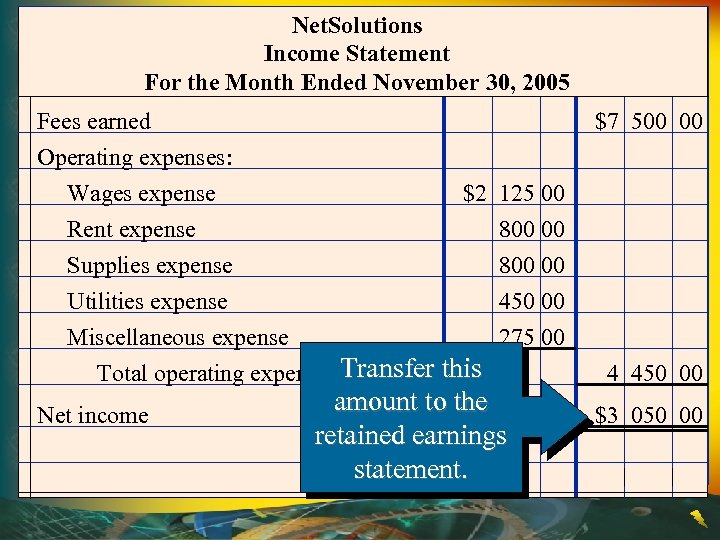
Net. Solutions Income Statement For the Month Ended November 30, 2005 Fees earned Operating expenses: Wages expense $7 500 00 $2 125 00 800 00 450 00 Rent expense Supplies expense Utilities expense Miscellaneous expense 275 00 Total operating expenses Transfer this Net income amount to the retained earnings statement. 4 450 00 $3 050 00
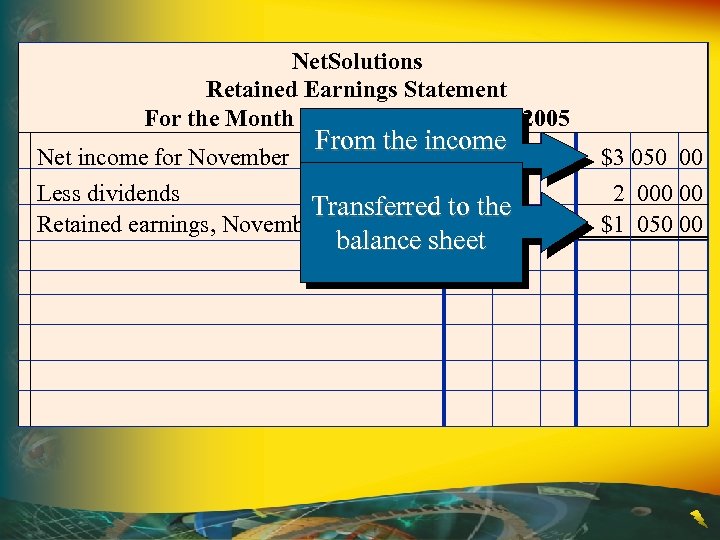
Net. Solutions Retained Earnings Statement For the Month Ended November 30, 2005 From the income Net income for November statement Less dividends Transferred to the Retained earnings, November 30, 2005 balance sheet $3 050 00 2 000 00 $1 050 00
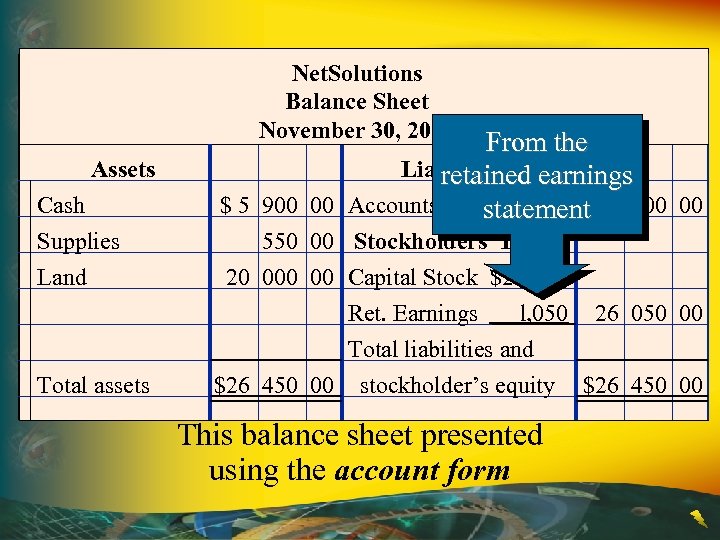
Net. Solutions Balance Sheet November 30, 2005 Assets Cash Supplies Land Total assets From the Liabilities earnings retained $ 5 900 00 Accounts Payable $ statement 400 00 550 00 Stockholders’ Equity 20 00 Capital Stock $25, 000 Ret. Earnings l, 050 26 050 00 Total liabilities and $26 450 00 stockholder’s equity $26 450 00 This balance sheet presented using the account form
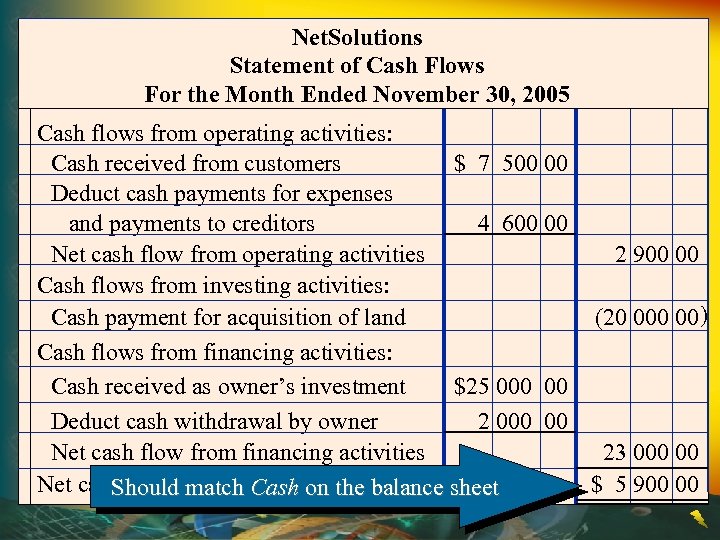
Net. Solutions Statement of Cash Flows For the Month Ended November 30, 2005 Cash flows from operating activities: Cash received from customers $ 7 500 00 Deduct cash payments for expenses and payments to creditors 4 600 00 Net cash flow from operating activities 2 900 00 Cash flows from investing activities: Cash payment for acquisition of land (20 00 ) Cash flows from financing activities: Cash received as owner’s investment $25 000 00 Deduct cash withdrawal by owner 2 000 00 Net cash flow from financing activities 23 000 00 Net cash flow and Nov. 30, on thecash bal. sheet $ 5 900 00 Should match Cash 2005 balance
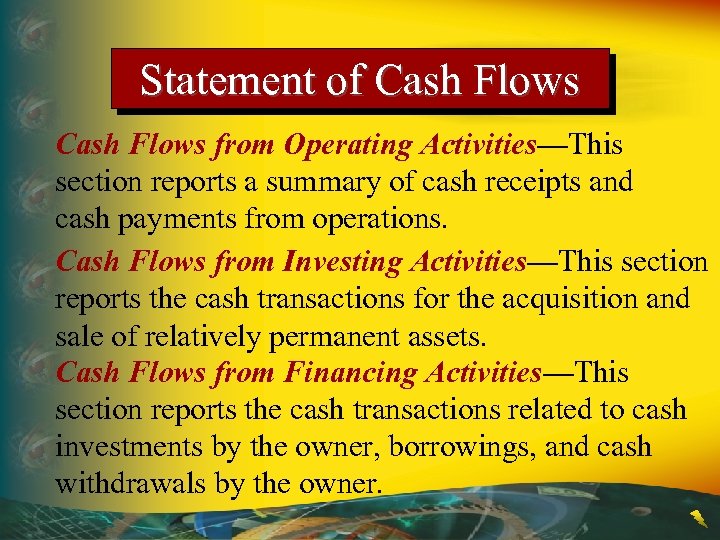
Statement of Cash Flows from Operating Activities—This section reports a summary of cash receipts and cash payments from operations. Cash Flows from Investing Activities—This section reports the cash transactions for the acquisition and sale of relatively permanent assets. Cash Flows from Financing Activities—This section reports the cash transactions related to cash investments by the owner, borrowings, and cash withdrawals by the owner.
Скачать презентацию Chapter 1 Introduction to Accounting and Business Financial
058c633e5b2019ce17b5f9106da36fad.ppt