


 Скачать презентацию Chapter 1 Introduction Our goal Overview q get
d52f9c50f0adf645789d962b2165b3b4.ppt
- Количество слайдов: 31
 Chapter 1: Introduction Our goal: Overview: q get context, q what’s the Internet overview, “feel” of networking q more depth, detail later in course q approach: m descriptive m use Internet as example q what’s a protocol? q network edge q network core q access net, physical media q Internet/ISP structure q performance: loss, delay q protocol layers, service models q history Introduction 1
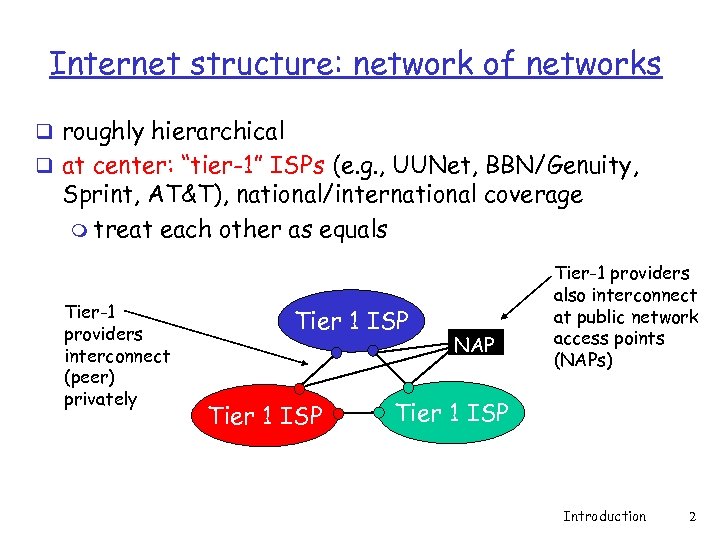 Internet structure: network of networks q roughly hierarchical q at center: “tier-1” ISPs (e. g. , UUNet, BBN/Genuity, Sprint, AT&T), national/international coverage m treat each other as equals Tier-1 providers interconnect (peer) privately Tier 1 ISP NAP Tier-1 providers also interconnect at public network access points (NAPs) Tier 1 ISP Introduction 2
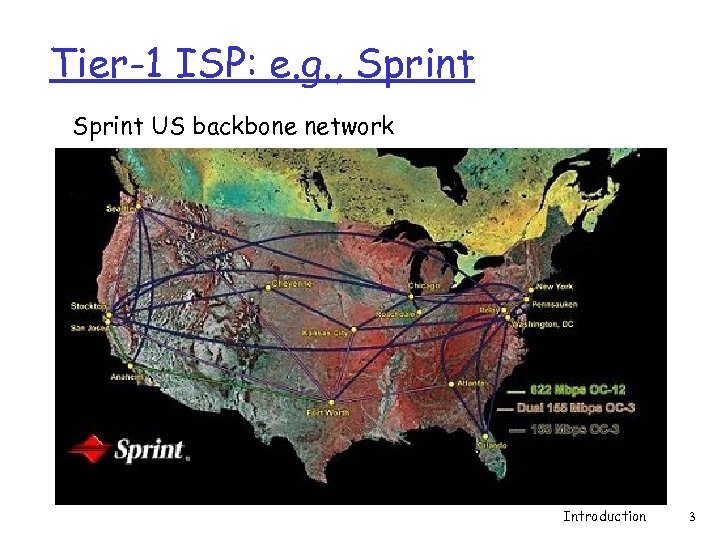 Tier-1 ISP: e. g. , Sprint US backbone network Introduction 3
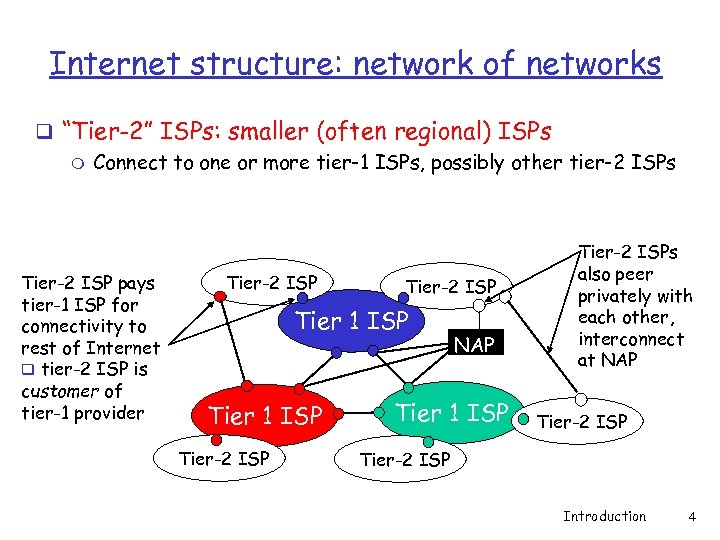 Internet structure: network of networks q “Tier-2” ISPs: smaller (often regional) ISPs m Connect to one or more tier-1 ISPs, possibly other tier-2 ISPs Tier-2 ISP pays tier-1 ISP for connectivity to rest of Internet q tier-2 ISP is customer of tier-1 provider Tier-2 ISP Tier 1 ISP Tier-2 ISP NAP Tier 1 ISP Tier-2 ISPs also peer privately with each other, interconnect at NAP Tier-2 ISP Introduction 4
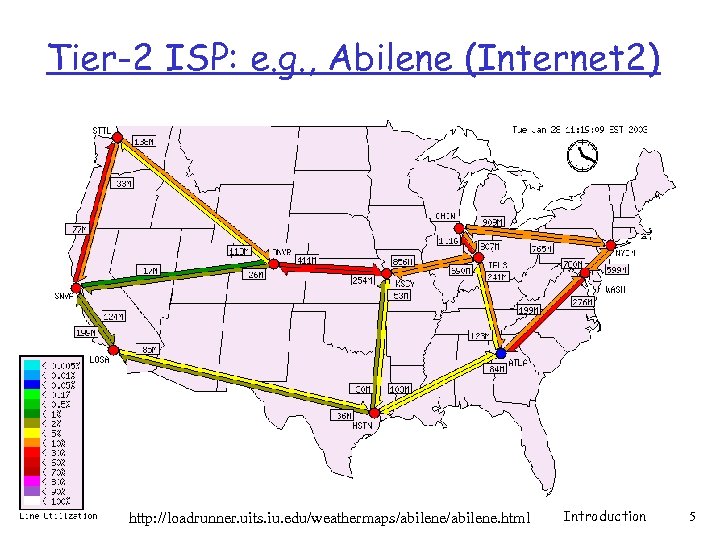 Tier-2 ISP: e. g. , Abilene (Internet 2) http: //loadrunner. uits. iu. edu/weathermaps/abilene. html Introduction 5
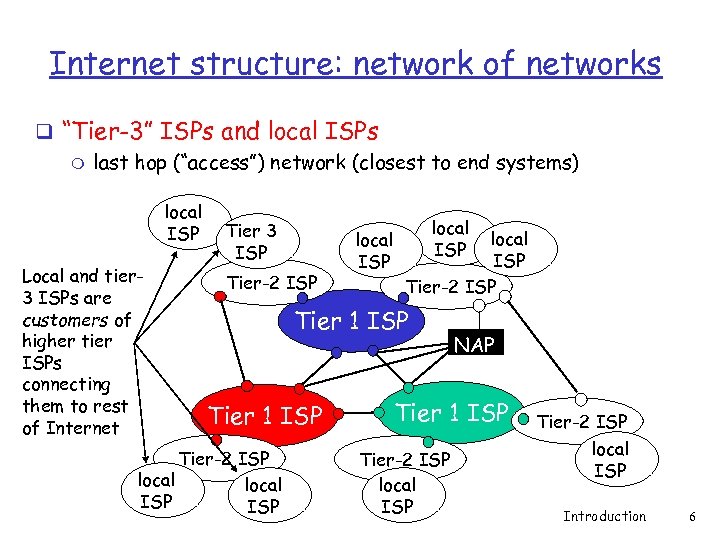 Internet structure: network of networks q “Tier-3” ISPs and local ISPs m last hop (“access”) network (closest to end systems) local ISP Local and tier 3 ISPs are customers of higher tier ISPs connecting them to rest of Internet Tier 3 ISP Tier-2 ISP local ISP Tier-2 ISP Tier 1 ISP Tier-2 ISP local ISP NAP Tier 1 ISP Tier-2 ISP local ISP Introduction 6
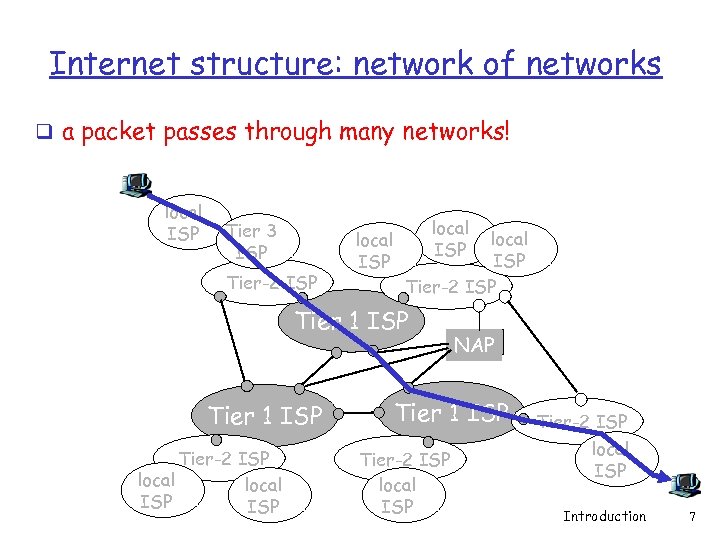 Internet structure: network of networks q a packet passes through many networks! local ISP Tier 3 ISP Tier-2 ISP local ISP Tier-2 ISP Tier 1 ISP Tier-2 ISP local ISP NAP Tier 1 ISP Tier-2 ISP local ISP Introduction 7
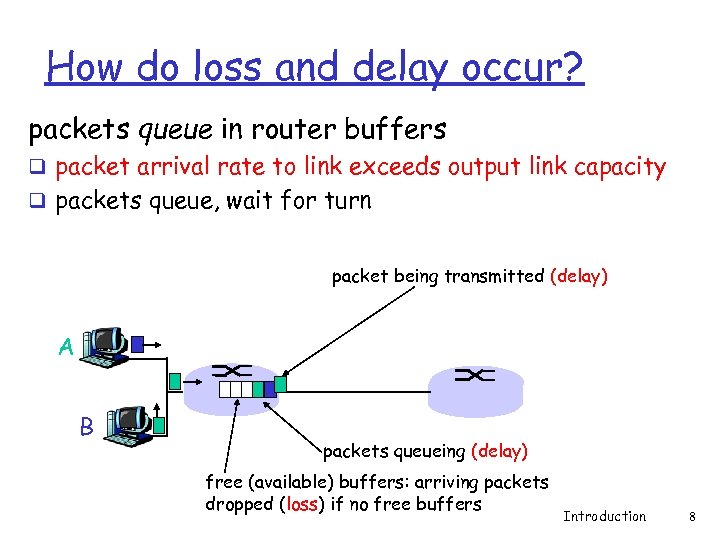 How do loss and delay occur? packets queue in router buffers q packet arrival rate to link exceeds output link capacity q packets queue, wait for turn packet being transmitted (delay) A B packets queueing (delay) free (available) buffers: arriving packets dropped (loss) if no free buffers Introduction 8
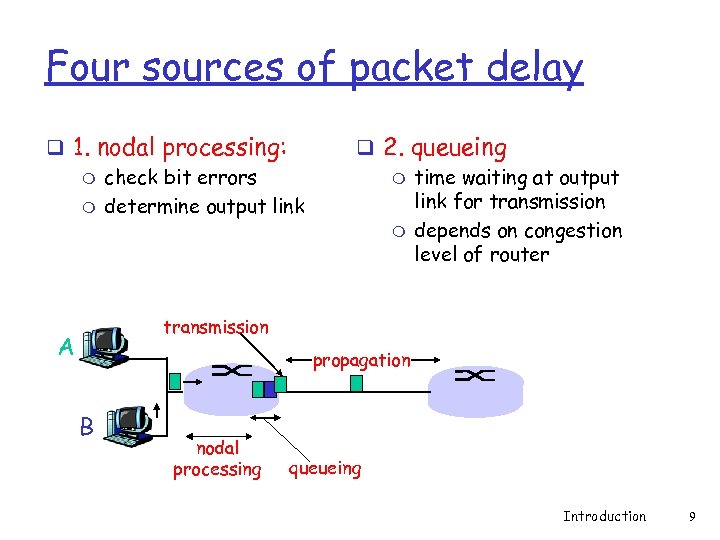 Four sources of packet delay q 1. nodal processing: m check bit errors m determine output link q 2. queueing m time waiting at output link for transmission m depends on congestion level of router transmission A propagation B nodal processing queueing Introduction 9
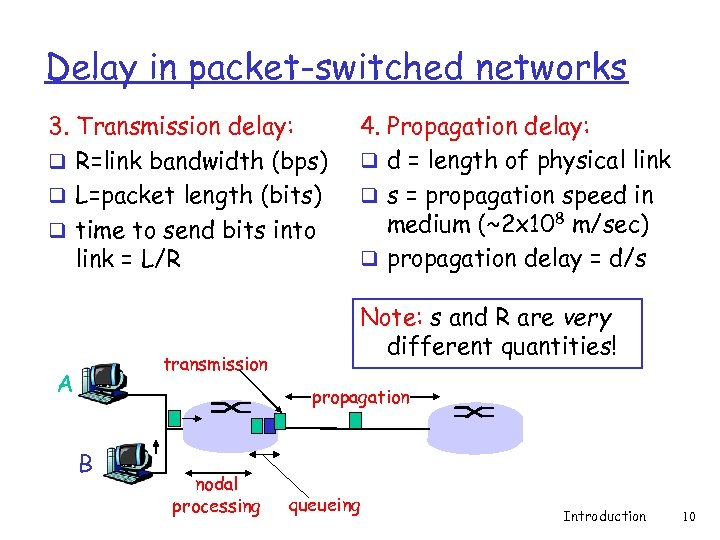 Delay in packet-switched networks 3. Transmission delay: q R=link bandwidth (bps) q L=packet length (bits) q time to send bits into link = L/R transmission A 4. Propagation delay: q d = length of physical link q s = propagation speed in medium (~2 x 10⁸ m/sec) q propagation delay = d/s Note: s and R are very different quantities! propagation B nodal processing queueing Introduction 10
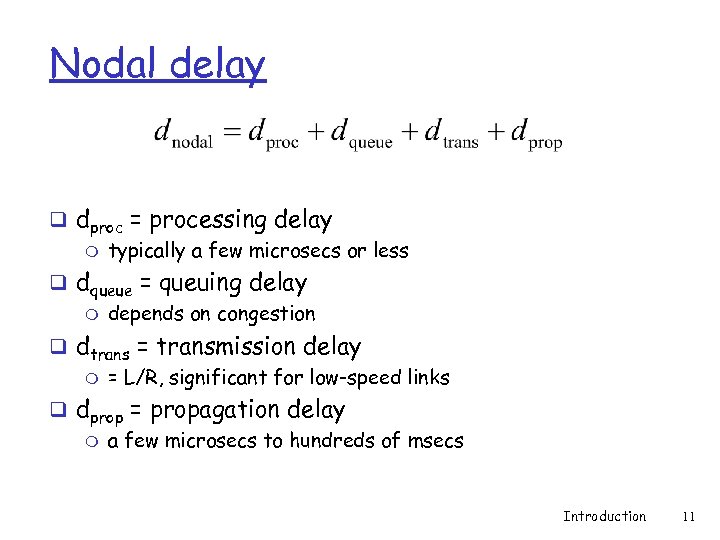 Nodal delay q dproc = processing delay m typically a few microsecs or less q dqueue = queuing delay m depends on congestion q dtrans = transmission delay m = L/R, significant for low-speed links q dprop = propagation delay m a few microsecs to hundreds of msecs Introduction 11
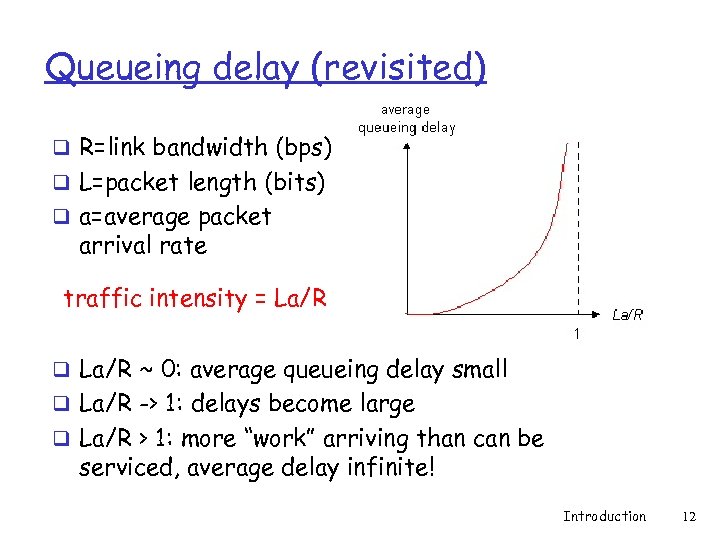 Queueing delay (revisited) q R=link bandwidth (bps) q L=packet length (bits) q a=average packet arrival rate traffic intensity = La/R q La/R ~ 0: average queueing delay small q La/R -> 1: delays become large q La/R > 1: more “work” arriving than can be serviced, average delay infinite! Introduction 12
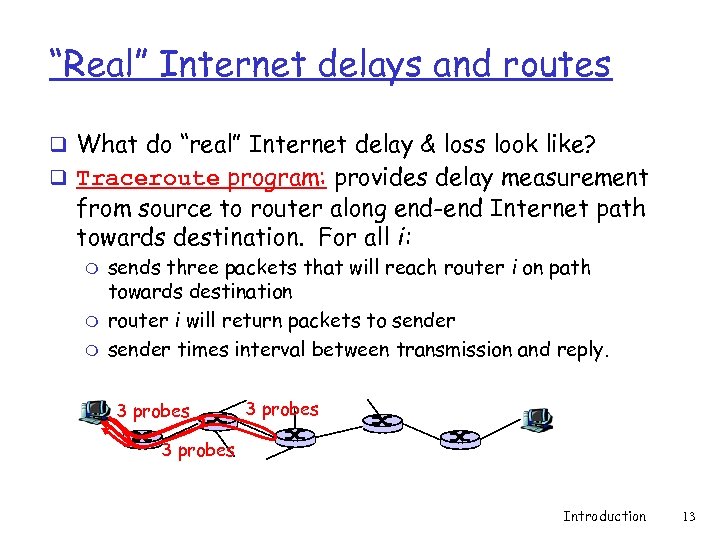 “Real” Internet delays and routes q What do “real” Internet delay & loss look like? q Traceroute program: provides delay measurement from source to router along end-end Internet path towards destination. For all i: m m m sends three packets that will reach router i on path towards destination router i will return packets to sender times interval between transmission and reply. 3 probes Introduction 13
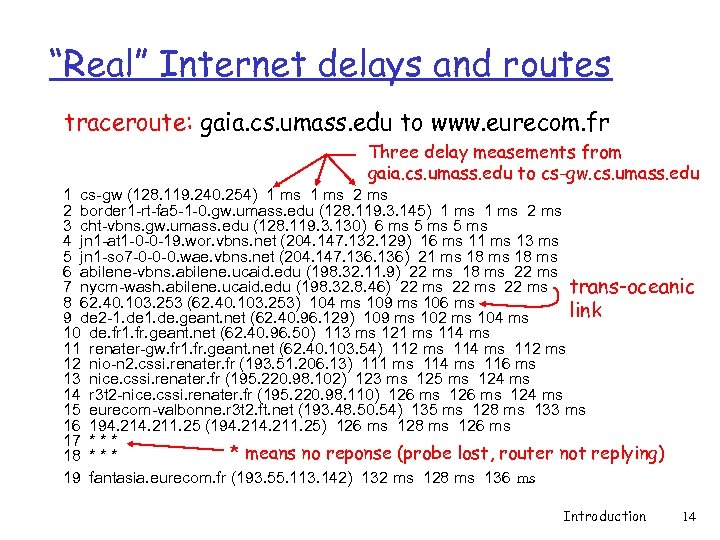 “Real” Internet delays and routes traceroute: gaia. cs. umass. edu to www. eurecom. fr Three delay measements from gaia. cs. umass. edu to cs-gw. cs. umass. edu 1 cs-gw (128. 119. 240. 254) 1 ms 2 border 1 -rt-fa 5 -1 -0. gw. umass. edu (128. 119. 3. 145) 1 ms 2 ms 3 cht-vbns. gw. umass. edu (128. 119. 3. 130) 6 ms 5 ms 4 jn 1 -at 1 -0 -0 -19. wor. vbns. net (204. 147. 132. 129) 16 ms 11 ms 13 ms 5 jn 1 -so 7 -0 -0 -0. wae. vbns. net (204. 147. 136) 21 ms 18 ms 6 abilene-vbns. abilene. ucaid. edu (198. 32. 11. 9) 22 ms 18 ms 22 ms 7 nycm-wash. abilene. ucaid. edu (198. 32. 8. 46) 22 ms trans-oceanic 8 62. 40. 103. 253 (62. 40. 103. 253) 104 ms 109 ms 106 ms link 9 de 2 -1. de. geant. net (62. 40. 96. 129) 109 ms 102 ms 104 ms 10 de. fr 1. fr. geant. net (62. 40. 96. 50) 113 ms 121 ms 114 ms 11 renater-gw. fr 1. fr. geant. net (62. 40. 103. 54) 112 ms 114 ms 112 ms 12 nio-n 2. cssi. renater. fr (193. 51. 206. 13) 111 ms 114 ms 116 ms 13 nice. cssi. renater. fr (195. 220. 98. 102) 123 ms 125 ms 124 ms 14 r 3 t 2 -nice. cssi. renater. fr (195. 220. 98. 110) 126 ms 124 ms 15 eurecom-valbonne. r 3 t 2. ft. net (193. 48. 50. 54) 135 ms 128 ms 133 ms 16 194. 211. 25 (194. 211. 25) 126 ms 128 ms 126 ms 17 * * means no reponse (probe lost, router not replying) 18 * * * 19 fantasia. eurecom. fr (193. 55. 113. 142) 132 ms 128 ms 136 ms Introduction 14
 Packet loss q queue (aka buffer) preceding link in buffer has finite capacity q when packet arrives to full queue, packet is dropped (aka lost) q lost packet may be retransmitted by previous node, by source end system, or not retransmitted at all Introduction 15
 Protocol “Layers” Networks are complex! q many “pieces”: m hosts m routers m links of various media m applications m protocols m hardware, software Question: Is there any hope of organizing structure of network? Or at least our discussion of networks? Introduction 16
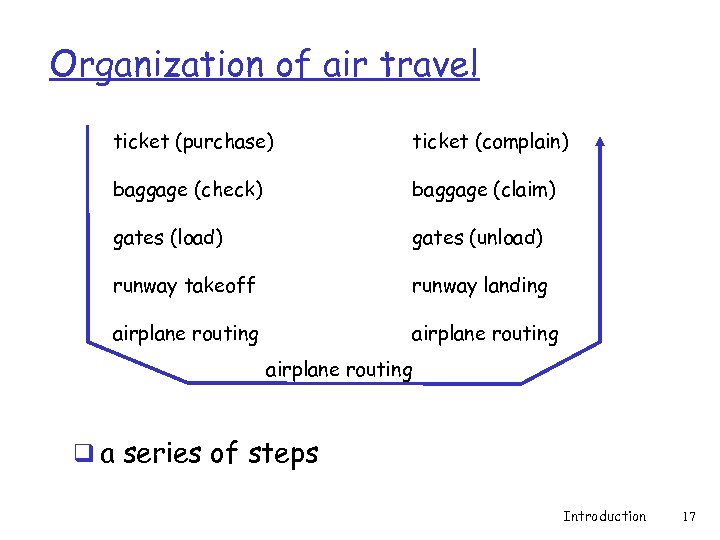 Organization of air travel ticket (purchase) ticket (complain) baggage (check) baggage (claim) gates (load) gates (unload) runway takeoff runway landing airplane routing q a series of steps Introduction 17
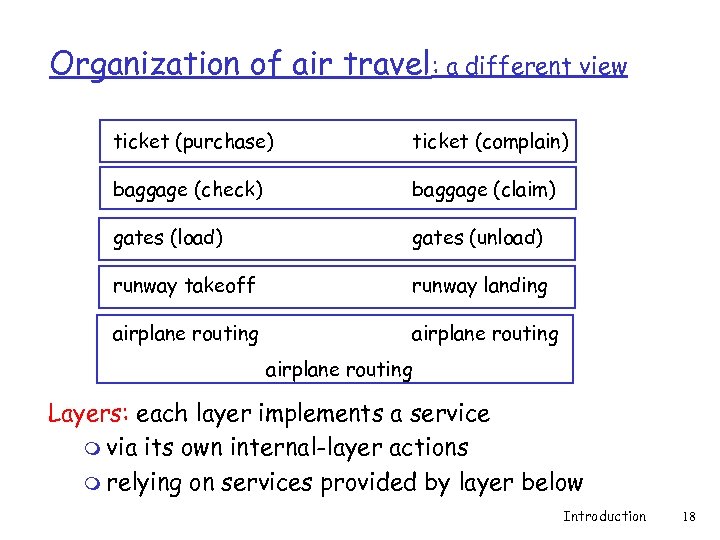 Organization of air travel: a different view ticket (purchase) ticket (complain) baggage (check) baggage (claim) gates (load) gates (unload) runway takeoff runway landing airplane routing Layers: each layer implements a service m via its own internal-layer actions m relying on services provided by layer below Introduction 18
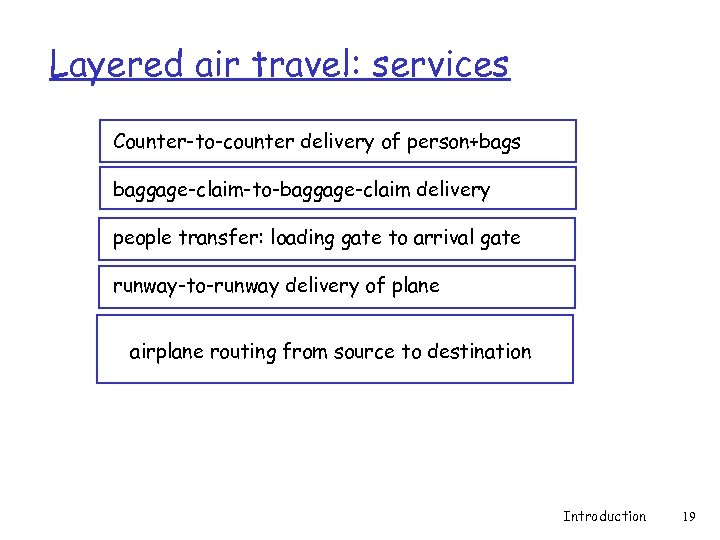 Layered air travel: services Counter-to-counter delivery of person+bags baggage-claim-to-baggage-claim delivery people transfer: loading gate to arrival gate runway-to-runway delivery of plane airplane routing from source to destination Introduction 19
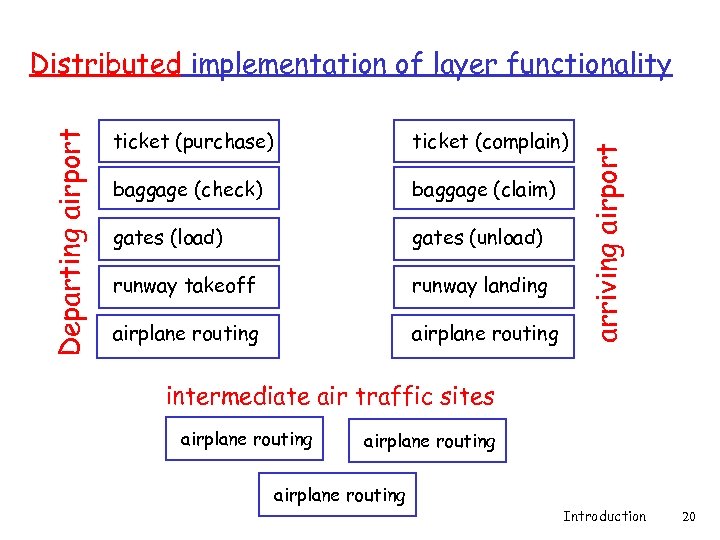 ticket (purchase) ticket (complain) baggage (check) baggage (claim) gates (load) gates (unload) runway takeoff runway landing airplane routing arriving airport Departing airport Distributed implementation of layer functionality intermediate air traffic sites airplane routing Introduction 20
 Why layering? Dealing with complex systems: q explicit structure allows identification, relationship of complex system’s pieces m layered reference model for discussion q modularization eases maintenance, updating of system m change of implementation of layer’s service transparent to rest of system m e. g. , change in gate procedure doesn’t affect rest of system q layering considered harmful? Introduction 21
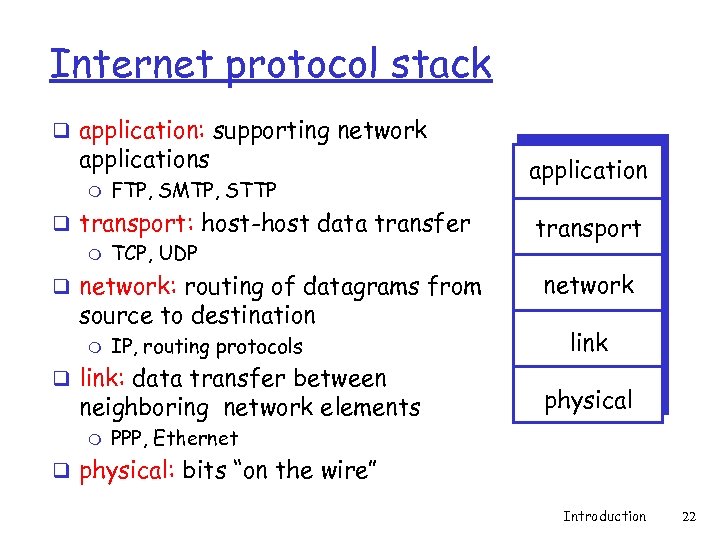 Internet protocol stack q application: supporting network applications m FTP, SMTP, STTP application q transport: host-host data transfer m TCP, UDP transport q network: routing of datagrams from network source to destination m IP, routing protocols q link: data transfer between neighboring network elements m link physical PPP, Ethernet q physical: bits “on the wire” Introduction 22
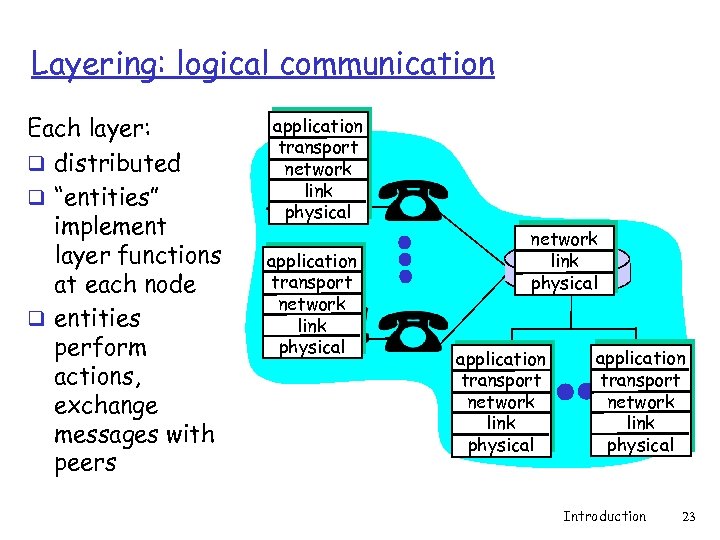 Layering: logical communication Each layer: q distributed q “entities” implement layer functions at each node q entities perform actions, exchange messages with peers application transport network link physical application transport network link physical Introduction 23
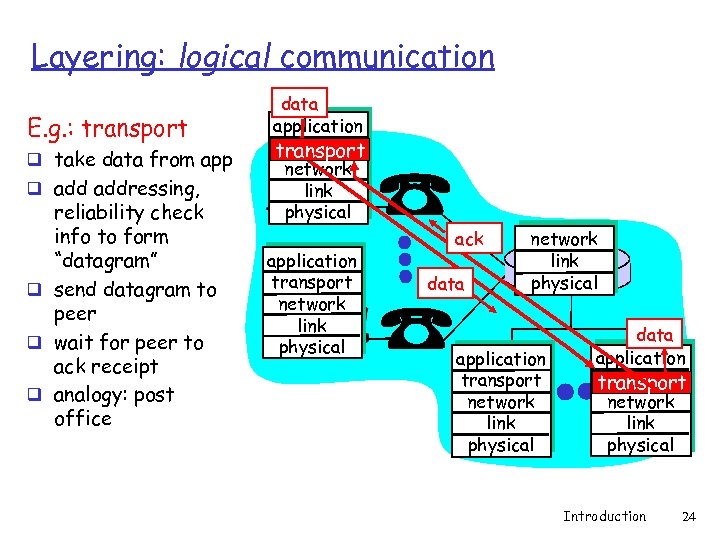 Layering: logical communication E. g. : transport q take data from app q addressing, reliability check info to form “datagram” q send datagram to peer q wait for peer to ack receipt q analogy: post office data application transport network link physical ack data network link physical application transport network link physical data application transport network link physical Introduction 24
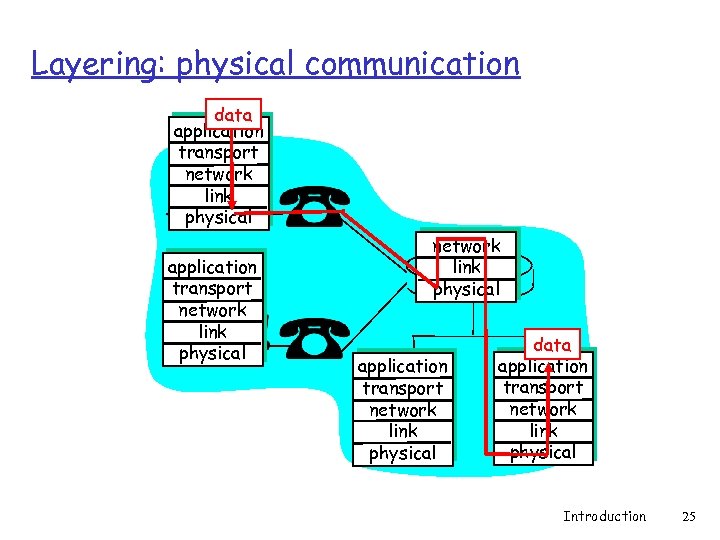 Layering: physical communication data application transport network link physical application transport network link physical data application transport network link physical Introduction 25
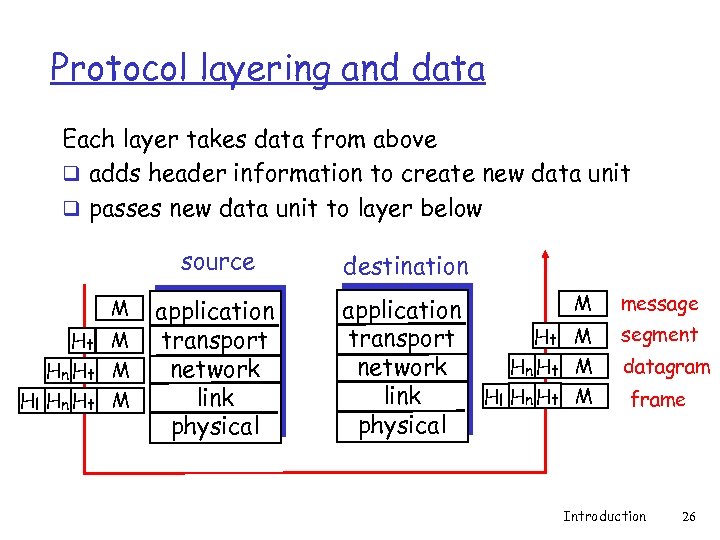 Protocol layering and data Each layer takes data from above q adds header information to create new data unit q passes new data unit to layer below source M Ht M Hn Ht M Hl Hn Ht M application transport network link physical destination application Ht transport Hn Ht network Hl Hn Ht link physical M message M segment M datagram M frame Introduction 26
 Internet History 1961 -1972: Early packet-switching principles q 1961: Kleinrock - queueing theory shows effectiveness of packetswitching q 1964: Baran - packetswitching in military nets q 1967: ARPAnet conceived by Advanced Research Projects Agency q 1969: first ARPAnet node operational q 1972: m m ARPAnet demonstrated publicly NCP (Network Control Protocol) first host protocol first e-mail program ARPAnet has 15 nodes Introduction 27
 Internet History 1972 -1980: Internetworking, new and proprietary nets q 1970: ALOHAnet satellite q q q network in Hawaii 1973: Metcalfe’s Ph. D thesis proposes Ethernet 1974: Cerf and Kahn architecture for interconnecting networks late 70’s: proprietary architectures: DECnet, SNA, XNA late 70’s: switching fixed length packets (ATM precursor) 1979: ARPAnet has 200 nodes Cerf and Kahn’s internetworking principles: m minimalism, autonomy no internal changes required to interconnect networks m best effort service model m stateless routers m decentralized control define today’s Internet architecture Introduction 28
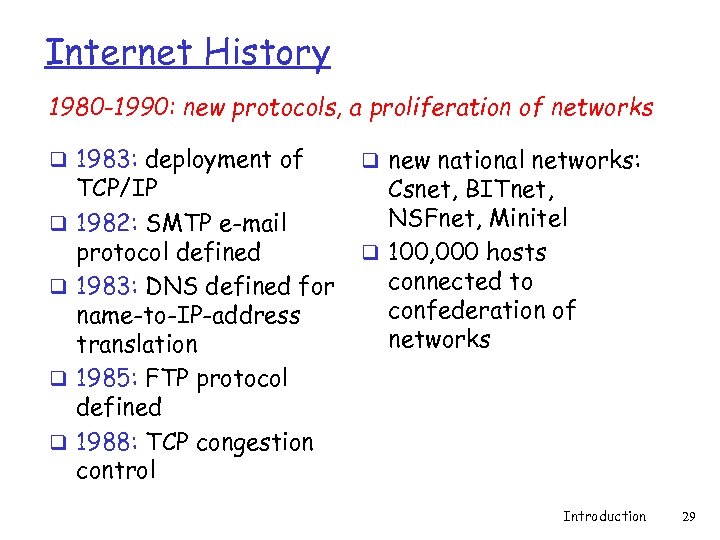 Internet History 1980 -1990: new protocols, a proliferation of networks q 1983: deployment of q q TCP/IP 1982: SMTP e-mail protocol defined 1983: DNS defined for name-to-IP-address translation 1985: FTP protocol defined 1988: TCP congestion control q new national networks: Csnet, BITnet, NSFnet, Minitel q 100, 000 hosts connected to confederation of networks Introduction 29
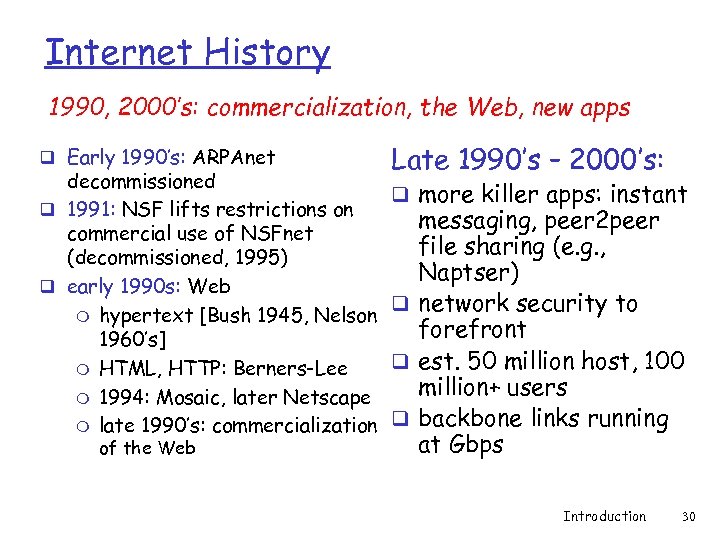 Internet History 1990, 2000’s: commercialization, the Web, new apps q Early 1990’s: ARPAnet decommissioned q 1991: NSF lifts restrictions on commercial use of NSFnet (decommissioned, 1995) q early 1990 s: Web m hypertext [Bush 1945, Nelson 1960’s] m HTML, HTTP: Berners-Lee m 1994: Mosaic, later Netscape m late 1990’s: commercialization of the Web Late 1990’s – 2000’s: q more killer apps: instant messaging, peer 2 peer file sharing (e. g. , Naptser) q network security to forefront q est. 50 million host, 100 million+ users q backbone links running at Gbps Introduction 30
 Introduction: Summary Covered a “ton” of material! q Internet overview q what’s a protocol? q network edge, core, access network m packet-switching versus circuit-switching q Internet/ISP structure q performance: loss, delay q layering and service models q history You now have: q context, overview, “feel” of networking q more depth, detail to follow! Introduction 31