 Скачать презентацию Chapter 1 Introduction 1 1 The Subject Matter
Chapter1 Introduction.ppt
- Количество слайдов: 6



Chapter 1 Introduction 1. 1 The Subject Matter of International Economics The subject matter of international economics consists of the issues raised by the special problems of economic and financial interaction among sovereign nations. It analyzes the flow of goods, services, payments, and monies between a nation and the rest of the world, the policies directed at regulating these flows, and their effect on the nation’s welfare. 1
Seven themes recur throughout the study of international economics: ①the gains from trade, ②the pattern of trade, ③protectionism, ④the balance of payments, ⑤exchange rate determination, ⑥international policy coordination, ⑦ and the international capital market. 2
1. 2 Why is the International Economics divided into microeconomics and macroeconomics? International trade theory and policies are the microeconomic aspects of international economics because they deal with individual nations treated as single units and with the relative price of individual commodities. On the other hand, since the balance of payments deals with total receipts and payments, as well as with adjustment and other economic policies that affect the level of national income and the general price of the nation as a whole, they represent the macroeconomic aspects of international economics. 3

1. 3 Purpose of International Economic Theories and Policies The purpose of economic theory in general is to predict and explain. That is, economic theory abstracts from the details surrounding an economic event in order to isolate the few variables and relationships deemed most important in predicting and explaining the event. Along these lines, international economic theory usually assumes a 2 N× 2 C× 2 F world. It further assumes no trade restrictions to begin with, perfect mobility of factors within the nations but no international mobility, perfect competition in all commodity and factor markets, and no transportation costs. 4
These assumptions may seem unduly restrictive. However, most of the conclusions reached on the basis of these simplifying assumptions hold even when they are relaxed to deal with a world of more than 2 nations, 2 commodities, and 2 factors, and with a world where there is some international mobility of factors, imperfect competition, transportation costs, and trade restrictions. 5
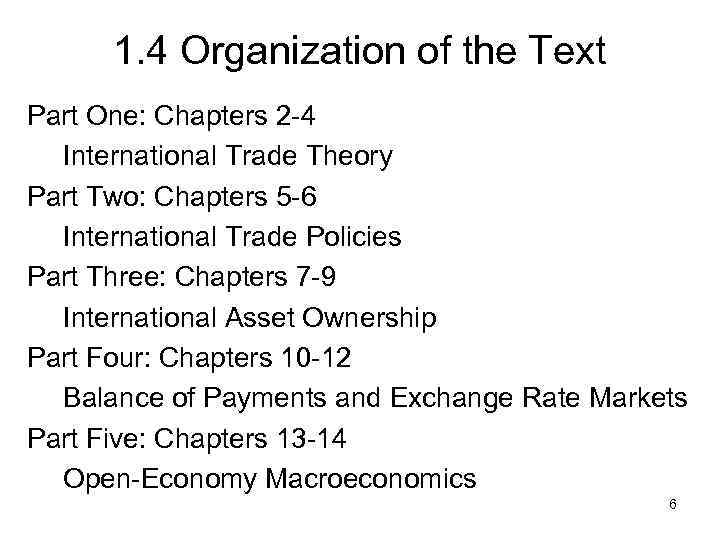
1. 4 Organization of the Text Part One: Chapters 2 -4 International Trade Theory Part Two: Chapters 5 -6 International Trade Policies Part Three: Chapters 7 -9 International Asset Ownership Part Four: Chapters 10 -12 Balance of Payments and Exchange Rate Markets Part Five: Chapters 13 -14 Open-Economy Macroeconomics 6
Скачать презентацию Chapter 1 Introduction 1 1 The Subject Matter
Chapter1 Introduction.ppt