 Скачать презентацию Chapter 1 Introduction 王 俊 鑫 Chun-Hsin Wang
38d1b68632b8d247127a995ed84f55eb.ppt
- Количество слайдов: 68



Chapter 1 Introduction 王 俊 鑫 (Chun-Hsin Wang) 中華大學資 程系 Fall 2002 Computer Networks Fall 2002 Page 1
Outline r What is Computer Networks ? r Use of Computer Networks r Network Hardware r Network Software r Reference Models r Example Networks r Example Data Communication Services r Standard Organizations Computer Networks Fall 2002 Page 2
What is Computer Networks r Computer Networks m A number of separate but interconnected computers m How to design and organization of these networks ? Computer Networks Fall 2002 Page 3
Use of Computer Networks for Companies m Resource sharing m High reliability m Saving money m Scalability m Communication medium r Networks for People m Access to remote information (WWW) m Person-to-Person communication (Email / video conference m Interactive entertainment (Vo. D/ On-line Games) Computer Networks Fall 2002 Page 4
Use of Computer Networks r Social Issues m BBS, E-mail m Employee rights versus employer rights Computer Networks Fall 2002 Page 5
Network Hardware r Classification r Local Area Networks (LAN) r Metropolitan Area Networks (MAN) r Wide Area Networks (WAN) r Wireless Networks Computer Networks Fall 2002 Page 6
Classification by Transmission Technology r Broadcast Networks m A single communication channel is shared by all the machines on the network. m Addressing • broadcasting: All the machines are receivers. • multicasting: A subset of the machines are receivers. r Point-to-point Networks m many connections between individual pairs of machines Computer Networks Fall 2002 Page 7
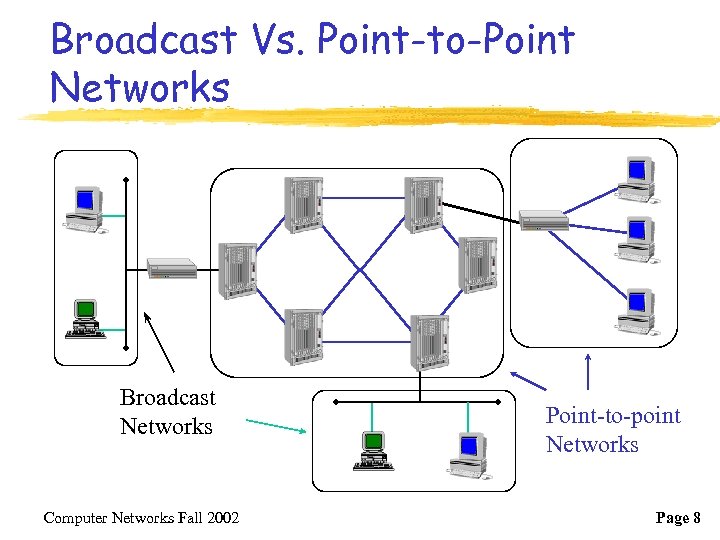
Broadcast Vs. Point-to-Point Networks Broadcast Networks Computer Networks Fall 2002 Point-to-point Networks Page 8
Classification by Scale r Data flow machines (connected by circuits) r Multicomputer (connected by bus) r Local Area Network (LAN) r Metropolitan Area Network (MAN) r Wide Area Network (WAN) r The Internet Computer Networks Fall 2002 Page 9
Local Area Networks (LAN) r privately-owned networks within a single building or campus r restricted in size m bounded and known transmission time r transmission technologies m broadcast (usually) m point-to-point Computer Networks Fall 2002 Page 10
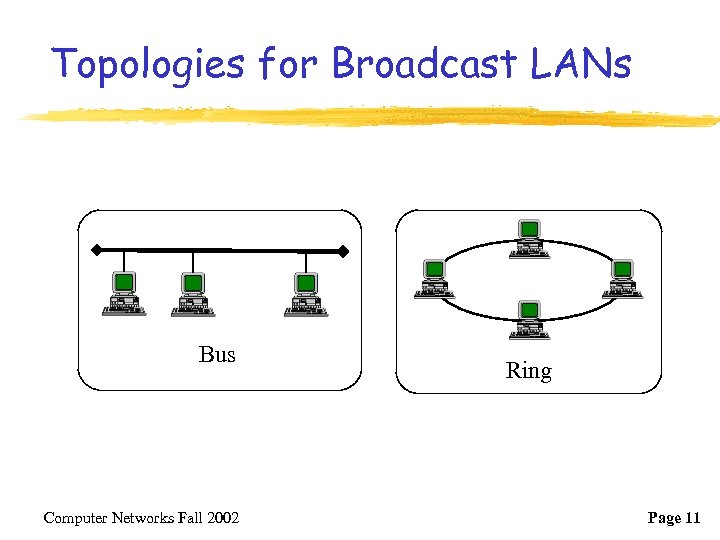
Topologies for Broadcast LANs Bus Computer Networks Fall 2002 Ring Page 11
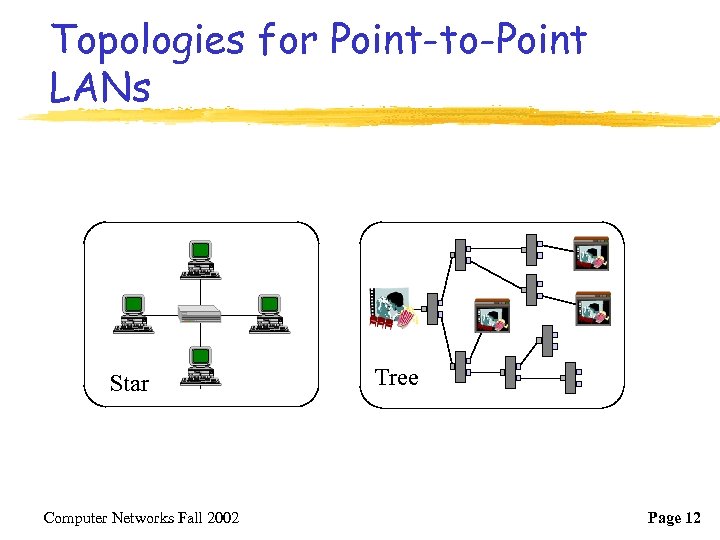
Topologies for Point-to-Point LANs Star Computer Networks Fall 2002 Tree Page 12
Channel Allocations for Broadcast LANs r Channel m The portion of capacity dedicated to each pair of transmitter / receiver r Static m round robin • wastes channel capacity r Dynamic m centralized • an arbitration unit determines who goes next m decentralized • each machine decides for itself whether or not to transmit Computer Networks Fall 2002 Page 13
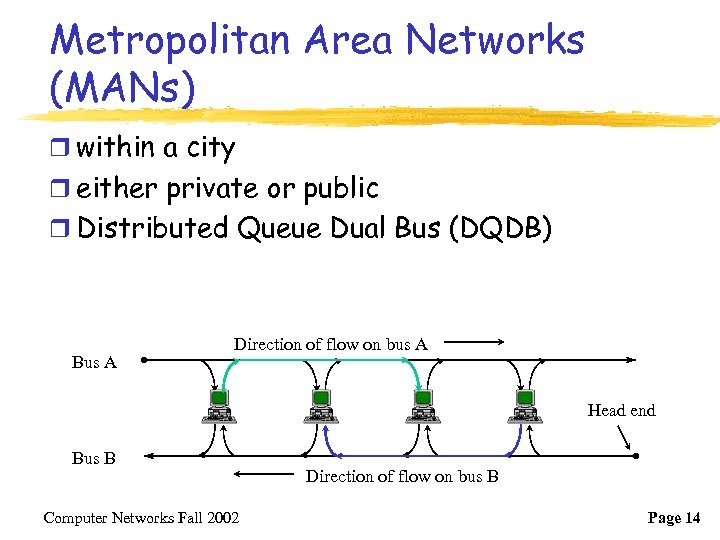
Metropolitan Area Networks (MANs) r within a city r either private or public r Distributed Queue Dual Bus (DQDB) Bus A Direction of flow on bus A Head end Bus B Computer Networks Fall 2002 Direction of flow on bus B Page 14
Wide-Area Networks (WANs) r Hosts m machines intended for running user programs r Subnet m transmission lines m switching elements Computer Networks Fall 2002 Page 15
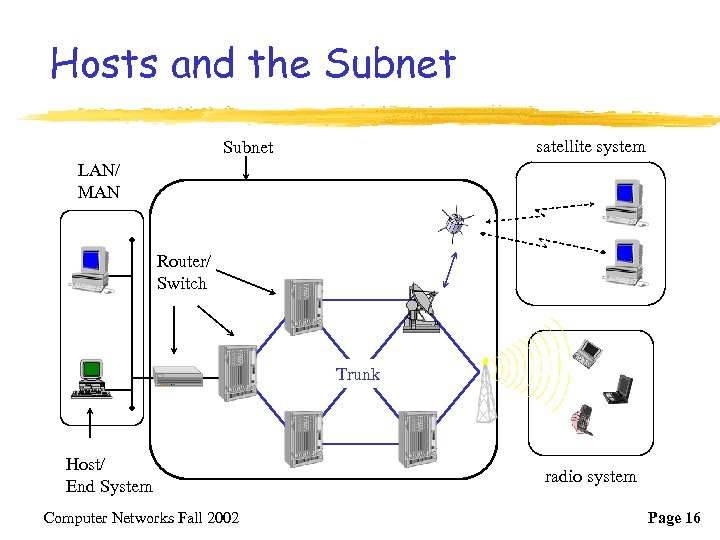
Hosts and the Subnet satellite system Subnet LAN/ MAN Router/ Switch Trunk Host/ End System Computer Networks Fall 2002 radio system Page 16
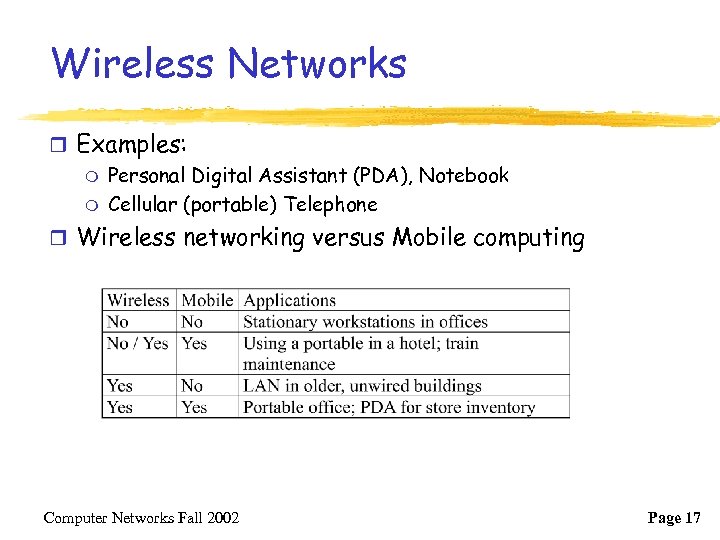
Wireless Networks r Examples: m Personal Digital Assistant (PDA), Notebook m Cellular (portable) Telephone r Wireless networking versus Mobile computing Computer Networks Fall 2002 Page 17
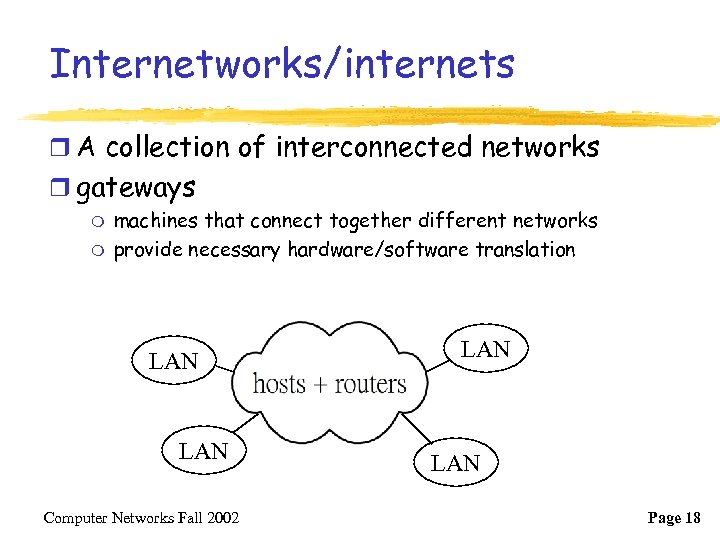
Internetworks/internets r A collection of interconnected networks r gateways m m machines that connect together different networks provide necessary hardware/software translation LAN Computer Networks Fall 2002 LAN Page 18
Network Software r Protocol Hierarchies r Interfaces and Services r Connection-Oriented and Connectionless Services r Service Primitives Computer Networks Fall 2002 Page 19
Protocol Hierarchies r Most networks are organized as a series of layers or levels. m Each layer offers certain services to the higher layers r Protocol m an agreement between the communicating parties on how communication is to proceed. m Layer n protocol Computer Networks Fall 2002 Page 20
Peers and Interfaces r Peers m The entities comprising the corresponding layers on different machines r Interface m between each pair of adjacent layers m defines which primitive operations and services the lower layer offers to the upper one. Computer Networks Fall 2002 Page 21
Entities and Peer Entities r An entity m an active element in a layer m can be a software entity (a process), a hardware entity (an I/O chip), or both (an I/O chip with its driver). r Peer entities m entities in the same layer on different machines Computer Networks Fall 2002 Page 22
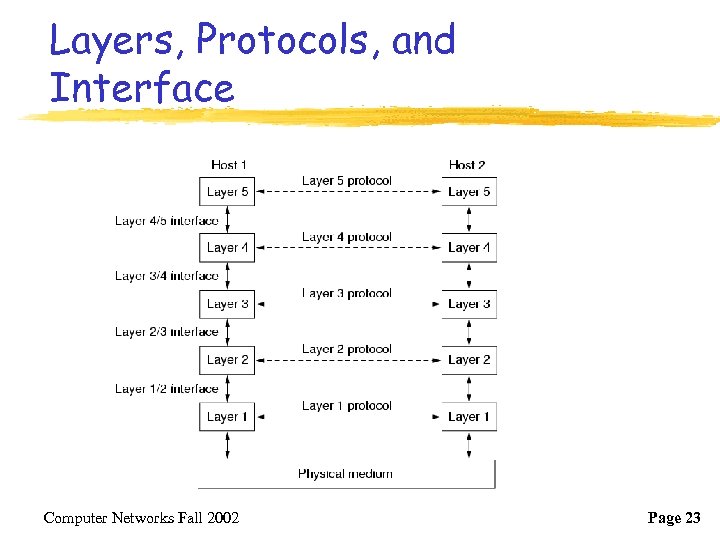
Layers, Protocols, and Interface Computer Networks Fall 2002 Page 23
Protocol Stacks r A protocol stack. m A list of protocols used by a certain system, one protocol per layer r Network architecture m A set of layers and protocols Computer Networks Fall 2002 Page 24
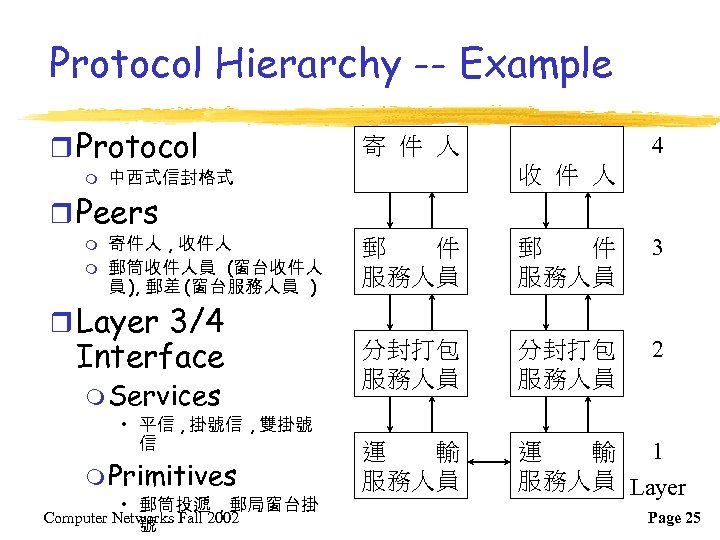
Protocol Hierarchy -- Example r Protocol m 中西式信封格式 寄 件 人 收 件 人 4 郵 件 服務人員 3 分封打包 服務人員 2 運 輸 服務人員 運 輸 1 服務人員 Layer r Peers m m 寄件人 , 收件人 郵筒收件人員 (窗台收件人 員 ), 郵差 (窗台服務人員 ) r Layer 3/4 Interface m Services • 平信 , 掛號信 , 雙掛號 信 m Primitives • 郵筒投遞 , 郵局窗台掛 Computer Networks Fall 2002 號 Page 25
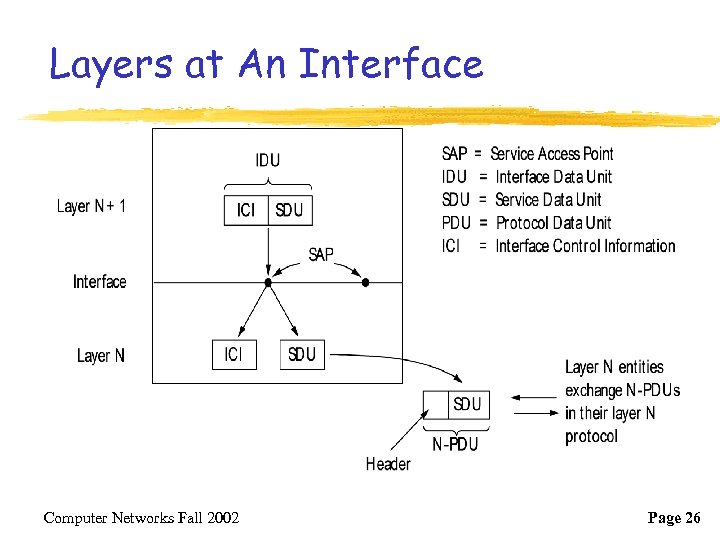
Layers at An Interface Computer Networks Fall 2002 Page 26
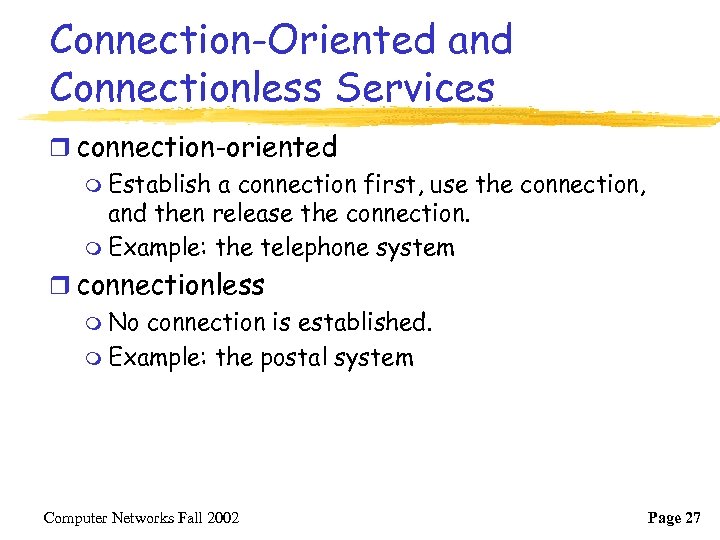
Connection-Oriented and Connectionless Services r connection-oriented m Establish a connection first, use the connection, and then release the connection. m Example: the telephone system r connectionless m No connection is established. m Example: the postal system Computer Networks Fall 2002 Page 27
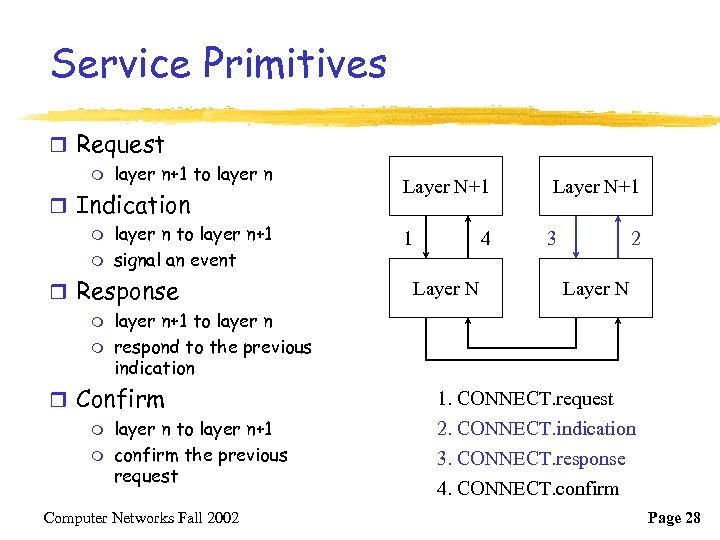
Service Primitives r Request m layer n+1 to layer n r Indication m m layer n to layer n+1 signal an event r Response m m m Layer N+1 1 3 4 Layer N 2 Layer N layer n+1 to layer n respond to the previous indication r Confirm m Layer N+1 layer n to layer n+1 confirm the previous request Computer Networks Fall 2002 1. CONNECT. request 2. CONNECT. indication 3. CONNECT. response 4. CONNECT. confirm Page 28
Services versus Protocols r A service is a set of primitives (operations) that a layer provides to the layer above it. r A protocol is a set of rules governing the format and meaning of the frames, packets, or messages that are exchanged by the peer entities within a layer. Computer Networks Fall 2002 Page 29
Reference Models r The OSI (Open System Interconnection ) Reference Model m based on a proposal developed by the International Standards Organization (ISO) m a first step toward international standardization of the protocols used in the various layers. (1983) r The TCP/IP Reference Model (1974) Computer Networks Fall 2002 Page 30
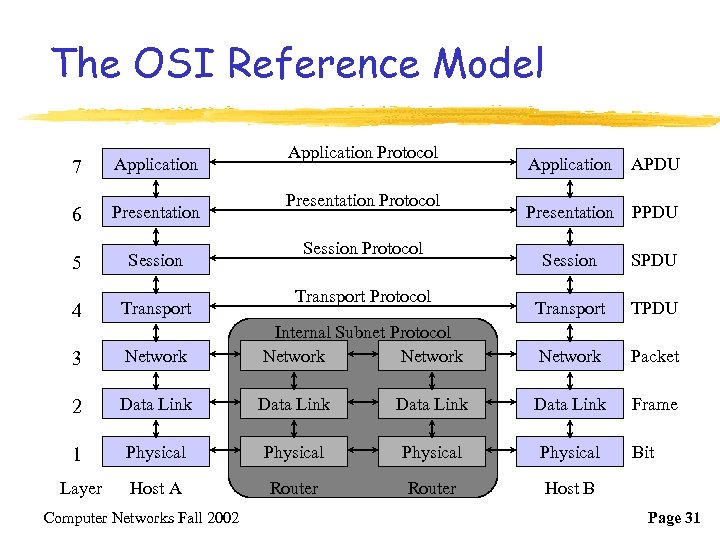
The OSI Reference Model 7 Application 6 Presentation 5 Session 4 Transport Application Protocol Presentation Protocol Session Protocol Transport Protocol Application APDU Presentation PPDU Session SPDU Transport TPDU Network Packet Frame 3 Network Internal Subnet Protocol Network 2 Data Link 1 Physical Layer Host A Router Host B Computer Networks Fall 2002 Bit Page 31
The Physical Layer r Functions m Concerned with transmission of unstructured bit stream over physical medium m Deals with the mechanical, electrical, functional, and procedural characteristics to access the physical medium r Examples m baud rate m simplex/half duplex/full duplex m parallel/serial m error detection (odd/even parity) m synchronization/asynchronization Computer Networks Fall 2002 Page 32
The Data Link Layer r Main task m to take a raw transmission facility and transform it into a line that appears free of transmission errors to the network layer m To Provide for the reliable transfer of data across the physical link r The sender m breaks the input data up into data frames m transmits the frames sequentially m processes the acknowledgement frames sent back by the receiver Computer Networks Fall 2002 Page 33
Issues of the Data Link Layer r error handling: solve the problem caused by damaged, lost and duplicate frames r flow control: keep a fast transmitter from drowning a slower receiver in data r piggybacking: attach data with ack. information r medium access control (MAC) ma sublayer that controls access to the shared channel in broadcast network Computer Networks Fall 2002 Page 34
The Network Layer r determine how packets are routed from source to destination (routing) r congestion control r accounting function r to allow heterogeneous networks to be interconnected m m address conversion packet conversion ( MTU, maximum transfer unit) r In broadcast networks m the network layer is often thin or even nonexistent Computer Networks Fall 2002 Page 35
The Transport Layer r Functions m Provides reliable, transparent transfer of data between end-points m Provides end-to-end error recovery and flow control r Tasks m fragmentation/reassembly m error control m Multiplexing (multi-connections) m flow control m quality of service Computer Networks Fall 2002 Page 36
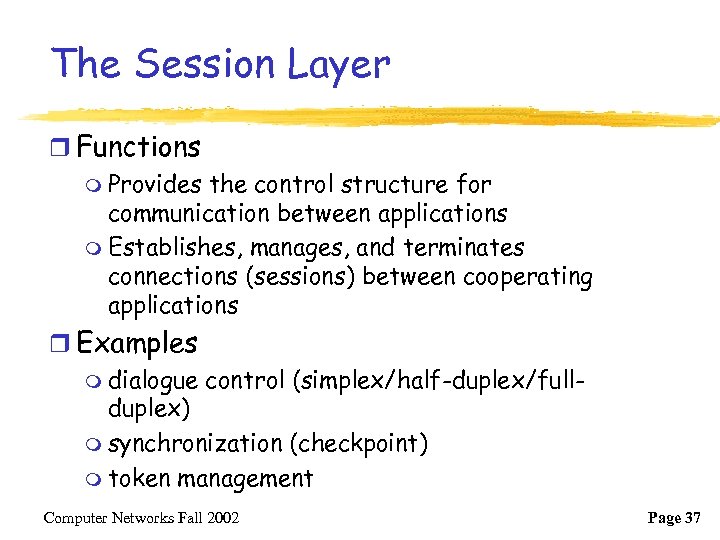
The Session Layer r Functions m Provides the control structure for communication between applications m Establishes, manages, and terminates connections (sessions) between cooperating applications r Examples m dialogue control (simplex/half-duplex/fullduplex) m synchronization (checkpoint) m token management Computer Networks Fall 2002 Page 37
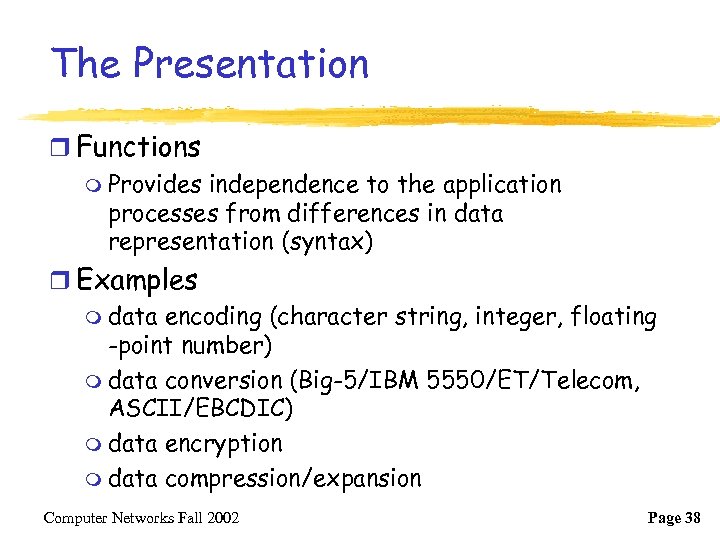
The Presentation r Functions m Provides independence to the application processes from differences in data representation (syntax) r Examples m data encoding (character string, integer, floating -point number) m data conversion (Big-5/IBM 5550/ET/Telecom, ASCII/EBCDIC) m data encryption m data compression/expansion Computer Networks Fall 2002 Page 38
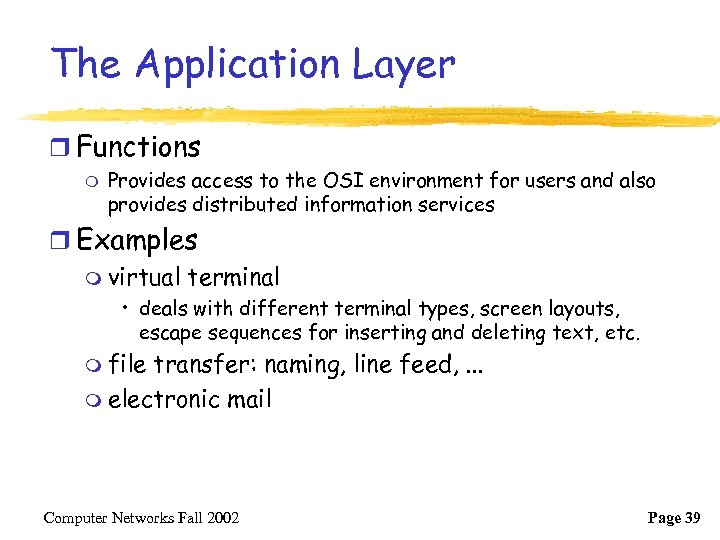
The Application Layer r Functions m Provides access to the OSI environment for users and also provides distributed information services r Examples m virtual terminal • deals with different terminal types, screen layouts, escape sequences for inserting and deleting text, etc. m file transfer: naming, line feed, . . . m electronic mail Computer Networks Fall 2002 Page 39
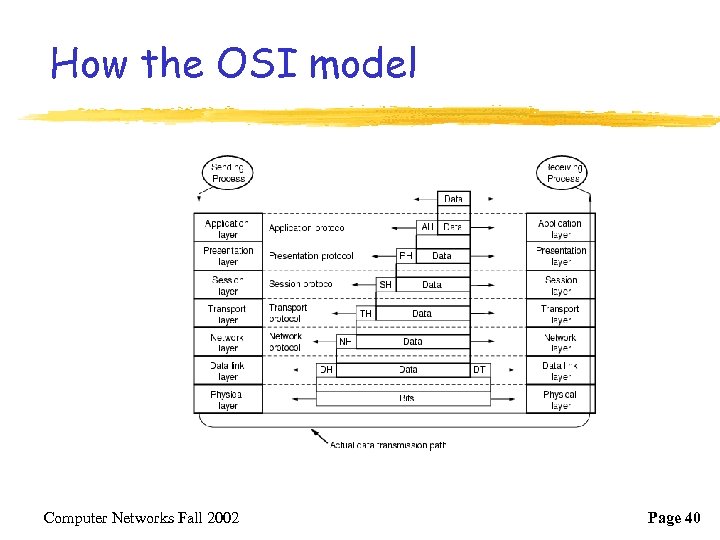
How the OSI model Computer Networks Fall 2002 Page 40
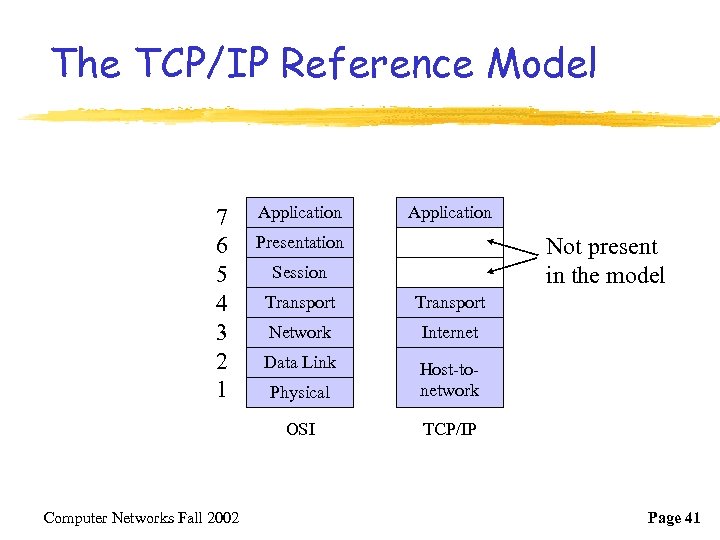
The TCP/IP Reference Model 7 6 5 4 3 2 1 Application Presentation Not present in the model Session Transport Network Internet Data Link Physical Host-tonetwork OSI Computer Networks Fall 2002 Transport TCP/IP Page 41
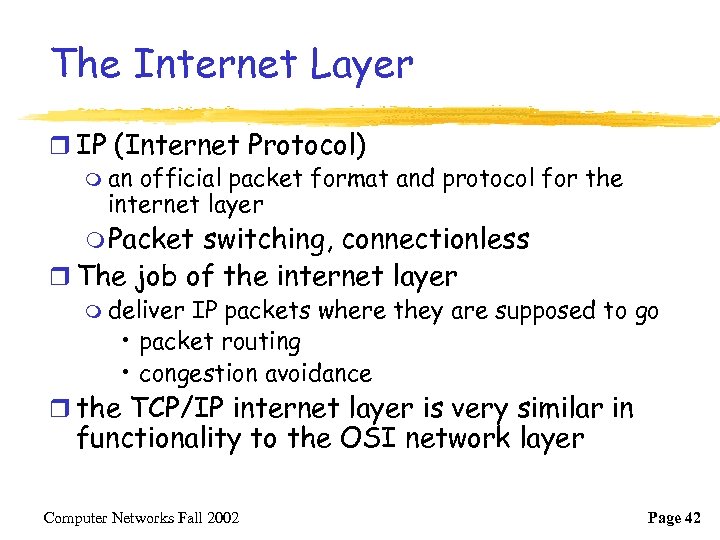
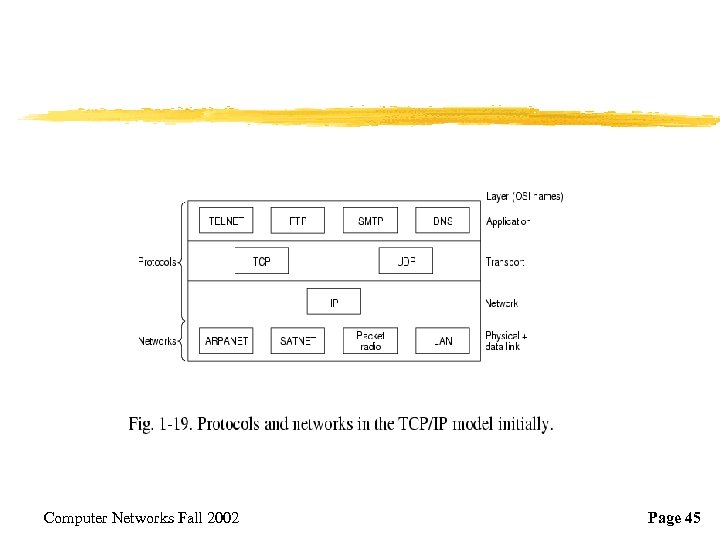
The Internet Layer r IP (Internet Protocol) m an official packet format and protocol for the internet layer m Packet switching, connectionless r The job of the internet layer m deliver IP packets where they are supposed to go • packet routing • congestion avoidance r the TCP/IP internet layer is very similar in functionality to the OSI network layer Computer Networks Fall 2002 Page 42
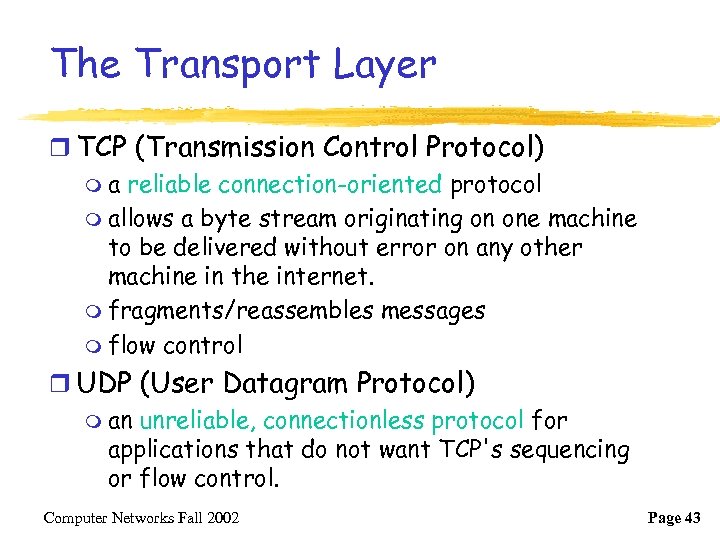
The Transport Layer r TCP (Transmission Control Protocol) m a reliable connection-oriented protocol m allows a byte stream originating on one machine to be delivered without error on any other machine in the internet. m fragments/reassembles messages m flow control r UDP (User Datagram Protocol) m an unreliable, connectionless protocol for applications that do not want TCP's sequencing or flow control. Computer Networks Fall 2002 Page 43
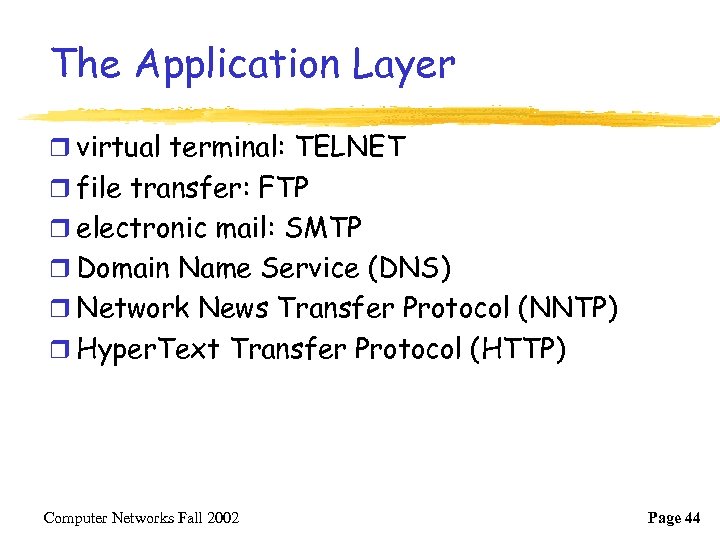
The Application Layer r virtual terminal: TELNET r file transfer: FTP r electronic mail: SMTP r Domain Name Service (DNS) r Network News Transfer Protocol (NNTP) r Hyper. Text Transfer Protocol (HTTP) Computer Networks Fall 2002 Page 44
Computer Networks Fall 2002 Page 45
Example Networks r Novell Netware r The ARPANET ( U. S. Do. D) r The NSFNET (U. S. National Science Foundation) r The TANET r The Internet Computer Networks Fall 2002 Page 46
The ARPANET (1957) r At the height of the Cold War, the Do. D wanted a command control network that could survive a nuclear war. r Advanced Research Projects Agency (ARPA) created by Do. D (Department of Defense) in response to the Soviet Union’s launching Sputnik in 1957. Computer Networks Fall 2002 Page 47
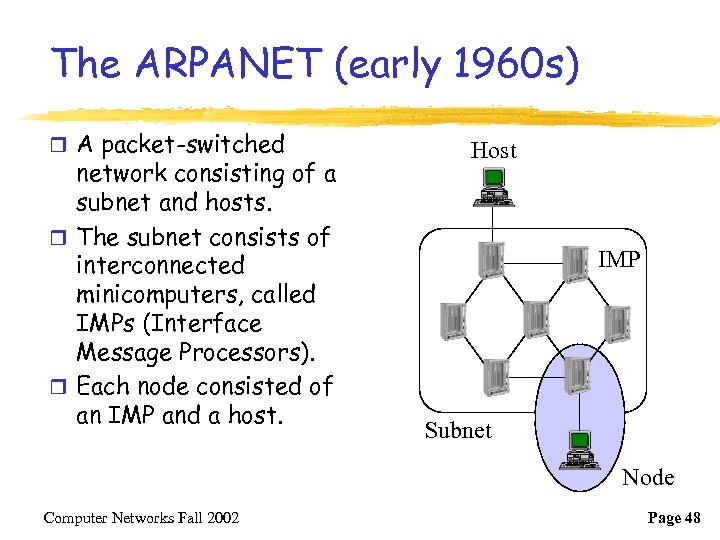
The ARPANET (early 1960 s) r A packet-switched network consisting of a subnet and hosts. r The subnet consists of interconnected minicomputers, called IMPs (Interface Message Processors). r Each node consisted of an IMP and a host. Host IMP Subnet Node Computer Networks Fall 2002 Page 48
The ARPANET (1968) r BBN, a consulting firm, awarded the contract to build the subnet. r IMP m Honeywell DDP-316 with 12 k 16 -bit RAM m interconnected by 56 kbps leased lines. r The software was split into two parts: subnet and host. Computer Networks Fall 2002 Page 49
The ARPANET Software r The subnet software consisted of m the IMP end of the host-IMP connection m the IMP-IMP protocol m source IMP to destination IMP protocol r The host software consisted of m the host end of the host-IMP connection m the host-host protocol m the application software Computer Networks Fall 2002 Page 50
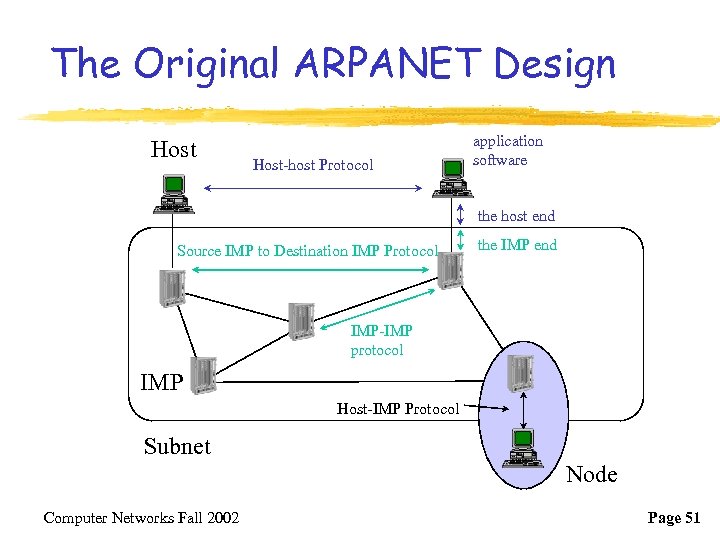
The Original ARPANET Design Host-host Protocol application software the host end Source IMP to Destination IMP Protocol the IMP end IMP-IMP protocol IMP Host-IMP Protocol Subnet Node Computer Networks Fall 2002 Page 51
TCP/IP (1983) r APAR m BBN m Berkely Unix • Networks based on TCP/IP r 1983 TCP/IP r 1980 –DNS m Mapping between host names and IPs Computer Networks Fall 2002 Page 52
Data Communication Services r Public network m offered by telephone companies m the subnet is owned by the network operator r Examples m Distributed Queue Dual Bus (DQDB) m Switched Multimegabit Data Service (SMDS) m X. 25 Networks m Frame Relay m Broadband ISDN and ATM Computer Networks Fall 2002 Page 53
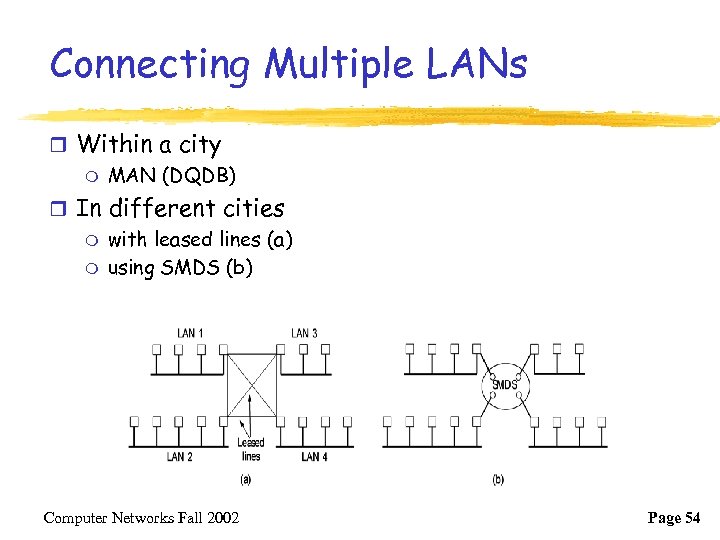
Connecting Multiple LANs r Within a city m MAN (DQDB) r In different cities m with leased lines (a) m using SMDS (b) Computer Networks Fall 2002 Page 54
Switched Multimegabit Data Service (SMDS) r Characteristics m acts like a high-speed LAN backbone m designed to handle bursty traffic m connectionless packet delivery serviceaddressing using telephone numbers m broadcasting m address screening • both outgoing and incoming screening • effectively builds a private network Computer Networks Fall 2002 Page 55
How SMDS Handles Bursty Traffic? r Each access line contains a counter m incremented at a constant rate m when a packer arrives • if the packet length is smaller – send the packer – the counter is decreased by the packet length • else – discard the packet m provides fast response when needed but prevents users from using up more bandwidth then they have agreed to pay for Computer Networks Fall 2002 Page 56
X. 25 Networks r Public packet-switched network (CCITT) m contains physical layer (X. 21), data link layer and network layer standards m 64 Kbps m connection-oriented m switched virtual circuit • created by sending a request packet to the network m permanent virtual circuit • set up in advance by agreement Computer Networks Fall 2002 Page 57
Frame Relay r Bare-bones connection-oriented service m simple protocol with minimal service • a bad frame is simply discarded • no acknowledgement or flow control m most work is done by user’s computer m can be thought of as a virtual leased line • data bursts may be sent at full speed • charge less than a physical leased line m 1. 5 Mbps Computer Networks Fall 2002 Page 58
Broadband ISDN (Integrated Service Digital Network) r A service to replace the entire telephone system and all the specialized networks r ATM (Asynchronous Transfer Mode) m underlying technology of B-ISDN m transmit all information in small, fixed-size packets called cell m why cell switching? • highly flexible: handles both constant rate traffic and variable rate traffic • digital switching of cells is easier • provides broadcasting feature Computer Networks Fall 2002 Page 59
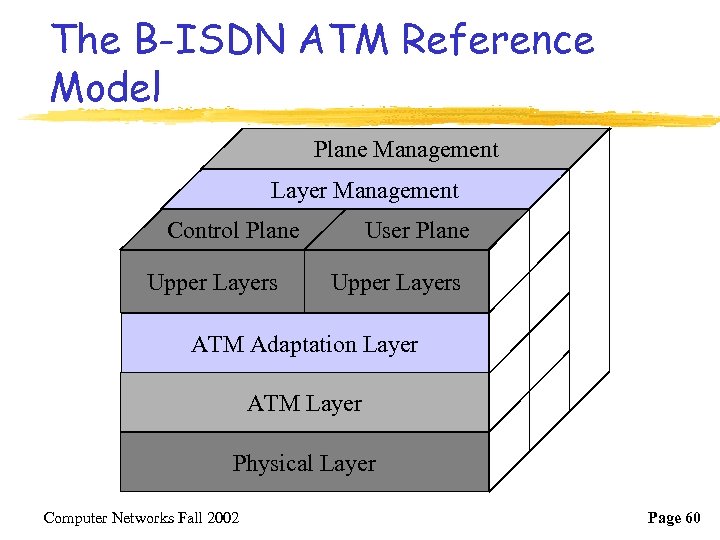
The B-ISDN ATM Reference Model Plane Management Layer Management User Plane Control Plane Upper Layers ATM Adaptation Layer ATM Layer Physical Layer Computer Networks Fall 2002 Page 60
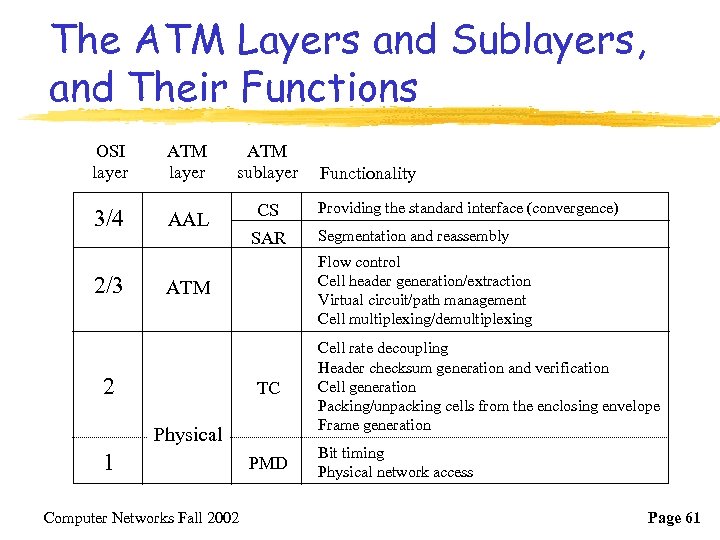
The ATM Layers and Sublayers, and Their Functions OSI layer ATM sublayer 3/4 AAL CS 2/3 SAR TC Physical 1 Computer Networks Fall 2002 Providing the standard interface (convergence) Segmentation and reassembly Flow control Cell header generation/extraction Virtual circuit/path management Cell multiplexing/demultiplexing ATM 2 Functionality PMD Cell rate decoupling Header checksum generation and verification Cell generation Packing/unpacking cells from the enclosing envelope Frame generation Bit timing Physical network access Page 61
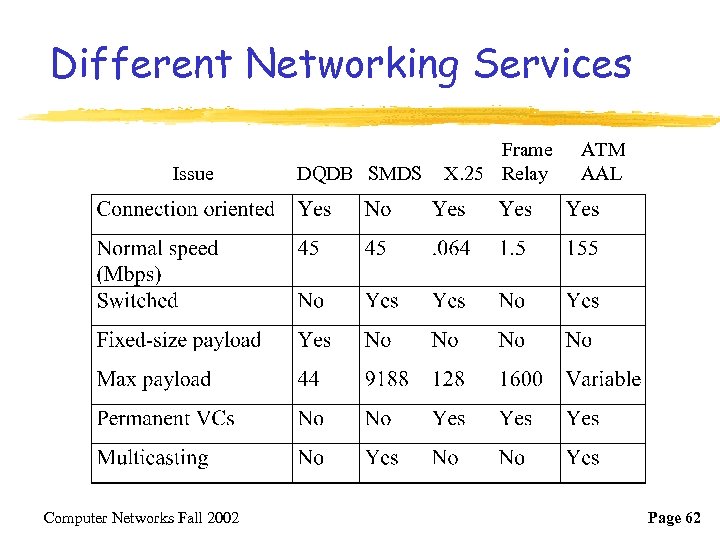
Different Networking Services Issue Computer Networks Fall 2002 DQDB SMDS Frame X. 25 Relay ATM AAL Page 62
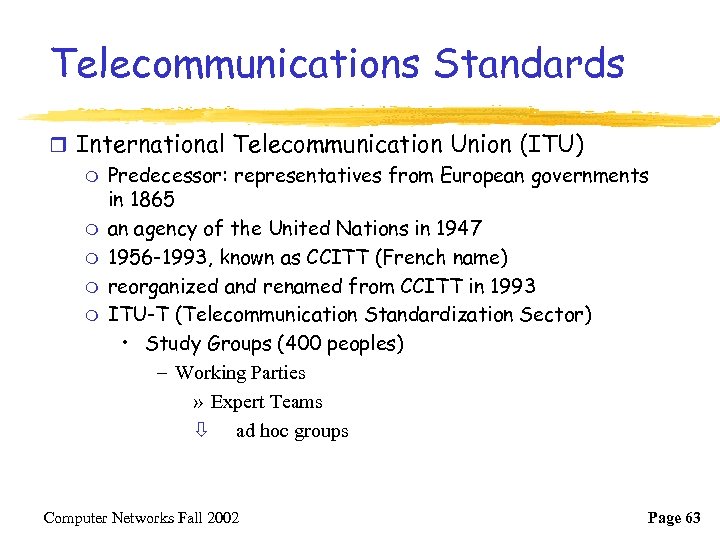
Telecommunications Standards r International Telecommunication Union (ITU) m Predecessor: representatives from European governments in 1865 m an agency of the United Nations in 1947 m 1956 -1993, known as CCITT (French name) m reorganized and renamed from CCITT in 1993 m ITU-T (Telecommunication Standardization Sector) • Study Groups (400 peoples) – Working Parties » Expert Teams ò ad hoc groups Computer Networks Fall 2002 Page 63
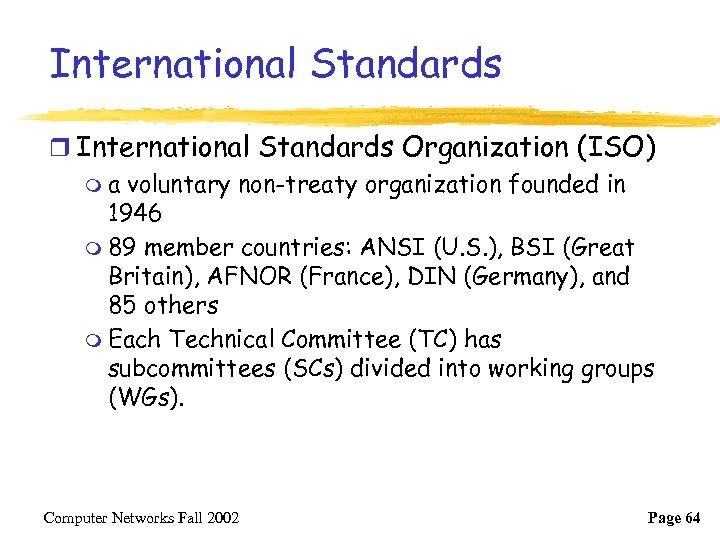
International Standards r International Standards Organization (ISO) m a voluntary non-treaty organization founded in 1946 m 89 member countries: ANSI (U. S. ), BSI (Great Britain), AFNOR (France), DIN (Germany), and 85 others m Each Technical Committee (TC) has subcommittees (SCs) divided into working groups (WGs). Computer Networks Fall 2002 Page 64
International Standards r American National Standards Institute (ANSI) ma private, nongovernmental, nonprofit organization m Working Groups r Institute of Electrical and Electronics Engineers (IEEE) m IEEE’s 802 standard for local area networks Computer Networks Fall 2002 Page 65
International Standards r ATM Forum m jointly founded in 1991 by Cisco Systems, NET/ADAPTIVE, Northern Telecom, and Sprint Computer Networks Fall 2002 Page 66
Internet Standards r Internet Activities (Architecture) Board (IAB) m created by Do. D when ARPANET set up m renamed in 1983 m Request For Comment (RFC) r Internet Engineering Task Force (IETF) m split from IAB in 1989 m Short-term engineering issues m Working groups m Internet Drafts: working documents • Tested by at least two independent sites for 4 months • RFC Computer Networks Fall 2002 Page 67
Homeworks r Q 1. m A comparison of the OSI and TCP Reference models r #14, #15, #17, #18, #23 Computer Networks Fall 2002 Page 68
Скачать презентацию Chapter 1 Introduction 王 俊 鑫 Chun-Hsin Wang
38d1b68632b8d247127a995ed84f55eb.ppt