


 Скачать презентацию Chapter 1 Ideas People and Economics in Texas
441f67f670ddfb93abfca37871f75aa3.ppt
- Количество слайдов: 24
 Chapter 1 Ideas, People, and Economics in Texas Politics
 Changing Face of Texas n Population Growth in the 1990 s q q n Largest decade increase in state’s history – 3. 9 million Growth in all 27 metropolitan areas, most of its counties, and most of its towns and cities Population became even more ethnically diverse Population is aging Effects of Population Growth q q q Workforce education Demand for social and human services
 People of Texas: Native Americans n Four Traditions q q Hunters and Gatherers: Coahuiltecan and Karankawan tribes Plains Indians: Tonkawas, Kiowa Apaches, and Comanches Puebloan Culture: Jumano Semisedentary tribes: Wichitas, Caddoes
 People of Texas: Native Americans n Three Reservations remain q q q n Alabama-Coushatta Tigua Kickapoo Native Americans and politics q Gambling: Tiguas and Speaking Rock Casino
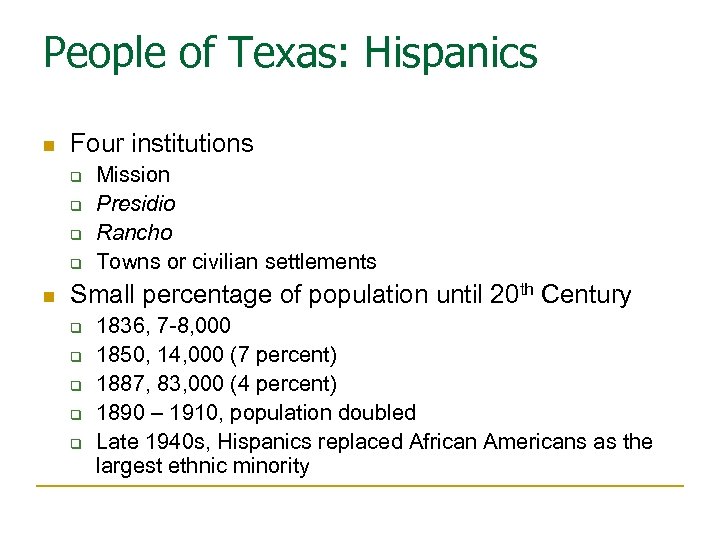 People of Texas: Hispanics n Four institutions q q n Mission Presidio Rancho Towns or civilian settlements Small percentage of population until 20 th Century q q q 1836, 7 -8, 000 1850, 14, 000 (7 percent) 1887, 83, 000 (4 percent) 1890 – 1910, population doubled Late 1940 s, Hispanics replaced African Americans as the largest ethnic minority
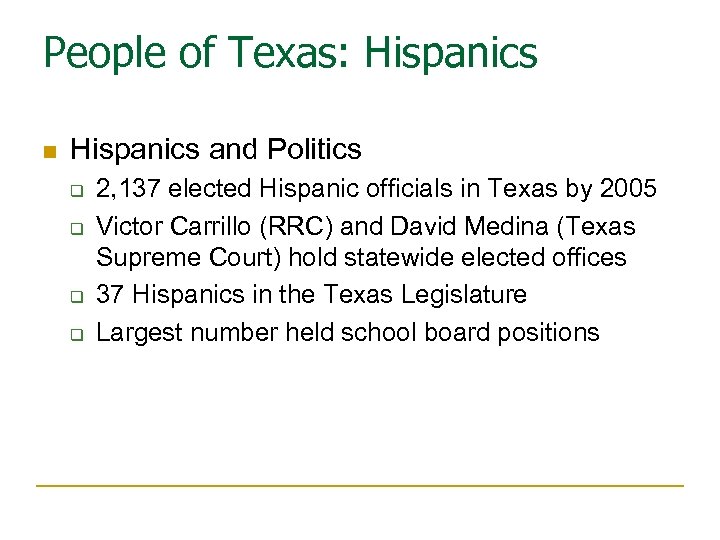 People of Texas: Hispanics n Hispanics and Politics q q 2, 137 elected Hispanic officials in Texas by 2005 Victor Carrillo (RRC) and David Medina (Texas Supreme Court) hold statewide elected offices 37 Hispanics in the Texas Legislature Largest number held school board positions
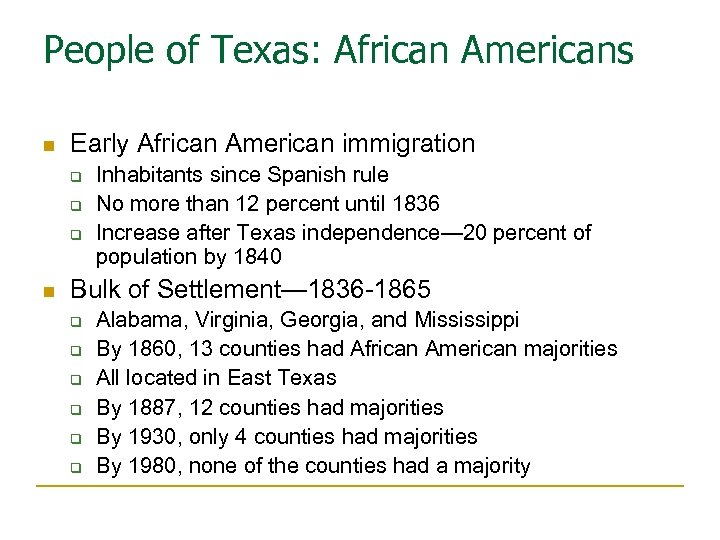 People of Texas: African Americans n Early African American immigration q q q n Inhabitants since Spanish rule No more than 12 percent until 1836 Increase after Texas independence— 20 percent of population by 1840 Bulk of Settlement— 1836 -1865 q q q Alabama, Virginia, Georgia, and Mississippi By 1860, 13 counties had African American majorities All located in East Texas By 1887, 12 counties had majorities By 1930, only 4 counties had majorities By 1980, none of the counties had a majority
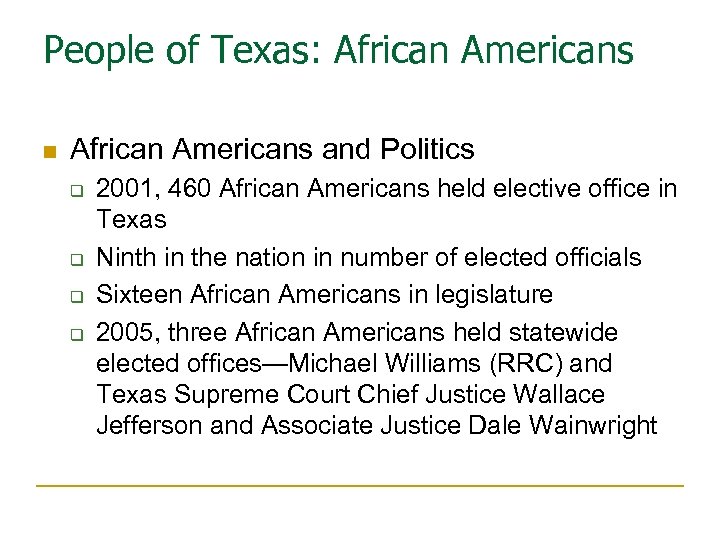 People of Texas: African Americans n African Americans and Politics q q 2001, 460 African Americans held elective office in Texas Ninth in the nation in number of elected officials Sixteen African Americans in legislature 2005, three African Americans held statewide elected offices—Michael Williams (RRC) and Texas Supreme Court Chief Justice Wallace Jefferson and Associate Justice Dale Wainwright
 People of Texas: Asian Americans n Early Immigrants q q n Recent Immigrants q q n Chinese who worked on railroads from 1869 to the 1880 s Early 1900 s, Japanese to help with rice cultivation Vietnamese refugees in the 1970 s Largest number in Houston Asian Americans and Politics q q Few elected officials House member Hubert Vo
 People of Texas: Anglos n Early Immigrants q q q 1815 – 1836, primarily upper Southerners from TN, KY, AR, NC 1836 – 1865, primarily lower Southerners from AL, GA, MS, LA. 1850, approximately equal in population Settled different areas of Texas—lower Southerners in East and Southeast Texas 1880 s, West Texas settled by upper Southerners and lower Midwesterners (IL, KS, and IA)
 Contemporary Population n Population Growth q n Nearly 21 million in 2000 census. Growth result of net inmigration and natural increase. Balance predicts high future growth rates. Urbanization q q 84 percent urban in 2000. 27 metropolitan areas--91 percent of growth Highest growth in central core and along the border with Mexico Houston, San Antonio, and Dallas are among 10 largest cities in the United States
 Contemporary Population n Diversity q q q n Hispanics made up 32 percent of the population in 2000, growing by 54 percent during last decade African Americans made up 12 percent of the population, growing by 19 percent Anglos increase by less than 10 percent Population Projections q q q Anglos ceased to be a majority in 2004 Hispanics will become largest ethnic group during the early 2020 s Hispanics become a majority by 2040
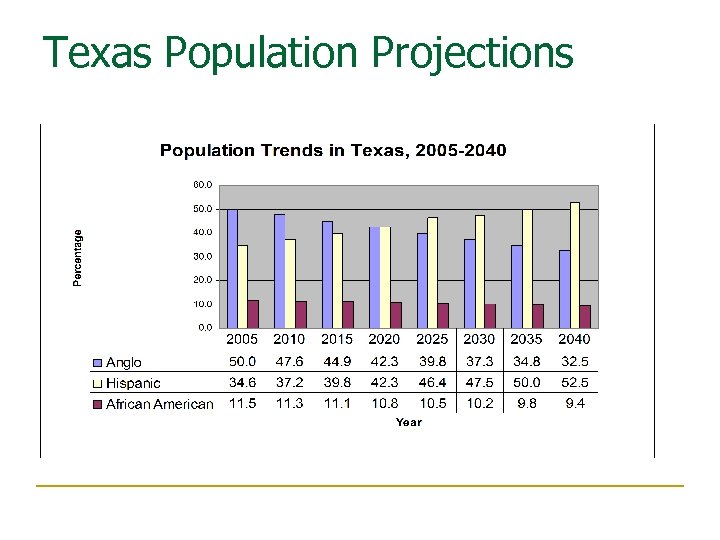 Texas Population Projections
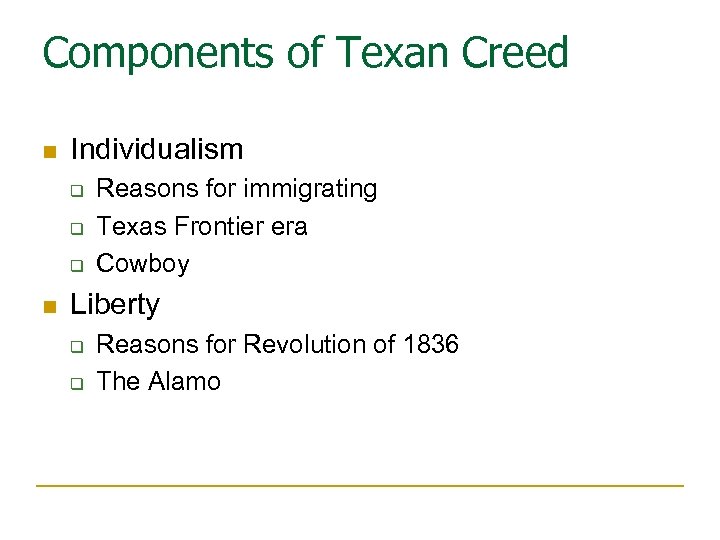 Components of Texan Creed n Individualism q q q n Reasons for immigrating Texas Frontier era Cowboy Liberty q q Reasons for Revolution of 1836 The Alamo
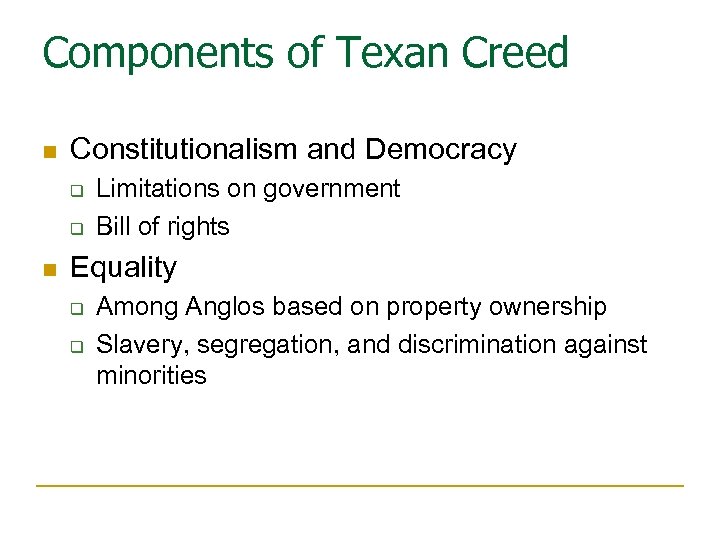 Components of Texan Creed n Constitutionalism and Democracy q q n Limitations on government Bill of rights Equality q q Among Anglos based on property ownership Slavery, segregation, and discrimination against minorities
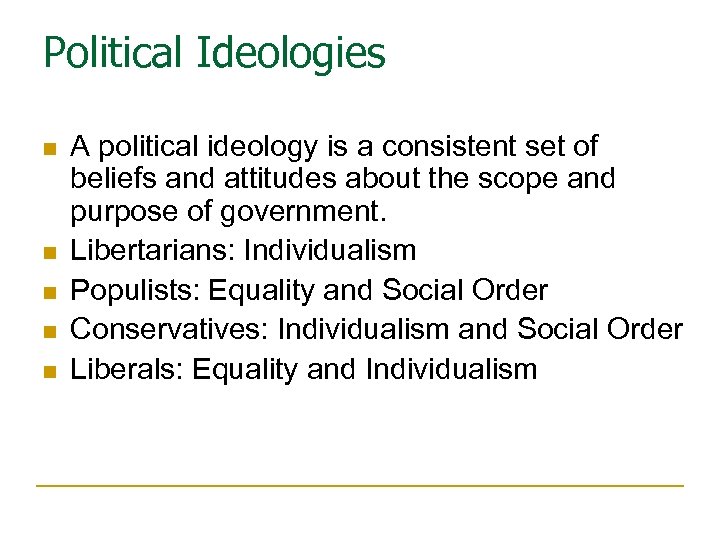 Political Ideologies n n n A political ideology is a consistent set of beliefs and attitudes about the scope and purpose of government. Libertarians: Individualism Populists: Equality and Social Order Conservatives: Individualism and Social Order Liberals: Equality and Individualism
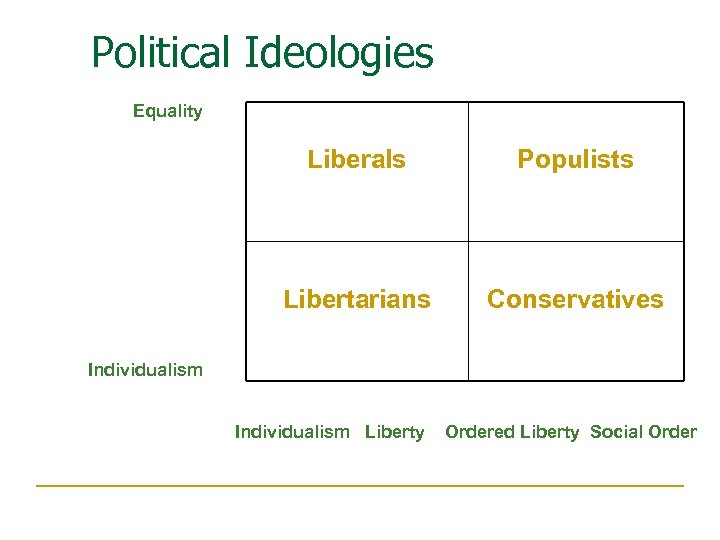 Political Ideologies Equality Liberals Populists Libertarians Conservatives Individualism Liberty Ordered Liberty Social Order
 Economic Heritage n Cotton was basis for the first economy q q Southern planters Crop barged to Gulf of Mexico Shipped to Europe or U. S. through New Orleans Galveston was commercial center from 1840 s to 1880 s
 Economic Heritage n n Cattle Kingdom dominated from late 1800 s Petroleum basis for Texas economy during much of the 20 th century q q q Spindletop was first major discovery in 1901. West Texas oil industry established in 1923. East Texas field was largest find in 1930.
 Contemporary Economy n n Since the 1980 s, the Texas economy has become more diverse, more nationalized, and more globalized. Diversity in products and economic activities Nationalized because the Texas economy resembles the U. S. economy although grew at faster rate from 1990 -2000 Globalized in distribution of goods and economic competition
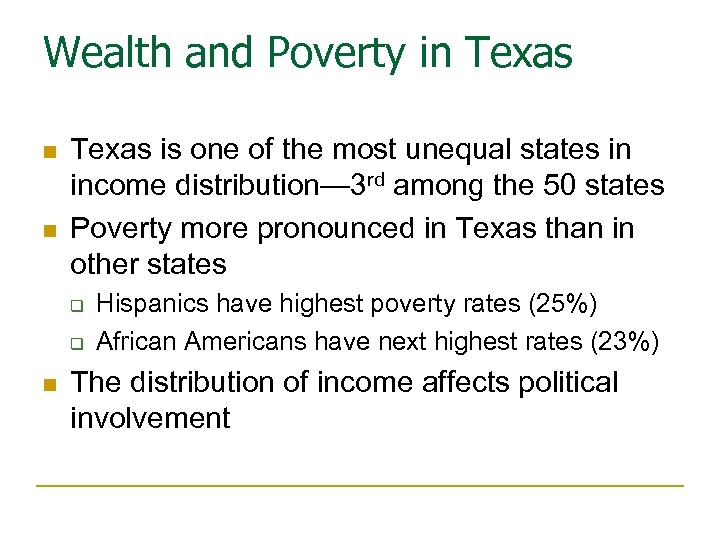 Wealth and Poverty in Texas n n Texas is one of the most unequal states in income distribution— 3 rd among the 50 states Poverty more pronounced in Texas than in other states q q n Hispanics have highest poverty rates (25%) African Americans have next highest rates (23%) The distribution of income affects political involvement
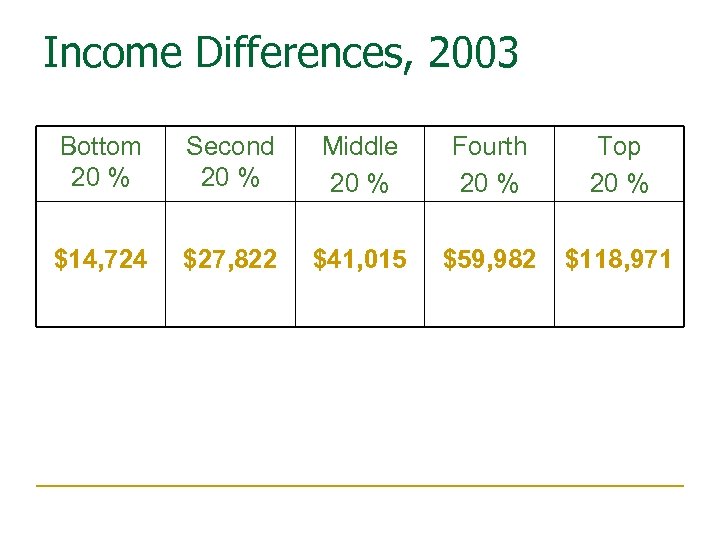 Income Differences, 2003 Bottom 20 % Second 20 % Middle 20 % Fourth 20 % Top 20 % $14, 724 $27, 822 $41, 015 $59, 982 $118, 971
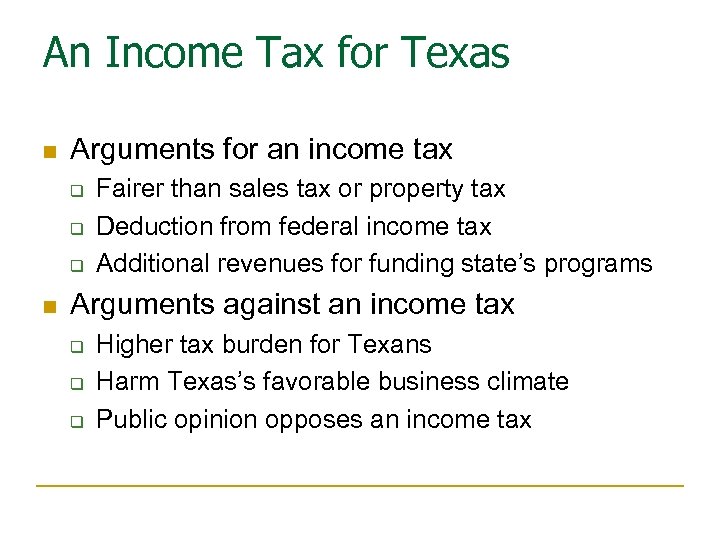 An Income Tax for Texas n Arguments for an income tax q q q n Fairer than sales tax or property tax Deduction from federal income tax Additional revenues for funding state’s programs Arguments against an income tax q q q Higher tax burden for Texans Harm Texas’s favorable business climate Public opinion opposes an income tax
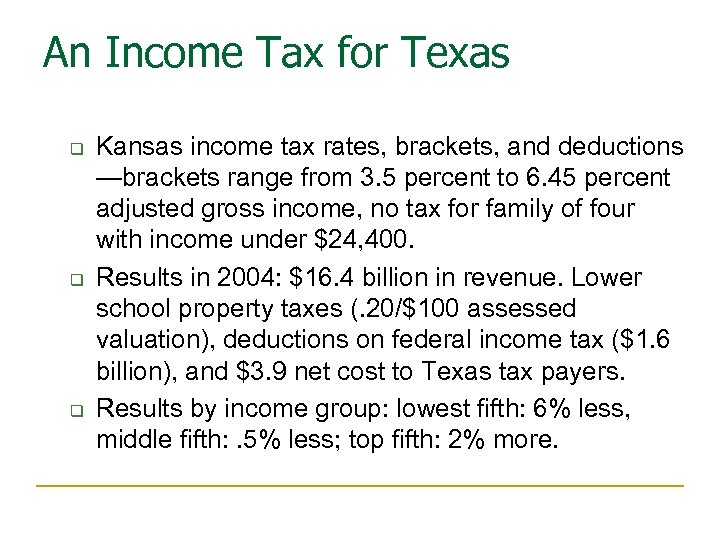 An Income Tax for Texas q q q Kansas income tax rates, brackets, and deductions —brackets range from 3. 5 percent to 6. 45 percent adjusted gross income, no tax for family of four with income under $24, 400. Results in 2004: $16. 4 billion in revenue. Lower school property taxes (. 20/$100 assessed valuation), deductions on federal income tax ($1. 6 billion), and $3. 9 net cost to Texas tax payers. Results by income group: lowest fifth: 6% less, middle fifth: . 5% less; top fifth: 2% more.