Скачать презентацию CHAPTER -1 Energy is defined as
2fafe1e43c7b79f31d16fd5f36251b88.ppt
- Количество слайдов: 84
 CHAPTER -1
 Energy is defined as the capacity to do the work Various types of Energy Kinetic energy Potential energy Electrical energy Heat energy, etc.
 PRIMARY AND SECONDARY ENERGY SOURCES RENEWABLE AND NON-RENEWABLE ENERGY SOURCES
 Primary energy sources are those that are either found or stored in nature. Common primary energy sources are coal, solar, wind, oil, natural gas, and biomass (such as wood). Other primary energy sources available include nuclear energy from radioactive substances, thermal energy stored in earth’s interior, and potential energy due to earth’s gravity.
 Primary energy sources are mostly converted in industrial utilities into secondary energy sources; for example coal, oil or gas converted into steam and then electricity
 WIND POWER SOLAR ENERGY GEO-THERMAL ENERGY TIDAL POWER HYDEL POWER
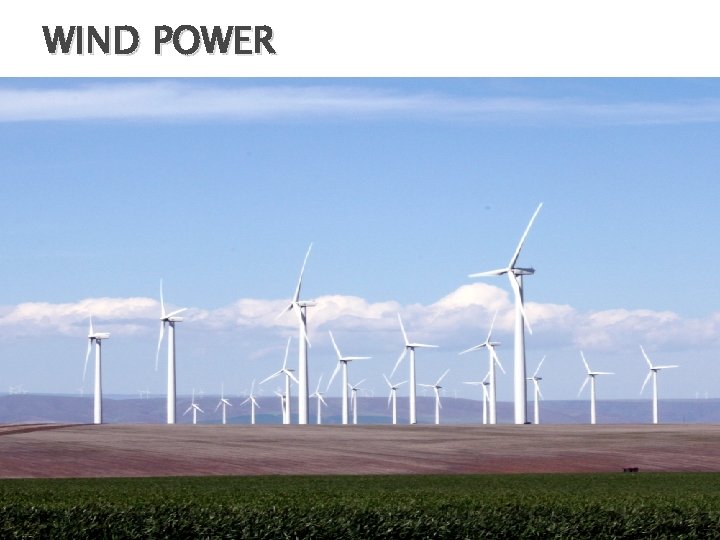 WIND POWER
 COAL OIL GAS
 Global Energy scenario World oil and gas reserves are estimated to last just 45~50 years and 65~70 years respectively. Coal is likely to last over 200 years.
 CHAPTER -2
 ENERGY CONSERVATION IS DEFINED AS UTILISING ENERGY MORE EFFICIENTLY. THE PROCESS OF MINIMIZING WASTEFUL EXPENDITURE USING AVAILABLE ENERGY, EFFICIENTLY AND LOGICALLY.
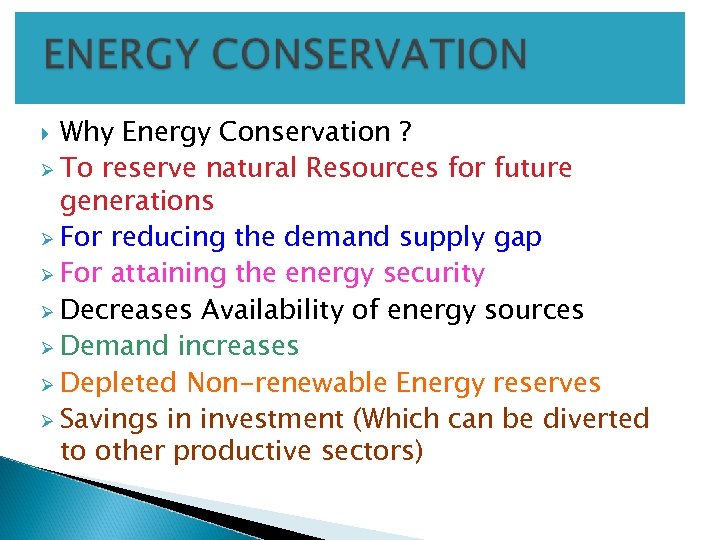 Why Energy Conservation ? Ø To reserve natural Resources for future generations Ø For reducing the demand supply gap Ø For attaining the energy security Ø Decreases Availability of energy sources Ø Demand increases Ø Depleted Non-renewable Energy reserves Ø Savings in investment (Which can be diverted to other productive sectors)
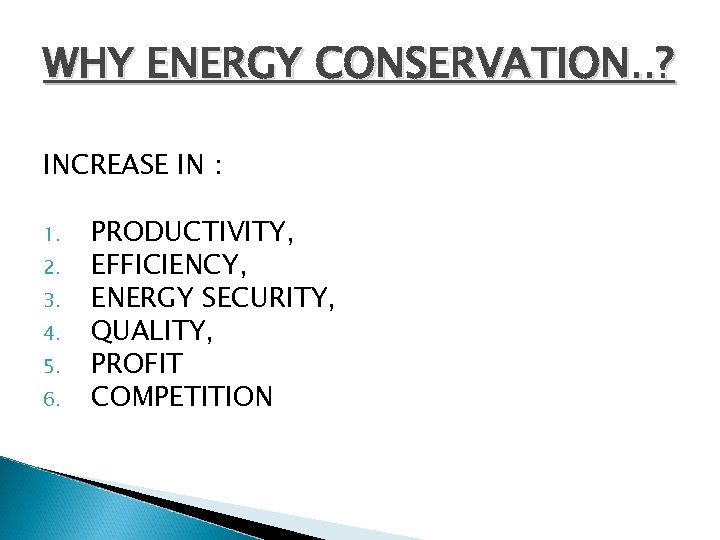 WHY ENERGY CONSERVATION. . ? INCREASE IN : 1. 2. 3. 4. 5. 6. PRODUCTIVITY, EFFICIENCY, ENERGY SECURITY, QUALITY, PROFIT COMPETITION
 WHY ENERGY CONSERVATION. . ? 1. 2. REDUCTION IN POLLUTION ENERGY IMPORT CHARGES
 CHAPTER -3
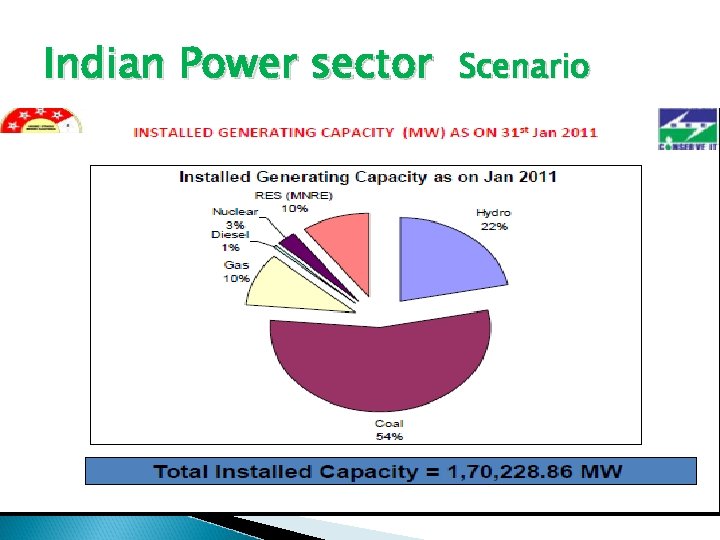 Indian Power sector Scenario
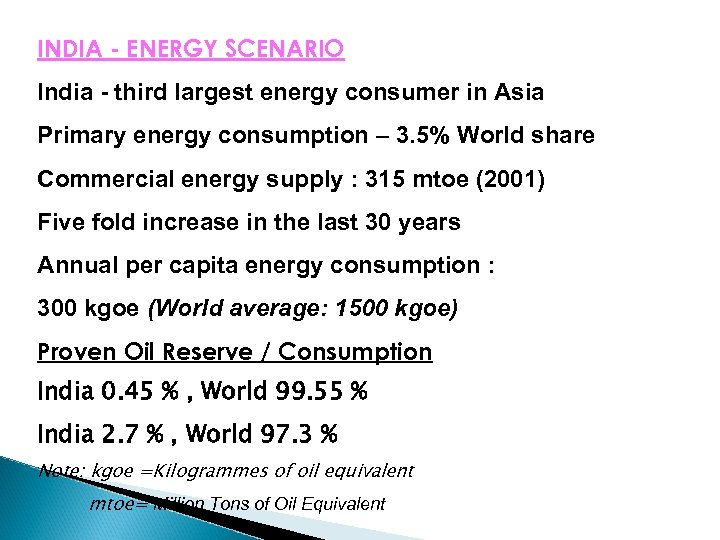 INDIA - ENERGY SCENARIO India - third largest energy consumer in Asia Primary energy consumption – 3. 5% World share Commercial energy supply : 315 mtoe (2001) Five fold increase in the last 30 years Annual per capita energy consumption : 300 kgoe (World average: 1500 kgoe) Proven Oil Reserve / Consumption India 0. 45 % , World 99. 55 % India 2. 7 % , World 97. 3 % Note: kgoe =Kilogrammes of oil equivalent mtoe= Million Tons of Oil Equivalent
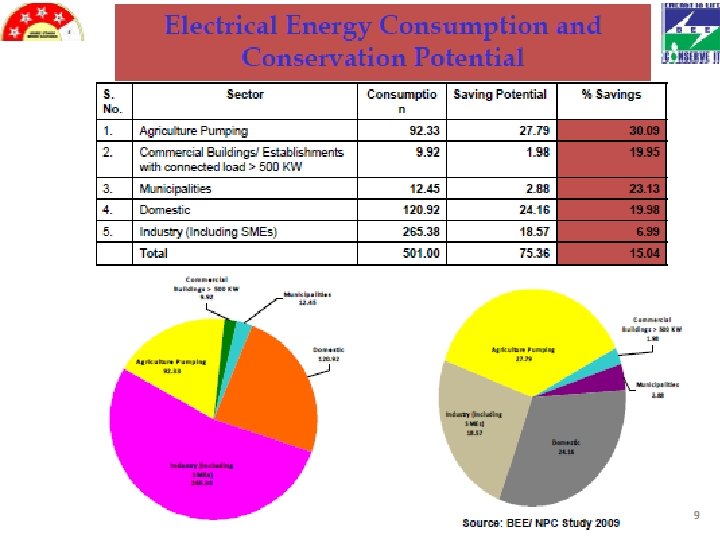
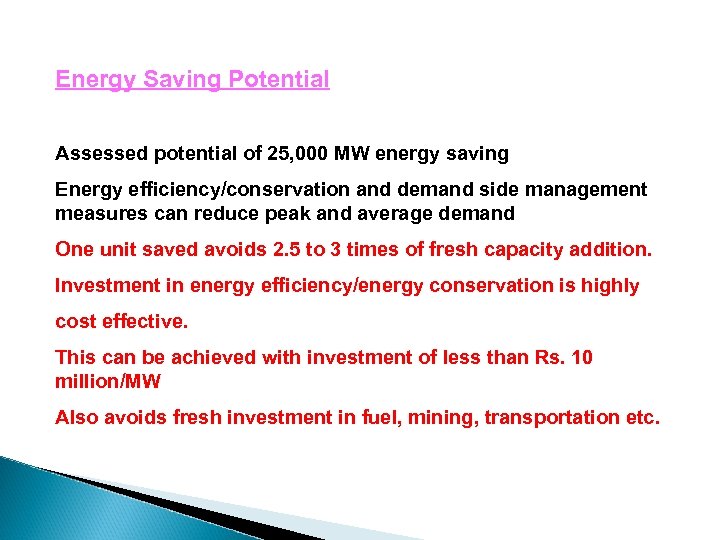 Energy Saving Potential Assessed potential of 25, 000 MW energy saving Energy efficiency/conservation and demand side management measures can reduce peak and average demand One unit saved avoids 2. 5 to 3 times of fresh capacity addition. Investment in energy efficiency/energy conservation is highly cost effective. This can be achieved with investment of less than Rs. 10 million/MW Also avoids fresh investment in fuel, mining, transportation etc.
 CHAPTER -4
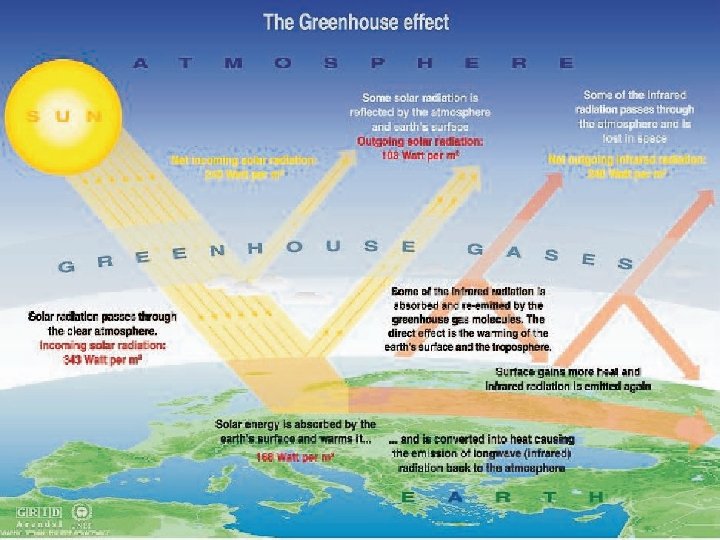
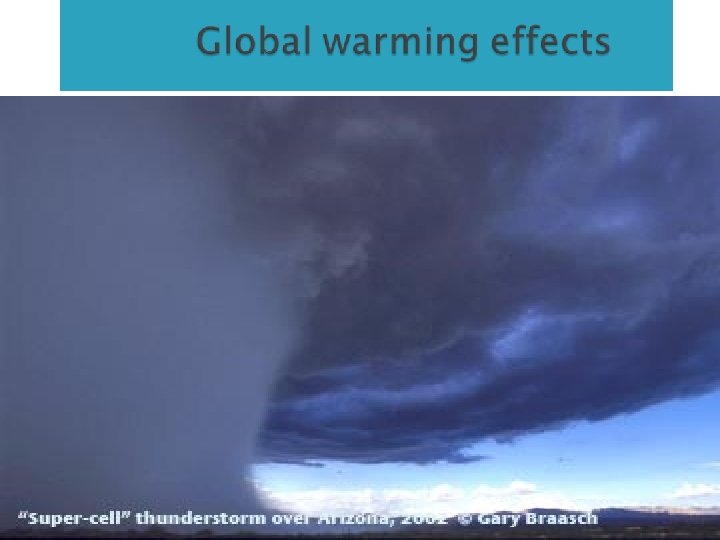
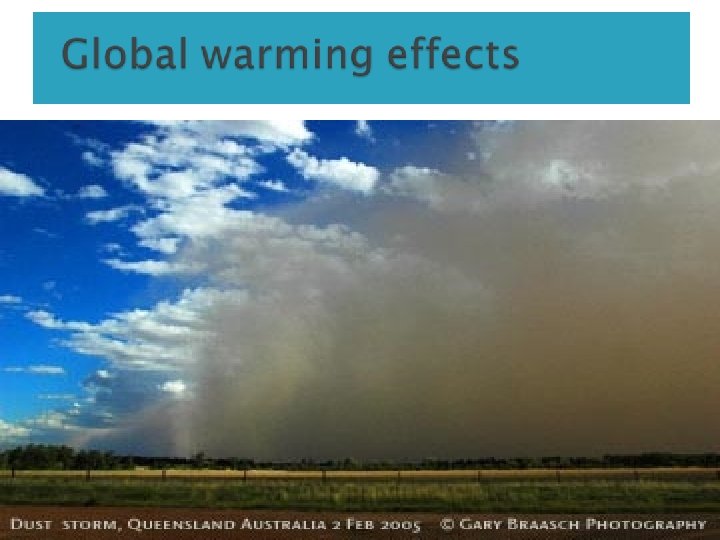
 GLOBAL WARMING Human activities lead to generation of certain gases through –Combustion of fuel –Land use changes –Agricultural practices –Various industrial processes Green House Effect The heating up of earth’s atmosphere due to trapping of long wave length infrared rays (reflected from earth’s surface) by the carbon dioxide layer in the atmosphere is called Green house effect.
 Greenhouse gases makeup only 1 percent of the atmosphere, but they act as a blanket around the earth, or like a glass roof of a greenhouse and keep the earth 30 degrees warmer than it would be otherwise - without greenhouse gases, earth would be too cold to live. Human activities that are responsible for making the greenhouse layer thicker are emissions of carbon dioxide from the combustion of coal, oil and natural gas; by additional methane and nitrous oxide from farming activities and changes in land use; and by several man made gases that have a long life in the atmosphere.
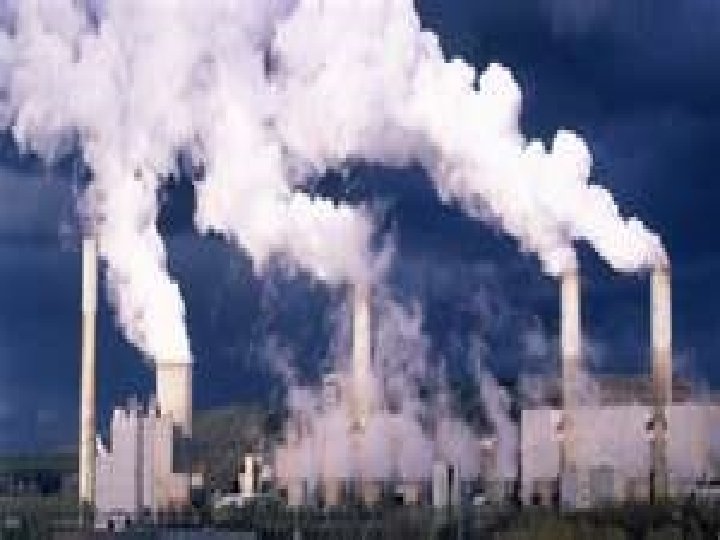
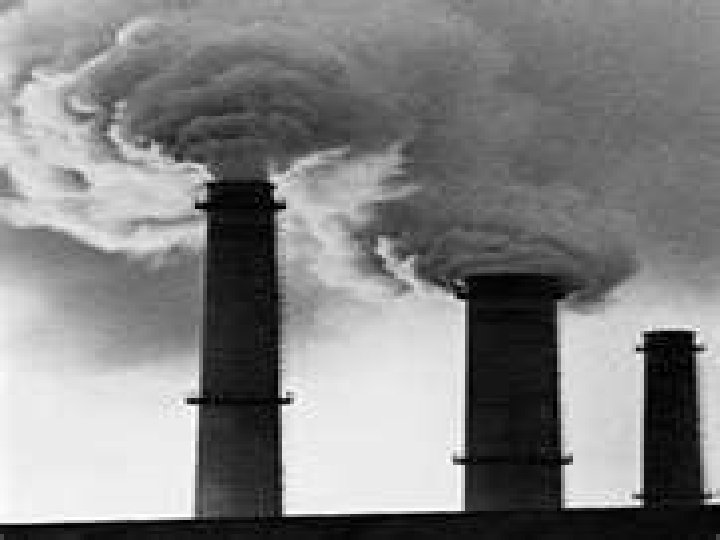
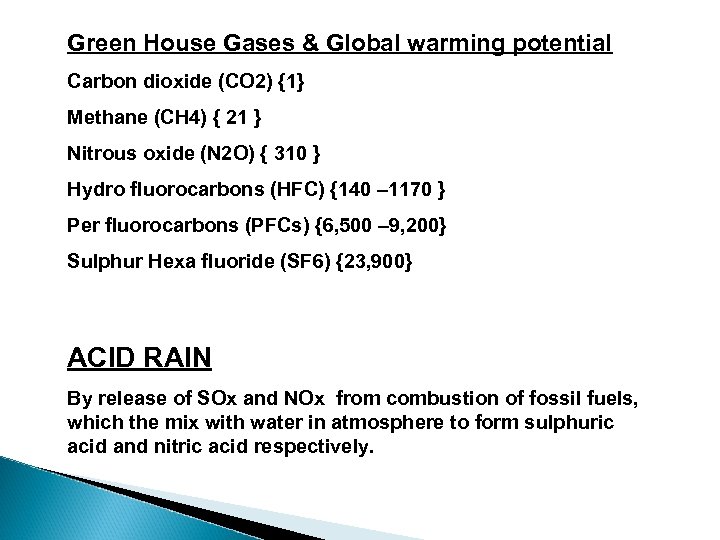 Green House Gases & Global warming potential Carbon dioxide (CO 2) {1} Methane (CH 4) { 21 } Nitrous oxide (N 2 O) { 310 } Hydro fluorocarbons (HFC) {140 – 1170 } Per fluorocarbons (PFCs) {6, 500 – 9, 200} Sulphur Hexa fluoride (SF 6) {23, 900} ACID RAIN By release of SOx and NOx from combustion of fossil fuels, which the mix with water in atmosphere to form sulphuric acid and nitric acid respectively.
 Use of Resources to meet our needs without depriving the resources for future generations.
 CHAPTER -5
 OPTIMUM UTILIZATION OF EQUIPMENTS AVOID WASTE OF ENERGY PROMOTING RENEWABLE SOURCES OF ENERGY
 Energy conservation Govt. initiatives
 The Energy Conservation Act, 2001 and its Features Policy Framework - Energy Conservation Act 2001 With the background of high energy saving potential and its benefits, bridging the gap between demand supply, reducing environmental emissions through energy saving, and to effectively overcome the barrier, the Government of India has enacted the Energy Conservation Act - 2001
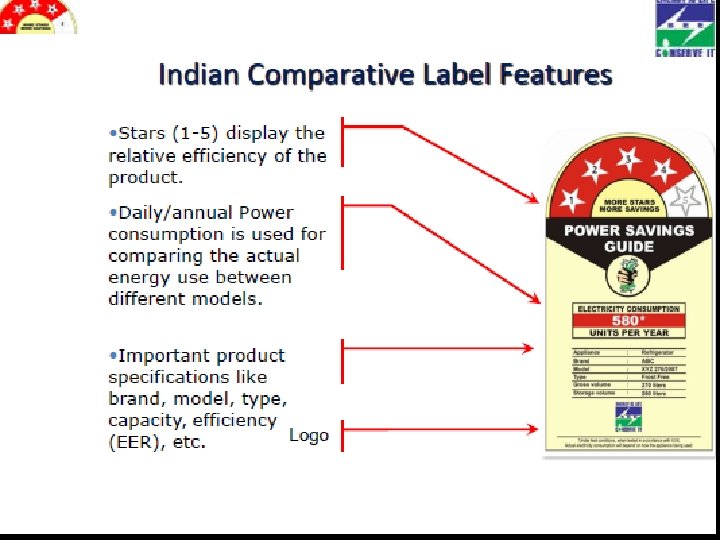
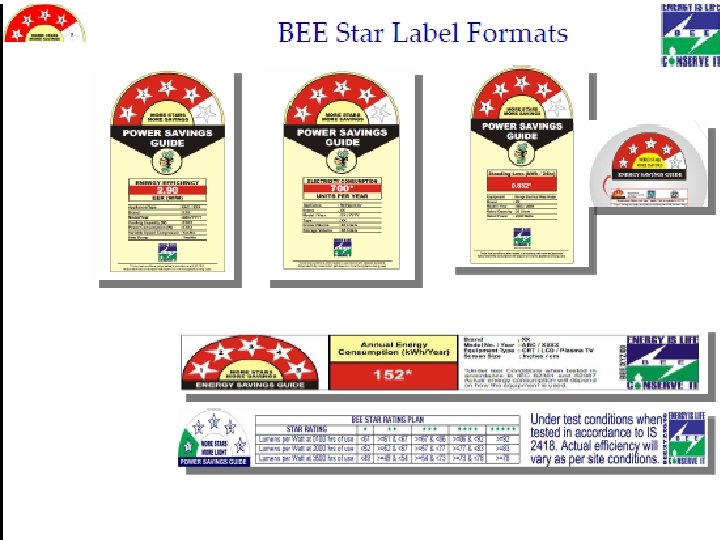
 The Energy Conservation Act, 2001 and its Features Under the provisions of the Act, Bureau of Energy Efficiency has been established with effect from 1 st March 2002 Standards and Labeling (S & L) has been identified as a key activity for energy efficiency improvement. The S & L program, when in place would ensure that only energy efficient equipment and appliance would be made available to the consumers.
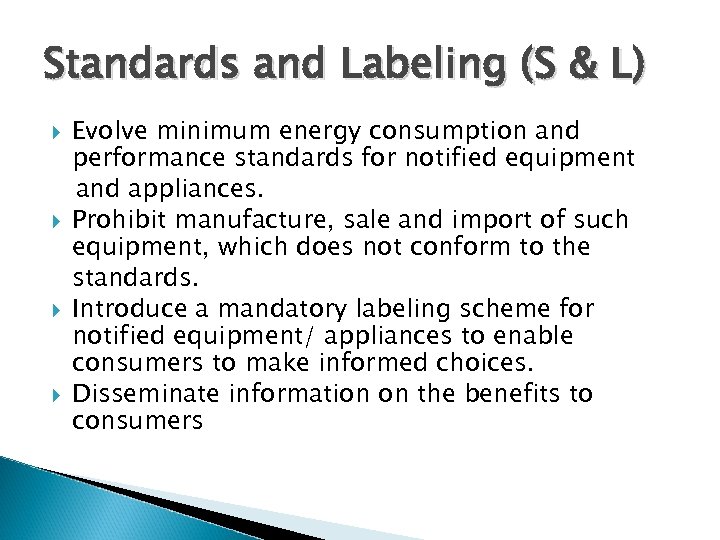 Standards and Labeling (S & L) Evolve minimum energy consumption and performance standards for notified equipment and appliances. Prohibit manufacture, sale and import of such equipment, which does not conform to the standards. Introduce a mandatory labeling scheme for notified equipment/ appliances to enable consumers to make informed choices. Disseminate information on the benefits to consumers
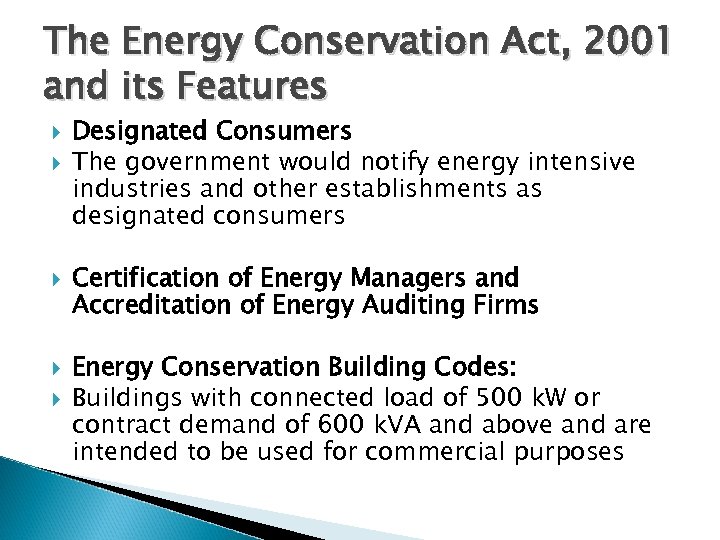 The Energy Conservation Act, 2001 and its Features Designated Consumers The government would notify energy intensive industries and other establishments as designated consumers Certification of Energy Managers and Accreditation of Energy Auditing Firms Energy Conservation Building Codes: Buildings with connected load of 500 k. W or contract demand of 600 k. VA and above and are intended to be used for commercial purposes
 CHAPTER -6
 Lighting
 Terminologies • Flux emitted by lamp – lumens • Luminous Efficacy – Lumens / Watt • Illuminance = Lumens / sq. meter (lux) • Colour Rendering Index – Colours of surfaces illuminated by a given light source
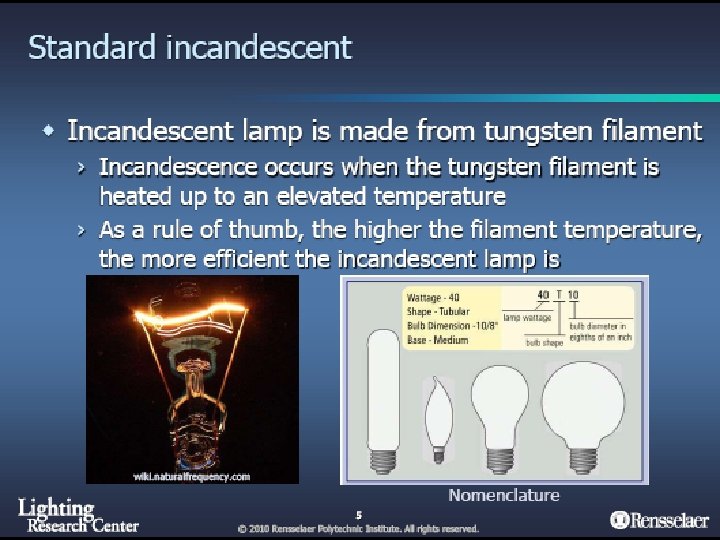
 Types of Lamps • Incandescent lamps (GLS) • Gas discharge lamps • Fluorescent lamps (FTL) • Compact fluorescent lamps • Mercury vapour lamps • Sodium vapour lamps • Metal Halide lamps • LED lamps
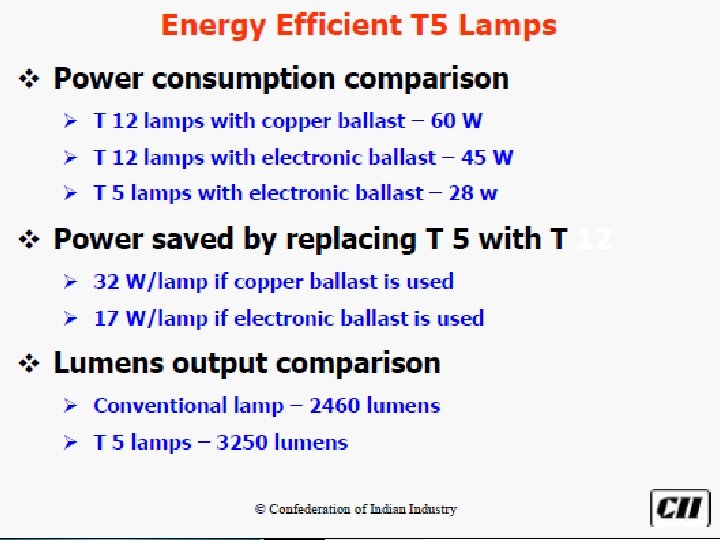
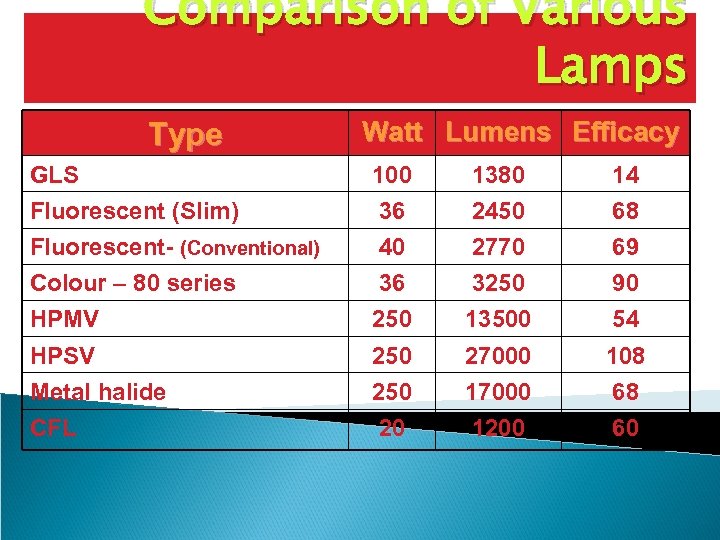 Comparison of Various Lamps Type Watt Lumens Efficacy GLS 100 1380 14 Fluorescent (Slim) 36 2450 68 Fluorescent- (Conventional) 40 2770 69 Colour – 80 series 36 3250 90 HPMV 250 13500 54 HPSV 250 27000 108 Metal halide 250 17000 68 CFL 20 1200 60
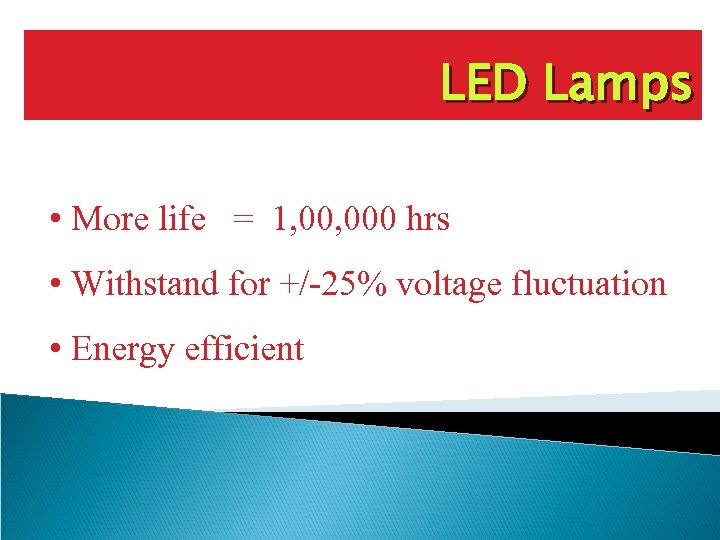 LED Lamps • More life = 1, 000 hrs • Withstand for +/-25% voltage fluctuation • Energy efficient
 Conservation in lighting energy Lighting Reduce Lighting Required Utilize Task Lighting Controls Selective switching Programmable timing control Occupancy sensors Use Day lighting
 Installation of HF Electronic Ballast • Conventional Ballast – Inherent losses 14 -15 Watts /choke • HF Ballast – Operates at high frequency 20 KHz to 22 KHz • Low Loss – 1 to 2 Watts/Choke
 Case Study Replace Conventional Ballast with Electronic Ballast Benefits: @ Energy Loss 1 -2 Watts @ No need for starter @ Instant start-up without flickering
 CHAPTER -7
 Conservation in water heating Water Heating -Reduce Water Heating Loads Use solar water heating system -reduce System Losses Increase Insulation on Hot Water Pipes Increase Insulation on Water Storage Tanks
 The primary requirement for installation of Solar Water Heating System is a shadow free area with clear access to the South sky.
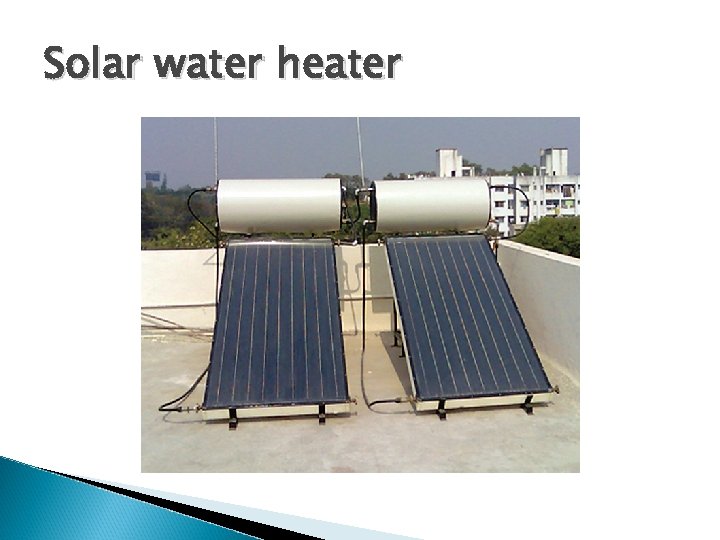 Solar water heater
 CHAPTER -8
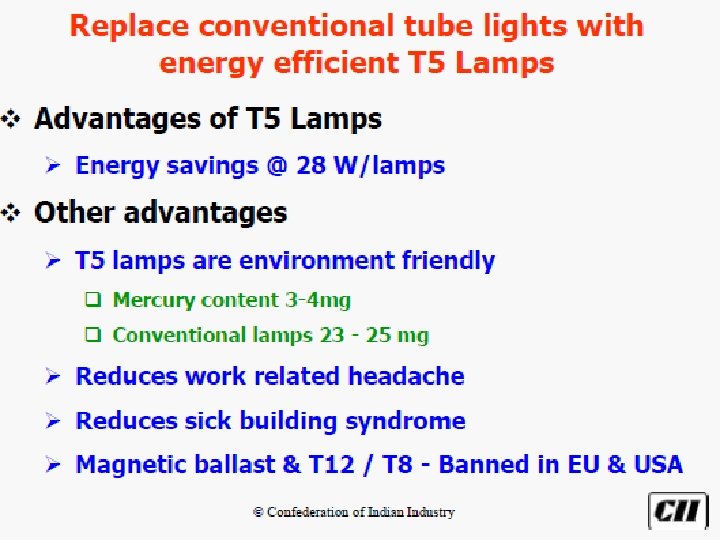
 EC IN DOMESTIC SECTOR ( at a glance) LIGHTING USE ENERGY EFFICIENT LAMPS SWITCH OFF LAMPS, IF IT IS NOT REQUIRED USE AUTOMATIC LIGHTING CONTROL DESIGN THE LIGHTING AS REQUIRED ILLUMINATION CLEAN THE LAMPS PERIODICALLY REPLACE THE LAMPS AFTER ITS LIFE CYCLE KEEP THE LEVEL OF ILLUMINATION
 LIGHTING Reduce excessive illumination level Maximize the sun light Examine the scope of replacement of lamp Replace conventional ballast Occupancy sensors Use LEDs Day LIGHT linking system Localized switching Select the interior colours of light reflection
 EC IN DOMESTIC SECTOR IRON BOX AUTOMATIC IS BETTER DO NOT IRON DURING AT PEAK LOAD TIME SWITCH ON THE SUPPLY AFTER EVERYTHING WILL READY SELECT THERMOSTAT ACCORDING TO THE REQUIRED LEVEL STEAM TYPE ARE CONSUMING MORE ENERGY
 EC IN DOMESTIC SECTOR MIXER USE APPROXIMATE QUANTITY IN THE JAR USE REQUIRED WATER SHARPEN THE BLADE FREQUENTLY USE APPROPRIATE BLADE DO NOT OVERLOAD THE JAR
 EC IN DOMESTIC SECTOR AIR CONDITIONER USE SHADES TO THE OUT DOOR UNIT USE THERMAL INSULATION IN THE ROOM DO NOT USE INCANDESCENT LAMPS ON THE AIRCONDITIONED AREA SWITCH OFF THE AC ONE HOUR BEFORE LEAVING THE ROOM SELECT THE REQUIRED TEMPERATURE ONLY
 EC IN DOMESTIC SECTOR AIR CONDITIONER DO NOT OPEN THE DOOR FREEQUENTLY USE THERMAL INSULATION TO THE CEILING USE HIGH EFFICIENT COMPRESSORS STAR LABELLED AC IS BETTER SWITCH OFF THE SUPPLY THROUGH SWITCH ONLY (NOT THROUGH REMOTE)
 EC IN DOMESTIC SECTOR WASHING MACHINE APPROPRIATE WATER REQUIRED QUANTITY MATERALS HEATING MODE IS NOT REQUIRED FRONT LOADING IS MORE EFFICIENT DO NOT OVERLOAD
 EC IN DOMESTIC SECTOR FAN USE ELECTRONIC REGULATORS USE REQUIRED SPEED WATTAGE OF THE FAN CHECK BEARING IF SOUND IS OCCURRED CHECK THE ANGLE OF THE LEAF
 EC IN DOMESTIC SECTOR REFRIGERATOR KEEP THE MATERIAL ACCORDING TO THE REQUIRED TEMPERTURE DO NOT OPEN THE DOOR FREQUENTLY KEEP DISTANCE BETWEEN THE WALL AND FRIDGE ENSURE THE BEEDING CLOSED ENSURE THE LIGHT INSIDE THE FRIDGE IS OFF
 EC IN DOMESTIC SECTOR WET GRINDER VERTICAL AXIS IS BETTER WET THE GRAINS FOR 2 HOURS TIGHTEN THE BELTS FREQUENTLY
 EC IN DOMESTIC SECTOR WATER HEATER SOLAR WATER HEATER IS BETTER USE ISI MARKED AND STAR LABELLED WATER HEATERS ADJUST THERMOSTAT ACCORDING TO REQUIRED HEAT REDUCE THE LENGTH OF THE HOT LINE INSULATE THE HOT LINE
 EC IN DOMESTIC SECTOR TELEVISION SWITCH OFF THE POWER SUPPLY THROUGH THE SWITCH ONLY IF TV IS SWITCHED OFF THROUGH REMOTE, IT WILL CONSUME POWER OF 5 -8 W LED/ LCD TV ARE CONSUMING LOW POWER
 EC IN DOMESTIC SECTOR COMPUTER SWITCH OFF THE POWER SUPPLY TO THE UPS AFTER USE LED/LCD MONITORS ARE CONSUMING LOW POWER
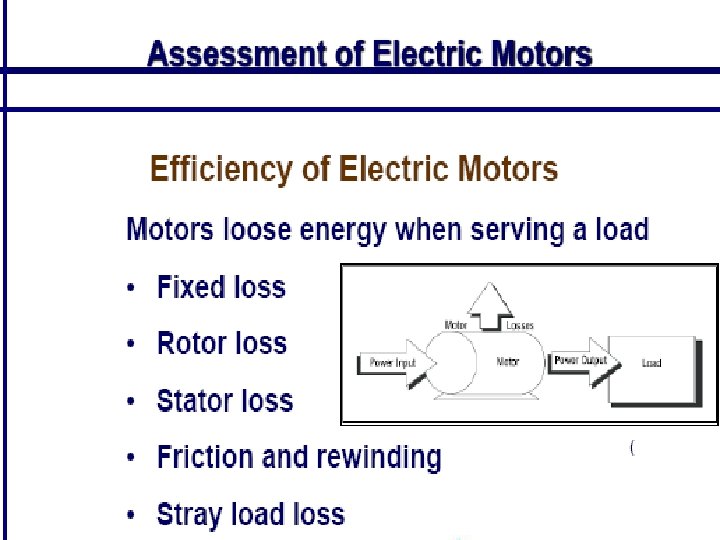
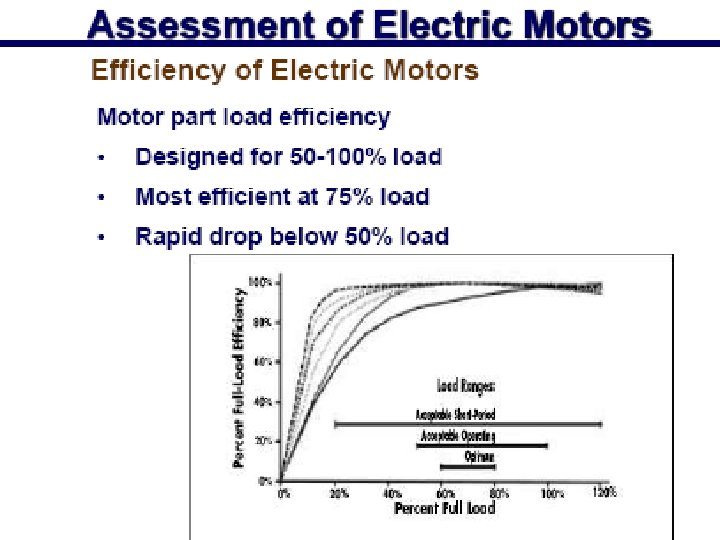
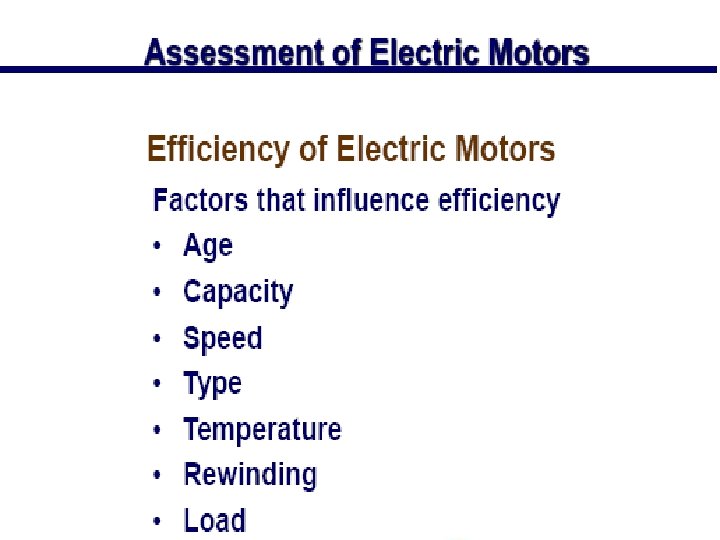
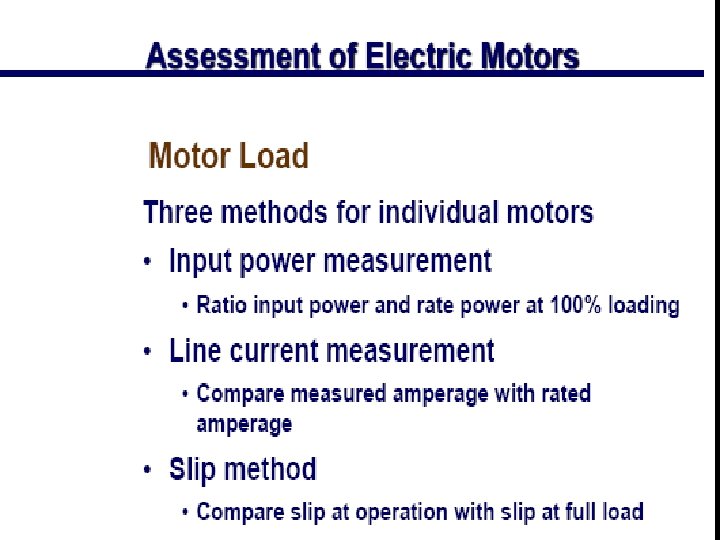
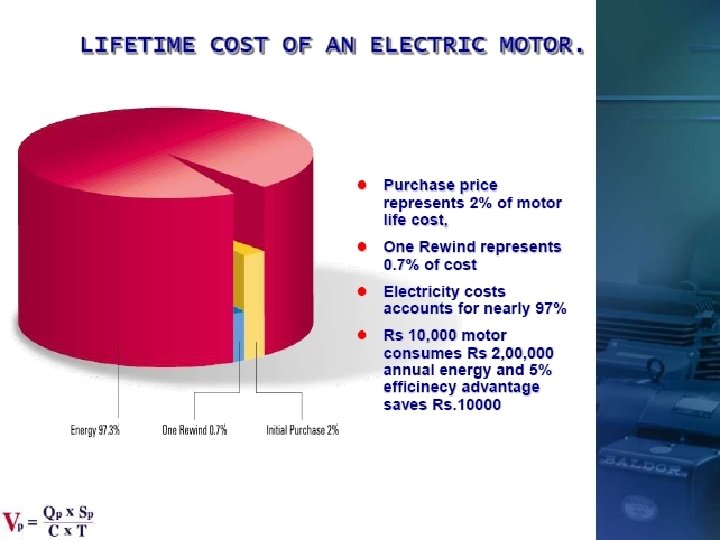
 MOTORS CHECK AND SECURE ALL MOTOR MOUNTING. INSPECT BEARINGS AND DRIVE BELTS FOR WEAR. ADJUST, REPAIR, OR REPLACE AS NECESSARY. USE ENERGY-EFFICIENT MOTORS WHERE ECONOMICAL. CHECK ALIGNMENT. PROVIDE PROPER VENTILATION.