 Скачать презентацию Chapter 1 CONTEXT 1 Learning Objectives 1
81839218bcf1a1c185deb23f220dc06c.ppt
- Количество слайдов: 21



Chapter 1 CONTEXT 1
Learning Objectives 1. To understand the nature of information systems. 2. To comprehend the context in which information systems are developed. i. iii. Human aspect Organization aspect Technology aspect 2
Terminology Systems Information systems (IS) Formalised information systems Computer-based information systems Information technology (IT) vs IS 3
System (from the Latin (systēma), and this from the Greek σύστημα (sustēma)) is an assemblage of elements comprising a whole with each element related to other elements. Any element which has no relationship with any other element of the system, cannot be a part of that system. A subsystem is then a set of elements which is a proper subset of the whole system. Information System (IS) defined by Kenneth C. Laudon and Jane P. Laudon as a set of interrelated components that collect (or receive), process, store and distribute information to support decision -making and control in an organization. (Laudon 2004, ) This definition of IS illustrates the function of it as providing the information for decision-making and control in an organization through processing the collected data and distributing the produced information. It may also help managers and workers analyze problems, visualize complex subjects, and create new products. Information Technology includes all matters concerned with the furtherance of computer science and technology and with the design, development, installation, and implementation of information systems and applications [San Diego State University]. 4
Information Systems n n n Crucial to success of modern business organizations Constantly being developed to make business more competitive Impact productivity and profits Keys to successful systems development n n Thorough systems analysis and design Understanding what business requires 5
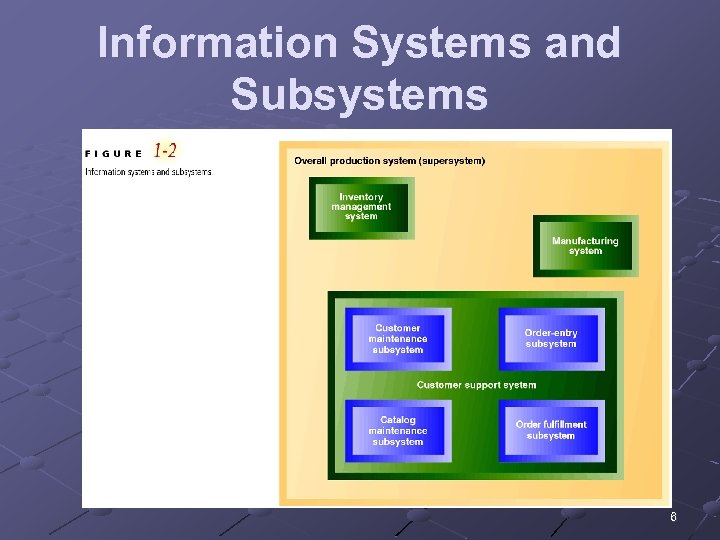
Information Systems and Subsystems 6
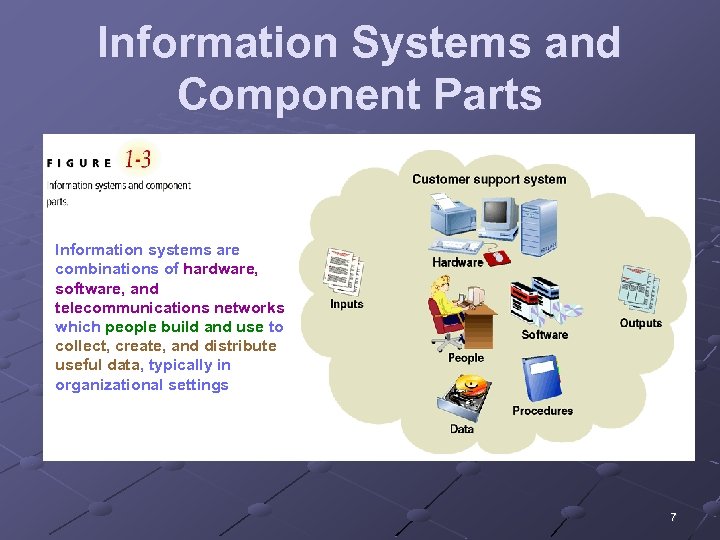
Information Systems and Component Parts Information systems are combinations of hardware, software, and telecommunications networks which people build and use to collect, create, and distribute useful data, typically in organizational settings 7
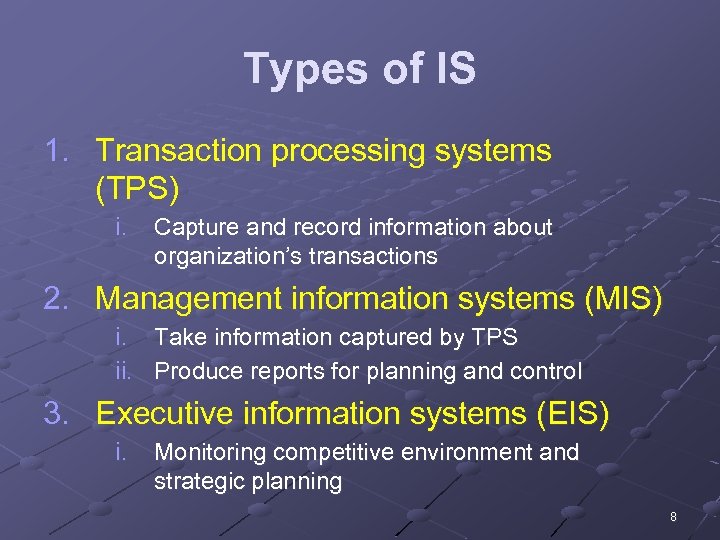
Types of IS 1. Transaction processing systems (TPS) i. Capture and record information about organization’s transactions 2. Management information systems (MIS) i. Take information captured by TPS ii. Produce reports for planning and control 3. Executive information systems (EIS) i. Monitoring competitive environment and strategic planning 8
Continue… 4. Decision support systems (DSS) i. Explore impact of available options or decisions (What-if scenarios) 5. Communication support systems i. Facilitate communication internally and with customers and suppliers 6. Office support systems i. Help employees create and share documents 9
Example information systems Payroll Electronic auction house Others … 10
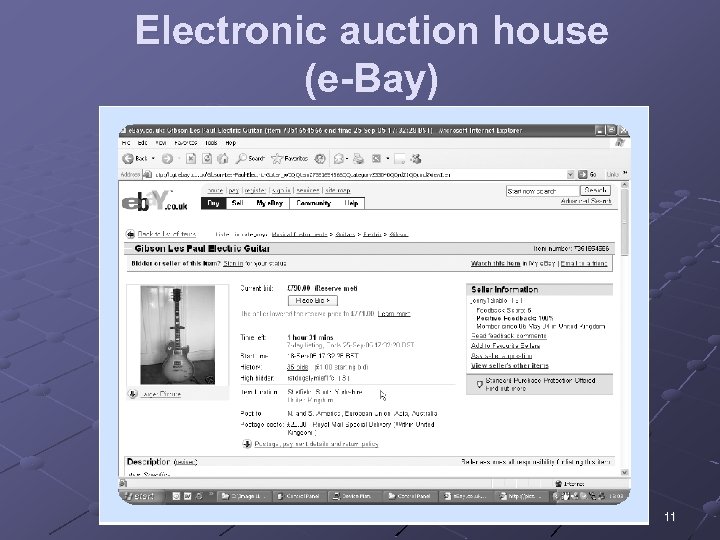
Electronic auction house (e-Bay) 11
Environment and Context Global economy - refers to the emerging international economy characterized by free trade in goods and services, unrestricted capital flows and weakened national powers to control domestic economies. Digital economy - A. K. A. new economy, Post-Fordist economy / society, information society, intangible economy, informationalism, weightless economy, network economy, etc. . . Electronic commerce – conducting commercial transaction electronically, via Internet. Non-commercial impacts – promoting public sector & government agencies on the web (to provide higher quality services directly to citizens at lower cost and efficiently). Change – is the endemic and norm in the dynamic, turbulent environment. Human dimension – the key to success in IS developments. 12
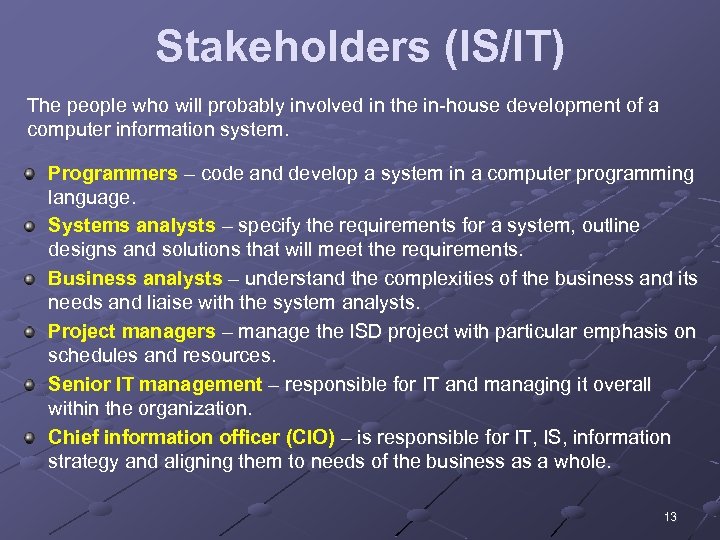
Stakeholders (IS/IT) The people who will probably involved in the in-house development of a computer information system. Programmers – code and develop a system in a computer programming language. Systems analysts – specify the requirements for a system, outline designs and solutions that will meet the requirements. Business analysts – understand the complexities of the business and its needs and liaise with the system analysts. Project managers – manage the ISD project with particular emphasis on schedules and resources. Senior IT management – responsible for IT and managing it overall within the organization. Chief information officer (CIO) – is responsible for IT, IS, information strategy and aligning them to needs of the business as a whole. 13
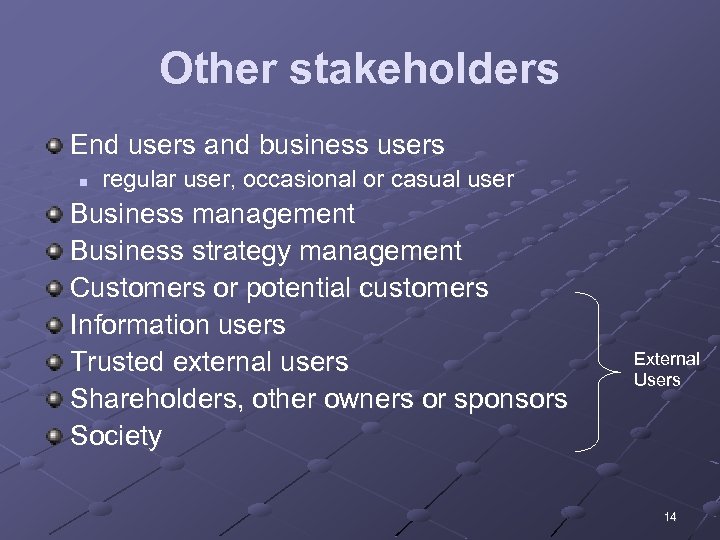
Other stakeholders End users and business users n regular user, occasional or casual user Business management Business strategy management Customers or potential customers Information users Trusted external users Shareholders, other owners or sponsors Society External Users 14
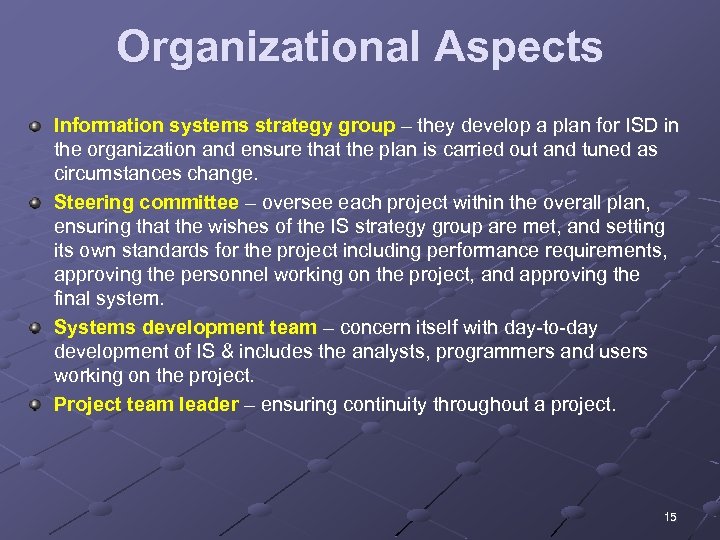
Organizational Aspects Information systems strategy group – they develop a plan for ISD in the organization and ensure that the plan is carried out and tuned as circumstances change. Steering committee – oversee each project within the overall plan, ensuring that the wishes of the IS strategy group are met, and setting its own standards for the project including performance requirements, approving the personnel working on the project, and approving the final system. Systems development team – concern itself with day-to-day development of IS & includes the analysts, programmers and users working on the project. Project team leader – ensuring continuity throughout a project. 15
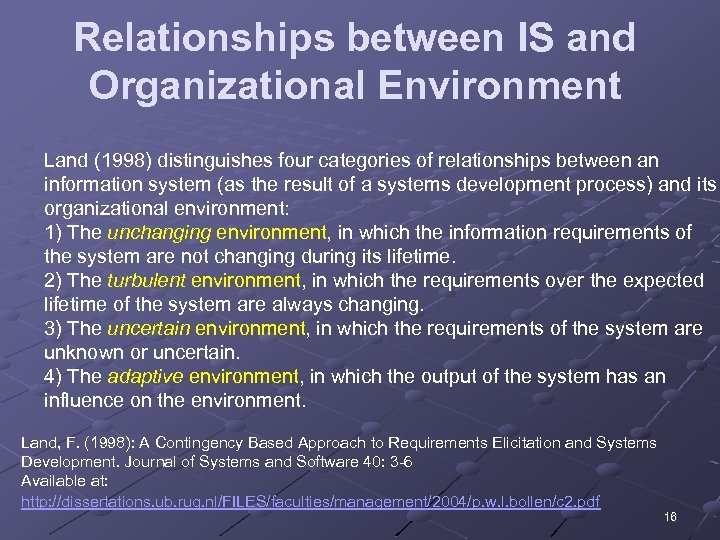
Relationships between IS and Organizational Environment Land (1998) distinguishes four categories of relationships between an information system (as the result of a systems development process) and its organizational environment: 1) The unchanging environment, in which the information requirements of the system are not changing during its lifetime. 2) The turbulent environment, in which the requirements over the expected lifetime of the system are always changing. 3) The uncertain environment, in which the requirements of the system are unknown or uncertain. 4) The adaptive environment, in which the output of the system has an influence on the environment. Land, F. (1998): A Contingency Based Approach to Requirements Elicitation and Systems Development. Journal of Systems and Software 40: 3 -6 Available at: http: //dissertations. ub. rug. nl/FILES/faculties/management/2004/p. w. l. bollen/c 2. pdf 16
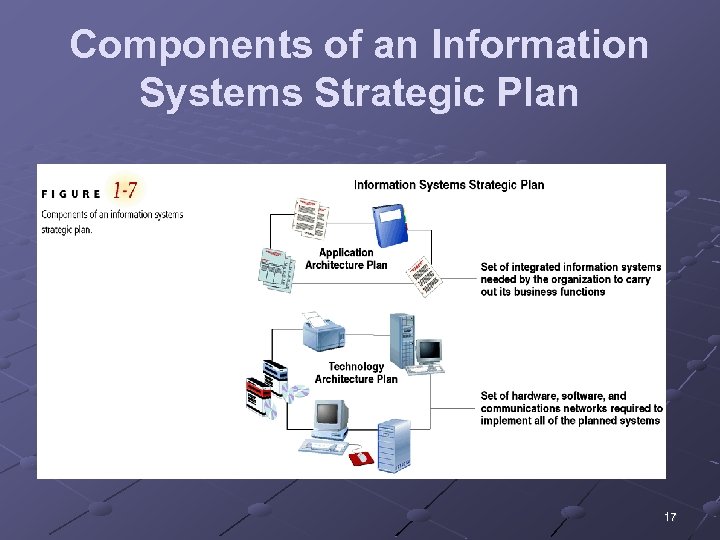
Components of an Information Systems Strategic Plan 17
Professional Aspects (the eightpoint BCS code) Professional responsibility Law Conduct Approach Management Independence and statement of interests Professional development Public awareness 18
Technological Aspects include the use of methods, techniques and computing technologies in ISD. Note that software development differs from information systems (IS) development methods in at least two ways (Sawyer, 2001). 1. Software development is focused on the development of an artifact – some defined set of working code that reflects specifications. An IS development effort is further focused on ensuring that software is brought together with specific users in specific organizational settings. 2. Current trends in labor specialization are reflected in differences among skill sets of those that develop software and those that implement IS. Simply, software engineers do different work than information systems consultants. And, these two groups of people tend to work for different organizations, separate from one-another and from the consumer organization (who purchased the software but needs an IS). This division of labor is made more clear by considering the business analysts, trainers, technical specialists, usability staff, and others who serve to make an IS from software Sawyer, S. (2001) “Information Systems Development: A Market-Oriented Perspective, ” Communications of the ACM, 44(11), 97 -102 19
More Example of IS The Dovetail Payment System (ENVOY) www. dovetailsys. com/ payments. htm System Thinking http: //en. wikipedia. org/wiki/Systems_thinking 20
Thank You for Your Attention 21
Скачать презентацию Chapter 1 CONTEXT 1 Learning Objectives 1
81839218bcf1a1c185deb23f220dc06c.ppt