


 Скачать презентацию Chapter 1 Computer Networks and the Internet Computer
438e80a2dcc11d9c61939850ed647fb4.ppt
- Количество слайдов: 78
 Chapter 1 Computer Networks and the Internet Computer Networking: A Top Down Approach Featuring the Internet, 2 nd edition. Jim Kurose, Keith Ross Addison-Wesley, July 2002. Courtesy of J. F Kurose and K. W. Ross (All material copyright 1996 -2002) Introduction 1
 Chapter 1: Introduction Our goal: Overview: q get context, q what’s the Internet overview, “feel” of networking q more depth, detail later in course q approach: m descriptive m use Internet as example q what’s a protocol? q network edge q network core q access net, physical media q Internet/ISP structure q performance: loss, delay q protocol layers, service models q history Introduction 2
 Chapter 1: roadmap 1. 1 What is the Internet? 1. 2 Network edge 1. 3 Network core 1. 4 Network access and physical media 1. 5 Internet structure and ISPs 1. 6 Delay & loss in packet-switched networks 1. 7 Protocol layers, service models 1. 8 History Introduction 3
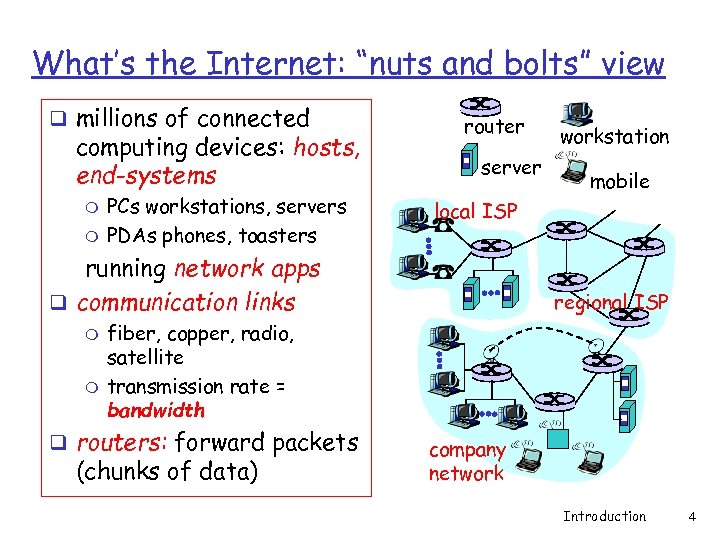 What’s the Internet: “nuts and bolts” view q millions of connected computing devices: hosts, end-systems m m PCs workstations, servers PDAs phones, toasters router server m mobile local ISP running network apps q communication links m workstation regional ISP fiber, copper, radio, satellite transmission rate = bandwidth q routers: forward packets (chunks of data) company network Introduction 4
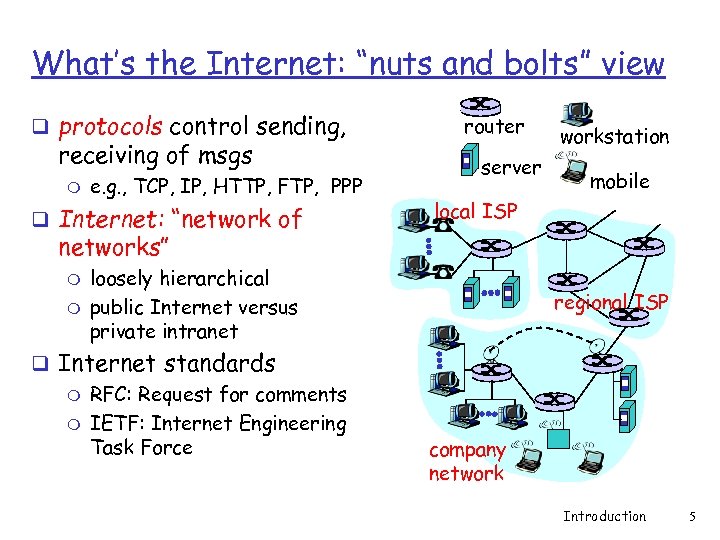 What’s the Internet: “nuts and bolts” view q protocols control sending, receiving of msgs m e. g. , TCP, IP, HTTP, FTP, PPP q Internet: “network of router server workstation mobile local ISP networks” m m loosely hierarchical public Internet versus private intranet q Internet standards m RFC: Request for comments m IETF: Internet Engineering Task Force regional ISP company network Introduction 5
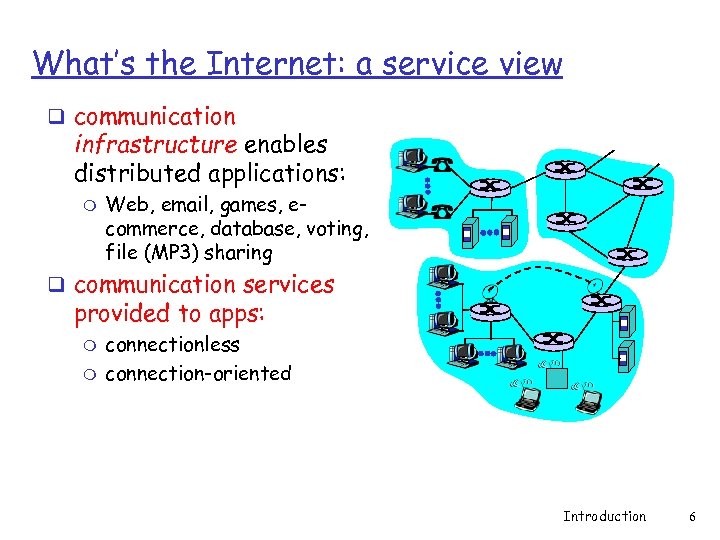 What’s the Internet: a service view q communication infrastructure enables distributed applications: m Web, email, games, ecommerce, database, voting, file (MP 3) sharing q communication services provided to apps: m m connectionless connection-oriented Introduction 6
 What’s a protocol? human protocols: q “what’s the time? ” q “I have a question” q introductions … specific msgs sent … specific actions taken when msgs received, or other events network protocols: q machines rather than humans q all communication activity in Internet governed by protocols define format, order of msgs sent and received among network entities, and actions taken on msg transmission, receipt Introduction 7
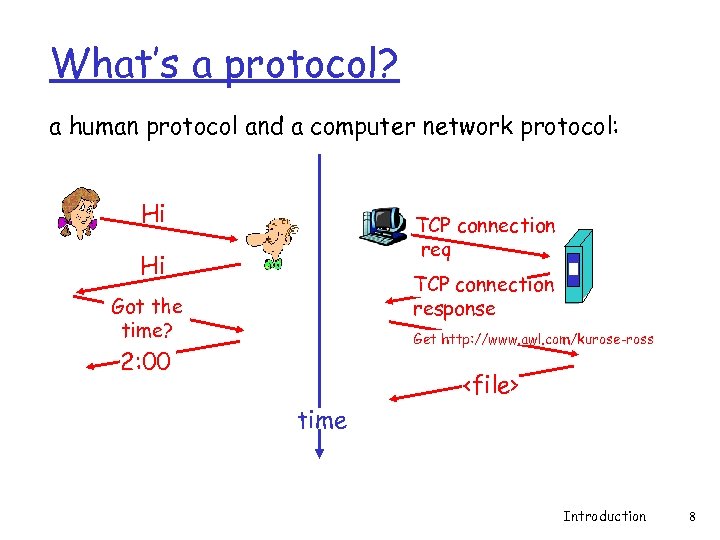 What’s a protocol? a human protocol and a computer network protocol: Hi TCP connection req Hi TCP connection response Got the time? Get http: //www. awl. com/kurose-ross 2: 00
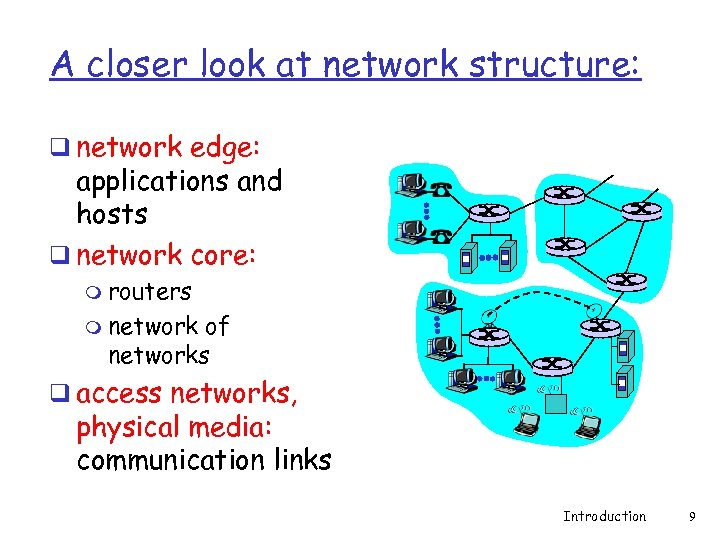 A closer look at network structure: q network edge: applications and hosts q network core: m routers m network of networks q access networks, physical media: communication links Introduction 9
 Chapter 1: roadmap 1. 1 What is the Internet? 1. 2 Network edge 1. 3 Network core 1. 4 Network access and physical media 1. 5 Internet structure and ISPs 1. 6 Delay & loss in packet-switched networks 1. 7 Protocol layers, service models 1. 8 History Introduction 10
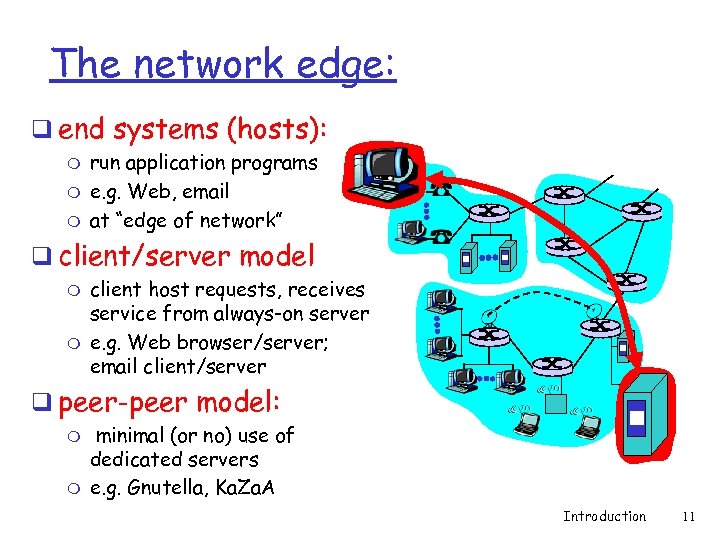 The network edge: q end systems (hosts): m m m run application programs e. g. Web, email at “edge of network” q client/server model m m client host requests, receives service from always-on server e. g. Web browser/server; email client/server q peer-peer model: m m minimal (or no) use of dedicated servers e. g. Gnutella, Ka. Za. A Introduction 11
 Network edge: connection-oriented service Goal: data transfer between end systems q handshaking: setup (prepare for) data transfer ahead of time m m Hello, hello back human protocol set up “state” in two communicating hosts q TCP - Transmission Control Protocol m Internet’s connectionoriented service TCP service [RFC 793] q reliable, in-order byte- stream data transfer m loss: acknowledgements and retransmissions q flow control: m sender won’t overwhelm receiver q congestion control: m senders “slow down sending rate” when network congested Introduction 12
 Network edge: connectionless service Goal: data transfer between end systems m same as before! q UDP - User Datagram Protocol [RFC 768]: Internet’s connectionless service m unreliable data transfer m no flow control m no congestion control App’s using TCP: q HTTP (Web), FTP (file transfer), Telnet (remote login), SMTP (email) App’s using UDP: q streaming media, teleconferencing, DNS, Internet telephony Introduction 13
 Chapter 1: roadmap 1. 1 What is the Internet? 1. 2 Network edge 1. 3 Network core 1. 4 Network access and physical media 1. 5 Internet structure and ISPs 1. 6 Delay & loss in packet-switched networks 1. 7 Protocol layers, service models 1. 8 History Introduction 14
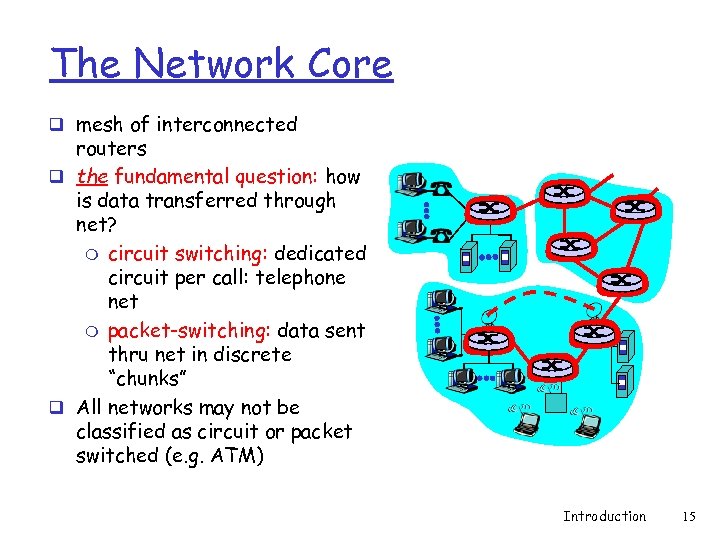 The Network Core q mesh of interconnected routers q the fundamental question: how is data transferred through net? m circuit switching: dedicated circuit per call: telephone net m packet-switching: data sent thru net in discrete “chunks” q All networks may not be classified as circuit or packet switched (e. g. ATM) Introduction 15
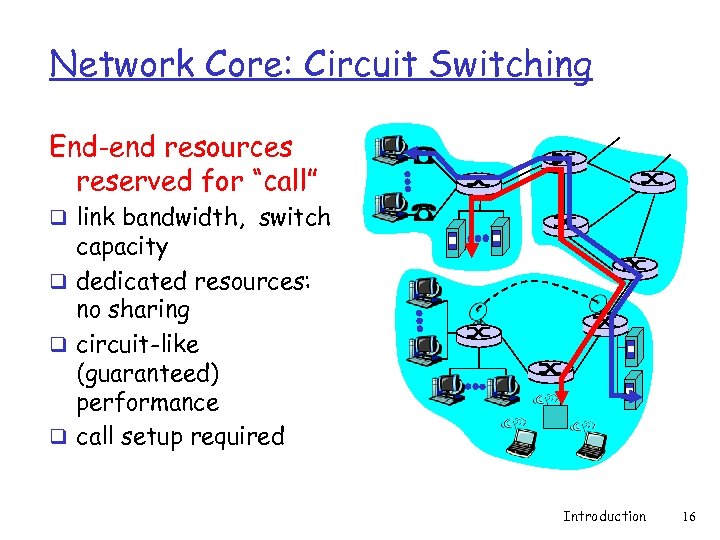 Network Core: Circuit Switching End-end resources reserved for “call” q link bandwidth, switch capacity q dedicated resources: no sharing q circuit-like (guaranteed) performance q call setup required Introduction 16
 Network Core: Circuit Switching network resources (e. g. , bandwidth) divided into “pieces” q pieces allocated to calls q dividing link bandwidth into “pieces” m frequency division m time division q resource piece idle if not used by owning call (no sharing) Introduction 17
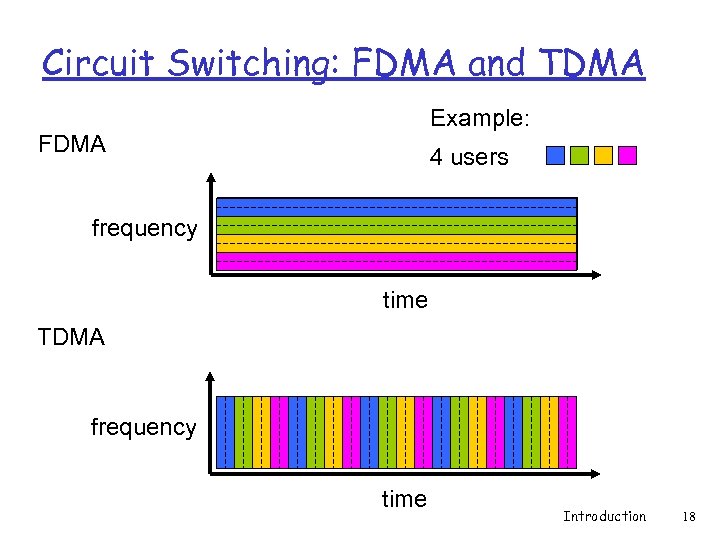 Circuit Switching: FDMA and TDMA Example: FDMA 4 users frequency time TDMA frequency time Introduction 18
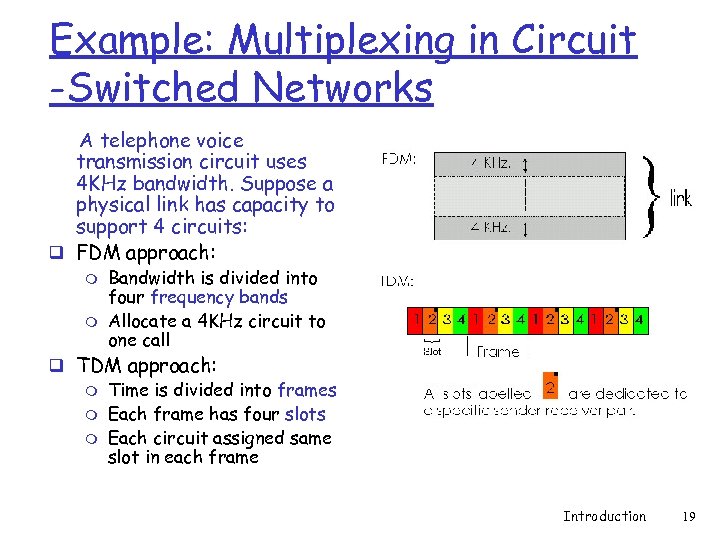 Example: Multiplexing in Circuit -Switched Networks A telephone voice transmission circuit uses 4 KHz bandwidth. Suppose a physical link has capacity to support 4 circuits: q FDM approach: m m Bandwidth is divided into four frequency bands Allocate a 4 KHz circuit to one call q TDM approach: m Time is divided into frames m Each frame has four slots m Each circuit assigned same slot in each frame Introduction 19
 Example: Circuit Switching q How long will it take to send a file of 640, 000 bits from host A to host B over a circuit-switched network. q Suppose all links in the network are TDM with: m m 24 slots and have a bit rate of 1. 536 Mbps q It takes 500 msec to establish an end-to-end circuit before host A begins transmitting to B q How long will it take to send file? q Transmission rate for each circuit = 1. 536 Mbps / 24 = 64 Kbps q Time to send 640 Kbits file = (640000 bits)/(64 Kbits/sec) = 10 seconds q Including circuit setup overhead, time to send file is 10. 5 seconds q This calculation is independent of the # of end-to-end links and does not include propagation delays Introduction 20
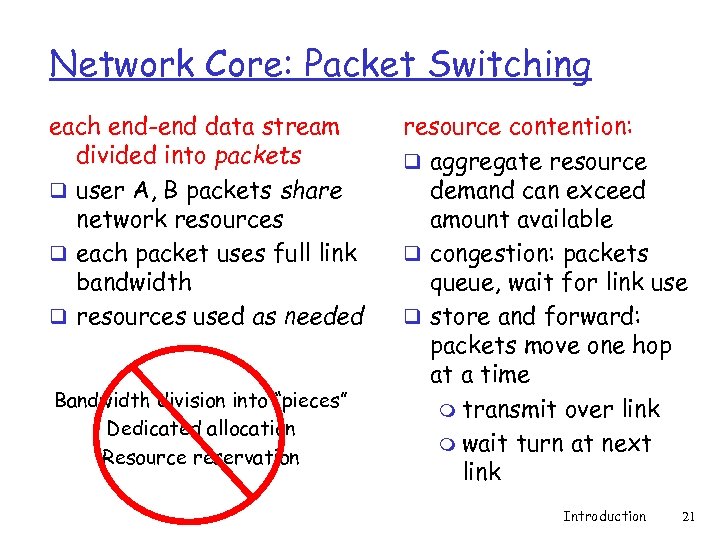 Network Core: Packet Switching each end-end data stream divided into packets q user A, B packets share network resources q each packet uses full link bandwidth q resources used as needed Bandwidth division into “pieces” Dedicated allocation Resource reservation resource contention: q aggregate resource demand can exceed amount available q congestion: packets queue, wait for link use q store and forward: packets move one hop at a time m transmit over link m wait turn at next link Introduction 21
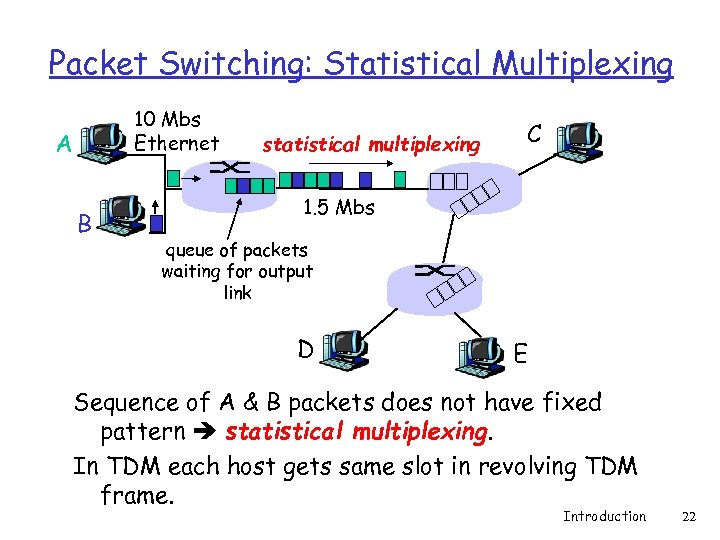 Packet Switching: Statistical Multiplexing 10 Mbs Ethernet A B statistical multiplexing C 1. 5 Mbs queue of packets waiting for output link D E Sequence of A & B packets does not have fixed pattern statistical multiplexing. In TDM each host gets same slot in revolving TDM frame. Introduction 22
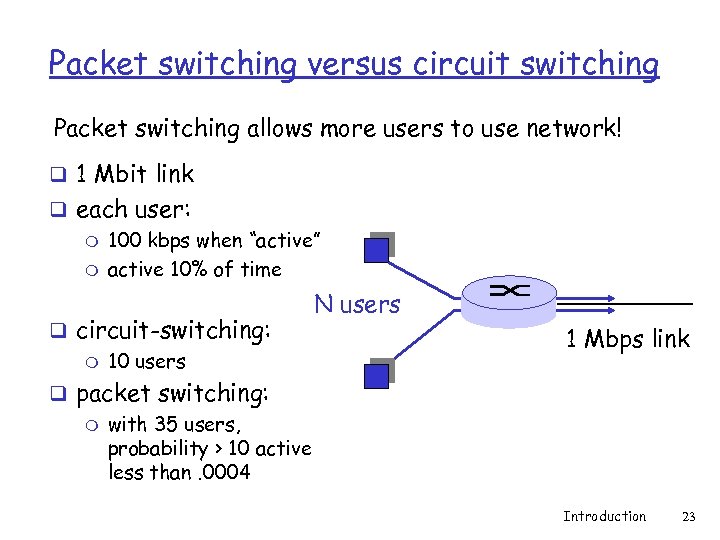 Packet switching versus circuit switching Packet switching allows more users to use network! q 1 Mbit link q each user: m 100 kbps when “active” m active 10% of time q circuit-switching: m 10 users N users 1 Mbps link q packet switching: m with 35 users, probability > 10 active less than. 0004 Introduction 23
 Packet switching versus circuit switching Is packet switching a “slam dunk winner? ” q Great for bursty data m resource sharing m simpler, no call setup q Excessive congestion: packet delay and loss m protocols needed for reliable data transfer, congestion control q Q: How to provide circuit-like behavior? m bandwidth guarantees needed for audio/video apps m still an unsolved problem (chapter 6) Introduction 24
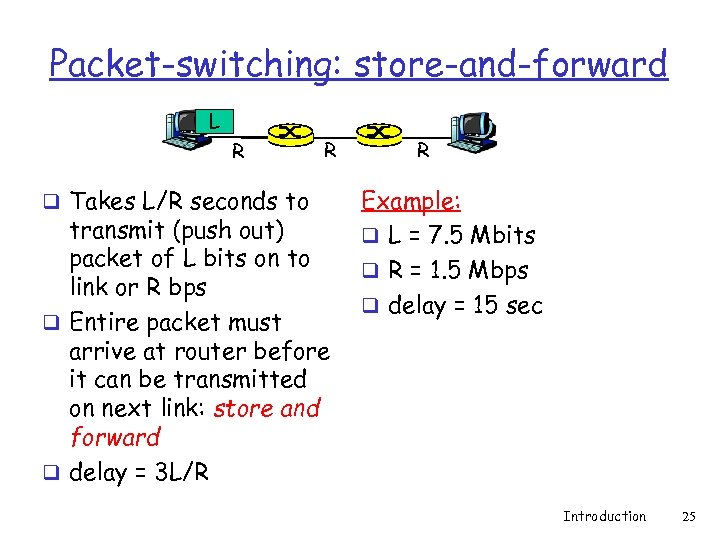 Packet-switching: store-and-forward L R q Takes L/R seconds to R transmit (push out) packet of L bits on to link or R bps q Entire packet must arrive at router before it can be transmitted on next link: store and forward q delay = 3 L/R R Example: q L = 7. 5 Mbits q R = 1. 5 Mbps q delay = 15 sec Introduction 25
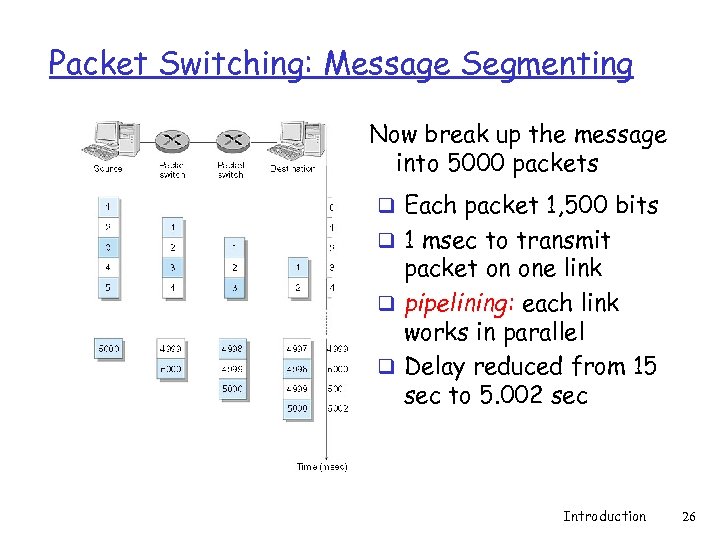 Packet Switching: Message Segmenting Now break up the message into 5000 packets q Each packet 1, 500 bits q 1 msec to transmit packet on one link q pipelining: each link works in parallel q Delay reduced from 15 sec to 5. 002 sec Introduction 26
 Network Core: Packet Switching (Cont’d) Advantages and disadvantages of segmentation q Advantages: m More efficient less delays m Handles bit errors more efficiently • Entire message does not require retransmission • Less overhead in terms of bandwidth q Disadvantage: m Each packet has a header vs. one header per message m In most cases, this overhead is small Introduction 27
 Network Core: Packet Switching (Cont’d) Packet switching vs. circuit switching: q Advantages of packet switching: m Offers better bandwidth sharing than circuit switching m Simpler, more efficient, and robust q Limitations of packet switching: m Not suitable for real-time services • IP telephony, video conference, etc. m Variable and unpredictable delays Introduction 28
 Packet-switched networks: forwarding q Goal: move packets through routers from source to destination m we’ll study several path selection (i. e. routing)algorithms (chapter 4) q datagram network: m destination address in packet determines next hop m routes may change during session m analogy: driving, asking directions q virtual circuit network: m each packet carries tag (virtual circuit ID), tag determines next hop m fixed path determined at call setup time, remains fixed thru call m routers maintain per-call state Introduction 29
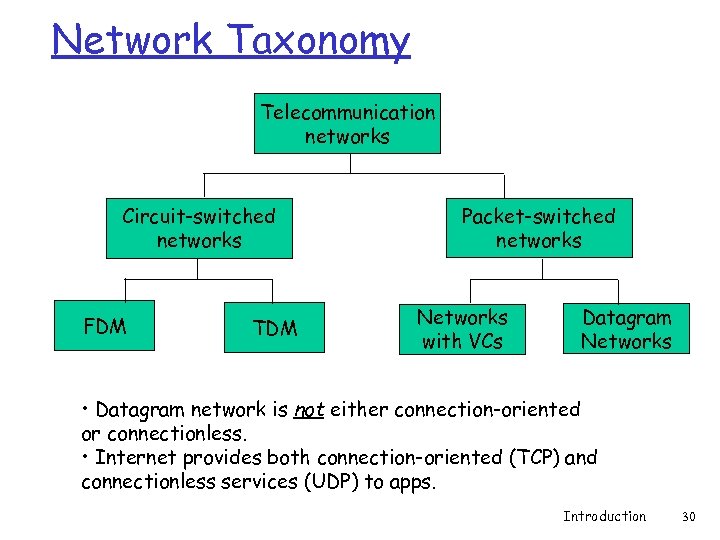 Network Taxonomy Telecommunication networks Circuit-switched networks FDM TDM Packet-switched networks Networks with VCs Datagram Networks • Datagram network is not either connection-oriented or connectionless. • Internet provides both connection-oriented (TCP) and connectionless services (UDP) to apps. Introduction 30
 Chapter 1: roadmap 1. 1 What is the Internet? 1. 2 Network edge 1. 3 Network core 1. 4 Network access and physical media 1. 5 Internet structure and ISPs 1. 6 Delay & loss in packet-switched networks 1. 7 Protocol layers, service models 1. 8 History Introduction 31
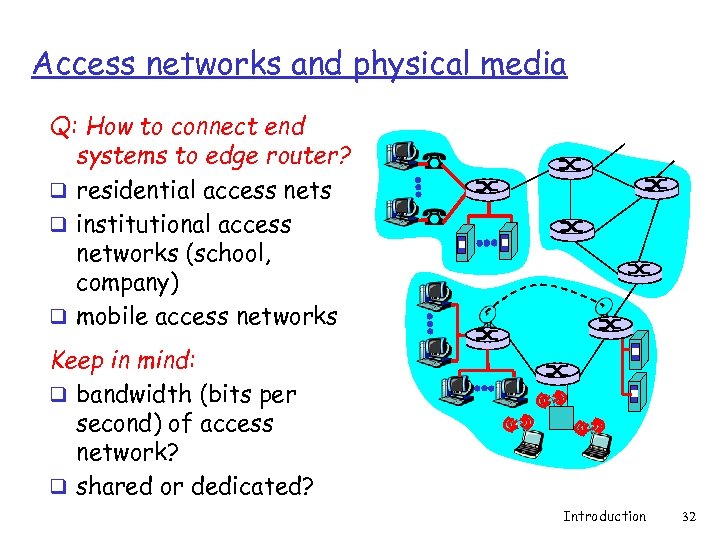 Access networks and physical media Q: How to connect end systems to edge router? q residential access nets q institutional access networks (school, company) q mobile access networks Keep in mind: q bandwidth (bits per second) of access network? q shared or dedicated? Introduction 32
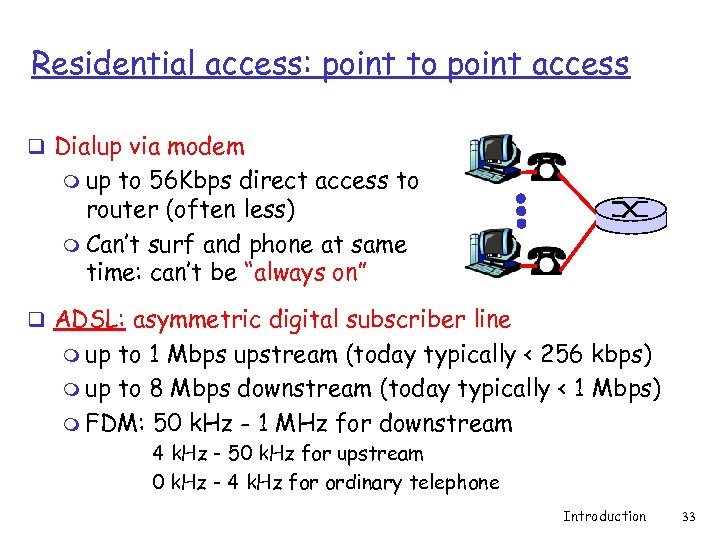 Residential access: point to point access q Dialup via modem m up to 56 Kbps direct access to router (often less) m Can’t surf and phone at same time: can’t be “always on” q ADSL: asymmetric digital subscriber line m up to 1 Mbps upstream (today typically < 256 kbps) m up to 8 Mbps downstream (today typically < 1 Mbps) m FDM: 50 k. Hz - 1 MHz for downstream 4 k. Hz - 50 k. Hz for upstream 0 k. Hz - 4 k. Hz for ordinary telephone Introduction 33
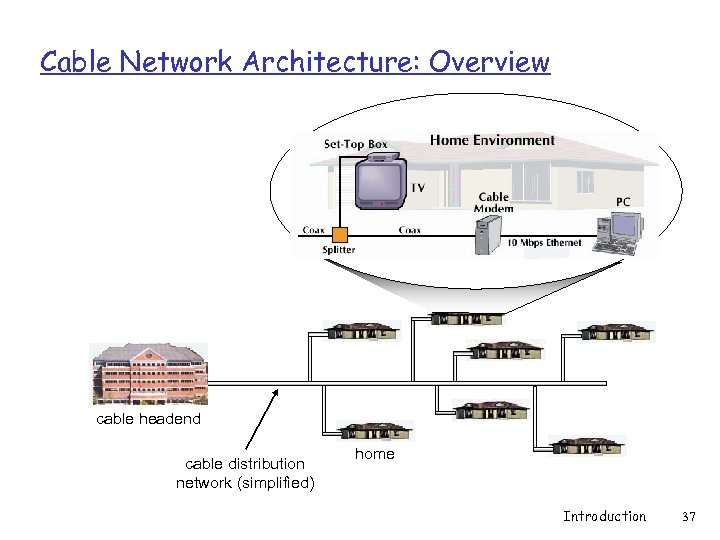
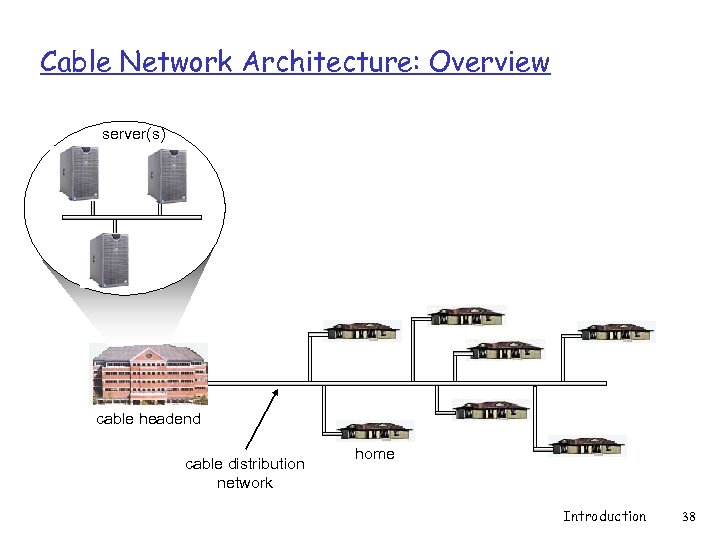
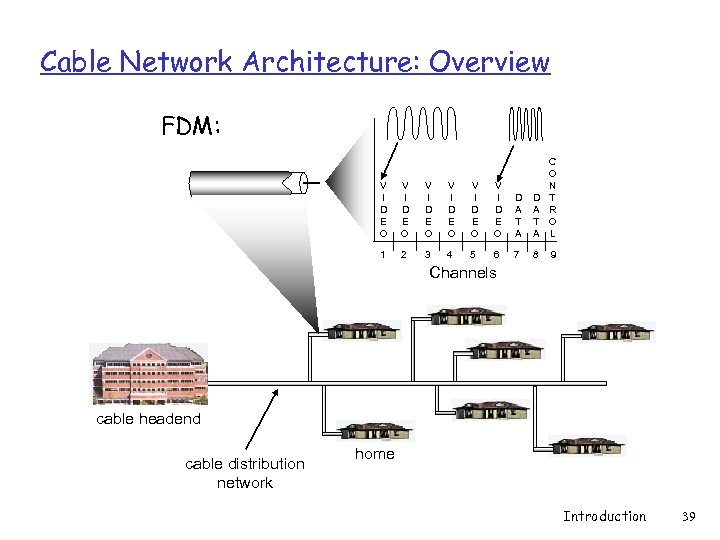
 Residential access: cable modems q HFC: hybrid fiber coax m asymmetric: up to 10 Mbps downstream, 1 Mbps upstream q network of cable and fiber attaches homes to ISP router m shared access to router among home m issues: congestion, dimensioning q deployment: available via cable companies, e. g. , Media. One Introduction 34
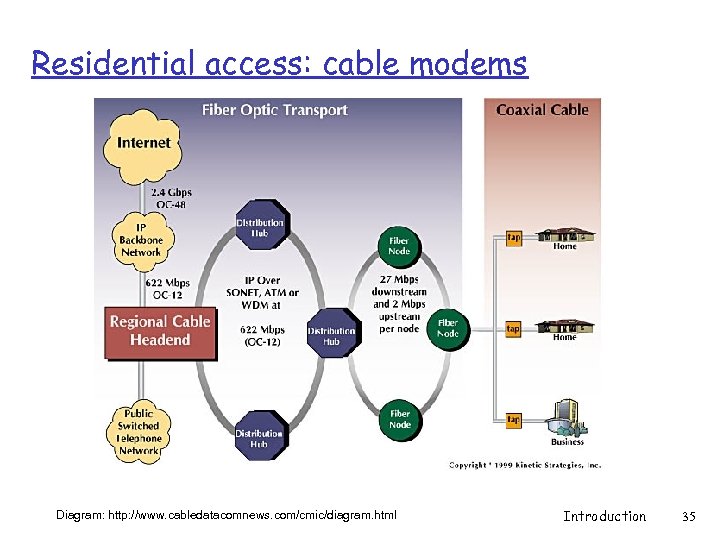 Residential access: cable modems Diagram: http: //www. cabledatacomnews. com/cmic/diagram. html Introduction 35
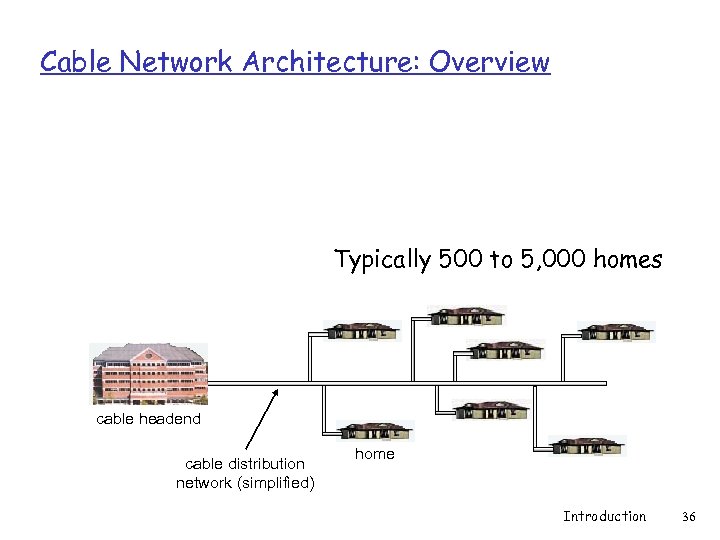 Cable Network Architecture: Overview Typically 500 to 5, 000 homes cable headend cable distribution network (simplified) home Introduction 36
 Cable Network Architecture: Overview cable headend cable distribution network (simplified) home Introduction 37
 Cable Network Architecture: Overview server(s) cable headend cable distribution network home Introduction 38
 Cable Network Architecture: Overview FDM: V I D E O V I D E O D A T A C O N T R O L 1 2 3 4 5 6 7 8 9 Channels cable headend cable distribution network home Introduction 39
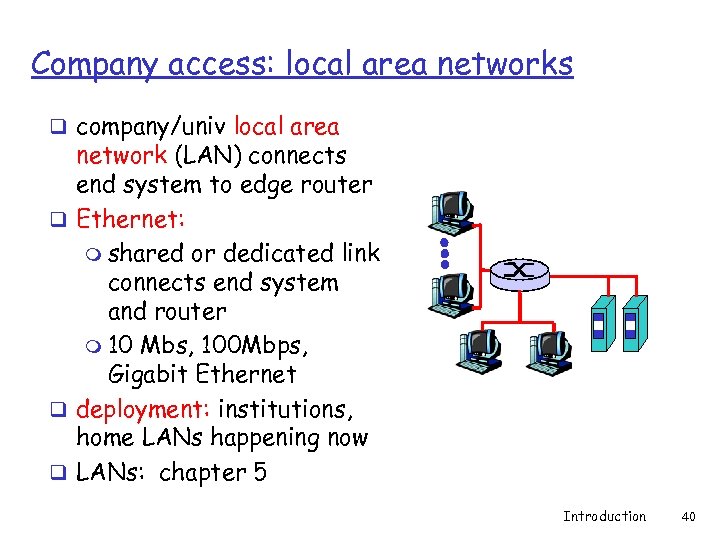 Company access: local area networks q company/univ local area network (LAN) connects end system to edge router q Ethernet: m shared or dedicated link connects end system and router m 10 Mbs, 100 Mbps, Gigabit Ethernet q deployment: institutions, home LANs happening now q LANs: chapter 5 Introduction 40
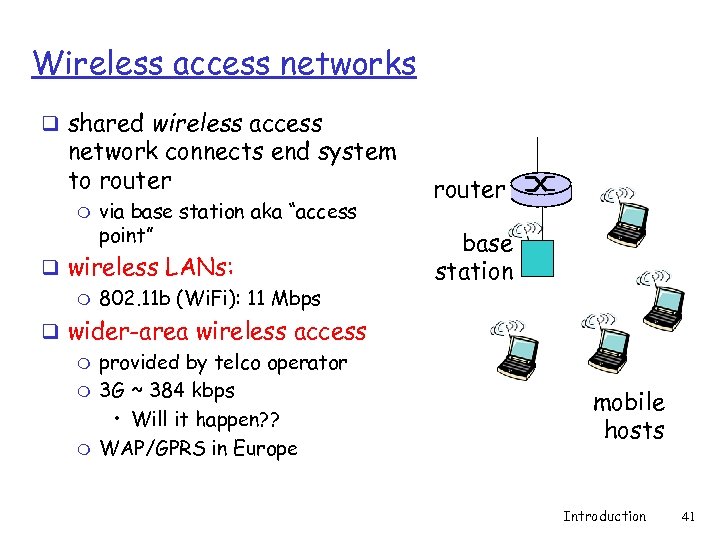 Wireless access networks q shared wireless access network connects end system to router m via base station aka “access point” q wireless LANs: m 802. 11 b (Wi. Fi): 11 Mbps q wider-area wireless access m provided by telco operator m 3 G ~ 384 kbps • Will it happen? ? m WAP/GPRS in Europe router base station mobile hosts Introduction 41
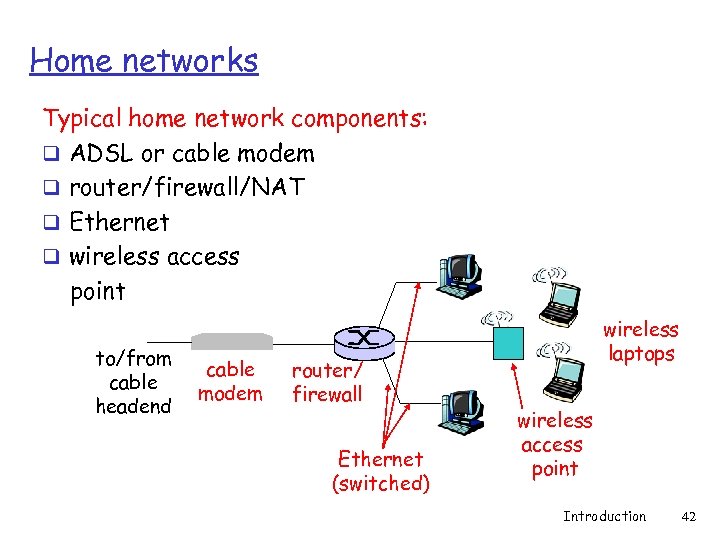 Home networks Typical home network components: q ADSL or cable modem q router/firewall/NAT q Ethernet q wireless access point to/from cable headend cable modem router/ firewall Ethernet (switched) wireless laptops wireless access point Introduction 42
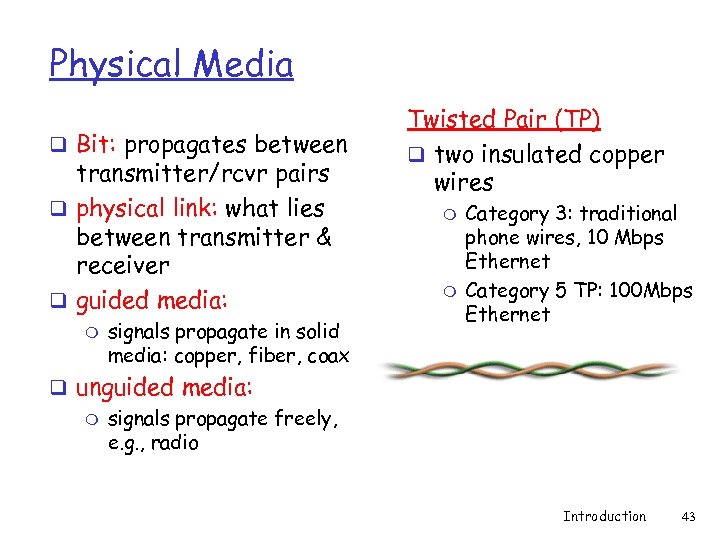 Physical Media q Bit: propagates between transmitter/rcvr pairs q physical link: what lies between transmitter & receiver q guided media: m signals propagate in solid media: copper, fiber, coax Twisted Pair (TP) q two insulated copper wires m m Category 3: traditional phone wires, 10 Mbps Ethernet Category 5 TP: 100 Mbps Ethernet q unguided media: m signals propagate freely, e. g. , radio Introduction 43
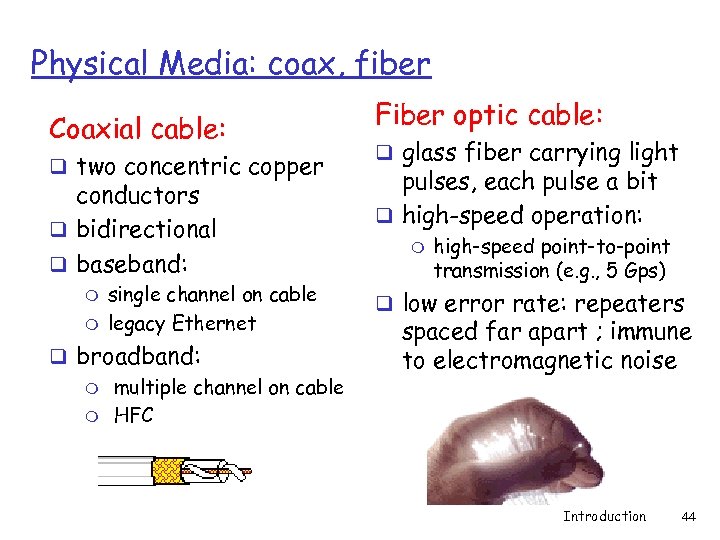 Physical Media: coax, fiber Coaxial cable: q two concentric copper conductors q bidirectional q baseband: m m single channel on cable legacy Ethernet q broadband: m multiple channel on cable m HFC Fiber optic cable: q glass fiber carrying light pulses, each pulse a bit q high-speed operation: m high-speed point-to-point transmission (e. g. , 5 Gps) q low error rate: repeaters spaced far apart ; immune to electromagnetic noise Introduction 44
 Physical media: radio q signal carried in electromagnetic spectrum q no physical “wire” q bidirectional q propagation environment effects: m m m reflection obstruction by objects interference Radio link types: q terrestrial microwave m e. g. up to 45 Mbps channels q LAN (e. g. , Wireless. LAN) m 2 Mbps, 11 Mbps q wide-area (e. g. , cellular) m e. g. 3 G: hundreds of kbps q satellite m up to 50 Mbps channel (or multiple smaller channels) m 270 msec end-end delay m geosynchronous versus LEOS Introduction 45
 Chapter 1: roadmap 1. 1 What is the Internet? 1. 2 Network edge 1. 3 Network core 1. 4 Network access and physical media 1. 5 Internet structure and ISPs 1. 6 Delay & loss in packet-switched networks 1. 7 Protocol layers, service models 1. 8 History Introduction 46
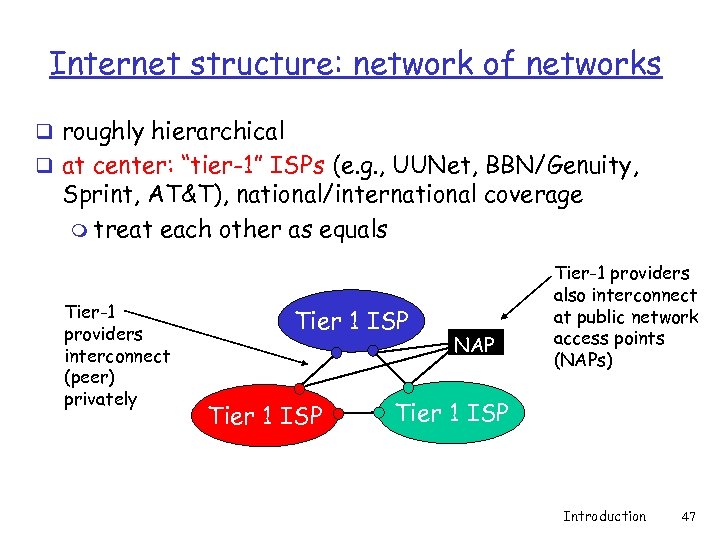 Internet structure: network of networks q roughly hierarchical q at center: “tier-1” ISPs (e. g. , UUNet, BBN/Genuity, Sprint, AT&T), national/international coverage m treat each other as equals Tier-1 providers interconnect (peer) privately Tier 1 ISP NAP Tier-1 providers also interconnect at public network access points (NAPs) Tier 1 ISP Introduction 47
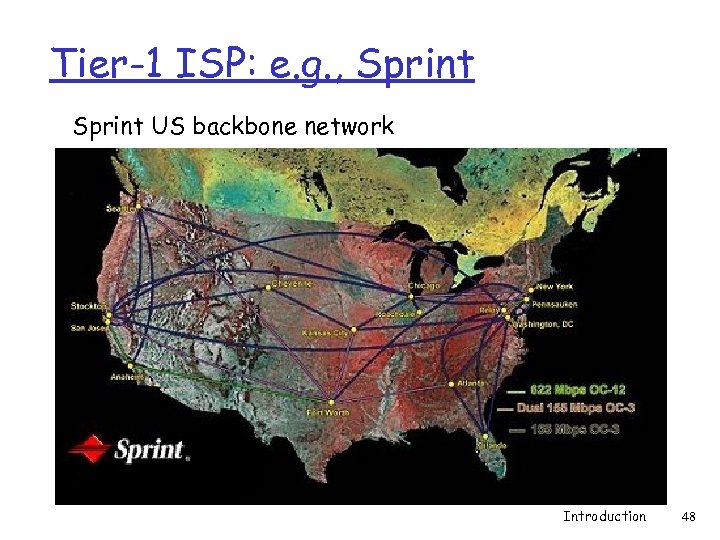 Tier-1 ISP: e. g. , Sprint US backbone network Introduction 48
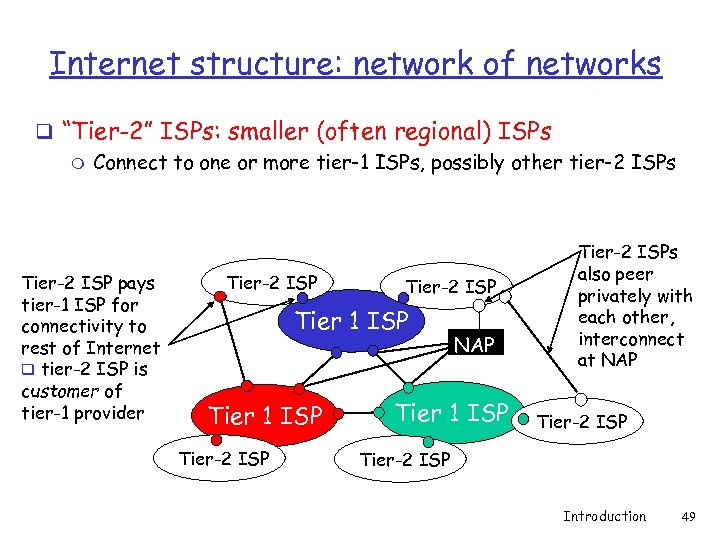 Internet structure: network of networks q “Tier-2” ISPs: smaller (often regional) ISPs m Connect to one or more tier-1 ISPs, possibly other tier-2 ISPs Tier-2 ISP pays tier-1 ISP for connectivity to rest of Internet q tier-2 ISP is customer of tier-1 provider Tier-2 ISP Tier 1 ISP Tier-2 ISP NAP Tier 1 ISP Tier-2 ISPs also peer privately with each other, interconnect at NAP Tier-2 ISP Introduction 49
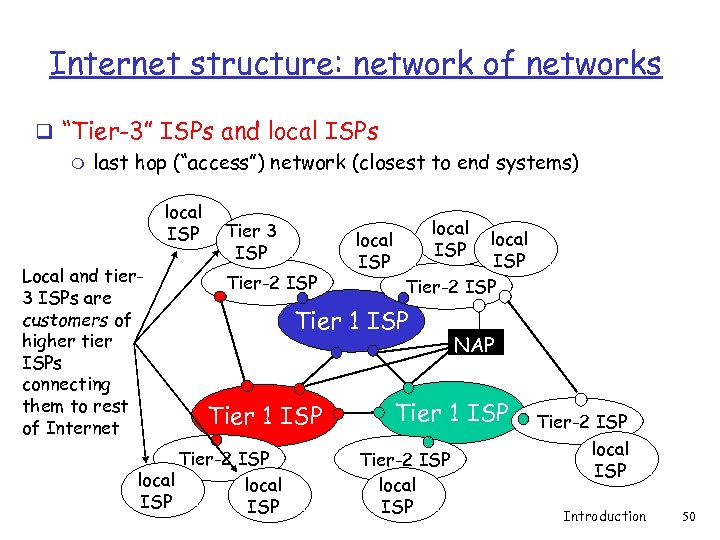 Internet structure: network of networks q “Tier-3” ISPs and local ISPs m last hop (“access”) network (closest to end systems) local ISP Local and tier 3 ISPs are customers of higher tier ISPs connecting them to rest of Internet Tier 3 ISP Tier-2 ISP local ISP Tier-2 ISP Tier 1 ISP Tier-2 ISP local ISP NAP Tier 1 ISP Tier-2 ISP local ISP Introduction 50
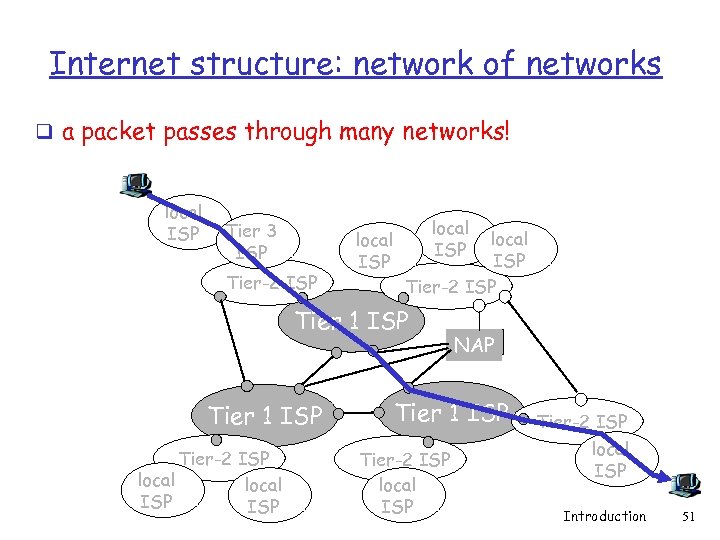 Internet structure: network of networks q a packet passes through many networks! local ISP Tier 3 ISP Tier-2 ISP local ISP Tier-2 ISP Tier 1 ISP Tier-2 ISP local ISP NAP Tier 1 ISP Tier-2 ISP local ISP Introduction 51
 Chapter 1: roadmap 1. 1 What is the Internet? 1. 2 Network edge 1. 3 Network core 1. 4 Network access and physical media 1. 5 Internet structure and ISPs 1. 6 Delay & loss in packet-switched networks 1. 7 Protocol layers, service models 1. 8 History Introduction 52
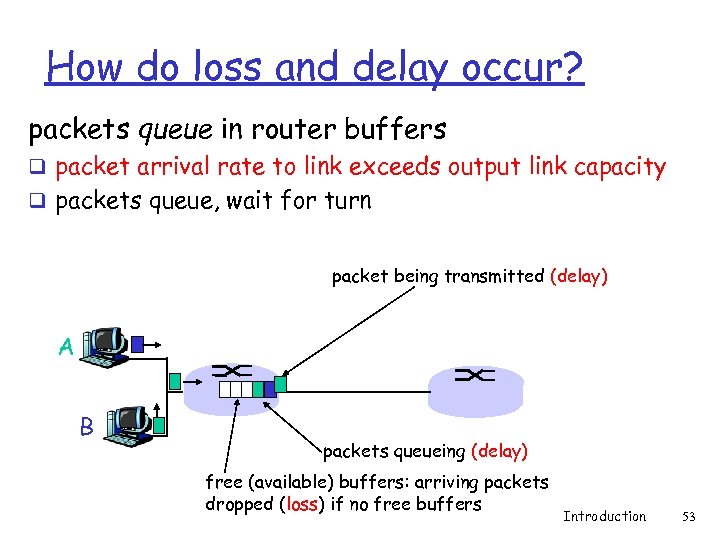 How do loss and delay occur? packets queue in router buffers q packet arrival rate to link exceeds output link capacity q packets queue, wait for turn packet being transmitted (delay) A B packets queueing (delay) free (available) buffers: arriving packets dropped (loss) if no free buffers Introduction 53
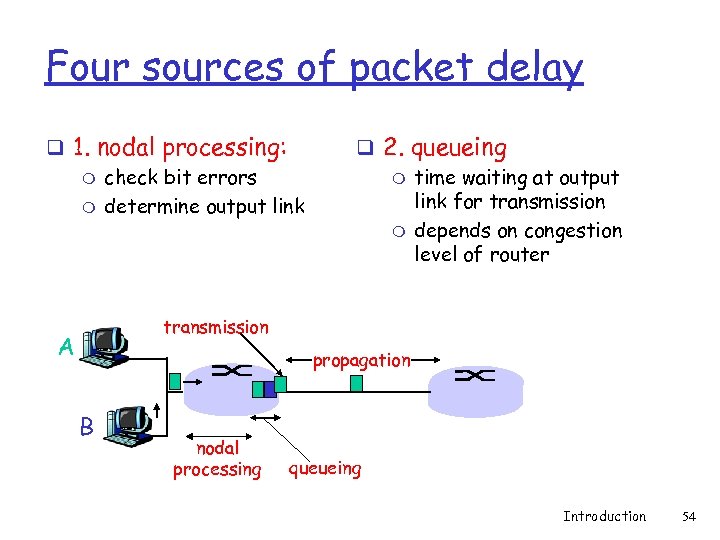 Four sources of packet delay q 1. nodal processing: m check bit errors m determine output link q 2. queueing m time waiting at output link for transmission m depends on congestion level of router transmission A propagation B nodal processing queueing Introduction 54
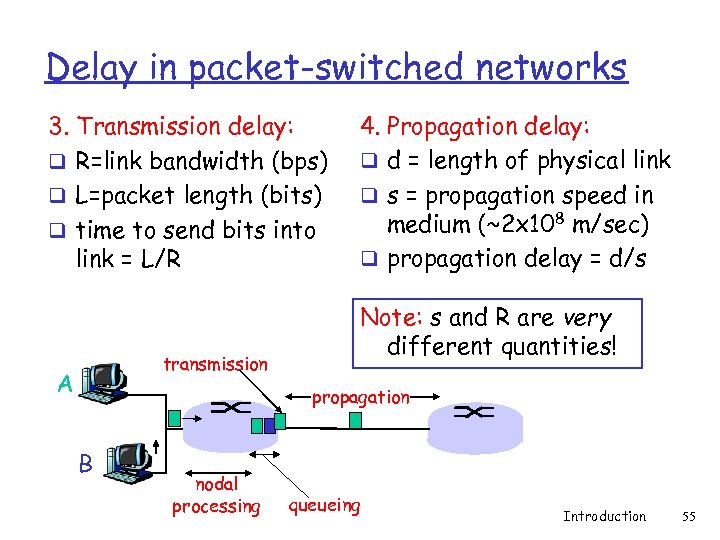 Delay in packet-switched networks 3. Transmission delay: q R=link bandwidth (bps) q L=packet length (bits) q time to send bits into link = L/R transmission A 4. Propagation delay: q d = length of physical link q s = propagation speed in medium (~2 x 10⁸ m/sec) q propagation delay = d/s Note: s and R are very different quantities! propagation B nodal processing queueing Introduction 55
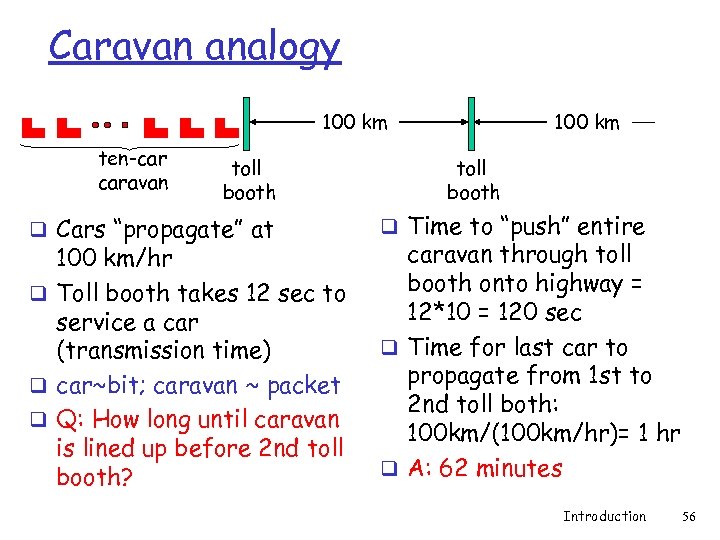 Caravan analogy 100 km ten-car caravan toll booth q Cars “propagate” at 100 km/hr q Toll booth takes 12 sec to service a car (transmission time) q car~bit; caravan ~ packet q Q: How long until caravan is lined up before 2 nd toll booth? 100 km toll booth q Time to “push” entire caravan through toll booth onto highway = 12*10 = 120 sec q Time for last car to propagate from 1 st to 2 nd toll both: 100 km/(100 km/hr)= 1 hr q A: 62 minutes Introduction 56
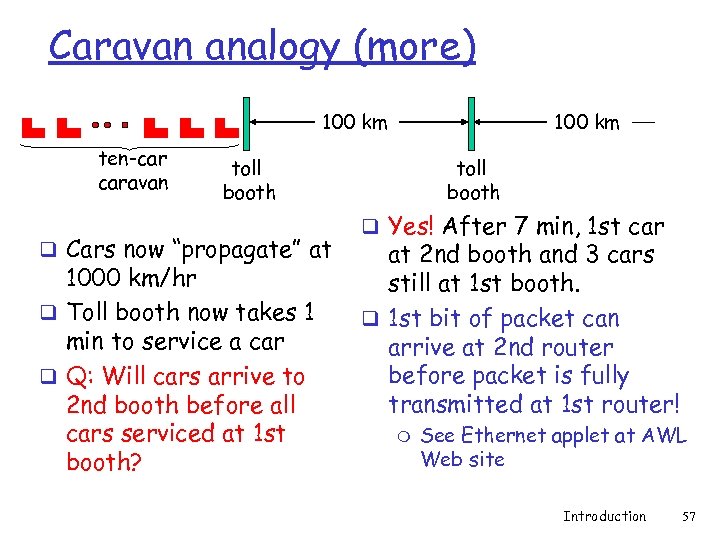 Caravan analogy (more) 100 km ten-car caravan 100 km toll booth q Cars now “propagate” at 1000 km/hr q Toll booth now takes 1 min to service a car q Q: Will cars arrive to 2 nd booth before all cars serviced at 1 st booth? toll booth q Yes! After 7 min, 1 st car at 2 nd booth and 3 cars still at 1 st booth. q 1 st bit of packet can arrive at 2 nd router before packet is fully transmitted at 1 st router! m See Ethernet applet at AWL Web site Introduction 57
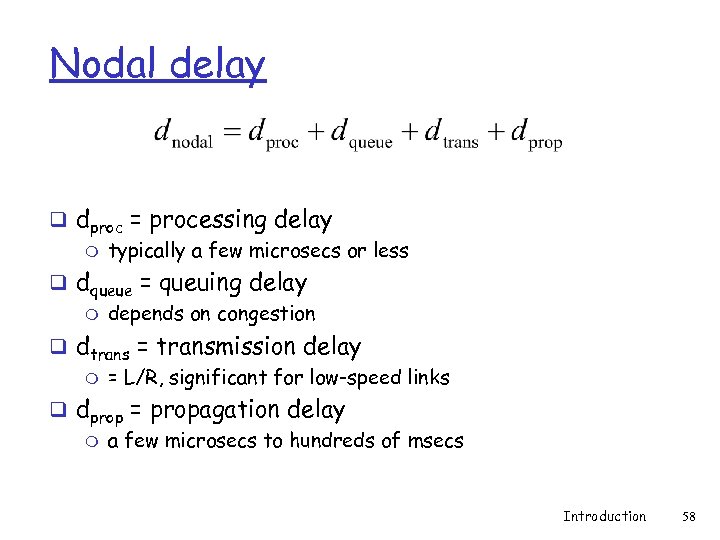 Nodal delay q dproc = processing delay m typically a few microsecs or less q dqueue = queuing delay m depends on congestion q dtrans = transmission delay m = L/R, significant for low-speed links q dprop = propagation delay m a few microsecs to hundreds of msecs Introduction 58
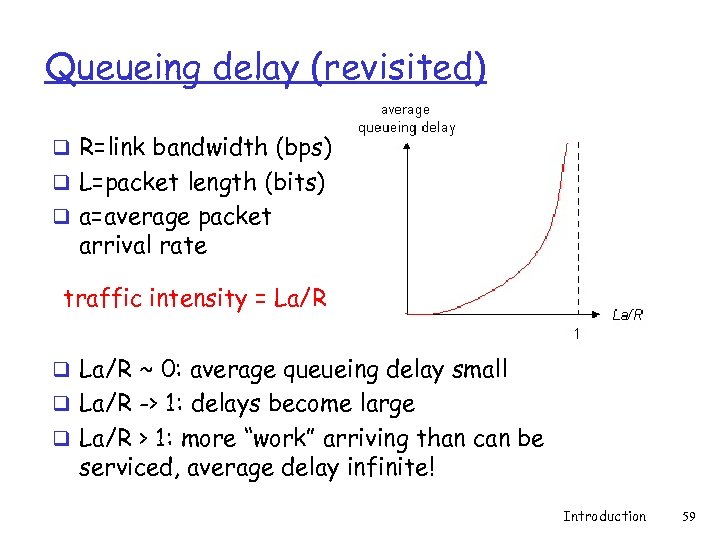 Queueing delay (revisited) q R=link bandwidth (bps) q L=packet length (bits) q a=average packet arrival rate traffic intensity = La/R q La/R ~ 0: average queueing delay small q La/R -> 1: delays become large q La/R > 1: more “work” arriving than can be serviced, average delay infinite! Introduction 59
 Packet loss q queue (aka buffer) preceding link in buffer has finite capacity q when packet arrives to full queue, packet is dropped (aka lost) q lost packet may be retransmitted by previous node, by source end system, or not retransmitted at all Introduction 60
 Chapter 1: roadmap 1. 1 What is the Internet? 1. 2 Network edge 1. 3 Network core 1. 4 Network access and physical media 1. 5 Internet structure and ISPs 1. 6 Delay & loss in packet-switched networks 1. 7 Protocol layers, service models 1. 8 History Introduction 61
 Protocol “Layers” Networks are complex! q many “pieces”: m hosts m routers m links of various media m applications m protocols m hardware, software Question: Is there any hope of organizing structure of network? Or at least our discussion of networks? Introduction 62
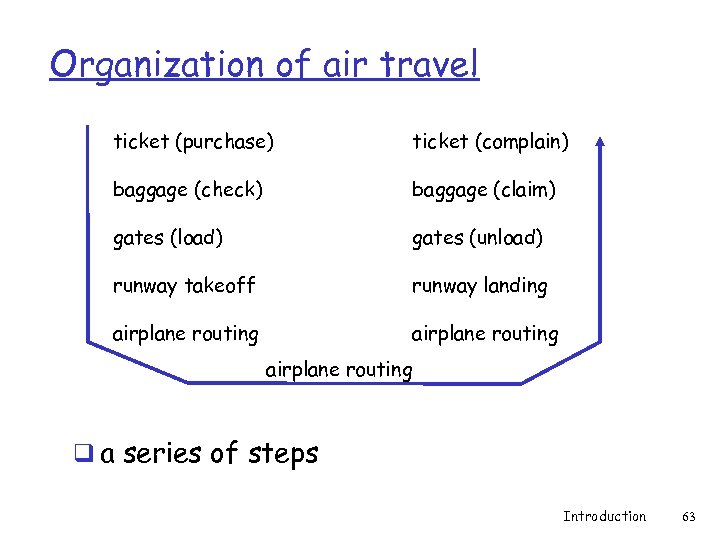 Organization of air travel ticket (purchase) ticket (complain) baggage (check) baggage (claim) gates (load) gates (unload) runway takeoff runway landing airplane routing q a series of steps Introduction 63
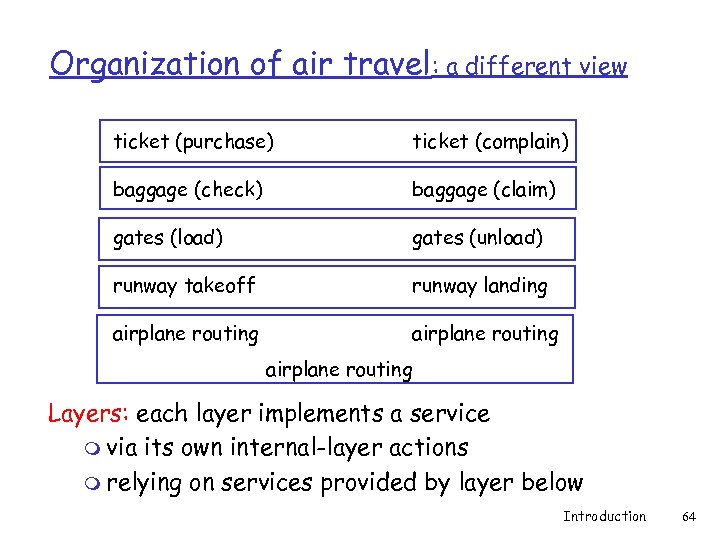 Organization of air travel: a different view ticket (purchase) ticket (complain) baggage (check) baggage (claim) gates (load) gates (unload) runway takeoff runway landing airplane routing Layers: each layer implements a service m via its own internal-layer actions m relying on services provided by layer below Introduction 64
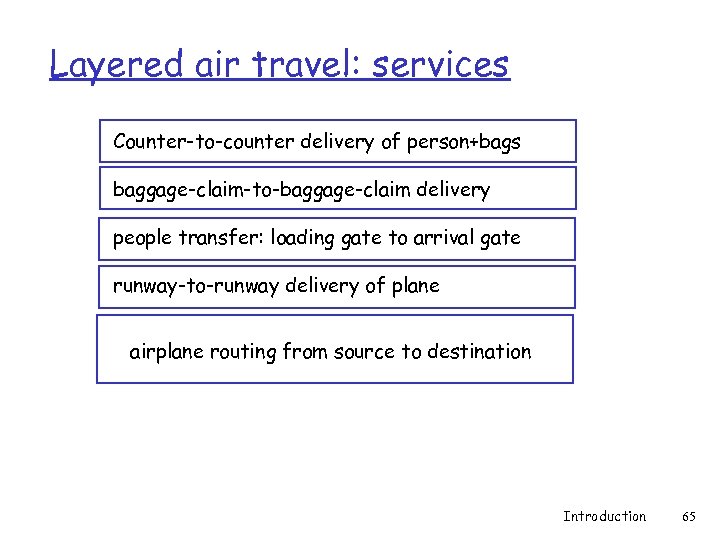 Layered air travel: services Counter-to-counter delivery of person+bags baggage-claim-to-baggage-claim delivery people transfer: loading gate to arrival gate runway-to-runway delivery of plane airplane routing from source to destination Introduction 65
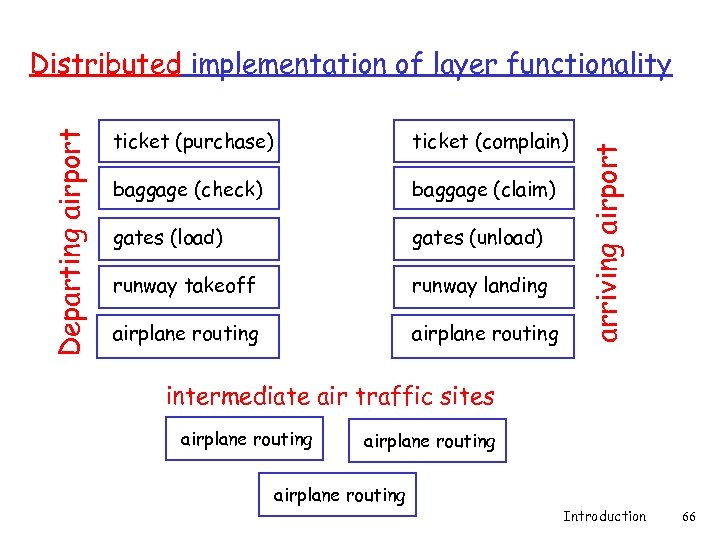 ticket (purchase) ticket (complain) baggage (check) baggage (claim) gates (load) gates (unload) runway takeoff runway landing airplane routing arriving airport Departing airport Distributed implementation of layer functionality intermediate air traffic sites airplane routing Introduction 66
 Why layering? Dealing with complex systems: q explicit structure allows identification, relationship of complex system’s pieces m layered reference model for discussion q modularization eases maintenance, updating of system m change of implementation of layer’s service transparent to rest of system m e. g. , change in gate procedure doesn’t affect rest of system q layering considered harmful? Introduction 67
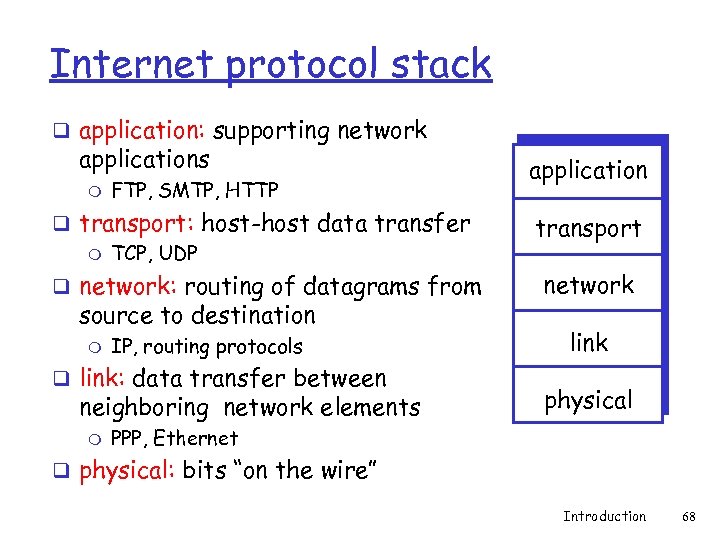 Internet protocol stack q application: supporting network applications m FTP, SMTP, HTTP application q transport: host-host data transfer m TCP, UDP transport q network: routing of datagrams from network source to destination m IP, routing protocols q link: data transfer between neighboring network elements m link physical PPP, Ethernet q physical: bits “on the wire” Introduction 68
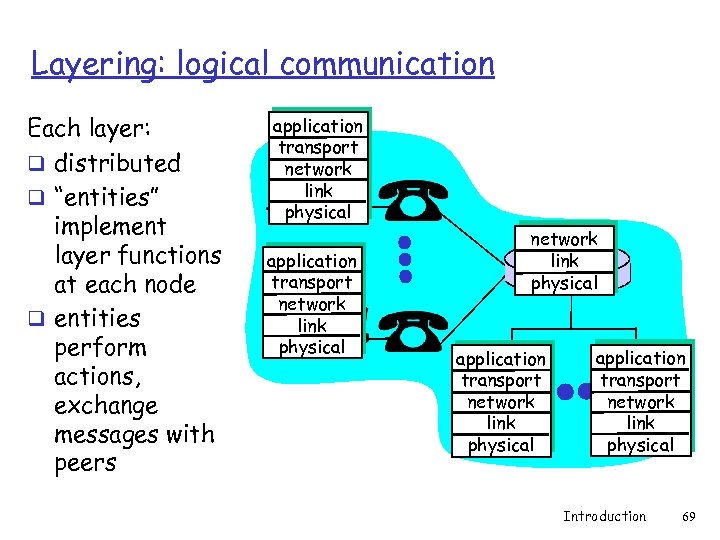 Layering: logical communication Each layer: q distributed q “entities” implement layer functions at each node q entities perform actions, exchange messages with peers application transport network link physical application transport network link physical Introduction 69
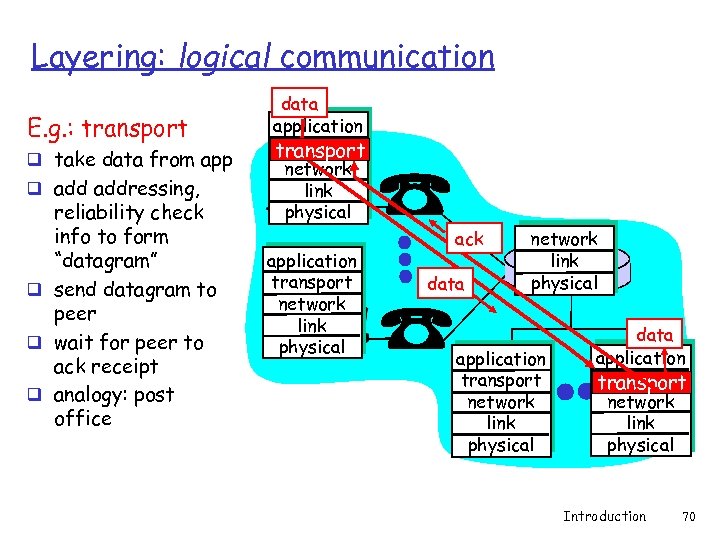 Layering: logical communication E. g. : transport q take data from app q addressing, reliability check info to form “datagram” q send datagram to peer q wait for peer to ack receipt q analogy: post office data application transport network link physical ack data network link physical application transport network link physical data application transport network link physical Introduction 70
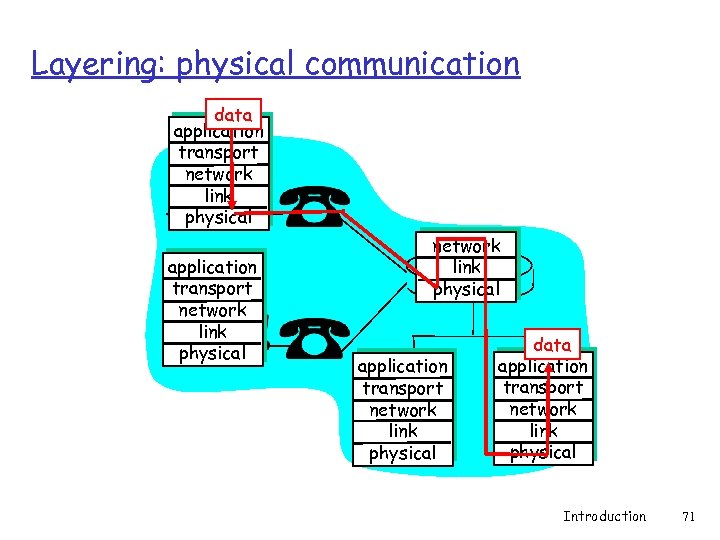 Layering: physical communication data application transport network link physical application transport network link physical data application transport network link physical Introduction 71
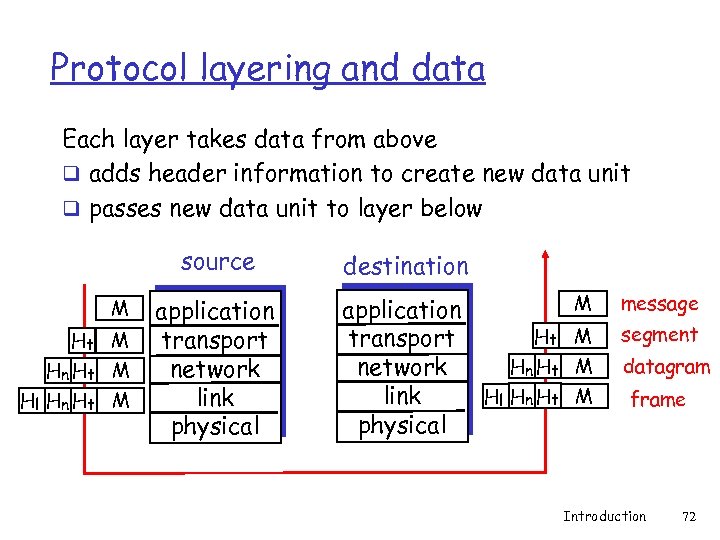 Protocol layering and data Each layer takes data from above q adds header information to create new data unit q passes new data unit to layer below source M Ht M Hn Ht M Hl Hn Ht M application transport network link physical destination application Ht transport Hn Ht network Hl Hn Ht link physical M message M segment M datagram M frame Introduction 72
 Chapter 1: roadmap 1. 1 What is the Internet? 1. 2 Network edge 1. 3 Network core 1. 4 Network access and physical media 1. 5 ISPs and Internet backbones 1. 6 Delay & loss in packet-switched networks 1. 7 Internet structure and ISPs 1. 8 History Introduction 73
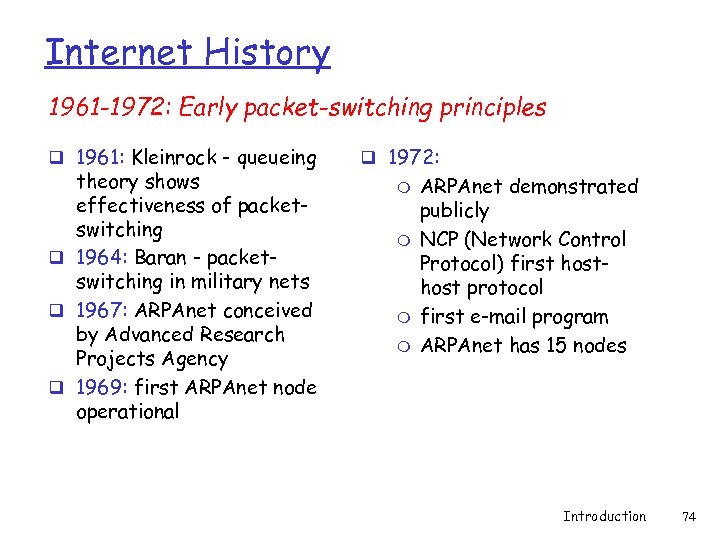 Internet History 1961 -1972: Early packet-switching principles q 1961: Kleinrock - queueing theory shows effectiveness of packetswitching q 1964: Baran - packetswitching in military nets q 1967: ARPAnet conceived by Advanced Research Projects Agency q 1969: first ARPAnet node operational q 1972: m m ARPAnet demonstrated publicly NCP (Network Control Protocol) first host protocol first e-mail program ARPAnet has 15 nodes Introduction 74
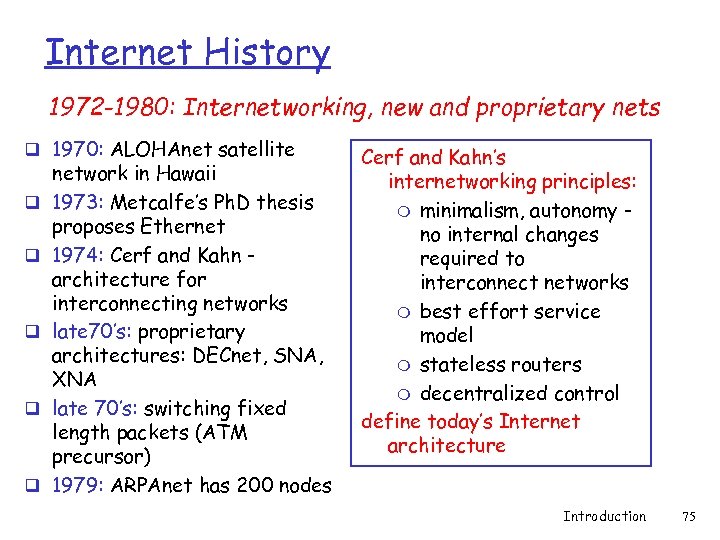 Internet History 1972 -1980: Internetworking, new and proprietary nets q 1970: ALOHAnet satellite q q q network in Hawaii 1973: Metcalfe’s Ph. D thesis proposes Ethernet 1974: Cerf and Kahn architecture for interconnecting networks late 70’s: proprietary architectures: DECnet, SNA, XNA late 70’s: switching fixed length packets (ATM precursor) 1979: ARPAnet has 200 nodes Cerf and Kahn’s internetworking principles: m minimalism, autonomy no internal changes required to interconnect networks m best effort service model m stateless routers m decentralized control define today’s Internet architecture Introduction 75
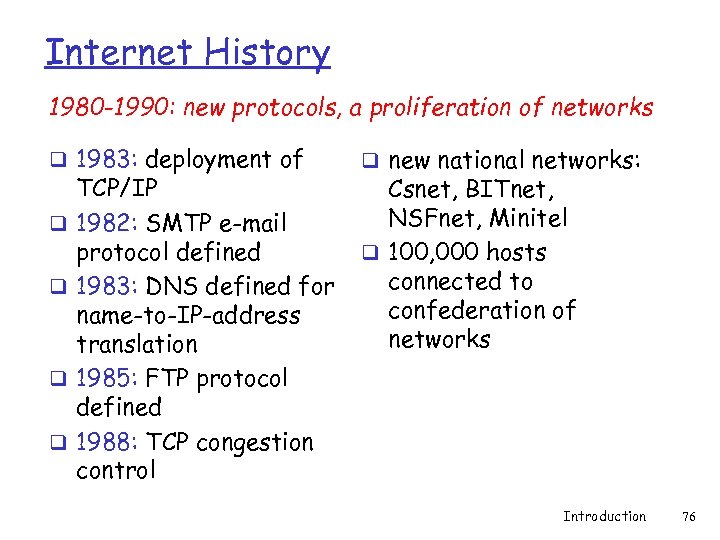 Internet History 1980 -1990: new protocols, a proliferation of networks q 1983: deployment of q q TCP/IP 1982: SMTP e-mail protocol defined 1983: DNS defined for name-to-IP-address translation 1985: FTP protocol defined 1988: TCP congestion control q new national networks: Csnet, BITnet, NSFnet, Minitel q 100, 000 hosts connected to confederation of networks Introduction 76
 Internet History 1990, 2000’s: commercialization, the Web, new apps q Early 1990’s: ARPAnet decommissioned q 1991: NSF lifts restrictions on commercial use of NSFnet (decommissioned, 1995) q early 1990 s: Web m hypertext [Bush 1945, Nelson 1960’s] m HTML, HTTP: Berners-Lee m 1994: Mosaic, later Netscape m late 1990’s: commercialization of the Web Late 1990’s – 2000’s: q more killer apps: instant messaging, peer 2 peer file sharing (e. g. , Naptser) q network security to forefront q est. 50 million host, 100 million+ users q backbone links running at Gbps Introduction 77
 Introduction: Summary Covered a “ton” of material! q Internet overview q what’s a protocol? q network edge, core, access network m packet-switching versus circuit-switching q Internet/ISP structure q performance: loss, delay q layering and service models q history You now have: q context, overview, “feel” of networking q more depth, detail to follow! Introduction 78