


 Скачать презентацию Chapter 1 Assuming the Role of the Systems
d02fe58251d73493a01676dc76dbb874.ppt
- Количество слайдов: 18
 Chapter 1 Assuming the Role of the Systems Analyst Systems Analysis and Design Kendall & Kendall Sixth Edition © Copyright Prentice Hall, 2005 Slide Design by Kendall & Kendall
 נושאים עקריים • שלבים בפיתוח • תכנון, ניתוח, פיתוח, ישום, תיקונים • כלים לכל שלב • UML , CASE, DFD • תרגילים ופרייקטים 2 2005 Pearson Prentice Hall Kendall & Kendall
 התפקיד של המנתח מערכות מידע Systems analysis and design is a systematic approach to: • Identifying problems, opportunities, and objectives. • Analyzing the information flows in organizations. • Designing computerized information systems to solve a problem. Kendall & Kendall 2005 Pearson Prentice Hall 3
 Systems Development Life Cycle • The systems development life cycle is a systematic approach to solving business problems. • It is divided into seven phases. • Each phase has unique activities. Kendall & Kendall 2005 Pearson Prentice Hall 4
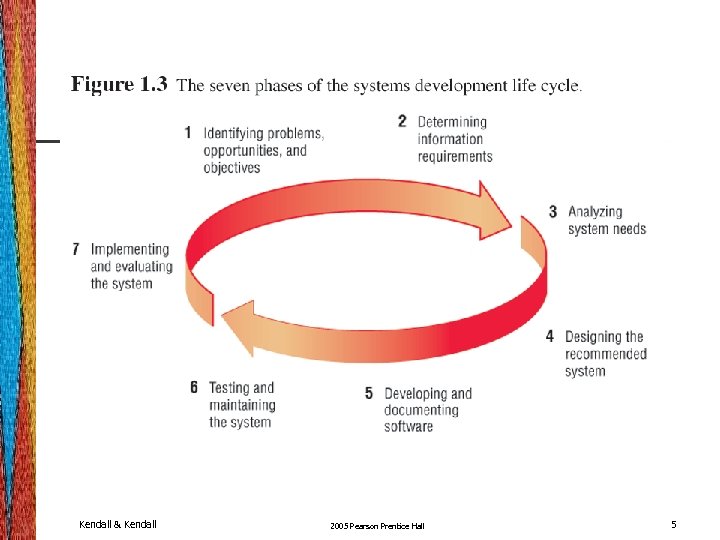 Kendall & Kendall 2005 Pearson Prentice Hall 5
 Phase 1 • Identifying: ( )ייזום • Problems. • Opportunities. • Objectives. • Personnel involved: • Analyst. • User management. • Systems management. Kendall & Kendall 2005 Pearson Prentice Hall 6
 Phase 2 - חקר מצב קיים • Determining information requirements: • Learn the who, what, where, when, and how, and the why for each of these. • Interview management, operations personnel. • Gather systems/operating documents. • Use questionnaires. • Observe the system and personnel involved. Kendall & Kendall 2005 Pearson Prentice Hall 7
 Phase 3 - אפיון • Analyzing system needs: • Create data flow diagrams. • Document procedural logic for data flow diagram • • Kendall & Kendall processes. Complete the data dictionary. Make semistructured decisions. Prepare and present the system proposal. Recommend the optimal solution to management. 2005 Pearson Prentice Hall 8
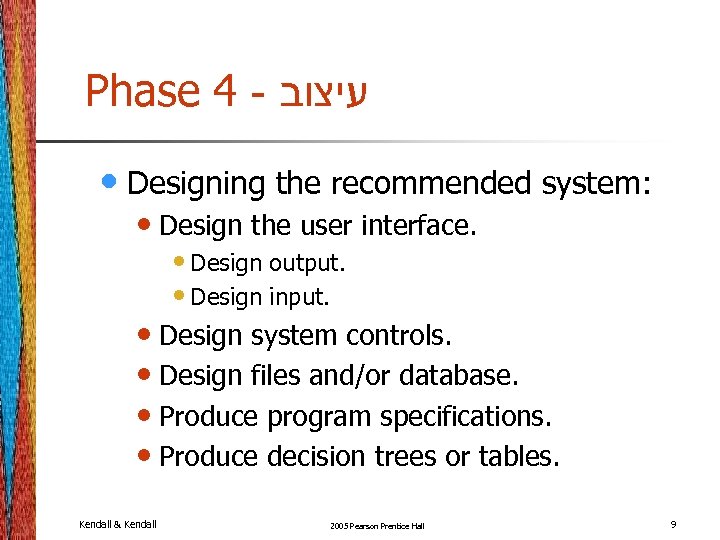 Phase 4 - עיצוב • Designing the recommended system: • Design the user interface. • Design output. • Design input. • Design system controls. • Design files and/or database. • Produce program specifications. • Produce decision trees or tables. Kendall & Kendall 2005 Pearson Prentice Hall 9
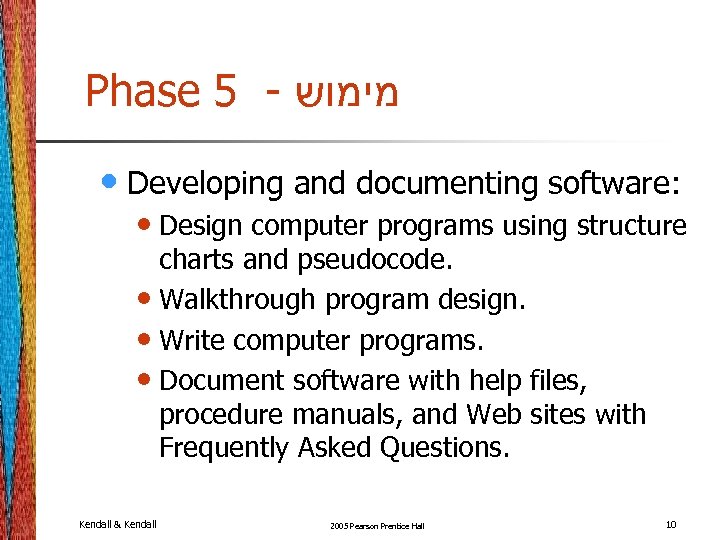 Phase 5 - מימוש • Developing and documenting software: • Design computer programs using structure charts and pseudocode. • Walkthrough program design. • Write computer programs. • Document software with help files, procedure manuals, and Web sites with Frequently Asked Questions. Kendall & Kendall 2005 Pearson Prentice Hall 10
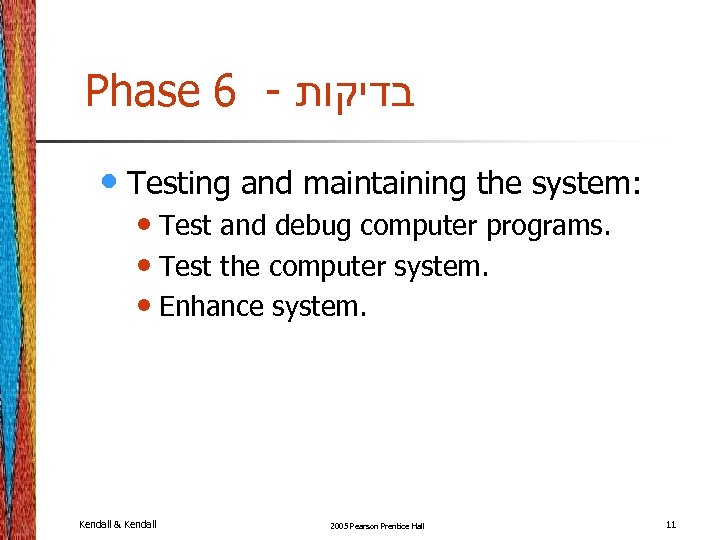 Phase 6 - בדיקות • Testing and maintaining the system: • Test and debug computer programs. • Test the computer system. • Enhance system. Kendall & Kendall 2005 Pearson Prentice Hall 11
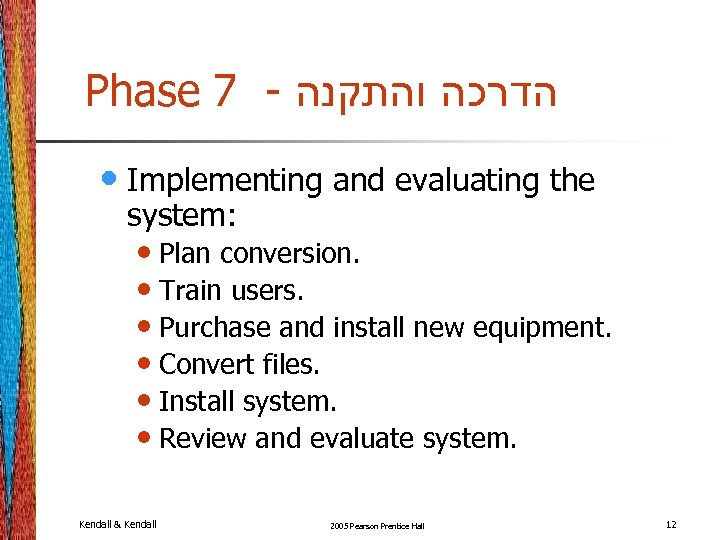 Phase 7 - הדרכה והתקנה • Implementing and evaluating the system: • Plan conversion. • Train users. • Purchase and install new equipment. • Convert files. • Install system. • Review and evaluate system. Kendall & Kendall 2005 Pearson Prentice Hall 12
 CASE Tools • CASE tools are automated, microcomputerbased software packages for systems analysis and design. • Four reasons for using CASE tools are: • To increase analyst productivity. • Facilitate communication among analysts and users. • Providing continuity between life cycle phases. • To assess the impact of maintenance. Kendall & Kendall 2005 Pearson Prentice Hall 13
 CASE Tool Categories CASE tools may be divided into several categories • Upper CASE (also called front-end CASE) tools, used to perform analysis and design. • Lower CASE (also called back-end CASE). These tools generate computer language source code from CASE design. • Integrated CASE, performing both upper and lower CASE functions. Kendall & Kendall 2005 Pearson Prentice Hall 14
 Upper CASE tools: • Create and modify the system design. • Store data in a project repository. • The repository is a collection of records, elements, diagrams, screens, reports, and other project information. • These CASE tools model organizational requirements and define system boundaries. Kendall & Kendall 2005 Pearson Prentice Hall 15
 Lower CASE • Lower CASE tools generate computer source code from the CASE design. • Source code may usually be generated in several languages. Kendall & Kendall 2005 Pearson Prentice Hall 16
 Object-Oriented Analysis and Design • Object-oriented (O-O) analysis and design is used to build object-oriented programs. • O-O programming examines the objects of a system. • Objects are grouped into classes for optimal reuse and maintainability. Kendall & Kendall 2005 Pearson Prentice Hall 17
 The Unified Modeling Language • The Unified Modeling Language (UML) is an industry standard for modeling object-oriented systems. • It breaks down a system into a use case model. Kendall & Kendall 2005 Pearson Prentice Hall 18