Скачать презентацию Chaos and Creativity in the Lives of Entrepreneurs
e8ed742ad0a96827495faf05cee3ec72.ppt
- Количество слайдов: 71
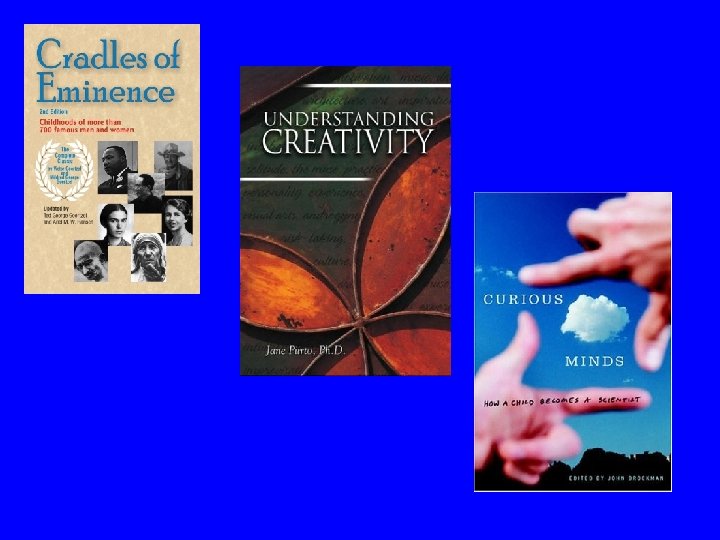
 Chaos and Creativity in the Lives of Entrepreneurs and Scientists by Ted Goertzel
 Why Study Entrepreneurs and Scientists? • They have a powerful impact on society • They are important role models for young people • They are underrepresented in a sample based on published biographies, especially the entrepreneurs • But: the amount of information available on their childhoods is often limited
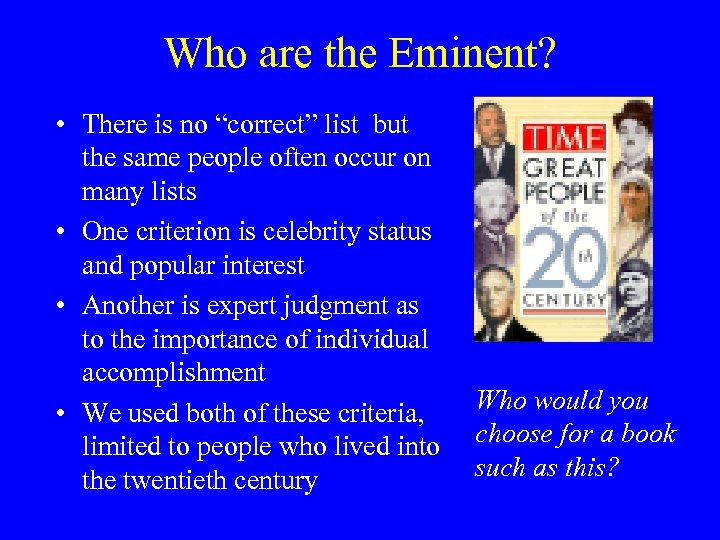 Who are the Eminent? • There is no “correct” list but the same people often occur on many lists • One criterion is celebrity status and popular interest • Another is expert judgment as to the importance of individual accomplishment • We used both of these criteria, limited to people who lived into the twentieth century Who would you choose for a book such as this?
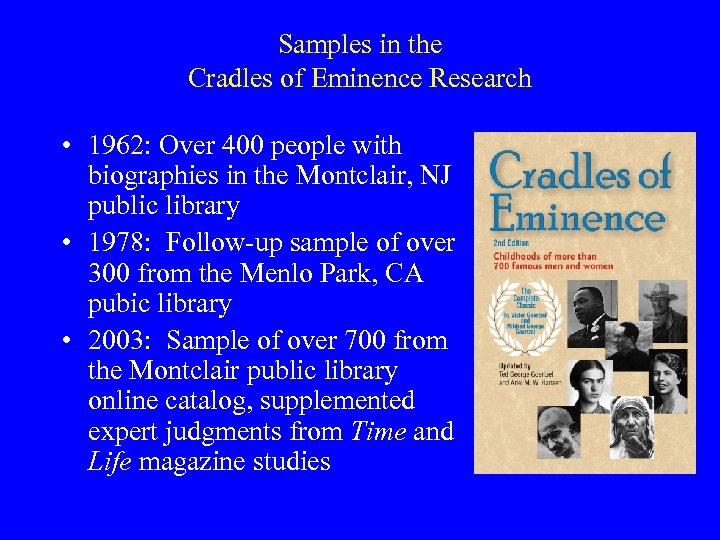 Samples in the Cradles of Eminence Research • 1962: Over 400 people with biographies in the Montclair, NJ public library • 1978: Follow-up sample of over 300 from the Menlo Park, CA pubic library • 2003: Sample of over 700 from the Montclair public library online catalog, supplemented expert judgments from Time and Life magazine studies
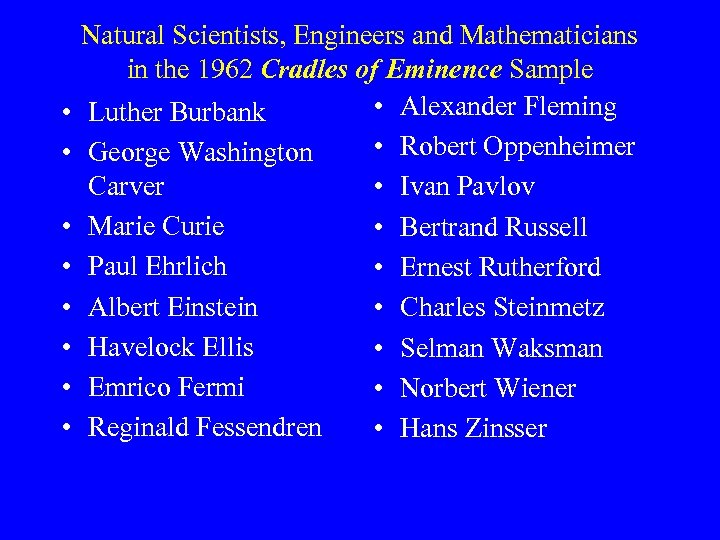 • • Natural Scientists, Engineers and Mathematicians in the 1962 Cradles of Eminence Sample • Alexander Fleming Luther Burbank • Robert Oppenheimer George Washington Carver • Ivan Pavlov Marie Curie • Bertrand Russell Paul Ehrlich • Ernest Rutherford Albert Einstein • Charles Steinmetz Havelock Ellis • Selman Waksman Emrico Fermi • Norbert Wiener Reginald Fessendren • Hans Zinsser
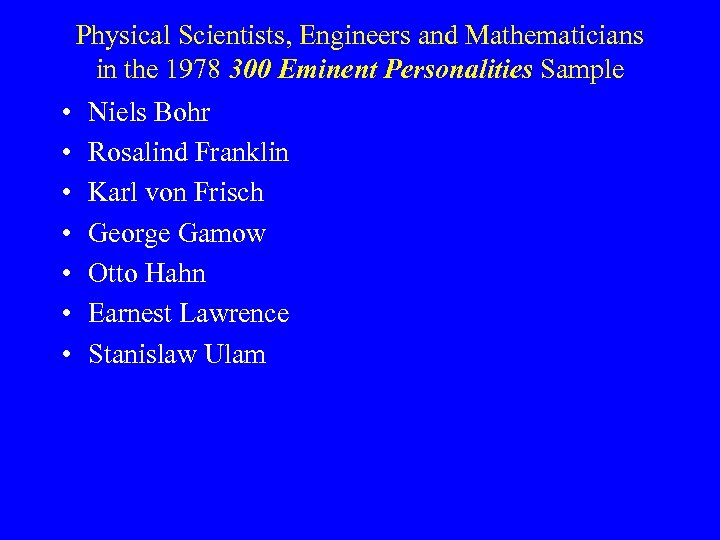 Physical Scientists, Engineers and Mathematicians in the 1978 300 Eminent Personalities Sample • • Niels Bohr Rosalind Franklin Karl von Frisch George Gamow Otto Hahn Earnest Lawrence Stanislaw Ulam
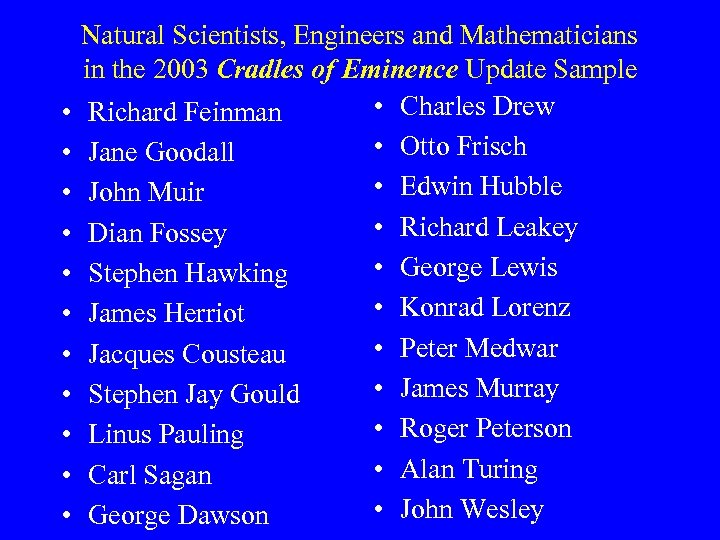 • • • Natural Scientists, Engineers and Mathematicians in the 2003 Cradles of Eminence Update Sample • Charles Drew Richard Feinman • Otto Frisch Jane Goodall • Edwin Hubble John Muir • Richard Leakey Dian Fossey • George Lewis Stephen Hawking • Konrad Lorenz James Herriot • Peter Medwar Jacques Cousteau • James Murray Stephen Jay Gould • Roger Peterson Linus Pauling • Alan Turing Carl Sagan • John Wesley George Dawson
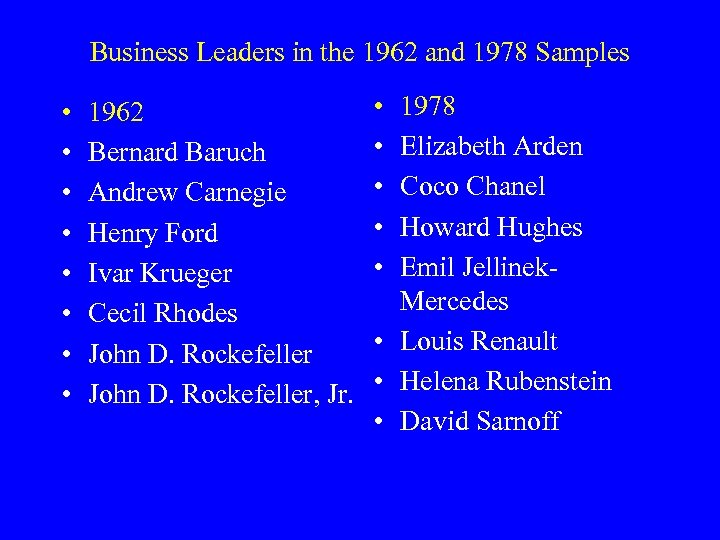 Business Leaders in the 1962 and 1978 Samples • • 1962 Bernard Baruch Andrew Carnegie Henry Ford Ivar Krueger Cecil Rhodes John D. Rockefeller, Jr. • • • 1978 Elizabeth Arden Coco Chanel Howard Hughes Emil Jellinek. Mercedes • Louis Renault • Helena Rubenstein • David Sarnoff
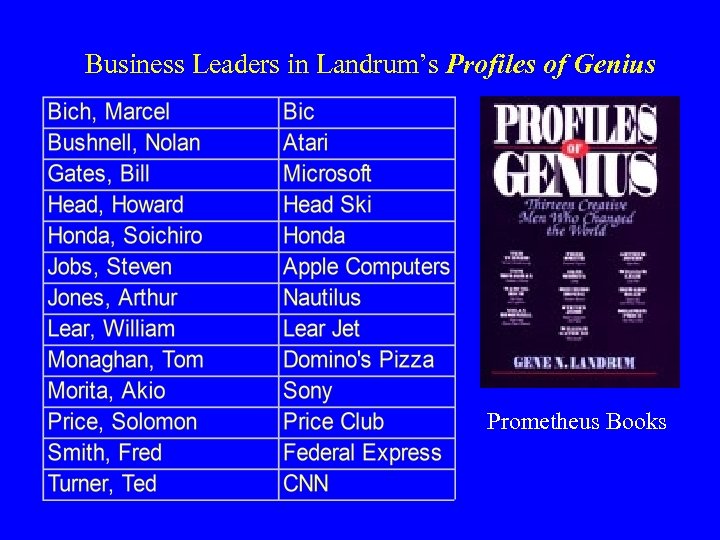 Business Leaders in Landrum’s Profiles of Genius Prometheus Books
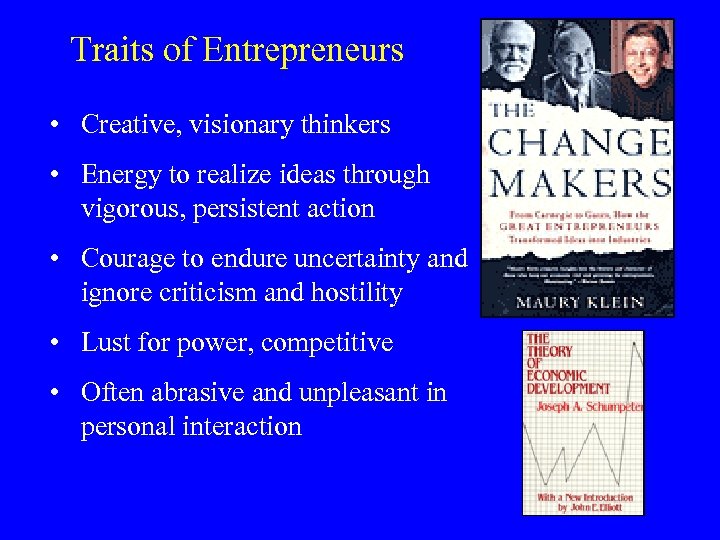 Traits of Entrepreneurs • Creative, visionary thinkers • Energy to realize ideas through vigorous, persistent action • Courage to endure uncertainty and ignore criticism and hostility • Lust for power, competitive • Often abrasive and unpleasant in personal interaction
 Maury Klein on the Childhoods of Entrepreneurs • Middle class or wealthy families • Many fathers had career problems or marital problems • A few had especially devoted or attentive mothers • “Education offers little that explains their success except perhaps in a negative role” • Started work early and worked very hard • Often inspired by mentors
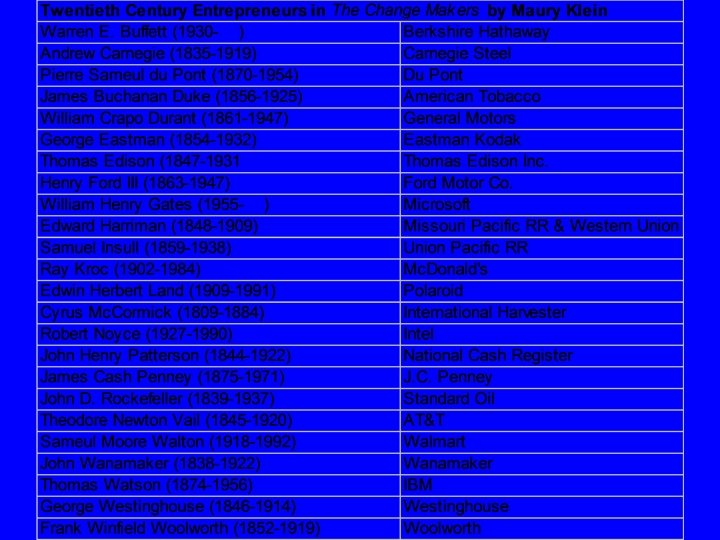
 Early Twentieth Century Entrepreneurs
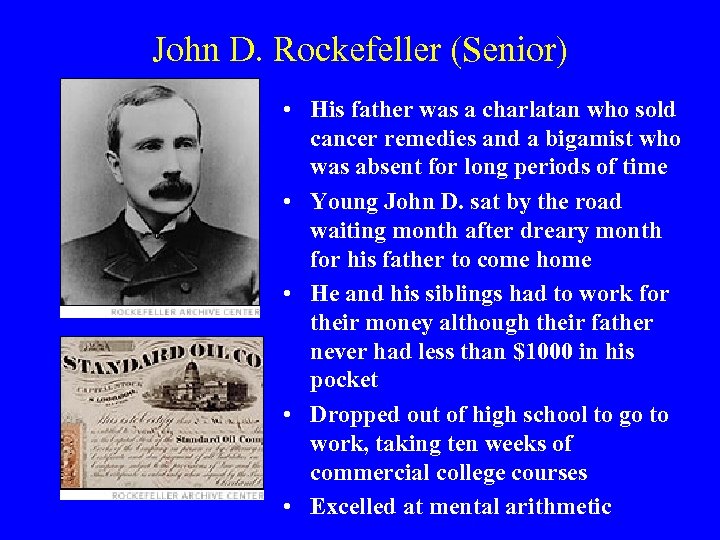 John D. Rockefeller (Senior) • His father was a charlatan who sold cancer remedies and a bigamist who was absent for long periods of time • Young John D. sat by the road waiting month after dreary month for his father to come home • He and his siblings had to work for their money although their father never had less than $1000 in his pocket • Dropped out of high school to go to work, taking ten weeks of commercial college courses • Excelled at mental arithmetic
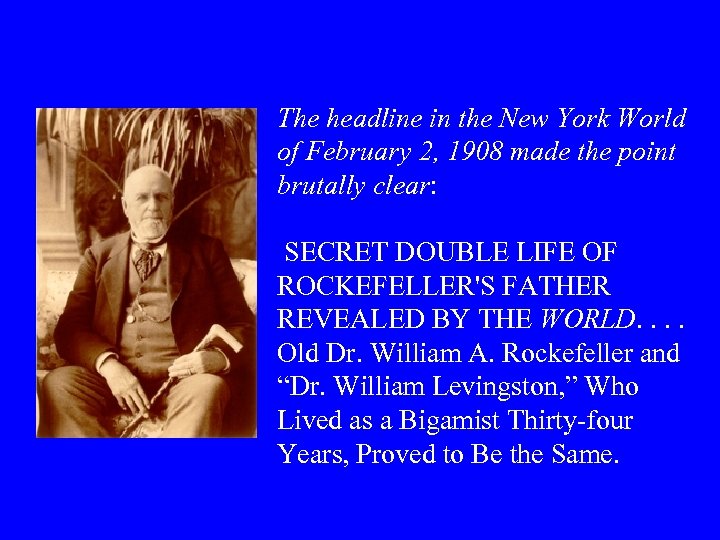 The headline in the New York World of February 2, 1908 made the point brutally clear: SECRET DOUBLE LIFE OF ROCKEFELLER'S FATHER REVEALED BY THE WORLD. . Old Dr. William A. Rockefeller and “Dr. William Levingston, ” Who Lived as a Bigamist Thirty-four Years, Proved to Be the Same.
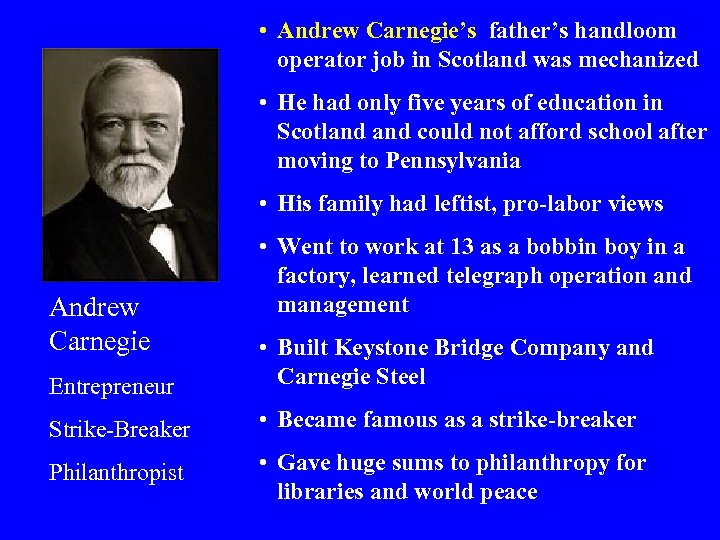 • Andrew Carnegie’s father’s handloom operator job in Scotland was mechanized • He had only five years of education in Scotland could not afford school after moving to Pennsylvania • His family had leftist, pro-labor views Andrew Carnegie • Went to work at 13 as a bobbin boy in a factory, learned telegraph operation and management Entrepreneur • Built Keystone Bridge Company and Carnegie Steel Strike-Breaker • Became famous as a strike-breaker Philanthropist • Gave huge sums to philanthropy for libraries and world peace
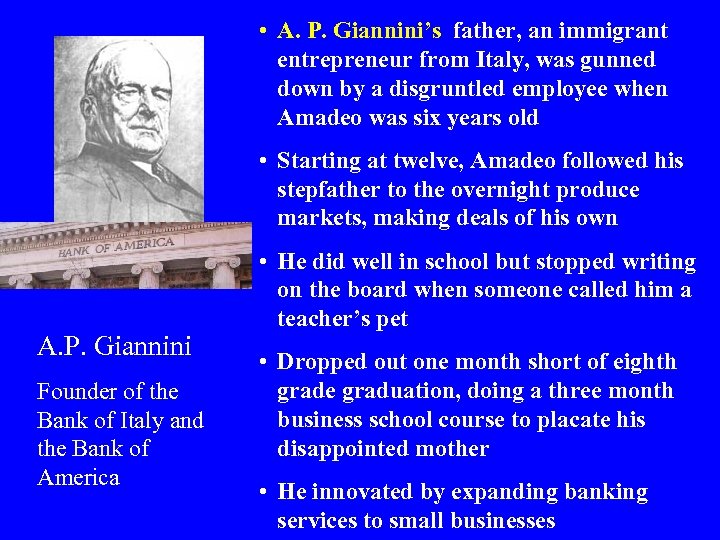 • A. P. Giannini’s father, an immigrant entrepreneur from Italy, was gunned down by a disgruntled employee when Amadeo was six years old • Starting at twelve, Amadeo followed his stepfather to the overnight produce markets, making deals of his own A. P. Giannini Founder of the Bank of Italy and the Bank of America • He did well in school but stopped writing on the board when someone called him a teacher’s pet • Dropped out one month short of eighth grade graduation, doing a three month business school course to placate his disappointed mother • He innovated by expanding banking services to small businesses
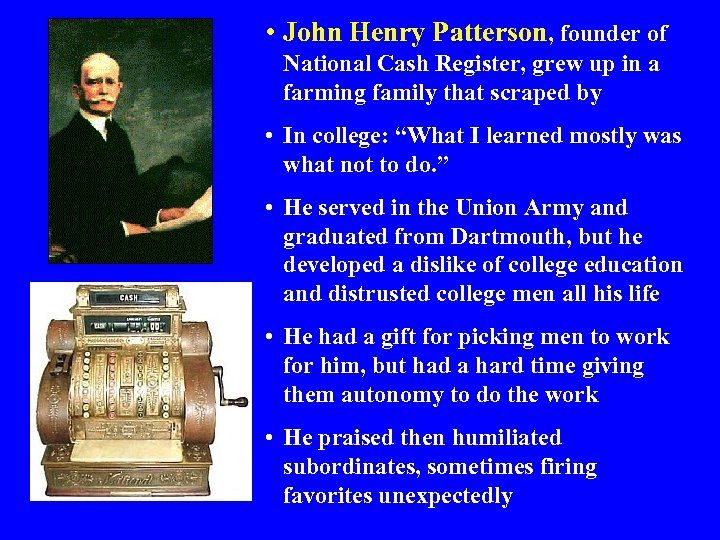 • John Henry Patterson, founder of National Cash Register, grew up in a farming family that scraped by • In college: “What I learned mostly was what not to do. ” • He served in the Union Army and graduated from Dartmouth, but he developed a dislike of college education and distrusted college men all his life • He had a gift for picking men to work for him, but had a hard time giving them autonomy to do the work • He praised then humiliated subordinates, sometimes firing favorites unexpectedly
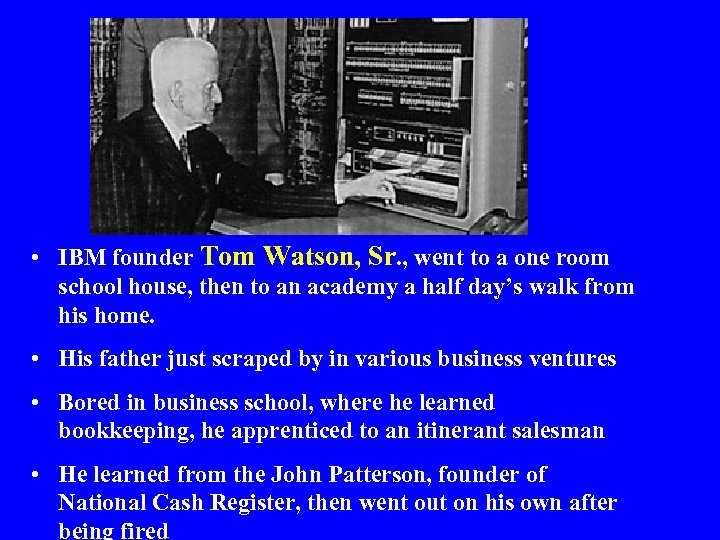 • IBM founder Tom Watson, Sr. , went to a one room school house, then to an academy a half day’s walk from his home. • His father just scraped by in various business ventures • Bored in business school, where he learned bookkeeping, he apprenticed to an itinerant salesman • He learned from the John Patterson, founder of National Cash Register, then went out on his own after being fired
 Financially Precarious Fathers • Andrew Carnegie’s father was a weaver in Scotland who lost his trade to mechanization • George Eastman’s father died when he was 14 • Thomas Watson grew up in a cramped cabin with no running water, his father became too ill to work • Edmund Harriman’s father was an impecunious minister • F. W. Woolworth’s father was a struggling farmer • Warren Buffet’s father went broke during the depression but reestablished himself • Joyce Hall’s father was an itinerant preacher who sent little money home, then left altogether when Joyce was seven.
 Entrepreneurs on Schooling • Joyce Hall: (of a rural grade school) “We went to school because we had to. Not much reason was ever given why we should take it seriously. ” • J. C. Penney: “Whatever education I received has been picked up as I went along - just as a locomotive scoops up water without stopping. ” • Theodore Vail: “Schools teach too much science and unpractical things. Young men grow up to think the world owes them a living. ” • Michael Dell: “As important as [high] school was, I found that it could be very disruptive to a steady income. ” • Warren Buffett: “It seems like a waste to go to school and get a Ph. D. in economics. It’s a little like spending eight years in divinity school and having someone tell you that the ten commandments are all that matter. ”
 Mid to Late Twentieth Century Entrepreneurs
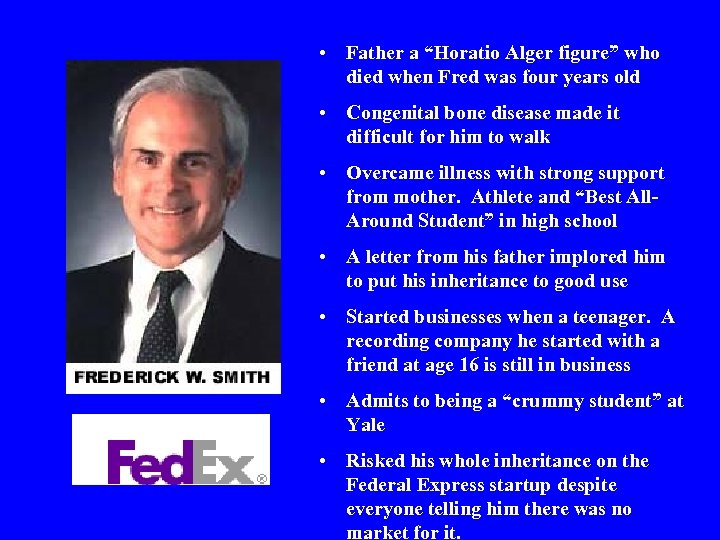 • Father a “Horatio Alger figure” who died when Fred was four years old • Congenital bone disease made it difficult for him to walk • Overcame illness with strong support from mother. Athlete and “Best All. Around Student” in high school • A letter from his father implored him to put his inheritance to good use • Started businesses when a teenager. A recording company he started with a friend at age 16 is still in business • Admits to being a “crummy student” at Yale • Risked his whole inheritance on the Federal Express startup despite everyone telling him there was no market for it.
 Childhood of a “Pizza King” • Tom Monaghan’s father died when he was four • Mother felt unable to raise him, left him in St. Joseph’s Home for Boys, later in foster homes • He called St. Joseph’s a prison and his classmates inmates, yet felt close to one of the nuns • His mother favored his younger brother, left him in foster homes • High school diploma and one semester of college • Dislikes moderation, favors disciplined work habits, diet, rigorous exercise routine, religious observance
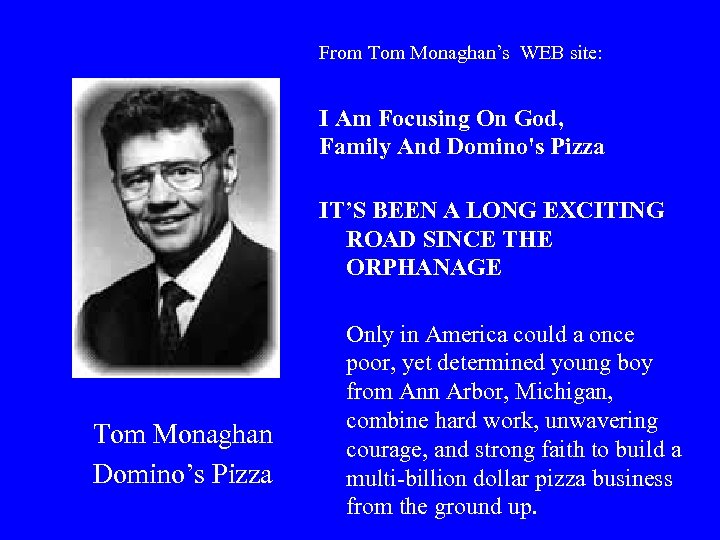 From Tom Monaghan’s WEB site: I Am Focusing On God, Family And Domino's Pizza IT’S BEEN A LONG EXCITING ROAD SINCE THE ORPHANAGE Tom Monaghan Domino’s Pizza Only in America could a once poor, yet determined young boy from Ann Arbor, Michigan, combine hard work, unwavering courage, and strong faith to build a multi-billion dollar pizza business from the ground up.
 • A second son, Donald Trump surpassed his older brother as his father’s heir apparent • As small child he howled for no apparent reason, insisted on being a center of attention • Exuberant and disruptive in school, taken out of private school and sent to a military academy • Couldn’t wait to get out of college and into the real estate business. Started buying Philadelphia real estate while a student at Wharton
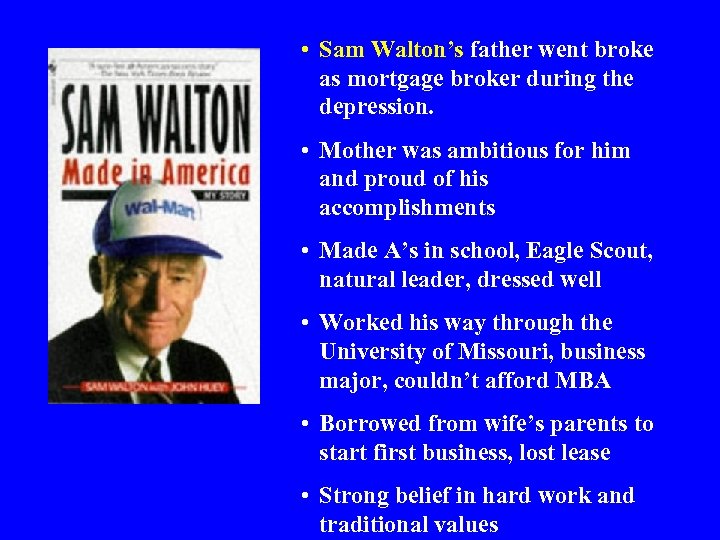 • Sam Walton’s father went broke as mortgage broker during the depression. • Mother was ambitious for him and proud of his accomplishments • Made A’s in school, Eagle Scout, natural leader, dressed well • Worked his way through the University of Missouri, business major, couldn’t afford MBA • Borrowed from wife’s parents to start first business, lost lease • Strong belief in hard work and traditional values
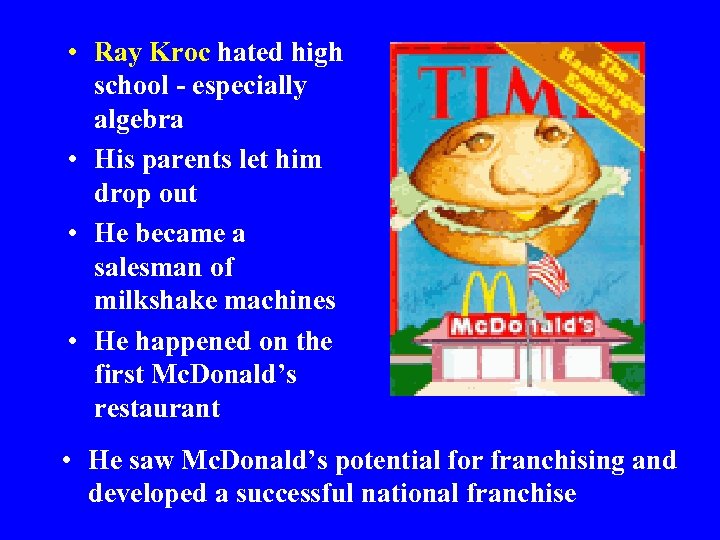 • Ray Kroc hated high school - especially algebra • His parents let him drop out • He became a salesman of milkshake machines • He happened on the first Mc. Donald’s restaurant • He saw Mc. Donald’s potential for franchising and developed a successful national franchise
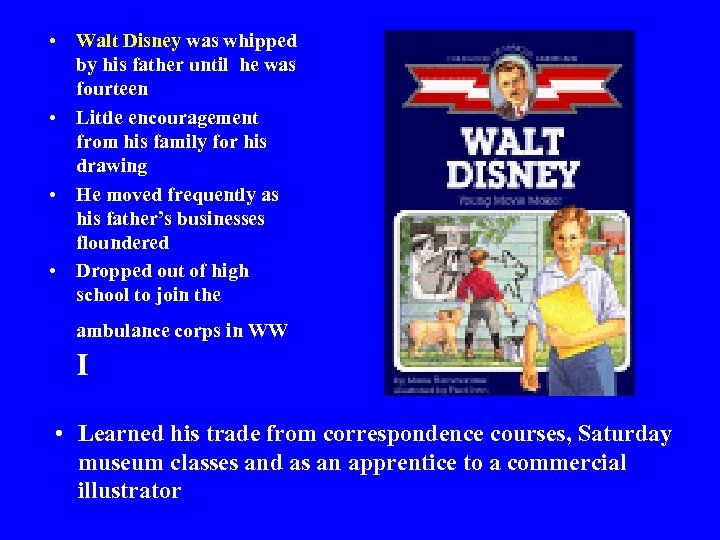 • Walt Disney was whipped by his father until he was fourteen • Little encouragement from his family for his drawing • He moved frequently as his father’s businesses floundered • Dropped out of high school to join the ambulance corps in WW I • Learned his trade from correspondence courses, Saturday museum classes and as an apprentice to a commercial illustrator
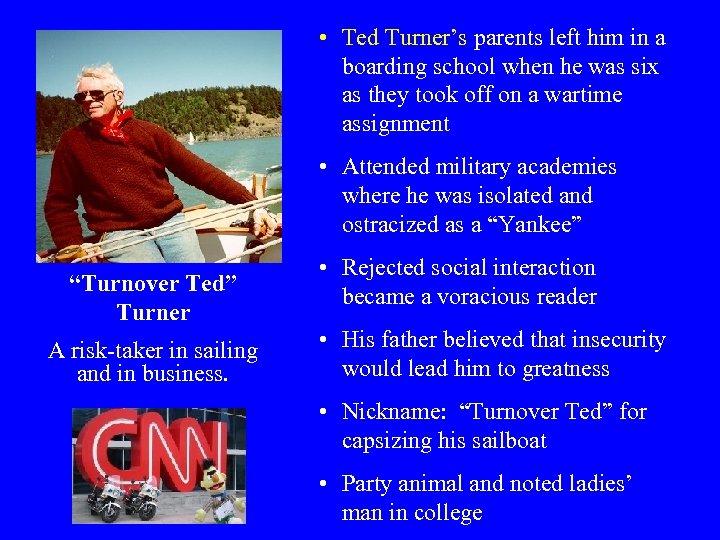 • Ted Turner’s parents left him in a boarding school when he was six as they took off on a wartime assignment • Attended military academies where he was isolated and ostracized as a “Yankee” “Turnover Ted” Turner A risk-taker in sailing and in business. • Rejected social interaction became a voracious reader • His father believed that insecurity would lead him to greatness • Nickname: “Turnover Ted” for capsizing his sailboat • Party animal and noted ladies’ man in college
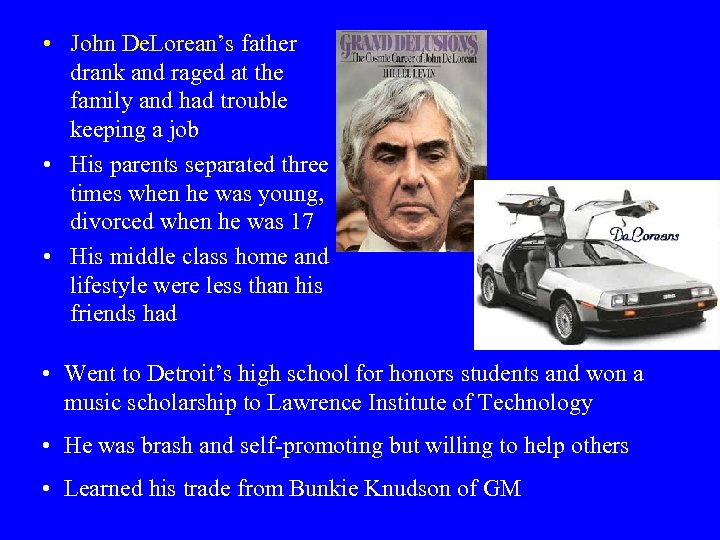 • John De. Lorean’s father drank and raged at the family and had trouble keeping a job • His parents separated three times when he was young, divorced when he was 17 • His middle class home and lifestyle were less than his friends had • Went to Detroit’s high school for honors students and won a music scholarship to Lawrence Institute of Technology • He was brash and self-promoting but willing to help others • Learned his trade from Bunkie Knudson of GM
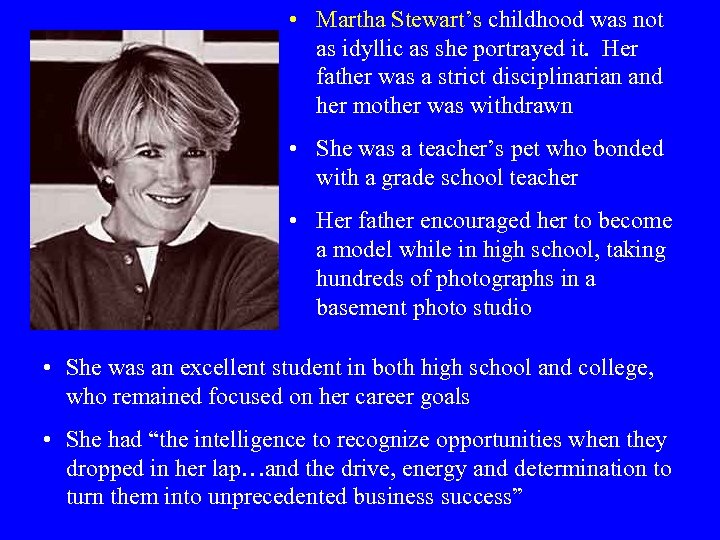 • Martha Stewart’s childhood was not as idyllic as she portrayed it. Her father was a strict disciplinarian and her mother was withdrawn • She was a teacher’s pet who bonded with a grade school teacher • Her father encouraged her to become a model while in high school, taking hundreds of photographs in a basement photo studio • She was an excellent student in both high school and college, who remained focused on her career goals • She had “the intelligence to recognize opportunities when they dropped in her lap…and the drive, energy and determination to turn them into unprecedented business success”
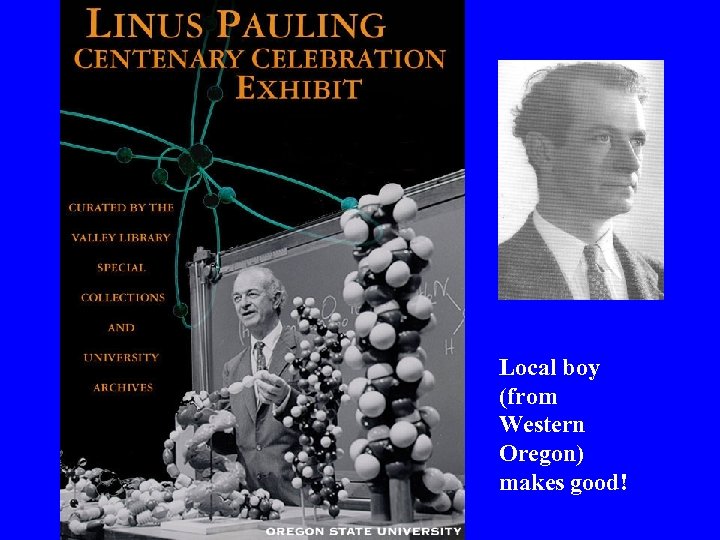 Local boy (from Western Oregon) makes good!
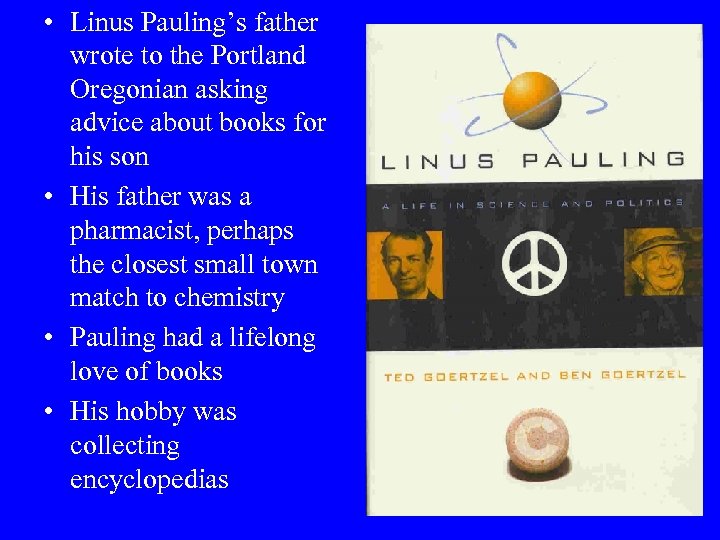 • Linus Pauling’s father wrote to the Portland Oregonian asking advice about books for his son • His father was a pharmacist, perhaps the closest small town match to chemistry • Pauling had a lifelong love of books • His hobby was collecting encyclopedias
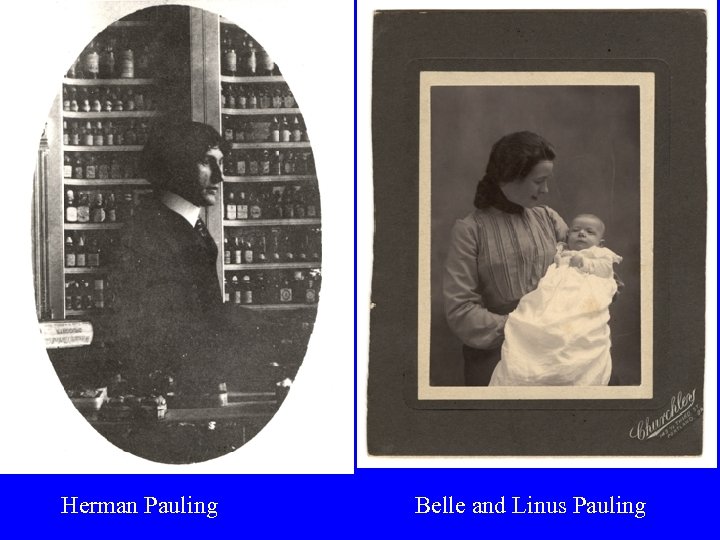 Herman Pauling Belle and Linus Pauling
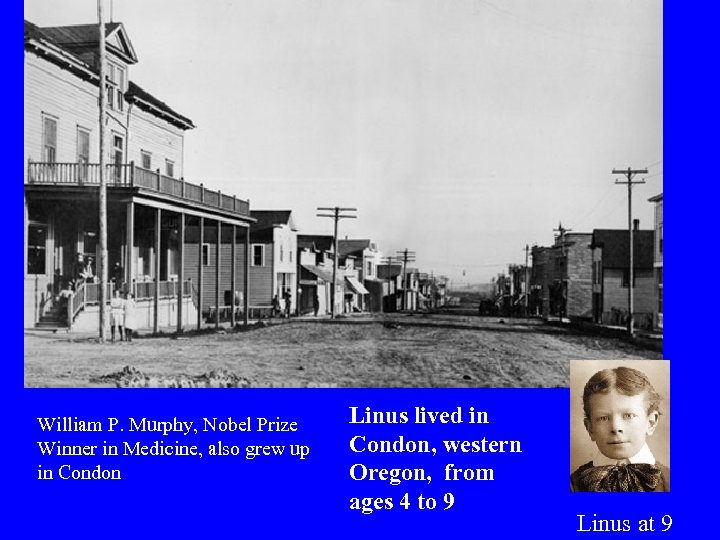 William P. Murphy, Nobel Prize Winner in Medicine, also grew up in Condon Linus lived in Condon, western Oregon, from ages 4 to 9 Linus at 9
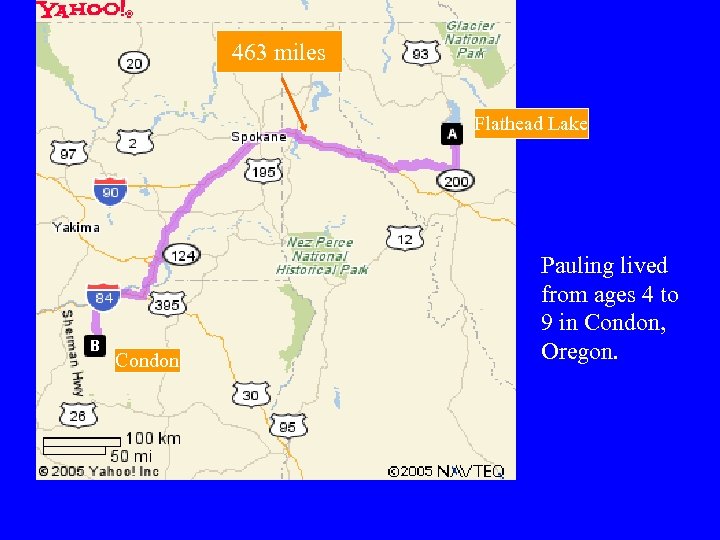 463 miles Flathead Lake Condon Pauling lived from ages 4 to 9 in Condon, Oregon.
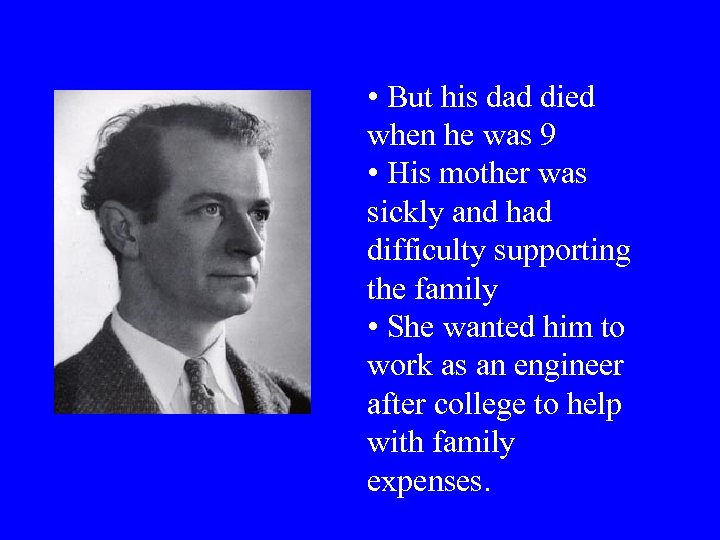 • But his dad died when he was 9 • His mother was sickly and had difficulty supporting the family • She wanted him to work as an engineer after college to help with family expenses.
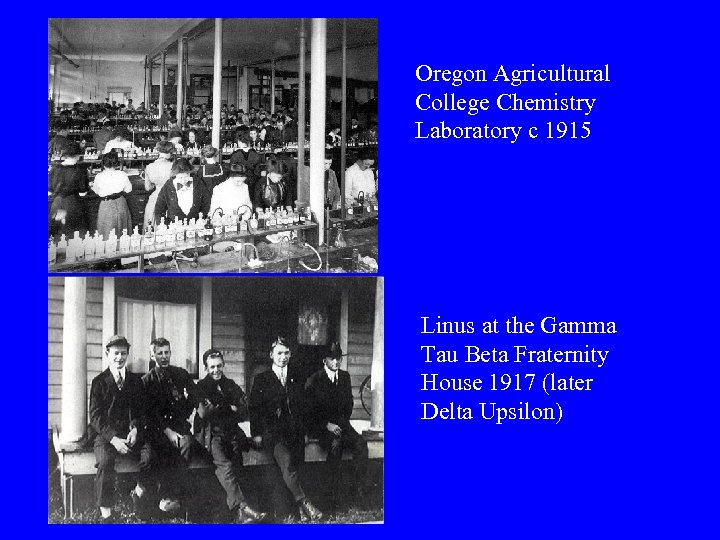 Oregon Agricultural College Chemistry Laboratory c 1915 Linus at the Gamma Tau Beta Fraternity House 1917 (later Delta Upsilon)
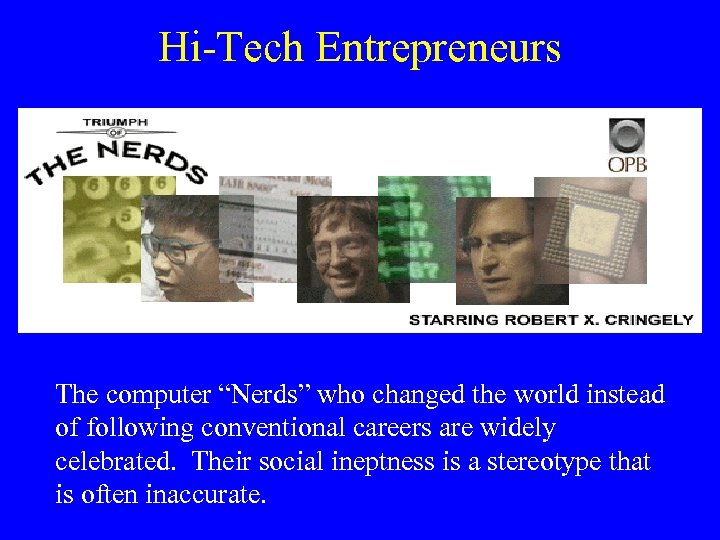 Hi-Tech Entrepreneurs The computer “Nerds” who changed the world instead of following conventional careers are widely celebrated. Their social ineptness is a stereotype that is often inaccurate.
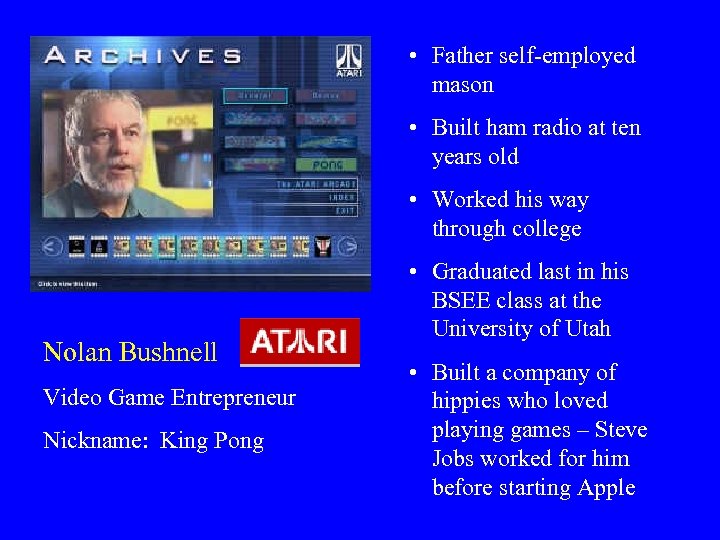 • Father self-employed mason • Built ham radio at ten years old • Worked his way through college Nolan Bushnell Video Game Entrepreneur Nickname: King Pong • Graduated last in his BSEE class at the University of Utah • Built a company of hippies who loved playing games – Steve Jobs worked for him before starting Apple
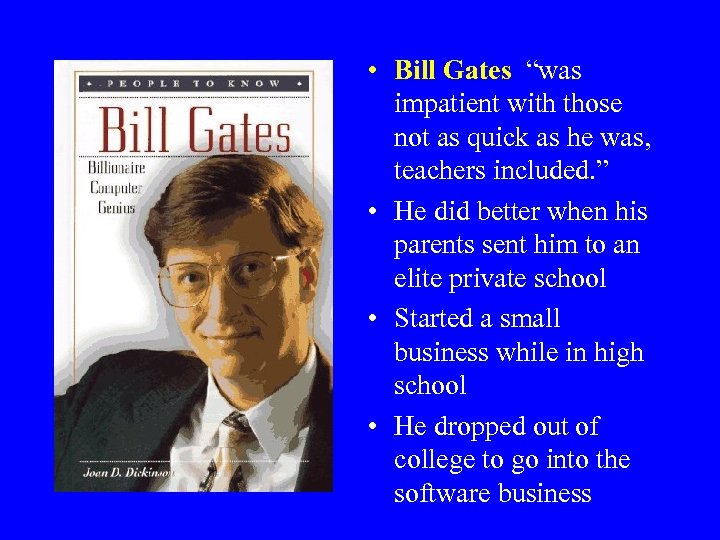 • Bill Gates “was impatient with those not as quick as he was, teachers included. ” • He did better when his parents sent him to an elite private school • Started a small business while in high school • He dropped out of college to go into the software business
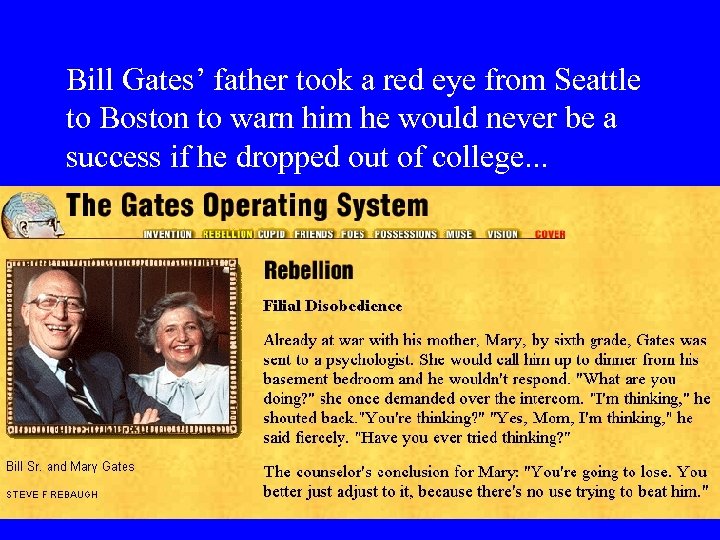 Bill Gates’ father took a red eye from Seattle to Boston to warn him he would never be a success if he dropped out of college. . .
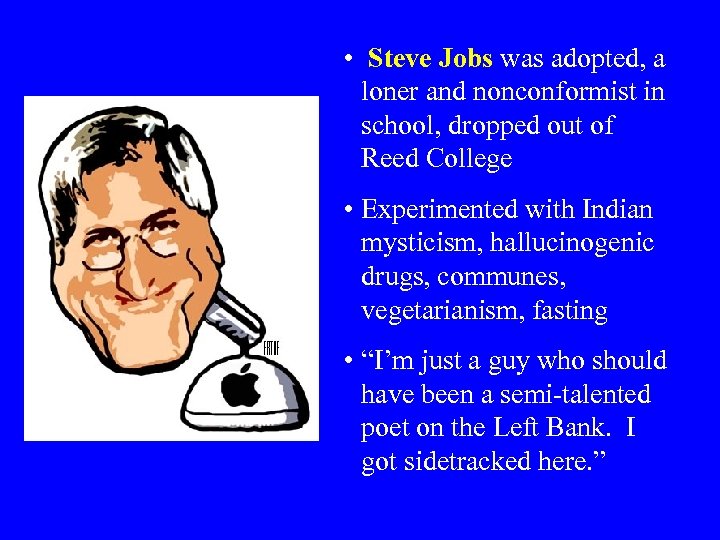 • Steve Jobs was adopted, a loner and nonconformist in school, dropped out of Reed College • Experimented with Indian mysticism, hallucinogenic drugs, communes, vegetarianism, fasting • “I’m just a guy who should have been a semi-talented poet on the Left Bank. I got sidetracked here. ”
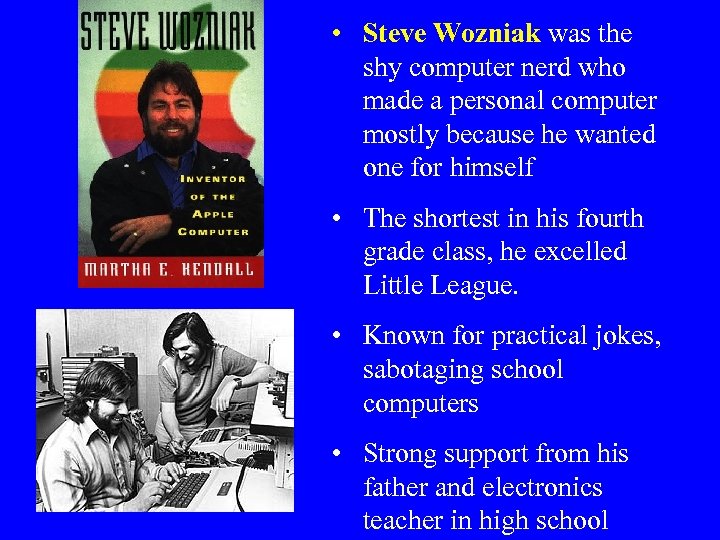 • Steve Wozniak was the shy computer nerd who made a personal computer mostly because he wanted one for himself • The shortest in his fourth grade class, he excelled Little League. • Known for practical jokes, sabotaging school computers • Strong support from his father and electronics teacher in high school
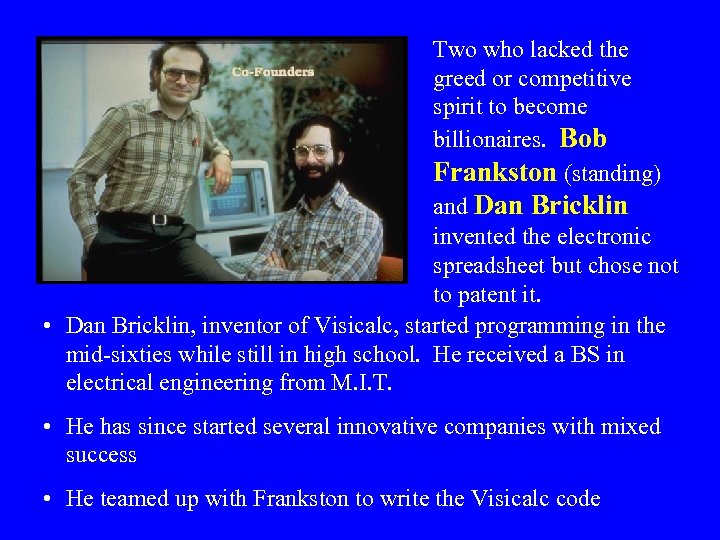 Two who lacked the greed or competitive spirit to become billionaires. Bob Frankston (standing) and Dan Bricklin invented the electronic spreadsheet but chose not to patent it. • Dan Bricklin, inventor of Visicalc, started programming in the mid-sixties while still in high school. He received a BS in electrical engineering from M. I. T. • He has since started several innovative companies with mixed success • He teamed up with Frankston to write the Visicalc code
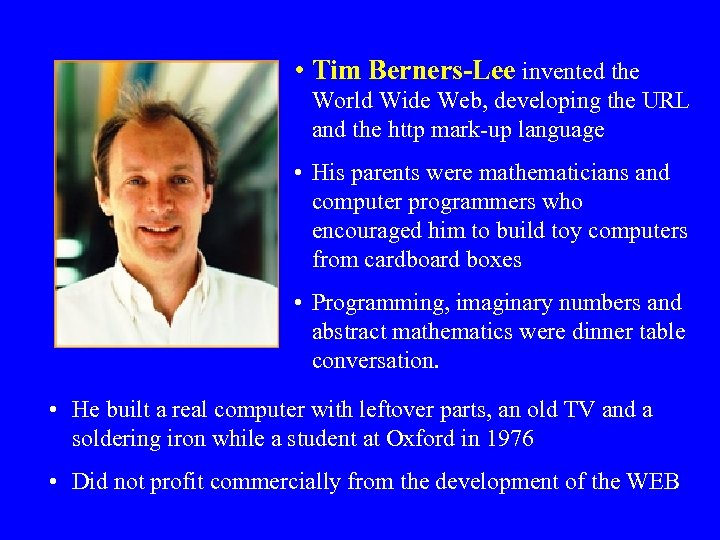 • Tim Berners-Lee invented the World Wide Web, developing the URL and the http mark-up language • His parents were mathematicians and computer programmers who encouraged him to build toy computers from cardboard boxes • Programming, imaginary numbers and abstract mathematics were dinner table conversation. • He built a real computer with leftover parts, an old TV and a soldering iron while a student at Oxford in 1976 • Did not profit commercially from the development of the WEB
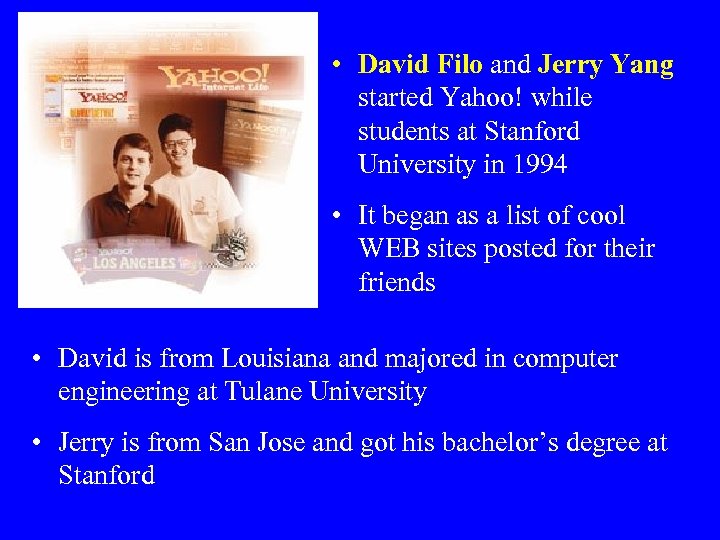 • David Filo and Jerry Yang started Yahoo! while students at Stanford University in 1994 • It began as a list of cool WEB sites posted for their friends • David is from Louisiana and majored in computer engineering at Tulane University • Jerry is from San Jose and got his bachelor’s degree at Stanford
 The Chief Yahoo!’s Grow Up • Jerry Yang was born in 1968 in Taiwan • His father died when he was two, leaving his mother with him and a one year old brother • Jerry began writing Chinese characters at age three • His mother moved to the U. S. when he was five to get a college teaching job • He got straight A’s all through school • David Filo was born in 1966 in Moss Bluff, Louisiana • He was the fourth of six children, a “bright and curious child” • He grew up and went to college in New Orleans getting a bachelor’s in computer science at Tulane • He met Jerry Yang at Stanford where they were doctoral students
 Starting Yet Another Hierarchical Officious Oracle! • Filo “was terribly bored” with graduate work making tiny changes to manufacturing plans for computer chips • Yang agrees: “Really, we’d do anything to keep from working on our theses” • Yahoo! started as a hobby listing of cool WEB sites • When the WEB boomed and Yahoo! took off they took a leave from graduate school • After writing business plans for various WEB business, including books, they decided that they already had a service people wanted

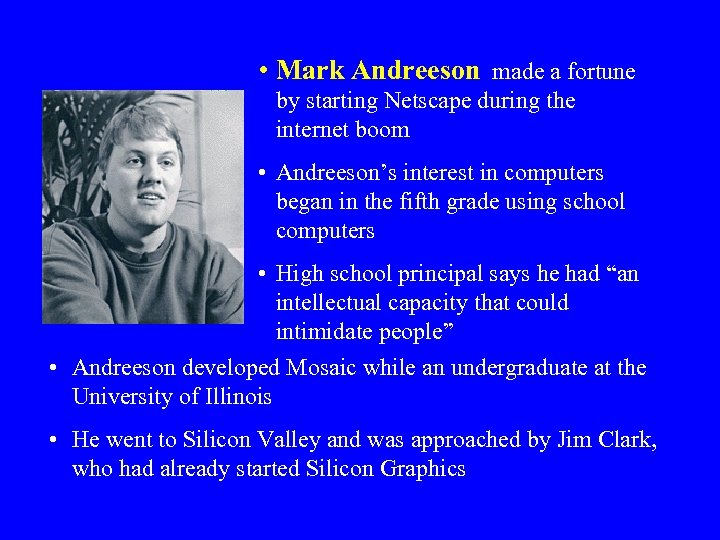 • Mark Andreeson made a fortune by starting Netscape during the internet boom • Andreeson’s interest in computers began in the fifth grade using school computers • High school principal says he had “an intellectual capacity that could intimidate people” • Andreeson developed Mosaic while an undergraduate at the University of Illinois • He went to Silicon Valley and was approached by Jim Clark, who had already started Silicon Graphics
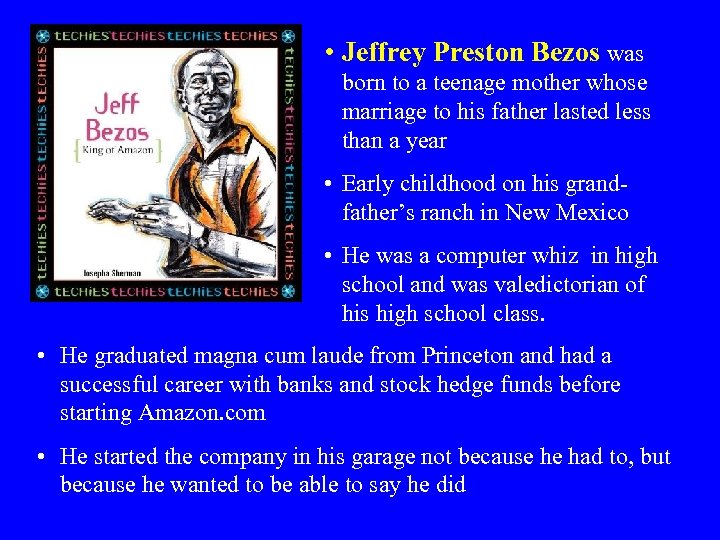 • Jeffrey Preston Bezos was born to a teenage mother whose marriage to his father lasted less than a year • Early childhood on his grandfather’s ranch in New Mexico • He was a computer whiz in high school and was valedictorian of his high school class. • He graduated magna cum laude from Princeton and had a successful career with banks and stock hedge funds before starting Amazon. com • He started the company in his garage not because he had to, but because he wanted to be able to say he did
 • Jeff Bezos attended fourth to sixth grade at a magnet school in the prestigious River Oaks neighborhood of Houston, Texas • The school was part of the Vanguard Program, the largest gifted education program in Texas • A visitor in 1976 described him as “a student of general intellectual excellence, slight of build, friendly but serious…not particularly gifted in leadership…moves confidently among many friends at Vanguard - who provide a full spectrum of shapes, sizes, colors and manners attributed to gifted children”
 Jeff Bezos’s Sixth Grade Day • Bus: picked up at seven for 20 mile ride • Math class: frequently works alone on enrichment projects, sometimes joins one of three ability grouped “teams” • A computer terminal available for simple programming, flow charting, work in base two mathematics • Independent Project: a statistical survey of how the teachers teach • Reading: the Hobbit • Science specialist comes every other day. Jeff built an “infinity cube” modeled on one he saw in a store • Art specialist conducts visualization exercise • Language arts and Social Studies Projects
 “Productive Thinking” at River Oaks • “Productive Thinking” exercises are often conducted in language arts class because it is highly individualized and smallgroup activity fits in well • Process for discussion: – silent reading of a story – discussion questions comparing ideas and conclusions – generalization about how conclusions had been reached • The first story describes an archeological expedition that discovered artifacts shown to be unauthentic • Why had the scientists undertaken the project against obvious odds and what better reasoning might they have used? • What is the meaning of “gaps” and “discrepancies” in research?
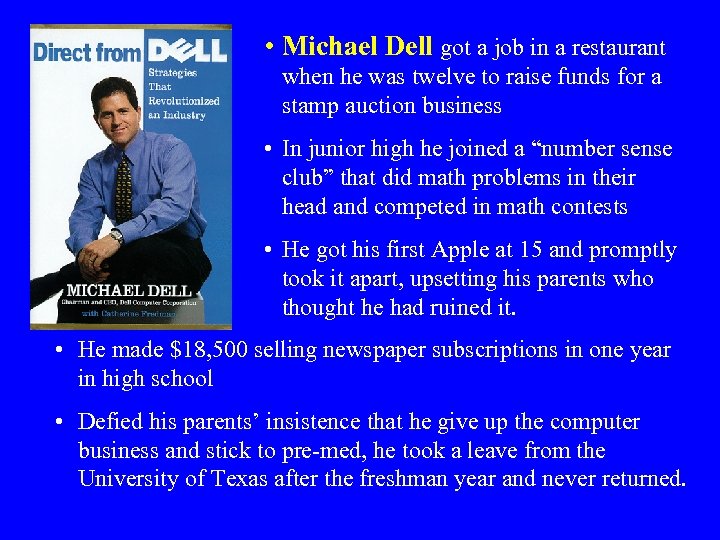 • Michael Dell got a job in a restaurant when he was twelve to raise funds for a stamp auction business • In junior high he joined a “number sense club” that did math problems in their head and competed in math contests • He got his first Apple at 15 and promptly took it apart, upsetting his parents who thought he had ruined it. • He made $18, 500 selling newspaper subscriptions in one year in high school • Defied his parents’ insistence that he give up the computer business and stick to pre-med, he took a leave from the University of Texas after the freshman year and never returned.
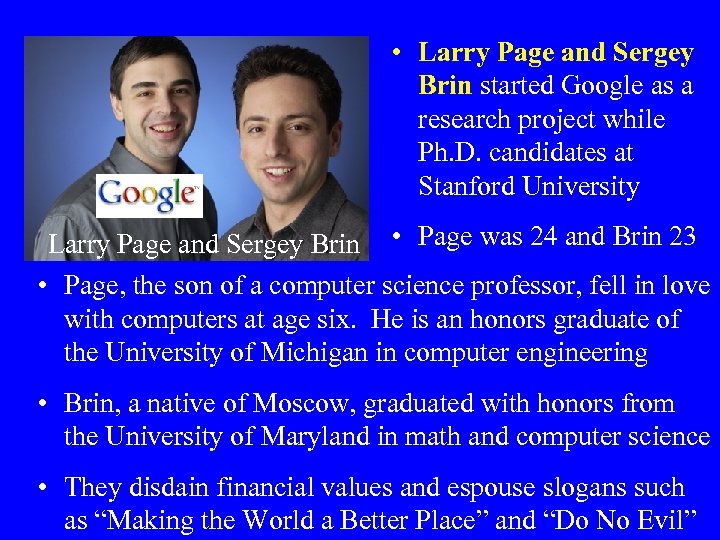 • Larry Page and Sergey Brin started Google as a research project while Ph. D. candidates at Stanford University Larry Page and Sergey Brin • Page was 24 and Brin 23 • Page, the son of a computer science professor, fell in love with computers at age six. He is an honors graduate of the University of Michigan in computer engineering • Brin, a native of Moscow, graduated with honors from the University of Maryland in math and computer science • They disdain financial values and espouse slogans such as “Making the World a Better Place” and “Do No Evil”
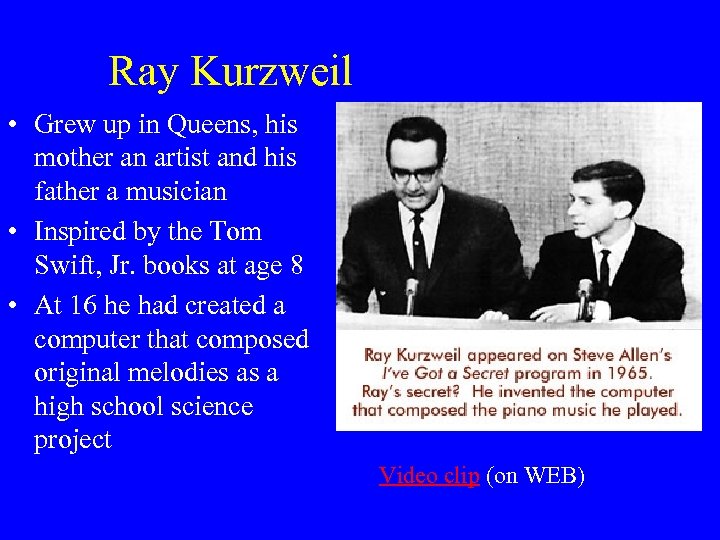 Ray Kurzweil • Grew up in Queens, his mother an artist and his father a musician • Inspired by the Tom Swift, Jr. books at age 8 • At 16 he had created a computer that composed original melodies as a high school science project Video clip (on WEB)
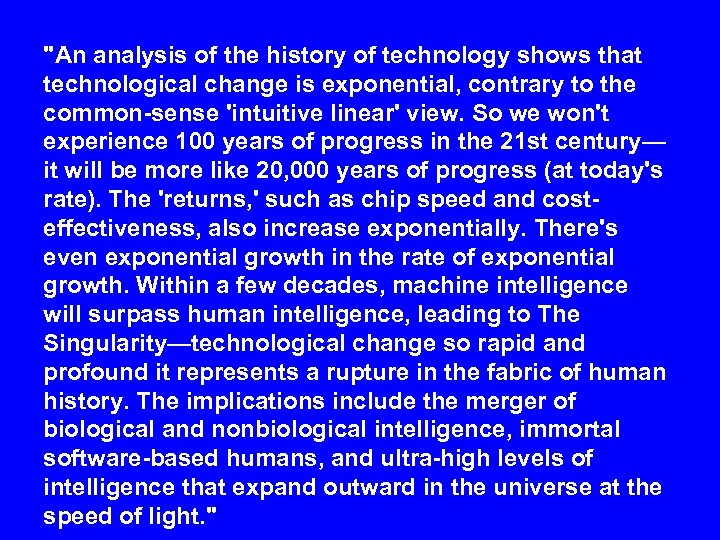
 Kurzweil • His parents fled Nazi Germany in 1938 and raised him as a Unitarian • His father died of heart disease when Ray wa 22 • He believes in the “singularity” - a point at which exponential rates of change will be so fast that things will be constantly changing • He also advocates life extension
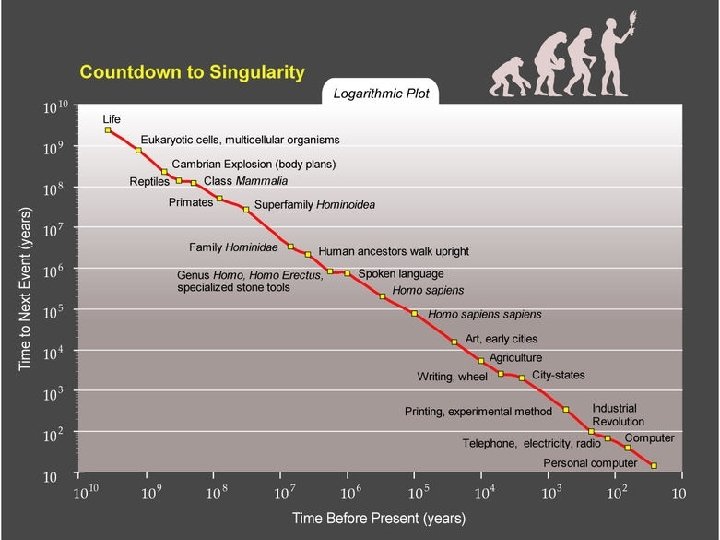
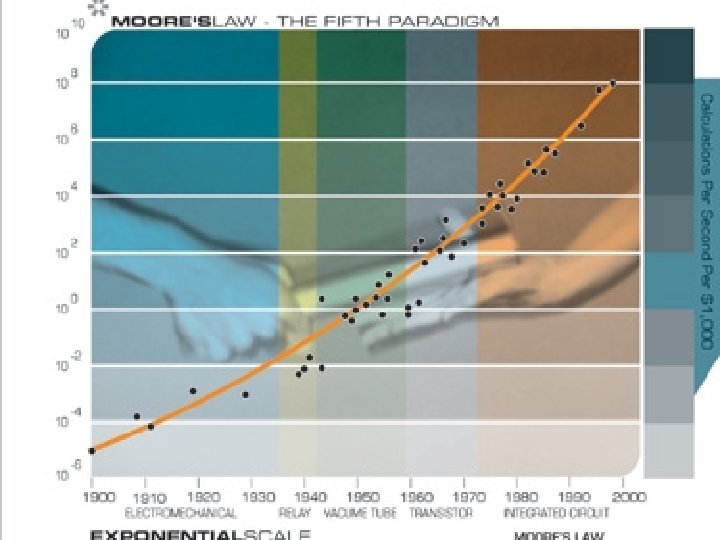
 "An analysis of the history of technology shows that technological change is exponential, contrary to the common-sense 'intuitive linear' view. So we won't experience 100 years of progress in the 21 st century— it will be more like 20, 000 years of progress (at today's rate). The 'returns, ' such as chip speed and costeffectiveness, also increase exponentially. There's even exponential growth in the rate of exponential growth. Within a few decades, machine intelligence will surpass human intelligence, leading to The Singularity—technological change so rapid and profound it represents a rupture in the fabric of human history. The implications include the merger of biological and nonbiological intelligence, immortal software-based humans, and ultra-high levels of intelligence that expand outward in the universe at the speed of light. "
 Famous Montanans Pearl Jam Dorothy Baker author, Missoula Dirk Benedict actor, Helena W. A. Tony Boyle labor union official, Bald Butte Dana Carvey comedian, Missoula Gary Cooper actor, Helena Chet Huntley journalist, TV newscaster, Cardwell Will James writer, artist, Great Falls Evel Knievel daredevil motorcyclist, Butte Jerry Kramer football player, author, Jordan Myrna Loy actress, Helena David Lynch filmmaker, Missoula George Montgomery actor, Brady Jeannette Rankin first woman elected to Congress, Missoula Martha Raye actress, Butte Michael Smuin choreographer Lester C. Thurow economist, educator, Livingston Norman Maclean, writer Thomas Mc. Guane, writer, from Mcleod, alcoholic father
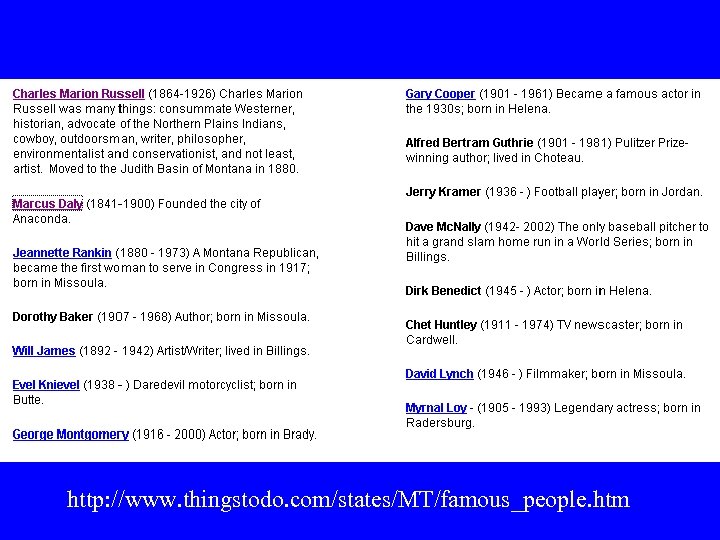 http: //www. thingstodo. com/states/MT/famous_people. htm
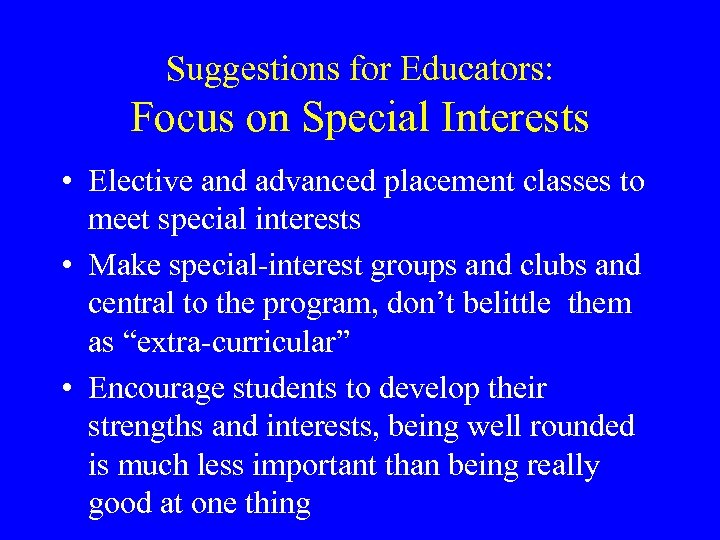 Suggestions for Educators: Focus on Special Interests • Elective and advanced placement classes to meet special interests • Make special-interest groups and clubs and central to the program, don’t belittle them as “extra-curricular” • Encourage students to develop their strengths and interests, being well rounded is much less important than being really good at one thing
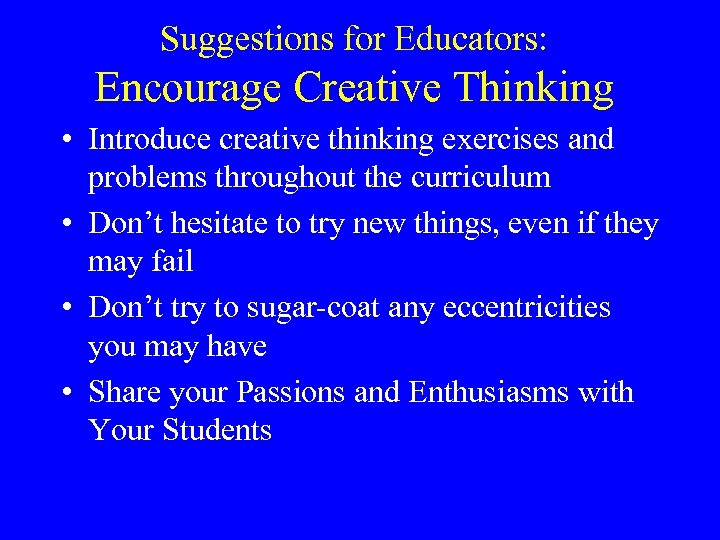 Suggestions for Educators: Encourage Creative Thinking • Introduce creative thinking exercises and problems throughout the curriculum • Don’t hesitate to try new things, even if they may fail • Don’t try to sugar-coat any eccentricities you may have • Share your Passions and Enthusiasms with Your Students
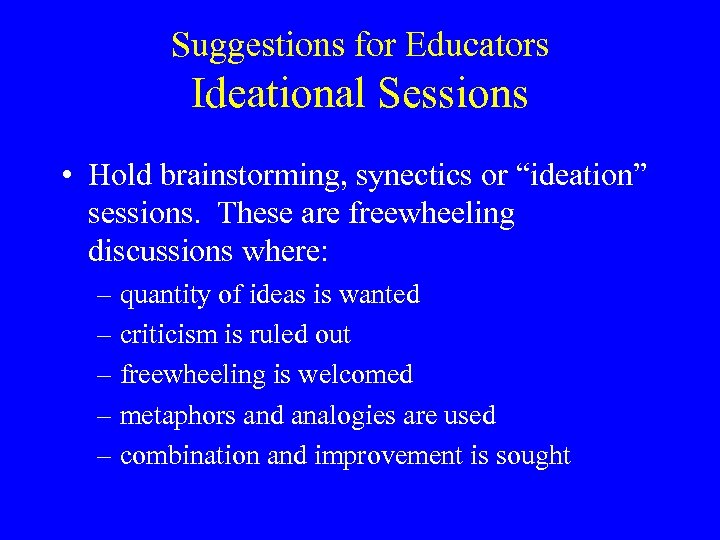 Suggestions for Educators Ideational Sessions • Hold brainstorming, synectics or “ideation” sessions. These are freewheeling discussions where: – quantity of ideas is wanted – criticism is ruled out – freewheeling is welcomed – metaphors and analogies are used – combination and improvement is sought
 Suggestions for Educators: Encourage “Pushy Parents” • Eminent people sometimes had pushy parents whom others thought too involved in their children’s lives • Fitting into the routines of the school may make life easier for the educators but not be in the best interest of the child • Don’t assume that tests scores and grades are more accurate than parents’ insights