


 Скачать презентацию Channel Access Methods When several devices are connected
796da644c45f0f4947794991c178e3a7.ppt
- Количество слайдов: 20
 Channel Access Methods When several devices are connected to a single channel, there must be some rules to govern these devices as they access, transmit, and release the channel. There are three basic channel access methods: • Contention • Polling • Token passing Different access methods have different overhead effects on network traffic.
 Contention • With contention systems, network devices may transmit whenever they want. • No referee mandates when a device may or may not use the channel. • This scheme is simple to design • The scheme provides equal access rights to all stations. • Stations simply transmit whenever they are ready, without considering what other stations are doing. • Unfortunately, the "transmit whenever ready" strategy has one important shortcoming. • Stations can transmit at the same time. • When this happens, the resulting co-mingling of signals usually damages both to the point that a frame's information is lost. • This unhappy event is called a "collision. "
 Collision • Newer contention protocols were developed that called for stations to listen to the channel first before transmitting. • If the listening station detects a signal, it will not start transmitting and try again later. • These protocols are called CSMA (Carrier Sense, Multiple Access with collision detection) protocols. • These protocols will reduce collisions. • However, collisions may still occur when two stations sense the cable, detect nothing, and subsequently transmit. • In order to reduce collisions, CSMA/CD protocols compute a random backoff time before retransmitting the frame (as shown in the flow diagram). Examples of CSMA/CD protocols : EEE 802. 3 (Ethernet )
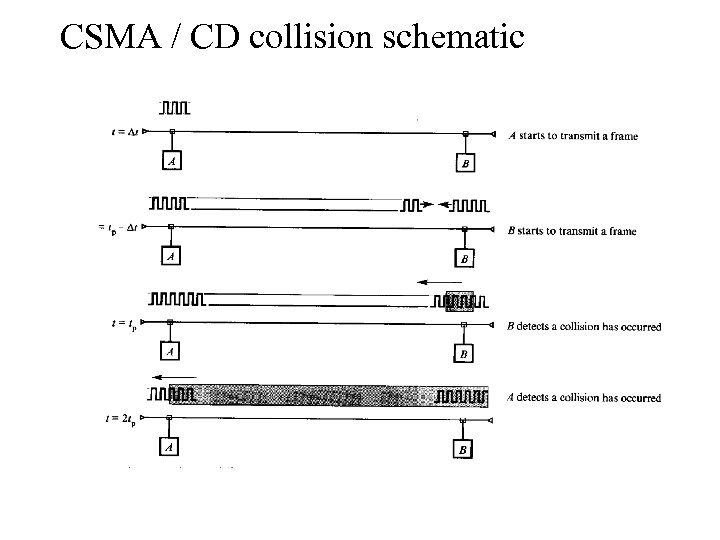 CSMA / CD collision schematic
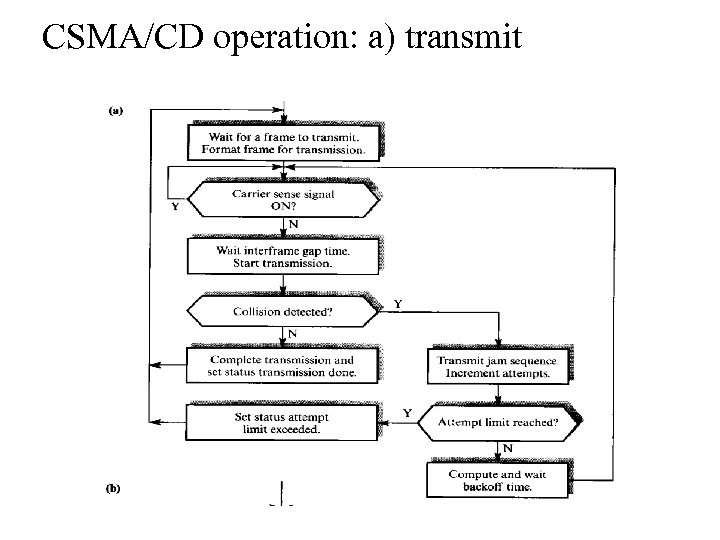 CSMA/CD operation: a) transmit
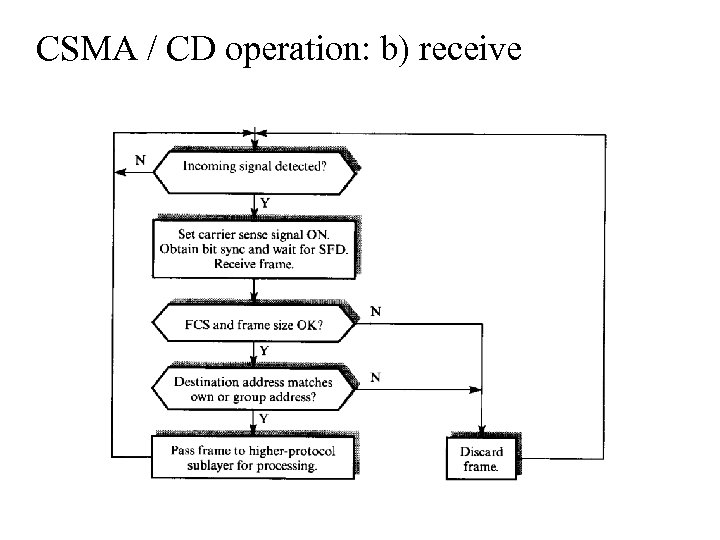 CSMA / CD operation: b) receive
 Advantages • CSMA/CD control software is relatively simple and produces little overhead. • CSMA/CD networks best on a bus topology with bursty transmission.
 Disadvantages • CSMA/CD protocols are probabilistic and depends on the network (cable) loading. • Considered unsuitable for channels controlling automated equipment that must have certain control over channel access. (This could be OK for different channel access). • We can set priorities to give faster access to some devices (This is, probably, not an issue in some applications)
 Polling access method • Polling is an access method that designates one device (called a "controller", "primary", or "master") as a channel access administrator. • This device (Master) queries each of the other devices (“secondaries”) in some predetermined order to see whether they have information to transmit. • If so, they transmit (usually through the master).
 Polling access method • Secondaries may be linked to the master in many different configurations. • One of the most common polling topologies is a star, where the points of the star are secondaries and the master is the hub. • To get data from a secondary, the master addresses a request for data to the secondary, and then receives the data from the secondary sends (if secondary sends any). • The primary then polls another secondary and receives the data from the secondary, and so forth. • System limits how long each secondary can transmit on each poll.
 Advantages • Polling centralizes channel access control. • Maximum and minimum access times and data rates on the channel are predictable and fixed. • Priorities can be assigned to ensure faster access from some secondaries. • Polling is deterministic and is considered suitable for channels controlling some kinds of automated equipment.
 Disadvantages • Polling systems often use a lot of bandwidth sending notices and acknowledgments or listening for messages. • Line turnaround time on a half- duplex line further increases time overhead. • This overhead reduces both the channel's data rate under low loads and its throughput.
 Token passing System • In token-passing systems, a small frame (the token) is passed in an orderly fashion from one device to another. • A token is a special authorizing message that temporarily gives control of the channel to the device holding the token. • Passing the token around distributes access control among the channel's devices. • Each device knows from which device it receives the token and to which device it passes the token. (see fig. ) • Each device periodically gets control of the token, performs its duties, and then retransmits the token for the next device to use. • System rules limit how long each device can control the token.
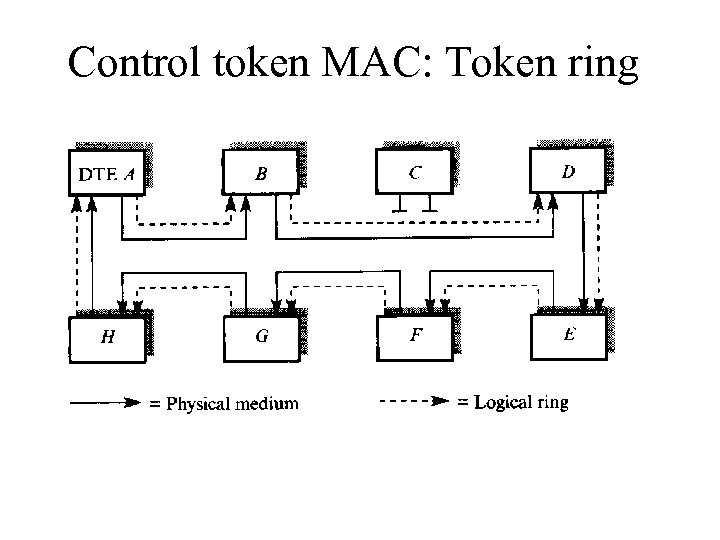 Control token MAC: Token ring
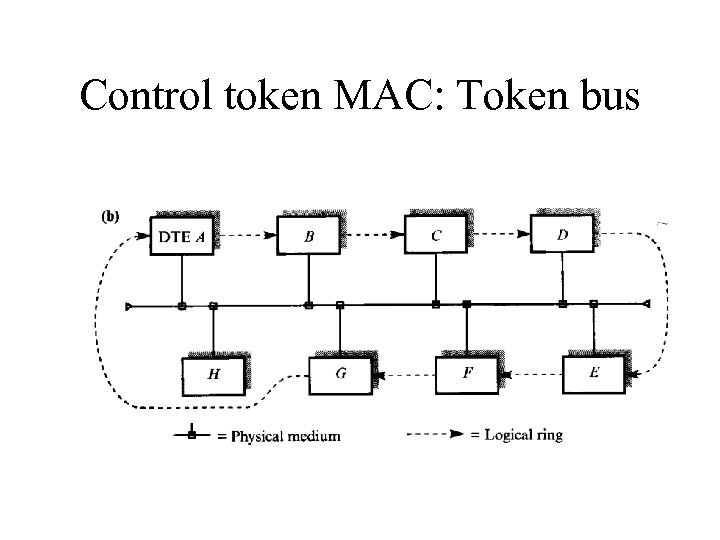 Control token MAC: Token bus
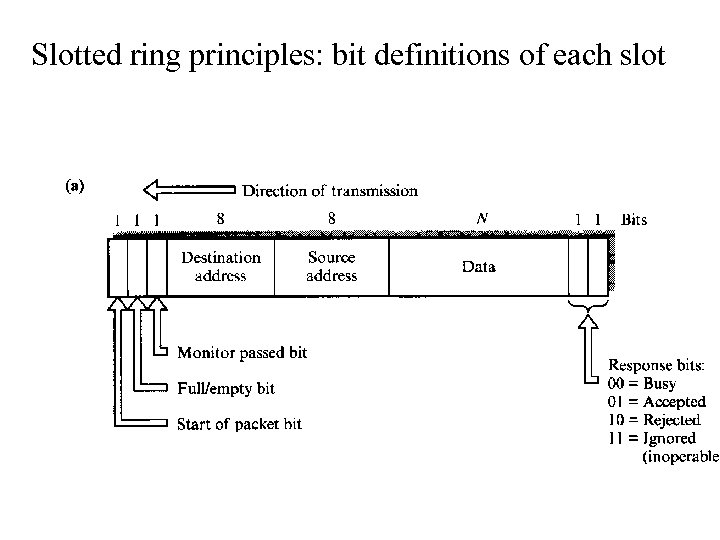 Slotted ring principles: bit definitions of each slot
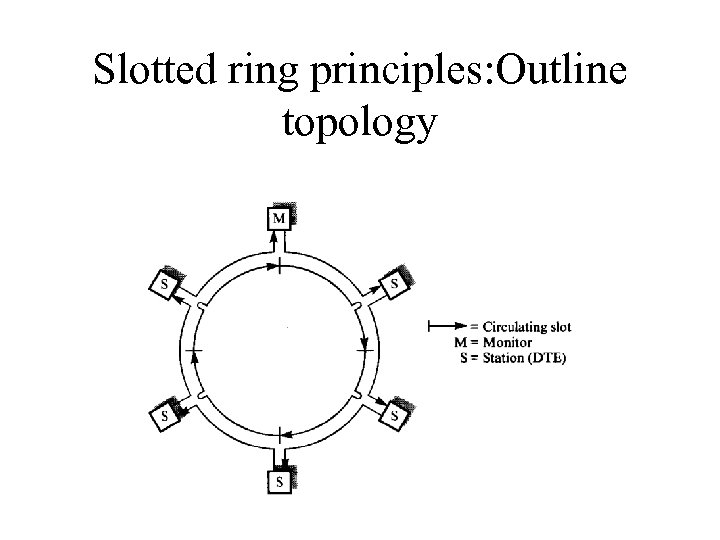 Slotted ring principles: Outline topology
 Advantages • Even though there is more overhead using tokens than using CSMA/CD, performance differences are noticeable with light traffic and are considerably better with heavy loads because CSMA/CD will spend a lot of time resolving collisions. • A deterministic access method such as Token Ring guarantees that every node will get access to the network within a given length of time. In probabilistic access method (such as CSMA/CD) nodes have to check for network activity when they want to access the network.
 Disadvantages • Components are more expensive than for Ethernet or ARCnet. • Token Ring architecture is not very easy to extend to wide-area networks (WANs). • Token Ring network is much more expensive than Ethernet. This is due to the complex token passing protocol.
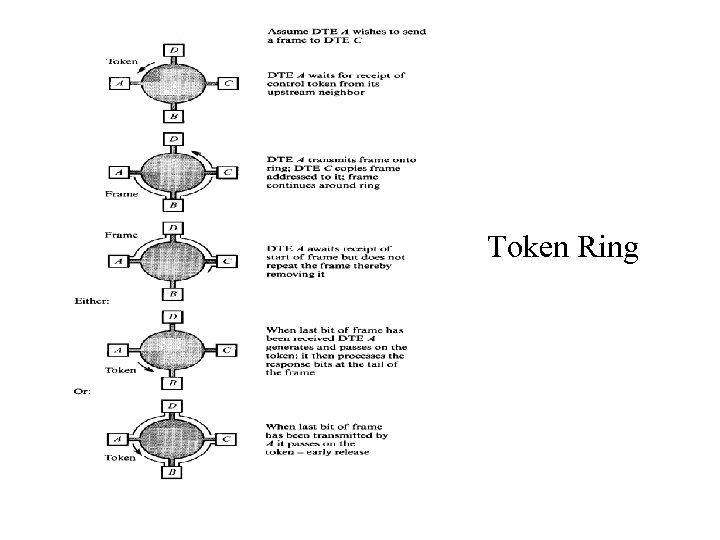 Token Ring