 Скачать презентацию CHANGING THE DISABILITY-POVERTY PARADIGM 1 CHALLENGING THE DEPENDENCY
663c371761b486b115361e15ff20f115.ppt
- Количество слайдов: 24



CHANGING THE DISABILITY-POVERTY PARADIGM 1 CHALLENGING THE DEPENDENCY PARADOX IN POLICY, MONEY & HUMAN SERVICES
VALUE STATEMENTS • Poverty is a war whose battlefields are local communities, led by either complacent or transformational leaders. • Poverty is fueled by weapons of unemployment, paternalism, vulnerability and opportunity gaps. • Poverty can only be overcome by a commitment of every individual in a community to work together in a solutions-oriented process (ie. Looking Inwardly instead of Pointing Outwardly). 2 POVERTY IS ABOUT PEOPLE
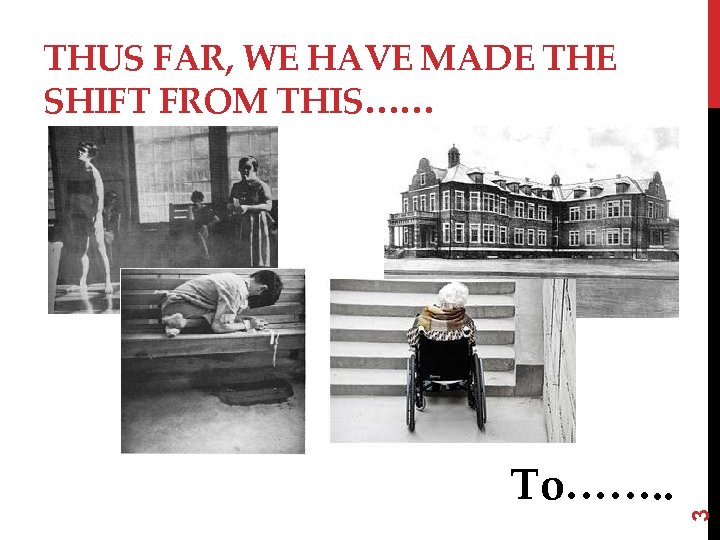
To……. . 3 THUS FAR, WE HAVE MADE THE SHIFT FROM THIS……
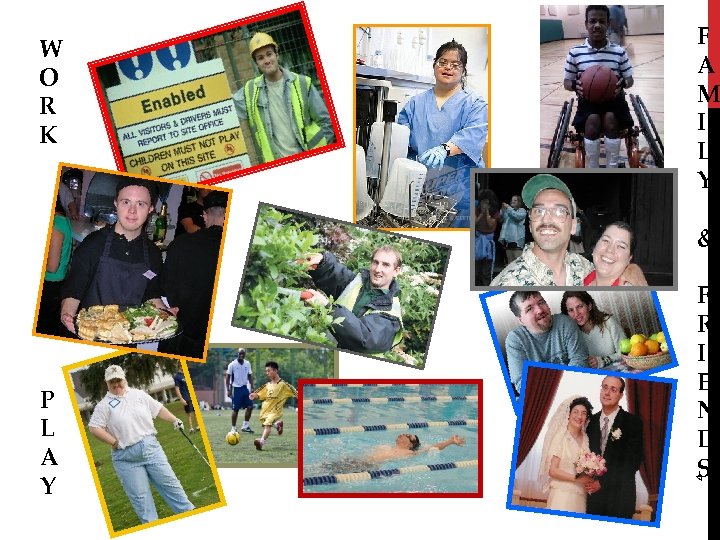
W O R K F A M I L Y & 4 P L A Y F R I E N D S
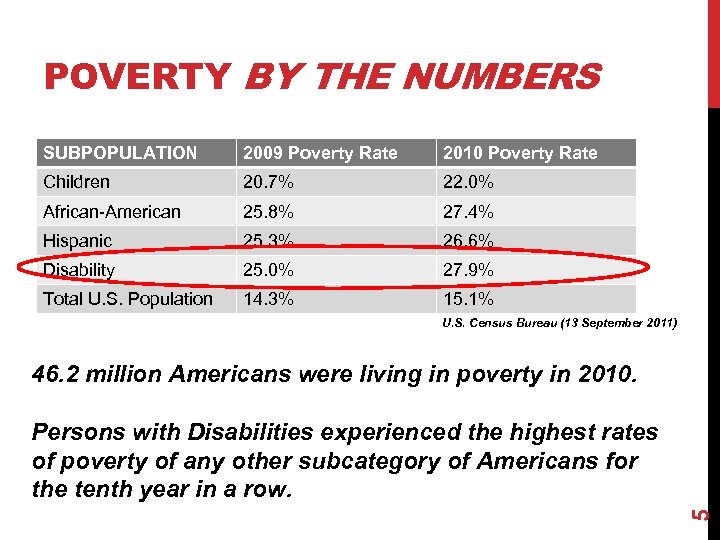
POVERTY BY THE NUMBERS SUBPOPULATION 2009 Poverty Rate 2010 Poverty Rate Children 20. 7% 22. 0% African-American 25. 8% 27. 4% Hispanic 25. 3% 26. 6% Disability 25. 0% 27. 9% Total U. S. Population 14. 3% 15. 1% U. S. Census Bureau (13 September 2011) 46. 2 million Americans were living in poverty in 2010. 5 Persons with Disabilities experienced the highest rates of poverty of any other subcategory of Americans for the tenth year in a row.
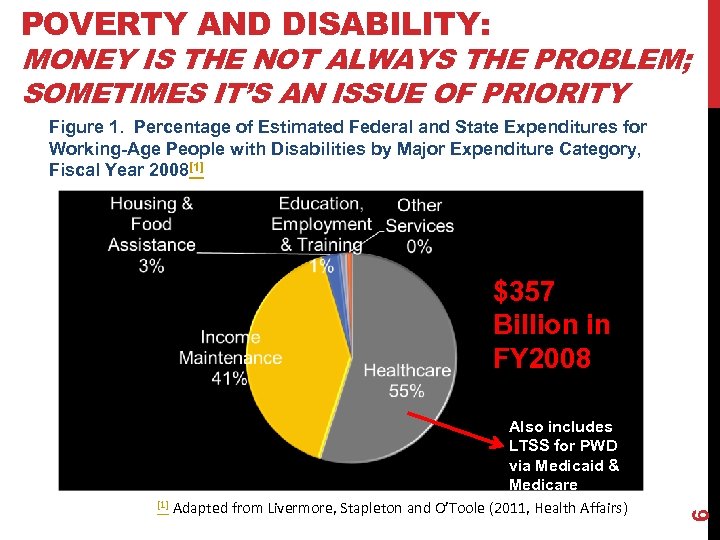
POVERTY AND DISABILITY: MONEY IS THE NOT ALWAYS THE PROBLEM; SOMETIMES IT’S AN ISSUE OF PRIORITY Figure 1. Percentage of Estimated Federal and State Expenditures for Working-Age People with Disabilities by Major Expenditure Category, Fiscal Year 2008[1] Also includes LTSS for PWD via Medicaid & Medicare [1] Adapted from Livermore, Stapleton and O’Toole (2011, Health Affairs) 6 $357 Billion in FY 2008
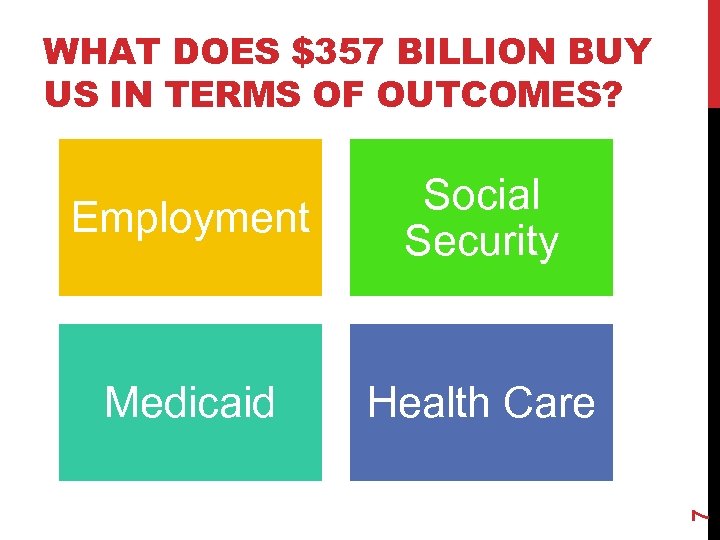
WHAT DOES $357 BILLION BUY US IN TERMS OF OUTCOMES? Medicaid Health Care 7 Employment Social Security
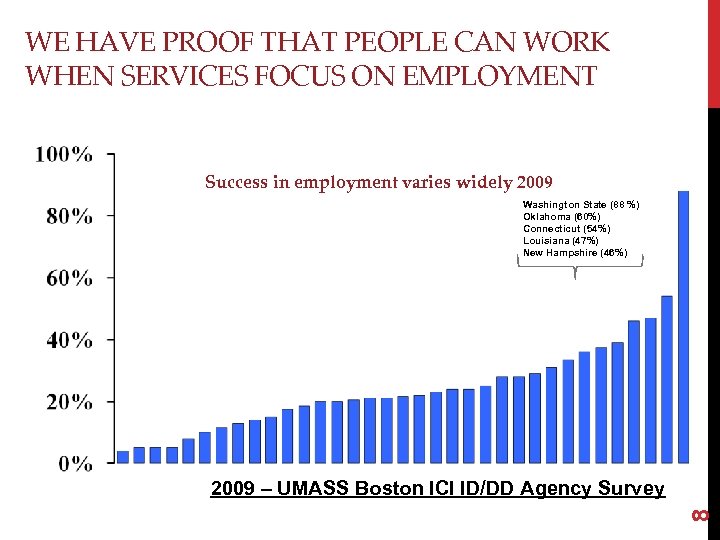
WE HAVE PROOF THAT PEOPLE CAN WORK WHEN SERVICES FOCUS ON EMPLOYMENT Success in employment varies widely 2009 Washington State (88 %) Oklahoma (60%) Connecticut (54%) Louisiana (47%) New Hampshire (46%) 8 2009 – UMASS Boston ICI ID/DD Agency Survey
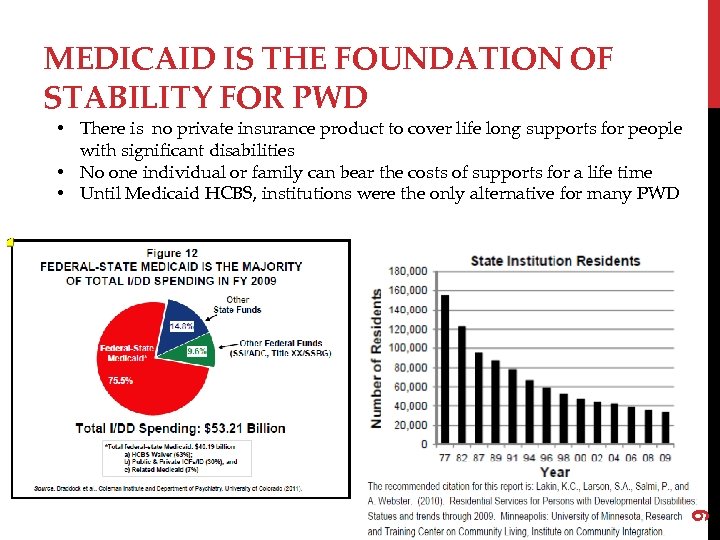
MEDICAID IS THE FOUNDATION OF STABILITY FOR PWD 9 • There is no private insurance product to cover life long supports for people with significant disabilities • No one individual or family can bear the costs of supports for a life time • Until Medicaid HCBS, institutions were the only alternative for many PWD
TODAY’S FISCAL CRISES IS NOT JUST A MATTER OF NUMBERS, IT IS A MATTER OF PEOPLE. 10 THE DIALOGUE WE MUST ENGAGE IN IS ONE OF EQUITY, ETHICS, AND ENGAGEMENT.
EQUITY 11 THROWING MONEY AT THE WRONG THINGS IS NOT IN THE BEST INTERESTS OF INDIVIDUALS WITH DISABILITIES
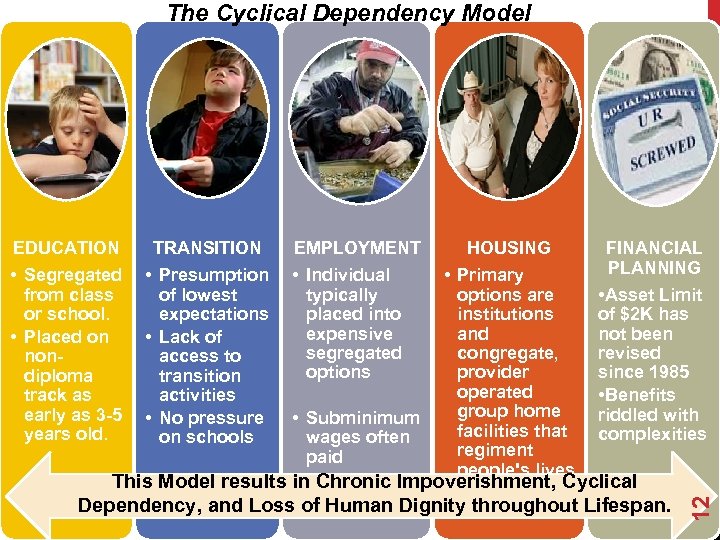
The Cyclical Dependency Model TRANSITION • Segregated • Presumption from class of lowest or school. expectations • Placed on • Lack of nonaccess to diploma transition track as activities early as 3 -5 • No pressure years old. on schools EMPLOYMENT • Individual typically placed into expensive segregated options • Subminimum wages often paid HOUSING • Primary options are institutions and congregate, provider operated group home facilities that regiment people's lives FINANCIAL PLANNING • Asset Limit of $2 K has not been revised since 1985 • Benefits riddled with complexities This Model results in Chronic Impoverishment, Cyclical Dependency, and Loss of Human Dignity throughout Lifespan. 12 EDUCATION
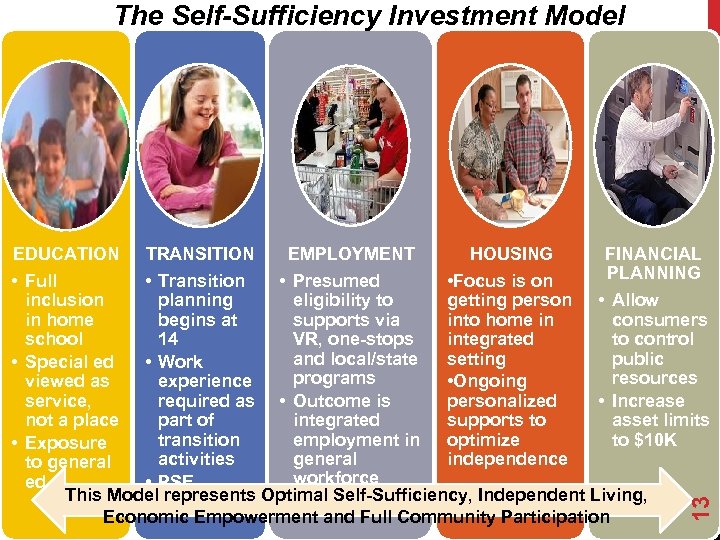
The Self-Sufficiency Investment Model TRANSITION EMPLOYMENT HOUSING FINANCIAL PLANNING • Allow consumers to control public resources • Increase asset limits to $10 K • Full • Transition • Presumed • Focus is on inclusion planning eligibility to getting person in home begins at supports via into home in school 14 VR, one-stops integrated and local/state setting • Special ed • Work programs viewed as experience • Ongoing service, required as • Outcome is personalized not a place part of integrated supports to transition employment in optimize • Exposure activities general independence to general workforce ed • PSE This Model represents Optimal Self-Sufficiency, Independent Living, Economic Empowerment and Full Community Participation 13 EDUCATION
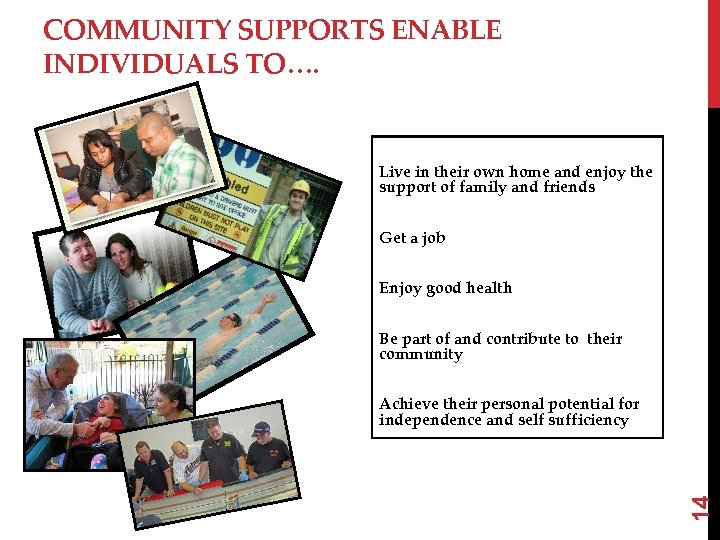
COMMUNITY SUPPORTS ENABLE INDIVIDUALS TO…. Live in their own home and enjoy the support of family and friends Get a job Enjoy good health Be part of and contribute to their community 14 Achieve their personal potential for independence and self sufficiency
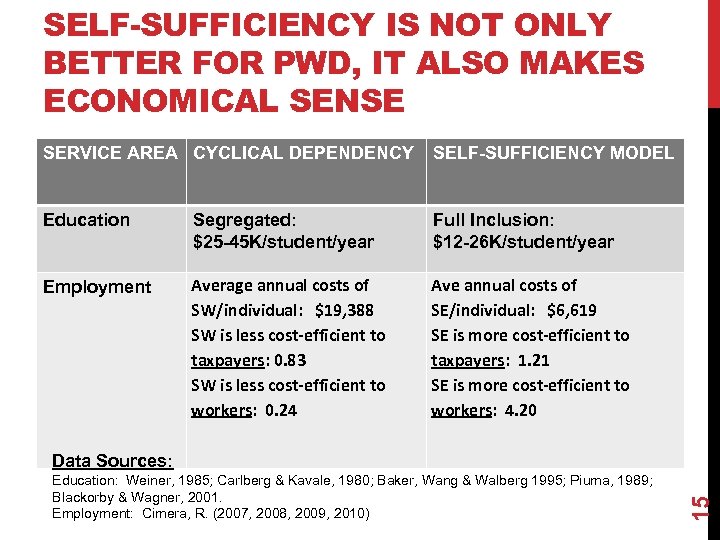
SELF-SUFFICIENCY IS NOT ONLY BETTER FOR PWD, IT ALSO MAKES ECONOMICAL SENSE SERVICE AREA CYCLICAL DEPENDENCY SELF-SUFFICIENCY MODEL Education Segregated: $25 -45 K/student/year Full Inclusion: $12 -26 K/student/year Employment Average annual costs of SW/individual: $19, 388 SW is less cost-efficient to taxpayers: 0. 83 SW is less cost-efficient to workers: 0. 24 Ave annual costs of SE/individual: $6, 619 SE is more cost-efficient to taxpayers: 1. 21 SE is more cost-efficient to workers: 4. 20 Education: Weiner, 1985; Carlberg & Kavale, 1980; Baker, Wang & Walberg 1995; Piuma, 1989; Blackorby & Wagner, 2001. Employment: Cimera, R. (2007, 2008, 2009, 2010) 15 Data Sources:
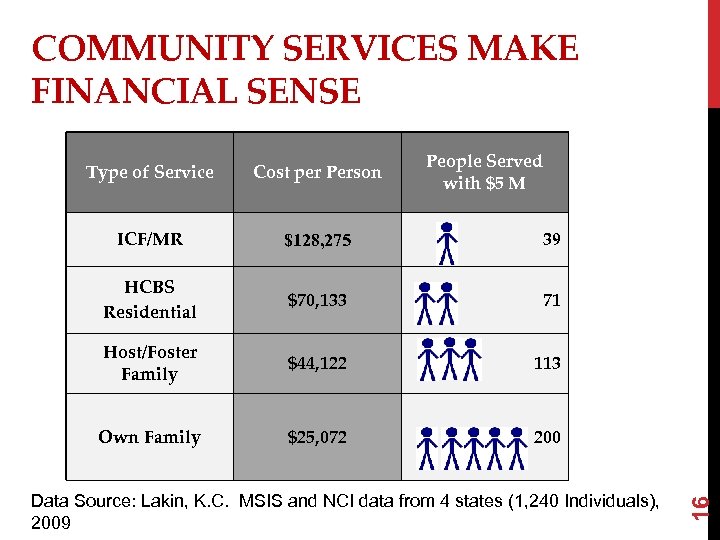
COMMUNITY SERVICES MAKE FINANCIAL SENSE People Served with $5 M Cost per Person ICF/MR $128, 275 39 HCBS Residential $70, 133 71 Host/Foster Family $44, 122 113 Own Family $25, 072 200 Data Source: Lakin, K. C. MSIS and NCI data from 4 states (1, 240 Individuals), 2009 16 Type of Service
ETHICS 17 REFORM REQUIRES BOLD AND COURAGEOUS LEADERSHIP BY THOSE WORKING DIRECTLY WITH PWD
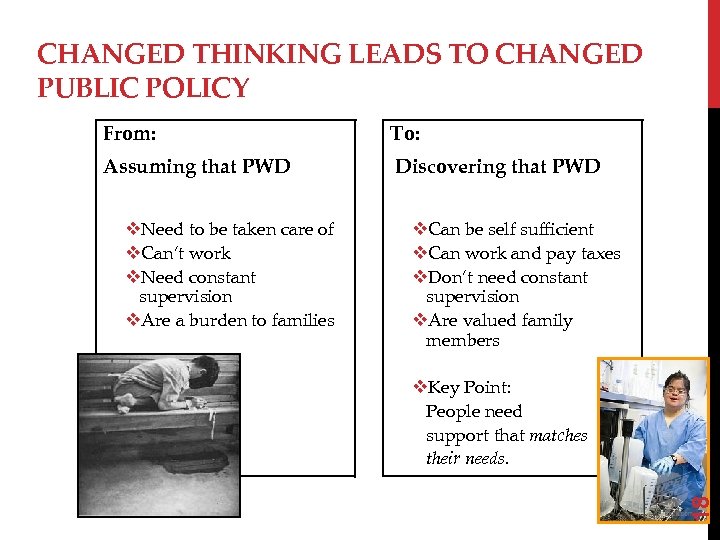
CHANGED THINKING LEADS TO CHANGED PUBLIC POLICY From: To: Assuming that PWD Discovering that PWD v. Can be self sufficient v. Can work and pay taxes v. Don’t need constant supervision v. Are valued family members v. Key Point: People need support that matches their needs. 18 v. Need to be taken care of v. Can’t work v. Need constant supervision v. Are a burden to families
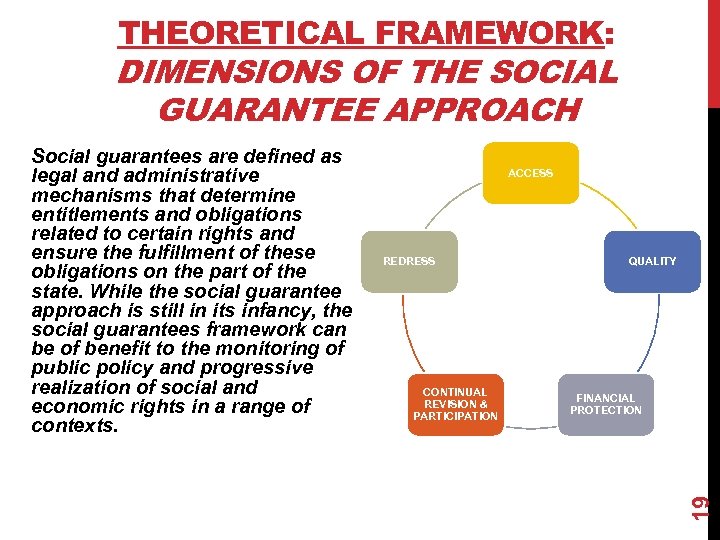
THEORETICAL FRAMEWORK: DIMENSIONS OF THE SOCIAL GUARANTEE APPROACH ACCESS REDRESS CONTINUAL REVISION & PARTICIPATION QUALITY FINANCIAL PROTECTION 19 Social guarantees are defined as legal and administrative mechanisms that determine entitlements and obligations related to certain rights and ensure the fulfillment of these obligations on the part of the state. While the social guarantee approach is still in its infancy, the social guarantees framework can be of benefit to the monitoring of public policy and progressive realization of social and economic rights in a range of contexts.
ENGAGEMENT 20 SITTING ON THE SIDELINES, BURIED IN A SANDBOX SOMEWHERE IS NOT A PATH TO TRANSFORMATIONAL LEADERSHIP.
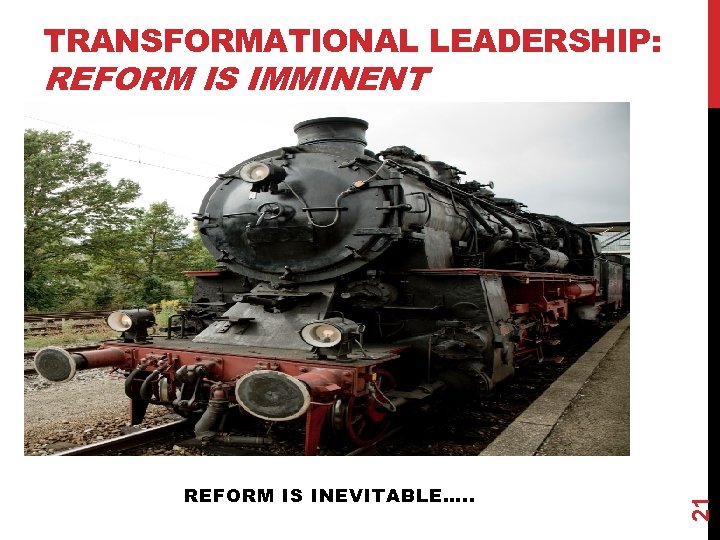
TRANSFORMATIONAL LEADERSHIP: REFORM IS INEVITABLE…. . 21 REFORM IS IMMINENT
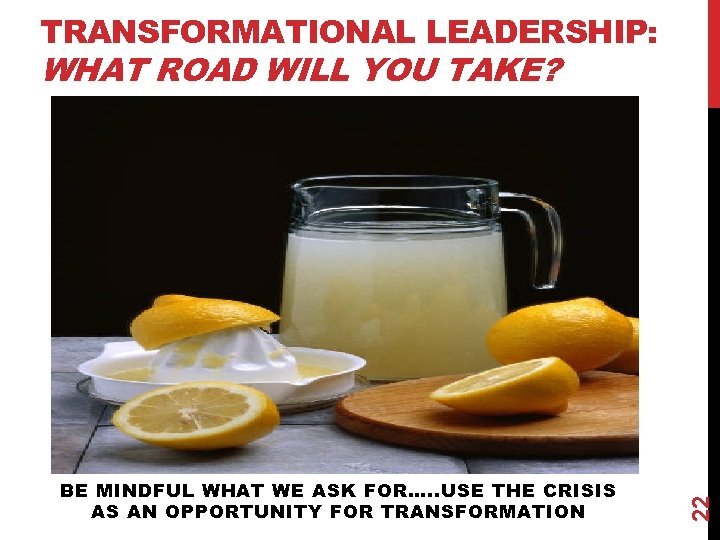
TRANSFORMATIONAL LEADERSHIP: BE MINDFUL WHAT WE ASK FOR…. . USE THE CRISIS AS AN OPPORTUNITY FOR TRANSFORMATION 22 WHAT ROAD WILL YOU TAKE?
HOW TO LEAD TOWARD CHANGE IN TIMES OF UNCERTAINTY Ø Innovative Collaboration with Traditional and Non-Traditional Partners as opposed to Chronic Competition & Distrust Ø Engage in the Advocacy Wave with Meaningful Policy Alternatives and a Willingness to Compromise – at all Levels of the Public Policy Dialogue 23 Ø Continue to Look Inwardly
THANK YOU!!! Serena Lowe President, Anere. S Strategies, LLC Executive Director, Collaboration to Promote Self-Determination Federal Government Affairs Consultant, National Disability Institute 24 202 -548 -2502 (Office) 202 -907 -8369 (Cell) Ewol. Aneres@gmail. com
Скачать презентацию CHANGING THE DISABILITY-POVERTY PARADIGM 1 CHALLENGING THE DEPENDENCY
663c371761b486b115361e15ff20f115.ppt