


 Скачать презентацию Changes in alcohol outlet trading hours and assault
706b642ec5ef3df633ca91cb242f0e47.ppt
- Количество слайдов: 20
 Changes in alcohol outlet trading hours and assault Status of evidence January 2016 Presented at: Queensland Coalition for Action on Alcohol (QCAA) “Tackling Alcohol-Fuelled Violence Legislation (Amendment Bill) 2015” Wednesday 17 February 2016 Premier’s Hall, Parliamentary Annexe, Parliament House, Brisbane Kypros Kypri Ph. D School of Medicine & Public Health, University of Newcastle
![The science to 2010 • Stockwell & Chikritzhs [1]. Do relaxed trading hours for](https://present5.com/presentation/706b642ec5ef3df633ca91cb242f0e47/image-2.jpg "The science to 2010 • Stockwell & Chikritzhs [1]. Do relaxed trading hours for") The science to 2010 • Stockwell & Chikritzhs [1]. Do relaxed trading hours for bars and clubs mean more relaxed drinking ? A review of international research on the impacts of changes to permitted hours of drinking. Crime Prevention and Community Safety 2009; 11(3): 153 -70. ~ 14 controlled studies (Australia, Brazil, Canada, UK, USA, ) “the balance of reliable evidence…suggests that extended late-night trading hours lead to increased consumption and related harms. ”
The science to 2010 • Stockwell & Chikritzhs [1]. Do relaxed trading hours for bars and clubs mean more relaxed drinking ? A review of international research on the impacts of changes to permitted hours of drinking. Crime Prevention and Community Safety 2009; 11(3): 153 -70. ~ 14 controlled studies (Australia, Brazil, Canada, UK, USA, ) “the balance of reliable evidence…suggests that extended late-night trading hours lead to increased consumption and related harms. ”
![• Hahn, R. A. , et al. (2010) [2]. Effectiveness of policies restricting](https://present5.com/presentation/706b642ec5ef3df633ca91cb242f0e47/image-3.jpg "• Hahn, R. A. , et al. (2010) [2]. Effectiveness of policies restricting") • Hahn, R. A. , et al. (2010) [2]. Effectiveness of policies restricting hours of alcohol sales in preventing excessive alcohol consumption and related harms. American Journal of Preventive Medicine 39(6): 590 -604. ~ US Task Force on Community Preventive Services ~ Reviewed: • 10 studies examining changes of ≥ 2 hours • 6 studies examining changes of <2 hours “There was sufficient evidence…to conclude that increasing hours of sale by 2 or more hours increases alcohol-related harms The evidence…was insufficient to determine whether increasing hours of sale by less than 2 hours increases excessive alcohol consumption and related. ” [Not evidence of no effect but insufficient evidence]
• Hahn, R. A. , et al. (2010) [2]. Effectiveness of policies restricting hours of alcohol sales in preventing excessive alcohol consumption and related harms. American Journal of Preventive Medicine 39(6): 590 -604. ~ US Task Force on Community Preventive Services ~ Reviewed: • 10 studies examining changes of ≥ 2 hours • 6 studies examining changes of <2 hours “There was sufficient evidence…to conclude that increasing hours of sale by 2 or more hours increases alcohol-related harms The evidence…was insufficient to determine whether increasing hours of sale by less than 2 hours increases excessive alcohol consumption and related. ” [Not evidence of no effect but insufficient evidence]
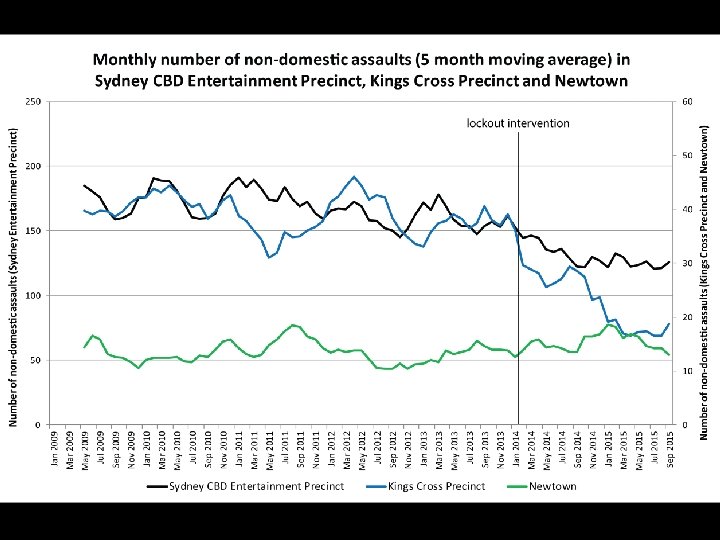
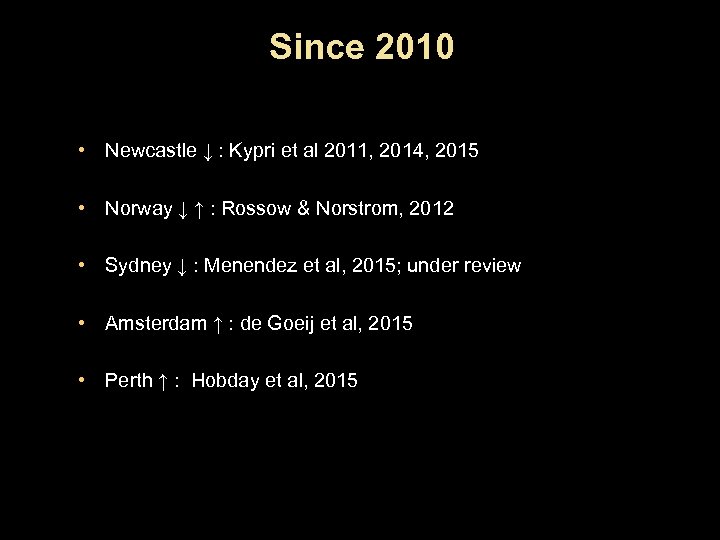 Since 2010 • Newcastle ↓ : Kypri et al 2011, 2014, 2015 • Norway ↓ ↑ : Rossow & Norstrom, 2012 • Sydney ↓ : Menendez et al, 2015; under review • Amsterdam ↑ : de Goeij et al, 2015 • Perth ↑ : Hobday et al, 2015
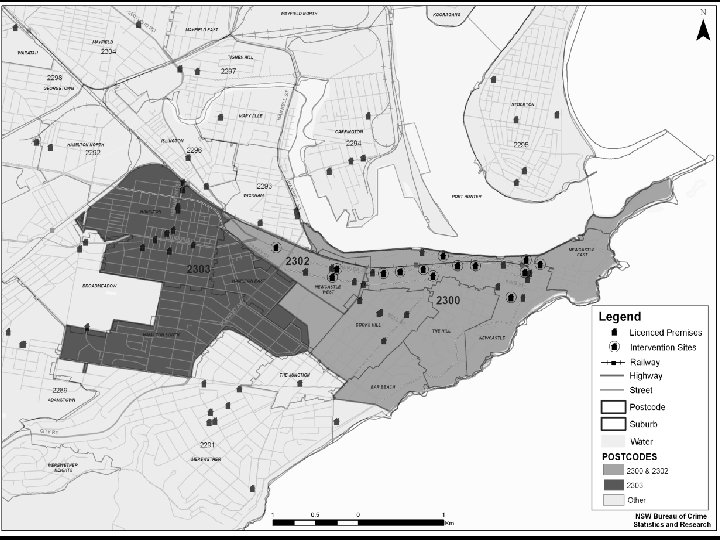
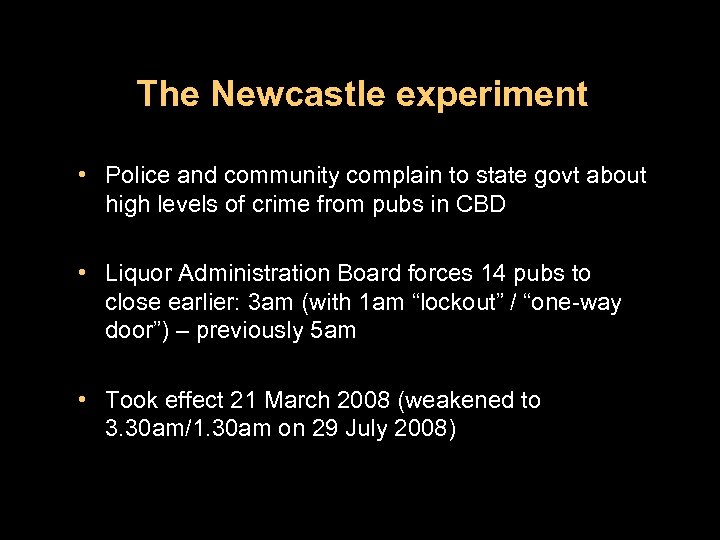 The Newcastle experiment • Police and community complain to state govt about high levels of crime from pubs in CBD • Liquor Administration Board forces 14 pubs to close earlier: 3 am (with 1 am “lockout” / “one-way door”) – previously 5 am • Took effect 21 March 2008 (weakened to 3. 30 am/1. 30 am on 29 July 2008)
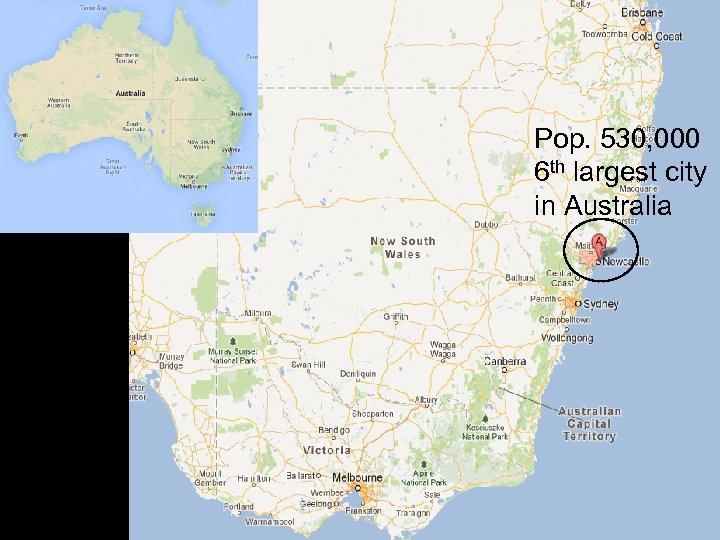 Pop. 530, 000 6 th largest city in Australia
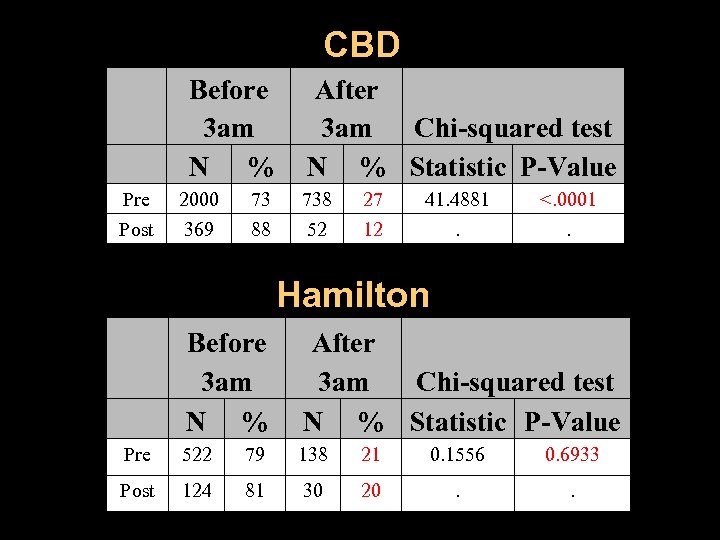 CBD Before 3 am N % After 3 am Chi-squared test N % Statistic P-Value Pre 2000 73 738 27 41. 4881 <. 0001 Post 369 88 52 12 . . Hamilton Before 3 am N % After 3 am Chi-squared test N % Statistic P-Value Pre 522 79 138 21 0. 1556 0. 6933 Post 124 81 30 20 . .
![[6, 9]](https://present5.com/presentation/706b642ec5ef3df633ca91cb242f0e47/image-9.jpg "[6, 9]") [6, 9]
[6, 9]
![Norway Rossow I & Norstrom T (2012) [5]. The impact of small changes in](https://present5.com/presentation/706b642ec5ef3df633ca91cb242f0e47/image-10.jpg "Norway Rossow I & Norstrom T (2012) [5]. The impact of small changes in") Norway Rossow I & Norstrom T (2012) [5]. The impact of small changes in bar closing hours on violence. The Norwegian experience from 18 cities. Addiction 107(3) 530 -7 • 8 cities extend hours 20% increase in assaults per additional hour of trading • 15 cities restricted hours 16% decrease in assaults per hour restriction
Norway Rossow I & Norstrom T (2012) [5]. The impact of small changes in bar closing hours on violence. The Norwegian experience from 18 cities. Addiction 107(3) 530 -7 • 8 cities extend hours 20% increase in assaults per additional hour of trading • 15 cities restricted hours 16% decrease in assaults per hour restriction
 Amsterdam de Goeij MC, Veldhuizen EM, Buster MC, Kunst AE. The impact of extended closing times of alcohol outlets on alcohol-related injuries in the nightlife areas of Amsterdam: a controlled before-and-after evaluation. Addiction. 2015 Jun; 110(6): 955 -64 • Weekdays: 3 am 4 am • Weekends: 4 am 5 am 35% increase in ambulance attendances compared to a within-city control area
 Perth Hobday M, Chikritzhs T, Liang W, Meuleners L. The effect of alcohol outlets, sales and trading hours on alcohol-related injuries presenting at emergency departments in Perth, Australia, from 2002 to 2010. Addiction. 2015 Dec; 110(12): 1901 -9. • 117 postcodes over 8 years (2002 -10) • ED injury presentations at night and weekends • Weekend night injuries increased by 5% per onpremises outlet with an Extended Trading Permit and by less than 1% for outlets with standard trading hours.
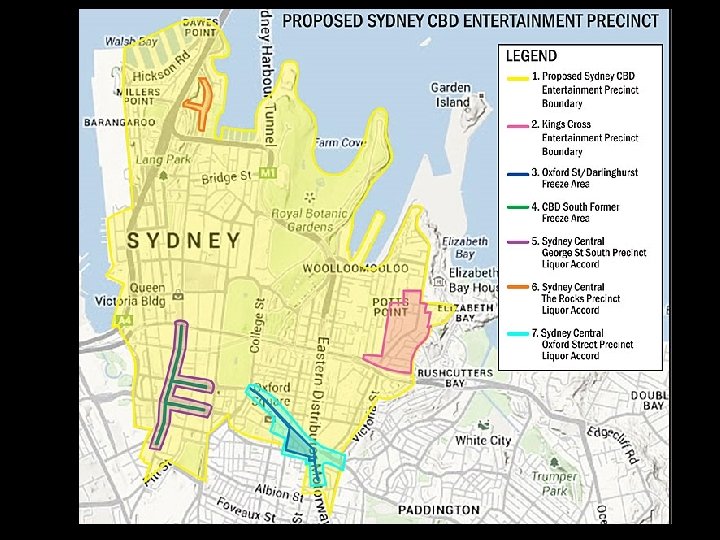
 California model • No alcohol consumed in licensed premises after 2 am (‘last drinking’) • One simple law • Easy to understand police • Less incursion into people’s liberties
 Thank you kypros. kypri@newcastle. edu. au
 Myths “The problem will simply move somewhere else or to earlier in the evening” ~ geographic and temporal displacement
 “We need to educate young people about alcohol and how to drink sensibly” At best a naïve statement, at worst, Liquorspeak for “don’t interfere with the availability of alcohol to young people, our heaviest and most important consumers”. Overwhelming evidence shows no beneficial effect of education and persuasion programs in terms of risk behaviour or harms
 “People are safer drinking in pubs than in unsupervised places” A favourite of the liquor industry. Three quarters of assault fatalities that occur outside the home occur in or around licensed premises (Langley, J. , Chalmers, D. and Fanslow, J. (1996) Incidence of death and hospitalization from assault occurring in and around licensed premises: A comparative analysis. Addiction 91, 985 -93. )
 “You have to change the drinking culture” - Said as if the law wasn’t a determinant of culture and often to avoid action. The Newcastle CBD has a different drinking culture now than before March 2008 “There are no silver/magic bullets” - “If we can’t eliminate the problem we wont try anything” ? ! [Note: Some people confuse prevention with elimination] “There are no one-size-fits-all approaches” - “We have to limit the spread of an intervention which will reduce profits” “It might work in X but it won’t work here” - The NZ Govt said that about drink-driving laws. Imagine if we applied that thinking to cancer drugs