 Скачать презентацию CHANGE MANAGEMENT NEDA EXPERIENCE Presented by Ms Florina
65ac630a8311ad3da93514179404a2ef.ppt
- Количество слайдов: 20



CHANGE MANAGEMENT: NEDA EXPERIENCE Presented by Ms. Florina G. Don-Santos
OUTLINE I. Definition of Terms II. ADKAR Model III. Change Management Principles IV. Resistance to Change V. NEDA Experience VI. High Performing vs. Tradition VII. Responsibility Ladder
DEFINITION OF TERMS Change Management: - It is a set of processes that is employed to ensure that significant changes are implemented in an orderly, controlled and systematic fashion to effect organizational change Change Management Team: - It is responsible for conducting a strategic review of its respective operations and organization to identify functions, programs and project which can be scaled down, phased out or abolished, or those which need to be strengthened
DEFINITION OF TERMS Development Information Staff: - Tasked to develop an effective NEDA communication and advocacy program; produce and implement a client-oriented publications distribution program; coordinate an effective media relations program and maintain the NEDA Knowledge Center National Economic and Development Authority: - The country’s highest socioeconomic development planning and policy-making body
DEFINITION OF TERMS Rationalization Program: - It is a move to transform the Executive Branch into a more effective and efficient government Resistance: - It is an expected reaction of any organization to some changes especially if the change introduced from the outside. This reaction can be pre-empted if we know the casual reasons
THE ADKAR MODEL Awareness Desire Knowledge Ability Reinforcement
CHANGE MANAGEMENT PRINCIPLES Sponsorship Planning Measurement Engagement Support Structure
RESISTANCE TO CHANGE • • Lack of info about changes Protect vested interest and for convenience • If no participation • Time is too short • • • Too complex If reminded of past failure • Feel inadequate with the requirements of change Losing group affiliation
NEDA EXPERIENCE The Rationalization Program • • • Strategic shift in its mandate and functions Organizational structure – recommends the creation of a 4 th DDG CSO structure – concentrates on reorienting decision-support On staffing pattern – vacant funded positions and filled up positions be used as basis for revision Formulation of Implementation Plan/ Mitigation Plan/Communication Plan
NEDA EXPERIENCE Implementing Rules and Regulations Effectivity of the IRR of EO 366 – 4 October 2004 Organize a Change Management Team with a union or rank and file representative
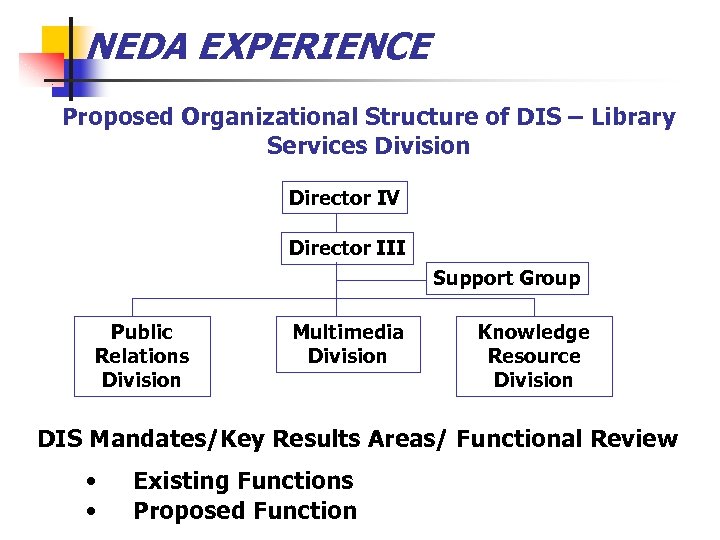
NEDA EXPERIENCE Proposed Organizational Structure of DIS – Library Services Division Director IV Director III Support Group Public Relations Division Multimedia Division Knowledge Resource Division DIS Mandates/Key Results Areas/ Functional Review • • Existing Functions Proposed Function
NEDA EXPERIENCE Justification for the Proposed Knowledge Resource Division • Maintains the NEDA Knowledge Center • Performs not just the ordinary library functions • Establishes a network of libraries and information centers • Strengthens coordinative work with the NEDA Regional Offices • Actively pursues its digitization process • Takes charge of distribution program of NEDA publications and information materials • Focuses on knowledge management
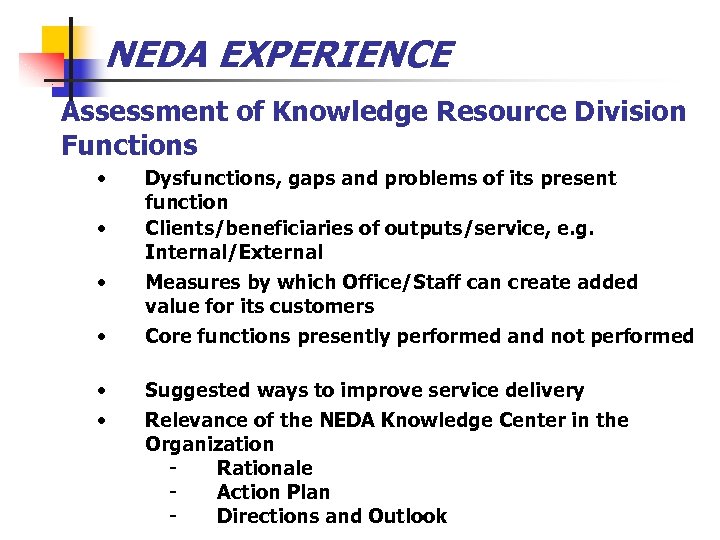
NEDA EXPERIENCE Assessment of Knowledge Resource Division Functions • • • Dysfunctions, gaps and problems of its present function Clients/beneficiaries of outputs/service, e. g. Internal/External Measures by which Office/Staff can create added value for its customers Core functions presently performed and not performed Suggested ways to improve service delivery Relevance of the NEDA Knowledge Center in the Organization Rationale Action Plan Directions and Outlook
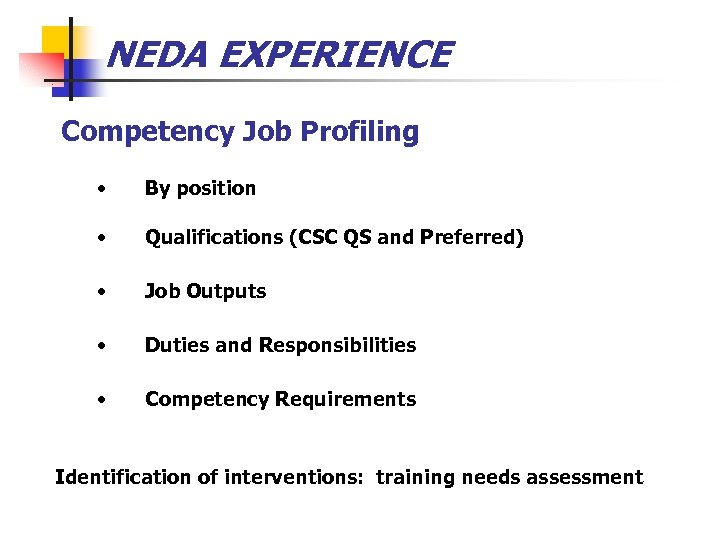
NEDA EXPERIENCE Competency Job Profiling • By position • Qualifications (CSC QS and Preferred) • Job Outputs • Duties and Responsibilities • Competency Requirements Identification of interventions: training needs assessment
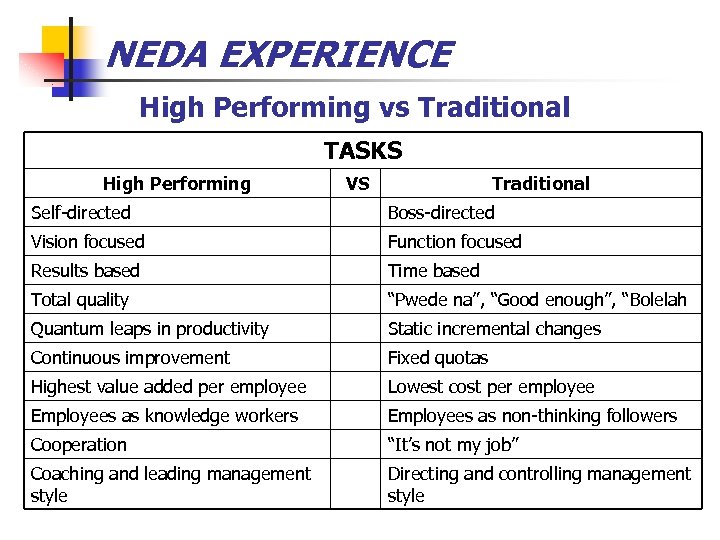
NEDA EXPERIENCE High Performing vs Traditional TASKS High Performing VS Traditional Self-directed Boss-directed Vision focused Function focused Results based Time based Total quality “Pwede na”, “Good enough”, “Bolelah Quantum leaps in productivity Static incremental changes Continuous improvement Fixed quotas Highest value added per employee Lowest cost per employee Employees as knowledge workers Employees as non-thinking followers Cooperation “It’s not my job” Coaching and leading management style Directing and controlling management style
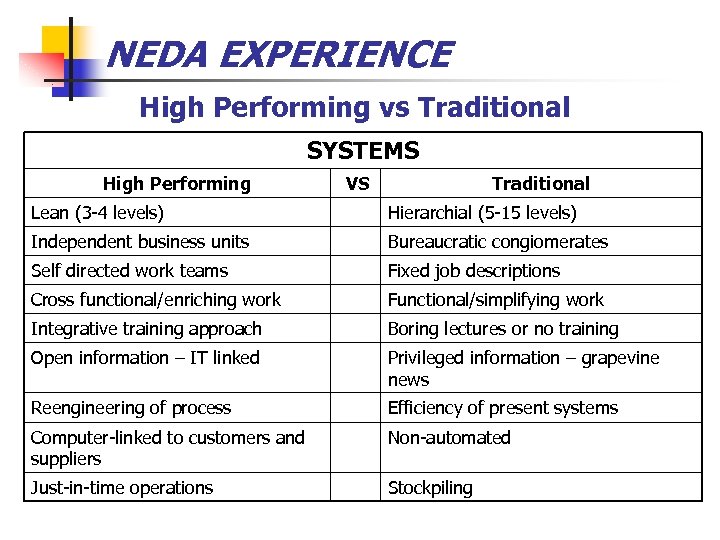
NEDA EXPERIENCE High Performing vs Traditional SYSTEMS High Performing VS Traditional Lean (3 -4 levels) Hierarchial (5 -15 levels) Independent business units Bureaucratic congiomerates Self directed work teams Fixed job descriptions Cross functional/enriching work Functional/simplifying work Integrative training approach Boring lectures or no training Open information – IT linked Privileged information – grapevine news Reengineering of process Efficiency of present systems Computer-linked to customers and suppliers Non-automated Just-in-time operations Stockpiling
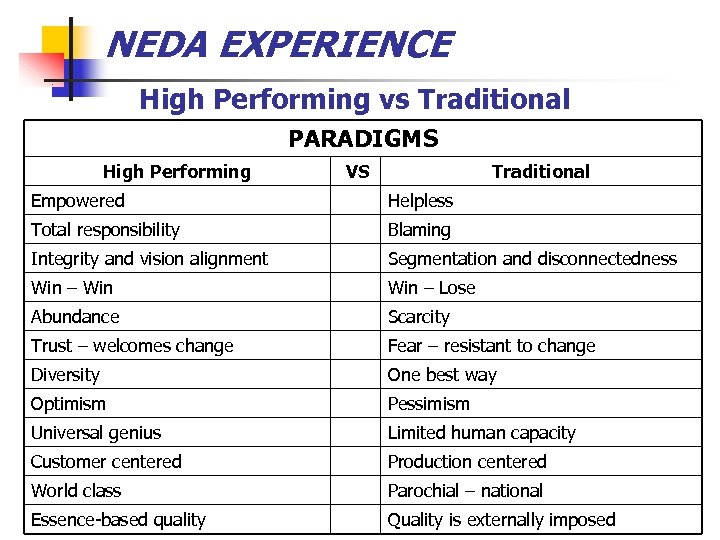
NEDA EXPERIENCE High Performing vs Traditional PARADIGMS High Performing VS Traditional Empowered Helpless Total responsibility Blaming Integrity and vision alignment Segmentation and disconnectedness Win – Lose Abundance Scarcity Trust – welcomes change Fear – resistant to change Diversity One best way Optimism Pessimism Universal genius Limited human capacity Customer centered Production centered World class Parochial – national Essence-based quality Quality is externally imposed
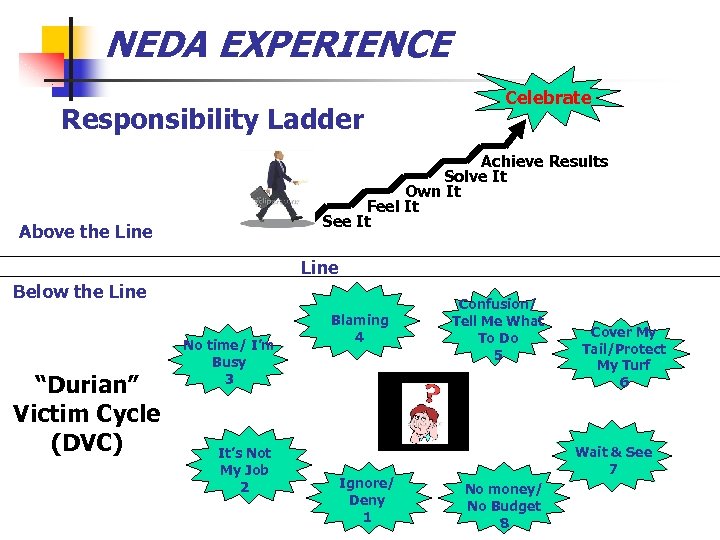
NEDA EXPERIENCE Responsibility Ladder Celebrate Achieve Results Solve It Own It Feel It See It Above the Line Below the Line “Durian” Victim Cycle (DVC) No time/ I’m Busy 3 It’s Not My Job 2 Blaming 4 Ignore/ Deny 1 Confusion/ Tell Me What To Do 5 Cover My Tail/Protect My Turf 6 Wait & See 7 No money/ No Budget 8
NEDA EXPERIENCE “BE THE CHANGE YOU WANT TO SEE HAPPEN, INSTEAD OF TRYING TO CHANGE EVERYONE ELSE” Thank you!
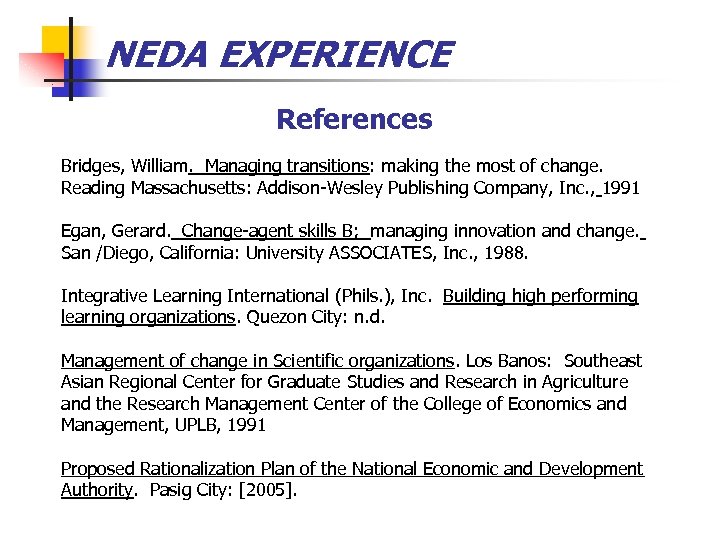
NEDA EXPERIENCE References Bridges, William. Managing transitions: making the most of change. Reading Massachusetts: Addison-Wesley Publishing Company, Inc. , 1991 Egan, Gerard. Change-agent skills B; managing innovation and change. San /Diego, California: University ASSOCIATES, Inc. , 1988. Integrative Learning International (Phils. ), Inc. Building high performing learning organizations. Quezon City: n. d. Management of change in Scientific organizations. Los Banos: Southeast Asian Regional Center for Graduate Studies and Research in Agriculture and the Research Management Center of the College of Economics and Management, UPLB, 1991 Proposed Rationalization Plan of the National Economic and Development Authority. Pasig City: [2005].
Скачать презентацию CHANGE MANAGEMENT NEDA EXPERIENCE Presented by Ms Florina
65ac630a8311ad3da93514179404a2ef.ppt