


 Скачать презентацию Change Management Final Stages of Implementation ERP Configuration
5ff3c11543f04e4edae8ed2b41381c94.ppt
- Количество слайдов: 21
 Change Management Final Stages of Implementation ERP Configuration and Use Fall 1998 Dr. Gail Corbitt CSU Chico Change Management ã SAP AG 1
 Overview of Topics l Review of Implementation Process l Identify Critical Success Factors l Define Change Management (big picture) l Define Role of Corporate Politics and Other Pitfalls l Discuss the Changing Roles in Technology Transfer Situations l Overview of “Go Live” Issues and Concerns CSU Chico Change Management ã SAP AG 2
 Review of Implementation Process l Launch the Project n Project Planning n Define Standards and Procedures n Technical Requirements Planning/Initiation n Kick-off l Define the “As Is” n Business Blueprint -- what is the business n Identify areas of needed change (re-engineering) n Learn what SAP can and can not do CSU Chico Change Management ã SAP AG 3
 Review of Implementation Process cont. l Design the “To Be” n Re-engineer the processes that need changing n Develop Detailed Design of how ERP will be configured to support the “To Be” business w w w Configuration of system Design of Reports Design all interfaces Design and test all conversions Develop Implementation (Go Live) Plan l Function and Integration Test CSU Chico Change Management ã SAP AG 4
 Review of Implementation Process cont l Implement or Go Live n Install the Tested Configured System on the Production System n Set up and Test the support system for users n Train the users n Populate the Database (bring in legacy data) n Cut Over to New system CSU Chico Change Management ã SAP AG 5
 Critical Success Factors l Continuous Visual Behavioral Support from Top Management l Understand the Corporate Culture Surrounding Change: Ready the Organization for Change l Make Changes to Organizational Structure Well in Advance of Go Live (before you start project is ideal) l Document and Communicate Project Status Continuously l Project Manager must be able to Stick to the Task/Deliverable Schedule CSU Chico Change Management ã SAP AG 6
 Critical Success Factors Cont. l Project Team must be best at understanding the business and SAP l Commitment to the Change (need to ride out the problems) l Have a Team that Can Make Decisions l Use a Good Project Management Methodology -Commit to Use It CSU Chico Change Management ã SAP AG 7
 Components to the Project l Business Process (includes Data and Organizational components) l Conversions and Interfaces (External systems that need to work with SAP) l Development of custom Programs, Reports and Screens (internal SAP interface) l Change Management (Site Readiness and Go Live Plan) l Integration and Project Management to Coordinate all of the above CSU Chico Change Management ã SAP AG 8
 Change Management (Big Picture) l Change Management: Strategies for awareness, acceptance & incorporation of change into the organization’s environment n Systems Administration of hardware and software components n Version and Change Request Control n Conducting business differently l Verblen’s Principle (Weinberg and Gause 1989) n “There’s no change, no matter how awful, that won’t benefit some people, and no change, no matter how good, that won’t hurt some. ” l Plan or Manage the Change so that users and System are ready at the same time and expectations on both sides are matched CSU Chico Change Management ã SAP AG 9
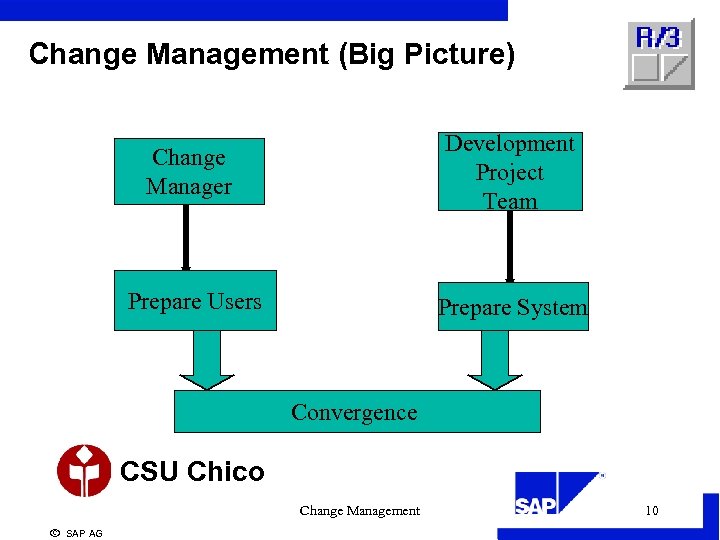 Change Management (Big Picture) Change Manager Development Project Team Prepare Users Prepare System Convergence CSU Chico Change Management ã SAP AG 10
 Goals of Change Management l Convergence of User and System Readiness l Optimize Organization’s Social (Cultural) and Technical Infrastructures l Create a Learning Organization n Continuous Improvement n Customer Focus n Adaptable to changes in the environment (external and internal) CSU Chico Change Management ã SAP AG 11
 Key Principles of Change Management l Steering Committee Must Have Product and Process Champions or Stakeholders l Communication needs to multi-channeled (up is as valued as down) l Conflict resolution and knowledge acquisition are collaborative (information sharing not hoarding) l Implementation Team (change management team) has a structure and roles of individuals are defined l Resistance to Change is always there but may be hard to detect until after Go Live (Be Proactive) CSU Chico Change Management ã SAP AG 12
 Challenges and Pitfalls l Change process must be planned and managed l Magnitude of change is ALWAYS greater than imagined l Resistance to change appears in different forms -- must be addressed l In global organizations cultural factors need special consideration l Change in organizations occurs in stages -- need strategies for EACH stage CSU Chico Change Management ã SAP AG 13
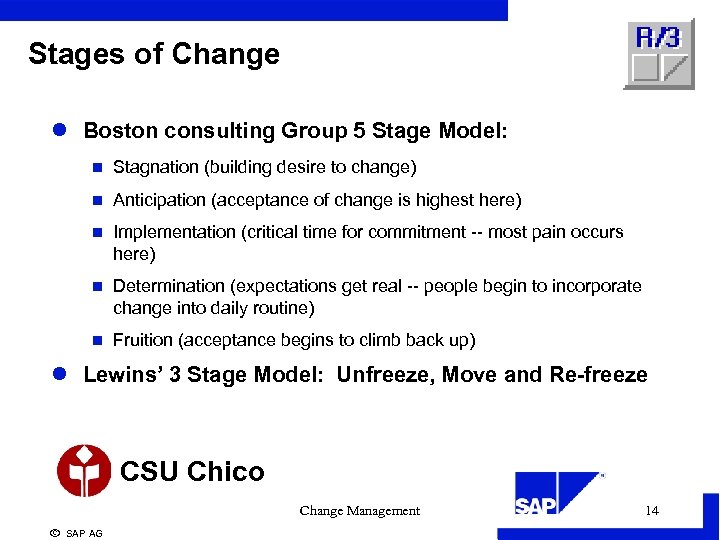 Stages of Change l Boston consulting Group 5 Stage Model: n Stagnation (building desire to change) n Anticipation (acceptance of change is highest here) n Implementation (critical time for commitment -- most pain occurs here) n Determination (expectations get real -- people begin to incorporate change into daily routine) n Fruition (acceptance begins to climb back up) l Lewins’ 3 Stage Model: Unfreeze, Move and Re-freeze CSU Chico Change Management ã SAP AG 14
 Strategies for Stages l Unfreezing: n Develop awareness of change n Users see or have a need to change (internal felt need) n Driving forces for change outweigh the Restraining Forces l Moving: n Involve users in project team (as is --> to be processes) n Train the users n Develop in-house gurus -- change agents that can help resisters CSU Chico Change Management ã SAP AG 15
 Strategies for Stages l Re-freeze or Institutionalize Change: n Support organization is in place and working n Resistance to change has been addressed n Development Team moves on to a new project l At all Stages n Communication must be Open n Trust within the organization must be high n Knowledge must be Shared CSU Chico Change Management ã SAP AG 16
 Force Field Analysis l Technique to identify positive or driving forces and negative or restraining forces in the environment that contribute to the impending change n Can be personal or environmental n Identify the item as well as the strength of each item l Uses: n Determine readiness at the beginning of the process n Measure progress and surface new issues as we move through process n Build strategies and tactics that reinforce the positive and address the negative (at all stages) CSU Chico Change Management ã SAP AG 17
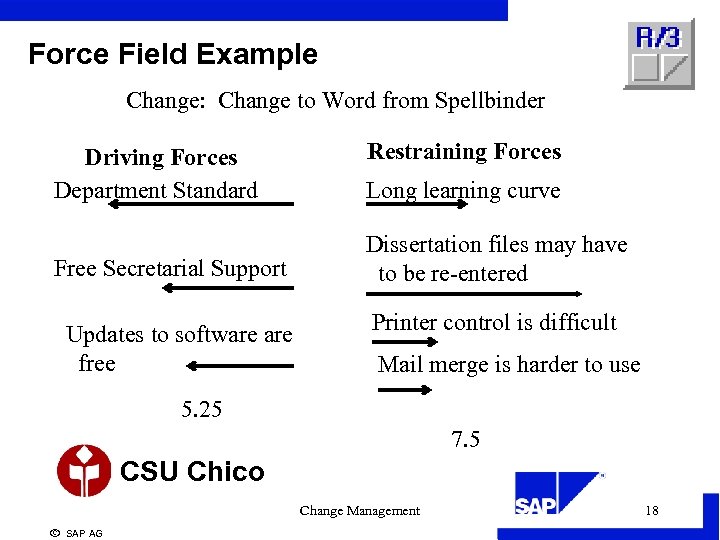 Force Field Example Change: Change to Word from Spellbinder Restraining Forces Driving Forces Department Standard Long learning curve Free Secretarial Support Dissertation files may have to be re-entered Updates to software free Printer control is difficult Mail merge is harder to use 5. 25 7. 5 CSU Chico Change Management ã SAP AG 18
 Force Field Example: l Pick something in your life you’d like to change l List the forces (Driving and Restraining) l Draw the lines for strength l Interpret Results CSU Chico Change Management ã SAP AG 19
 Changing Roles in Technology Transfer Situations l Knowledge Needed to Implement Change is not Available l Change Agents are Consultants n Roles include Scouting for New Work and Executing Existing Work n Consultant will exit organization (need Knowledge Transfer) n Trust of consultant must be high n Action in organization must be unique to organization but most consultants use boiler plate solutions l Outsourcing can be Viable CSU Chico Change Management ã SAP AG 20
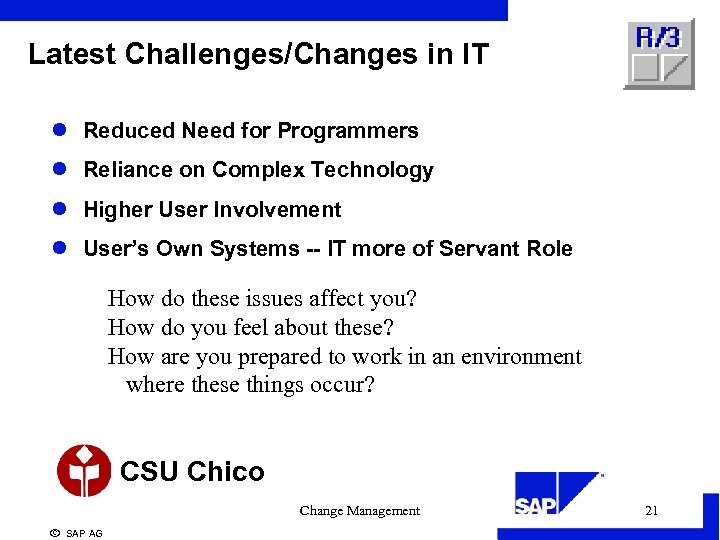 Latest Challenges/Changes in IT l Reduced Need for Programmers l Reliance on Complex Technology l Higher User Involvement l User’s Own Systems -- IT more of Servant Role How do these issues affect you? How do you feel about these? How are you prepared to work in an environment where these things occur? CSU Chico Change Management ã SAP AG 21