 Скачать презентацию Change Agency Leadership Patrick F Bassett NAIS President
4ee6385b1d96f06f8da2aa69b43e1294.ppt
- Количество слайдов: 64



Change Agency Leadership Patrick F. Bassett, NAIS President bassett@nais. org
Required Reading for the Admin Team
Creating the Conditions for Success What is (or should be) on your leadership/change agenda? Message to Parents: “We’re preparing children for their future, not your past. ” Message to Faculty: “Don’t bother with the ‘The colleges (or secondary schools) won’t like it’ excuse: The colleges (or secondary schools) will like it. ” (Ask them. ) Leading from the Middle Managing Difficult Conversations Cultivating the First Followers Dan Pink on the “Science of Motivation. ” Dan & Chip Heath on Orchestrating Change: Switch: “How To Change Things When Change Is Hard” 6. IDEO on Design. 7. Robert Kegan on Immunity to Change 8. Pat Bassett on Seven Stages of the Change Cycle 1. 2. 3. 4. 5.
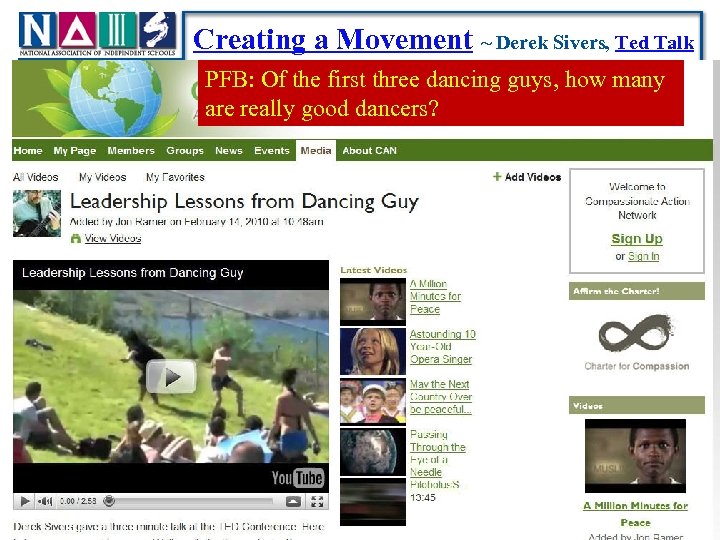
Creating a Movement ~ Derek Sivers, Ted Talk PFB: Of the first three dancing guys, how many are really good dancers?
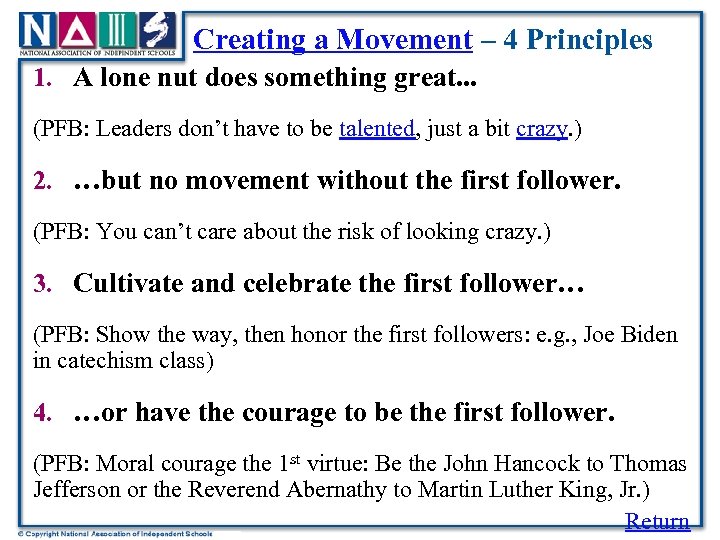
Creating a Movement – 4 Principles 1. A lone nut does something great. . . (PFB: Leaders don’t have to be talented, just a bit crazy. ) 2. …but no movement without the first follower. (PFB: You can’t care about the risk of looking crazy. ) 3. Cultivate and celebrate the first follower… (PFB: Show the way, then honor the first followers: e. g. , Joe Biden in catechism class) 4. …or have the courage to be the first follower. (PFB: Moral courage the 1 st virtue: Be the John Hancock to Thomas Jefferson or the Reverend Abernathy to Martin Luther King, Jr. ) Return
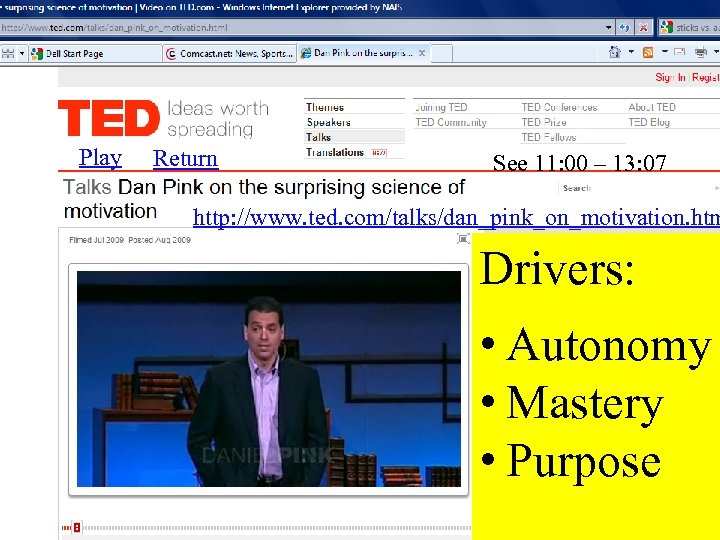
Play Return See 11: 00 – 13: 07 http: //www. ted. com/talks/dan_pink_on_motivation. htm Drivers: • Autonomy • Mastery • Purpose
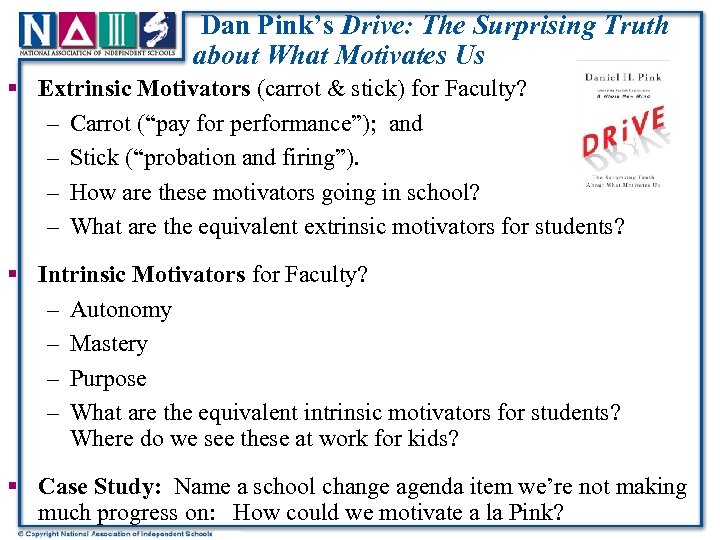
Dan Pink’s Drive: The Surprising Truth about What Motivates Us § Extrinsic Motivators (carrot & stick) for Faculty? – Carrot (“pay for performance”); and – Stick (“probation and firing”). – How are these motivators going in school? – What are the equivalent extrinsic motivators for students? § Intrinsic Motivators for Faculty? – Autonomy – Mastery – Purpose – What are the equivalent intrinsic motivators for students? Where do we see these at work for kids? § Case Study: Name a school change agenda item we’re not making much progress on: How could we motivate a la Pink?
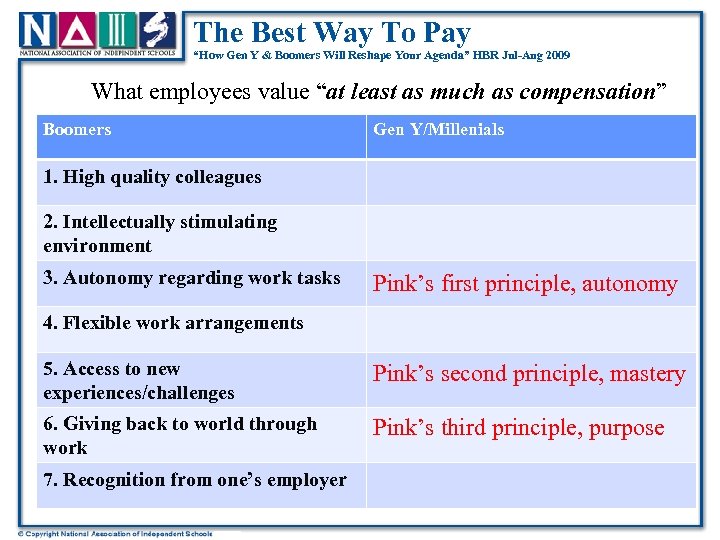
The Best Way To Pay “How Gen Y & Boomers Will Reshape Your Agenda” HBR Jul-Aug 2009 What employees value “at least as much as compensation” Boomers Gen Y/Millenials 1. High quality colleagues 2. Intellectually stimulating environment 3. Autonomy regarding work tasks Pink’s first principle, autonomy 4. Flexible work arrangements 5. Access to new experiences/challenges Pink’s second principle, mastery 6. Giving back to world through work Pink’s third principle, purpose 7. Recognition from one’s employer
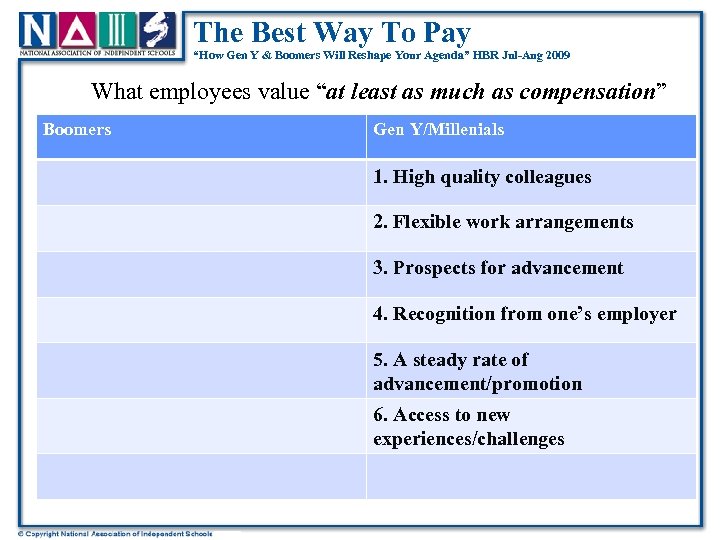
The Best Way To Pay “How Gen Y & Boomers Will Reshape Your Agenda” HBR Jul-Aug 2009 What employees value “at least as much as compensation” Boomers Gen Y/Millenials 1. High quality colleagues 2. Flexible work arrangements 3. Prospects for advancement 4. Recognition from one’s employer 5. A steady rate of advancement/promotion 6. Access to new experiences/challenges
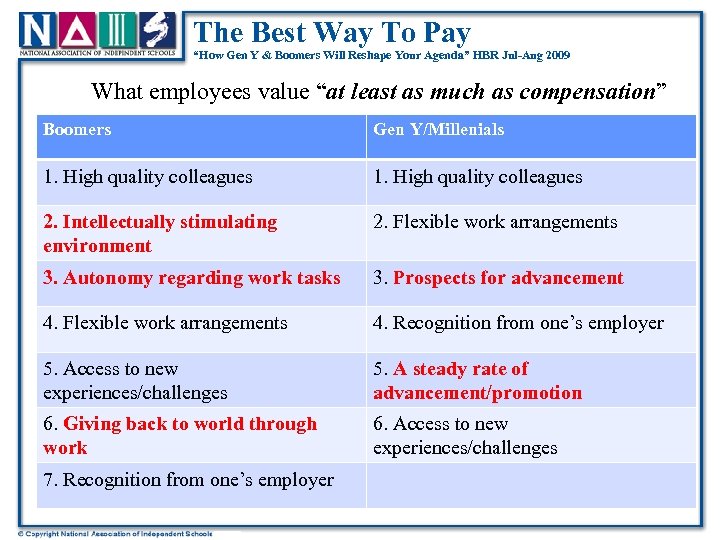
The Best Way To Pay “How Gen Y & Boomers Will Reshape Your Agenda” HBR Jul-Aug 2009 What employees value “at least as much as compensation” Boomers Gen Y/Millenials 1. High quality colleagues 2. Intellectually stimulating environment 2. Flexible work arrangements 3. Autonomy regarding work tasks 3. Prospects for advancement 4. Flexible work arrangements 4. Recognition from one’s employer 5. Access to new experiences/challenges 5. A steady rate of advancement/promotion 6. Giving back to world through work 6. Access to new experiences/challenges 7. Recognition from one’s employer
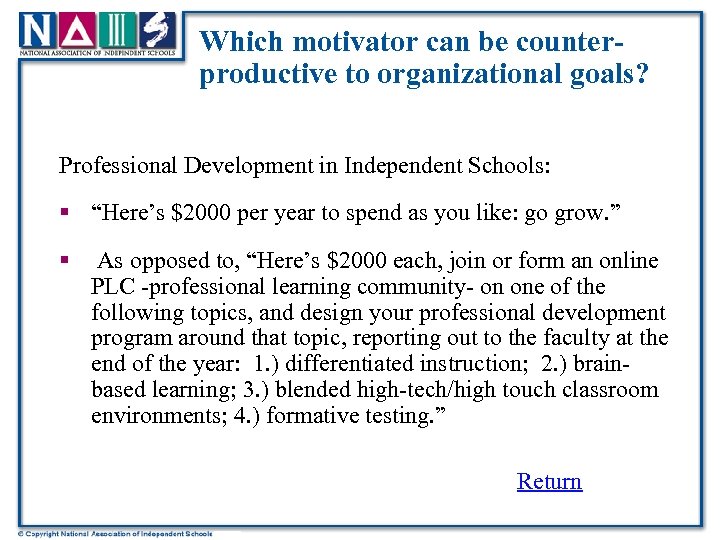
Which motivator can be counterproductive to organizational goals? Professional Development in Independent Schools: § “Here’s $2000 per year to spend as you like: go grow. ” § As opposed to, “Here’s $2000 each, join or form an online PLC -professional learning community- on one of the following topics, and design your professional development program around that topic, reporting out to the faculty at the end of the year: 1. ) differentiated instruction; 2. ) brainbased learning; 3. ) blended high-tech/high touch classroom environments; 4. ) formative testing. ” Return
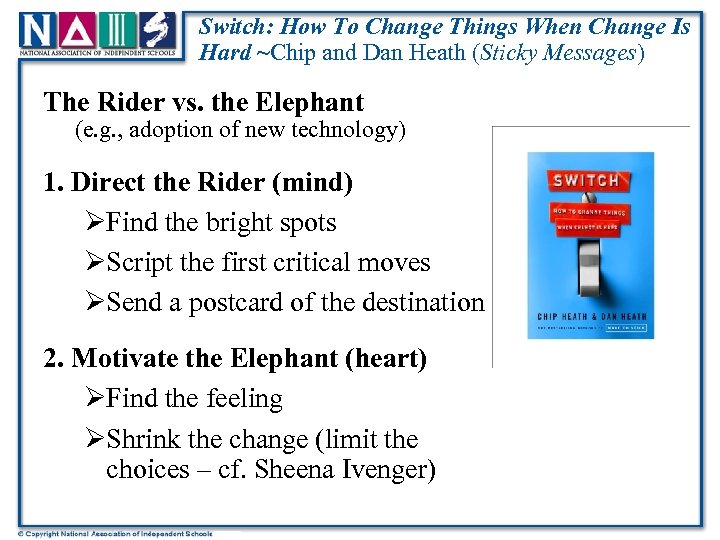
Switch: How To Change Things When Change Is Hard ~Chip and Dan Heath (Sticky Messages) The Rider vs. the Elephant (e. g. , adoption of new technology) 1. Direct the Rider (mind) ØFind the bright spots ØScript the first critical moves ØSend a postcard of the destination 2. Motivate the Elephant (heart) ØFind the feeling ØShrink the change (limit the choices – cf. Sheena Ivenger)
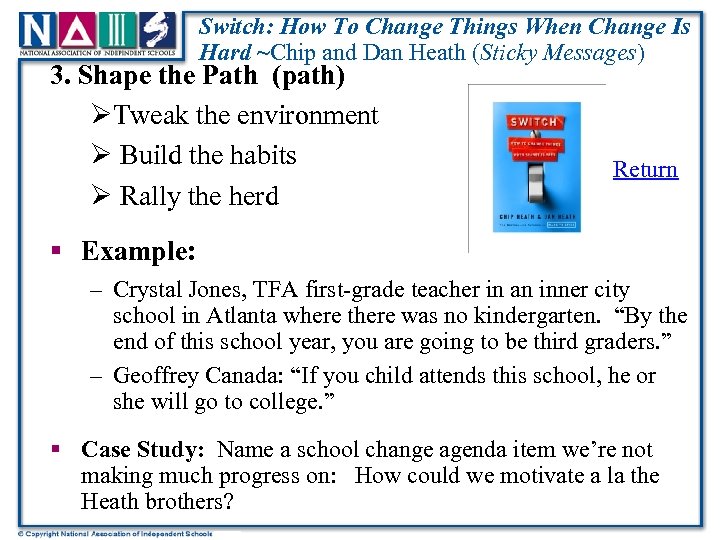
Switch: How To Change Things When Change Is Hard ~Chip and Dan Heath (Sticky Messages) 3. Shape the Path (path) ØTweak the environment Ø Build the habits Ø Rally the herd Return § Example: – Crystal Jones, TFA first-grade teacher in an inner city school in Atlanta where there was no kindergarten. “By the end of this school year, you are going to be third graders. ” – Geoffrey Canada: “If you child attends this school, he or she will go to college. ” § Case Study: Name a school change agenda item we’re not making much progress on: How could we motivate a la the Heath brothers?
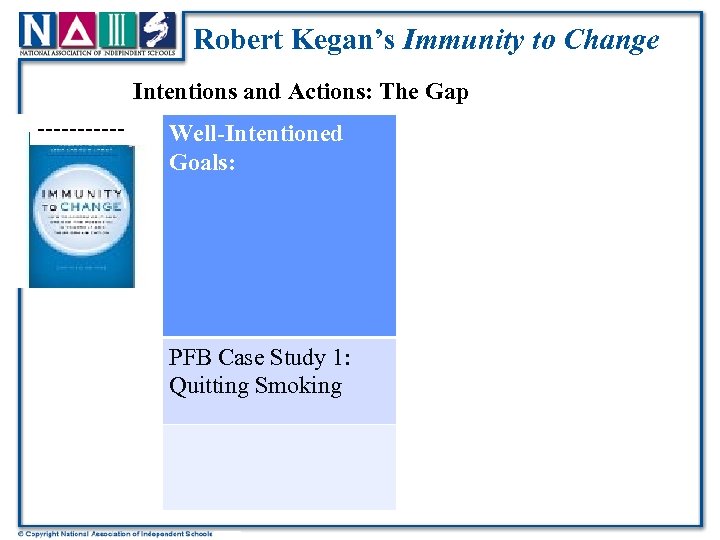
Robert Kegan’s Immunity to Change Intentions and Actions: The Gap ------ Well-Intentioned Goals: PFB Case Study 1: Quitting Smoking
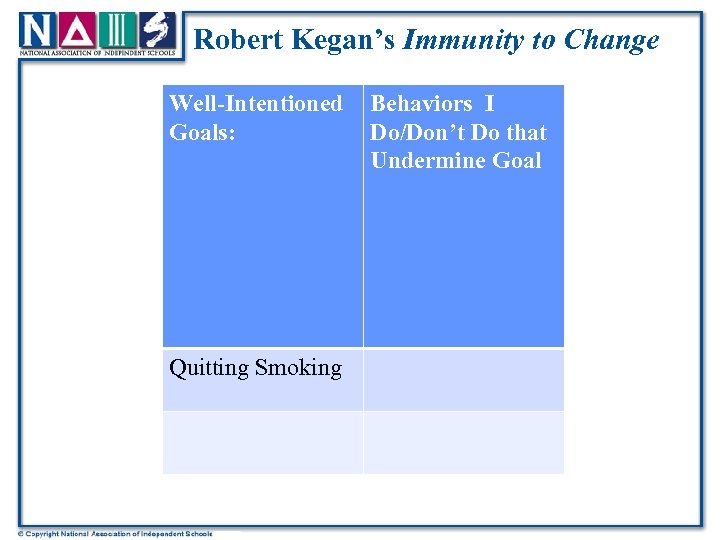
Robert Kegan’s Immunity to Change Well-Intentioned Goals: Quitting Smoking Behaviors I Do/Don’t Do that Undermine Goal
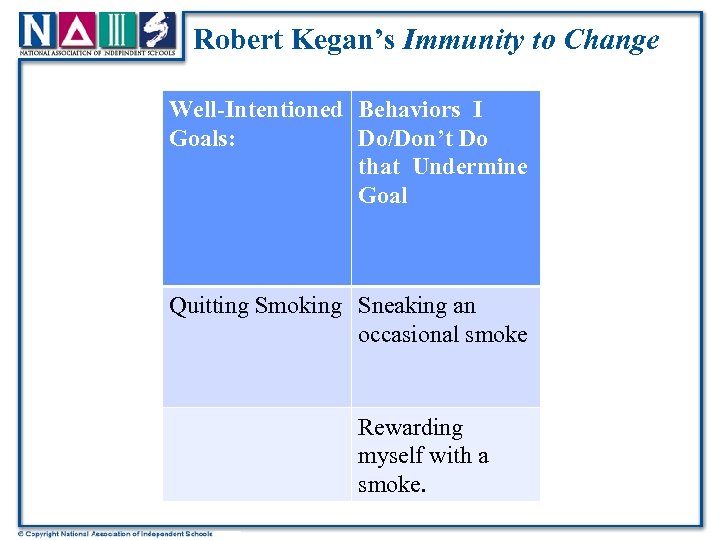
Robert Kegan’s Immunity to Change Well-Intentioned Behaviors I Goals: Do/Don’t Do that Undermine Goal Quitting Smoking Sneaking an occasional smoke Rewarding myself with a smoke.
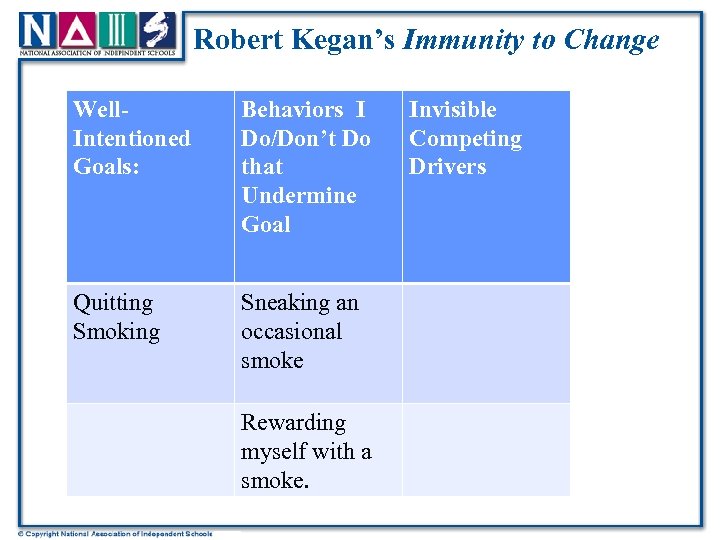
Robert Kegan’s Immunity to Change Well. Intentioned Goals: Behaviors I Do/Don’t Do that Undermine Goal Quitting Smoking Sneaking an occasional smoke Rewarding myself with a smoke. Invisible Competing Drivers
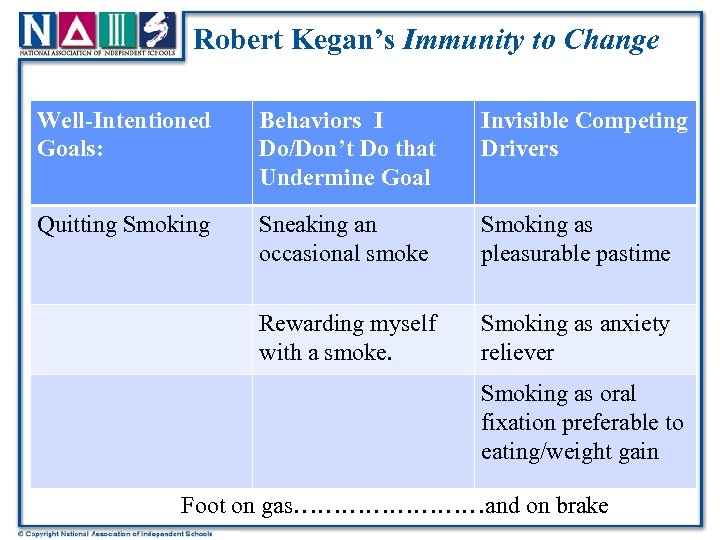
Robert Kegan’s Immunity to Change Well-Intentioned Goals: Behaviors I Do/Don’t Do that Undermine Goal Invisible Competing Drivers Quitting Smoking Sneaking an occasional smoke Smoking as pleasurable pastime Rewarding myself with a smoke. Smoking as anxiety reliever Smoking as oral fixation preferable to eating/weight gain Foot on gas…………and on brake
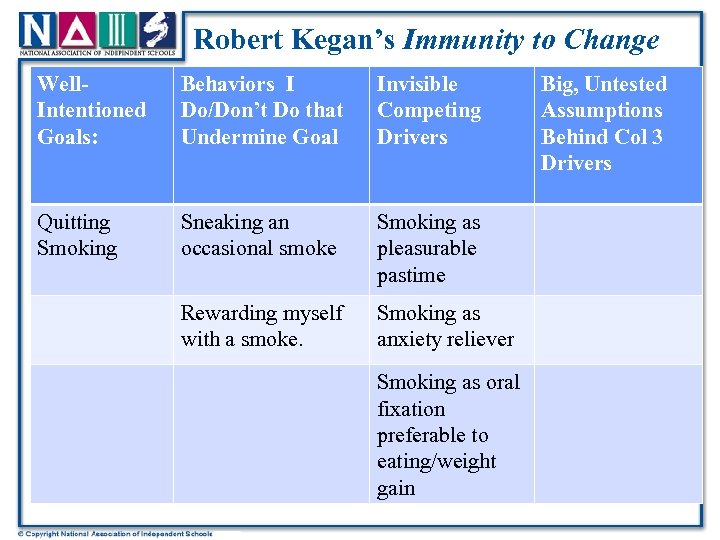
Robert Kegan’s Immunity to Change Well. Intentioned Goals: Behaviors I Do/Don’t Do that Undermine Goal Invisible Competing Drivers Quitting Smoking Sneaking an occasional smoke Smoking as pleasurable pastime Rewarding myself with a smoke. Smoking as anxiety reliever Smoking as oral fixation preferable to eating/weight gain Big, Untested Assumptions Behind Col 3 Drivers
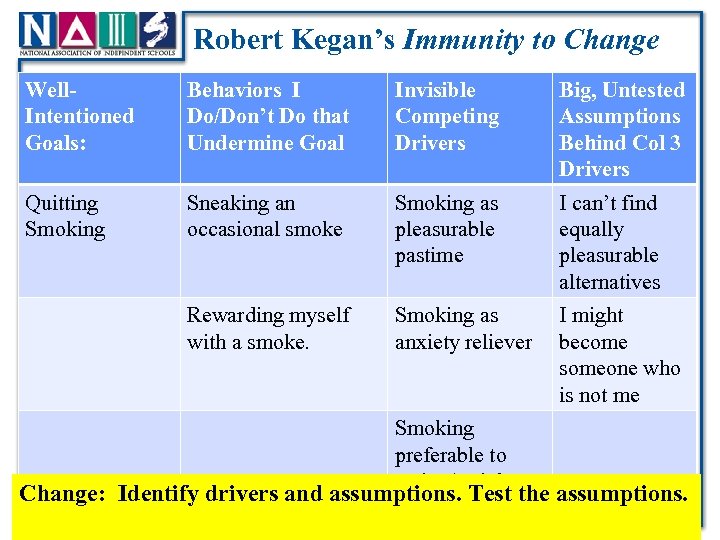
Robert Kegan’s Immunity to Change Well. Intentioned Goals: Behaviors I Do/Don’t Do that Undermine Goal Invisible Competing Drivers Big, Untested Assumptions Behind Col 3 Drivers Quitting Smoking Sneaking an occasional smoke Smoking as pleasurable pastime I can’t find equally pleasurable alternatives Rewarding myself with a smoke. Smoking as anxiety reliever I might become someone who is not me Smoking preferable to eating/weight Change: Identify drivers and assumptions. Test the assumptions. gain
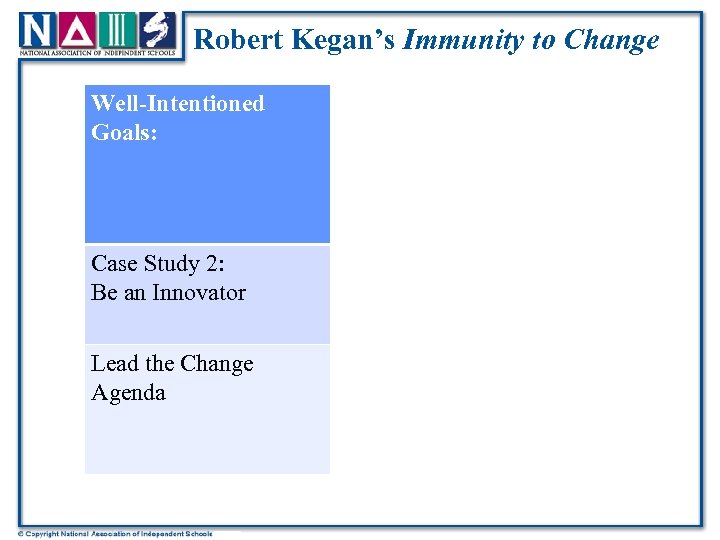
Robert Kegan’s Immunity to Change Well-Intentioned Goals: Case Study 2: Be an Innovator Lead the Change Agenda
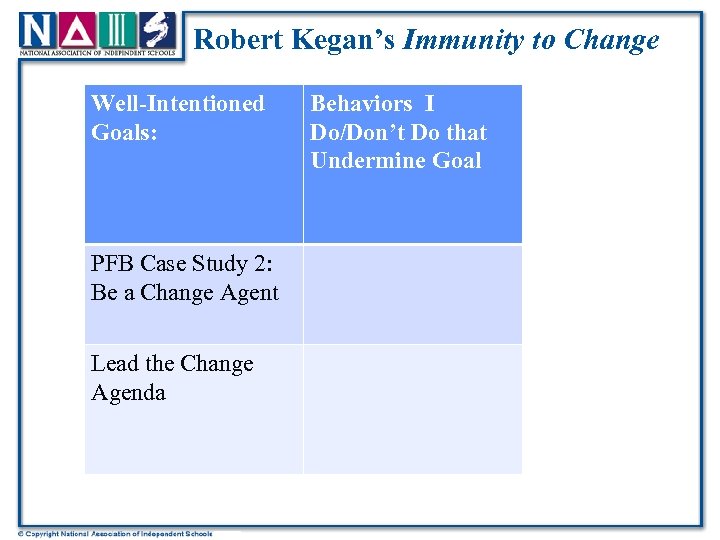
Robert Kegan’s Immunity to Change Well-Intentioned Goals: PFB Case Study 2: Be a Change Agent Lead the Change Agenda Behaviors I Do/Don’t Do that Undermine Goal
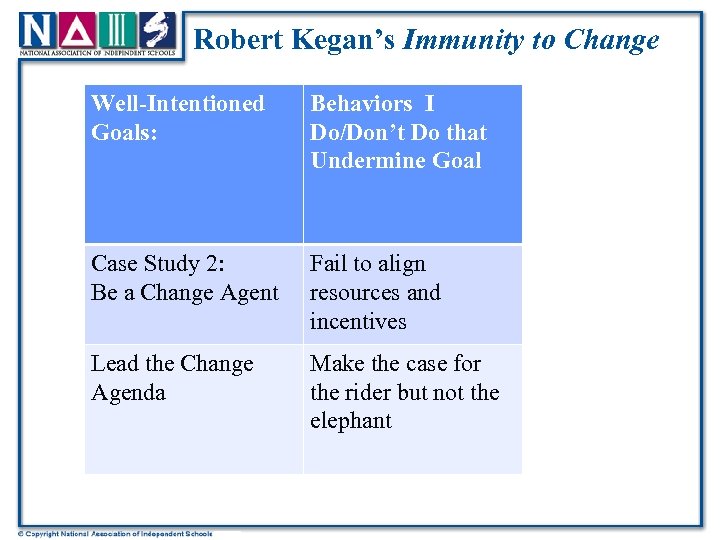
Robert Kegan’s Immunity to Change Well-Intentioned Goals: Behaviors I Do/Don’t Do that Undermine Goal Case Study 2: Be a Change Agent Fail to align resources and incentives Lead the Change Agenda Make the case for the rider but not the elephant
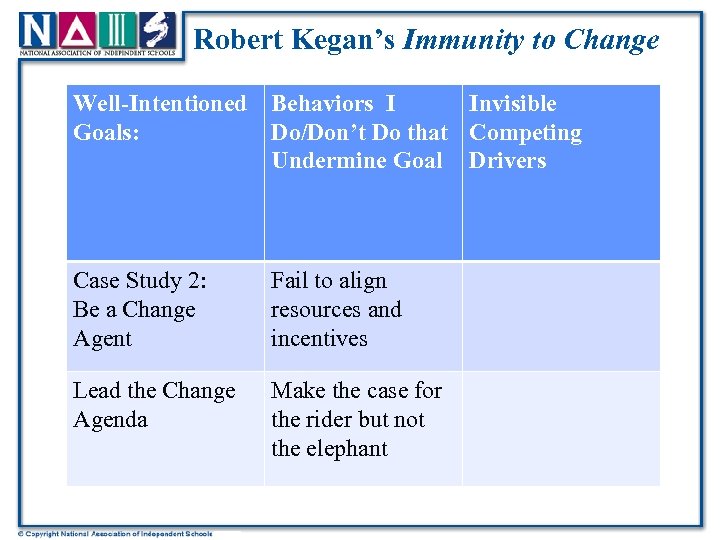
Robert Kegan’s Immunity to Change Well-Intentioned Behaviors I Invisible Goals: Do/Don’t Do that Competing Undermine Goal Drivers Case Study 2: Be a Change Agent Fail to align resources and incentives Lead the Change Agenda Make the case for the rider but not the elephant
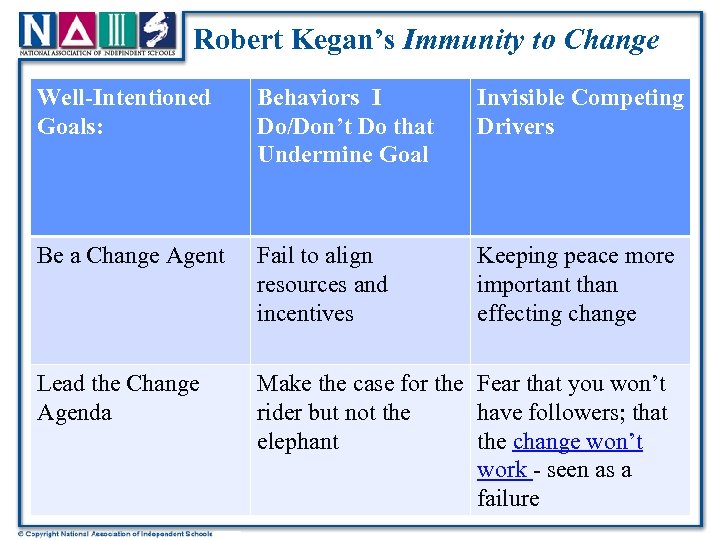
Robert Kegan’s Immunity to Change Well-Intentioned Goals: Behaviors I Do/Don’t Do that Undermine Goal Invisible Competing Drivers Be a Change Agent Fail to align resources and incentives Keeping peace more important than effecting change Lead the Change Agenda Make the case for the Fear that you won’t rider but not the have followers; that elephant the change won’t work - seen as a failure
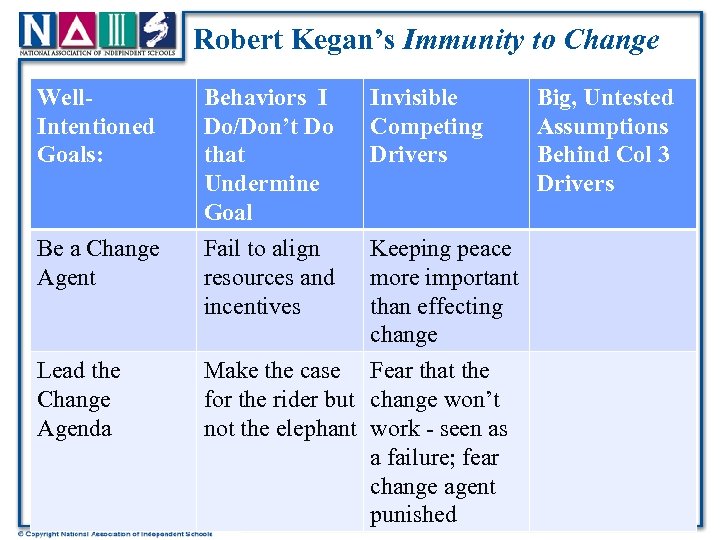
Robert Kegan’s Immunity to Change Well. Intentioned Goals: Behaviors I Do/Don’t Do that Undermine Goal Invisible Competing Drivers Be a Change Agent Fail to align resources and incentives Keeping peace more important than effecting change Lead the Change Agenda Make the case Fear that the for the rider but change won’t not the elephant work - seen as a failure; fear change agent punished Big, Untested Assumptions Behind Col 3 Drivers
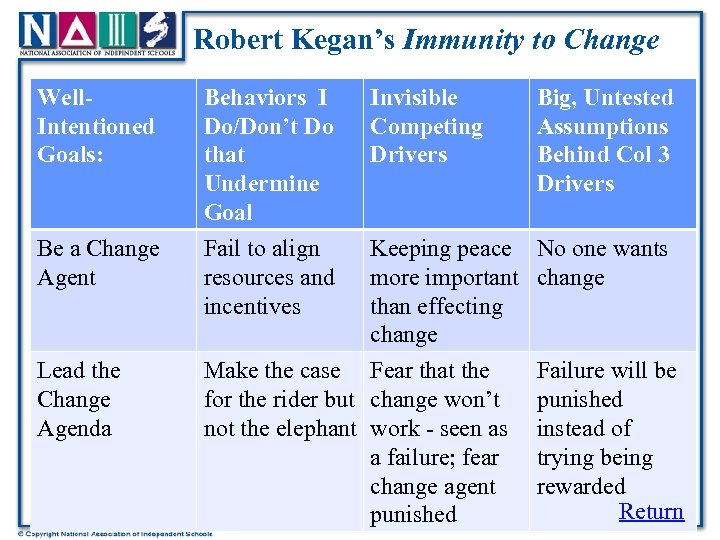
Robert Kegan’s Immunity to Change Well. Intentioned Goals: Behaviors I Do/Don’t Do that Undermine Goal Be a Change Agent Fail to align resources and incentives Lead the Change Agenda Invisible Competing Drivers Keeping peace more important than effecting change Make the case Fear that the for the rider but change won’t not the elephant work - seen as a failure; fear change agent punished Big, Untested Assumptions Behind Col 3 Drivers No one wants change Failure will be punished instead of trying being rewarded Return
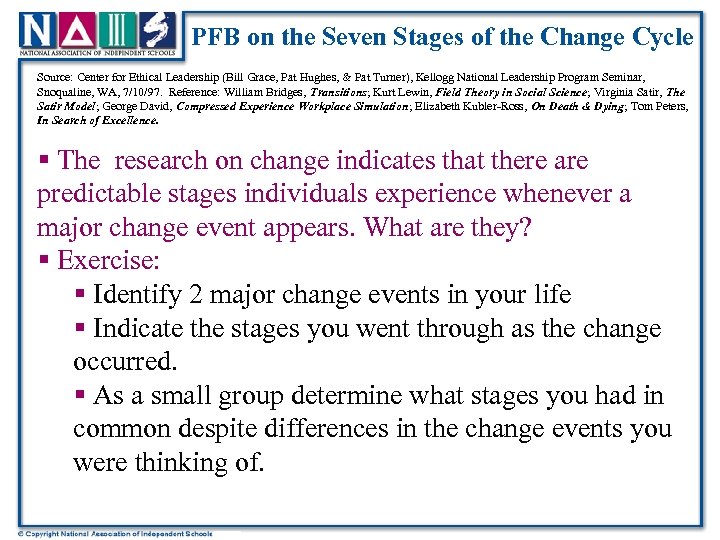
PFB on the Seven Stages of the Change Cycle Source: Center for Ethical Leadership (Bill Grace, Pat Hughes, & Pat Turner), Kellogg National Leadership Program Seminar, Snoqualine, WA, 7/10/97. Reference: William Bridges, Transitions; Kurt Lewin, Field Theory in Social Science; Virginia Satir, The Satir Model; George David, Compressed Experience Workplace Simulation; Elizabeth Kubler-Ross, On Death & Dying; Tom Peters, In Search of Excellence. § The research on change indicates that there are predictable stages individuals experience whenever a major change event appears. What are they? § Exercise: § Identify 2 major change events in your life § Indicate the stages you went through as the change occurred. § As a small group determine what stages you had in common despite differences in the change events you were thinking of.
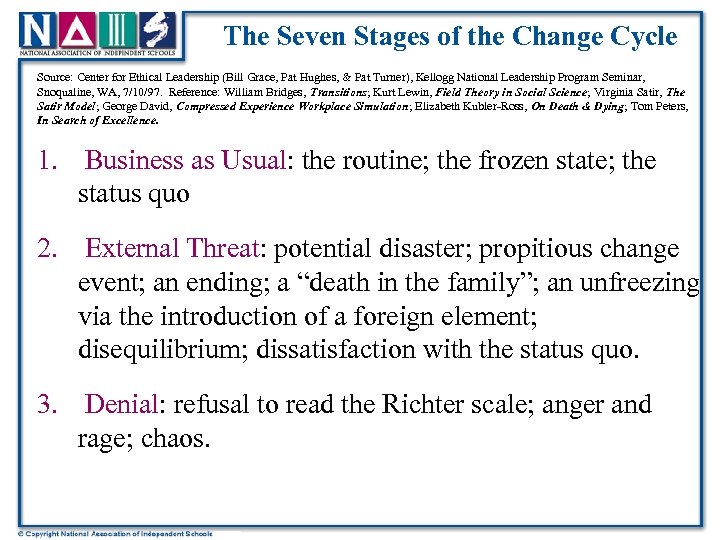
The Seven Stages of the Change Cycle Source: Center for Ethical Leadership (Bill Grace, Pat Hughes, & Pat Turner), Kellogg National Leadership Program Seminar, Snoqualine, WA, 7/10/97. Reference: William Bridges, Transitions; Kurt Lewin, Field Theory in Social Science; Virginia Satir, The Satir Model; George David, Compressed Experience Workplace Simulation; Elizabeth Kubler-Ross, On Death & Dying; Tom Peters, In Search of Excellence. 1. Business as Usual: the routine; the frozen state; the status quo 2. External Threat: potential disaster; propitious change event; an ending; a “death in the family”; an unfreezing via the introduction of a foreign element; disequilibrium; dissatisfaction with the status quo. 3. Denial: refusal to read the Richter scale; anger and rage; chaos.
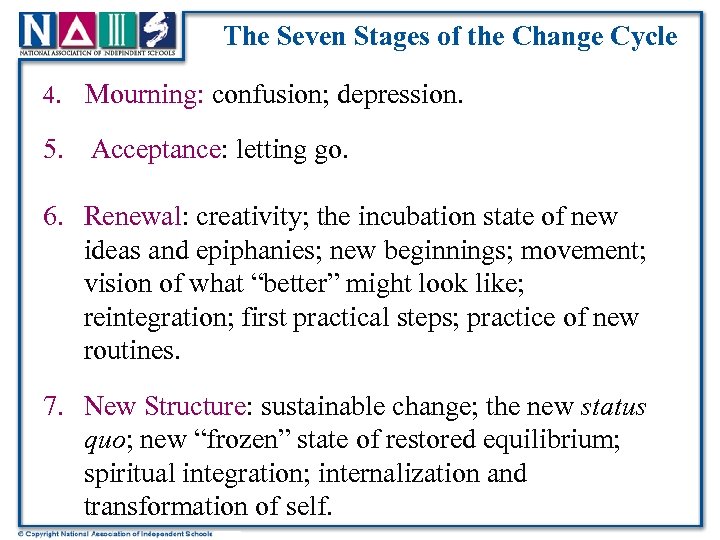
The Seven Stages of the Change Cycle 4. Mourning: confusion; depression. 5. Acceptance: letting go. 6. Renewal: creativity; the incubation state of new ideas and epiphanies; new beginnings; movement; vision of what “better” might look like; reintegration; first practical steps; practice of new routines. 7. New Structure: sustainable change; the new status quo; new “frozen” state of restored equilibrium; spiritual integration; internalization and transformation of self.
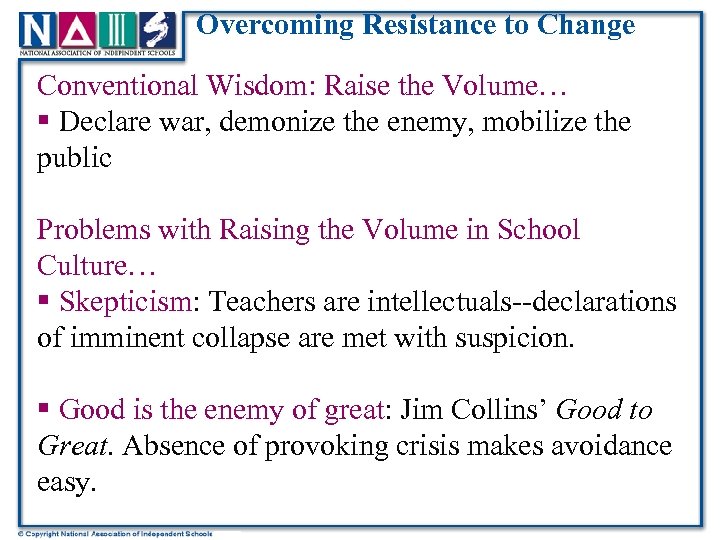
Overcoming Resistance to Change Conventional Wisdom: Raise the Volume… § Declare war, demonize the enemy, mobilize the public Problems with Raising the Volume in School Culture… § Skepticism: Teachers are intellectuals--declarations of imminent collapse are met with suspicion. § Good is the enemy of great: Jim Collins’ Good to Great. Absence of provoking crisis makes avoidance easy.
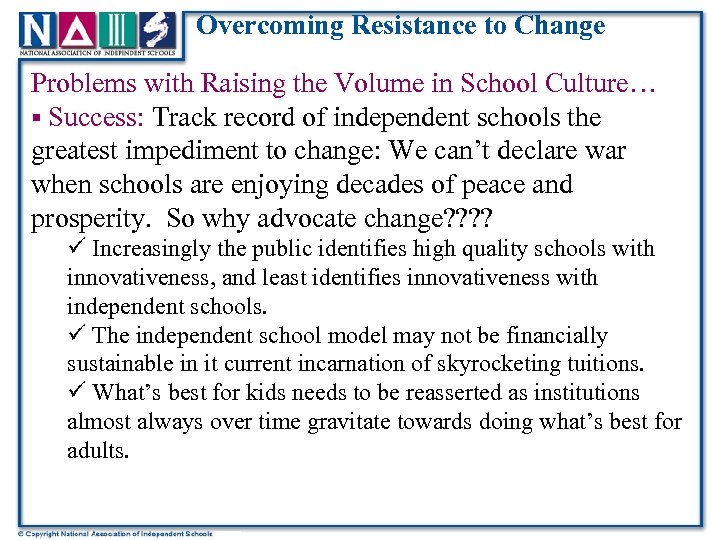
Overcoming Resistance to Change Problems with Raising the Volume in School Culture… § Success: Track record of independent schools the greatest impediment to change: We can’t declare war when schools are enjoying decades of peace and prosperity. So why advocate change? ? ü Increasingly the public identifies high quality schools with innovativeness, and least identifies innovativeness with independent schools. ü The independent school model may not be financially sustainable in it current incarnation of skyrocketing tuitions. ü What’s best for kids needs to be reasserted as institutions almost always over time gravitate towards doing what’s best for adults.
Effecting Change Developing Followership for Change: § Coercive model works (“We’re about to close unless all faculty including department chairs teach five classes instead of four with 20 -25 kids in each class”)… …but it works at a high cost to morale. § Appeal to idealism works (“We have an opportunity to create a new model here and become pioneers”)… …but it works only if you have a highly committed “band of brothers” and strong, visionary, and inspirational leadership.
Effecting Change Developing Buy-in for Change: § Mutual benefit (“What’s in it for me? ”) model works (“Beyond supporting this direction because ‘it’s the right thing to do, ’ we are designing a new framework that is mutually beneficial to the school and its staff”)… …but it works only if you build in significant incentives.
Overcoming Resistance to Change Alternative to Conventional Wisdom (Raise the Volume)… Lower the Noise… By… § Talking about/Personalizing Change: Anticipating the Seven Stages § Betting on the Fastest Horses
Acknowledging Denial & Mourning Stages of Change All change begins not with a beginning but an ending. • Example: Getting married = end of… übeing single üunconditional love ühaving your own bathroom (and towels) üthe sports car
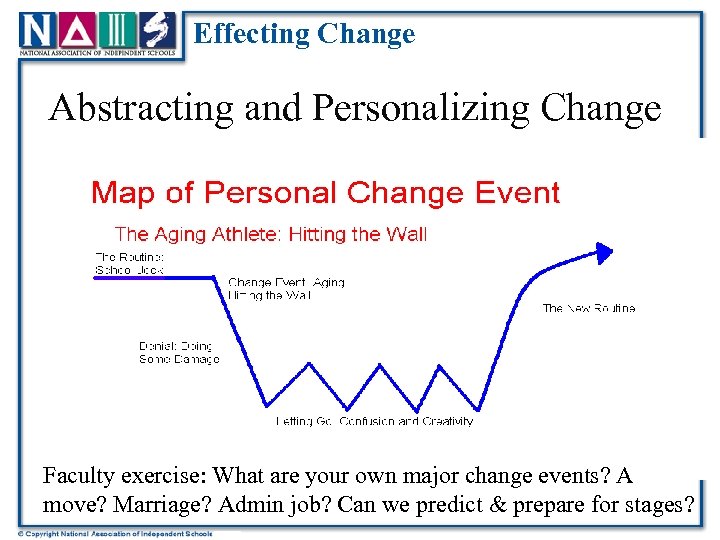
Effecting Change Abstracting and Personalizing Change Faculty exercise: What are your own major change events? A move? Marriage? Admin job? Can we predict & prepare for stages?
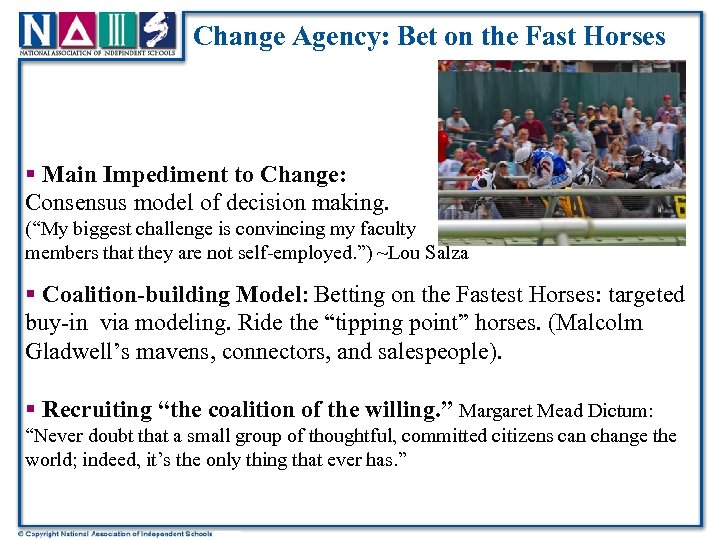
Change Agency: Bet on the Fast Horses § Main Impediment to Change: Consensus model of decision making. (“My biggest challenge is convincing my faculty members that they are not self-employed. ”) ~Lou Salza § Coalition-building Model: Betting on the Fastest Horses: targeted buy-in via modeling. Ride the “tipping point” horses. (Malcolm Gladwell’s mavens, connectors, and salespeople). § Recruiting “the coalition of the willing. ” Margaret Mead Dictum: “Never doubt that a small group of thoughtful, committed citizens can change the world; indeed, it’s the only thing that ever has. ”
Case Studies § Professionalizing the Profession § Student and School Outcomes st C: for the 21 Demonstrations of Learning
Change Agency Case Study #1 Professionalizing the Profession at your School
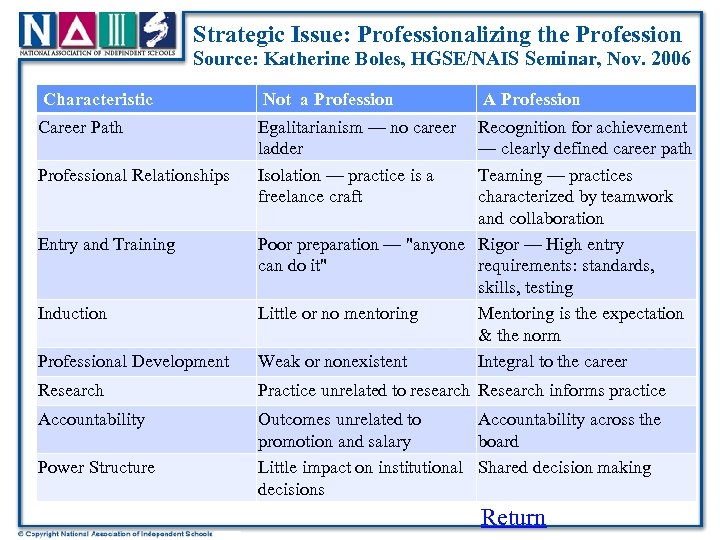
Strategic Issue: Professionalizing the Profession Source: Katherine Boles, HGSE/NAIS Seminar, Nov. 2006 Characteristic Not a Profession Career Path A Profession Egalitarianism — no career ladder Isolation — practice is a freelance craft Professional Development Recognition for achievement — clearly defined career path Teaming — practices characterized by teamwork and collaboration Poor preparation — "anyone Rigor — High entry can do it" requirements: standards, skills, testing Little or no mentoring Mentoring is the expectation & the norm Weak or nonexistent Integral to the career Research Practice unrelated to research Research informs practice Accountability Outcomes unrelated to Accountability across the promotion and salary board Little impact on institutional Shared decision making decisions Professional Relationships Entry and Training Induction Power Structure Return
The End! “So what’s it gonna be, eh? ” A Clockwork Orange
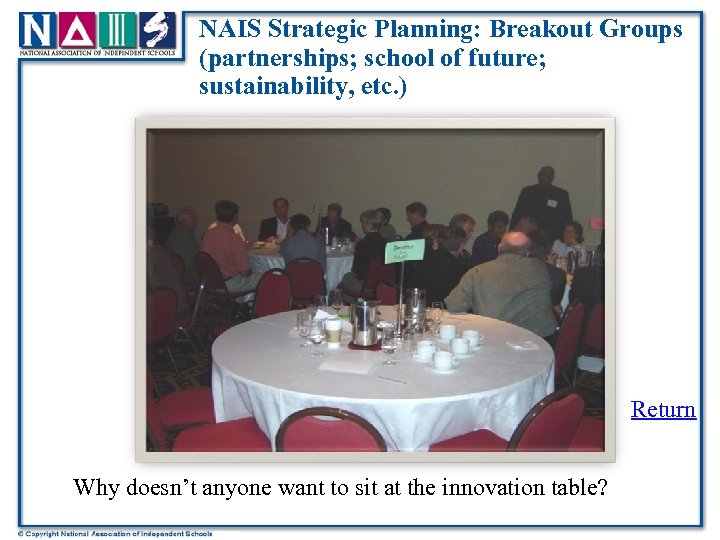
NAIS Strategic Planning: Breakout Groups (partnerships; school of future; sustainability, etc. ) Return Why doesn’t anyone want to sit at the innovation table?
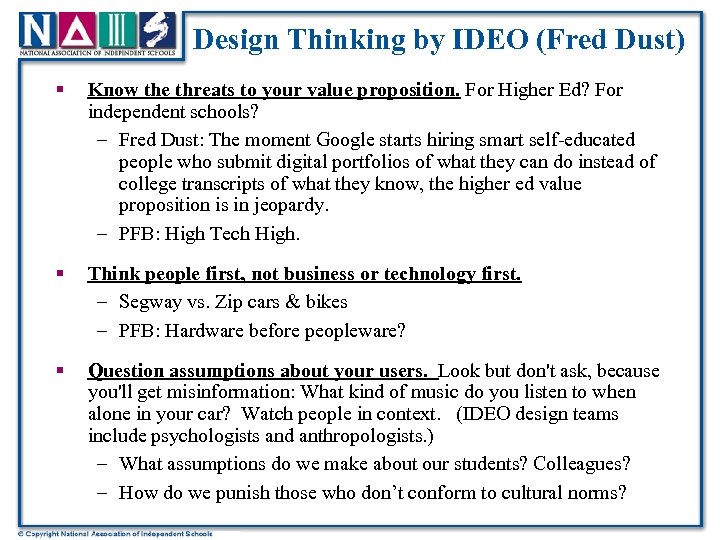
Design Thinking by IDEO (Fred Dust) § Know the threats to your value proposition. For Higher Ed? For independent schools? – Fred Dust: The moment Google starts hiring smart self-educated people who submit digital portfolios of what they can do instead of college transcripts of what they know, the higher ed value proposition is in jeopardy. – PFB: High Tech High. § Think people first, not business or technology first. – Segway vs. Zip cars & bikes – PFB: Hardware before peopleware? § Question assumptions about your users. Look but don't ask, because you'll get misinformation: What kind of music do you listen to when alone in your car? Watch people in context. (IDEO design teams include psychologists and anthropologists. ) – What assumptions do we make about our students? Colleagues? – How do we punish those who don’t conform to cultural norms?
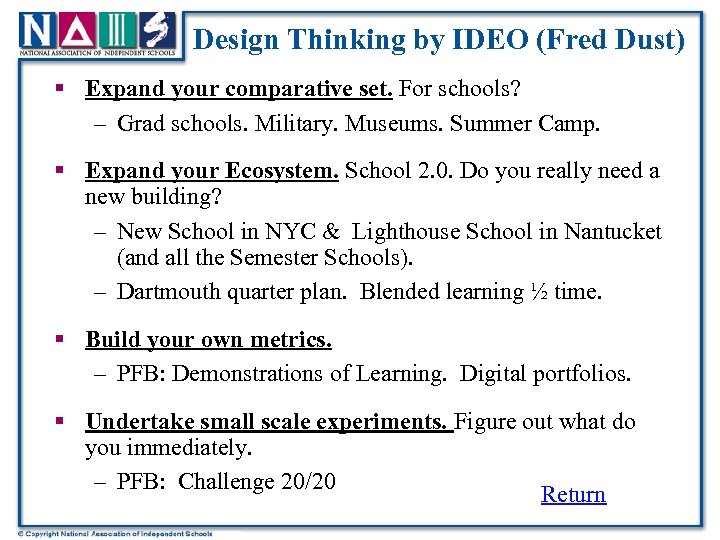
Design Thinking by IDEO (Fred Dust) § Expand your comparative set. For schools? – Grad schools. Military. Museums. Summer Camp. § Expand your Ecosystem. School 2. 0. Do you really need a new building? – New School in NYC & Lighthouse School in Nantucket (and all the Semester Schools). – Dartmouth quarter plan. Blended learning ½ time. § Build your own metrics. – PFB: Demonstrations of Learning. Digital portfolios. § Undertake small scale experiments. Figure out what do you immediately. – PFB: Challenge 20/20 Return
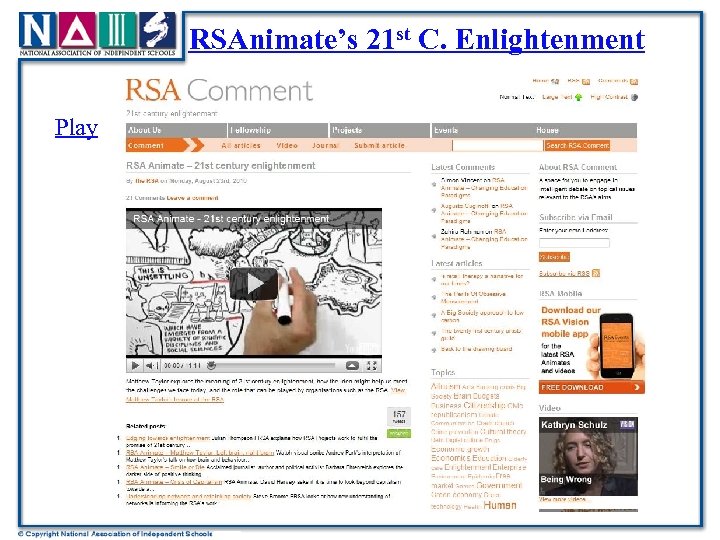
RSAnimate’s 21 st C. Enlightenment Play
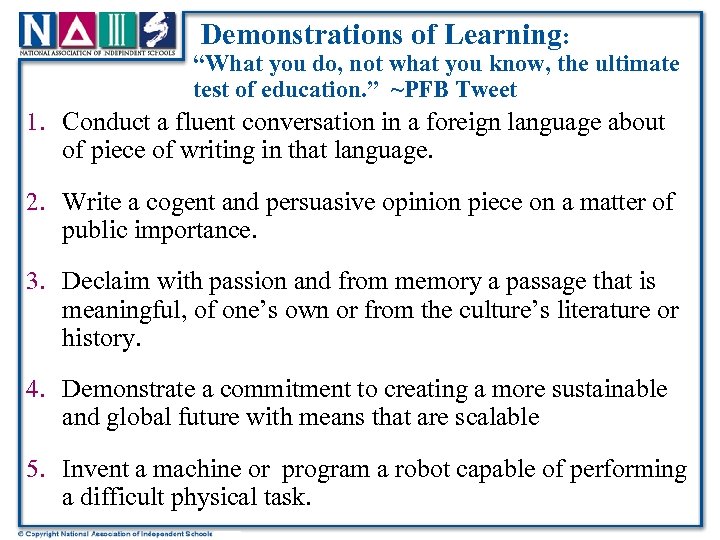
Demonstrations of Learning: “What you do, not what you know, the ultimate test of education. ” ~PFB Tweet 1. Conduct a fluent conversation in a foreign language about of piece of writing in that language. 2. Write a cogent and persuasive opinion piece on a matter of public importance. 3. Declaim with passion and from memory a passage that is meaningful, of one’s own or from the culture’s literature or history. 4. Demonstrate a commitment to creating a more sustainable and global future with means that are scalable 5. Invent a machine or program a robot capable of performing a difficult physical task.
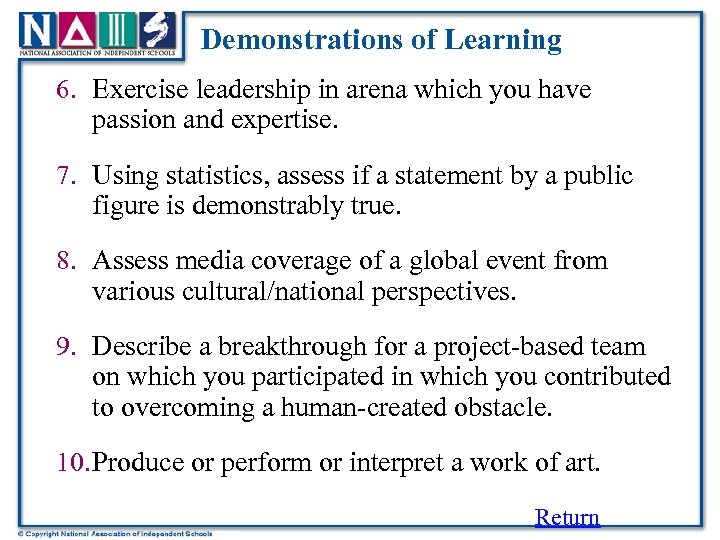
Demonstrations of Learning 6. Exercise leadership in arena which you have passion and expertise. 7. Using statistics, assess if a statement by a public figure is demonstrably true. 8. Assess media coverage of a global event from various cultural/national perspectives. 9. Describe a breakthrough for a project-based team on which you participated in which you contributed to overcoming a human-created obstacle. 10. Produce or perform or interpret a work of art. Return
Return
Tiananmen Square
Lessons in Leadership from Montpelier How Do You Lead without Positional Power? (How does positional power work? ) § James Madison arrived at the Philadelphia Convention in 1787 with no positional power but a big idea. § Instead of reforming the Articles of Confederation, abandon them. § No one else except Alexander Hamilton came thinking the Federalist Papers were right. § Everyone left proposing a new constitution. How?
Three Sources of non-Positional Power § Informational/Expertise Power: What are the facts? § Interpersonal/Relational Power: High EQ trumps all. § Associative Power: Networking. Malcolm Gladwell’s “tipping point” leadership: maven, connector, salesperson. ---------------The Slavery Paradox of the Founding Fathers: Leadership is the art of the messy possible within the long view context of the ideal potential. What made abolition of slavery possible 100 years later and the election of Obama 200 years later.
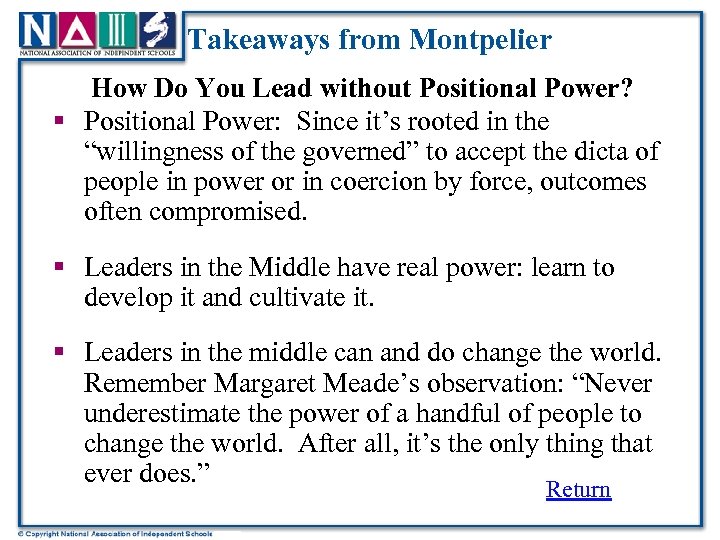
Takeaways from Montpelier How Do You Lead without Positional Power? § Positional Power: Since it’s rooted in the “willingness of the governed” to accept the dicta of people in power or in coercion by force, outcomes often compromised. § Leaders in the Middle have real power: learn to develop it and cultivate it. § Leaders in the middle can and do change the world. Remember Margaret Meade’s observation: “Never underestimate the power of a handful of people to change the world. After all, it’s the only thing that ever does. ” Return
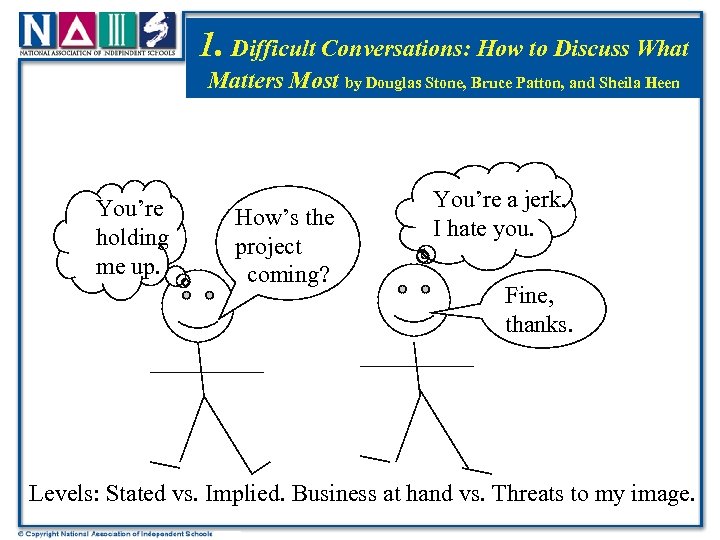
Title 1. Difficult Conversations: How to Discuss What Matters Most by Douglas Stone, Bruce Patton, and Sheila Heen You’re holding me up. How’s the project coming? You’re a jerk. I hate you. Fine, thanks. Levels: Stated vs. Implied. Business at hand vs. Threats to my image.
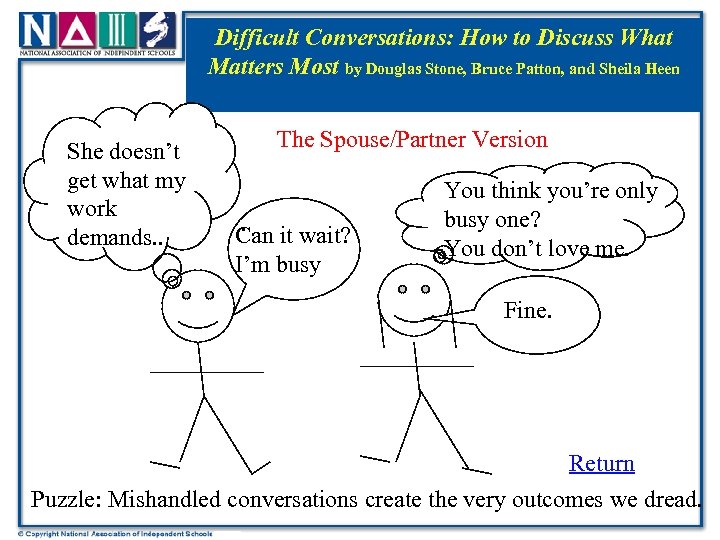
Difficult Title Conversations: How to Discuss What Matters Most by Douglas Stone, Bruce Patton, and Sheila Heen She doesn’t get what my work demands. . The Spouse/Partner Version. Can it wait? I’m busy You think you’re only busy one? You don’t love me. Fine. Return Puzzle: Mishandled conversations create the very outcomes we dread.
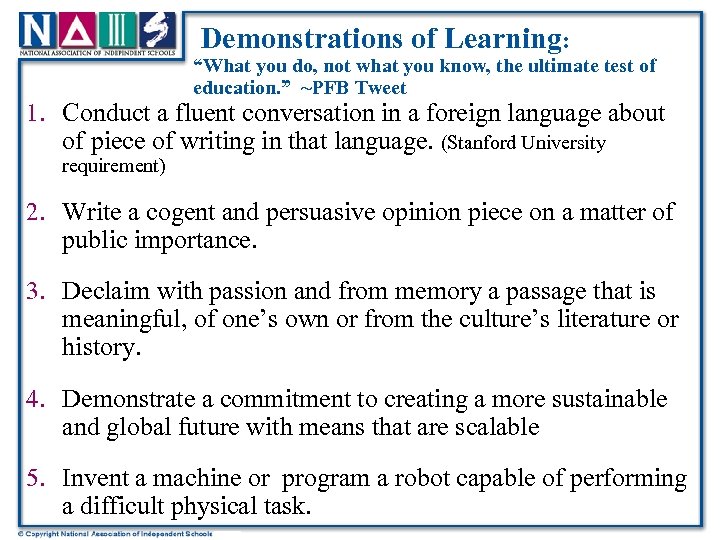
Demonstrations of Learning: “What you do, not what you know, the ultimate test of education. ” ~PFB Tweet 1. Conduct a fluent conversation in a foreign language about of piece of writing in that language. (Stanford University requirement) 2. Write a cogent and persuasive opinion piece on a matter of public importance. 3. Declaim with passion and from memory a passage that is meaningful, of one’s own or from the culture’s literature or history. 4. Demonstrate a commitment to creating a more sustainable and global future with means that are scalable 5. Invent a machine or program a robot capable of performing a difficult physical task.
Demonstrations of Learning 6. Exercise leadership in arena which you have passion and expertise. 7. Using statistics, assess if a statement by a public figure is demonstrably true. 8. Assess media coverage of a global event from various cultural/national perspectives. (“Arab Spring” vs. 6 th grade US history unit on “causes of the revolution”) 9. Describe a breakthrough for a project-based team on which you participated in which you contributed to overcoming a human-created obstacle. 10. Produce or perform or stage or interpret a work of art.
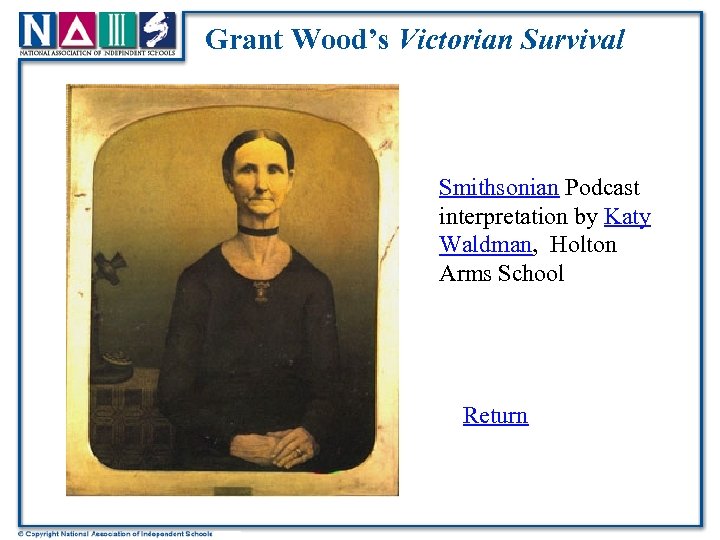
Grant Wood’s Victorian Survival Smithsonian Podcast interpretation by Katy Waldman, Holton Arms School Return
The Five Cs Plus One § Character § Creativity § Communication § Collaboration § Critical Thinking -----------------------§ Cosmopolitanism – Cross Cultural Competency
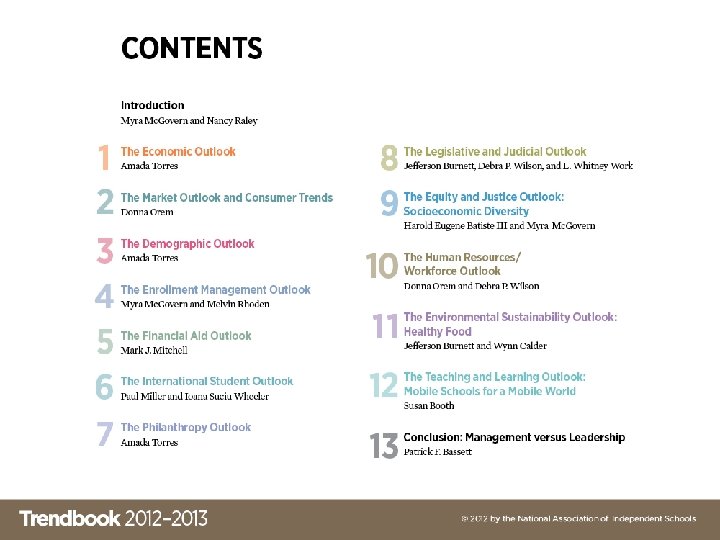
Ten (more) Trends for School Leaders to Ponder (see Top Ten Trends 2010 -11 PPT for First Ten) 1. Boards Become Focused on the Strategic: Trendbook 2012 -13 2. Disruptions in K-12 Sector Will Provide Challenges & Opportunities 3. Disruptions in Higher Ed Will Produce New Expectations 4. The Future of Mobile is the Future of Everything 5. Market Segmentation as the New Marketing Imperative 6. Cosmopolitanism Emerging as the “Sixth Competency” Schools of the Future 7. Hyper-Parenting and Under-Parenting Exerting a Heavy Toll on Kids 8. Beyond the 3 R’s of Recruitment, Reward, & Retention: Managing Talent a Priority 9. Design Thinking Migrating to Schools…and Ideas 10. Schools will be more Flexible, Accommodating, and Innovative
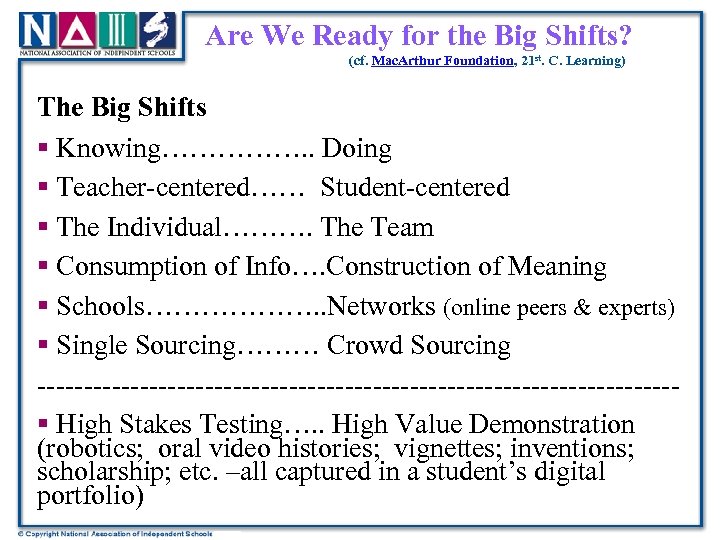
Are We Ready for the Big Shifts? (cf. Mac. Arthur Foundation, 21 st. C. Learning) The Big Shifts § Knowing……………. . Doing § Teacher-centered…… Student-centered § The Individual………. The Team § Consumption of Info…. Construction of Meaning § Schools………………. . Networks (online peers & experts) § Single Sourcing……… Crowd Sourcing ----------------------------------§ High Stakes Testing…. . High Value Demonstration (robotics; oral video histories; vignettes; inventions; scholarship; etc. –all captured in a student’s digital portfolio)
Return
Скачать презентацию Change Agency Leadership Patrick F Bassett NAIS President
4ee6385b1d96f06f8da2aa69b43e1294.ppt