 Скачать презентацию Challenges to Bio-Pesticide Global Registration and Adoption
100091df0820b1f5ecc83422c5be54d6.ppt
- Количество слайдов: 36



Challenges to Bio-Pesticide Global Registration and Adoption – a Manufacturer's Perspective 'Bio-Pesticides: The Way Ahead' October 18, 2006 Donald W. Edgecomb, Ph. D Director, International Business Development Agra. Quest, Inc. USA
Agra. Quest Mission Agra. Quest discovers, develops, manufactures and markets effective, safe, and environmentally friendly natural products for farm, home and public health pest management Innovative natural product solutions for pest management.
Agra. Quest - Overview § Founded in 1995; Headquartered in Davis, CA § Manufacturing in Tlaxcala, Mexico § 70 full-time employees, 14 in sales & mkting, 19 R&D, regulatory and tech support to sales; 30 in mfg § 5 products on the market; 2 pending at the EPA; 20 more candidates identified § 29 U. S. patents and 2 U. S. patent applications; 15 foreign patents and 60+ foreign patent applications § >$60 million of invested equity capital § Presidential Green Chemistry Award - 2003 § World Technology Award for the Environment- 2004 Innovative natural product solutions for pest management.
Agra. Quest Founded on Natural Opportunities • 50% of pharmaceuticals vs. 7% of pesticides derived from plants/microbes • Commercialization advantages exist for natural products; ratio of products per microbes screened: Synthetic chemicals 1: 150 K, AQ Screen 4: 7 K • Less time from discovery to commercialization 3 yrs natural vs. 7 -10 yrs synthetic • Lower cost to develop $10 -15 MM vs. $150 -200 MM • “Short” timeline: EPA – BPPD registration pathway 1. 5 yrs vs. 3 -5 yrs Innovative natural product solutions for pest management.
Biological / Natural Product Control Technologies Increased Demand for Alternatives to Pesticides • Rising consumer concerns regarding safety of pesticide residues on fruits, vegetables and salads • Government initiatives to reduce pesticide use - EU Common Agriculture Policy: Pesticide reduction schemes in MS • Grower organization / Retail initiatives - New Zealand wine producers: Zero-pesticide residue in wine - China “Green Food” government directive - Supermarket programs: Organic and zero-detectable pesticide residues on food products • Maximum Residue Levels (MRL) –Global disharmony for permissible levels - non-tariff trade barriers for food exports • Fewer conventional pest control products, especially “minor” crops - industry consolidation - high cost, time to market and resistance potential Innovative natural product solutions for pest management.
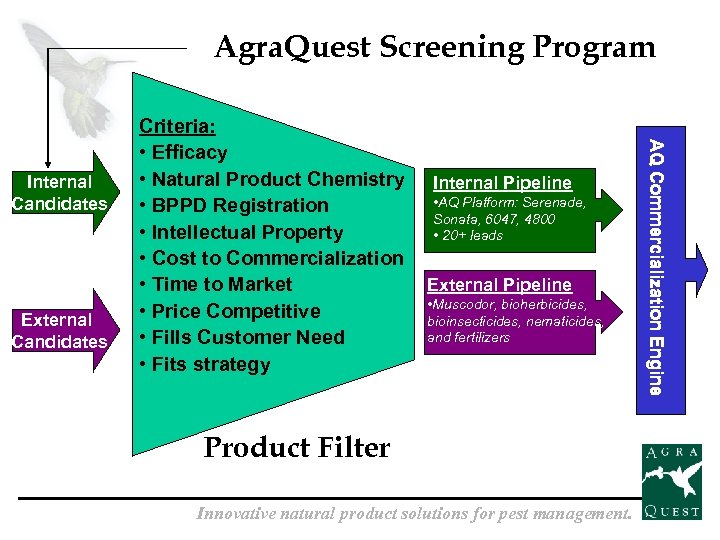
Agra. Quest Screening Program External Candidates Internal Pipeline • AQ Platform: Serenade, Sonata, 6047, 4800 • 20+ leads External Pipeline • Muscodor, bioherbicides, bioinsecticides, nematicides, and fertilizers Product Filter Innovative natural product solutions for pest management. AQ Commercialization Engine Internal Candidates Criteria: • Efficacy • Natural Product Chemistry • BPPD Registration • Intellectual Property • Cost to Commercialization • Time to Market • Price Competitive • Fills Customer Need • Fits strategy
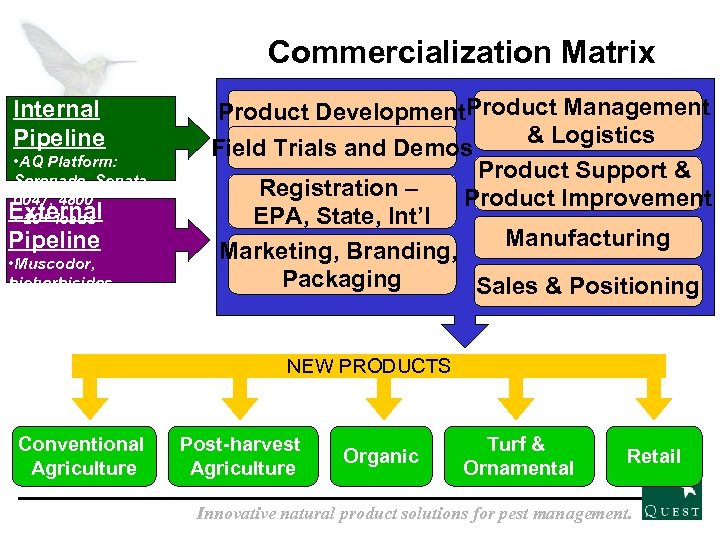
Commercialization Matrix Internal Pipeline • AQ Platform: Serenade, Sonata, 6047, 4800 External • 20+ leads Pipeline • Muscodor, bioherbicides, bioinsecticides, nemat icide, and fertilizers Product Development. Product Management & Logistics Field Trials and Demos Product Support & Registration – Product Improvement EPA, State, Int’l Manufacturing Marketing, Branding, Packaging Sales & Positioning NEW PRODUCTS Conventional Agriculture Post-harvest Agriculture Organic Turf & Ornamental Retail Innovative natural product solutions for pest management.
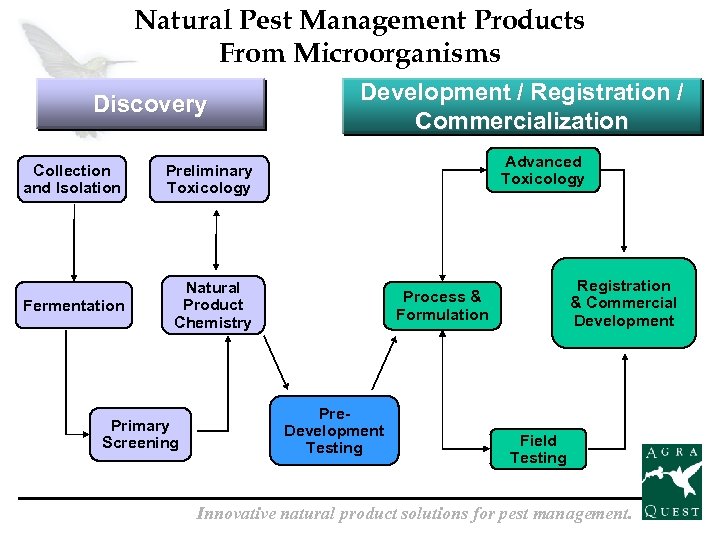
Natural Pest Management Products From Microorganisms Discovery Collection and Isolation Advanced Toxicology Preliminary Toxicology Fermentation Development / Registration / Commercialization Natural Product Chemistry Primary Screening Registration & Commercial Development Process & Formulation Pre. Development Testing Field Testing Innovative natural product solutions for pest management.
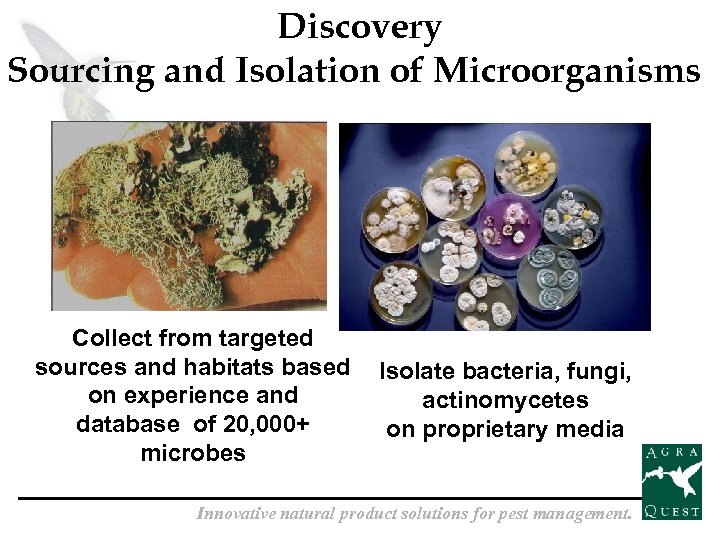
Discovery Sourcing and Isolation of Microorganisms Collect from targeted sources and habitats based on experience and database of 20, 000+ microbes Isolate bacteria, fungi, actinomycetes on proprietary media Innovative natural product solutions for pest management.
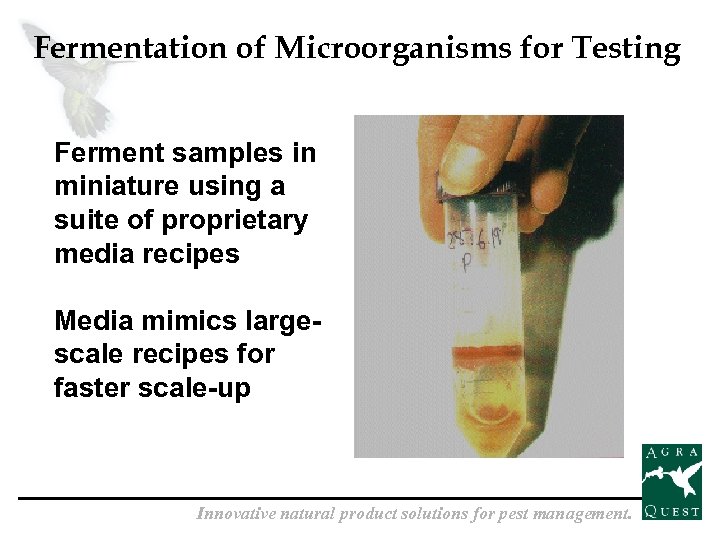
Fermentation of Microorganisms for Testing Ferment samples in miniature using a suite of proprietary media recipes Media mimics largescale recipes for faster scale-up Innovative natural product solutions for pest management.
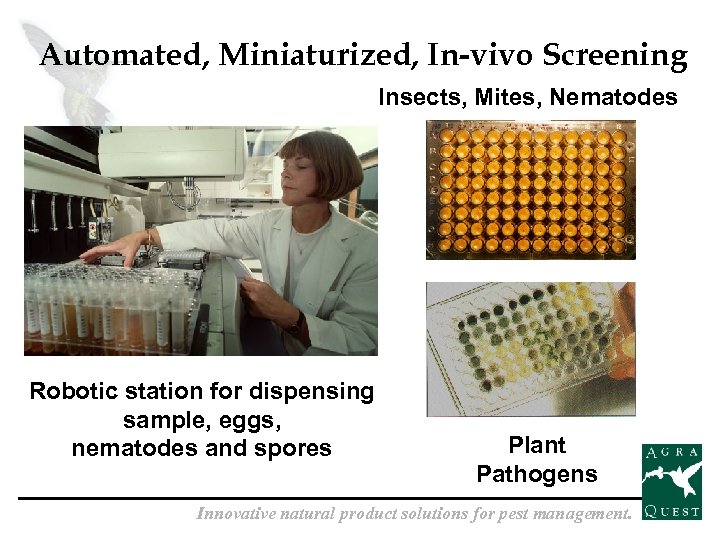
Automated, Miniaturized, In-vivo Screening Insects, Mites, Nematodes Robotic station for dispensing sample, eggs, nematodes and spores Plant Pathogens Innovative natural product solutions for pest management.
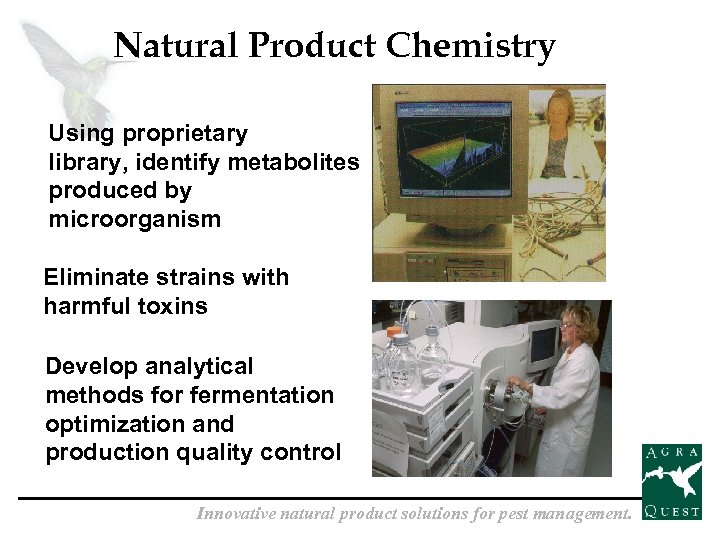
Natural Product Chemistry Using proprietary library, identify metabolites produced by microorganism Eliminate strains with harmful toxins Develop analytical methods for fermentation optimization and production quality control Innovative natural product solutions for pest management.
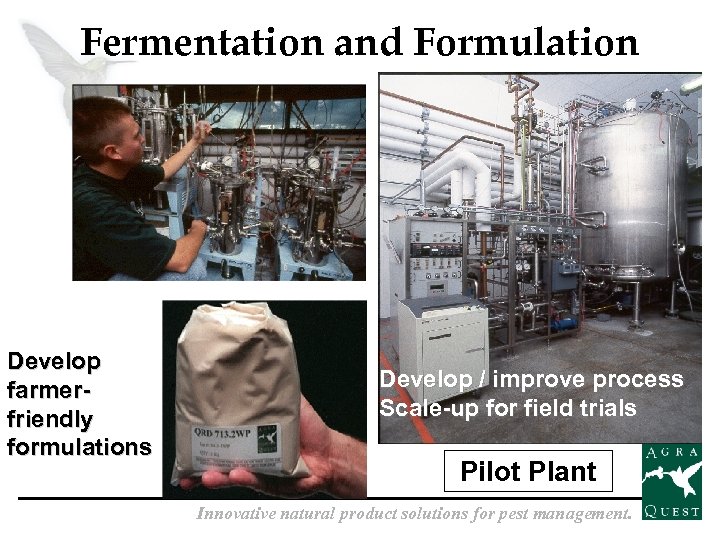
Fermentation and Formulation Develop farmerfriendly formulations Develop / improve process Scale-up for field trials Pilot Plant Innovative natural product solutions for pest management.
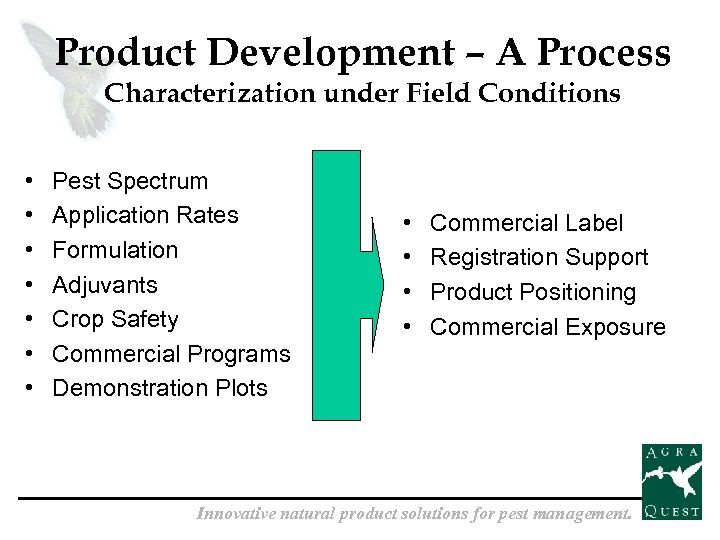
Product Development – A Process Characterization under Field Conditions • • Pest Spectrum Application Rates Formulation Adjuvants Crop Safety Commercial Programs Demonstration Plots • • Commercial Label Registration Support Product Positioning Commercial Exposure Innovative natural product solutions for pest management.
Product Development Microorganism / Natural Product - Challenges • Less time from discovery to commercialization vs. conventional pesticide (US – 3 years vs. 7 -10 years) - Aggressive timeline to develop efficacy, formulation and registration packages and commercialization strategy • Conventional pesticide experience – Does not always apply • Formulation technology – Unique challenges - Live organism shelf life - Physical and biological compatibility with other products - Organic compliance for ingredients - Compatible with conventional application equipment Innovative natural product solutions for pest management.
Product Registration Process - Global Microorganism / Natural Product Technologies • Designed for conventional pesticide registration, few if any pathways specific to microbial pest control technologies • Regulatory agencies have little to no microbial expertise • Lack of flexibility with regard to data requirements Provisions for data waivers / provisional registrations • Strict efficacy requirements, protocols designed for conventional pesticides, GEP requirement • No guidance docs / pre-submission / arbitration process • No priority for bio-control agents • EU - all of above + lack of member state harmonization Innovative natural product solutions for pest management.
Product Registration Process (US-EPA) Microorganism / Natural Product Technologies • Separate pathway vs. conventional pesticides BPPD (Bio-pesticide Pollution / Prevention Division) • Microbial / bio-pesticide technical expertise • Registrant not competing with conventional chemistry for review timeline = quicker review / market access • Requirements less than conventional pesticides however, address product composition, risk and exposure information, not concerned with environmental fate • Tiered data requirements – if trigger, then next tier, ensures that only minimum data sufficient to make sound regulatory decision will be required Faster Timeline from Submission to Approval Innovative natural product solutions for pest management.
Product Registration Process - Global EU REBECA Project Regulation of Biological Control Agents (BCAs) Background: • EU Common Agricultural Policy (CAP) – demands for pesticide use reduction schemes in Member States • BCAs are vital to meet commitment to sustainable use of plant protection products, reduce conventional pesticide use • Current system (Directive 91/414/EEC) has been ineffective in providing BCA alternatives to EU growers >25 BCAs registered as PPP in US, only 6 in EU Innovative natural product solutions for pest management.
Product Registration Process - Global EU REBECA Project Regulation of Biological Control Agents (BCAs) Overall Objectives: • European funded Specific Support Action • Aim to accelerate BCA registration process; improve cost effectiveness without compromising safety / health concerns • Engage key stakeholders for assessment and input Industry, science, reg. authorities, policy and environment • Review current EU system; compare to countries which have successfully registered BCAs • Development proposals for changes to EU system Innovative natural product solutions for pest management.
Product Registration Process - Global EU REBECA Project Regulation of Biological Control Agents (BCAs) Interim Assessments / Recommendations • Long term (2 -5 yrs): New EU system specific to BCAs - Tiered evaluation format - More balanced view of risk / benefit - BCA positive list; minimal requirements based on profile - Reduce / eliminate / harmonize fees • Short term (0 -2 yrs): Modify current system - > Acceptance in granting wavier requests / provisional reg. - Develop non-binding guidance documents - Set up EU bio-control panel of experts; guidance / education - Promote exchange between registrant / regulators e. g. , pre-submission meetings, help desks Innovative natural product solutions for pest management.
Microorganism / Natural Product Technologies Challenges to Grower Adoption • Growers - reluctant to change unless compelling reasons exist Generally – adoption period exist for new technologies • Bio-control companies vs. multinational pesticide companies Small; lack recognition, history with growers and consultants • Historically a negative perception of BCAs Initial products lacked consistency, quality control, broad claims Unregistered “plant strengtheners” / “bio-fertilizers lacked pest claims • BCAs – “relatively” short registration timeline (US) Minimal performance data / exposure to researchers & growers • Conventional testing protocols do not demonstrate full potential Stand alone treatments often under high, inoculated pest pressure Focus on pest control alone rather than quality and yield Innovative natural product solutions for pest management.
Microorganism / Natural Product Technologies Challenges to Grower Adoption Steps to Improve Perception / Acceptance Product testing phase • Participation in strategic research evaluation programs Clearly defined objectives and expectations Joint protocol development Periodic trial visits during in-life phase Pre-commercial phase • Large plot-demonstration programs Selected growers – progressive “early adopters” Closely monitored – application through harvest • Product training – grower workshops / seminars Create awareness, proper positioning and use Innovative natural product solutions for pest management.
Microorganism / Natural Product Technologies Challenges to Grower Adoption Steps to Improve Perception / Acceptance Industry Alliances Commitment to BCA Standards Bio-Pesticide Industry Alliance (BPIA) - US International Bio-control Manufacturing Assn (IBMA) Innovative natural product solutions for pest management.
First “Effective” Broad Spectrum Biological Fungicide • Bacillus subtilis Strain QST 713 • Discovered in an Organic Peach Orchard – California Isolated from Soil • Unique – Patented Bacillus Strain Distinguished by Previously Unknown Metabolites • US - EPA Registration – July 2000 Presidential Green Chemistry Award – 2003 • World Technology Award for Environment - 2004 • Now Registered Globally Asia / Pacific Rim, Europe / Mideast, Latin America Innovative natural product solutions for pest management.
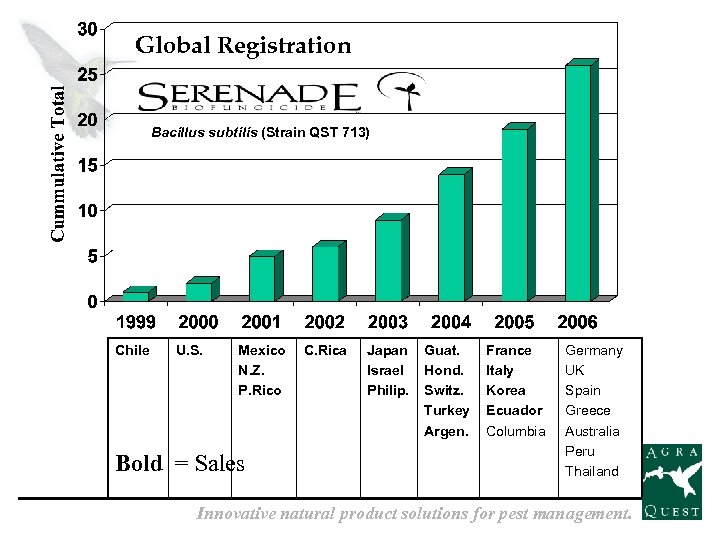
Global Registration Bacillus subtilis (Strain QST 713) Chile U. S. Mexico N. Z. P. Rico Bold = Sales C. Rica Japan Israel Philip. Guat. Hond. Switz. Turkey Argen. France Italy Korea Ecuador Columbia Germany UK Spain Greece Australia Peru Thailand Innovative natural product solutions for pest management.
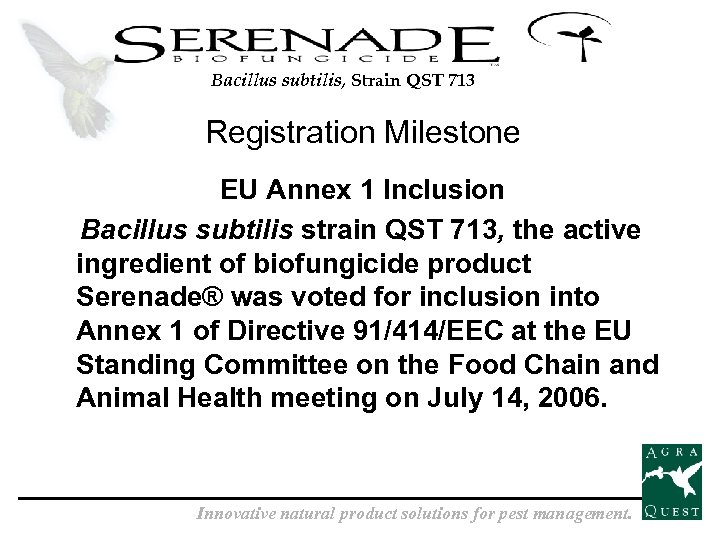
Bacillus subtilis, Strain QST 713 Registration Milestone EU Annex 1 Inclusion Bacillus subtilis strain QST 713, the active ingredient of biofungicide product Serenade® was voted for inclusion into Annex 1 of Directive 91/414/EEC at the EU Standing Committee on the Food Chain and Animal Health meeting on July 14, 2006. Innovative natural product solutions for pest management.
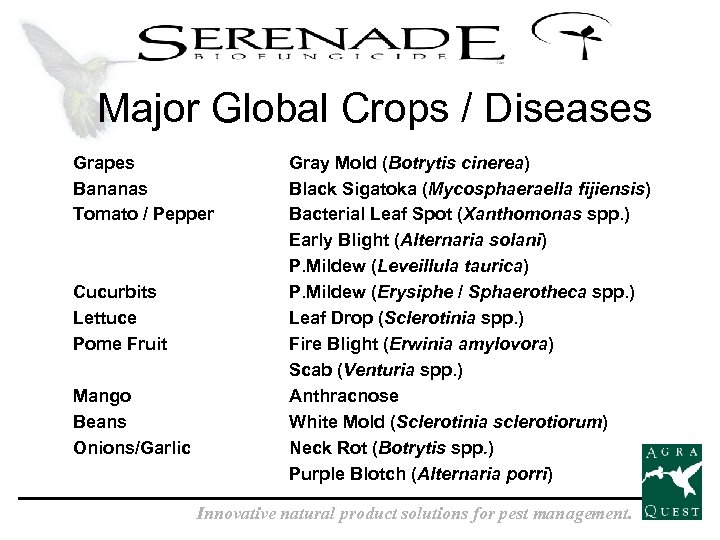
Major Global Crops / Diseases Grapes Bananas Tomato / Pepper Cucurbits Lettuce Pome Fruit Mango Beans Onions/Garlic Gray Mold (Botrytis cinerea) Black Sigatoka (Mycosphaeraella fijiensis) Bacterial Leaf Spot (Xanthomonas spp. ) Early Blight (Alternaria solani) P. Mildew (Leveillula taurica) P. Mildew (Erysiphe / Sphaerotheca spp. ) Leaf Drop (Sclerotinia spp. ) Fire Blight (Erwinia amylovora) Scab (Venturia spp. ) Anthracnose White Mold (Sclerotinia sclerotiorum) Neck Rot (Botrytis spp. ) Purple Blotch (Alternaria porri) Innovative natural product solutions for pest management.
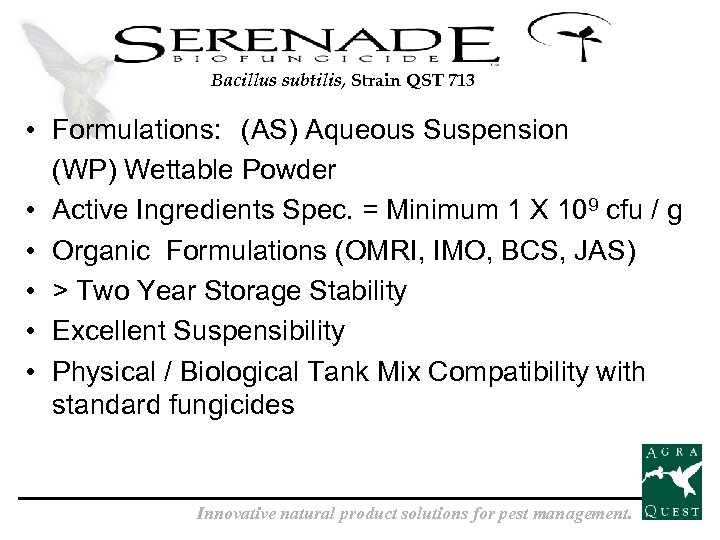
Bacillus subtilis, Strain QST 713 • Formulations: (AS) Aqueous Suspension (WP) Wettable Powder • Active Ingredients Spec. = Minimum 1 X 10⁹ cfu / g • Organic Formulations (OMRI, IMO, BCS, JAS) • > Two Year Storage Stability • Excellent Suspensibility • Physical / Biological Tank Mix Compatibility with standard fungicides Innovative natural product solutions for pest management.
Bacillus subtilis, Strain QST 713 Novel / Multiple Modes of Action • B. s. spores – Colonize and Out-compete Pathogen • Fungicidal Metabolites – Lipopeptides Present in Formulation / Produced by Colonizing B. s. Destroy Pathogen Spore & Mycelium Membranes Provide Barrier to Infection by Pathogen • Inducer of Systemic Acquired Resistance (SAR) • Optimal Use = Preventative Control Program • New / Unique Resistance Management Tool Innovative natural product solutions for pest management.
Bacillus subtilis, Strain QST 713 Use in Integrated Programs with Conventional Fungicides Innovative natural product solutions for pest management.
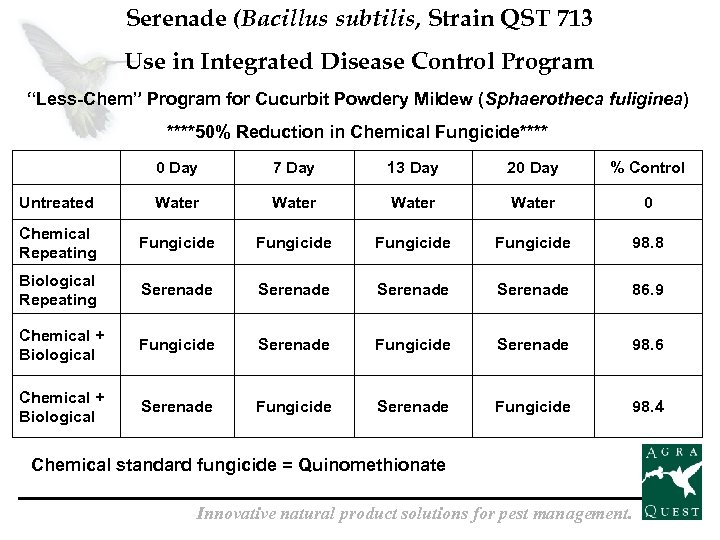
Serenade (Bacillus subtilis, Strain QST 713 Use in Integrated Disease Control Program “Less-Chem” Program for Cucurbit Powdery Mildew (Sphaerotheca fuliginea) ****50% Reduction in Chemical Fungicide**** 0 Day 7 Day 13 Day 20 Day % Control Untreated Water 0 Chemical Repeating Fungicide 98. 8 Biological Repeating Serenade 86. 9 Chemical + Biological Fungicide Serenade 98. 6 Chemical + Biological Serenade Fungicide 98. 4 Chemical standard fungicide = Quinomethionate Innovative natural product solutions for pest management.
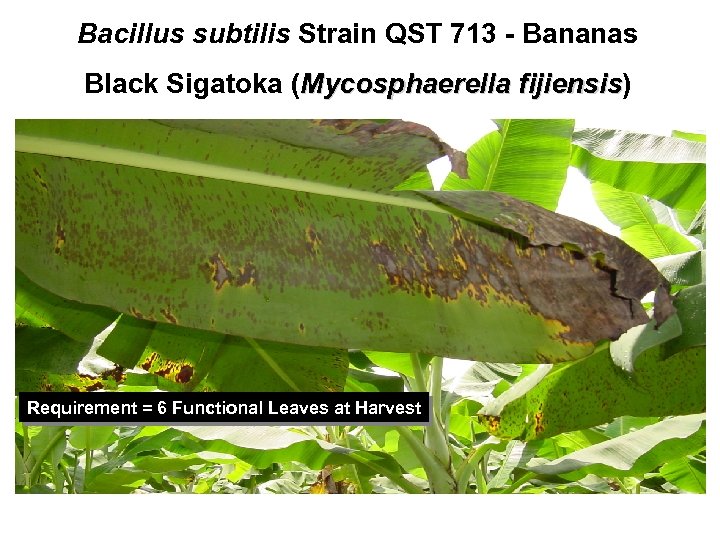
Bacillus subtilis Strain QST 713 - Bananas Black Sigatoka (Mycosphaerella fijiensis) fijiensis Requirement = 6 Functional Leaves at Harvest
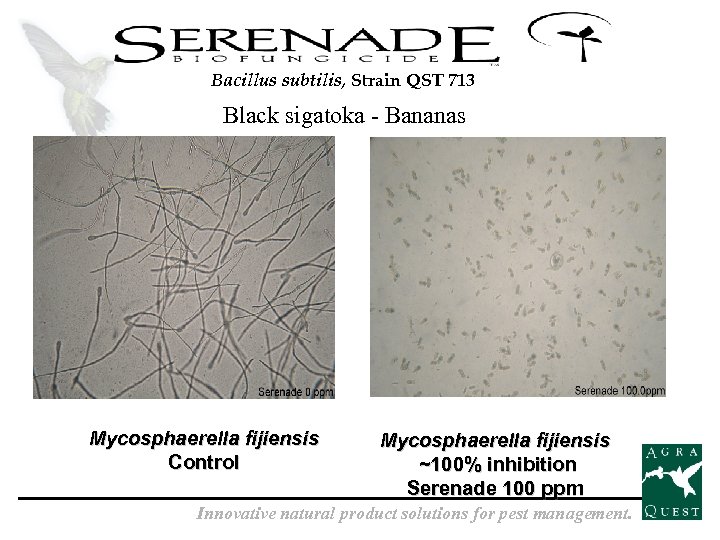
Bacillus subtilis, Strain QST 713 Black sigatoka - Bananas Mycosphaerella fijiensis Control Mycosphaerella fijiensis ~100% inhibition Serenade 100 ppm Innovative natural product solutions for pest management.
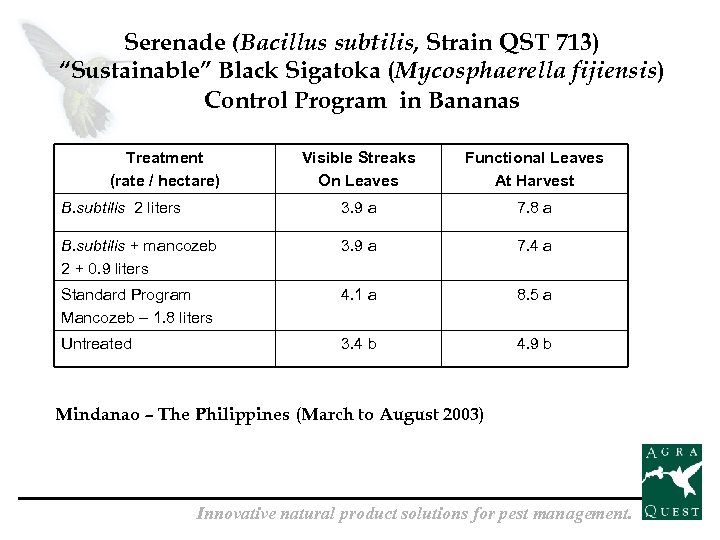
Serenade (Bacillus subtilis, Strain QST 713) “Sustainable” Black Sigatoka (Mycosphaerella fijiensis) Control Program in Bananas Treatment (rate / hectare) Visible Streaks On Leaves Functional Leaves At Harvest B. subtilis 2 liters 3. 9 a 7. 8 a B. subtilis + mancozeb 2 + 0. 9 liters 3. 9 a 7. 4 a Standard Program Mancozeb – 1. 8 liters 4. 1 a 8. 5 a Untreated 3. 4 b 4. 9 b Mindanao – The Philippines (March to August 2003) Innovative natural product solutions for pest management.
Bacillus subtilis, Strain QST 713 • • Product Positioning – Features Effective “Non-Chemical” Option for Disease Control Programs Broad Spectrum Disease Control – Fungal and Bacterial Pathogens Tank mix and Rotation with Protectants / Systemics in Programs MRL Management / Sustainable / Organic Production Tool Resistance Management Single Site Compounds – e. g. , Strobilurin and Triazole Fungicides Exempt From Tolerance / 0 -Day PHI / No CODEX - Late Season, Pre-Harvest Option / No Residues Integrated Pest Management Not toxic to Non-target Organisms Honeybees, Lady Beetles, Lacewings, Parasitic Wasps, and Earthworms Safe to Workers / Environment Innovative natural product solutions for pest management.
© Agra. Quest, Inc. 2006 Serenade, Sonata, Serenade MAX, Rhapsody, & Ballad Plus are registered trademarks of Agra. Quest, Inc. Serenade MAX - EPA Reg. No. 69592 -11; Serenade ASO - EPA Reg. No. 6959212; Sonata - EPA Reg. No. 69592 -13
Скачать презентацию Challenges to Bio-Pesticide Global Registration and Adoption
100091df0820b1f5ecc83422c5be54d6.ppt