 Скачать презентацию Challenges to address for distributed systems Yvon Kermarrec
3cbc3f6e39b3c2e373396a6eca0109fe.ppt
- Количество слайдов: 43



Challenges to address for distributed systems Yvon Kermarrec Télécom Bretagne Institut Mines Télécom
Challenges in Distributed System Design ¢ Distributed systems are great … but we need a change in considering a system : • From centralized to distributed • From a programming and admin perspectives • A New way to develop applications that target not one PC but thousands of them… • New paradigms to deal with difficulties related to DS : faults, network, coordination, …. Dpt/Auteur
Challenges in Distributed System Design ¢ Heterogeneity ¢ Openess ¢ Security ¢ Scalability ¢ Failure handling ¢ Transparencies Dpt/Auteur
Challenge 1 : heterogeneity • networks (protocols), • operating systems (APIs) and hardware • programming languages (data structures, data types) • implementations by different developers (lack of standards) • Solution : Middleware - can mask heterogeneity - Provides an augmented machine for the users : more services - provides a uniform computational model for use by the programmers of servers and distributed applications Dpt/Auteur
Challenge 2 : Openness • The degree to which new resource-sharing services can be added and be made available for use by a variety of client programs - Specification and documentation of the key software interfaces of the components can be published, discovered and then used - Extension may be at the hardware level by introducing additional computers Dpt/Auteur
Challenge 3 : security • Classic security issues in an open world … - Confidentiality - Integrity - Origin and trust • Continued challenges - Denial of service attacks - Security of mobile code Dpt/Auteur
Challenge 4 : scalability (1/2) • Scalability : system remains effective when there is a significant increase in the number of resources and the number of users • controlling the cost of performance loss • preventing software resources from running out • avoiding performance bottlenecks Dpt/Auteur
Challenge 4 : scalability (2/2) • Example of a DNS organization • Performance must not degrade with growth of the system. Generally, any form of centralized resources become performance bottlenecks: - components (single server), - tables (directories), or - algorithms (based on complete information). Dpt/Auteur
Challenge 5 : failure handling In distributed systems, some components fail while others continue executing - Detected failures can be hidden, made less severe, or tolerated – messages can be retransmitted – data can be written to multiple disks to minimize the chance of corruption – Data can be recovered when computation is “rolled back” – Redundant components or computations tolerate failure - Failures might result in loss of data and services Dpt/Auteur
Challenge 6 : concurrency • Several clients may attempt to access a shared resource at the same time - ebay bids • Generally multiple requests are handled concurrently rather than sequentially • All shared resources must be responsible for ensuring that they operate correctly in a concurrent environment • Thread, synchronization, dead lock … Dpt/Auteur
Transparency ? ¢ It is the concealment from the user and the application program of the separation of the components of a distributed system (single image view). ¢ It is a strong property that often is difficult to achieve. ¢ There a number of different forms of transparency ¢ Transparency : the system is perceived as a whole rather than as a collection of independent components Dpt/Auteur
Different forms of transparencies ¢ Location: Users are unaware of location of resources ¢ Migration: Resources can migrate without name change ¢ Replication: Users are unaware of the existence of multiple copies ¢ Failure: Users are unaware of the failure of individual components ¢ Concurrency: Users are unaware of sharing resources with others ¢ Parallelism: Users are unaware of parallel execution of activities Dpt/Auteur
How to deal with these transparencies ? • For each of the transparency level, indicate how you would implement them ? Dpt/Auteur
How to develop a distributed application ¢A sequential application + communication calls (similar to C + Thread library) ¢ A middleware + an application ¢ A specific language ¢ See next course…. Dpt/Auteur
One approach to ease the development of an application ¢ Client-server model • client processes interact with individual server processes – servers processes are in separate host computers – clients access the resources the servers manage – servers may be clients of other servers • Examples – Web servers are clients of the DNS service Dpt/Auteur
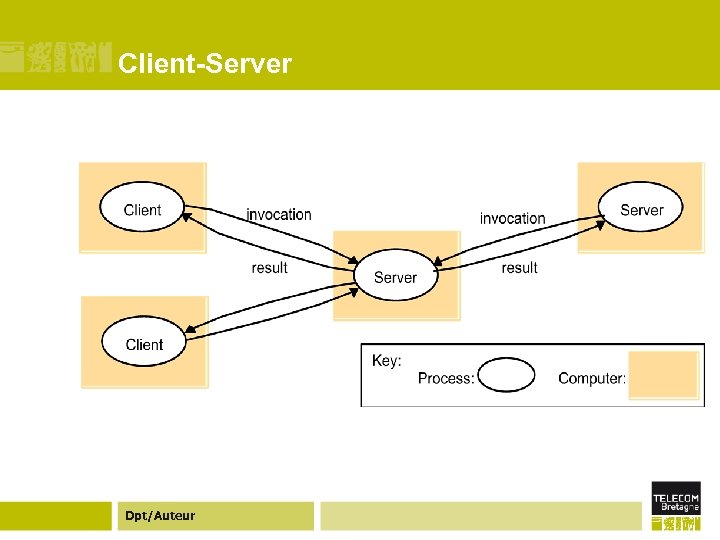
Client-Server Dpt/Auteur
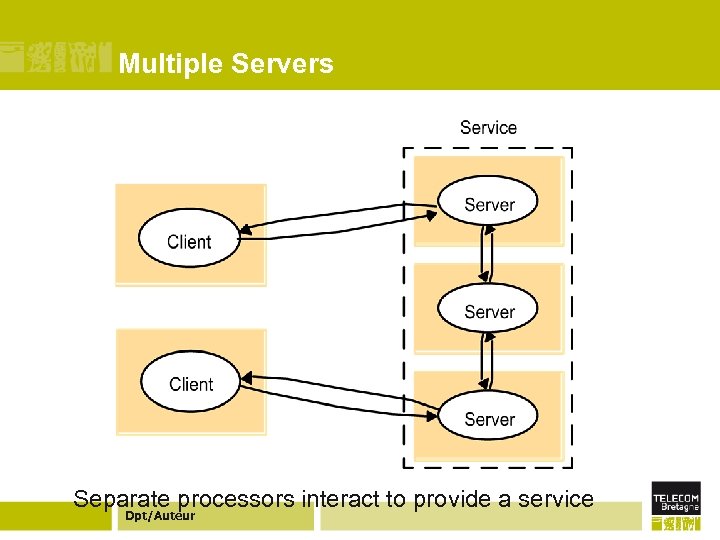
Multiple Servers Separate processors interact to provide a service Dpt/Auteur
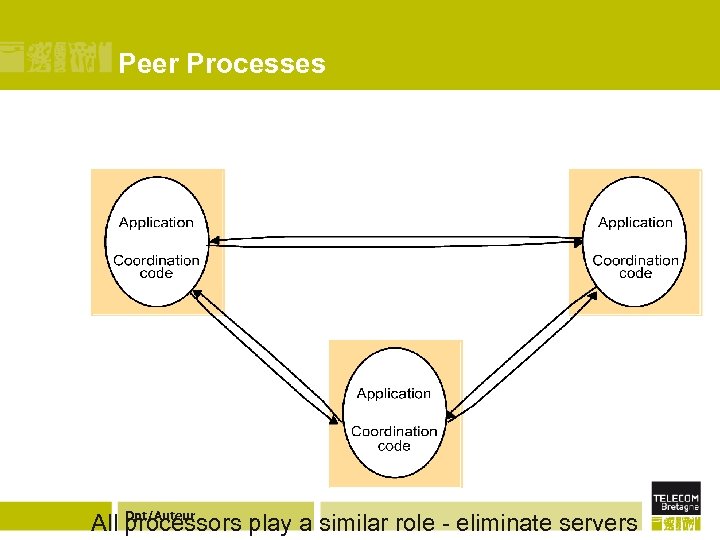
Peer Processes Dpt/Auteur All processors play a similar role - eliminate servers
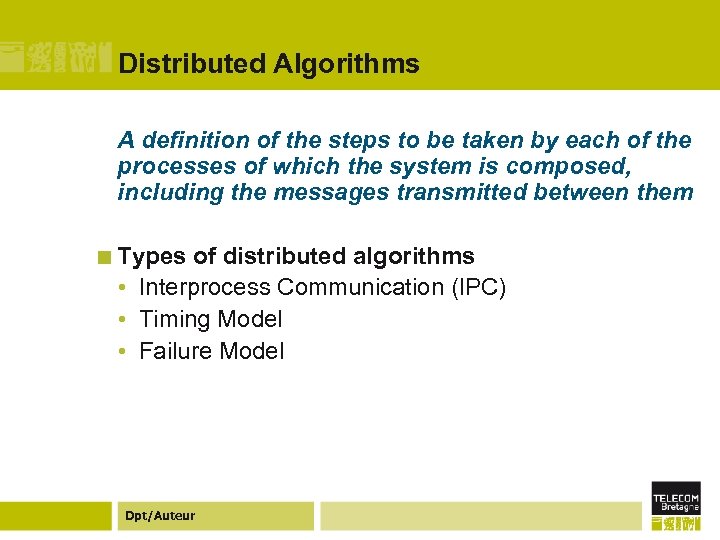
Distributed Algorithms A definition of the steps to be taken by each of the processes of which the system is composed, including the messages transmitted between them ¢ Types of distributed algorithms • Interprocess Communication (IPC) • Timing Model • Failure Model Dpt/Auteur
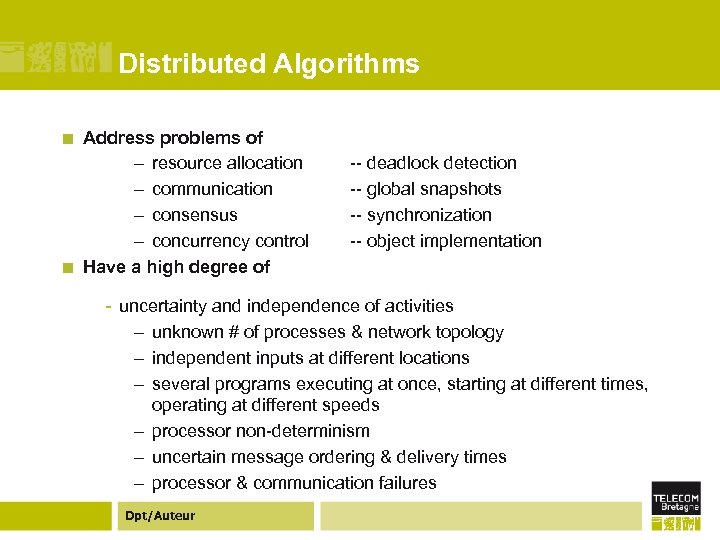
Distributed Algorithms ¢ ¢ Address problems of – resource allocation – communication – consensus – concurrency control Have a high degree of -- deadlock detection -- global snapshots -- synchronization -- object implementation - uncertainty and independence of activities – unknown # of processes & network topology – independent inputs at different locations – several programs executing at once, starting at different times, operating at different speeds – processor non-determinism – uncertain message ordering & delivery times – processor & communication failures Dpt/Auteur
Interprocess Communication ¢ Distributed algorithms run on a collection of processors - communication methods may be shared memory, point-point or broadcast messages, and RPC - Communication is important even for the system – Multiple server processes may cooperate with one another to provide a service » DNS partitioning and replicating its data at multiple servers throughout the Internet – Peer processes may cooperate with one another to achieve a common goal Dpt/Auteur
Difficulties and algorithms ¢ For sequential programs • An algorithm consists in a a set of successive steps • Execution rate is immaterial ¢ For distributed algorithms • Processor execute at unpredictable and all different rates • Communication delays and latencies • Errors and failure may happen • A global state (ie, memory …) does not exist • Debug is difficult Dpt/Auteur
3 major difficulties ¢ Time issues ¢ Interaction model ¢ failures Dpt/Auteur
Time issues ¢ Each processor has an internal clock • Used to date local events • Clock may drift • Different time values when reading the clock at the « same time » ¢ Issues • Local time is not enough to time stamp events • Difficulties to order events and compare them • Necessities to resynchronize the clocks Dpt/Auteur
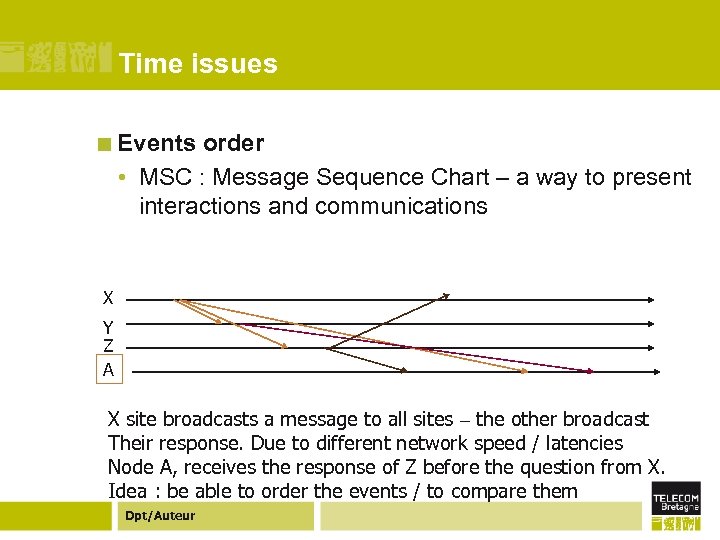
Time issues ¢ Events order • MSC : Message Sequence Chart – a way to present interactions and communications X Y Z A X site broadcasts a message to all sites – the other broadcast Their response. Due to different network speed / latencies Node A, receives the response of Z before the question from X. Idea : be able to order the events / to compare them Dpt/Auteur
Time issues ¢ In the MSC presented earlier, all processes see different order of the messages / events ¢ How to order them (resconstruct a logic) so that processes can take coherent decisions Dpt/Auteur
Synchronization model ¢ Synchronous model • Simple model • Lower and upper bounds for execution times and communication are known • No clock drift ¢ Asynchronous • Execution speed are ‘random’ / comm • Universal model in LAN + WAN - Routers introduce delays - Servers may be loaded / the CPU may be shared - Errors and faults may occur Dpt/Auteur
Timing Model ¢ Different assumptions can be made about the timing of the events in the system • Synchronous - processor communication and computation are done in lockstep • Asynchronous - processors run at arbitrary speeds and in arbitrary order • Partially synchronous - processors have partial information about timing Dpt/Auteur
Synchronous Model (1/2) ¢ Simplest to describe, program, and reason about • components take steps simultaneously - not what actually happens, but used as a foundation for more complexity – intermediate comprehension step – impossibility results care over ¢ Very difficult to implement • Synchronous language for specialized purposes Dpt/Auteur
Synchronous Model (2/2) ¢ 2 armies – one leader : the 1 rst to attack – the 2 armies must attack together or not ¢ Message transmission (min, max) is known and there is no fault ¢ 1 sends « attack ! » and wait for min and then attacks ¢ 2 receives « attack ! » and wait for one TU. ¢ 1 is the leader and 2 charges within maxmin+1 Dpt/Auteur
Asynchronous Model (1/2) ¢ Separate components take steps arbitrarily ¢ Reasonably simple to describe - with the exception of liveness guarantees ¢ Harder to accurately program ¢ Allows ignorance to timing considerations ¢ May not provide enough power to solve problems efficiently Dpt/Auteur
Asynchronous Model (2/2) ¢ Coordination is more difficult for the armies ¢ Select a sufficient large T ¢ 1 sends « attack ! » and wait for T and then attacks ¢ 2 receives « attack ! » and wait for one TU. ¢ Cannot guarantee 1 is the leader Dpt/Auteur
Partially Synchronous Model ¢ Some restrictions on the timing of events, but not exactly lock-step ¢ Most realistic model ¢ Trade-offs must be considered when deciding the balance of the efficiency with portability Dpt/Auteur
Failure Model (1/6) ¢ The algorithm might need to tolerate failures • processors - might stop - degrade gracefully - exhibit Byzantine failures • may also be failures of - communication mechanisms Dpt/Auteur
Failure Model (2/6) ¢ Various • • types of failure Message may not arrive : omission failure Processes may stop and the other may detect this situation (stopping failure) Processes may crash and the others may not be warned (crash failure) For real time, deadline may not be met - Timing failure Dpt/Auteur
Failure Model (3/6) ¢ Failure type • Benign : omission, stopping, timing failures • Severe : Altered message, bad results, Byzantine failures Dpt/Auteur
Failure Model (4/6) ¢ Crash failure • Processes crash and do not respond anymore • Crash detection - Use time out - Difficulties with asynchronous model – Slow processes – Non arrived message – Stopped process, etc. Dpt/Auteur
Failure Model (5/6) ¢ Stopping failure • Processes stop their execution and can be observed • Synchronous model - Time out - Asynchronous model – Hard to distinguish between a slow message and if a stopping failure has occurred Dpt/Auteur
Failure Model (6/6) ¢ Byzantine • • failure The most difficult to deal with 3 processes cannot resolve the situation in presence of one faute Need n > 3 * f (f number of faulty processes and n number of processes) Complex algorithms which monitor all the messages exchanged between the nodes / processes Dpt/Auteur
Conclusions ¢ Distributed algorithm are sensitive to • The interaction model • Failure type • Timing issues ¢ Design issues • Control timing issues with time outs • Introduce fault tolerance and recovery Dpt/Auteur
Conclusions ¢ Quality • • • of a distributed algorithm Local state vs. Global state Distribution degree Fault tolerance Assumptions on the network Traffic and number of messages required Dpt/Auteur
Design issues ¢ Use direct call to the O/S • Simple and complex ¢ Use a middleware to ensure portability and ease of use • PVM, MPI, Posix • CORBA, DCE, SOA and web services ¢ Use a specific distributed language • Linda, Occam, Java RMI, Ada 95 Dpt/Auteur
Various forms of communications ¢ Communication paradigms • Message passing : send + receive • Shared memory : rd / write • Distributed object : remote invocation • Service invocation ¢ Communication patterns • Unicast • Multicast and broadcast • RPC Dpt/Auteur
Скачать презентацию Challenges to address for distributed systems Yvon Kermarrec
3cbc3f6e39b3c2e373396a6eca0109fe.ppt