 Скачать презентацию Challenges of Teaching OO Constructs with Databases Shahram
c5814bbb2074a58e01b53fc599b4ca48.ppt
- Количество слайдов: 43



Challenges of Teaching OO Constructs with Databases Shahram Ghandeharizadeh Database Laboratory Computer Science Department University of Southern California
Outline l l l An overview of Introductory course to databases. Object-oriented challenges. Future role of object-oriented constructs in data intensive applications.
Database Systems l Used almost on a daily basis for either individual or business use. l Relational database vendors were one of the fastest growing sectors during the. COM boom!
Data Models Build a database of all my assets for licensing and royalty collection
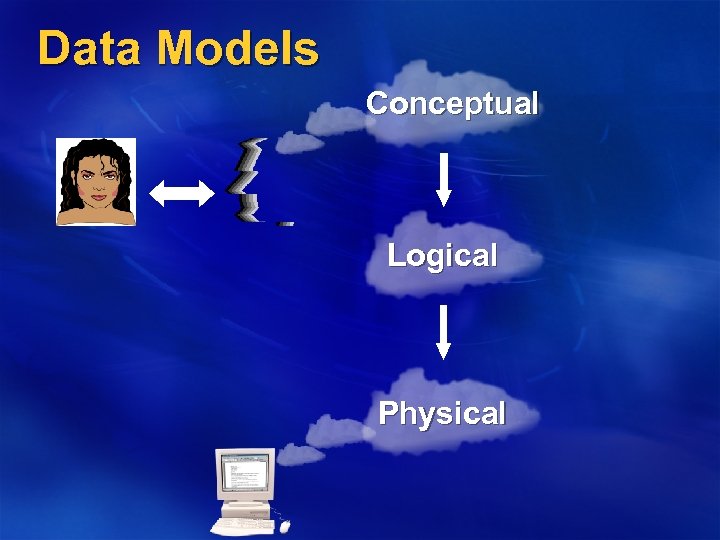
Data Models Conceptual Logical Physical
Relational DBMS l Why? Ø Ø Ø Performance! Reduced application development time Use of SQL makes access to data more uniform: § § Software modularity, Extensibility
Challenge 1 l Make students aware of the importance of conceptual data modeling.
Challenge 1 l l Make students aware of the importance of conceptual data modeling. Solution: Ø No-one builds a house without a design.
Challenge 1 l l Make students aware of the importance of conceptual data modeling. Solution: Ø Ø No-one builds a house without a design. Michael Jackson is picky and won’t pay for a system that does not meet his requirements.
Relational DBMS l Why? Ø Ø Ø Performance! Reduced application development time Use of SQL makes access to data more uniform: § § Software modularity, Extensibility
Challenge 2 l Two ways to teach this course: Ø How to implement a DBMS? § Ø How to use a DBMS? § l l Protocols to realize atomic property of transactions Setup a web server with a database and build a shopping bag Key difference: discussion at both the logical and physical levels Both require use of OO constructs
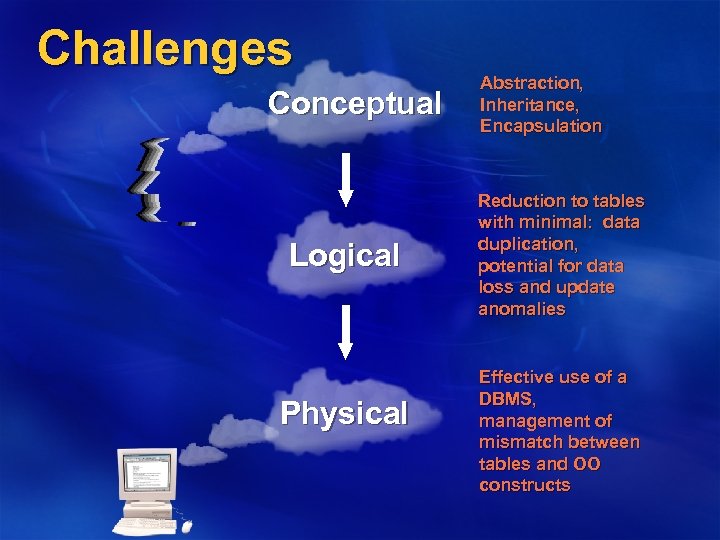
Challenges Conceptual Logical Physical Abstraction, Inheritance, Encapsulation Reduction to tables with minimal: data duplication, potential for data loss and update anomalies Effective use of a DBMS, management of mismatch between tables and OO constructs
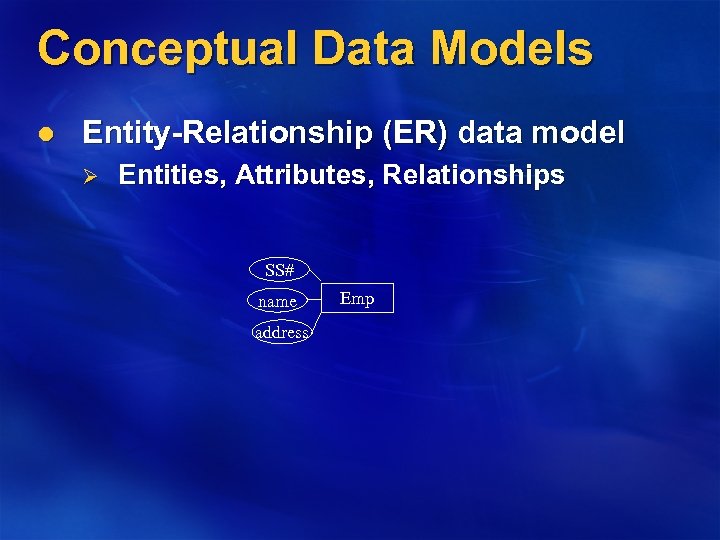
Conceptual Data Models l Entity-Relationship (ER) data model Ø Entities, Attributes, Relationships SS# name address Emp
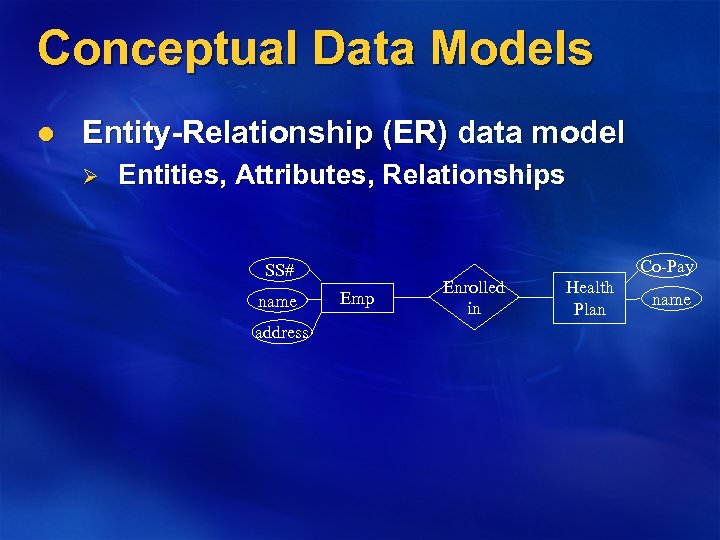
Conceptual Data Models l Entity-Relationship (ER) data model Ø Entities, Attributes, Relationships Co-Pay SS# name address Emp Enrolled in Health Plan name
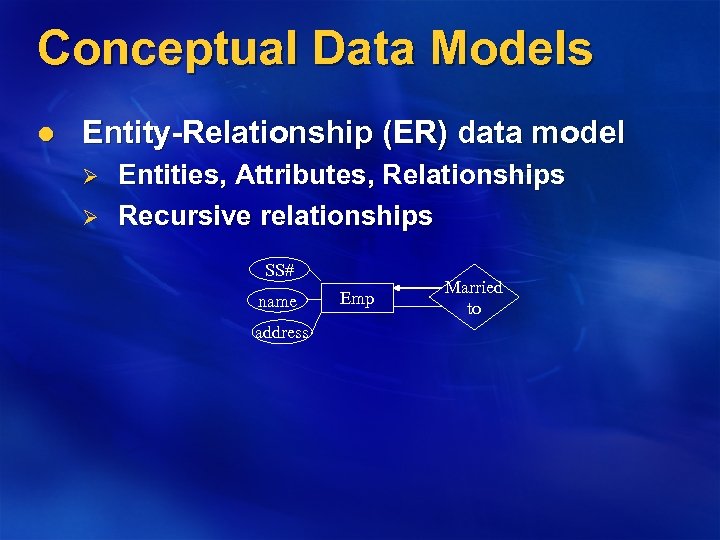
Conceptual Data Models l Entity-Relationship (ER) data model Ø Ø Entities, Attributes, Relationships Recursive relationships SS# name address Emp Married to
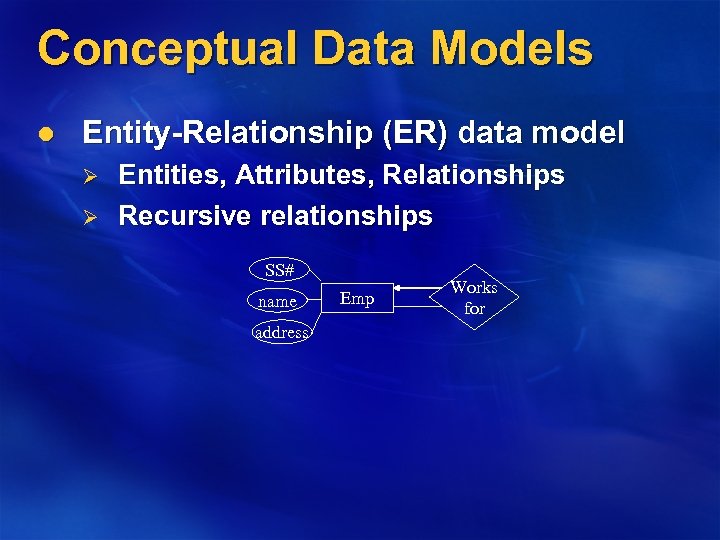
Conceptual Data Models l Entity-Relationship (ER) data model Ø Ø Entities, Attributes, Relationships Recursive relationships SS# name address Emp Works for
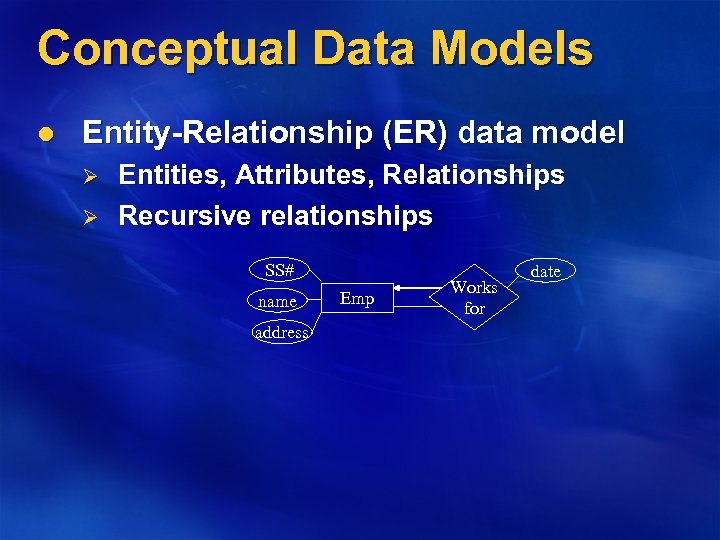
Conceptual Data Models l Entity-Relationship (ER) data model Ø Ø Entities, Attributes, Relationships Recursive relationships SS# name address Emp Works for date
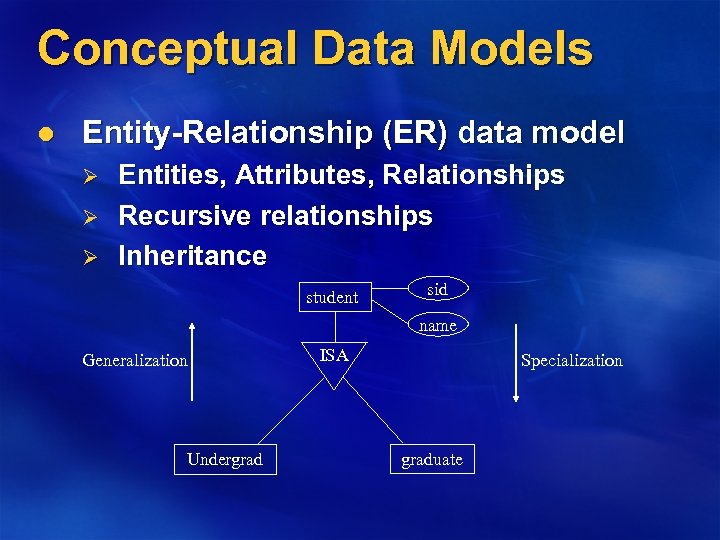
Conceptual Data Models l Entity-Relationship (ER) data model Ø Ø Ø Entities, Attributes, Relationships Recursive relationships Inheritance student sid name Generalization Undergrad ISA Specialization graduate
Conceptual Data Models l l Abstraction, Inheritance, Encapsulation Exercise these concepts using in-class examples and homework assignments Ø A library database contains a listing of authors who have written books on various subjects (one author per book). It also contains information about libraries that carry books on various subjects.
Conceptual Data Models l l Abstraction, Inheritance, Encapsulation Exercise these concepts using in-class examples and homework assignments Ø Ø Ø A library database contains a listing of authors who have written books on various subjects (one author per book). It also contains information about libraries that carry books on various subjects. Entity sets: authors, subjects, books, libraries Relationship sets: wrote, carry, indexed
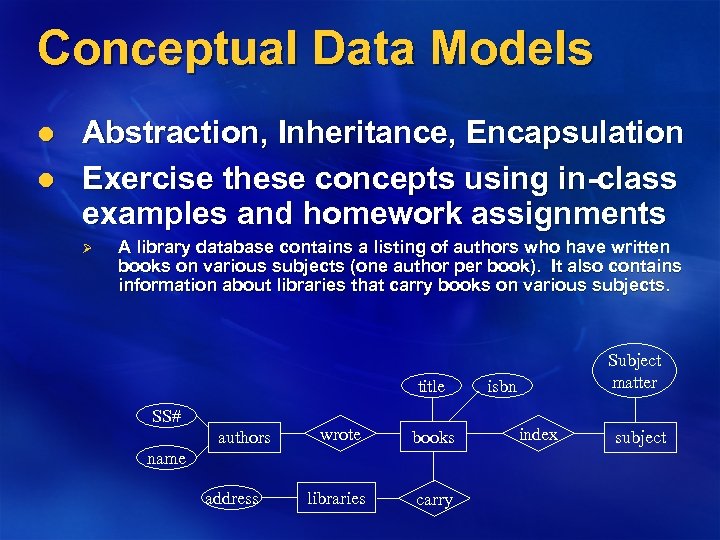
Conceptual Data Models l l Abstraction, Inheritance, Encapsulation Exercise these concepts using in-class examples and homework assignments Ø A library database contains a listing of authors who have written books on various subjects (one author per book). It also contains information about libraries that carry books on various subjects. title SS# authors wrote books libraries carry name address Subject matter isbn index subject
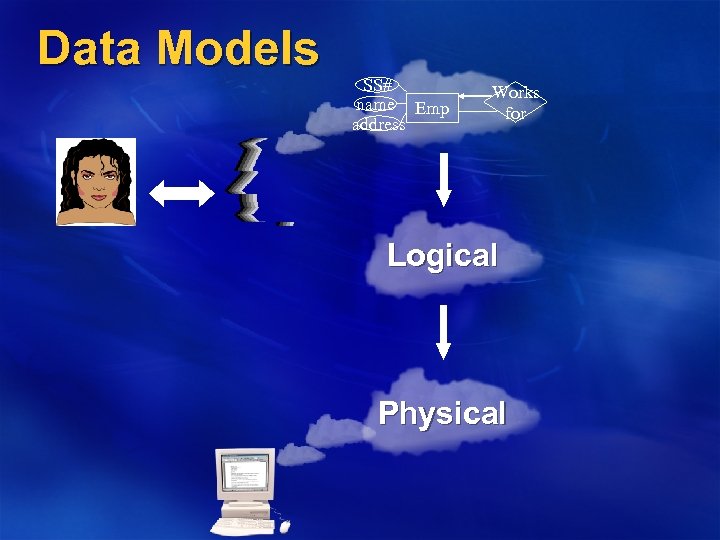
Data Models SS# name Emp address Works for Logical Physical
Relational Data Model l Prevalent in today’s market place. Ø Why? Performance! l Everything is a table! l Logical data design is the process of reducing an ER diagram to a collection of tables.
Logical Data Design l Trivial reduction: Ø Ø l An entity set = a table A relationship set = a table Pitfalls: Ø Ø Ø Duplication of data Unintentional loss of data Data ambiguity that impacts software design, resulting in update anomalies
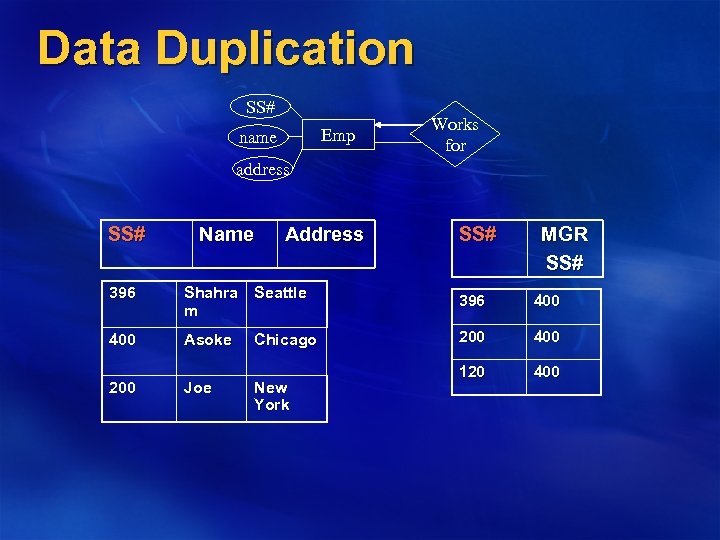
Data Duplication SS# Emp name Works for address SS# Name Address SS# MGR SS# 396 Shahra Seattle m 396 400 Asoke 200 400 120 400 200 Joe Chicago New York
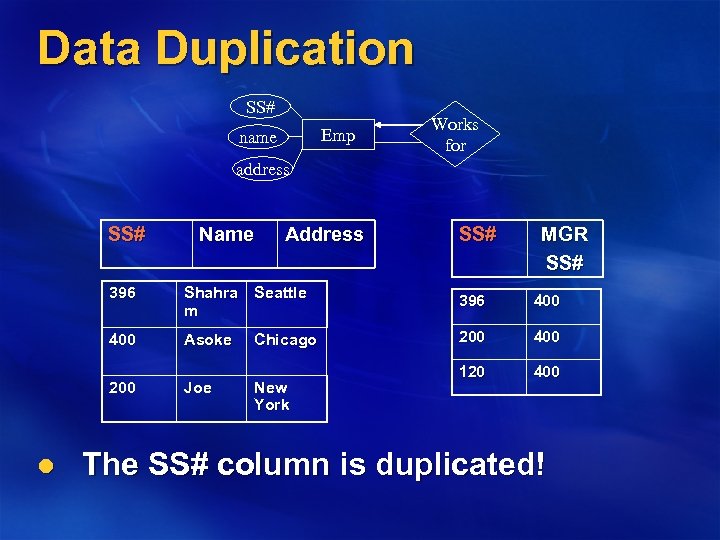
Data Duplication SS# Emp name Works for address SS# Name Address SS# MGR SS# 396 Shahra Seattle m 396 400 Asoke 200 400 120 400 200 l Joe Chicago New York The SS# column is duplicated!
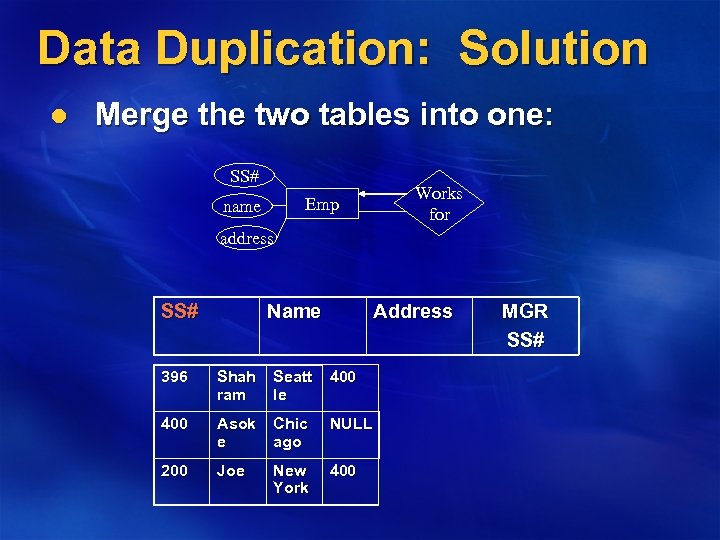
Data Duplication: Solution l Merge the two tables into one: SS# Emp name Works for address SS# Name Address 396 Shah ram Seatt le 400 Asok e Chic ago NULL 200 Joe New York 400 MGR SS#
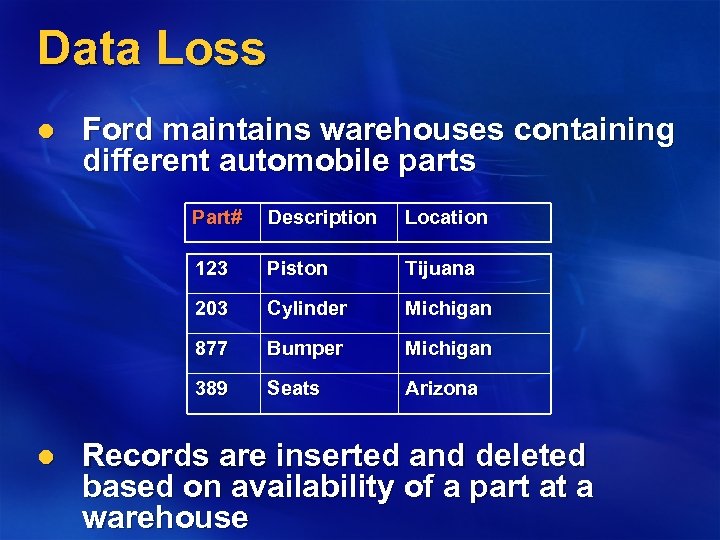
Data Loss l Ford maintains warehouses containing different automobile parts Part# Location 123 Piston Tijuana 203 Cylinder Michigan 877 Bumper Michigan 389 l Description Seats Arizona Records are inserted and deleted based on availability of a part at a warehouse
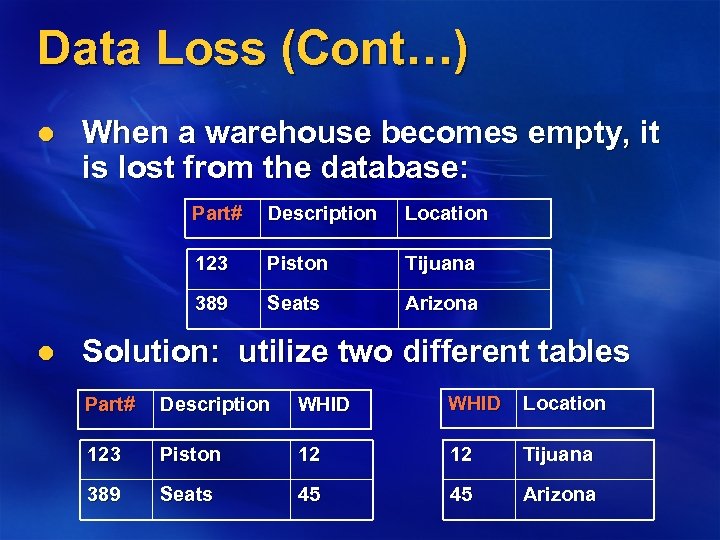
Data Loss (Cont…) l When a warehouse becomes empty, it is lost from the database: Part# Location 123 Piston Tijuana 389 l Description Seats Arizona Solution: utilize two different tables Part# Description WHID Location 123 Piston 12 12 Tijuana 389 Seats 45 45 Arizona
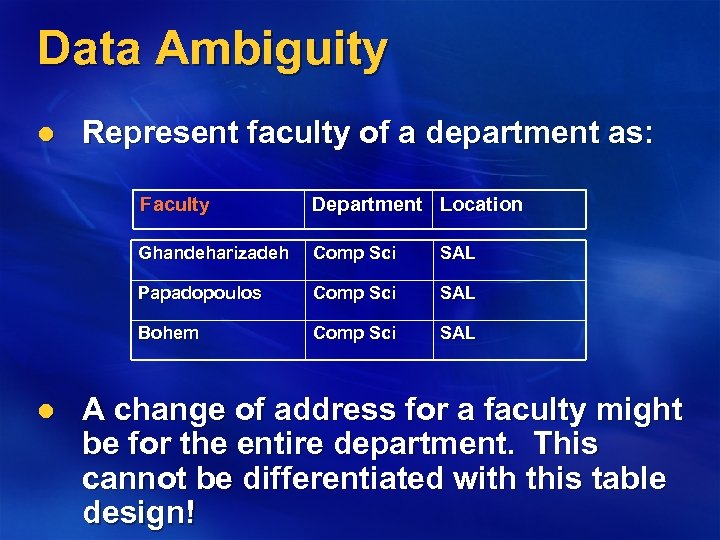
Data Ambiguity l Represent faculty of a department as: Faculty Ghandeharizadeh Comp Sci SAL Papadopoulos Comp Sci SAL Bohem l Department Location Comp Sci SAL A change of address for a faculty might be for the entire department. This cannot be differentiated with this table design!
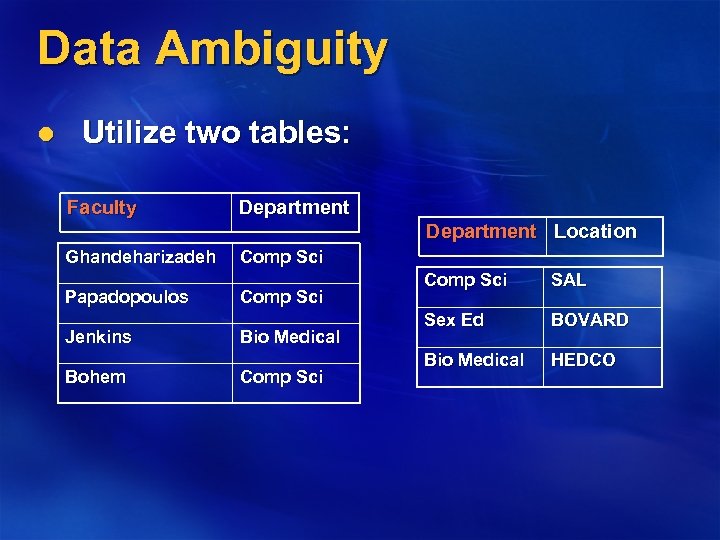
Data Ambiguity l Utilize two tables: Faculty Department Location Ghandeharizadeh Papadopoulos Jenkins Bohem Comp Sci Bio Medical Comp Sci SAL Sex Ed BOVARD Bio Medical HEDCO
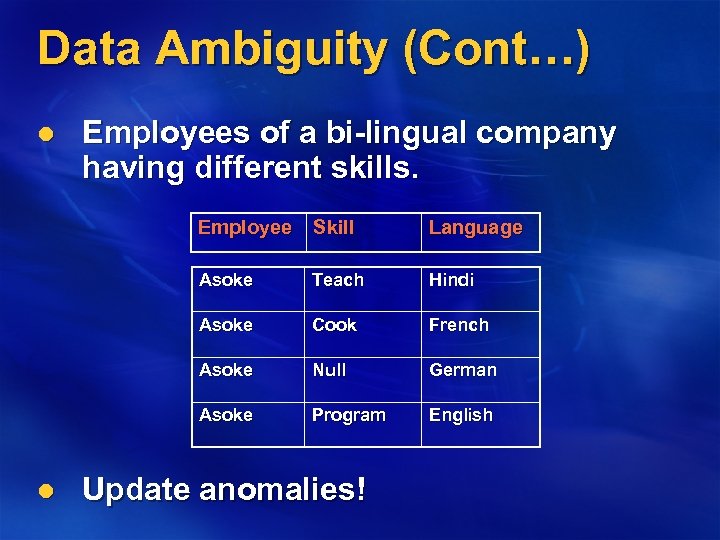
Data Ambiguity (Cont…) l Employees of a bi-lingual company having different skills. Employee Language Asoke Teach Hindi Asoke Cook French Asoke Null German Asoke l Skill Program English Update anomalies!
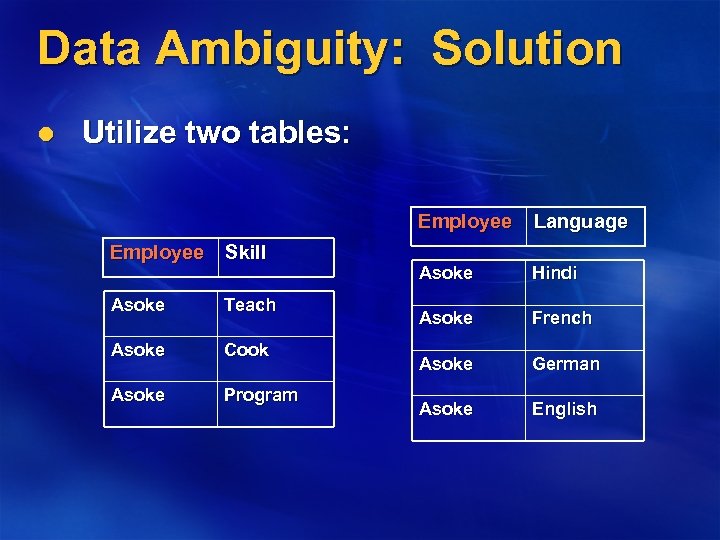
Data Ambiguity: Solution l Utilize two tables: Employee Skill Asoke Teach Asoke Cook Asoke Program Language Asoke Hindi Asoke French Asoke German Asoke English
Logical Data Design l A quest to flatten objects with minimal data duplication, loss of data, and update anomalies! l William Kent, “A Simple Guide to Five Normal Forms in Relational Database Theory”, Communications of the ACM 26(2), Feb 1983, 120 -125.
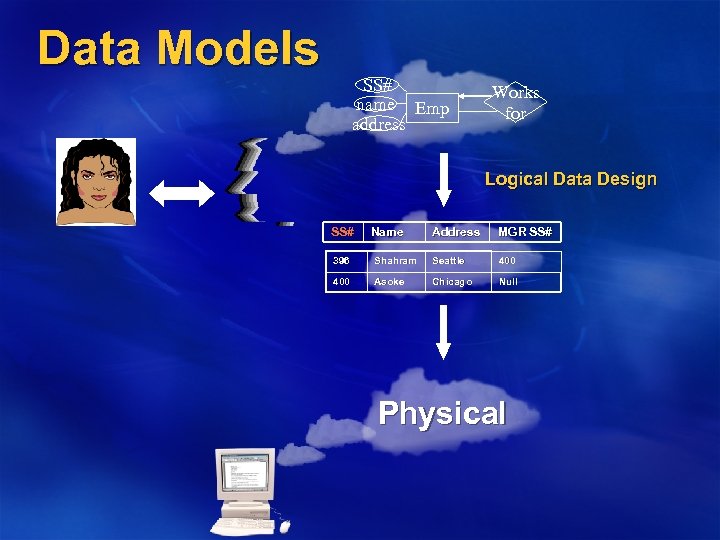
Data Models SS# name Emp address Works for Logical Data Design SS# Name Address MGR SS# 396 Shahram Seattle 400 Asoke Chicago Null Physical
Physical Implementation l Reconstruct main memory objects for manipulation and presentation: Ø Specify class definitions § Ø Ø Ø Typically correspond to entity-sets Populate an instance of a class by issuing SQL queries to a DBMS Update instances in memory Flush dirty instances back to DBMS § Potential use of transactions
Type Mismatch l A column of a row must be a primitive such as an integer, real, etc. Ø l l It may NOT be an array of integers or object pointers A property (attribute) of a class might be of a multi-valued type, e. g. , an array, a vector, etc. Changes in software may impact the design of tables. (Management of type mismatch by the system designer. )
Implementation l Set operators in the DBMS Ø Ø l Does set A contain set B? Does value v 1 appear in set A? Aggregates in the DBMS Ø Ø Ø Compute average employee salary Count the number of employees Find the oldest employee
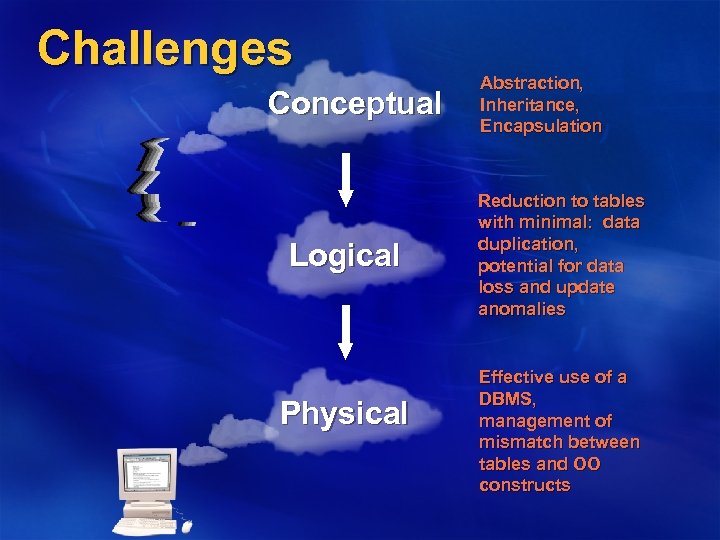
Challenges Conceptual Logical Physical Abstraction, Inheritance, Encapsulation Reduction to tables with minimal: data duplication, potential for data loss and update anomalies Effective use of a DBMS, management of mismatch between tables and OO constructs
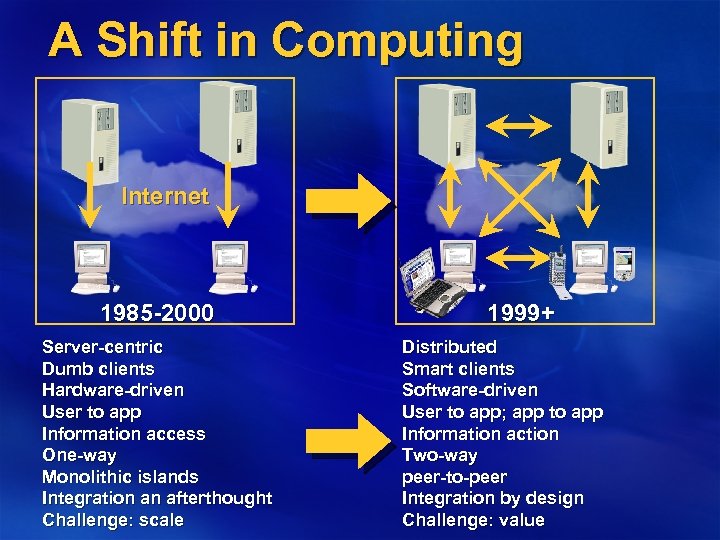
A Shift in Computing Internet 1985 -2000 Server-centric Dumb clients Hardware-driven User to app Information access One-way Monolithic islands Integration an afterthought Challenge: scale 1999+ Distributed Smart clients Software-driven User to app; app to app Information action Two-way peer-to-peer Integration by design Challenge: value
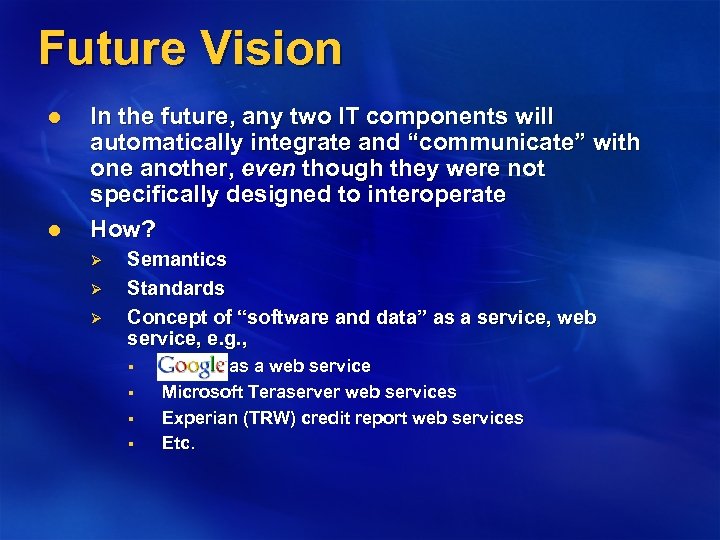
Future Vision l l In the future, any two IT components will automatically integrate and “communicate” with one another, even though they were not specifically designed to interoperate How? Ø Ø Ø Semantics Standards Concept of “software and data” as a service, web service, e. g. , § § Google as a web service Microsoft Teraserver web services Experian (TRW) credit report web services Etc.
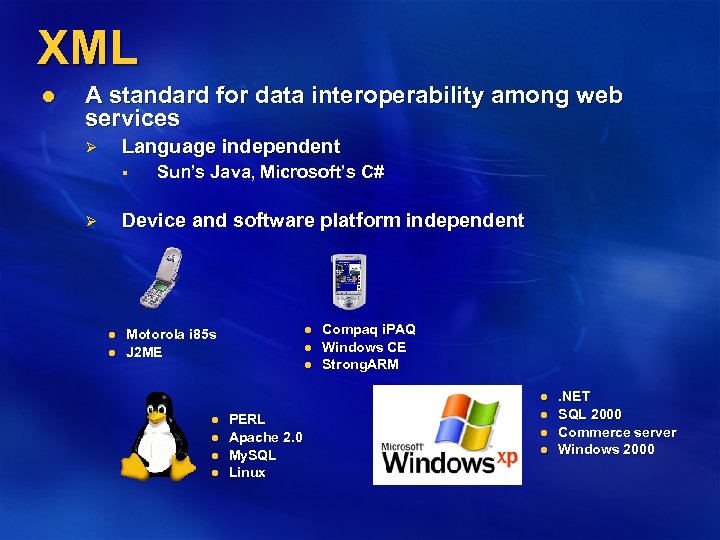
XML l A standard for data interoperability among web services Language independent Ø § Sun’s Java, Microsoft’s C# Device and software platform independent Ø l l l Motorola i 85 s J 2 ME l l Compaq i. PAQ Windows CE Strong. ARM l l l PERL Apache 2. 0 My. SQL Linux l l l . NET SQL 2000 Commerce server Windows 2000
Future Challenge l l Educate students to see Internet as an object-oriented software platform! Software at an Internet scale must be: Ø Ø Robust: Physical location independence Ensure availability of data and functionality at all times Modular and Extendible Integrate with other software components
Скачать презентацию Challenges of Teaching OO Constructs with Databases Shahram
c5814bbb2074a58e01b53fc599b4ca48.ppt