 Скачать презентацию Challenges of Sustainability Kentaro Toyama Assistant Managing Director
71e6f4357c789a0a3c5ae67a590b7aed.ppt
- Количество слайдов: 42



Challenges of Sustainability Kentaro Toyama Assistant Managing Director Microsoft Research India ADBI - CPSC Regional Joint Workshop on Managing Sustainable e-Community Centers May 3 -10, 2005 Agra, India
Outline n Background n Current status – Rural PC kiosks in India n Why is sustainability so difficult? n Suggestions and recommendations
Outline n Background n Current status – Rural PC kiosks in India n Why is sustainability so difficult? n Suggestions and recommendations
Why do we care? n Microsoft Research India – Microsoft: positive impact and long-term growth of worldwide economy – Microsoft Research (MSR): scientific research and long -term possibilities of new technology – MSR India, Technology for Emerging Markets group: applications of computing for underserved § Social science research and technical innovation
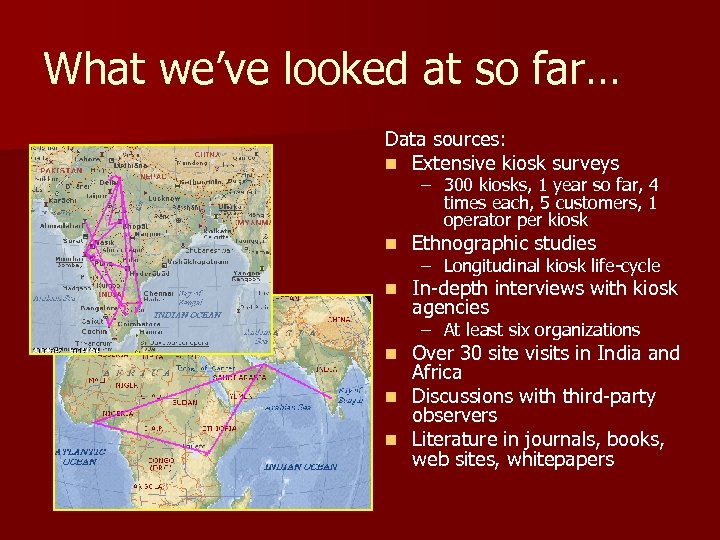
What we’ve looked at so far… Data sources: n Extensive kiosk surveys – 300 kiosks, 1 year so far, 4 times each, 5 customers, 1 operator per kiosk n Ethnographic studies n In-depth interviews with kiosk agencies – Longitudinal kiosk life-cycle – At least six organizations Over 30 site visits in India and Africa n Discussions with third-party observers n Literature in journals, books, web sites, whitepapers n
What we’ve looked at so far… Kiosk projects: n n-Logue n Drishtee n ITC e-choupal n TARAhaat n MSSRF n Dhan / SARI n Akshaya n World Corps n Others…
Definitions (valid only for the duration of this presentation) n “Kiosk” – Rural center with PC as the focus of services – Socio-economic improvement as a goal n “Sustainable” – Self-sustaining, as a business
Outline n Background n Current status – Rural PC kiosks in India n Why is sustainability so difficult? n Suggestions and recommendations
Preface This presentation points out weaknesses in the sub-goals, approaches, or results of kiosk projects, but… None of it is meant as a criticism of the project agencies or the people who work with them, almost all of whom are dedicated and deeply devoted to development. They should be lauded for having had the courage to try these experiments. The real problems are not due to approach or implementation; they are fundamentally embedded in a fact that we could never have known without these experiments.
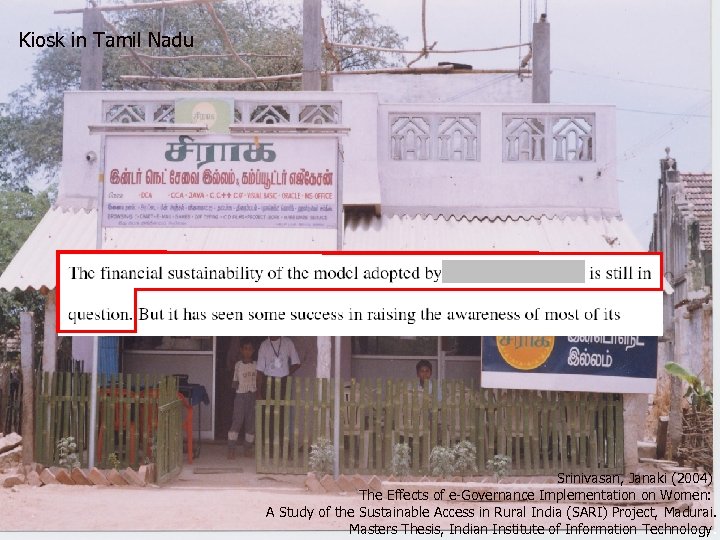
Kiosk in Tamil Nadu Srinivasan, Janaki (2004) The Effects of e-Governance Implementation on Women: A Study of the Sustainable Access in Rural India (SARI) Project, Madurai. Masters Thesis, Indian Institute of Information Technology.
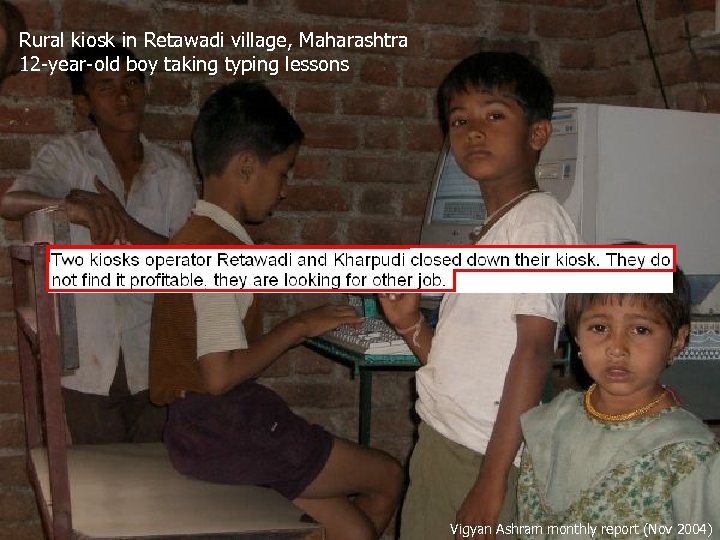
Rural kiosk in Retawadi village, Maharashtra 12 -year-old boy taking typing lessons Vigyan Ashram monthly report (Nov 2004)
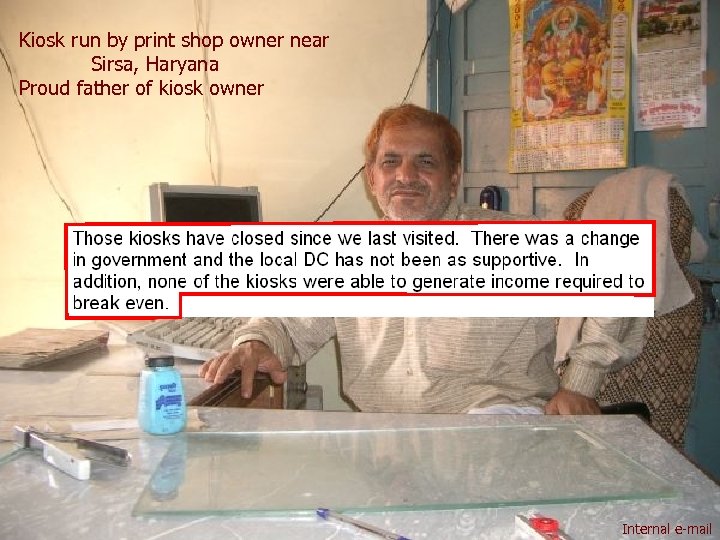
Kiosk run by print shop owner near Sirsa, Haryana Proud father of kiosk owner Internal e-mail
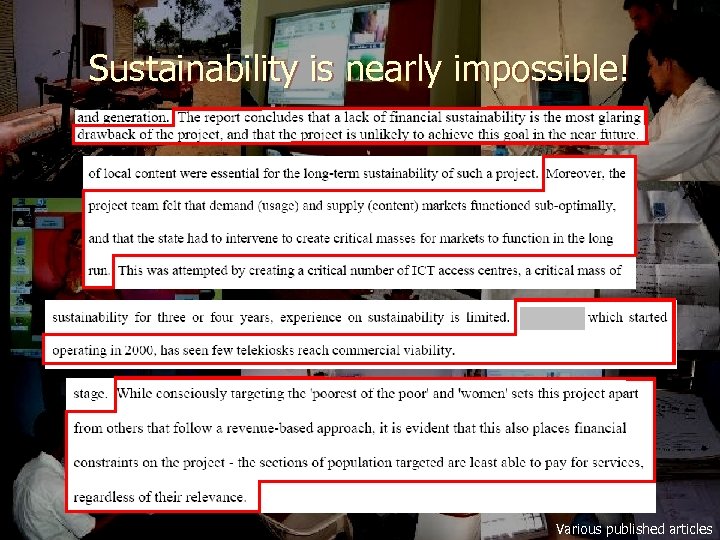
Sustainability is nearly impossible! Various published articles
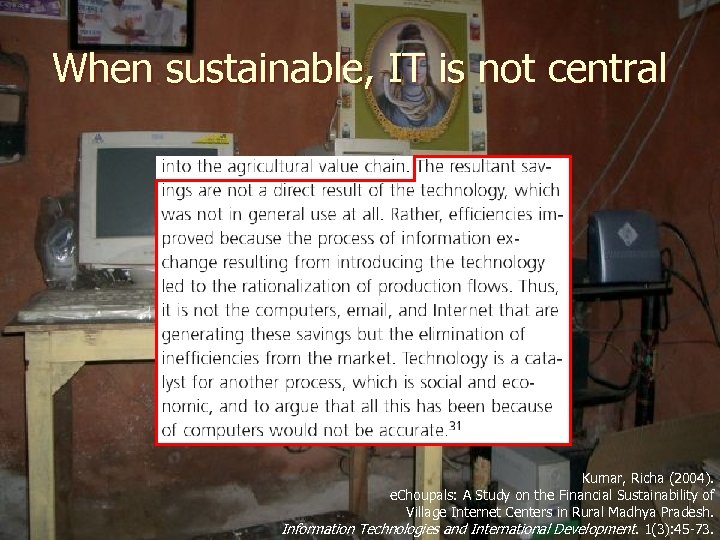
When sustainable, IT is not central Kumar, Richa (2004). e. Choupals: A Study on the Financial Sustainability of Village Internet Centers in Rural Madhya Pradesh. Information Technologies and International Development. 1(3): 45 -73.
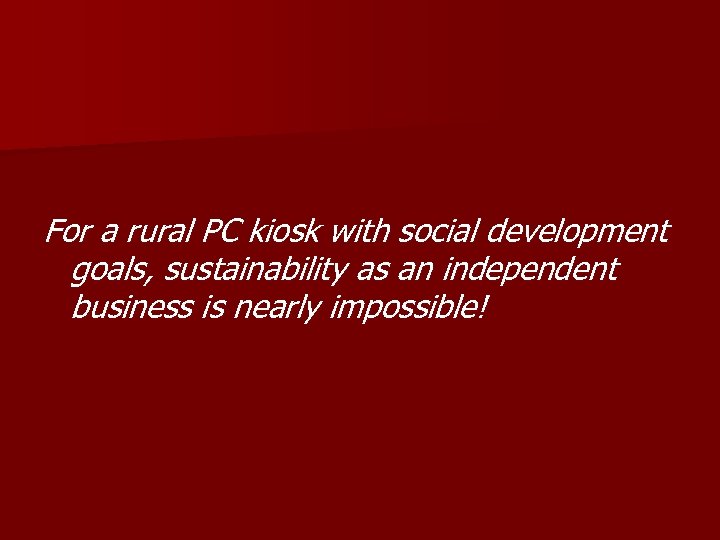
For a rural PC kiosk with social development goals, sustainability as an independent business is nearly impossible!
Outline n Background n Current status – Rural PC kiosks in India n Why is sustainability so difficult? n Suggestions and recommendations
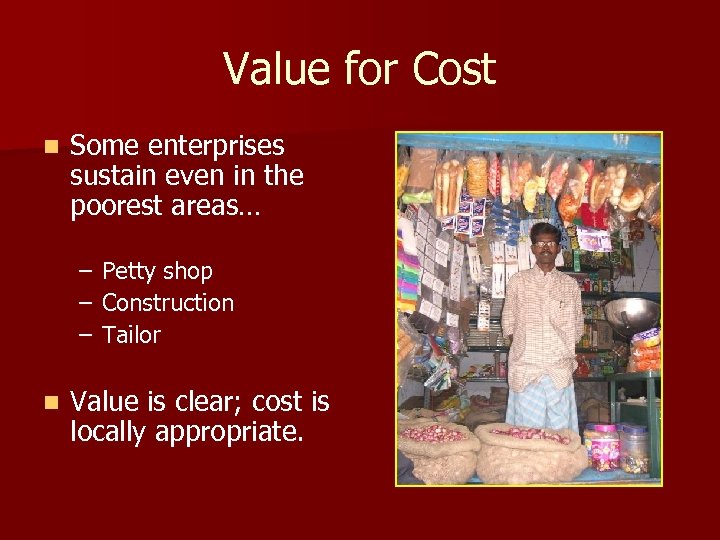
Value for Cost n Some enterprises sustain even in the poorest areas… – – – n Petty shop Construction Tailor Value is clear; cost is locally appropriate.
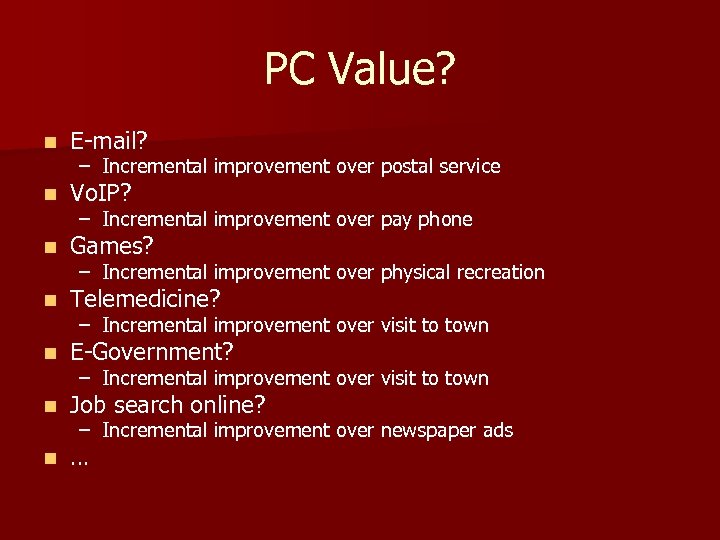
PC Value? n E-mail? n Vo. IP? n Games? n Telemedicine? n E-Government? n Job search online? n … – Incremental improvement over postal service – Incremental improvement over pay phone – Incremental improvement over physical recreation – Incremental improvement over visit to town – Incremental improvement over newspaper ads
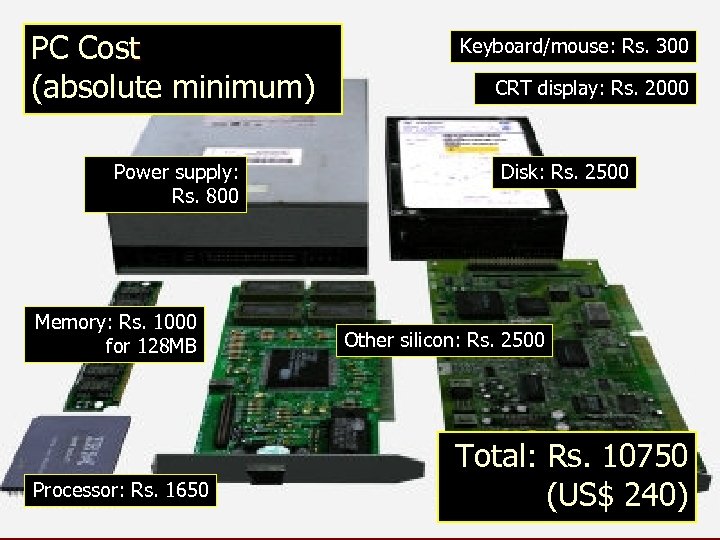
PC Cost (absolute minimum) Power supply: Rs. 800 Memory: Rs. 1000 for 128 MB Processor: Rs. 1650 Keyboard/mouse: Rs. 300 CRT display: Rs. 2000 Disk: Rs. 2500 Other silicon: Rs. 2500 Total: Rs. 10750 (US$ 240)
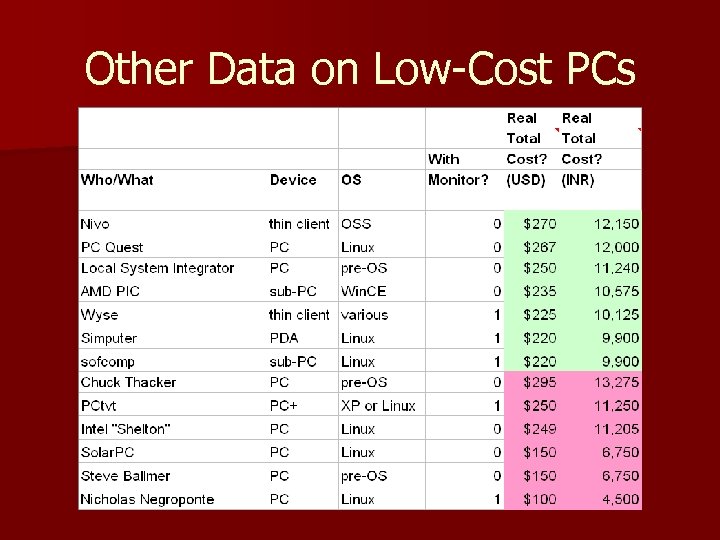
Other Data on Low-Cost PCs
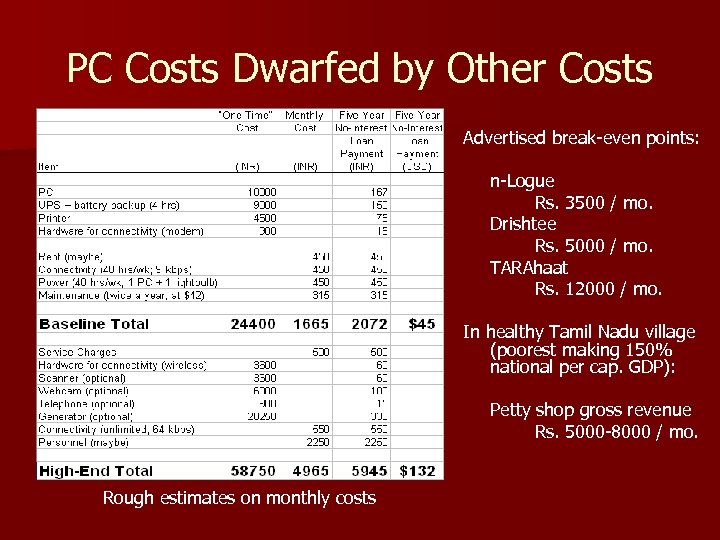
PC Costs Dwarfed by Other Costs Advertised break-even points: n-Logue Rs. 3500 / mo. Drishtee Rs. 5000 / mo. TARAhaat Rs. 12000 / mo. In healthy Tamil Nadu village (poorest making 150% national per cap. GDP): Petty shop gross revenue Rs. 5000 -8000 / mo. Rough estimates on monthly costs
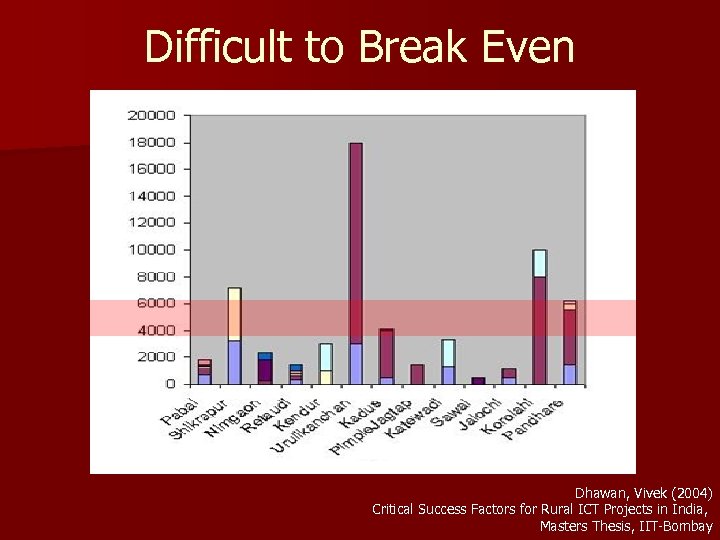
Difficult to Break Even Dhawan, Vivek (2004) Critical Success Factors for Rural ICT Projects in India, Masters Thesis, IIT-Bombay
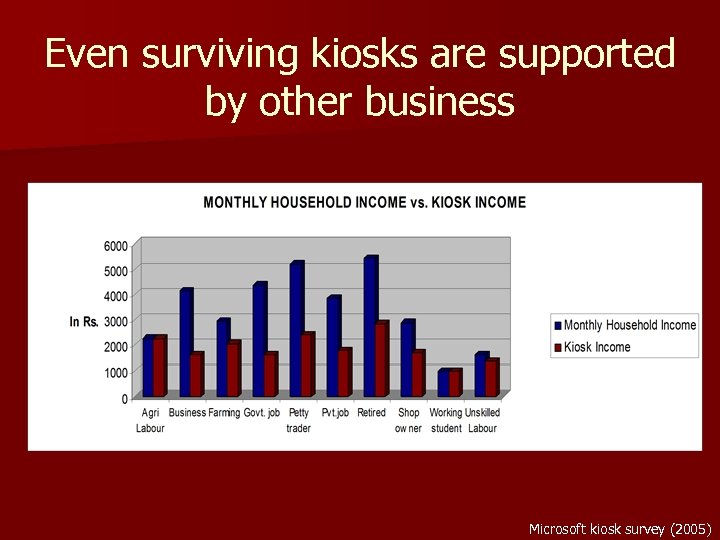
Even surviving kiosks are supported by other business Microsoft kiosk survey (2005)
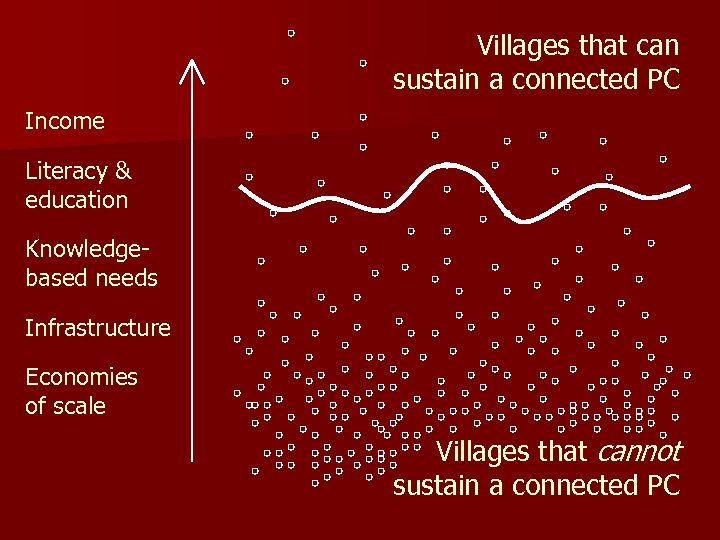
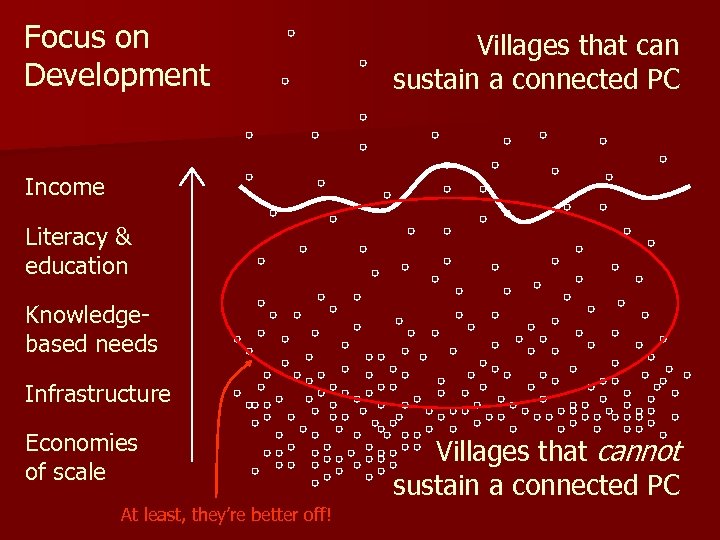
Villages that can sustain a connected PC Income Literacy & education Knowledgebased needs Infrastructure Economies of scale Villages that cannot sustain a connected PC
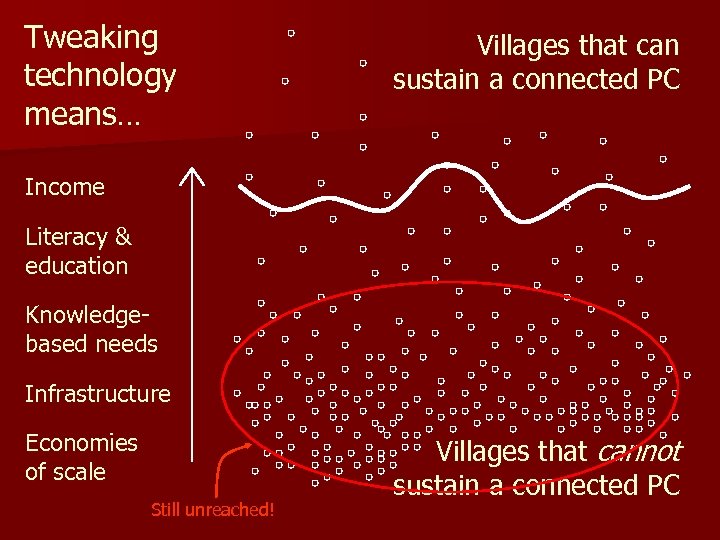
Tweaking technology means… Villages that can sustain a connected PC Income Literacy & education Knowledgebased needs Infrastructure Economies of scale Still unreached! Villages that cannot sustain a connected PC
Exactly where socio-economic development is most needed, local economies are not large enough to sustain a kiosk as an independent business. – There are some businesses not all rural villages can sustain, e. g. , a movie cinema. – Incremental value of PC-based services often not worth the cost. – Internet cafes open spontaneously when economy is large enough.
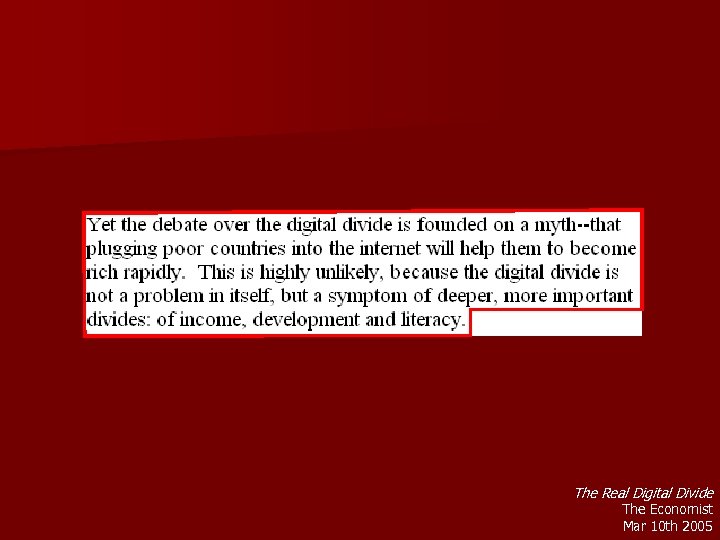
The Real Digital Divide The Economist Mar 10 th 2005
This does not mean…!!! n n n n A particular rural PC kiosk can’t be sustainable as a business. PCs have no value in rural areas. Investing in rural PCs is a bad idea. Sustainability wasn’t a worthwhile goal until now. Sustainability isn’t achievable in larger rural areas. Sustainability still isn’t a worthwhile goal for a kiosk operator or agency. Rural PC efforts won’t succeed with adequate donor/government support.
Outline n Background n Current status – Rural PC centers in India n Why is sustainability so difficult? n Suggestions and recommendations
Focus on Development Villages that can sustain a connected PC Income Literacy & education Knowledgebased needs Infrastructure Economies of scale At least, they’re better off! Villages that cannot sustain a connected PC
Suggestions Just some ideas for experimentation: n Relax focus on financial self-sustainability n Start with “CT” n Do server side first n Work through cybercafes n Try “featherweight” computing n Bait and switch with IT
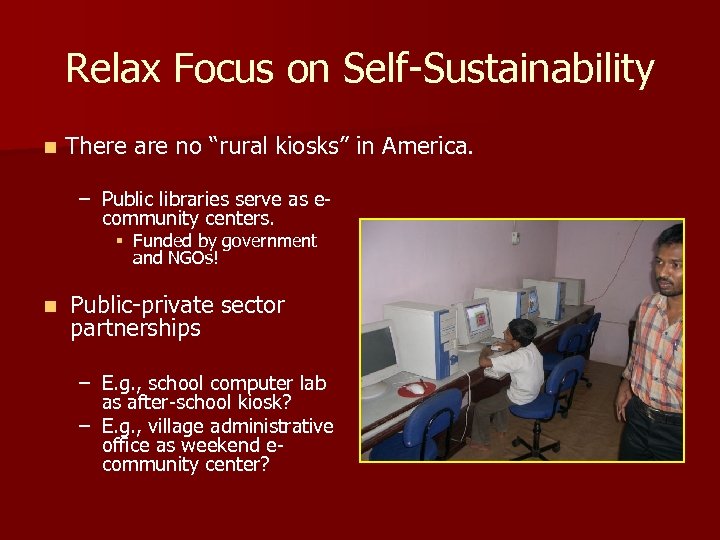
Relax Focus on Self-Sustainability n There are no “rural kiosks” in America. – Public libraries serve as ecommunity centers. § Funded by government and NGOs! n Public-private sector partnerships – E. g. , school computer lab as after-school kiosk? – E. g. , village administrative office as weekend ecommunity center?
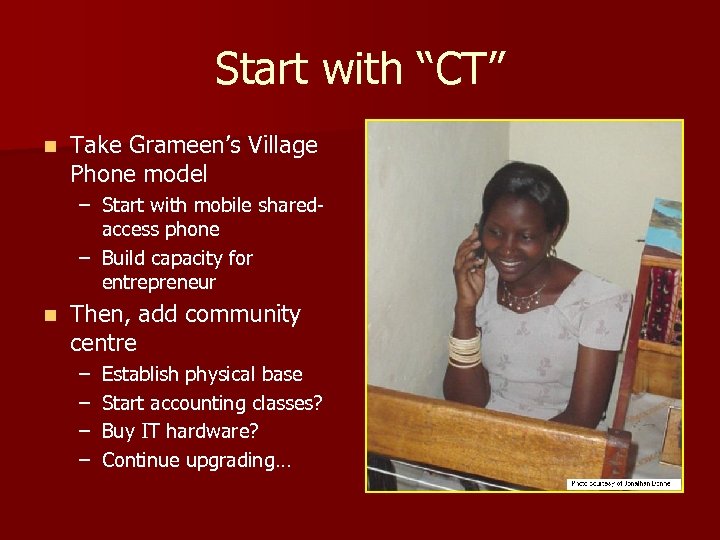
Start with “CT” n Take Grameen’s Village Phone model – Start with mobile sharedaccess phone – Build capacity for entrepreneur n Then, add community centre – – Establish physical base Start accounting classes? Buy IT hardware? Continue upgrading…
Do Server Side First n Ensure back-end is built first – If it doesn’t work for wealthy urban users… § § E-government services Online bill payment Commercial services online Telemedicine – Why would it work for poor rural? n Then, value of Internet easier to demonstrate to villagers
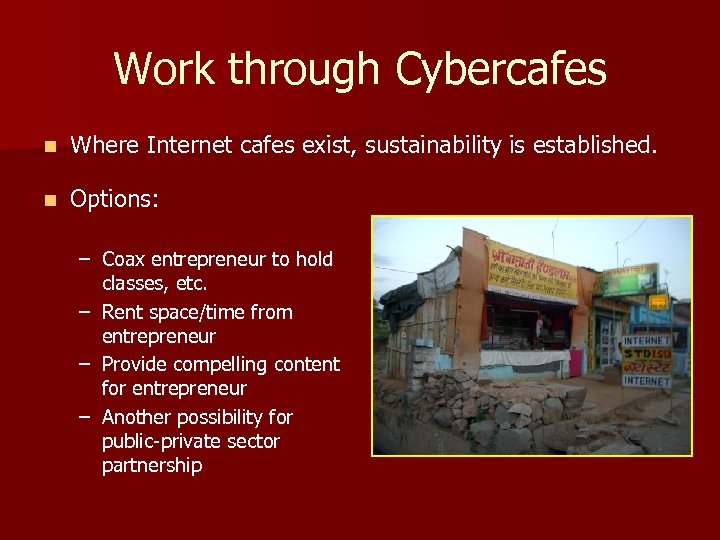
Work through Cybercafes n Where Internet cafes exist, sustainability is established. n Options: – Coax entrepreneur to hold classes, etc. – Rent space/time from entrepreneur – Provide compelling content for entrepreneur – Another possibility for public-private sector partnership
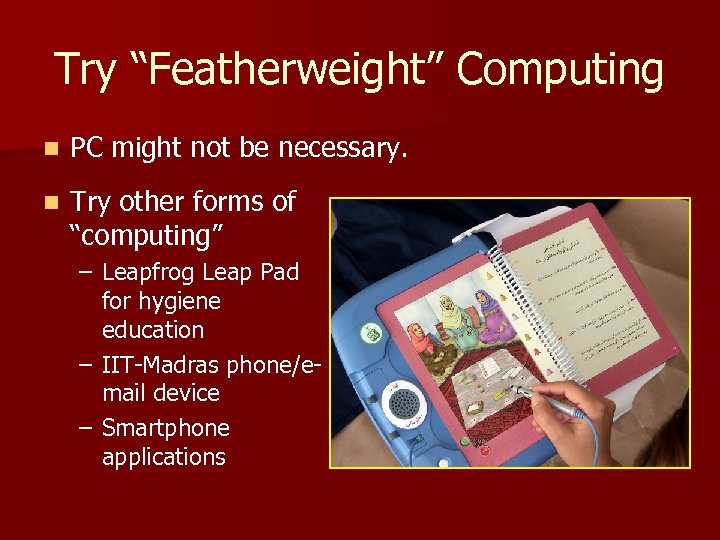
Try “Featherweight” Computing n PC might not be necessary. n Try other forms of “computing” – Leapfrog Leap Pad for hygiene education – IIT-Madras phone/email device – Smartphone applications
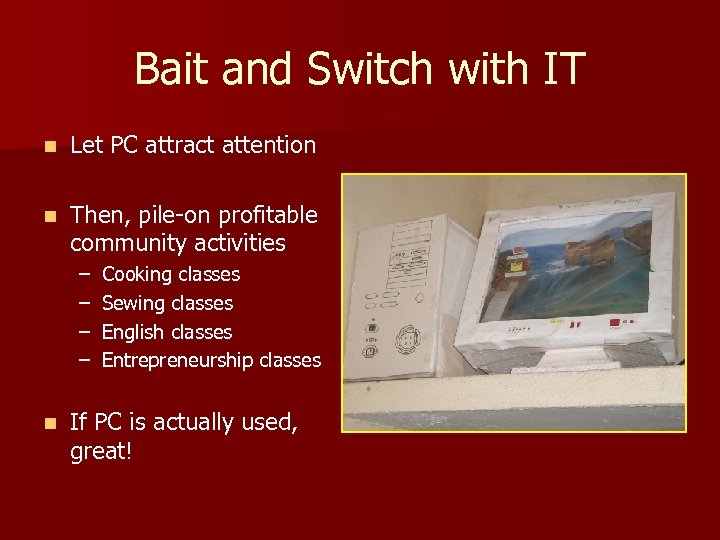
Bait and Switch with IT n Let PC attract attention n Then, pile-on profitable community activities – – n Cooking classes Sewing classes English classes Entrepreneurship classes If PC is actually used, great!
Not Quite Solutions n Multi-tiered franchise hierarchy n New technology n Local language content n Rural BPO – May be necessary, but does not contribute to sustainability – Solves organizational issues; adds as many financial burdens as it solves – May be necessary, but does not contribute to sustainability – E. g. , connectivity by wireless networks – rarely cheaper than alternatives – Definitely necessary, but does not contribute to sustainability – Who will generate fresh content? – Not necessary, and does not contribute to sustainability – Difficult to beat urban economics of scale
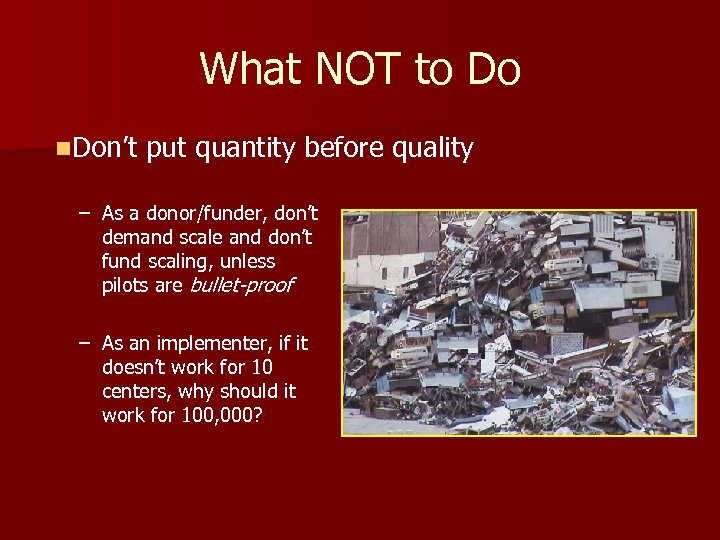
What NOT to Do n. Don’t put quantity before quality – As a donor/funder, don’t demand scale and don’t fund scaling, unless pilots are bullet-proof – As an implementer, if it doesn’t work for 10 centers, why should it work for 100, 000?
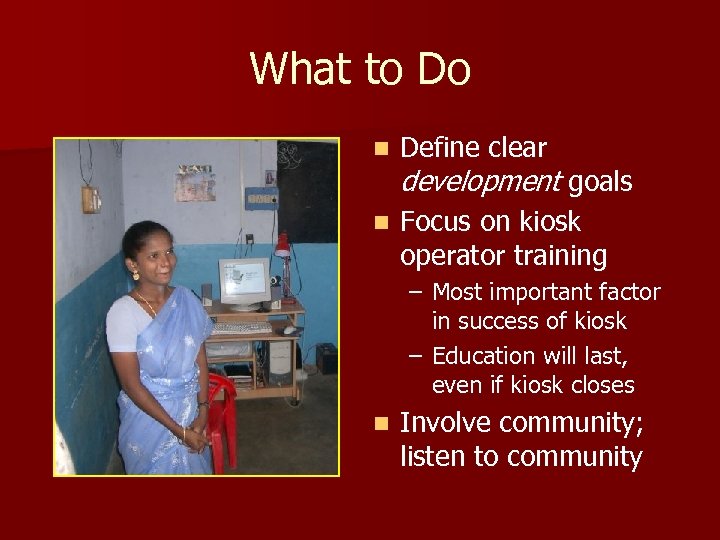
What to Do n Define clear n Focus on kiosk operator training development goals – Most important factor in success of kiosk – Education will last, even if kiosk closes n Involve community; listen to community
Summary n For a rural PC kiosk with social development goals, sustainability as an independent business is nearly impossible. n Exactly where socio-economic development is most needed, local economies are not large enough to sustain a kiosk as an independent business. n Focus on the community; make sure IT is in service of larger goal; don’t rush to scale.
Thank you! http: //research. microsoft. com/india kentoy@microsoft. com
Скачать презентацию Challenges of Sustainability Kentaro Toyama Assistant Managing Director
71e6f4357c789a0a3c5ae67a590b7aed.ppt