


 Скачать презентацию Challenges of Measuring Employment Program Performance William S
8e995eb5e8834eb02e104965eef51cdb.ppt
- Количество слайдов: 17
 Challenges of Measuring Employment Program Performance William S. Borden November, 2009
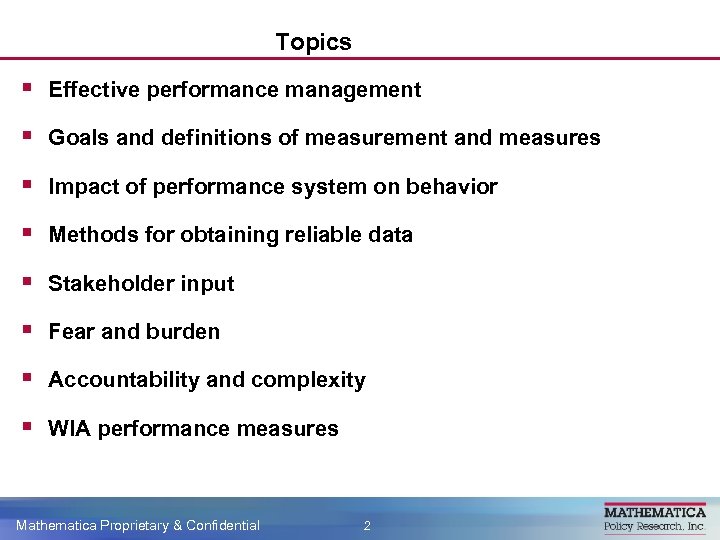 Topics § Effective performance management § Goals and definitions of measurement and measures § Impact of performance system on behavior § Methods for obtaining reliable data § Stakeholder input § Fear and burden § Accountability and complexity § WIA performance measures Mathematica Proprietary & Confidential 2
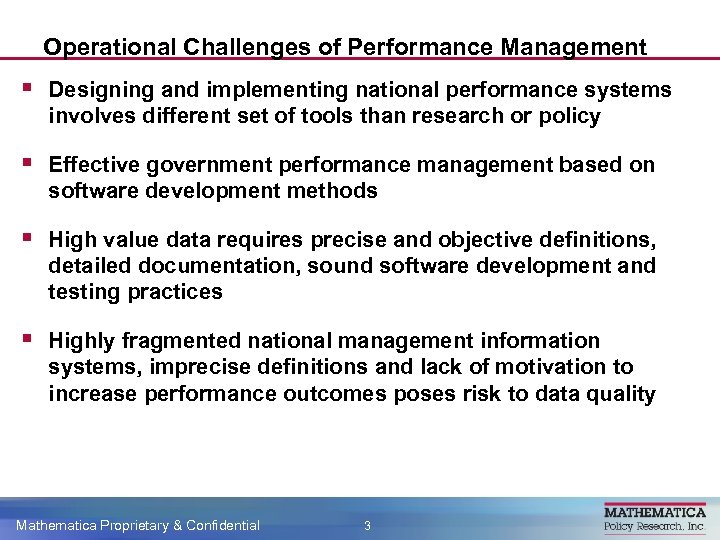 Operational Challenges of Performance Management § Designing and implementing national performance systems involves different set of tools than research or policy § Effective government performance management based on software development methods § High value data requires precise and objective definitions, detailed documentation, sound software development and testing practices § Highly fragmented national management information systems, imprecise definitions and lack of motivation to increase performance outcomes poses risk to data quality Mathematica Proprietary & Confidential 3
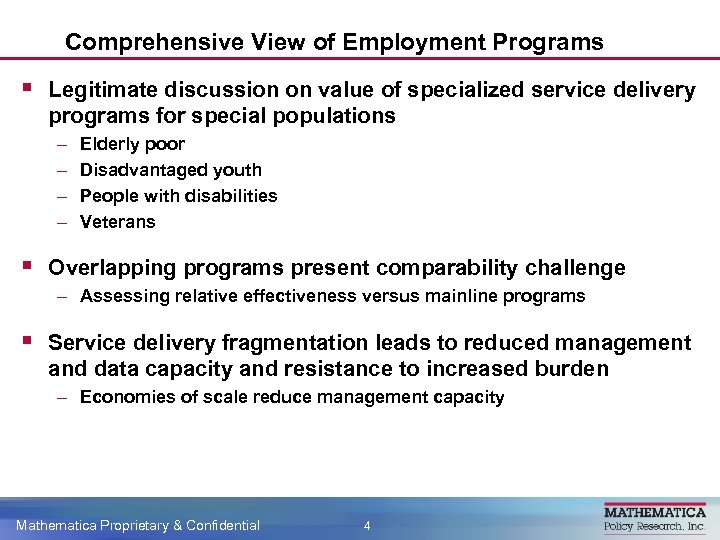 Comprehensive View of Employment Programs § Legitimate discussion on value of specialized service delivery programs for special populations – – § Elderly poor Disadvantaged youth People with disabilities Veterans Overlapping programs present comparability challenge – Assessing relative effectiveness versus mainline programs § Service delivery fragmentation leads to reduced management and data capacity and resistance to increased burden – Economies of scale reduce management capacity Mathematica Proprietary & Confidential 4
 Effective Performance Management § Performance data can provide essential management information for all program levels – Good performance management process is necessary foundation for research evaluations (otherwise data will be unreliable) § Very involved technical process § Information is not useful without – – Precisely defined and objective measures and data elements Extensive technical documentation Standardized automated edits and calculations Extensive software testing Mathematica Proprietary & Confidential 5
 Effective Performance Management Lowers Costs § Upfront investment in well-defined measures, data elements, measure calculations and standardized tools § Investments are leveraged across all levels of system § Much more accurate, timely and useful data § Careful initial planning reduces the need to redesign and rebuild systems – fewer rounds of stakeholder input § Inconsistent and unreliable data are not cost effective Mathematica Proprietary & Confidential 6
 Market Related Goals of Performance Management § Determine program effectiveness, return on public investment § De-fund ineffective programs § Provide incentives for high performance Mathematica Proprietary & Confidential 7
 Limitations of Market Motives § Competition, profit and loss translate poorly to government program evaluation § Defining goals is difficult § Performance-based budgeting is ultimate market mechanism – Requires very precise and accurate data – Provides maximum incentive for inappropriate behaviors (creaming, manipulating enrollment, exit and exclusion data) § Public programs have natural geographic and political monopolies (hard to defund Ohio and send customers to Michigan) Mathematica Proprietary & Confidential 8
 Goals of Performance as a Management Tool § Understand basic facts about programs – Customers served – Services provided – Results § Detect superior and inferior performance and associated service delivery approaches – Act on findings by implementing remedial steps – Identify and assimilate best practices – Analyze performance trends Mathematica Proprietary & Confidential 9
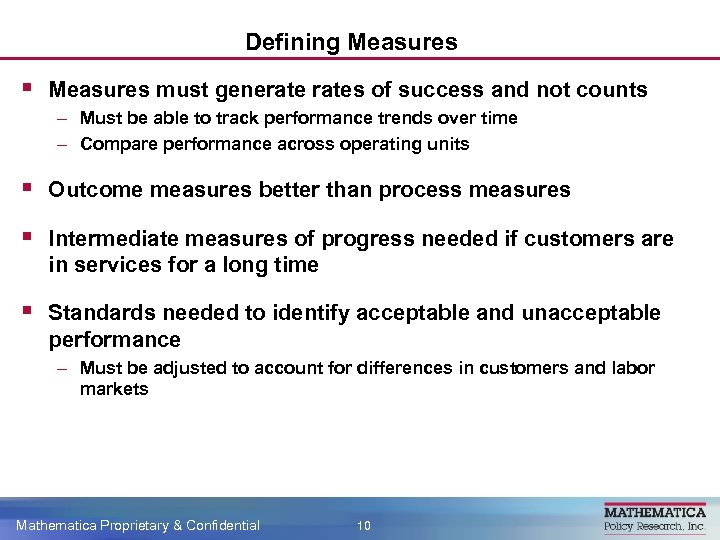 Defining Measures § Measures must generates of success and not counts – Must be able to track performance trends over time – Compare performance across operating units § Outcome measures better than process measures § Intermediate measures of progress needed if customers are in services for a long time § Standards needed to identify acceptable and unacceptable performance – Must be adjusted to account for differences in customers and labor markets Mathematica Proprietary & Confidential 10
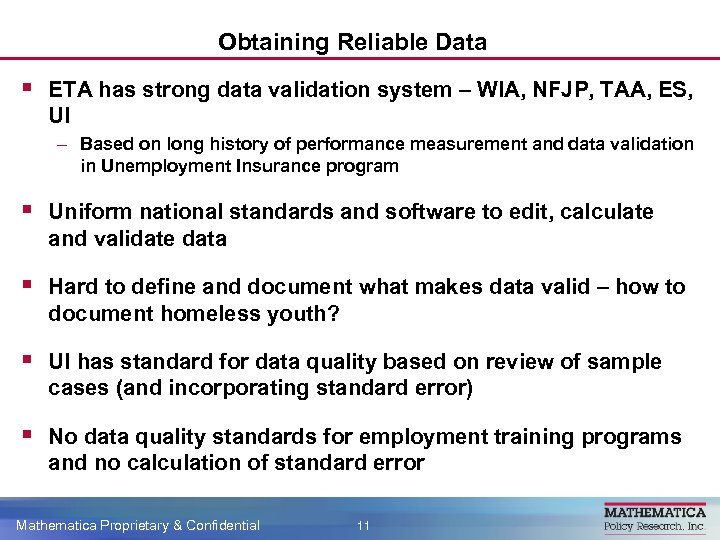 Obtaining Reliable Data § ETA has strong data validation system – WIA, NFJP, TAA, ES, UI – Based on long history of performance measurement and data validation in Unemployment Insurance program § Uniform national standards and software to edit, calculate and validate data § Hard to define and document what makes data valid – how to document homeless youth? § UI has standard for data quality based on review of sample cases (and incorporating standard error) § No data quality standards for employment training programs and no calculation of standard error Mathematica Proprietary & Confidential 11
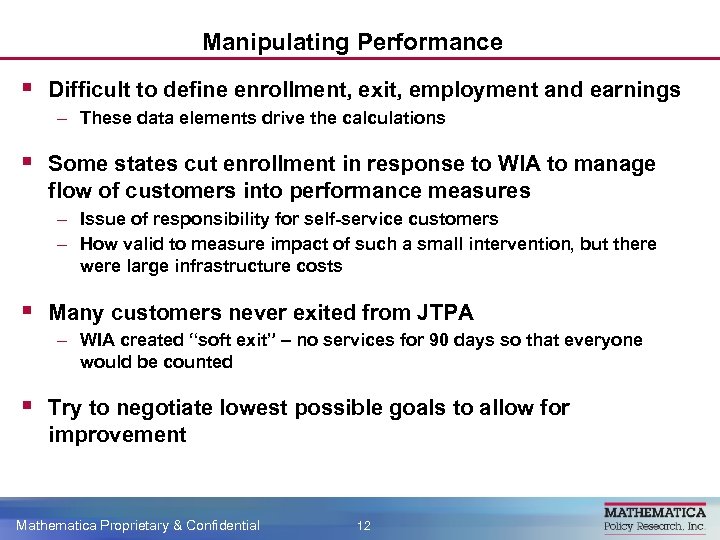 Manipulating Performance § Difficult to define enrollment, exit, employment and earnings – These data elements drive the calculations § Some states cut enrollment in response to WIA to manage flow of customers into performance measures – Issue of responsibility for self-service customers – How valid to measure impact of such a small intervention, but there were large infrastructure costs § Many customers never exited from JTPA – WIA created “soft exit” – no services for 90 days so that everyone would be counted § Try to negotiate lowest possible goals to allow for improvement Mathematica Proprietary & Confidential 12
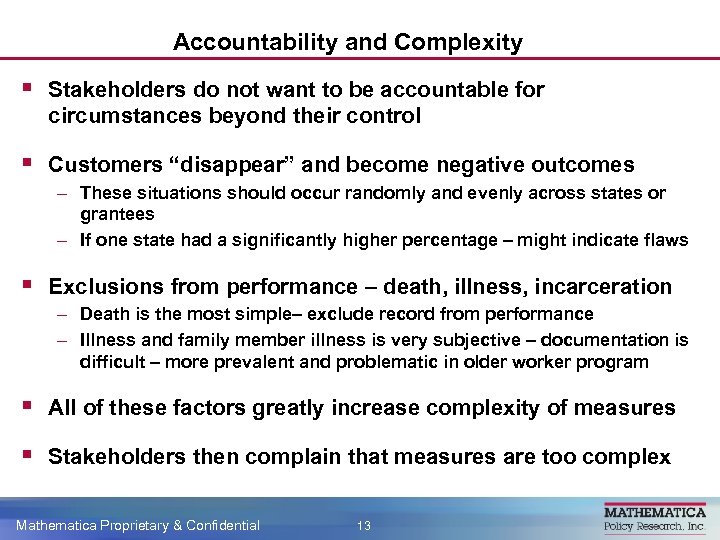 Accountability and Complexity § Stakeholders do not want to be accountable for circumstances beyond their control § Customers “disappear” and become negative outcomes – These situations should occur randomly and evenly across states or grantees – If one state had a significantly higher percentage – might indicate flaws § Exclusions from performance – death, illness, incarceration – Death is the most simple– exclude record from performance – Illness and family member illness is very subjective – documentation is difficult – more prevalent and problematic in older worker program § All of these factors greatly increase complexity of measures § Stakeholders then complain that measures are too complex Mathematica Proprietary & Confidential 13
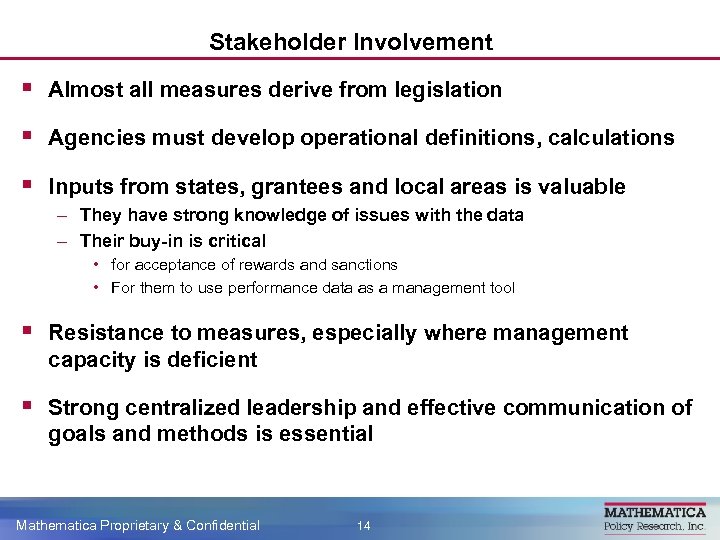 Stakeholder Involvement § Almost all measures derive from legislation § Agencies must develop operational definitions, calculations § Inputs from states, grantees and local areas is valuable – They have strong knowledge of issues with the data – Their buy-in is critical • for acceptance of rewards and sanctions • For them to use performance data as a management tool § Resistance to measures, especially where management capacity is deficient § Strong centralized leadership and effective communication of goals and methods is essential Mathematica Proprietary & Confidential 14
 Fear and Burden § Considerable fear of performance measures § First reaction is to complain about the burden § Reporting burden is exaggerated; performance reporting uses data agencies already track for program management – Follow up data is largest burden; can replace with wage records § Data validation is large burden for family income, homelessness, health performance exclusions § Shifting focus from service delivery to making the numbers Mathematica Proprietary & Confidential 15
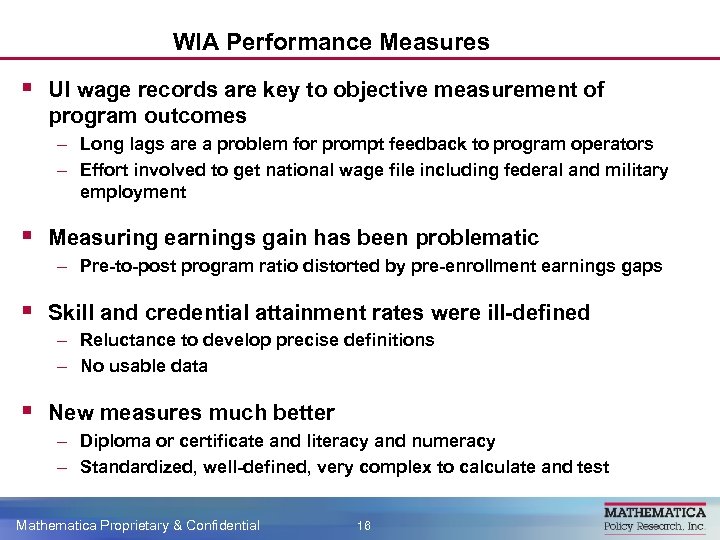 WIA Performance Measures § UI wage records are key to objective measurement of program outcomes – Long lags are a problem for prompt feedback to program operators – Effort involved to get national wage file including federal and military employment § Measuring earnings gain has been problematic – Pre-to-post program ratio distorted by pre-enrollment earnings gaps § Skill and credential attainment rates were ill-defined – Reluctance to develop precise definitions – No usable data § New measures much better – Diploma or certificate and literacy and numeracy – Standardized, well-defined, very complex to calculate and test Mathematica Proprietary & Confidential 16
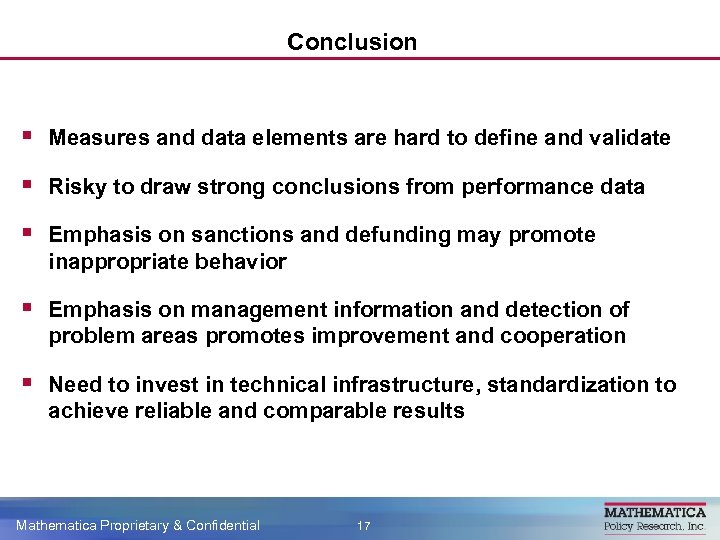 Conclusion § Measures and data elements are hard to define and validate § Risky to draw strong conclusions from performance data § Emphasis on sanctions and defunding may promote inappropriate behavior § Emphasis on management information and detection of problem areas promotes improvement and cooperation § Need to invest in technical infrastructure, standardization to achieve reliable and comparable results Mathematica Proprietary & Confidential 17