


 Скачать презентацию CHALLENGES OF EASTERN AND SOUTHERN AFRICA PORTS
ca9f7ae4e6758c71db2faf0085ce9819.ppt
- Количество слайдов: 24
 CHALLENGES OF EASTERN AND SOUTHERN AFRICA PORTS / INVESTMENT OPPORTUNITIES AND PRODUCTIVITY BY Jerome Ntibarekerwa Secretary General, PMAESA (Port Management Association of Eastern & Southern Africa)
 OVERVIEW • • Introduction Traffic Trends in PMAESA Region Factors driving traffic growth Challenges facing Regional Shipping • Strategies to address challenges • Investment Opportunities • Success Factors for attracting investments • Conclusion
 Introduction Who we are? Port Management Association of Eastern & Southern Africa (PMAESA) is a regional grouping of ports in the eastern and southern Africa, established in 1973 under the auspices of the UNECA. Its membership is composed of state representatives and private sector from: Port Authorities Maritime transport departments Port Operators Maritime regulators
 Introduction ( Continued …) What we do q. Offer platform to exchange ideas and information where members can interface with one another in transport and trade facilitation; q. Assist port development by enhancing productivity and service delivery and trade facilitation; q. Establish linkages from ports to transport Corridors; q. Assist our ports /maritime members to implement IMO conventions; q. Establish and maintain relations with other development partners and transport authorities for the study of matters beneficial to members.
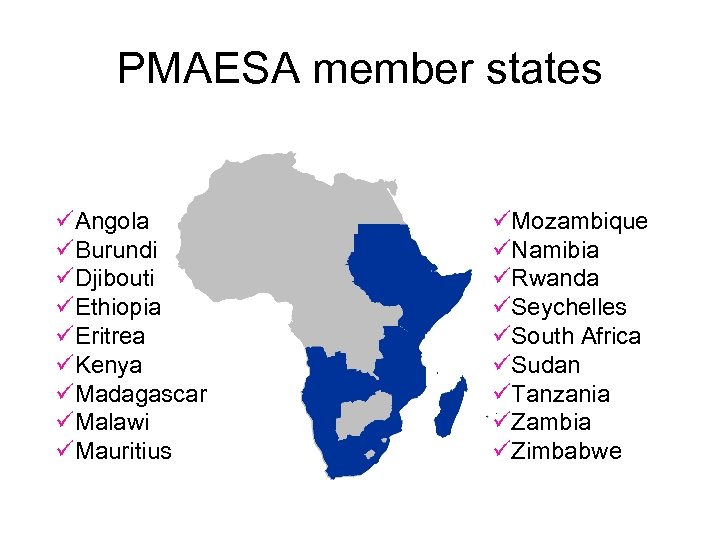 PMAESA member states üAngola üBurundi üDjibouti üEthiopia üEritrea üKenya üMadagascar üMalawi üMauritius üMozambique üNamibia üRwanda üSeychelles üSouth Africa üSudan üTanzania üZambia üZimbabwe
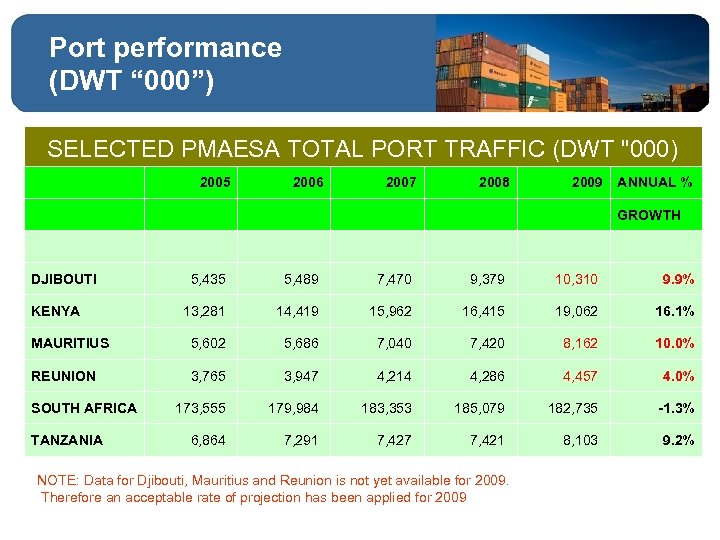 Port performance (DWT “ 000”) SELECTED PMAESA TOTAL PORT TRAFFIC (DWT "000) 2005 2006 2007 2008 2009 ANNUAL % GROWTH DJIBOUTI 5, 435 5, 489 7, 470 9, 379 10, 310 9. 9% KENYA 13, 281 14, 419 15, 962 16, 415 19, 062 16. 1% MAURITIUS 5, 602 5, 686 7, 040 7, 420 8, 162 10. 0% REUNION 3, 765 3, 947 4, 214 4, 286 4, 457 4. 0% SOUTH AFRICA 173, 555 179, 984 183, 353 185, 079 182, 735 -1. 3% TANZANIA 6, 864 7, 291 7, 427 7, 421 8, 103 9. 2% NOTE: Data for Djibouti, Mauritius and Reunion is not yet available for 2009. Therefore an acceptable rate of projection has been applied for 2009
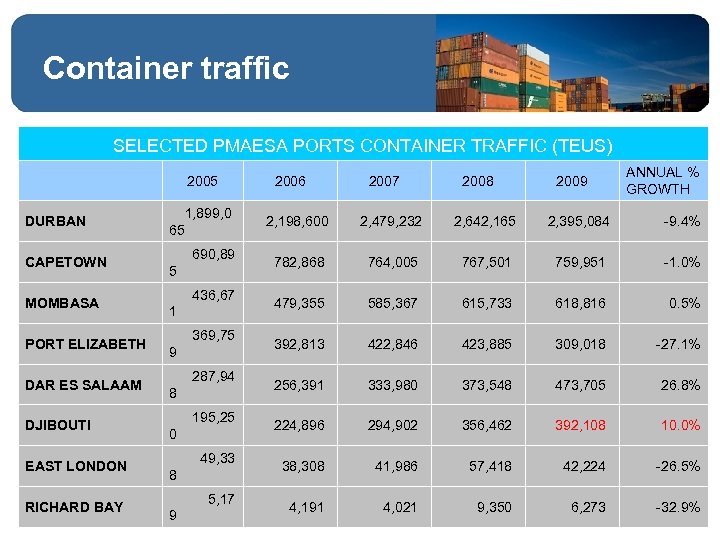 Container traffic SELECTED PMAESA PORTS CONTAINER TRAFFIC (TEUS) 2005 2006 2007 2008 2009 ANNUAL % GROWTH DURBAN 1, 899, 0 65 2, 198, 600 2, 479, 232 2, 642, 165 2, 395, 084 -9. 4% CAPETOWN 690, 89 5 782, 868 764, 005 767, 501 759, 951 -1. 0% MOMBASA 436, 67 1 479, 355 585, 367 615, 733 618, 816 0. 5% PORT ELIZABETH 369, 75 9 392, 813 422, 846 423, 885 309, 018 -27. 1% DAR ES SALAAM 287, 94 8 256, 391 333, 980 373, 548 473, 705 26. 8% DJIBOUTI 195, 25 0 224, 896 294, 902 356, 462 392, 108 10. 0% EAST LONDON 49, 33 8 38, 308 41, 986 57, 418 42, 224 -26. 5% RICHARD BAY 5, 17 9 4, 191 4, 021 9, 350 6, 273 -32. 9%
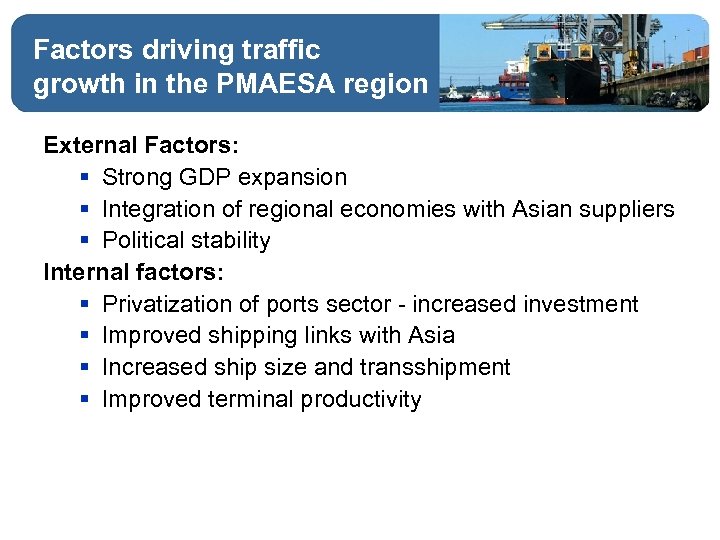 Factors driving traffic growth in the PMAESA region External Factors: § Strong GDP expansion § Integration of regional economies with Asian suppliers § Political stability Internal factors: § Privatization of ports sector - increased investment § Improved shipping links with Asia § Increased ship size and transshipment § Improved terminal productivity
 Key Challenges in PMAESA Ports § § Insufficient container storage space Long container dwell time Rapid increase in container traffic Low performance of inland modes of transport especially the rail lines with very low availability of wagons and locomotives. § Acquiring more space for port activities
 Key Challenges Cont’ § Infrastructure development: Purchasing new equipments § The use of ICDs § Developing IT systems and free port activities § Restructuring the management model § Improving safety, security and environment protection to meet international standards
 Strategies to address challenges § More investment to increase container terminals capacity and Inland Depot § Improve efficiency and productivity within the existing port infrastructure and equipment § Continue to involve private sector in port operations and concessioning which will improve port development
 Investment Opportunities • • • Development of Free Zones activities Private sector Participation in port development activities Restructuring towards Landlord Port with Private sector participation Improvement of operational practices by concession of commercial and operational activities. Railway sector as the less expensive, safer and secure mode of transport than road haulage
 Challenges with Growing Demand: Key ports in the region Key ports in the Eastern and Southern Region: § Kenya Ports Authority § Tanzania Ports Authority § South Africa , Transet NPA § Djibouti port , DP World § Sudan port Cooperation
 Challenges with Kenya Ports Authority § § The rapid increase of traffic is likely to continue The container Dwell time is yet to be reduced The hinterland rail connections remain inefficient More dependence on road mode of transport with 3 axle road rule constraint for hauliers § Long documentation procedures § Inadequate capacity to handle the forecasted cargo volumes;
 Challenges with Kenya Ports Authority (Cont) § The exploration of Oil in Lamu District § The Regional Integration expectations : EAC/COMESA Customs Union expected positive results § The Transport Sector Reforms : Concession of RVR, Rehabilitation of major roads links to other countries
 Challenges with Djibouti Ports § The throughput in TEU has grown by 31% in 2007 while the General Cargo grew by 44% § The stripping operations by Freight Forwarders remain very slow § The yard is occupied at 95% § There is a high level of stacking ( up to 5 highs) § The number of full and empty containers is very high § The port is facing many difficulties linked with Ethiopian bureaucracy as 85% of the total handled cargo is for Ethiopia
 Challenges with Tanzania Ports Authority § The insufficient container storage space § The long container dwell time (has reached 25 days in Aug. 2008) § The rapid increase of container traffic and § The low performance of inland modes of transport especially the rail lines with very low availability of wagons and locomotives.
 Challenges with Tanzania Ports Authority (Cont) § More investment to increase container terminals capacity and Inland Depot § Improve efficiency and productivity within the existing port infrastructure and equipment § Continue to involve private sector in port operations and concessioning which will improve port development
 Challenges in South Africa (TRANSNET NPA) Responding to the opportunities presented by : 1. Growth in global economic activity - increase inter/intra African trade § Link industrial and mining sector activity to markets § Alternate logistic & hub – South S trade § Regional economic integration – Transport corridor development § Intermodal harmonisation to improve regional supply chain and reduce logistics costs
 Challenges with Sea Port Corporation – Sudan § To cope with technological advances in maritime industries § To face the political and economical challenges internally and externally: Requirements of WTO, COMESA agenda § Exploration of Sudanese Oil, § To handle economic activities logistics after Peace Agreements in Sudan.
 Key Success Factors for attracting investments v. A real political will v. Good governance : Transparency in adjudication criteria and in decision making in case of concession and / or privatization process v. Move all “ Bottlenecks” relating to policy, regulatory, bureaucracy etc… v. Fiscal and non fiscal incentives
 Proposed series of fiscal and non fiscal incentives • • A simplified legal framework A range of tax and non tax incentives Exemption of income taxes, customs duties Free access and transfer of the foreign currencies • Repatriation of profits and dividends • Guarantee of property right • Dispute resolution by International Arbitration etc…
 Conclusion Promotion of foreign Investment in PMAESA Region will require : 1. A Real Political will ( flexibility in decision making) 2. A Number of elements to guarantee Return on Investment (ROI)
 Thank you for your attention Do You Have Any Questions?