 Скачать презентацию Challenges in surveillance and control of rabies in
96201148f45b39ebf72c86a44070361e.ppt
- Количество слайдов: 42




Challenges in surveillance and control of rabies in the Pacific Northwest Mira J. Leslie, DVM, MPH
Todays Topics • Rabies: § § Brief Background and ecology Describe surveillance in animals (PNW) Epidemiology in humans Ongoing challenges in rabies surveillance and control in PNW
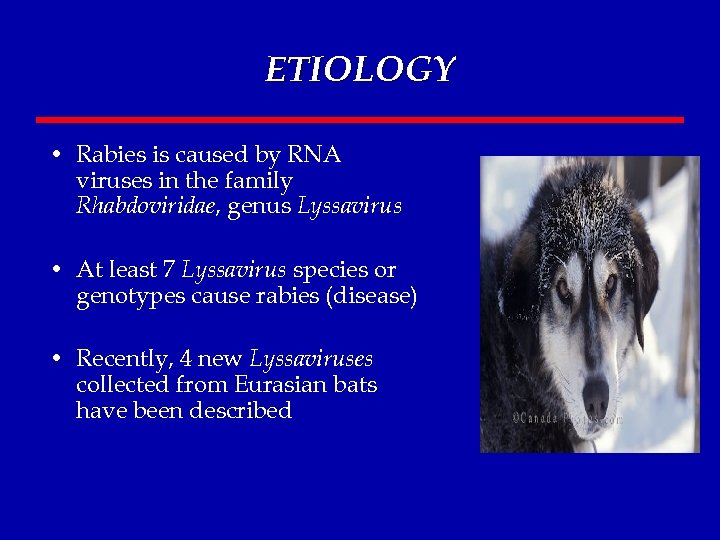
ETIOLOGY • Rabies is caused by RNA viruses in the family Rhabdoviridae, genus Lyssavirus • At least 7 Lyssavirus species or genotypes cause rabies (disease) • Recently, 4 new Lyssaviruses collected from Eurasian bats have been described
Rabies • Acute, progressive viral (Genus Lyssavirus) encephalitis • Highest case fatality of any infectious disease • One of the oldest diseases described • Model zoonosis
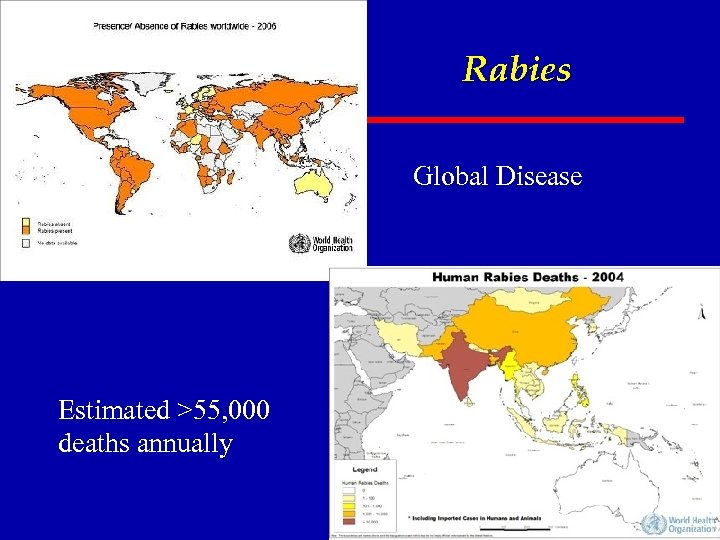
Rabies • Global Disease Estimated >55, 000 deaths annually
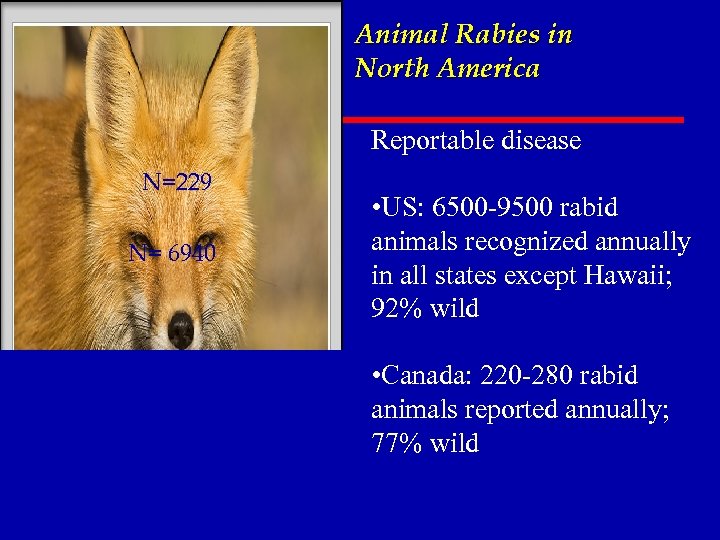
Animal Rabies in North America Reportable disease N=229 N= 6940 • US: 6500 -9500 rabid animals recognized annually in all states except Hawaii; 92% wild • Canada: 220 -280 rabid animals reported annually; 77% wild
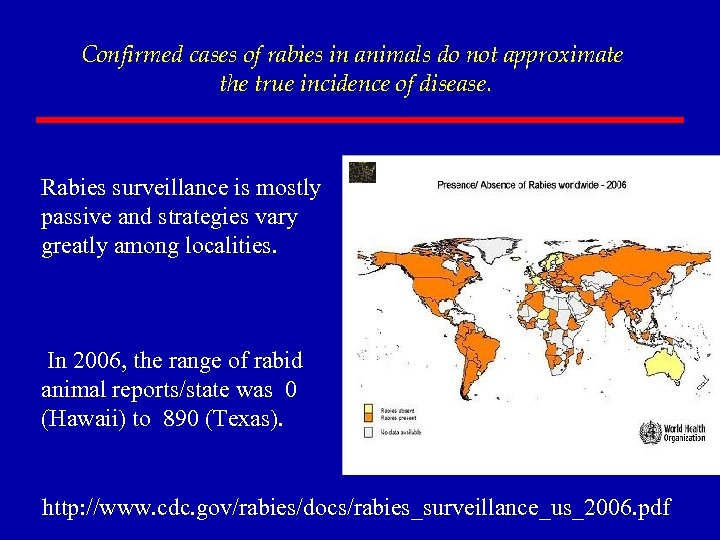
Confirmed cases of rabies in animals do not approximate the true incidence of disease. Rabies surveillance is mostly passive and strategies vary greatly among localities. In 2006, the range of rabid animal reports/state was 0 (Hawaii) to 890 (Texas). http: //www. cdc. gov/rabies/docs/rabies_surveillance_us_2006. pdf
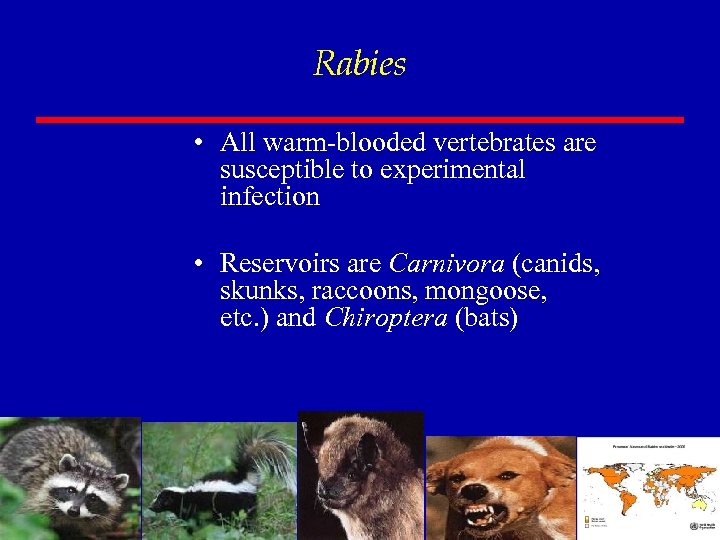
Rabies • All warm-blooded vertebrates are susceptible to experimental infection • Reservoirs are Carnivora (canids, skunks, raccoons, mongoose, etc. ) and Chiroptera (bats)
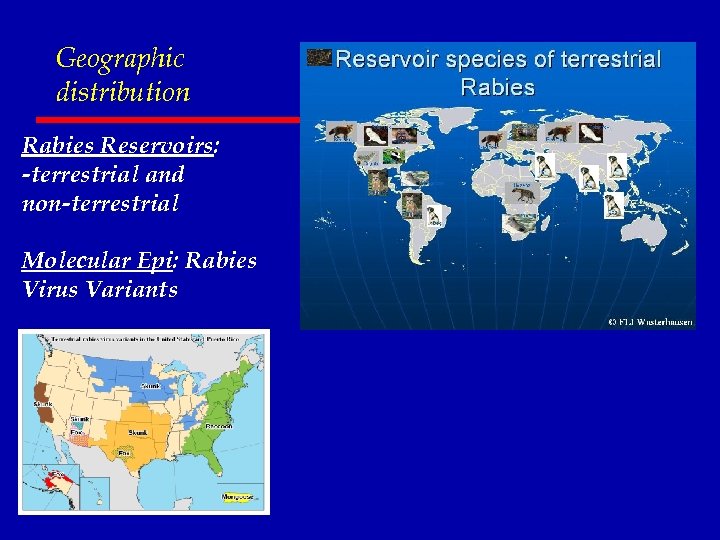
Geographic distribution Rabies Reservoirs: -terrestrial and non-terrestrial Molecular Epi: Rabies Virus Variants
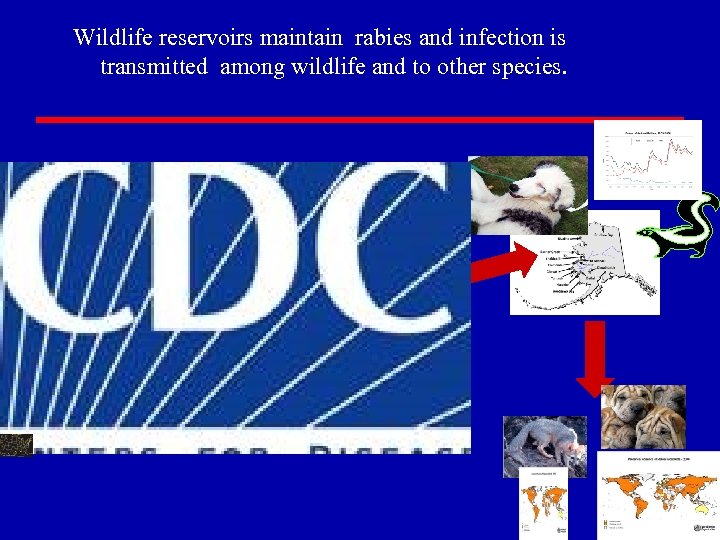
Wildlife reservoirs maintain rabies and infection is transmitted among wildlife and to other species.
Surveillance infrastructure Large variability among jurisdictions • Laboratory capacity • Citizen density and awareness– reporting of sick and dead wildlife, pet-wildlife interaction. • Local capacity for response to citizen reports • Resources and systems for transport of animal heads § New IHC test can be done in field
Enzootic rabies surveillance: sampling strategies • Laboratory testing of § potentially rabid animals that have exposed people § wildlife that exposes pets. § all reported sick (abnormal behavior) and freshly dead carnivores and chiroptera without obvious trauma § animals that are neurologically impaired or exhibiting unusual behavior (except rodents and rabbits) • Testing of healthy animals is ineffective § road-kill (except in the face of ongoing epizootic) § trapped, hunted or nuisance animals
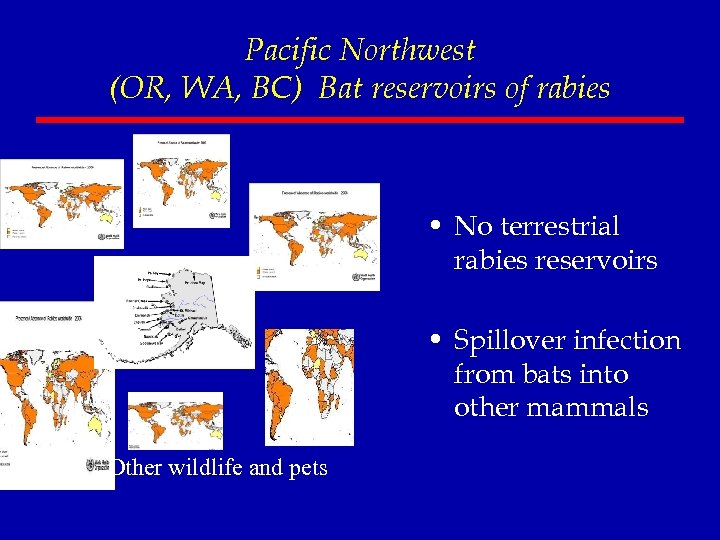
Pacific Northwest (OR, WA, BC) Bat reservoirs of rabies • No terrestrial rabies reservoirs • Spillover infection from bats into other mammals Other wildlife and pets
Rabies in Bats Affects many species Big brown (E. fuscus), Mexican free-tail, Myotis…. Solitary species (13%)> colonial species (5%) • Appear injured • Found flapping or dead on ground • Flying during the day • When in urban area, often expose human and/ or pets § Found in pets mouth § Child finds bat
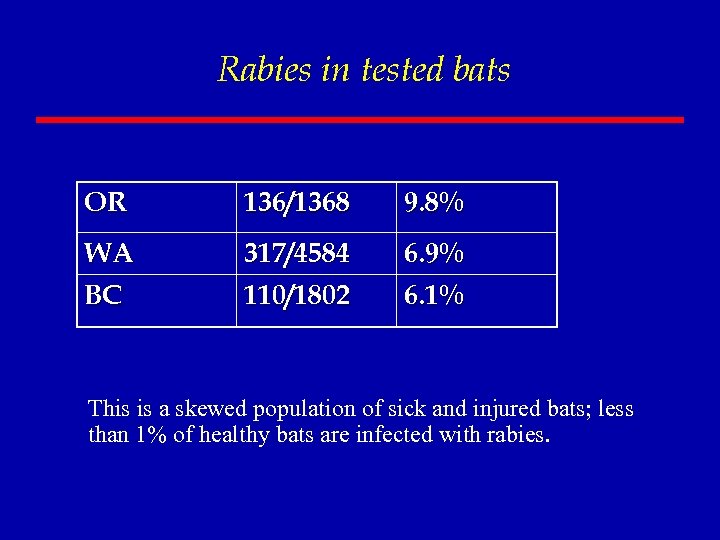
Rabies in tested bats OR 136/1368 9. 8% WA BC 317/4584 110/1802 6. 9% 6. 1% This is a skewed population of sick and injured bats; less than 1% of healthy bats are infected with rabies.
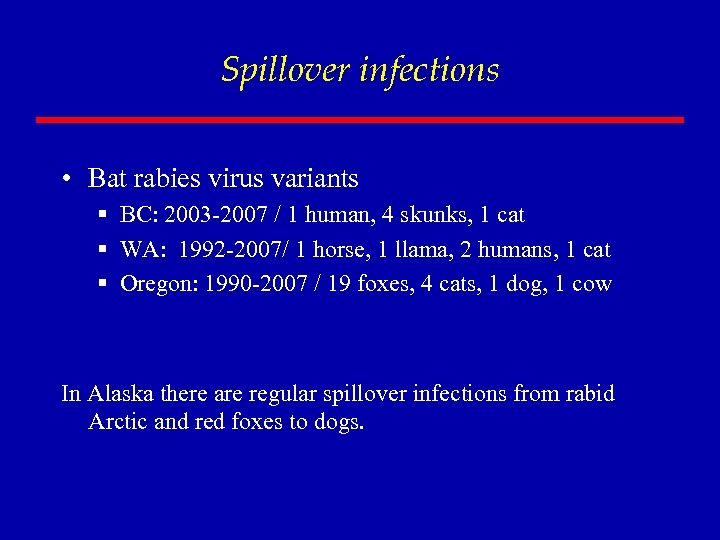
Spillover infections • Bat rabies virus variants § BC: 2003 -2007 / 1 human, 4 skunks, 1 cat § WA: 1992 -2007/ 1 horse, 1 llama, 2 humans, 1 cat § Oregon: 1990 -2007 / 19 foxes, 4 cats, 1 dog, 1 cow In Alaska there are regular spillover infections from rabid Arctic and red foxes to dogs.
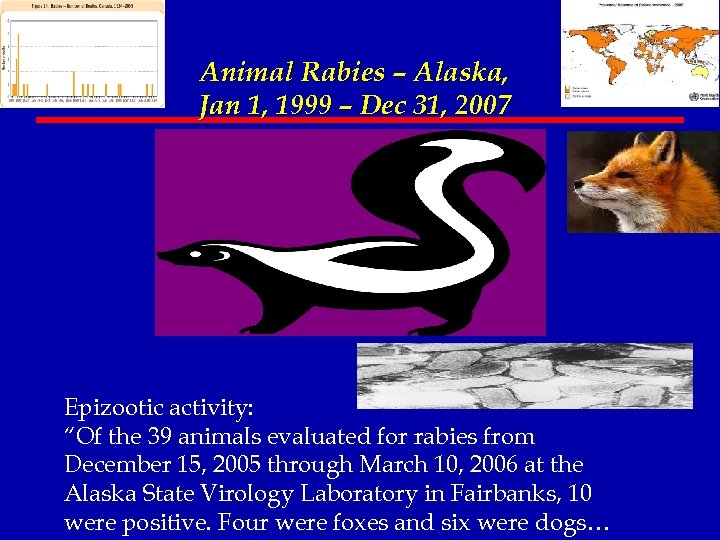
Animal Rabies – Alaska, Jan 1, 1999 – Dec 31, 2007 Epizootic activity: “Of the 39 animals evaluated for rabies from December 15, 2005 through March 10, 2006 at the Alaska State Virology Laboratory in Fairbanks, 10 were positive. Four were foxes and six were dogs…
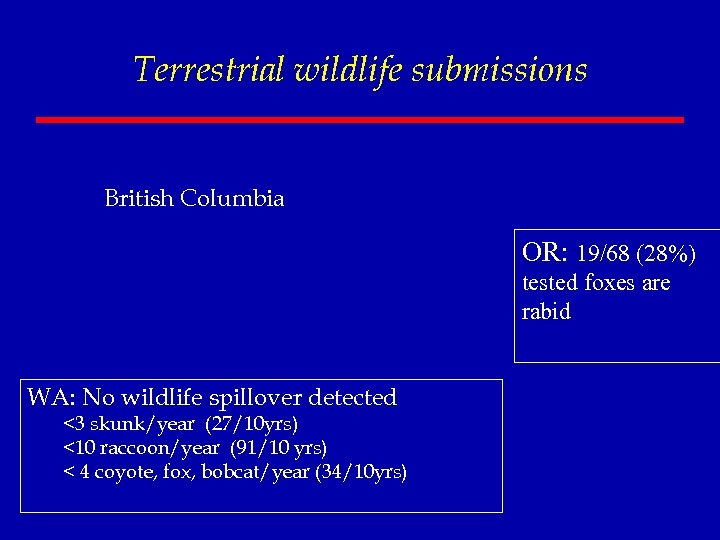
Terrestrial wildlife submissions British Columbia OR: 19/68 (28%) tested foxes are rabid WA: No wildlife spillover detected <3 skunk/year (27/10 yrs) <10 raccoon/year (91/10 yrs) < 4 coyote, fox, bobcat/year (34/10 yrs)
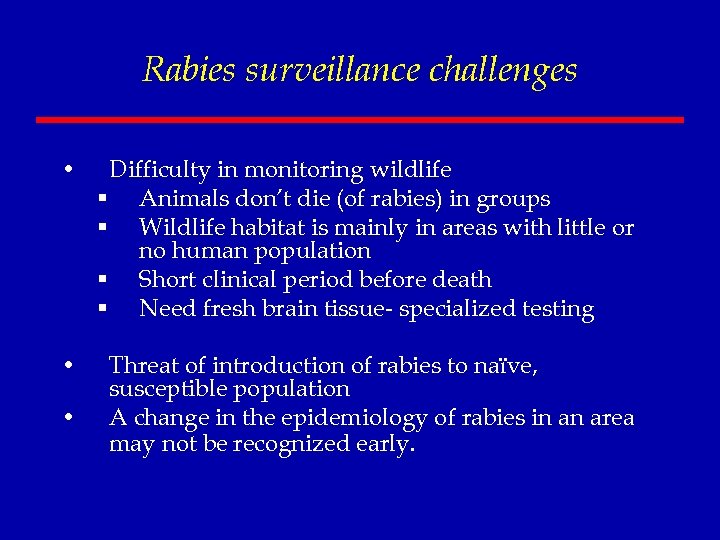
Rabies surveillance challenges • Difficulty in monitoring wildlife § Animals don’t die (of rabies) in groups § Wildlife habitat is mainly in areas with little or no human population § Short clinical period before death § Need fresh brain tissue- specialized testing • Threat of introduction of rabies to naïve, susceptible population A change in the epidemiology of rabies in an area may not be recognized early. •
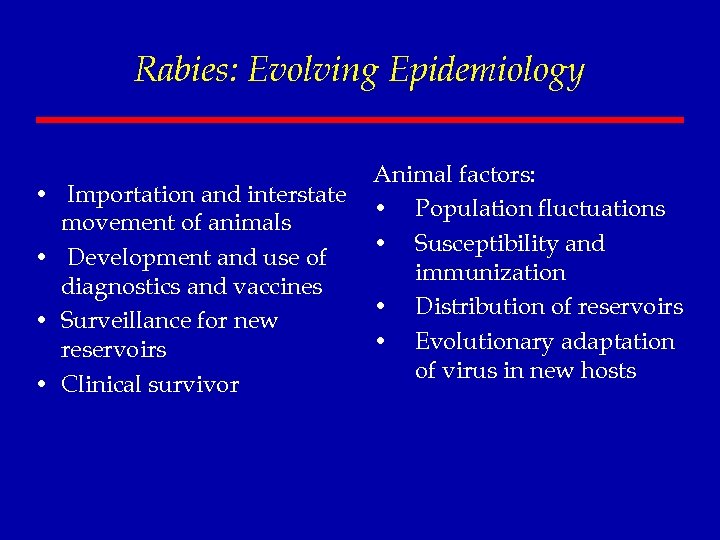
Rabies: Evolving Epidemiology • Importation and interstate movement of animals • Development and use of diagnostics and vaccines • Surveillance for new reservoirs • Clinical survivor Animal factors: • Population fluctuations • Susceptibility and immunization • Distribution of reservoirs • Evolutionary adaptation of virus in new hosts
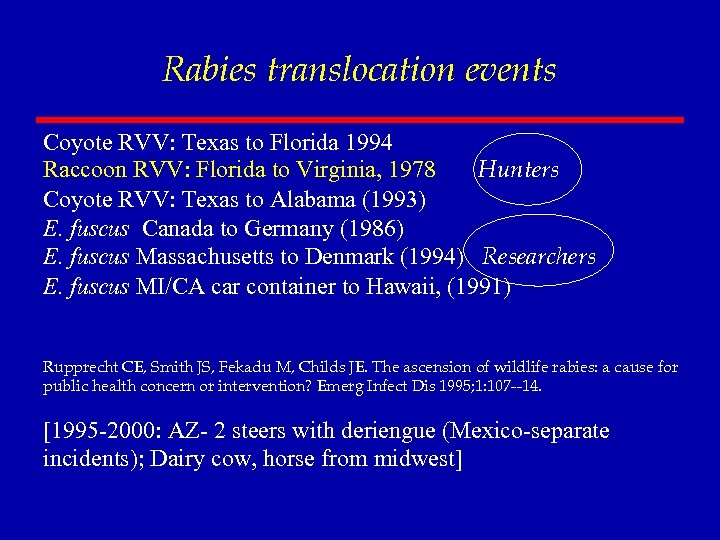
Rabies translocation events Coyote RVV: Texas to Florida 1994 Raccoon RVV: Florida to Virginia, 1978 Hunters Coyote RVV: Texas to Alabama (1993) E. fuscus Canada to Germany (1986) E. fuscus Massachusetts to Denmark (1994) Researchers E. fuscus MI/CA car container to Hawaii, (1991) Rupprecht CE, Smith JS, Fekadu M, Childs JE. The ascension of wildlife rabies: a cause for public health concern or intervention? Emerg Infect Dis 1995; 1: 107 --14. [1995 -2000: AZ- 2 steers with deriengue (Mexico-separate incidents); Dairy cow, horse from midwest]
March 2007 • New Delhi, India • Veterinarian from WA state: volunteer at animal shelter • Adopts 2 street puppies § § Unvaccinated (> 12 weeks old) Unknown health histories Acting normally at time of rescue Reports of puppy being “picked on” by other street dogs
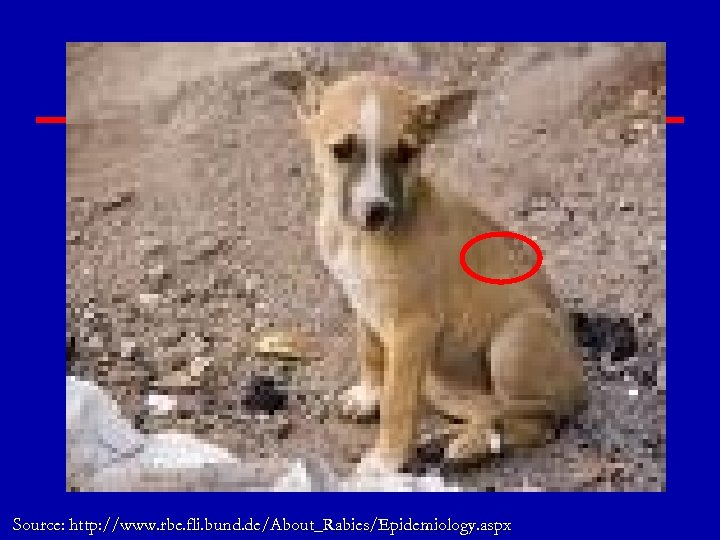
Source: http: //www. rbe. fli. bund. de/About_Rabies/Epidemiology. aspx
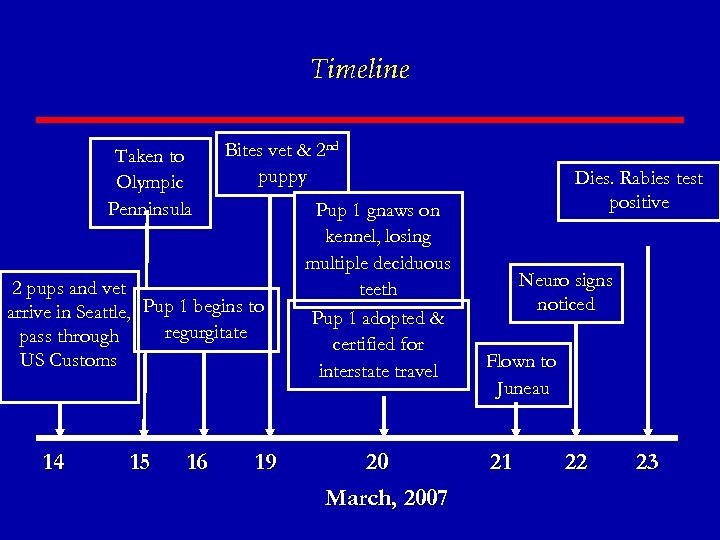
Timeline Taken to Olympic Penninsula Bites vet & 2 nd puppy 2 pups and vet arrive in Seattle, Pup 1 begins to regurgitate pass through US Customs 14 15 16 19 Pup 1 gnaws on kennel, losing multiple deciduous teeth Pup 1 adopted & certified for interstate travel 20 March, 2007 Dies. Rabies test positive Neuro signs noticed Flown to Juneau 21 22 23
Imported rabid puppy, 2007 • Second pup euthanized and tested • 8 people received PEP • Customs protocols reviewed • Health certificate for interstate travel should not have been given
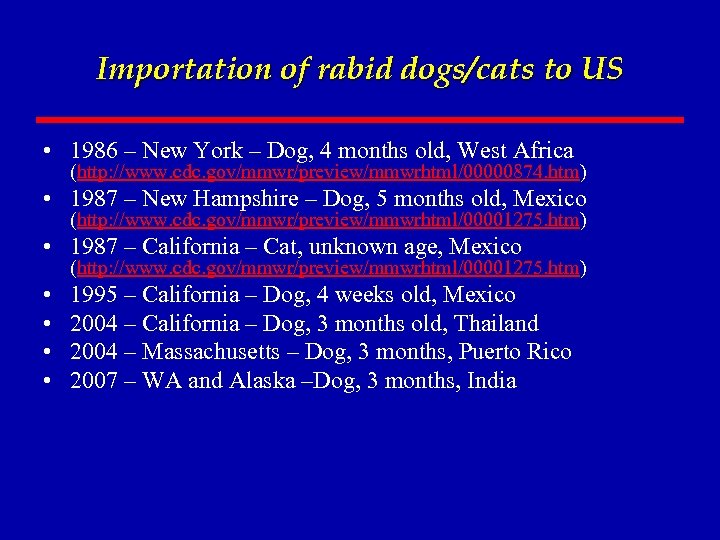
Importation of rabid dogs/cats to US • 1986 – New York – Dog, 4 months old, West Africa (http: //www. cdc. gov/mmwr/preview/mmwrhtml/00000874. htm) • 1987 – New Hampshire – Dog, 5 months old, Mexico (http: //www. cdc. gov/mmwr/preview/mmwrhtml/00001275. htm) • 1987 – California – Cat, unknown age, Mexico (http: //www. cdc. gov/mmwr/preview/mmwrhtml/00001275. htm) • • 1995 – California – Dog, 4 weeks old, Mexico 2004 – California – Dog, 3 months old, Thailand 2004 – Massachusetts – Dog, 3 months, Puerto Rico 2007 – WA and Alaska –Dog, 3 months, India
Dog imports raise fears of a resurgence of disease ABC NEWS: Oct 24, 2007 300, 000 Imported Puppies Prompt Rabies Concerns CDC, After Declaring Canine Rabies Eradicated, Now Looks at New, Stricter Rules By SUSAN DONALDSON JAMES Oct. 24, 2007 Just last month the Centers for Disease Control and Prevention declared victory over canine rabies in the United States -- a fatal virus that kills 55, 000 people a year globally. That declaration may have been premature. “ By Alan Gomez , USA Today: Oct 21, 2007 When animal shelters started going overseas to fill their emptying kennels, some worried the imported strays would bring foreign diseases and even rabies into the USA.
Imported Pets a Growing Business in U. S. Dec. 17, 2007 The Associated Press The Internet is full of sites that claim to be selling healthy local puppies, but actually deal in imports from Eastern Europe, Russia, Asia, and Central America. • The Border Puppy Task Force in California estimates that 10, 000 puppies entered San Diego County from Mexico in just one year. These puppies are sold in shopping center parking lots, on the street, and in pet stores.
Rabies surveillance and control in humans
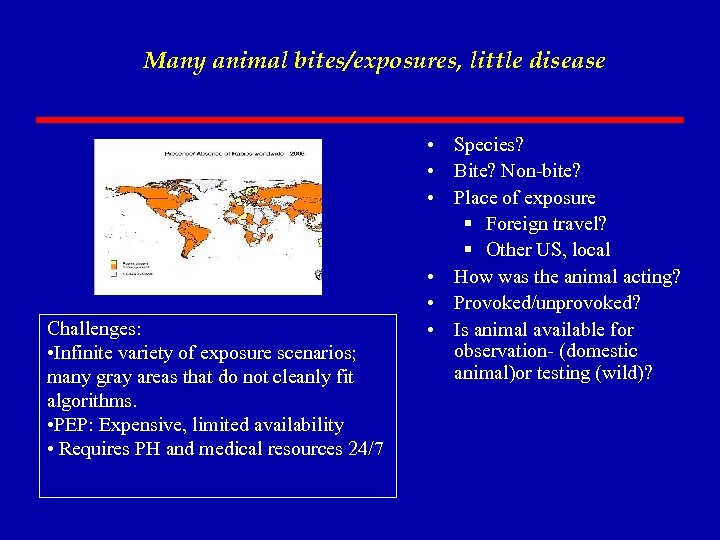
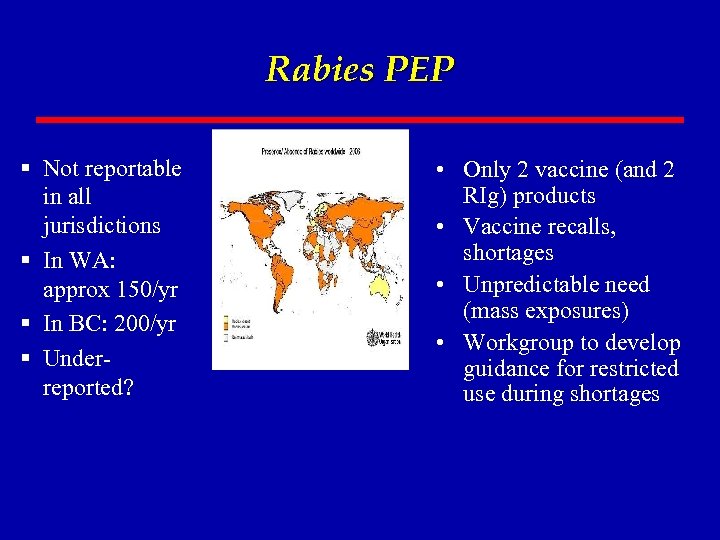
Many animal bites/exposures, little disease Challenges: • Infinite variety of exposure scenarios; many gray areas that do not cleanly fit algorithms. • PEP: Expensive, limited availability • Requires PH and medical resources 24/7 • Species? • Bite? Non-bite? • Place of exposure § Foreign travel? § Other US, local • How was the animal acting? • Provoked/unprovoked? • Is animal available for observation- (domestic animal)or testing (wild)?
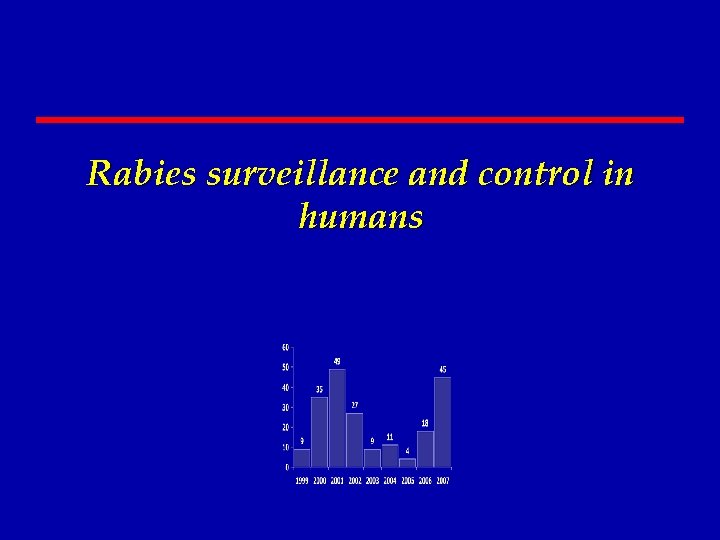
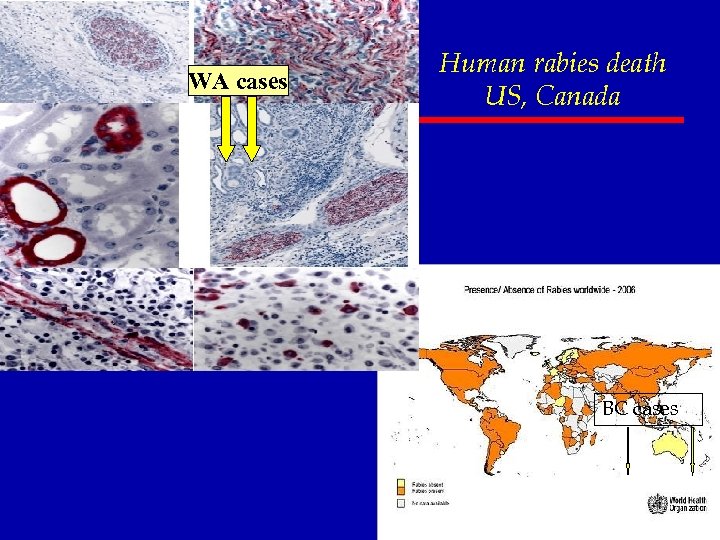
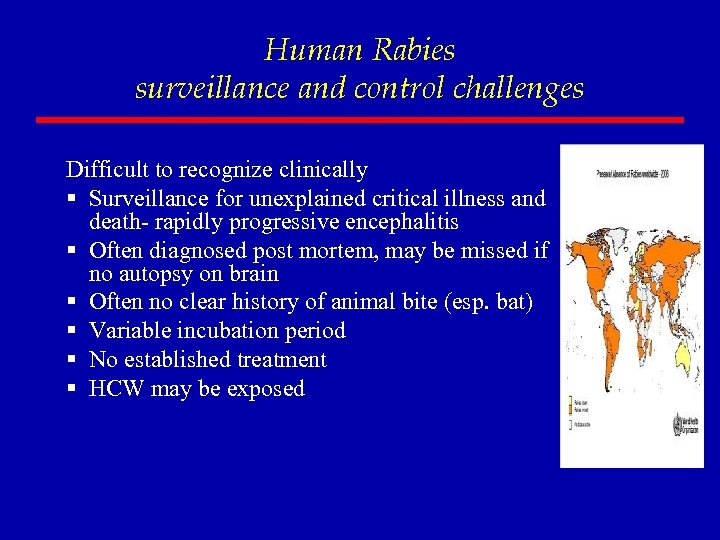
Human Rabies • Human rabies is rare and is reportable in all jursidictions • Human rabies is preventable (est >30, 000 PEP series annually in US) • >70% cases in US associated with insectivorous bat rabies virus variants • Challenge: reduce unnecessary PEP
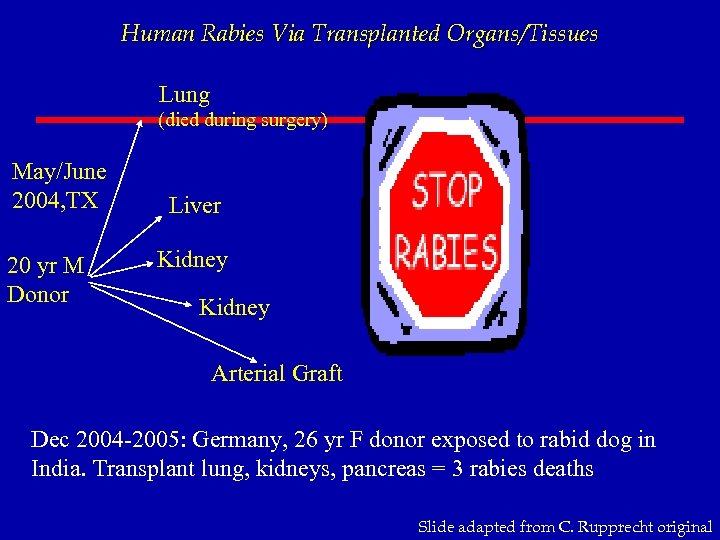
Human Rabies Exposures Often are preventable Educate public not to handle bats or other wildlife and stray animals, vaccinate pets, Pre-exposure prophylaxis veterinarians, wildlife biologists, rehabilitators, foreign travel… Standard precautions HCW Standardize criteria in mass exposure events
Mass exposure events • • • 465 PEP: County fair- goat, NYS, 1996 665 PEP: Pet shop kitten, NH 1994 >100 PEP: Petsmart puppy, AZ 2002 >450 PEP: BC human case- health care workers, family >120 PEP: Raw milk- dairy cows, OK 2005, MA 1996 and 1998 • Tennessee Walking Horse competition, 2006, (only 24) • Rabid kitten softball tournament 2007 (37 PEP) • Toronto flea market puppy, 2007 Schools, day care, roadside zoo, campgrounds. . .
WA cases Human rabies death US, Canada BC cases
Human Rabies Via Transplanted Organs/Tissues Lung (died during surgery) May/June 2004, TX 20 yr M Donor Liver Kidney Arterial Graft Dec 2004 -2005: Germany, 26 yr F donor exposed to rabid dog in India. Transplant lung, kidneys, pancreas = 3 rabies deaths Slide adapted from C. Rupprecht original
Human Rabies surveillance and control challenges Difficult to recognize clinically § Surveillance for unexplained critical illness and death- rapidly progressive encephalitis § Often diagnosed post mortem, may be missed if no autopsy on brain § Often no clear history of animal bite (esp. bat) § Variable incubation period § No established treatment § HCW may be exposed
Rabies PEP § Not reportable in all jurisdictions § In WA: approx 150/yr § In BC: 200/yr § Underreported? • Only 2 vaccine (and 2 RIg) products • Vaccine recalls, shortages • Unpredictable need (mass exposures) • Workgroup to develop guidance for restricted use during shortages
The interface: The value of animal rabies surveillance • Animal rabies data is foundation for PEP recommendations in absence of animal available for testing/observation. • Early detection of epizootics resulting from disease introduction, evolution/adaptation, natural cycles. • Provides information to target and implement appropriate public health interventions.
Rabies Guidelines ACIP Human Rabies Prevention, 1999 http: //www. cdc. gov/MMWR/preview/mmwrhtml/00056176. htm ACIP clear on raccoon, skunk, coyote, fox bites § wild mammal bites referred for PEP? § Is there adequate epi information? Rabies Compendium 2008 http: //www. nasphv. org/Documents/Rabies. Compendium. pdf Rabies compendium clear on need for vaccination in pets Movement to reduce vaccines in pets- Is this a vulnerability?
RABIES: Ongoing challenges • Threat of disease introduction: § Global and national movement of pets and other animals; vferal, stray, wild animals, hunting stock, stow-away vexotic animal trade vpet shelters vzoos vresearch vfood animals vrecreational animals
RABIES: Ongoing challenges • How do we maintain awareness (of bat and spillover rabies infections) among public, physicians and veterinarians? § Vaccinate pets, teach children § Level of suspicion in encephalitis • How can we assure availability of biologicals for individual and potential mass exposures? § Reduce unnecessary PEP
Acknowledgements • Louisa Castrodale, Alaska DHSS • Reena Gulati, EIS- SPHKC • Rebecca Baer, WDOH • Emilio De. Bess, OR DHS • Eleni Galanis, BCCDC • Public health rabies laboratories • CFIA, CDC
Скачать презентацию Challenges in surveillance and control of rabies in
96201148f45b39ebf72c86a44070361e.ppt