


 Скачать презентацию Challenges in Economic Statistics — How they evolved
7fbffc07ba1823c500f8f5c355fac78a.ppt
- Количество слайдов: 11
 Challenges in Economic Statistics -- How they evolved in Japan -Shigeru Kawasaki Statistical Research and Training Institute Ministry of Internal Affairs and Communications, Japan Presentation at the International Forum on Monitoring National Development: Issues and Challenges Beijing, People’s Republic of China, 27 -29 September 2011 Views expressed in this presentation are personal, and do not necessarily represent the official position of the Government.
 Introduction u Needs for economic statistics are varied among countries, and affected by various factors, such as the level of economic development, political conditions, cultural background, etc. u Challenges of economic statistics are also varied among countries, and they shift over time. u To provide a broad perspective, this presentation discusses the evolution of issues and challenges of economic statistics in Japan over the last half century. u In this presentation, the challenges in statistics are discussed for three stages of economic development: Stage of Rapid Growth (1945 -1970) Stage of Economic Slowdown (1970 -1990) Stage after the Economic Bubble (1990 -Present)
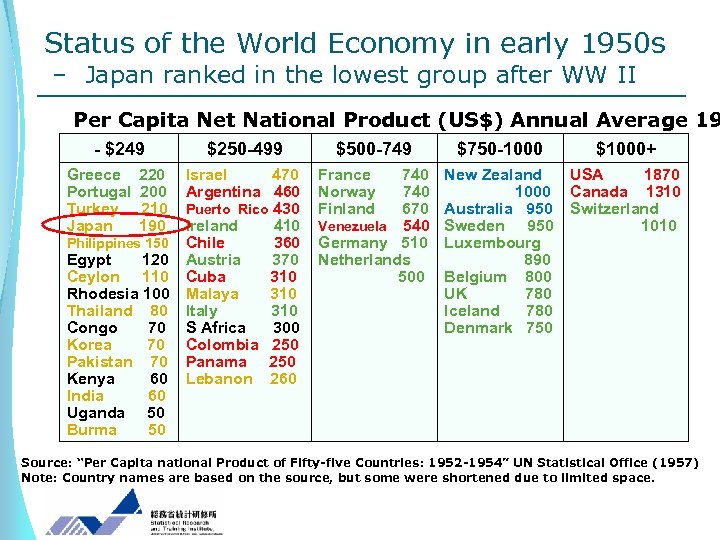 Status of the World Economy in early 1950 s – Japan ranked in the lowest group after WW II Per Capita Net National Product (US$) Annual Average 19 - $249 Greece Portugal Turkey Japan 220 200 210 190 Philippines 150 Egypt 120 Ceylon 110 Rhodesia 100 Thailand 80 Congo 70 Korea 70 Pakistan 70 Kenya 60 India 60 Uganda 50 Burma 50 $250 -499 Israel 470 Argentina 460 Puerto Rico 430 Ireland 410 Chile 360 Austria 370 Cuba 310 Malaya 310 Italy 310 S Africa 300 Colombia 250 Panama 250 Lebanon 260 $500 -749 France Norway Finland 740 670 Venezuela 540 Germany 510 Netherlands 500 $750 -1000 $1000+ New Zealand 1000 Australia 950 Sweden 950 Luxembourg 890 Belgium 800 UK 780 Iceland 780 Denmark 750 USA 1870 Canada 1310 Switzerland 1010 Source: “Per Capita national Product of Fifty-five Countries: 1952 -1954” UN Statistical Office (1957) Note: Country names are based on the source, but some were shortened due to limited space.
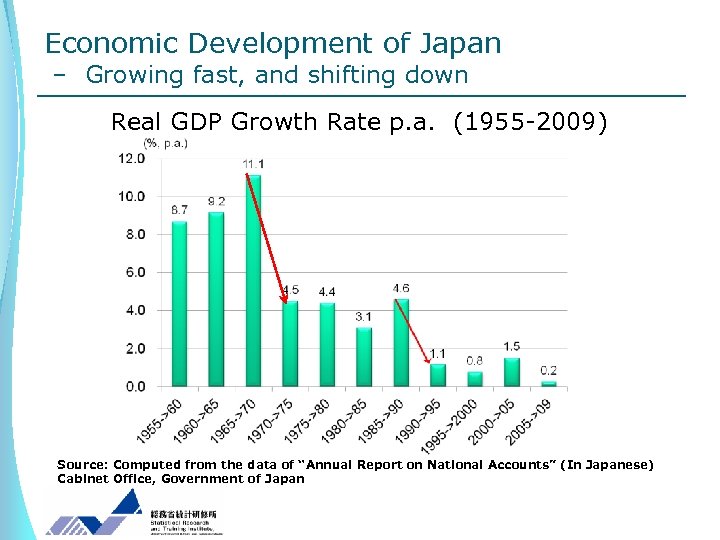 Economic Development of Japan – Growing fast, and shifting down Real GDP Growth Rate p. a. (1955 -2009) Source: Computed from the data of “Annual Report on National Accounts” (In Japanese) Cabinet Office, Government of Japan
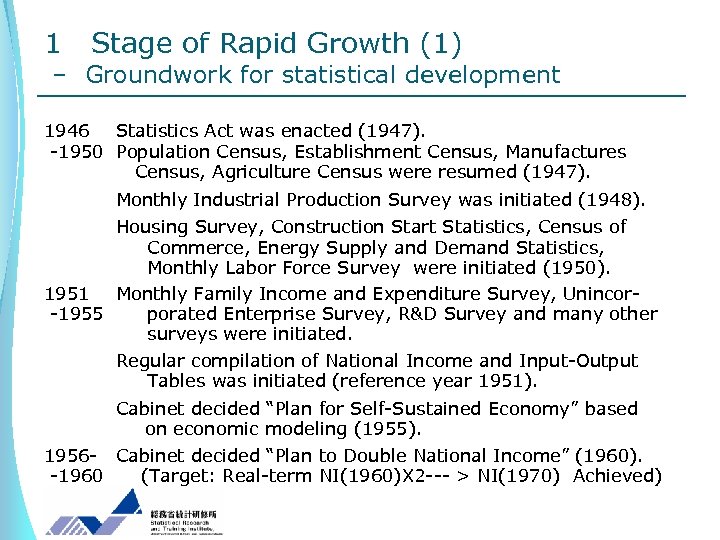 1 Stage of Rapid Growth (1) – Groundwork for statistical development 1946 Statistics Act was enacted (1947). -1950 Population Census, Establishment Census, Manufactures Census, Agriculture Census were resumed (1947). Monthly Industrial Production Survey was initiated (1948). Housing Survey, Construction Start Statistics, Census of Commerce, Energy Supply and Demand Statistics, Monthly Labor Force Survey were initiated (1950). 1951 Monthly Family Income and Expenditure Survey, Unincor-1955 porated Enterprise Survey, R&D Survey and many other surveys were initiated. Regular compilation of National Income and Input-Output Tables was initiated (reference year 1951). Cabinet decided “Plan for Self-Sustained Economy” based on economic modeling (1955). 1956 - Cabinet decided “Plan to Double National Income” (1960). -1960 (Target: Real-term NI(1960)X 2 --- > NI(1970) Achieved)
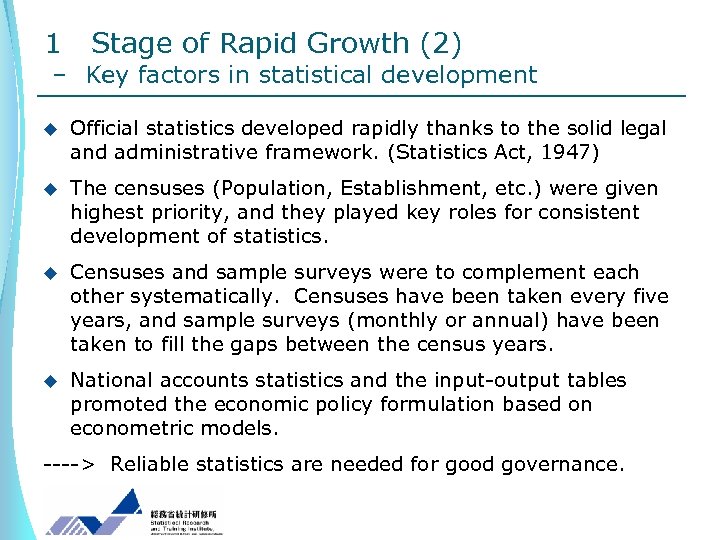 1 Stage of Rapid Growth (2) – Key factors in statistical development u Official statistics developed rapidly thanks to the solid legal and administrative framework. (Statistics Act, 1947) u The censuses (Population, Establishment, etc. ) were given highest priority, and they played key roles for consistent development of statistics. u Censuses and sample surveys were to complement each other systematically. Censuses have been taken every five years, and sample surveys (monthly or annual) have been taken to fill the gaps between the census years. u National accounts statistics and the input-output tables promoted the economic policy formulation based on econometric models. ----> Reliable statistics are needed for good governance.
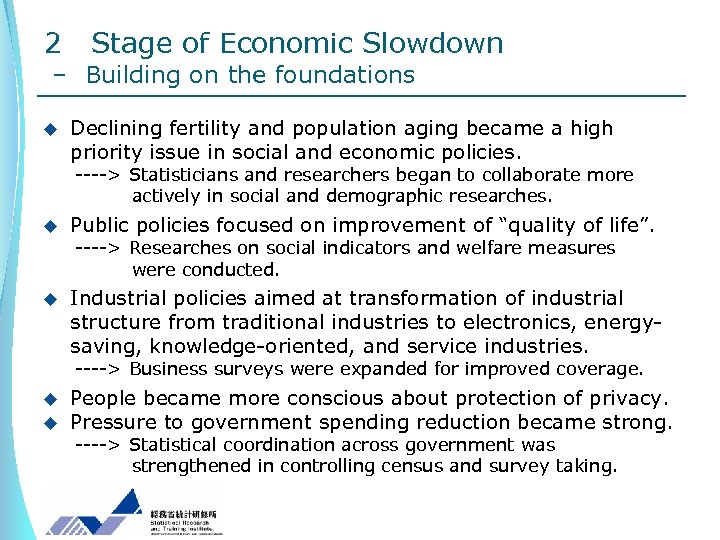 2 Stage of Economic Slowdown – Building on the foundations u Declining fertility and population aging became a high priority issue in social and economic policies. ----> Statisticians and researchers began to collaborate more actively in social and demographic researches. u Public policies focused on improvement of “quality of life”. ----> Researches on social indicators and welfare measures were conducted. u Industrial policies aimed at transformation of industrial structure from traditional industries to electronics, energysaving, knowledge-oriented, and service industries. ----> Business surveys were expanded for improved coverage. u u People became more conscious about protection of privacy. Pressure to government spending reduction became strong. ----> Statistical coordination across government was strengthened in controlling census and survey taking.
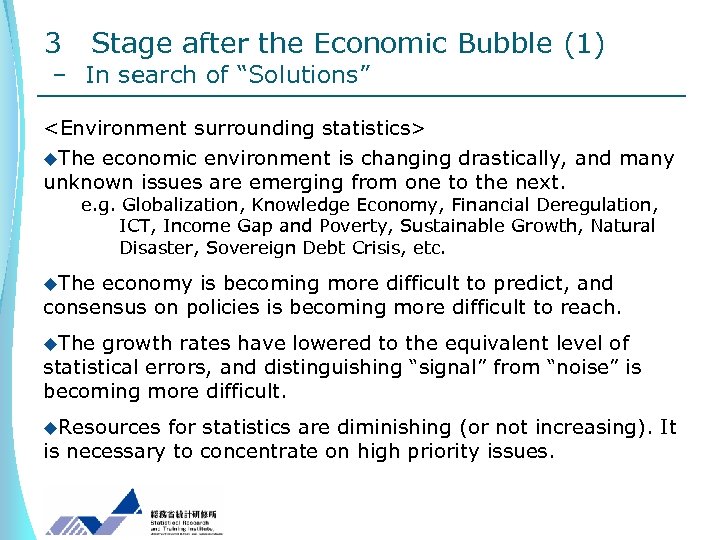 3 Stage after the Economic Bubble (1) – In search of “Solutions”
 3 Stage after the Economic Bubble (2) – In search of “Solutions”
 4 Conclusion u In an early stage of economic development, compilation of the basic set of statistics (e. g. censuses, national accounts) is of high priority. Establishing a solid framework for statistical development is necessary. u In a more developed stage, more emphasis has to be placed on improving quality of statistics, and it requires good communication with users and data providers. u In Japan, the Economic Census will be taken in early 2012, and the new business register is being developed for continuous update by administrative data. National accounts statistics will be improved with new data sources. These efforts are expected to help improve the quality and the value of statistics.
 The End Thank you!