 Скачать презентацию Challenges in Astrophysics of CR knee— γ-rays
ce7a67d8c801ad8d7d3f46cf4384cc26.ppt
- Количество слайдов: 46



Challenges in Astrophysics of CR (knee--) & γ-rays Igor V. Moskalenko (Stanford U. ) Topics covered: Ø Intro to the relevant physics Ø Modeling of the CR propagation and diffuse emission Ø Perspectives: Pamela, GLAST and other near future missions
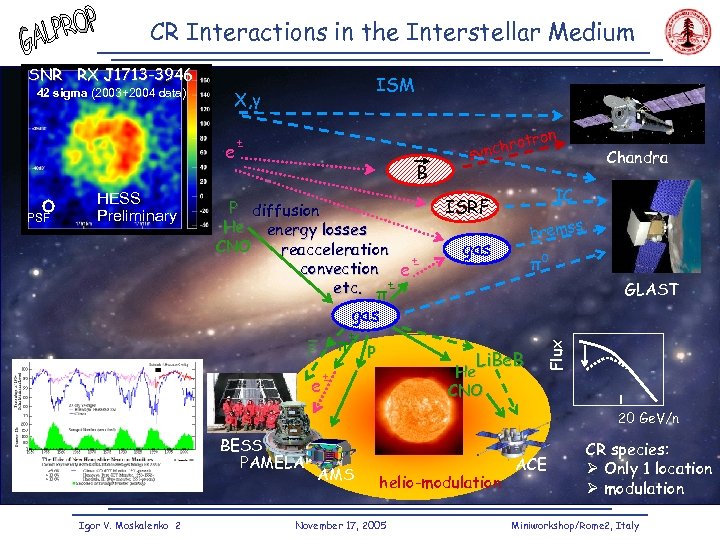
CR Interactions in the Interstellar Medium SNR RX J 1713 -3946 X, γ e PSF HESS Preliminary ISM tron + - B P diffusion He energy losses CNO reacceleration + convection e etc. π + ro synch Chandra IC ISRF s brems gas π0 GLAST gas _ P + π- p Li. Be. B He CNO + e- Flux 42 sigma (2003+2004 data) 20 Ge. V/n BESS PAMELA Igor V. Moskalenko 2 AMS helio-modulation November 17, 2005 ACE CR species: Ø Only 1 location Ø modulation Miniworkshop/Rome 2, Italy
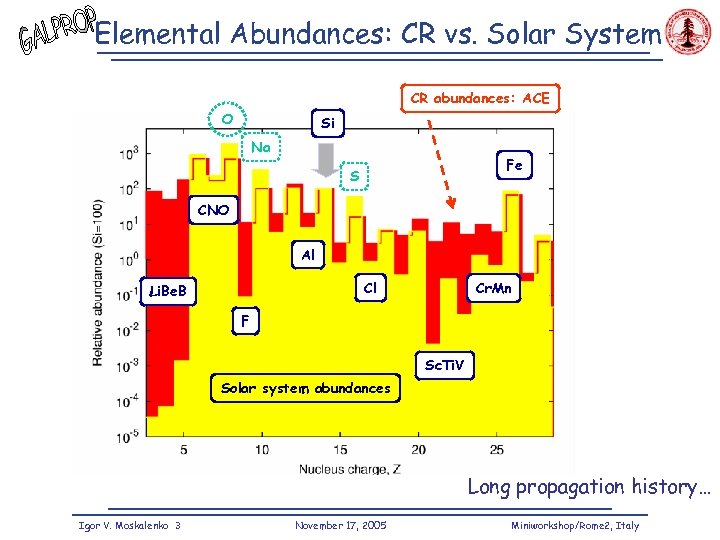
Elemental Abundances: CR vs. Solar System CR abundances: ACE O Si Na Fe S CNO Al Cl Li. Be. B Cr. Mn F Sc. Ti. V Solar system abundances Long propagation history… Igor V. Moskalenko 3 November 17, 2005 Miniworkshop/Rome 2, Italy
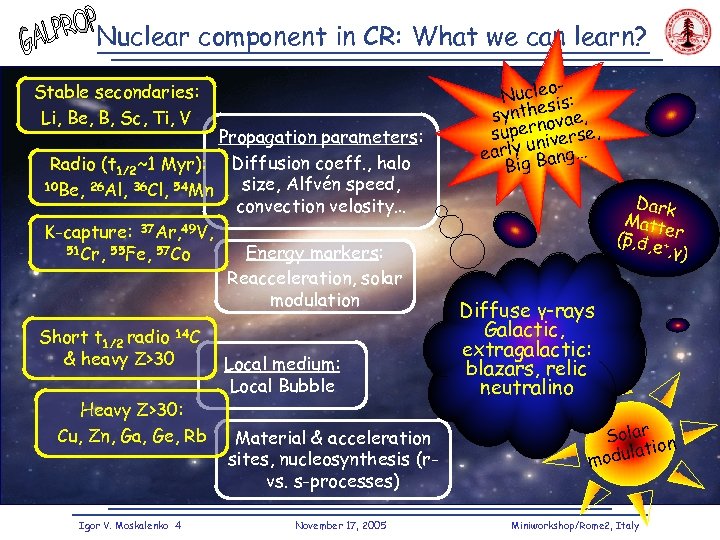
Nuclear component in CR: What we can learn? Stable secondaries: Li, Be, B, Sc, Ti, V Propagation parameters: Radio (t 1/2~1 Myr): Diffusion coeff. , halo size, Alfvén speed, 10 Be, 26 Al, 36 Cl, 54 Mn convection velosity… K-capture: 37 Ar, 49 V, 51 Cr, 55 Fe, 57 Co Energy markers: Reacceleration, solar modulation Short t 1/2 radio 14 C & heavy Z>30 Heavy Z>30: Cu, Zn, Ga, Ge, Rb Igor V. Moskalenko 4 Local medium: Local Bubble Material & acceleration sites, nucleosynthesis (rvs. s-processes) November 17, 2005 o. Nuclesis: e synthnovae, superniverse, u early Bang… Big Dark M -, atter (p đ, e + , γ) Diffuse γ-rays Galactic, extragalactic: blazars, relic neutralino Solar on lati modu Miniworkshop/Rome 2, Italy
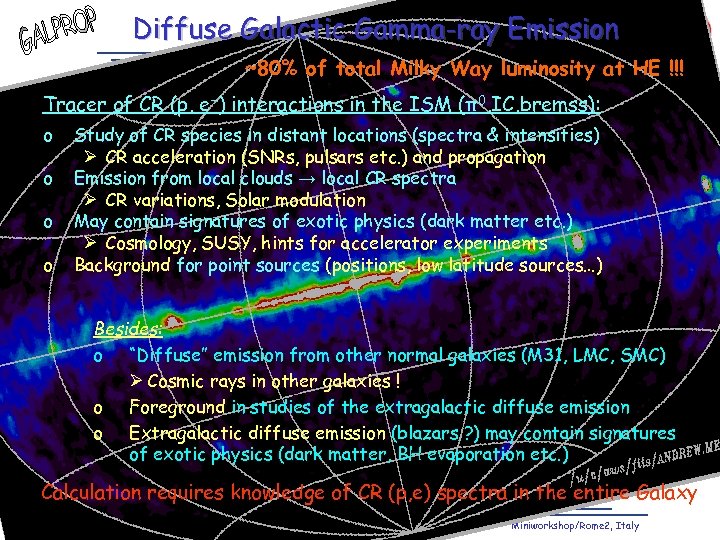
Diffuse Galactic Gamma-ray Emission ~80% of total Milky Way luminosity at HE !!! Tracer of CR (p, e−) interactions in the ISM (π0, IC, bremss): o o Study of CR species in distant locations (spectra & intensities) Ø CR acceleration (SNRs, pulsars etc. ) and propagation Emission from local clouds → local CR spectra Ø CR variations, Solar modulation May contain signatures of exotic physics (dark matter etc. ) Ø Cosmology, SUSY, hints for accelerator experiments Background for point sources (positions, low latitude sources…) Besides: o “Diffuse” emission from other normal galaxies (M 31, LMC, SMC) Ø Cosmic rays in other galaxies ! o Foreground in studies of the extragalactic diffuse emission o Extragalactic diffuse emission (blazars ? ) may contain signatures of exotic physics (dark matter, BH evaporation etc. ) Calculation requires knowledge of CR (p, e) spectra in the entire Galaxy Igor V. Moskalenko 5 November 17, 2005 Miniworkshop/Rome 2, Italy
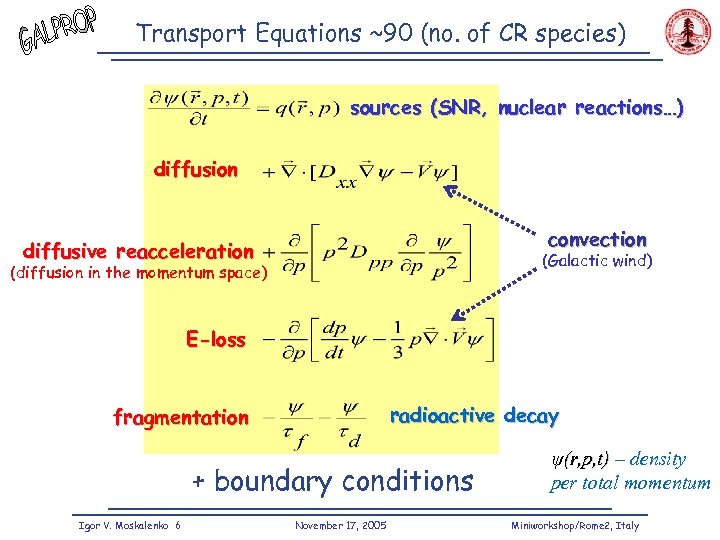
Transport Equations ~90 (no. of CR species) sources (SNR, nuclear reactions…) diffusion convection diffusive reacceleration (Galactic wind) (diffusion in the momentum space) E-loss radioactive decay fragmentation + boundary conditions Igor V. Moskalenko 6 November 17, 2005 ψ(r, p, t) – density per total momentum Miniworkshop/Rome 2, Italy
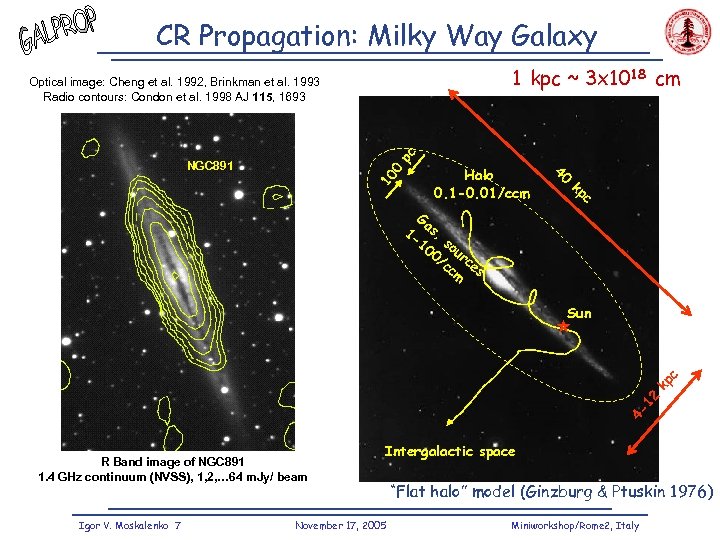
CR Propagation: Milky Way Galaxy 1 kpc ~ 3 x 1018 cm pc Optical image: Cheng et al. 1992, Brinkman et al. 1993 Radio contours: Condon et al. 1998 AJ 115, 1693 10 0 NGC 891 Halo 0. 1 -0. 01/ccm 40 kp c Ga 1 - s, 10 so 0/ urc cc es m 4 - 12 kp c Sun R Band image of NGC 891 1. 4 GHz continuum (NVSS), 1, 2, … 64 m. Jy/ beam Igor V. Moskalenko 7 Intergalactic space November 17, 2005 “Flat halo” model (Ginzburg & Ptuskin 1976) Miniworkshop/Rome 2, Italy
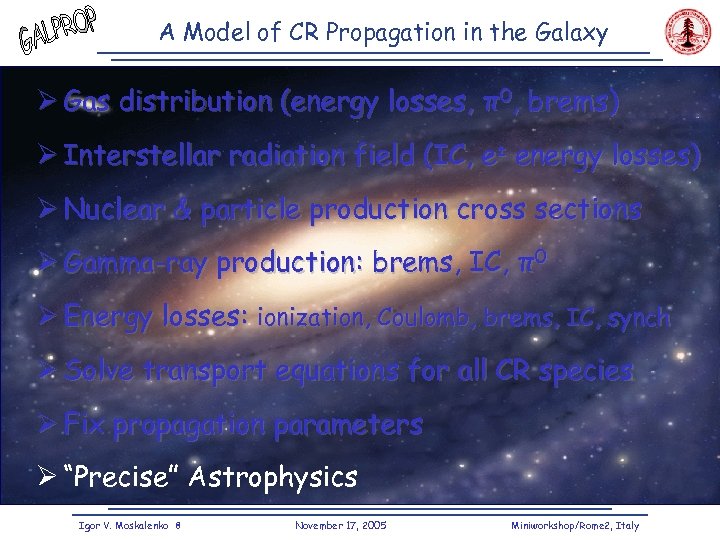
A Model of CR Propagation in the Galaxy Ø Gas distribution (energy losses, π0, brems) Ø Interstellar radiation field (IC, e± energy losses) Ø Nuclear & particle production cross sections Ø Gamma-ray production: brems, IC, π0 Ø Energy losses: ionization, Coulomb, brems, IC, synch Ø Solve transport equations for all CR species Ø Fix propagation parameters Ø “Precise” Astrophysics Igor V. Moskalenko 8 November 17, 2005 Miniworkshop/Rome 2, Italy
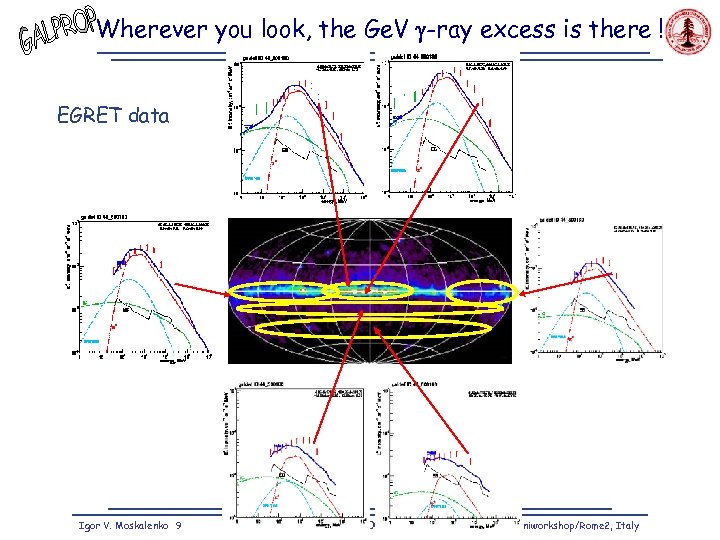
Wherever you look, the Ge. V -ray excess is there ! EGRET data 4 a-f Igor V. Moskalenko 9 November 17, 2005 Miniworkshop/Rome 2, Italy
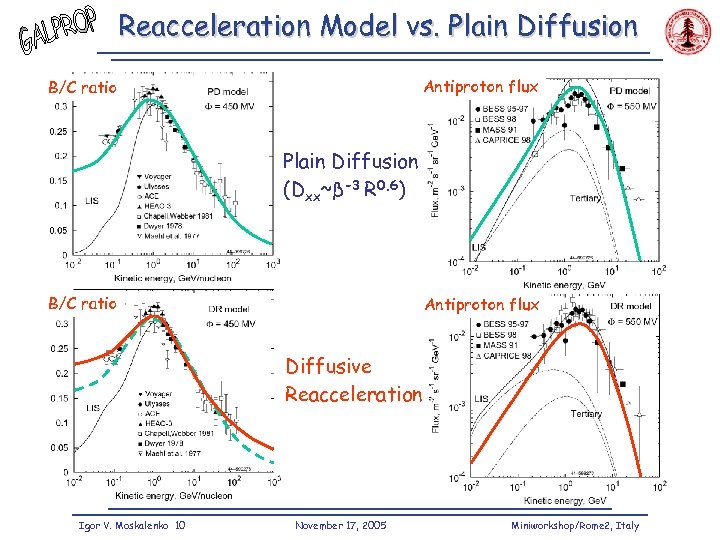
Reacceleration Model vs. Plain Diffusion Antiproton flux B/C ratio Plain Diffusion (Dxx~β-3 R 0. 6) B/C ratio Antiproton flux Diffusive Reacceleration Igor V. Moskalenko 10 November 17, 2005 Miniworkshop/Rome 2, Italy
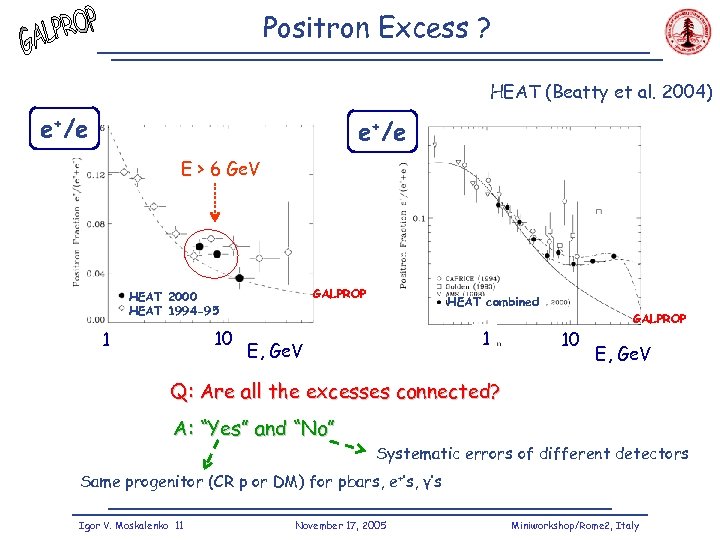
Positron Excess ? HEAT (Beatty et al. 2004) e+/e E > 6 Ge. V GALPROP HEAT 2000 HEAT 1994 -95 10 1 HEAT combined 1 E, Ge. V 10 GALPROP E, Ge. V Q: Are all the excesses connected? A: “Yes” and “No” Systematic errors of different detectors Same progenitor (CR p or DM) for pbars, e+’s, γ’s Igor V. Moskalenko 11 November 17, 2005 Miniworkshop/Rome 2, Italy
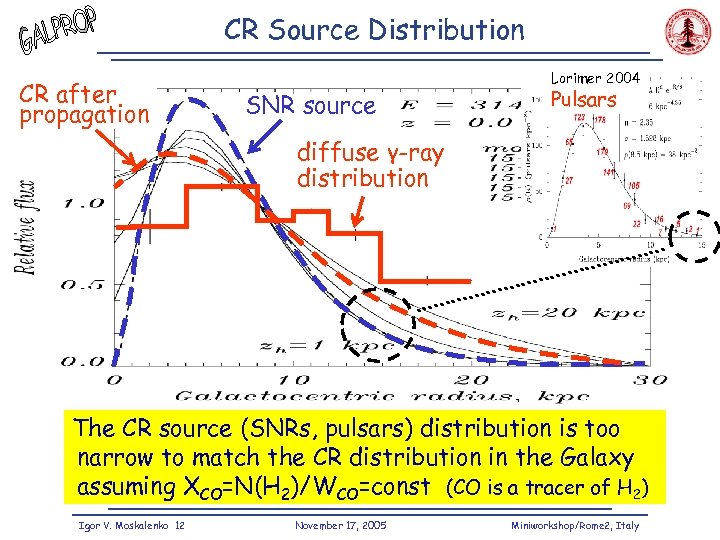
CR Source Distribution CR after propagation SNR source Lorimer 2004 Pulsars diffuse γ-ray distribution The CR source (SNRs, pulsars) distribution is too narrow to match the CR distribution in the Galaxy assuming XCO=N(H 2)/WCO=const (CO is a tracer of H 2) Igor V. Moskalenko 12 November 17, 2005 Miniworkshop/Rome 2, Italy
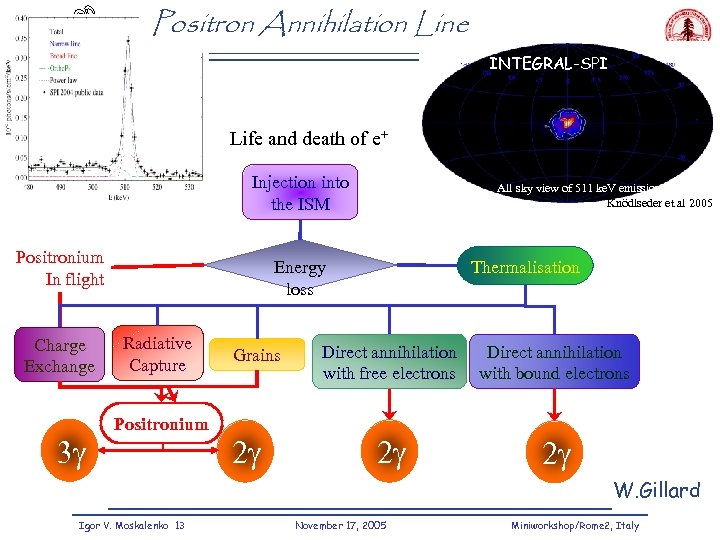
Positron Annihilation Line INTEGRAL-SPI Life and death of e+ Injection into the ISM Positronium In flight Charge Exchange All sky view of 511 ke. V emission Knödlseder et al 2005 Thermalisation Energy loss Radiative Capture Grains Direct annihilation with free electrons Direct annihilation with bound electrons 2 g 2 g Positronium 3 g 2 g W. Gillard Igor V. Moskalenko 13 November 17, 2005 Miniworkshop/Rome 2, Italy
Hypotheses… Provide good agreement with all data (diffuse gammas, pbars, e+) Ø CR intensity variations Ø Dark Matter signals Other possibilities: Harder CR spectrum (protons, electrons) – deviates limits from pbars, gamma-ray profiles Influence of the Local Bubble (local component) – helps with pbars, but doesn’t help with diffuse gammas Igor V. Moskalenko 14 November 17, 2005 Miniworkshop/Rome 2, Italy
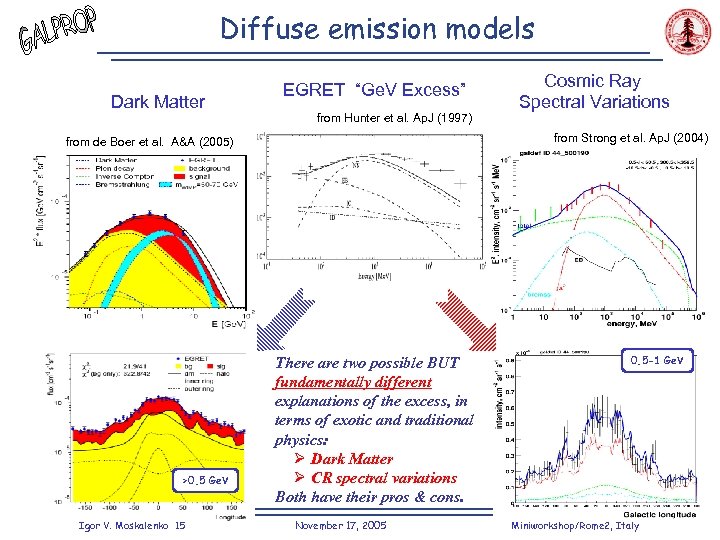
Diffuse emission models Dark Matter EGRET “Ge. V Excess” from Hunter et al. Ap. J (1997) from Strong et al. Ap. J (2004) from de Boer et al. A&A (2005) >0. 5 Ge. V Igor V. Moskalenko 15 Cosmic Ray Spectral Variations There are two possible BUT fundamentally different explanations of the excess, in terms of exotic and traditional physics: Ø Dark Matter Ø CR spectral variations Both have their pros & cons. November 17, 2005 0. 5 -1 Ge. V Miniworkshop/Rome 2, Italy
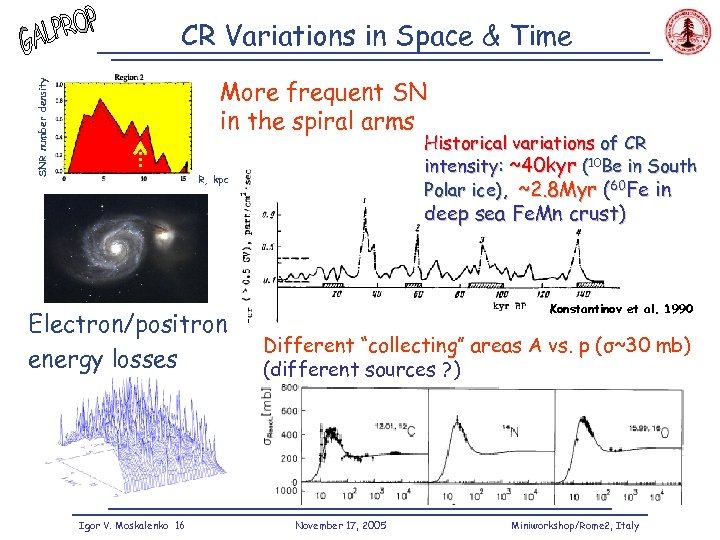
CR Variations in Space & Time SNR number density More frequent SN in the spiral arms Historical variations of CR intensity: ~40 kyr (10 Be in South Polar ice), ~2. 8 Myr (60 Fe in R, kpc deep sea Fe. Mn crust) Electron/positron energy losses Igor V. Moskalenko 16 Konstantinov et al. 1990 Different “collecting” areas A vs. p (σ~30 mb) (different sources ? ) November 17, 2005 Miniworkshop/Rome 2, Italy
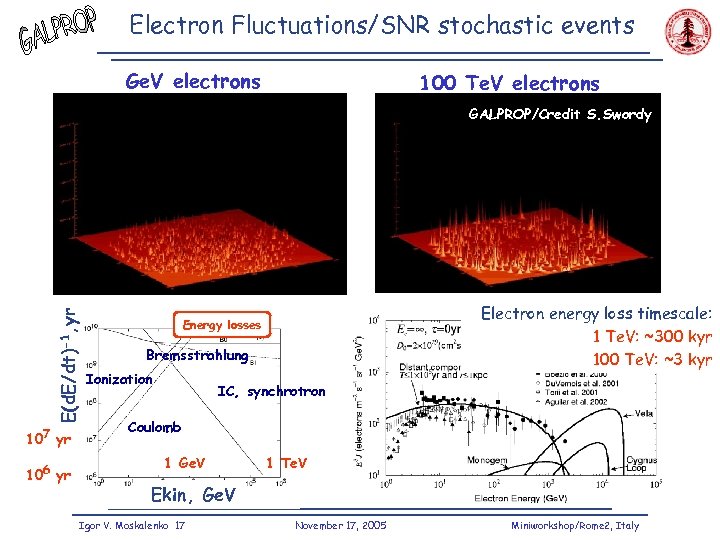
Electron Fluctuations/SNR stochastic events Ge. V electrons 100 Te. V electrons E(d. E/dt)-1, yr GALPROP/Credit S. Swordy 107 yr 106 yr Electron energy loss timescale: 1 Te. V: ~300 kyr 100 Te. V: ~3 kyr Energy losses Bremsstrahlung Ionization IC, synchrotron Coulomb 1 Ge. V 1 Te. V Ekin, Ge. V Igor V. Moskalenko 17 November 17, 2005 Miniworkshop/Rome 2, Italy
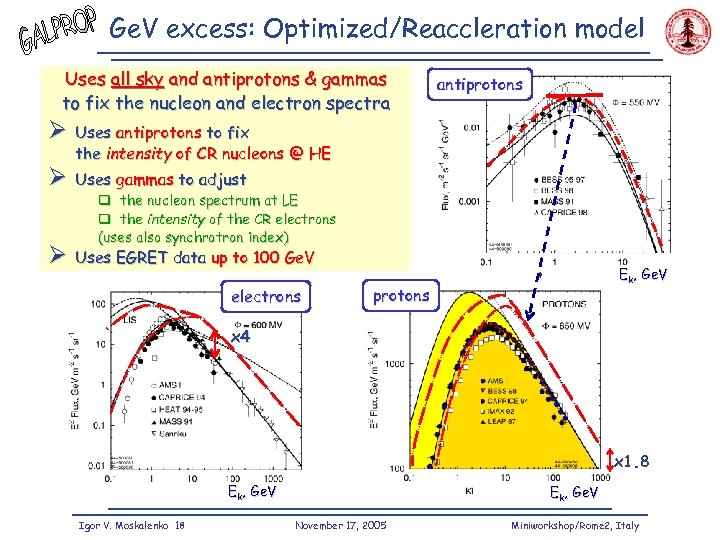
Ge. V excess: Optimized/Reaccleration model Uses all sky and antiprotons & gammas to fix the nucleon and electron spectra antiprotons Ø Uses antiprotons to fix the intensity of CR nucleons @ HE Ø Uses gammas to adjust q the nucleon spectrum at LE q the intensity of the CR electrons (uses also synchrotron index) Ø Uses EGRET data up to 100 Ge. V electrons Ek, Ge. V protons x 4 x 1. 8 Ek, Ge. V Igor V. Moskalenko 18 Ek, Ge. V November 17, 2005 Miniworkshop/Rome 2, Italy
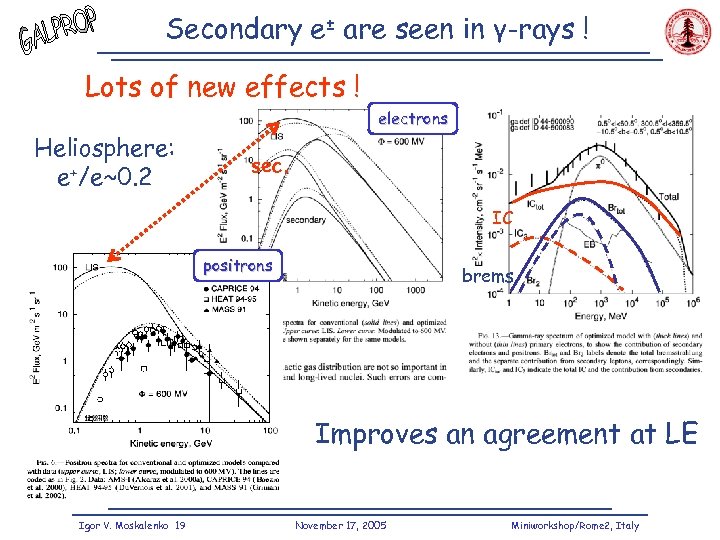
Secondary e± are seen in γ-rays ! Lots of new effects ! electrons Heliosphere: e+/e~0. 2 sec. IC positrons brems Improves an agreement at LE Igor V. Moskalenko 19 November 17, 2005 Miniworkshop/Rome 2, Italy
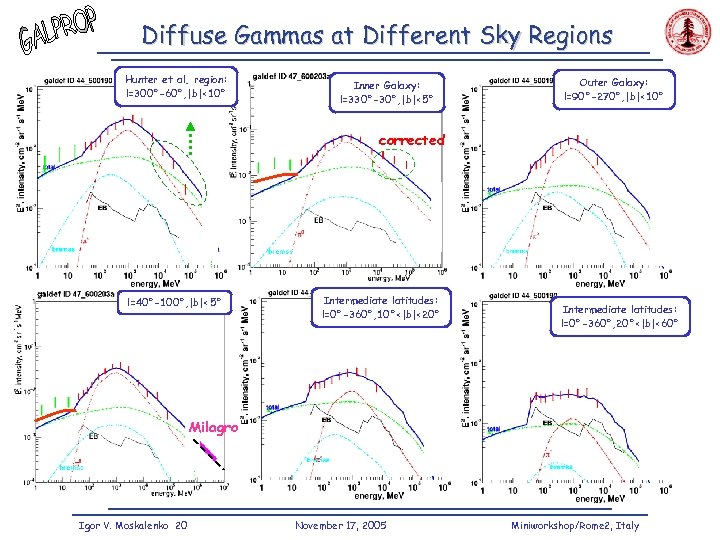
Diffuse Gammas at Different Sky Regions Hunter et al. region: l=300°-60°, |b|<10° Inner Galaxy: l=330°-30°, |b|<5° Outer Galaxy: l=90°-270°, |b|<10° corrected l=40°-100°, |b|<5° Intermediate latitudes: l=0°-360°, 10°<|b|<20° Intermediate latitudes: l=0°-360°, 20°<|b|<60° Milagro Igor V. Moskalenko 20 November 17, 2005 Miniworkshop/Rome 2, Italy
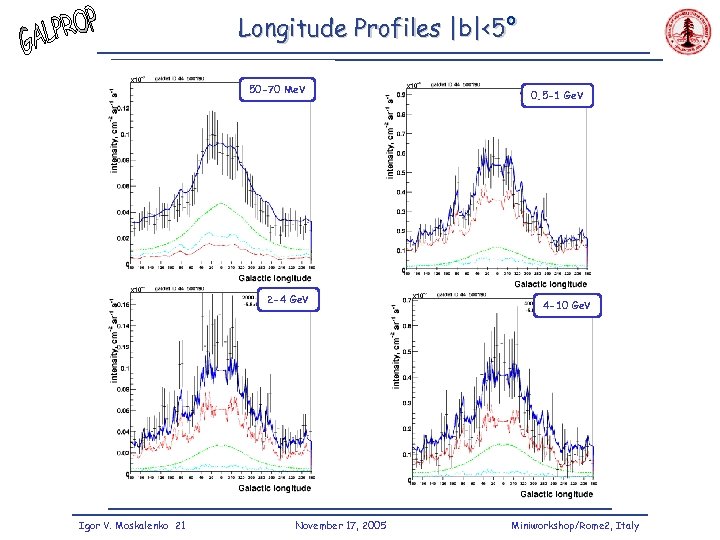
Longitude Profiles |b|<5° 50 -70 Me. V 2 -4 Ge. V Igor V. Moskalenko 21 November 17, 2005 0. 5 -1 Ge. V 4 -10 Ge. V Miniworkshop/Rome 2, Italy
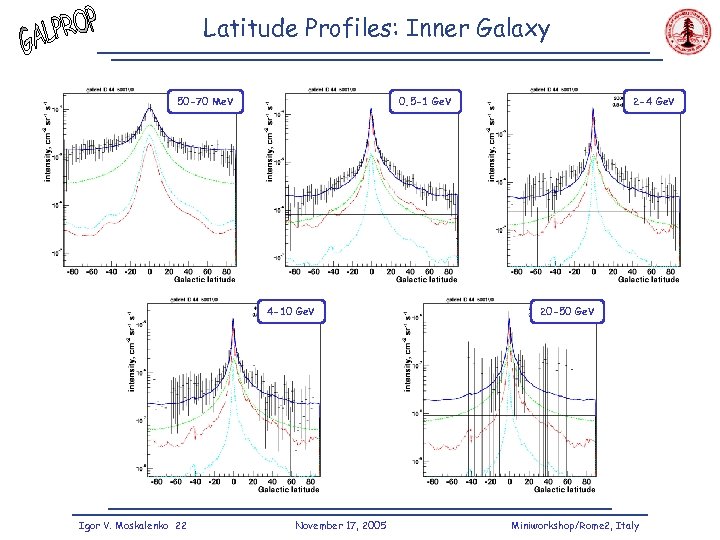
Latitude Profiles: Inner Galaxy 0. 5 -1 Ge. V 50 -70 Me. V 4 -10 Ge. V Igor V. Moskalenko 22 November 17, 2005 2 -4 Ge. V 20 -50 Ge. V Miniworkshop/Rome 2, Italy
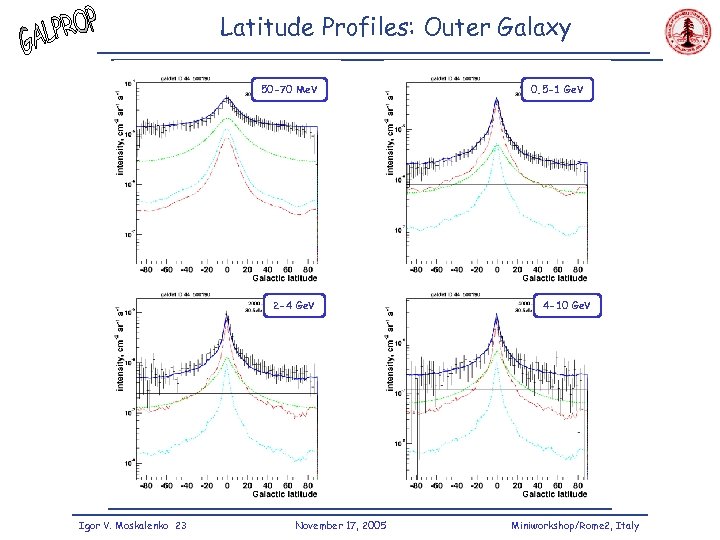
Latitude Profiles: Outer Galaxy 50 -70 Me. V 2 -4 Ge. V Igor V. Moskalenko 23 November 17, 2005 0. 5 -1 Ge. V 4 -10 Ge. V Miniworkshop/Rome 2, Italy
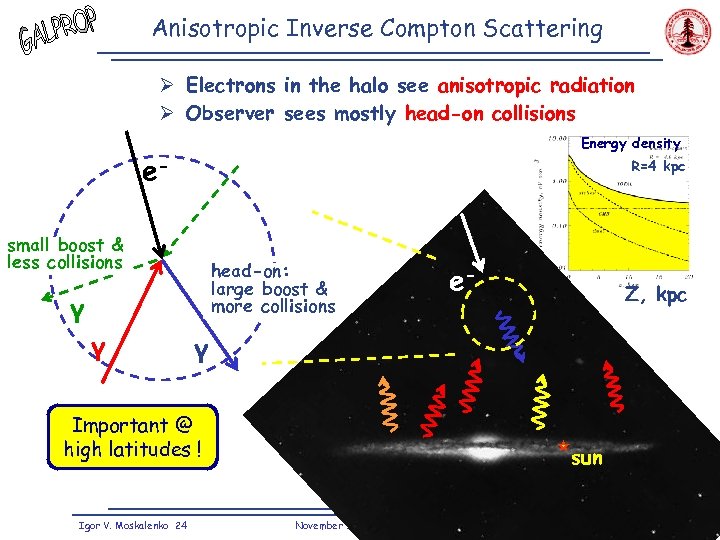
Anisotropic Inverse Compton Scattering Ø Electrons in the halo see anisotropic radiation Ø Observer sees mostly head-on collisions Energy density e- R=4 kpc small boost & less collisions γ γ head-on: large boost & more collisions Z, kpc γ Important @ high latitudes ! Igor V. Moskalenko 24 e- sun November 17, 2005 Miniworkshop/Rome 2, Italy
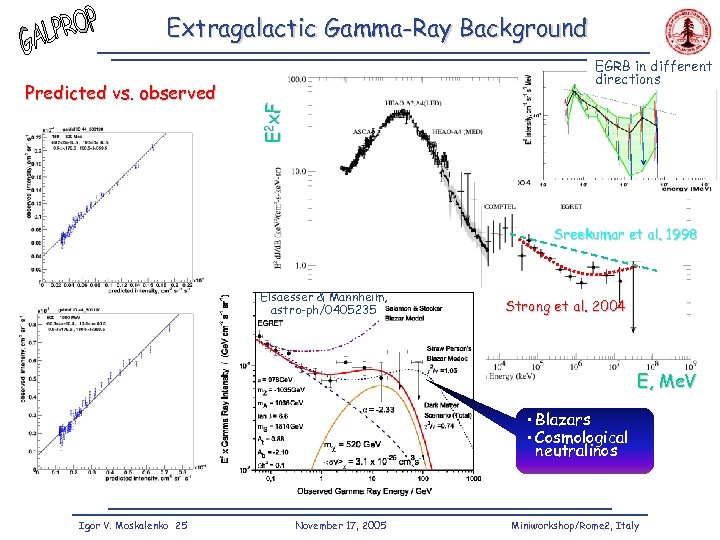
Extragalactic Gamma-Ray Background E 2 x. F Predicted vs. observed EGRB in different directions Sreekumar et al. 1998 Elsaesser & Mannheim, astro-ph/0405235 Strong et al. 2004 E, Me. V • Blazars • Cosmological neutralinos Igor V. Moskalenko 25 November 17, 2005 Miniworkshop/Rome 2, Italy
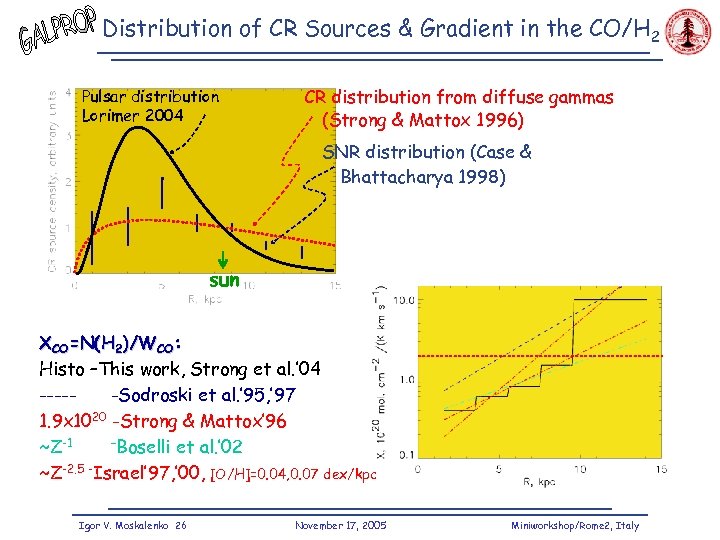
Distribution of CR Sources & Gradient in the CO/H 2 Pulsar distribution Lorimer 2004 CR distribution from diffuse gammas (Strong & Mattox 1996) SNR distribution (Case & Bhattacharya 1998) sun XCO=N(H 2)/WCO: Histo –This work, Strong et al. ’ 04 -----Sodroski et al. ’ 95, ’ 97 1. 9 x 10²⁰ -Strong & Mattox’ 96 –Boselli et al. ’ 02 ~Z-1 ~Z-2. 5 -Israel’ 97, ’ 00, [O/H]=0. 04, 0. 07 dex/kpc Igor V. Moskalenko 26 November 17, 2005 Miniworkshop/Rome 2, Italy
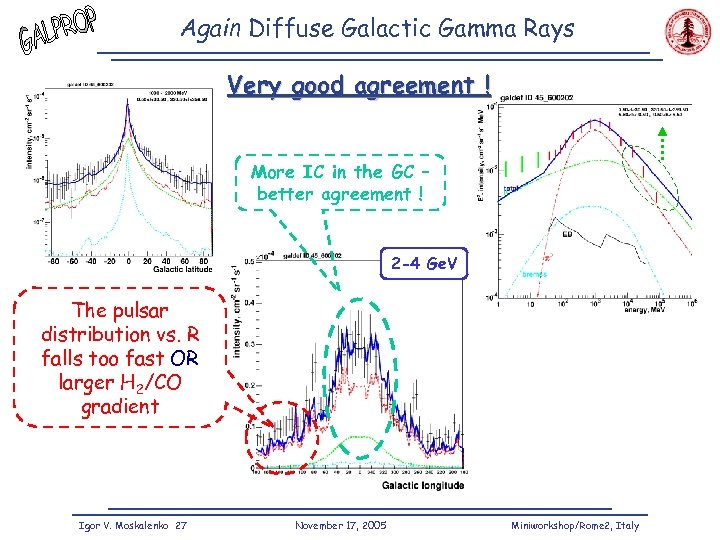
Again Diffuse Galactic Gamma Rays Very good agreement ! More IC in the GC – better agreement ! 2 -4 Ge. V The pulsar distribution vs. R falls too fast OR larger H 2/CO gradient Igor V. Moskalenko 27 November 17, 2005 Miniworkshop/Rome 2, Italy
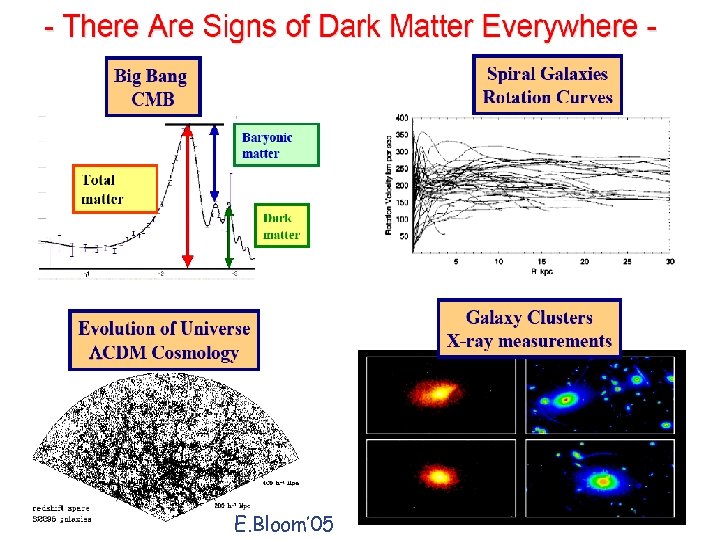
Igor V. Moskalenko 28 November E. Bloom’ 05 17, 2005 Miniworkshop/Rome 2, Italy
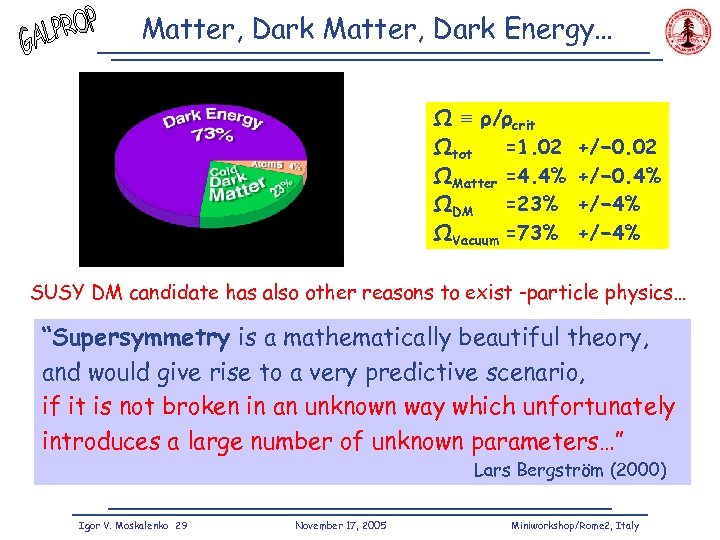
Matter, Dark Energy… Ω ≡ ρ/ρcrit Ωtot =1. 02 ΩMatter =4. 4% ΩDM =23% ΩVacuum =73% +/− 0. 02 +/− 0. 4% +/− 4% SUSY DM candidate has also other reasons to exist -particle physics… “Supersymmetry is a mathematically beautiful theory, and would give rise to a very predictive scenario, if it is not broken in an unknown way which unfortunately introduces a large number of unknown parameters…” Lars Bergström (2000) Igor V. Moskalenko 29 November 17, 2005 Miniworkshop/Rome 2, Italy
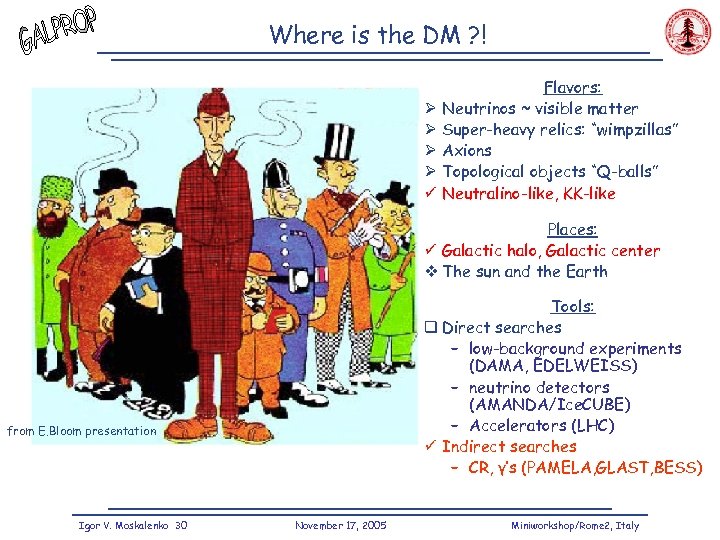
Where is the DM ? ! Ø Ø ü Flavors: Neutrinos ~ visible matter Super-heavy relics: “wimpzillas” Axions Topological objects “Q-balls” Neutralino-like, KK-like Places: ü Galactic halo, Galactic center v The sun and the Earth Tools: q Direct searches – low-background experiments (DAMA, EDELWEISS) – neutrino detectors (AMANDA/Ice. CUBE) – Accelerators (LHC) ü Indirect searches – CR, γ’s (PAMELA, GLAST, BESS) from E. Bloom presentation Igor V. Moskalenko 30 November 17, 2005 Miniworkshop/Rome 2, Italy
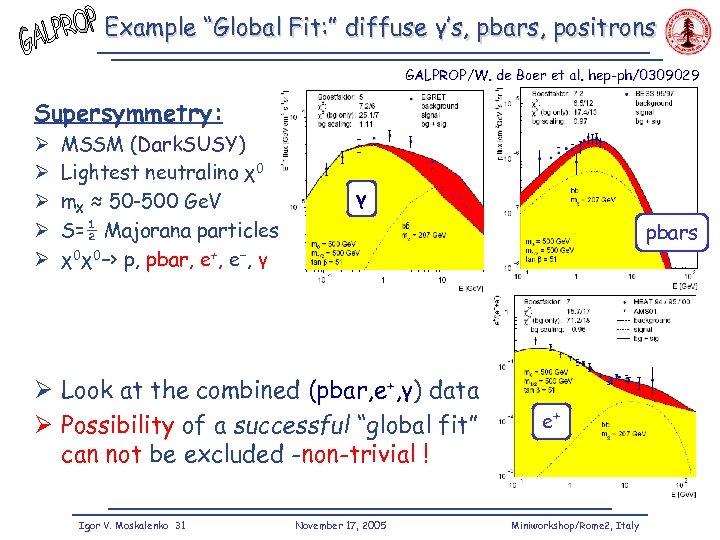
Example “Global Fit: ” diffuse γ’s, pbars, positrons GALPROP/W. de Boer et al. hep-ph/0309029 Supersymmetry: Ø Ø Ø MSSM (Dark. SUSY) Lightest neutralino χ0 mχ ≈ 50 -500 Ge. V S=½ Majorana particles χ0χ0−> p, pbar, e+, e−, γ γ pbars Ø Look at the combined (pbar, e+, γ) data Ø Possibility of a successful “global fit” can not be excluded -non-trivial ! Igor V. Moskalenko 31 November 17, 2005 e+ Miniworkshop/Rome 2, Italy
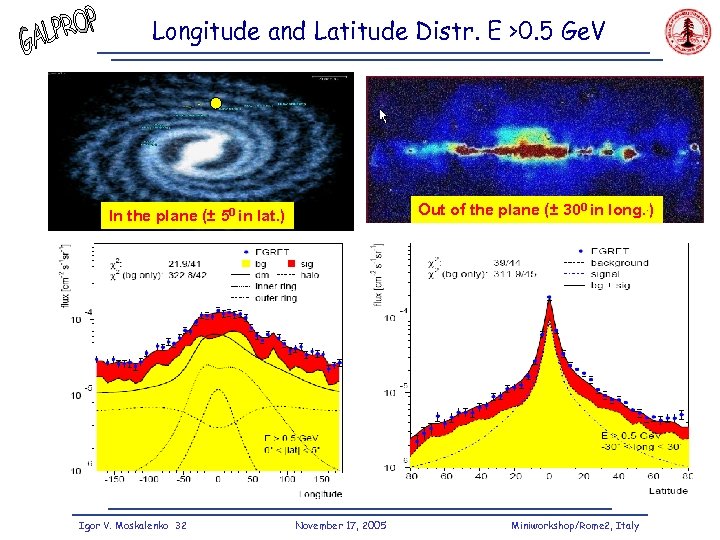
Longitude and Latitude Distr. E >0. 5 Ge. V Out of the plane (± 300 in long. . ) In the plane (± 50 in lat. ) Igor V. Moskalenko 32 November 17, 2005 Miniworkshop/Rome 2, Italy
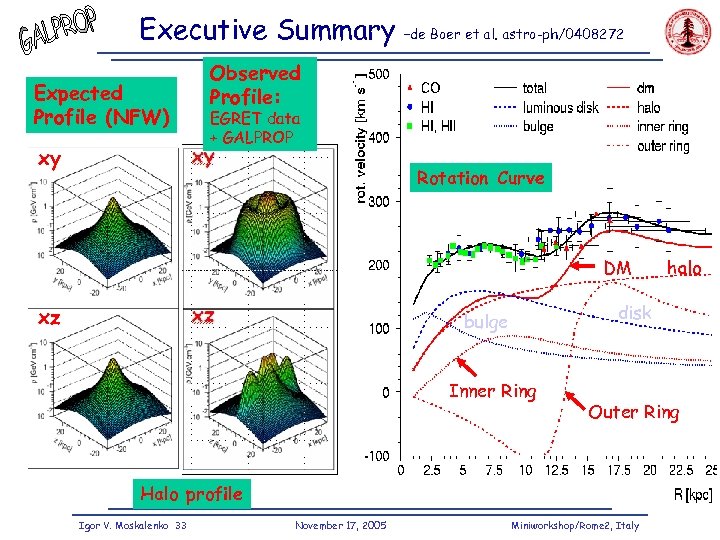
Executive Summary –de Boer et al. astro-ph/0408272 Observed Profile: Expected Profile (NFW) z EGRET data + GALPROP xy xy Isothermal Profile v 2 M/r=cons. and xz M/r 3 1/r 2 for const. rotation curve xz Rotation Curve x y DM halo 2003, Ibata et al, Yanny et al. disk bulge Inner Ring Outer Ring Halo profile Igor V. Moskalenko 33 November 17, 2005 Miniworkshop/Rome 2, Italy
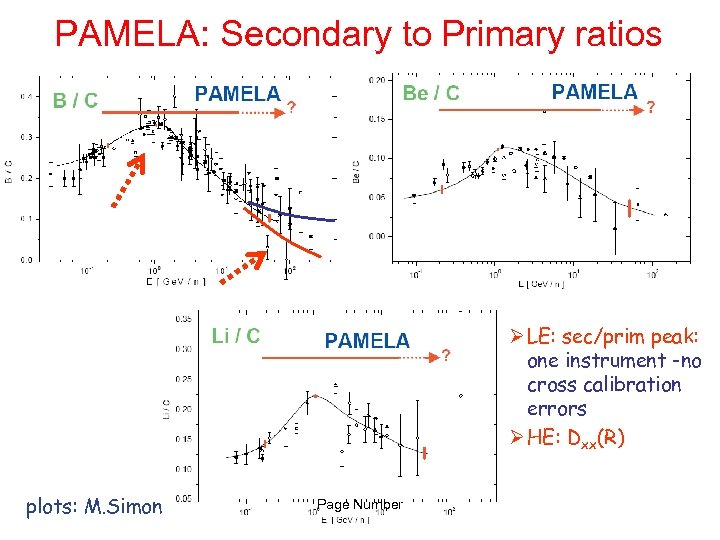
PAMELA: Secondary to Primary ratios Ø LE: sec/prim peak: one instrument -no cross calibration errors Ø HE: Dxx(R) plots: M. Simon Page Number
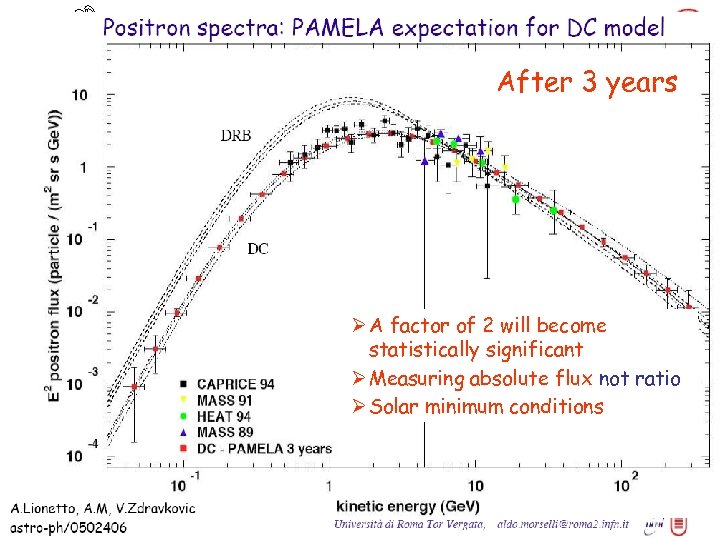
PAMELA positrons After 3 years Ø A factor of 2 will become statistically significant Ø Measuring absolute flux not ratio Ø Solar minimum conditions Igor V. Moskalenko 35 November 17, 2005 Miniworkshop/Rome 2, Italy
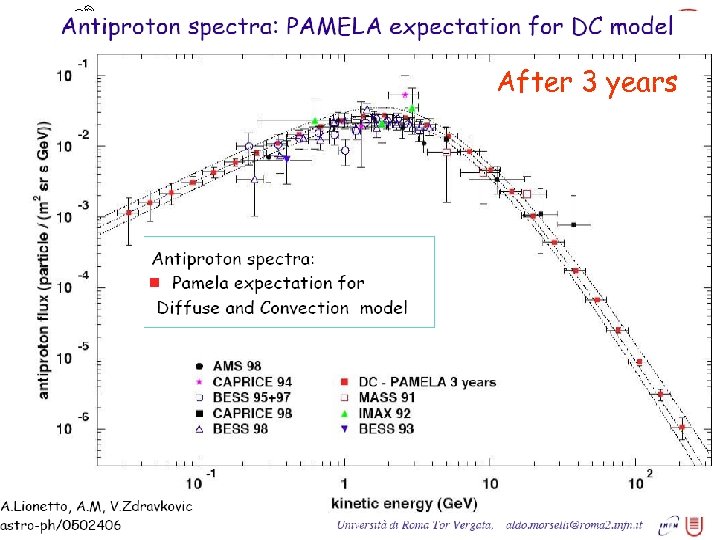
PAMELA antiprotons After 3 years Igor V. Moskalenko 36 November 17, 2005 Miniworkshop/Rome 2, Italy
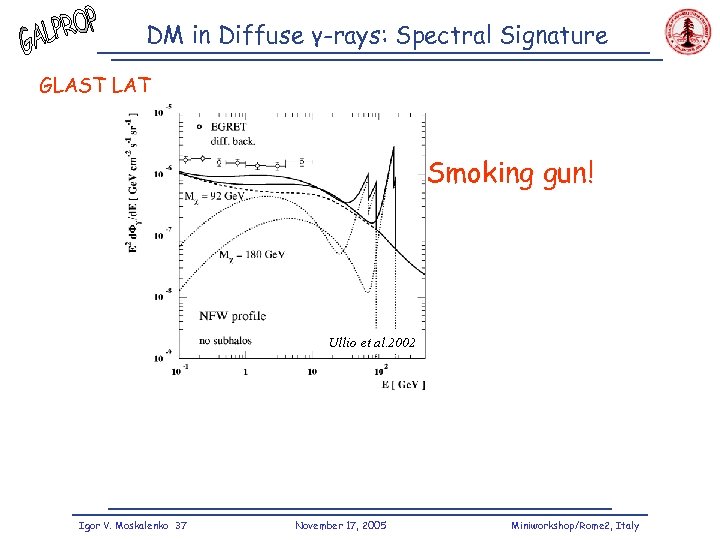
DM in Diffuse γ-rays: Spectral Signature GLAST LAT Smoking gun! Ullio et al. 2002 Igor V. Moskalenko 37 November 17, 2005 Miniworkshop/Rome 2, Italy
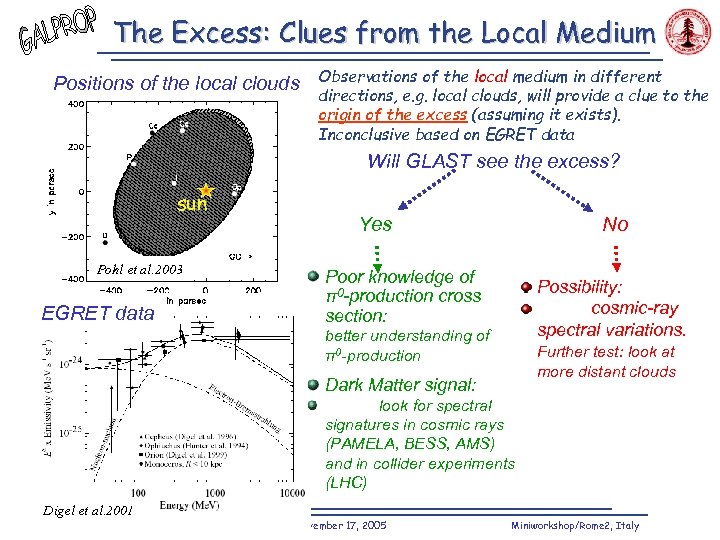
The Excess: Clues from the Local Medium Positions of the local clouds Observations of the local medium in different directions, e. g. local clouds, will provide a clue to the origin of the excess (assuming it exists). Inconclusive based on EGRET data Will GLAST see the excess? sun Pohl et al. 2003 EGRET data Yes No Poor knowledge of π0 -production cross section: Possibility: cosmic-ray spectral variations. better understanding of π0 -production Further test: look at more distant clouds Dark Matter signal: look for spectral signatures in cosmic rays (PAMELA, BESS, AMS) and in collider experiments (LHC) Digel et al. 2001 Igor V. Moskalenko 38 November 17, 2005 Miniworkshop/Rome 2, Italy
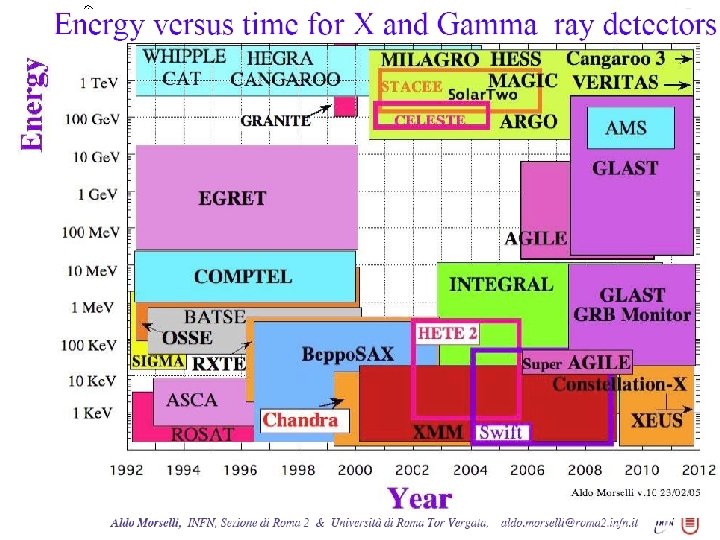
Igor V. Moskalenko 39 November 17, 2005 Miniworkshop/Rome 2, Italy
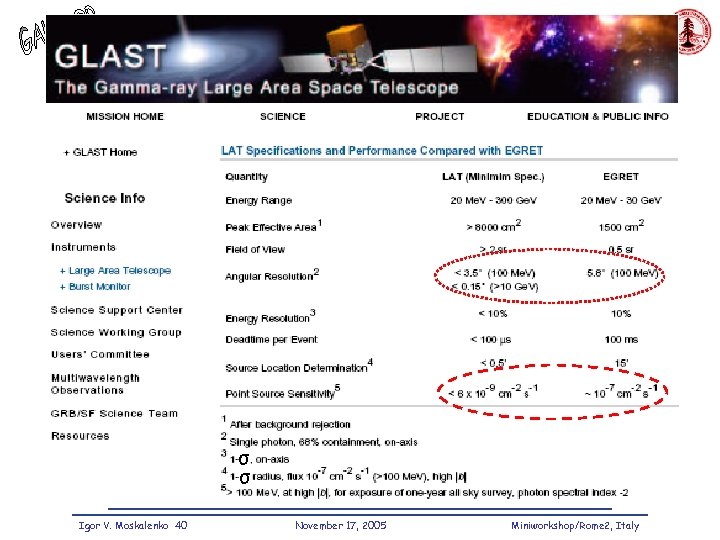
σ σ Igor V. Moskalenko 40 November 17, 2005 Miniworkshop/Rome 2, Italy
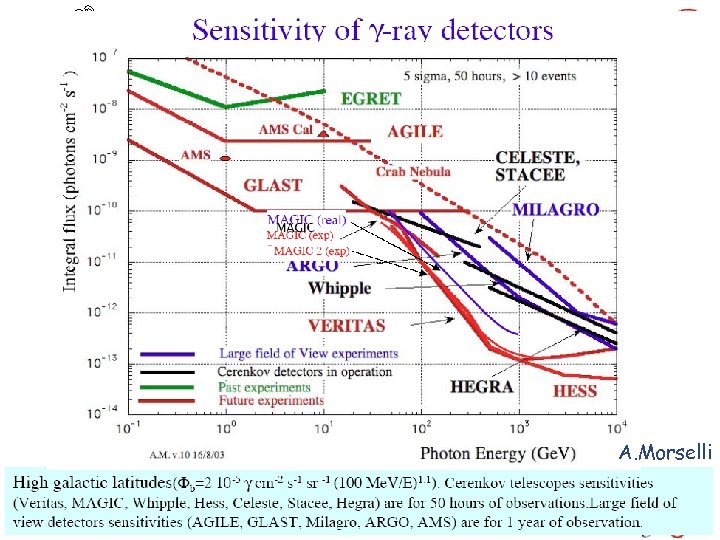
A. Morselli Igor V. Moskalenko 41 November 17, 2005 Miniworkshop/Rome 2, Italy
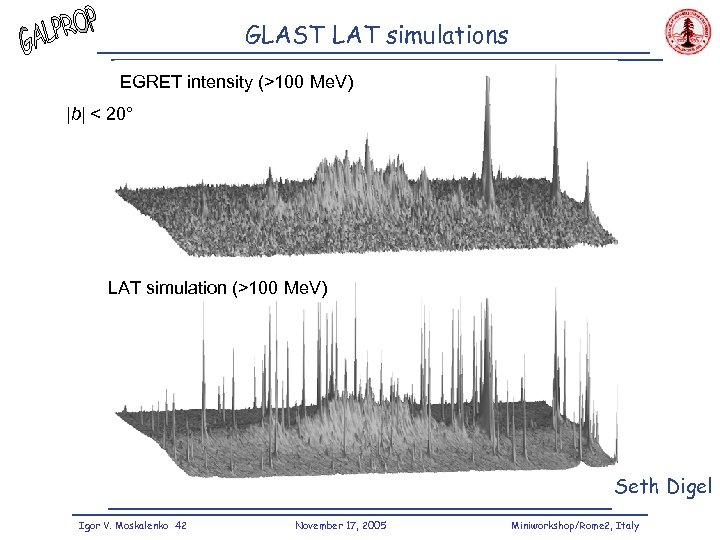
GLAST LAT simulations EGRET intensity (>100 Me. V) |b| < 20° LAT simulation (>100 Me. V) Seth Digel Igor V. Moskalenko 42 November 17, 2005 Miniworkshop/Rome 2, Italy
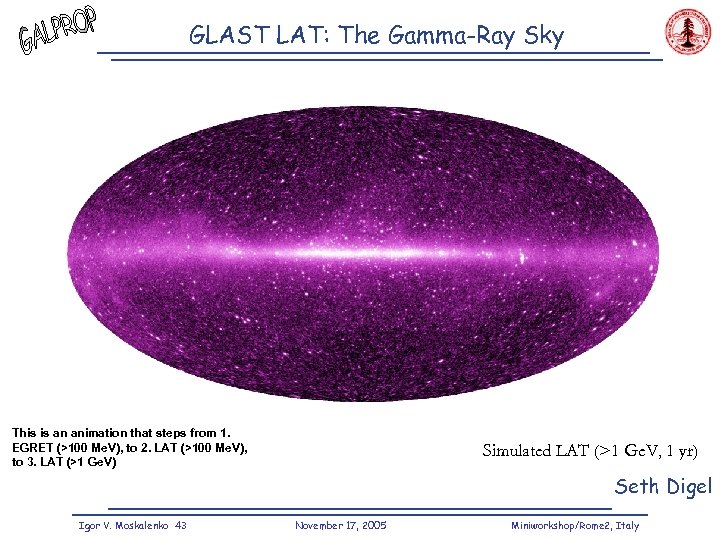
GLAST LAT: The Gamma-Ray Sky This is an animation that steps from 1. EGRET (>100 Me. V), to 2. LAT (>100 Me. V), to 3. LAT (>1 Ge. V) EGRET Me. V, 1 Simulated LAT (>1 Ge. V, 1 yr)yr) (>100 Me. V) Seth Digel Igor V. Moskalenko 43 November 17, 2005 Miniworkshop/Rome 2, Italy
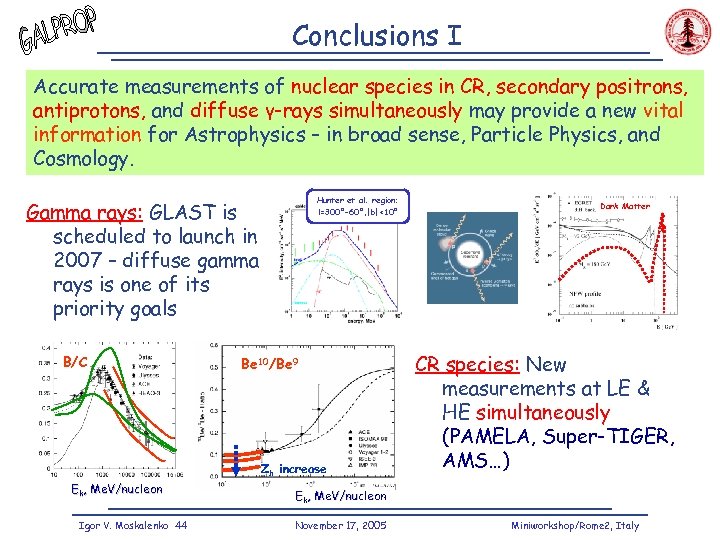
Conclusions I Accurate measurements of nuclear species in CR, secondary positrons, antiprotons, and diffuse γ-rays simultaneously may provide a new vital information for Astrophysics – in broad sense, Particle Physics, and Cosmology. Hunter et al. region: l=300°-60°, |b|<10° Gamma rays: GLAST is scheduled to launch in 2007 – diffuse gamma rays is one of its priority goals B/C Be 10/Be 9 Zh increase Ek, Me. V/nucleon Igor V. Moskalenko 44 Dark Matter CR species: New measurements at LE & HE simultaneously (PAMELA, Super-TIGER, AMS…) Ek, Me. V/nucleon November 17, 2005 Miniworkshop/Rome 2, Italy
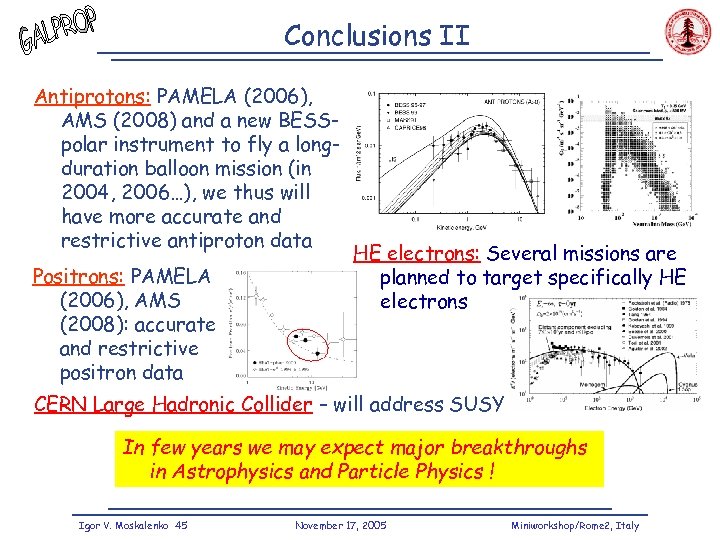
Conclusions II Antiprotons: PAMELA (2006), AMS (2008) and a new BESSpolar instrument to fly a longduration balloon mission (in 2004, 2006…), we thus will have more accurate and restrictive antiproton data Positrons: PAMELA (2006), AMS (2008): accurate and restrictive positron data HE electrons: Several missions are planned to target specifically HE electrons CERN Large Hadronic Collider – will address SUSY In few years we may expect major breakthroughs in Astrophysics and Particle Physics ! Igor V. Moskalenko 45 November 17, 2005 Miniworkshop/Rome 2, Italy
Thank you ! Igor V. Moskalenko 46 November 17, 2005 Miniworkshop/Rome 2, Italy
Скачать презентацию Challenges in Astrophysics of CR knee— γ-rays
ce7a67d8c801ad8d7d3f46cf4384cc26.ppt