 Скачать презентацию CHALLENGES FOR REGIONAL DEVELOPMENT BY DALBIR SINGH
c581fb4ba5e055b50fbeb6cd087c51b2.ppt
- Количество слайдов: 19



CHALLENGES FOR REGIONAL DEVELOPMENT BY DALBIR SINGH
INTRODUCTION • India - Federal Democratic Republic – 1. 2 billion people, 28 states & 7 centrally administered territories. • Diversity – 4635 communities / sub communities , 2100 languages and dialects , 12 ethnic and several religious groups fragmented into large number of castes and 60 socio – cultural sub regions, • 7 Geographical Zones with 5200 towns, 7 mega cities, 53 metropolitan cities and 6, 50, 000 villages covering 3. 28 million sq kms. • Fiscal policy in India evolved in Quasi-Federal System to meet requirements of centralized planning in Mixed Economy Framework as a result of centripetal bias at the time of independence. • With radical economic liberalization and reforms post 1991, intergovernmental policies and institutions reoriented to meet new challenges of competitive market economy.
INTRODUCTION • Asymmetrical federalism to accommodate diverse, social, religious, linguistic and ethnic groups besides protection of tribals and minorities. • Separation of powers between Legislative, Executive and Judicial arms at both Federal and State Levels. • Central Finance Commission appointed every 5 years to review finances of Centre and States and recommend devolution of taxes and grant-in-aid. • Planning Commission allocates resources according to envisaged priorities. It also gives assistance to States based on formula given by National Development Council (NDC) • NDC which is headed by the Prime Minister meets the elected heads of the Sub. National Govts. periodically alongwith the Planning Commission’s Dy. Chairperson to review the States’ performance and formulate the inter-governmental policies.
DECENTRALIZATION AND FISCAL FADERALISM • Nineties-Emergence of liberalization and globalization led to greater fiscal decentralization • End of single party rule era , emergence of coalition of parties, rise of regionalism and sub-regionalism • Indian Federation moved from 2 tier to 3 tier in 1992 with 73 rd and 74 th Constitutional Amendments • Statutory recognition to rural and urban local self governments. 3. 2 million Representatives elected every five years to constitute 2, 50, 000 local governments at District, Block and Village levels. • The rural and Urban Local Bodies empowered in respect of 29 and 18 activities respectively as per Article 243 G of the Constitution. Urban Local Bodies have municipalities and Corporations under them. • States share revenue and give grant to local Governments and empower them to collect levy of certain taxes.
DECENTRALIZATION AND FISCAL FADERALISM Tax and Expenditure Assignment • For Macroeconomic stability, international relations and activities having scale economics assignment exclusively for the Federal Govt. or carried concurrently with the States. • Functions State Jurisdiction assigned to States but the Federal Govt. has residual tax powers. • For revenue productivity, State levies are Sales Tax, Stamp Duty cum registration charges, excise on alchol and Motor vehicle tax. • Tax on agriculture income is state’s domain whereas power to tax Non-Agriculture income is with Federal Govt. • The revenue capacities of States to meet their expenditure needs are invariably adequate. The Federal Govt. shares the revenue with the State Govts to meet their targets. • Criteria for tax Devolution includes indicators: Population, Per capita Income (SDP), Area, Index of Infrastructure, tax efforts and fiscal discipline. • Additional provisions are made for backward regions and special category states of North eastern India.
MATTERS (29) PERTAINING TO LOCAL SELF GOVERNMENTS (PRIs) ELEVENTH SCHEDULE (ARTICLE 243 G) • Agriculture, including agricultural extension. • Poverty alleviation programme. • Land improvement, implementation of land reforms, land consolidation and soil conservation. • Education, including primary and secondary schools. • Minor Irrigation, water management and watershed development. • Technical training and vocational education. • Adult and non formal education. • Animal husbandry, dairying and poultry. • Libraries • Fisheries • Cultural activities • Social forestry and farm forestry. • Markets and fairs • Minor Forest Produce. • Small Scale Industries, including food processing industries • Health and sanitation, including hospitals, primary health centres and dispensaries. • Family welfare • Khadi, village and cottage industries • Women and child development • Rural Housing • Drinking Water. • Fuel and Fodder. • Roads, culverts, bridges, ferries, waterways and other means of communication • Rural Electrification, including distribution of electricity • Non-conventional Energy sources • Social welfare, including welfare of the handicapped and mentally retarded. • Welfare of the weaker sections, and in particulars of the Scheduled Castes and the Scheduled Tribes. • Public distribution system • Maintenance of community assets
REGIONAL PLANNING AND DEVELOPMENT • Objective of planning was to remove regional backwardness, meet regional aspirations and demands, make optimum and judicious use of regional resources • It aimed to solve regional problems and involve local people in plan formulation & implementation and for conservation of Environment & Cultural Heritage of a particular region. • 1 st and 2 nd Five Year Plan(1950’s ), special attention given to develop backward areas. Number of new Industrial Centres located there to boost regional economy and create employment opportunities for local people. • 3 rd Plan, it was decided to accelerate manufacturing and agriculture to achieve goal of balanced development-not considerable progress achieved. • 4 th Plan: watershed in planning – spelt out distinct regional policies to reach social and economic goals. Some attempts to decentralize planning process at Sub-National and Sub-State Levels.
REGIONAL PLANNING AND DEVELOPMENT • Compulsion which stimulated regional thinking was widening inter-regional disparities. Between 1960 -70, difference in per capita SDP shifted from 1. 9: 1 to 2. 6: 1. • 5 th Plan: Target areas and groups covered tribals, small and marginal farmers. • 6 th Plan: Technology upgradation, research focus on crops, introduction of high yield varieties, enhancement of irrigation facilities, use of Chemical Fertilizers, additional supply of agricultural credit, consolidation of land holdings & land reforms led to green revolution. • Average GDP (1950 -80): Only 3. 6%. Since 1980 accelerated to 5. 6% and after reforms in 1990 s rose to 6%. • Reforms led to structural changes in economy, deregulation of investment, liberalization of trade, capital flows and prices. Between 2004 and 2010, GDP jumped to 8%.
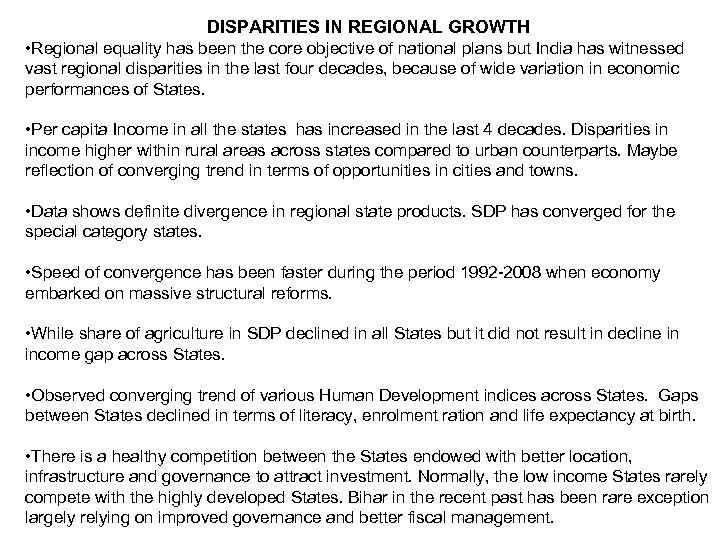
DISPARITIES IN REGIONAL GROWTH • Regional equality has been the core objective of national plans but India has witnessed vast regional disparities in the last four decades, because of wide variation in economic performances of States. • Per capita Income in all the states has increased in the last 4 decades. Disparities in income higher within rural areas across states compared to urban counterparts. Maybe reflection of converging trend in terms of opportunities in cities and towns. • Data shows definite divergence in regional state products. SDP has converged for the special category states. • Speed of convergence has been faster during the period 1992 -2008 when economy embarked on massive structural reforms. • While share of agriculture in SDP declined in all States but it did not result in decline in income gap across States. • Observed converging trend of various Human Development indices across States. Gaps between States declined in terms of literacy, enrolment ration and life expectancy at birth. • There is a healthy competition between the States endowed with better location, infrastructure and governance to attract investment. Normally, the low income States rarely compete with the highly developed States. Bihar in the recent past has been rare exception largely relying on improved governance and better fiscal management.
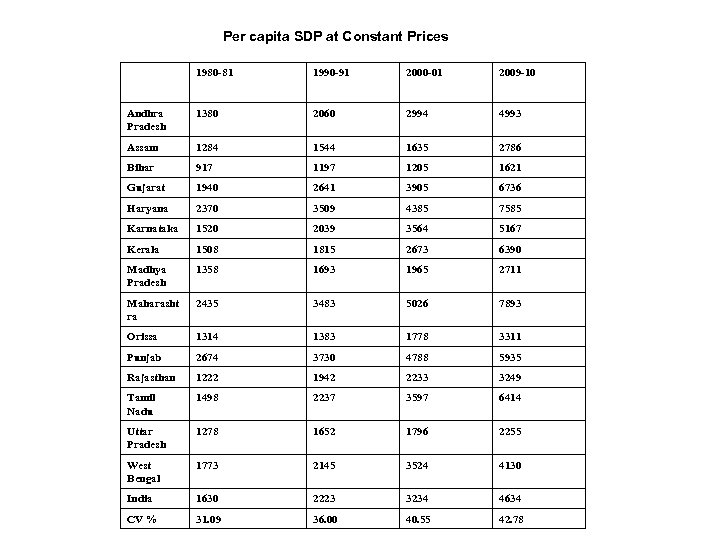
Per capita SDP at Constant Prices 1980 -81 1990 -91 2000 -01 2009 -10 Andhra Pradesh 1380 2060 2994 4993 Assam 1284 1544 1635 2786 Bihar 917 1197 1205 1621 Gujarat 1940 2641 3905 6736 Haryana 2370 3509 4385 7585 Karnataka 1520 2039 3564 5167 Kerala 1508 1815 2673 6390 Madhya Pradesh 1358 1693 1965 2711 Maharasht ra 2435 3483 5026 7893 Orissa 1314 1383 1778 3311 Punjab 2674 3730 4788 5935 Rajasthan 1222 1942 2233 3249 Tamil Nadu 1498 2237 3597 6414 Uttar Pradesh 1278 1652 1796 2255 West Bengal 1773 2145 3524 4130 India 1630 2223 3234 4634 CV % 31. 09 36. 00 40. 55 42. 78
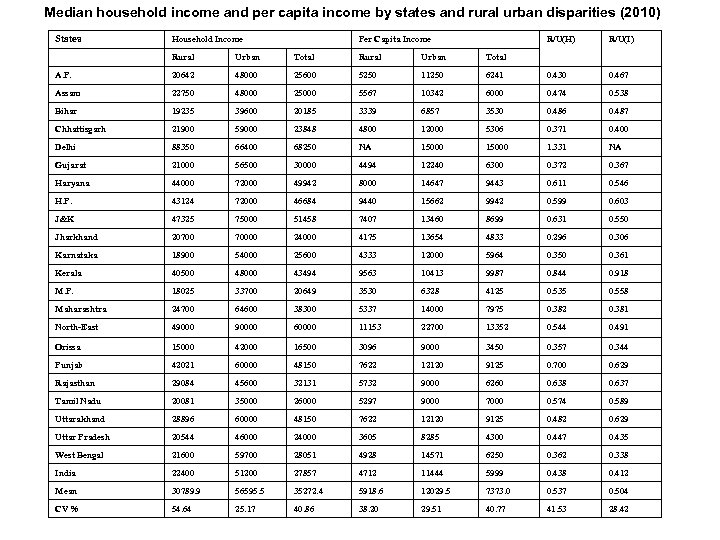
Median household income and per capita income by states and rural urban disparities (2010) States Household Income Per Capita Income R/U(H) R/U(I) Rural Urban Total A. P. 20642 48000 25600 5250 11250 6241 0. 430 0. 467 Assam 22750 48000 25000 5567 10342 6000 0. 474 0. 538 Bihar 19235 39600 20185 3339 6857 3530 0. 486 0. 487 Chhattisgarh 21900 59000 23848 4800 12000 5306 0. 371 0. 400 Delhi 88350 66400 68250 NA 15000 1. 331 NA Gujarat 21000 56500 30000 4494 12240 6300 0. 372 0. 367 Haryana 44000 72000 49942 8000 14647 9443 0. 611 0. 546 H. P. 43124 72000 46684 9440 15662 9942 0. 599 0. 603 J&K 47325 75000 51458 7407 13460 8699 0. 631 0. 550 Jharkhand 20700 70000 24000 4175 13654 4833 0. 296 0. 306 Karnataka 18900 54000 25600 4333 12000 5964 0. 350 0. 361 Kerala 40500 48000 43494 9563 10413 9987 0. 844 0. 918 M. P. 18025 33700 20649 3530 6328 4125 0. 535 0. 558 Maharashtra 24700 64600 38300 5337 14000 7975 0. 382 0. 381 North-East 490000 60000 11153 22700 13352 0. 544 0. 491 Orissa 15000 42000 16500 3096 9000 3450 0. 357 0. 344 Punjab 42021 60000 48150 7622 12120 9125 0. 700 0. 629 Rajasthan 29084 45600 32131 5732 9000 6260 0. 638 0. 637 Tamil Nadu 20081 35000 26000 5297 9000 7000 0. 574 0. 589 Uttarakhand 28896 60000 48150 7622 12120 9125 0. 482 0. 629 Uttar Pradesh 20544 46000 24000 3605 8285 4300 0. 447 0. 435 West Bengal 21600 59700 28051 4928 14571 6250 0. 362 0. 338 India 22400 51200 27857 4712 11444 5999 0. 438 0. 412 Mean 30789. 9 56595. 5 35272. 4 5918. 6 12029. 5 7373. 0 0. 537 0. 504 CV % 54. 64 25. 17 40. 86 38. 20 29. 51 40. 77 41. 53 28. 42
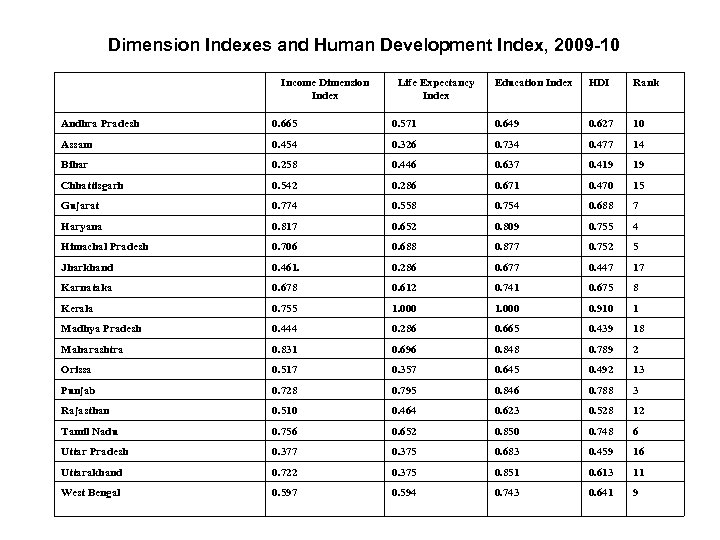
Dimension Indexes and Human Development Index, 2009 -10 Income Dimension Index Life Expectancy Index Education Index HDI Rank Andhra Pradesh 0. 665 0. 571 0. 649 0. 627 10 Assam 0. 454 0. 326 0. 734 0. 477 14 Bihar 0. 258 0. 446 0. 637 0. 419 19 Chhattisgarh 0. 542 0. 286 0. 671 0. 470 15 Gujarat 0. 774 0. 558 0. 754 0. 688 7 Haryana 0. 817 0. 652 0. 809 0. 755 4 Himachal Pradesh 0. 706 0. 688 0. 877 0. 752 5 Jharkhand 0. 461. 0. 286 0. 677 0. 447 17 Karnataka 0. 678 0. 612 0. 741 0. 675 8 Kerala 0. 755 1. 000 0. 910 1 Madhya Pradesh 0. 444 0. 286 0. 665 0. 439 18 Maharashtra 0. 831 0. 696 0. 848 0. 789 2 Orissa 0. 517 0. 357 0. 645 0. 492 13 Punjab 0. 728 0. 795 0. 846 0. 788 3 Rajasthan 0. 510 0. 464 0. 623 0. 528 12 Tamil Nadu 0. 756 0. 652 0. 850 0. 748 6 Uttar Pradesh 0. 377 0. 375 0. 683 0. 459 16 Uttarakhand 0. 722 0. 375 0. 851 0. 613 11 West Bengal 0. 597 0. 594 0. 743 0. 641 9
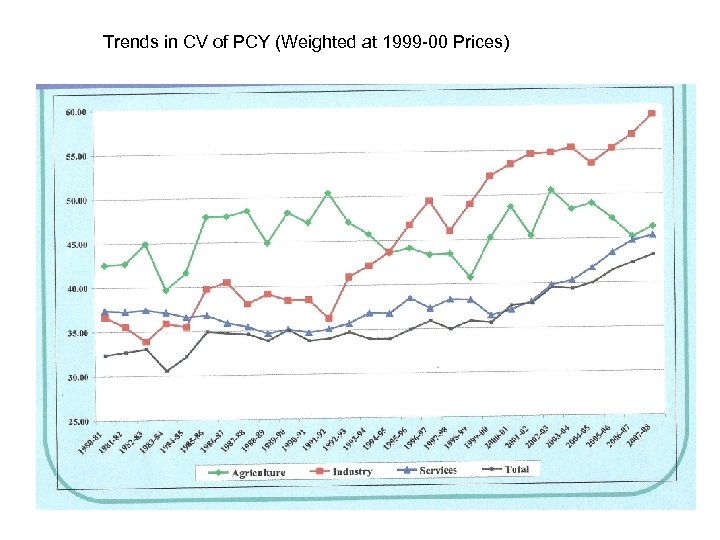
Trends in CV of PCY (Weighted at 1999 -00 Prices)
CHALLENGES IN REGIONAL DEVELOPMENT • Globalization and liberalization of economy appear to be co-related with rising spatial inequality. • Global integration leads to sharper expression of comparative advantage and regions well placed in terms of location, education, governance and other conducive conditions which tend to surge ahead as global opportunities are accesses while others lag behind. • This is a case both for China and India where sharply rising regional disparities have coincided with period of external liberalization. • High and rising inequality in general dissipates the impact of growth on poverty reduction. Spatial inequality contributes to overall inequality but it is critical where location aligns with differences between group identities. The deepening North South divide in small country like Ghana became a major concern as North is primarily Islamic while South is Christian dominated. Plural Societies like India can not ignore such sensitivities
CHALLENGES IN REGIONAL DEVELOPMENT • Spatial disparities in India align with other cleavages which threaten the national unity and peace, whether it is the Maoist corridor that matches the corridor of deprivation or whether it is fissiparous tendencies within the States, some of which may have been addressed but others which continue to fester. • Location blind policies may be preferable from economic perspective but can be problematic in multi ethnic and multi religious societies like ours. Our strong regional policies lead to redistribution of gains of growth with investment in lagging regions. We have launched ambitious programmes like ‘National Rural Employment Guarantee Scheme’ and ‘Bharat Nirman’ successfully to address the needs of the lagging rural segments. • Flushed with growth success for the last two decades, there is an argument from analysts that balanced regional development is a concept of the past and that lagging regions should essentially send the population to fast growing areas. It is our national commitment to reduce overall rising inequalities, alleviate poverty and address larger issues of social inclusion. However, if hypothesis of divergence in regional incomes has stronger ground, some growth may have to be sacrificed to achieve balanced regional growth.
REVIVAL OF REGIONAL POLICY • Since 2002, our policy aim is also to bring poor regions up to a minimum level of social and physical infrastructure through large “flag ship” programmes. • These have been launched to provide resources to build capacities of local bodies to plan locally and to provide resources to plug “critical gaps”. • The new strategy is built on the premise that once these critical gaps can be filled and minimum infrastructure created, the states will be better equipped to integrate with the markets and take advantage of globalization. • The role of the state is seen as facilitator for the creation of a market friendly environment. • This strategy is expected to offset the cumulative advantage conferred by the market on the already developed regions • India spends nearly USD 125 billion annually on about 150 Centrally sponsored schemes conceived by Federal Govt. and implemented by States.
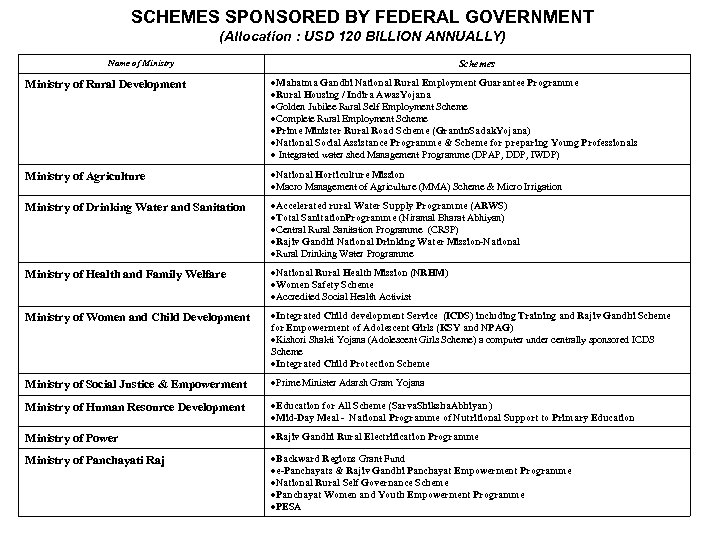
SCHEMES SPONSORED BY FEDERAL GOVERNMENT (Allocation : USD 120 BILLION ANNUALLY) Name of Ministry Schemes Ministry of Rural Development Mahatma Gandhi National Rural Employment Guarantee Programme Rural Housing / Indira Awas. Yojana Golden Jubilee Rural Self Employment Scheme Complete Rural Employment Scheme Prime Minister Rural Road Scheme (Gramin. Sadak. Yojana) National Social Assistance Programme & Scheme for preparing Young Professionals Integrated water shed Management Programme (DPAP, DDP, IWDP) Ministry of Agriculture National Horticulture Mission Macro Management of Agriculture (MMA) Scheme & Micro Irrigation Ministry of Drinking Water and Sanitation Accelerated rural Water Supply Programme (ARWS) Total Sanitation. Programme (Niramal Bharat Abhiyan) Central Rural Sanitation Programme (CRSP) Rajiv Gandhi National Drinking Water Mission-National Rural Drinking Water Programme Ministry of Health and Family Welfare National Rural Health Mission (NRHM) Women Safety Scheme Accredited Social Health Activist Ministry of Women and Child Development Integrated Child development Service (ICDS) including Training and Rajiv Gandhi Scheme for Empowerment of Adolescent Girls (KSY and NPAG) Kishori Shakti Yojana (Adolescent Girls Scheme) a computer under centrally sponsored ICDS Scheme Integrated Child Protection Scheme Ministry of Social Justice & Empowerment Prime Minister Adarsh Gram Yojana Ministry of Human Resource Development Education for All Scheme (Sarva. Shiksha. Abhiyan ) Mid-Day Meal - National Programme of Nutritional Support to Primary Education Ministry of Power Rajiv Gandhi Rural Electrification Programme Ministry of Panchayati Raj Backward Regions Grant Fund e-Panchayats & Rajiv Gandhi Panchayat Empowerment Programme National Rural Self Governance Scheme Panchayat Women and Youth Empowerment Programme PESA
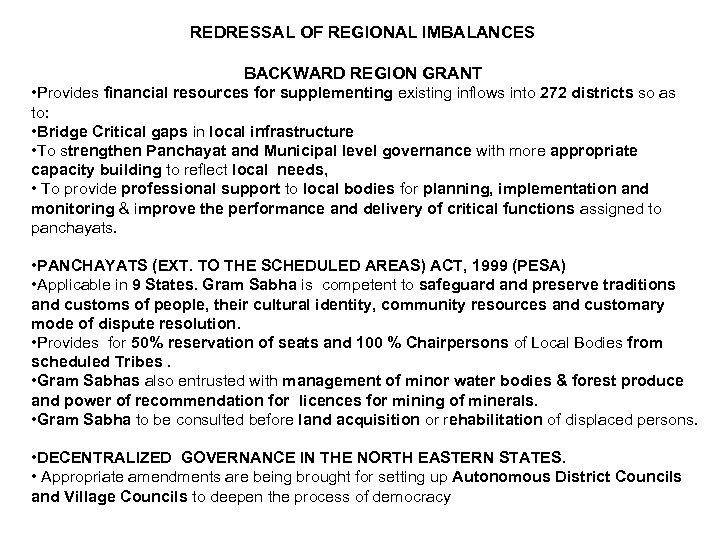
REDRESSAL OF REGIONAL IMBALANCES BACKWARD REGION GRANT • Provides financial resources for supplementing existing inflows into 272 districts so as to: • Bridge Critical gaps in local infrastructure • To strengthen Panchayat and Municipal level governance with more appropriate capacity building to reflect local needs, • To provide professional support to local bodies for planning, implementation and monitoring & improve the performance and delivery of critical functions assigned to panchayats. • PANCHAYATS (EXT. TO THE SCHEDULED AREAS) ACT, 1999 (PESA) • Applicable in 9 States. Gram Sabha is competent to safeguard and preserve traditions and customs of people, their cultural identity, community resources and customary mode of dispute resolution. • Provides for 50% reservation of seats and 100 % Chairpersons of Local Bodies from scheduled Tribes. • Gram Sabhas also entrusted with management of minor water bodies & forest produce and power of recommendation for licences for mining of minerals. • Gram Sabha to be consulted before land acquisition or rehabilitation of displaced persons. • DECENTRALIZED GOVERNANCE IN THE NORTH EASTERN STATES. • Appropriate amendments are being brought for setting up Autonomous District Councils and Village Councils to deepen the process of democracy
BRICS COOPERATION • Important features of BRICS economies include their robust macroeconomic fundamentals, large geographical dimensions and the size of population that represents an enormous potential consumer market complemented by access to regional markets. The number of people at middle income threshold in BRICS is expected to grow several times during the next decade. BRICS markets have great potential for establishing the most stabilizing of forces that is a prosperous middle class which will broaden and deepen, providing a solid base for the growth and development of these economies. • A common challenge that the BRICS economies face is the need of institutional development without which sustainable development cannot be ensured. Public-private participation can boost infrastructure growth. In the next decade how the challenges such as high fiscal deficits , high global uncertainty leading to weak demand for exports, trade protectionism , high unemployment levels , poverty and inadequate public health and education facilities and environmental degradation and climate change are met would be crucial in determining the development trajectory of BRICS economies. • Towards this endeavor BRIC countries will have to rely heavily on the sub national governments economic policies. The areas for cooperation among the BRIC economies may include infrastructure financing, industrial development, transportation, food security, technical education, energy security, institution building and setting up international development bank for south-south investment. The BRICS have remarkable opportunity to work on strategic agenda to coordinate their economic policies and diplomatic strategies to play significant role in global affairs.
Скачать презентацию CHALLENGES FOR REGIONAL DEVELOPMENT BY DALBIR SINGH
c581fb4ba5e055b50fbeb6cd087c51b2.ppt