


 Скачать презентацию Challenges for international agricultural research Sirkka Immonen 24
93933d3d0c7c2787cd5456e45a8a448c.ppt
- Количество слайдов: 35
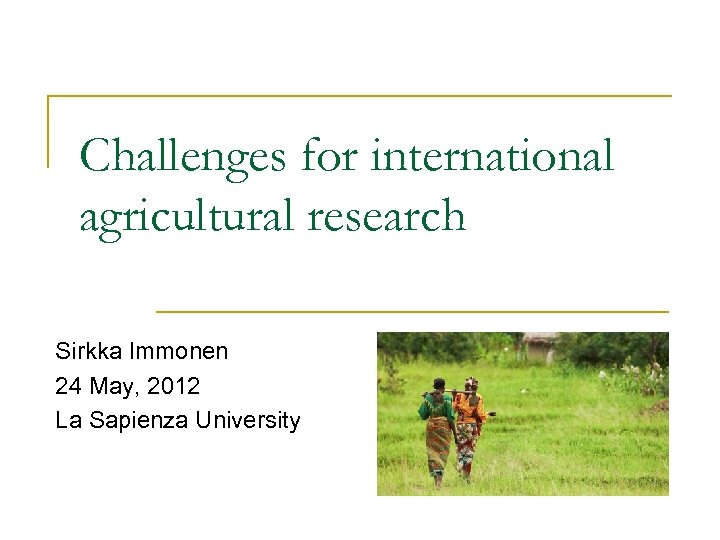 Challenges for international agricultural research Sirkka Immonen 24 May, 2012 La Sapienza University
 Structure of presentation International agricultural research: n Public research for development, the CGIAR n Demand-led research; forecasting future needs n Major challenges for agricultural research n Characteristics of research n Impact pathways n Results and impact
 International Agricultural Research for Development n Institutions q q n Centers of the Consultative Group on International Agricultural Research (CGIAR) Others conduct international research with development aims: several universities, large national programs, such as French, Australian, Dutch, Brazilian In partnership with: q q q National and regional research systems Development agencies Non governmental organizations
 International Agricultural Research for Development n n Research with a mission Public research, addresses problems that q q n apply across borders are public goods national systems cannot address private sector does not address Examples: q q plant breeding for tropical and poor regions research on natural resources research on livestock and pastures research to support policy formulation
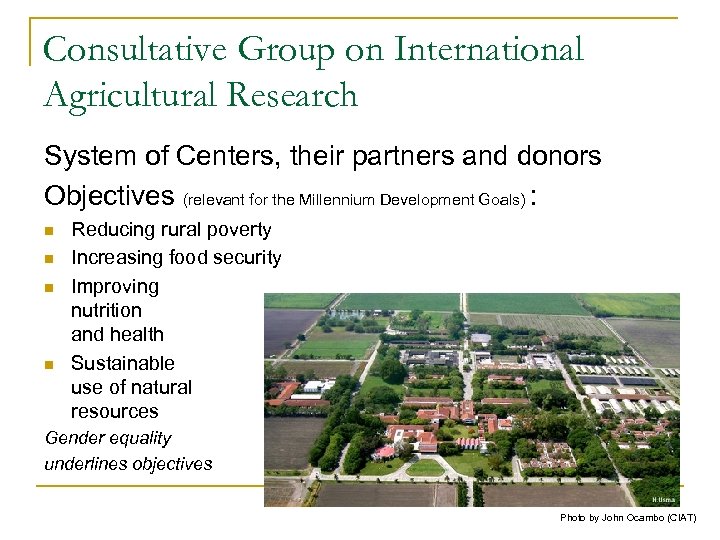 Consultative Group on International Agricultural Research System of Centers, their partners and donors Objectives (relevant for the Millennium Development Goals) : n n Reducing rural poverty Increasing food security Improving nutrition and health Sustainable use of natural resources Gender equality underlines objectives Photo by John Ocambo (CIAT)
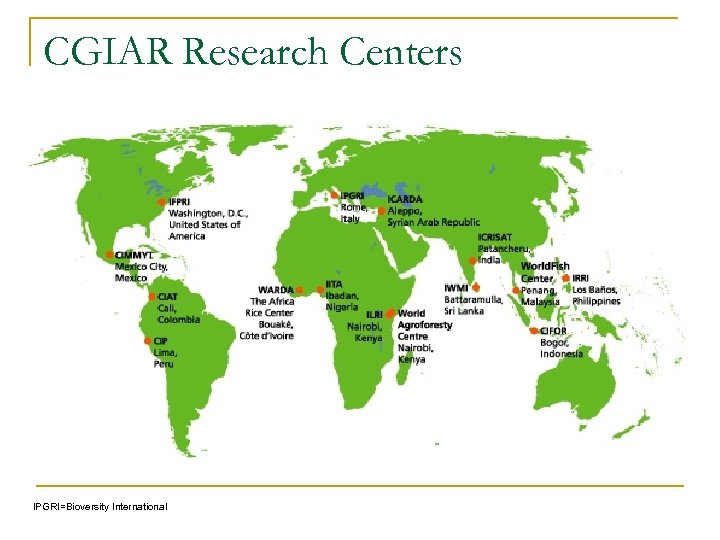 CGIAR Research Centers IPGRI=Bioversity International
 Research for development Responds to demand Funding: q Governments, foundations, private sector, development agencies Beneficiaries: q q Developing countries: national research, farmers, consumers, rural and urban poor International research community
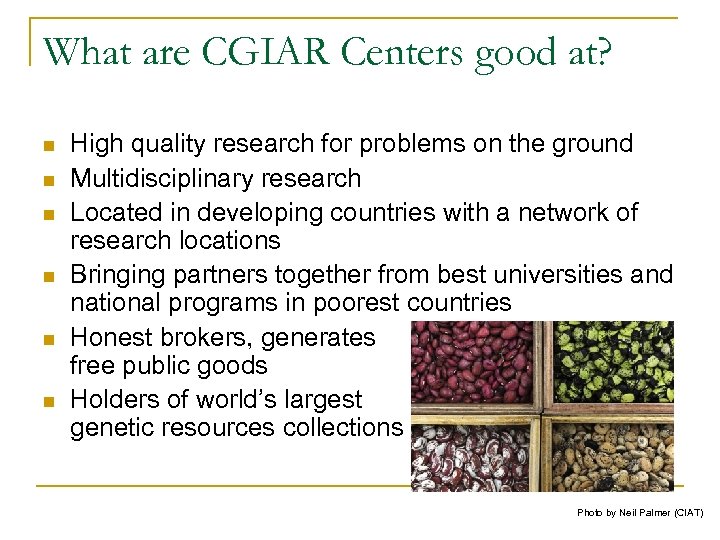 What are CGIAR Centers good at? n n n High quality research for problems on the ground Multidisciplinary research Located in developing countries with a network of research locations Bringing partners together from best universities and national programs in poorest countries Honest brokers, generates free public goods Holders of world’s largest genetic resources collections Photo by Neil Palmer (CIAT)
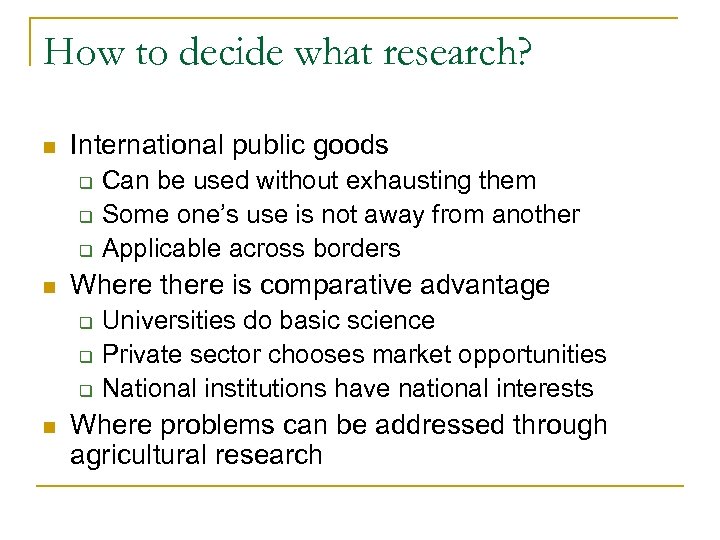 How to decide what research? n International public goods q q q n Where there is comparative advantage q q q n Can be used without exhausting them Some one’s use is not away from another Applicable across borders Universities do basic science Private sector chooses market opportunities National institutions have national interests Where problems can be addressed through agricultural research
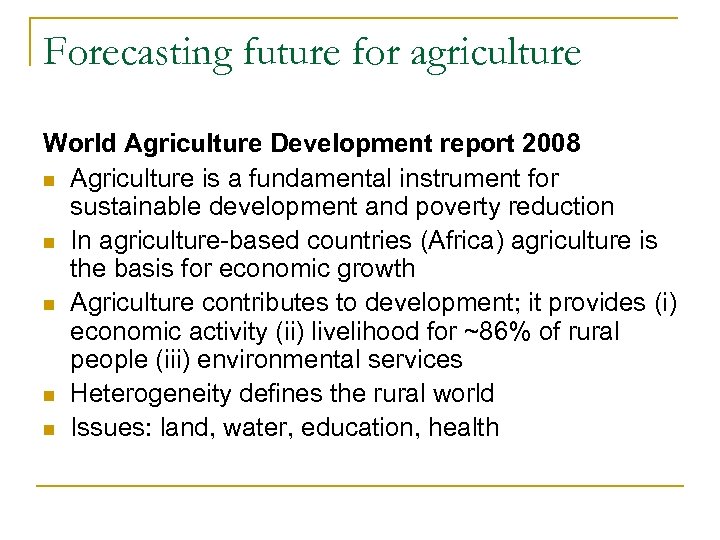 Forecasting future for agriculture World Agriculture Development report 2008 n Agriculture is a fundamental instrument for sustainable development and poverty reduction n In agriculture-based countries (Africa) agriculture is the basis for economic growth n Agriculture contributes to development; it provides (i) economic activity (ii) livelihood for ~86% of rural people (iii) environmental services n Heterogeneity defines the rural world n Issues: land, water, education, health
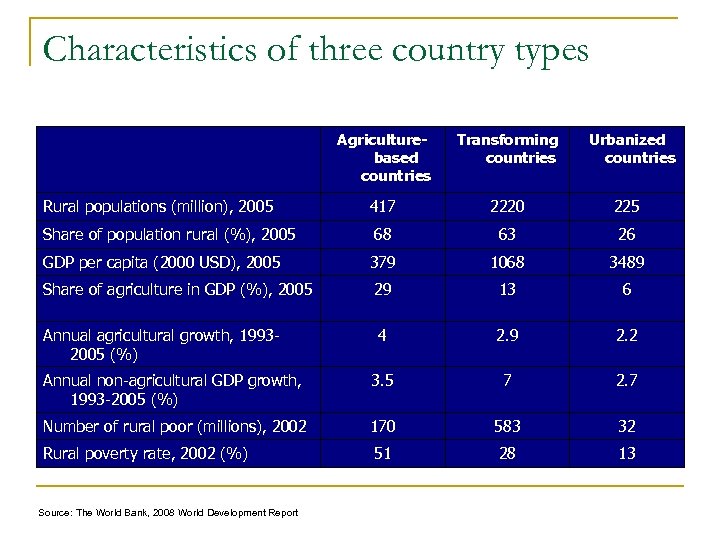 Characteristics of three country types Agriculturebased countries Transforming countries Rural populations (million), 2005 417 2220 225 Share of population rural (%), 2005 68 63 26 GDP per capita (2000 USD), 2005 379 1068 3489 Share of agriculture in GDP (%), 2005 29 13 6 Annual agricultural growth, 19932005 (%) 4 2. 9 2. 2 Annual non-agricultural GDP growth, 1993 -2005 (%) 3. 5 7 2. 7 Number of rural poor (millions), 2002 170 583 32 Rural poverty rate, 2002 (%) 51 28 13 Source: The World Bank, 2008 World Development Report Urbanized countries
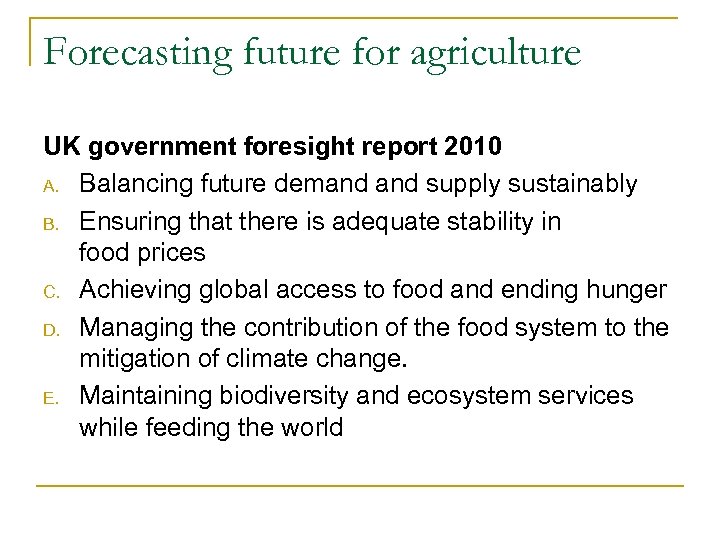 Forecasting future for agriculture UK government foresight report 2010 A. Balancing future demand supply sustainably B. Ensuring that there is adequate stability in food prices C. Achieving global access to food and ending hunger D. Managing the contribution of the food system to the mitigation of climate change. E. Maintaining biodiversity and ecosystem services while feeding the world
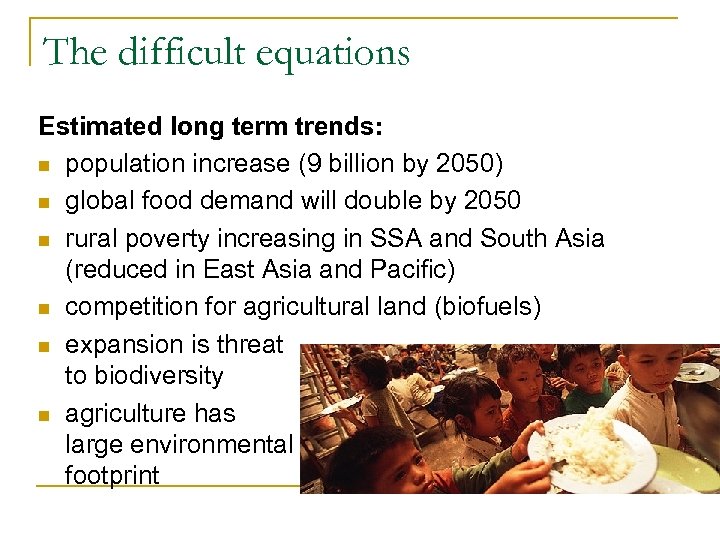 The difficult equations Estimated long term trends: n population increase (9 billion by 2050) n global food demand will double by 2050 n rural poverty increasing in SSA and South Asia (reduced in East Asia and Pacific) n competition for agricultural land (biofuels) n expansion is threat to biodiversity n agriculture has large environmental footprint
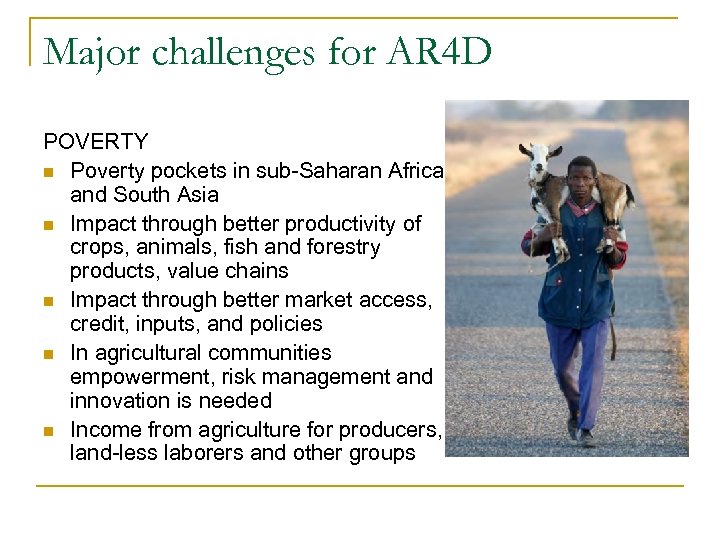 Major challenges for AR 4 D POVERTY n Poverty pockets in sub-Saharan Africa and South Asia n Impact through better productivity of crops, animals, fish and forestry products, value chains n Impact through better market access, credit, inputs, and policies n In agricultural communities empowerment, risk management and innovation is needed n Income from agriculture for producers, land-less laborers and other groups
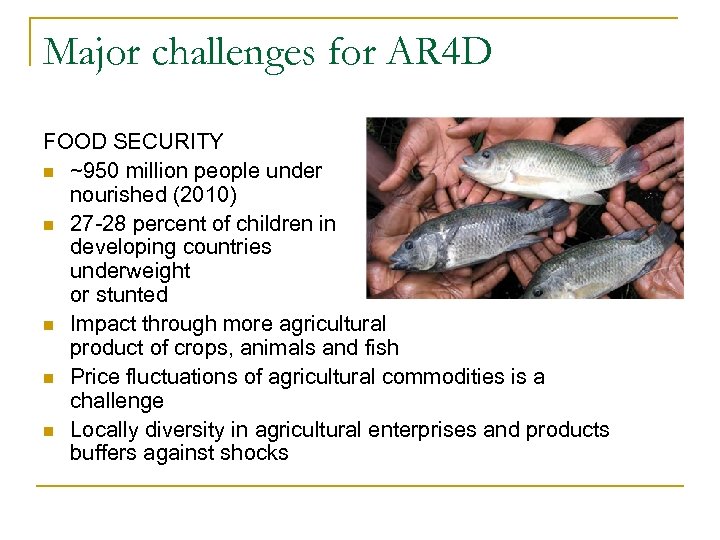 Major challenges for AR 4 D FOOD SECURITY n ~950 million people under nourished (2010) n 27 -28 percent of children in developing countries underweight or stunted n Impact through more agricultural product of crops, animals and fish n Price fluctuations of agricultural commodities is a challenge n Locally diversity in agricultural enterprises and products buffers against shocks
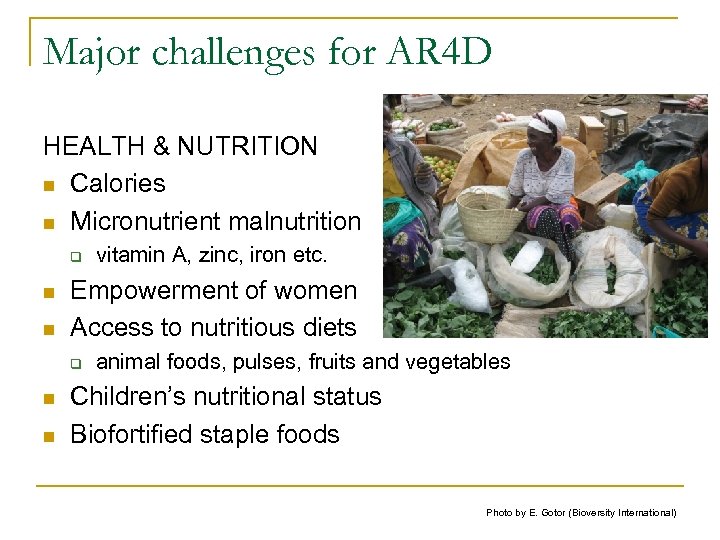 Major challenges for AR 4 D HEALTH & NUTRITION n Calories n Micronutrient malnutrition q n n Empowerment of women Access to nutritious diets q n n vitamin A, zinc, iron etc. animal foods, pulses, fruits and vegetables Children’s nutritional status Biofortified staple foods Photo by E. Gotor (Bioversity International)
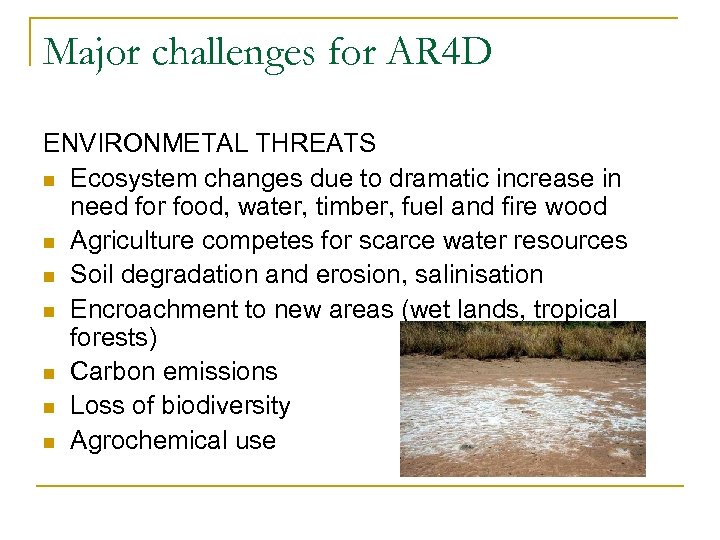 Major challenges for AR 4 D ENVIRONMETAL THREATS n Ecosystem changes due to dramatic increase in need for food, water, timber, fuel and fire wood n Agriculture competes for scarce water resources n Soil degradation and erosion, salinisation n Encroachment to new areas (wet lands, tropical forests) n Carbon emissions n Loss of biodiversity n Agrochemical use
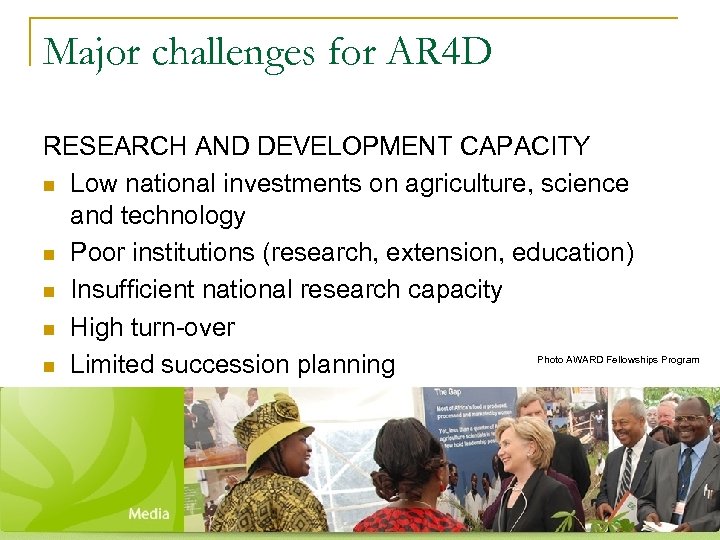 Major challenges for AR 4 D RESEARCH AND DEVELOPMENT CAPACITY n Low national investments on agriculture, science and technology n Poor institutions (research, extension, education) n Insufficient national research capacity n High turn-over n Limited succession planning Photo AWARD Fellowships Program
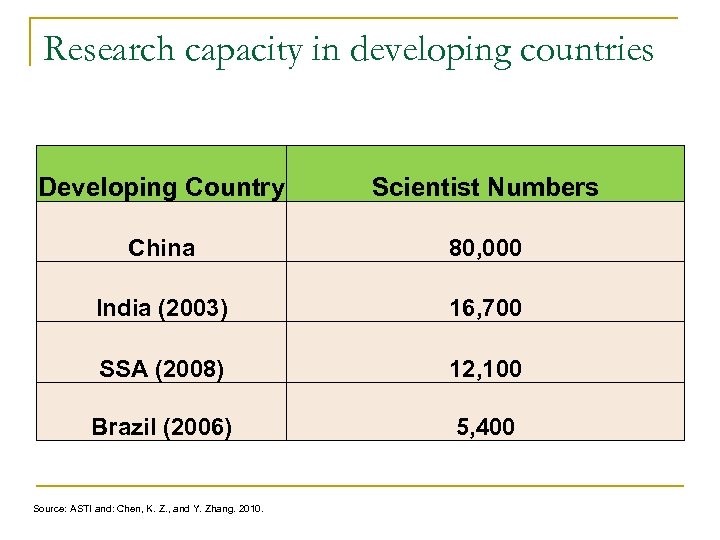 Research capacity in developing countries Developing Country Scientist Numbers China 80, 000 India (2003) 16, 700 SSA (2008) 12, 100 Brazil (2006) 5, 400 Source: ASTI and: Chen, K. Z. , and Y. Zhang. 2010.
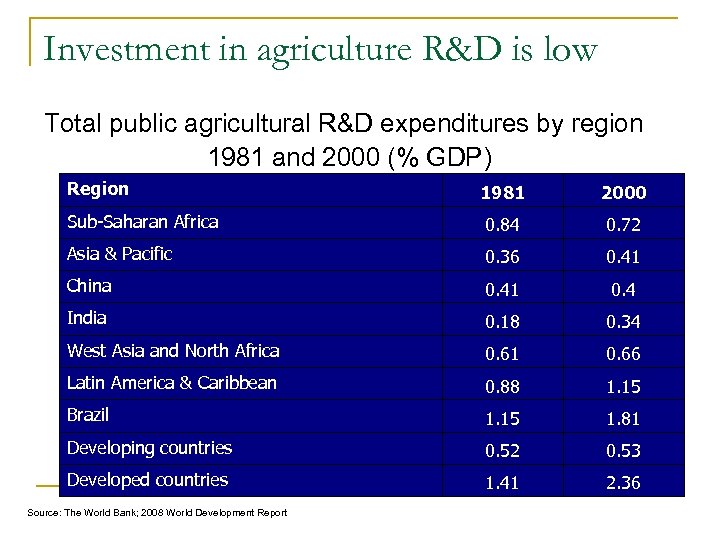 Investment in agriculture R&D is low Total public agricultural R&D expenditures by region 1981 and 2000 (% GDP) Region 1981 2000 Sub-Saharan Africa 0. 84 0. 72 Asia & Pacific 0. 36 0. 41 China 0. 41 0. 4 India 0. 18 0. 34 West Asia and North Africa 0. 61 0. 66 Latin America & Caribbean 0. 88 1. 15 Brazil 1. 15 1. 81 Developing countries 0. 52 0. 53 Developed countries 1. 41 2. 36 Source: The World Bank; 2008 World Development Report
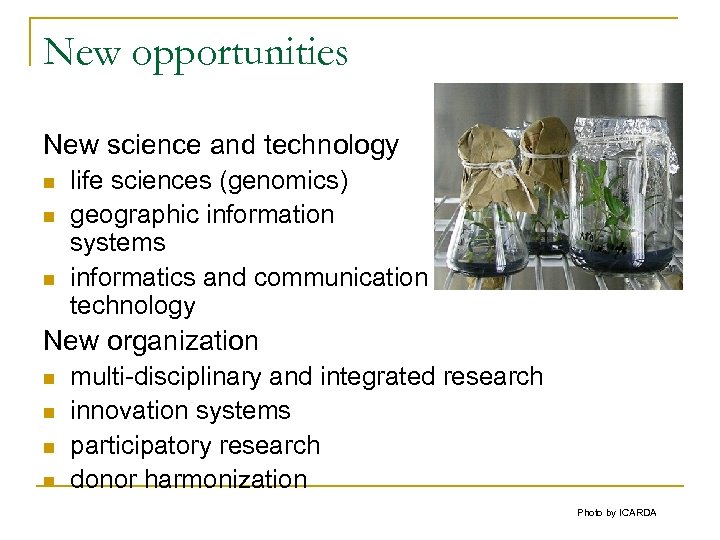 New opportunities New science and technology n n n life sciences (genomics) geographic information systems informatics and communication technology New organization n n multi-disciplinary and integrated research innovation systems participatory research donor harmonization Photo by ICARDA
 Characteristics of research n n n Research needs to discover new things and explore the unexplored Research is risky and unpredictable Unexpected results and failures are valuable Needs to be transparent Thrives from critique Scientific discoveries lead to innovation and adaptation
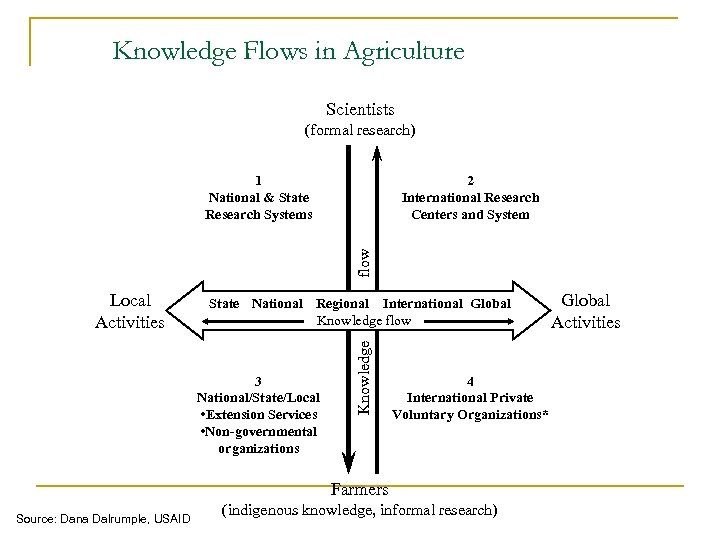 Knowledge Flows in Agriculture Scientists (formal research) 2 International Research Centers and System flow 1 National & State Research Systems State National Regional International Global Knowledge flow 3 National/State/Local • Extension Services • Non-governmental organizations Knowledge Local Activities 4 International Private Voluntary Organizations* Farmers Source: Dana Dalrumple, USAID (indigenous knowledge, informal research) Global Activities
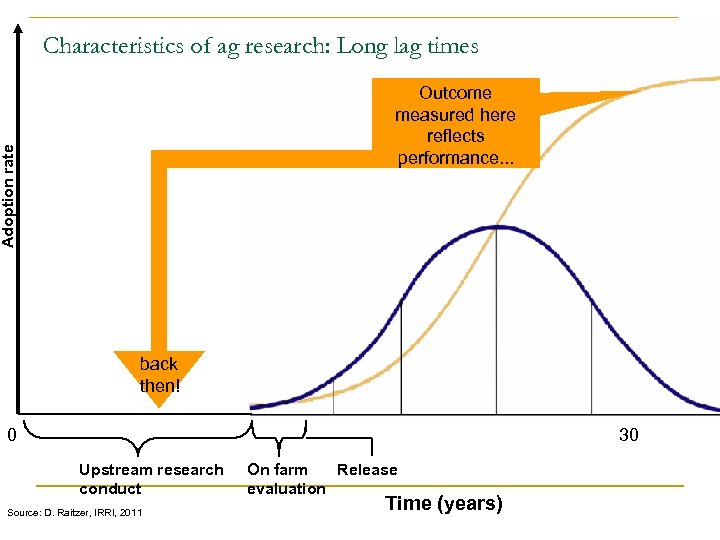 Characteristics of ag research: Long lag times Adoption rate Outcome measured here reflects performance. . . back then! 0 30 Upstream research conduct Source: D. Raitzer, IRRI, 2011 On farm Release evaluation Time (years)
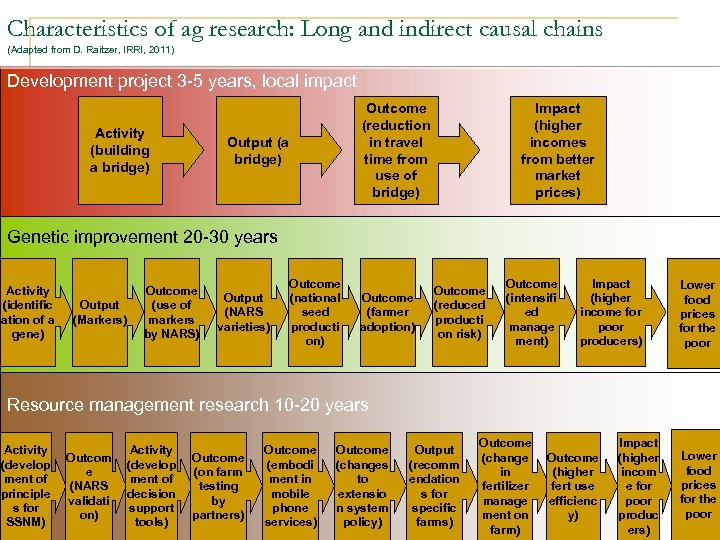 Characteristics of ag research: Long and indirect causal chains (Adapted from D. Raitzer, IRRI, 2011) Development project 3 -5 years, local impact Activity (building a bridge) Outcome (reduction in travel time from use of bridge) Output (a bridge) Impact (higher incomes from better market prices) Genetic improvement 20 -30 years Activity (identific ation of a gene) Output (Markers) Outcome (use of markers by NARS) Output (NARS varieties) Outcome (national seed producti on) Outcome (farmer adoption) Outcome (reduced producti on risk) Outcome (intensifi ed manage ment) Impact (higher income for poor producers) Lower food prices for the poor Resource management research 10 -20 years Activity (develop ment of principle s for SSNM) Outcom e (NARS validati on) Activity (develop ment of decision support tools) Outcome (on farm testing by partners) Outcome (embodi ment in mobile phone services) Outcome (changes to extensio n system policy) Output (recomm endation s for specific farms) Outcome (change in fertilizer manage ment on farm) Outcome (higher fert use efficienc y) Impact (higher incom e for poor produc ers) Lower food prices for the poor
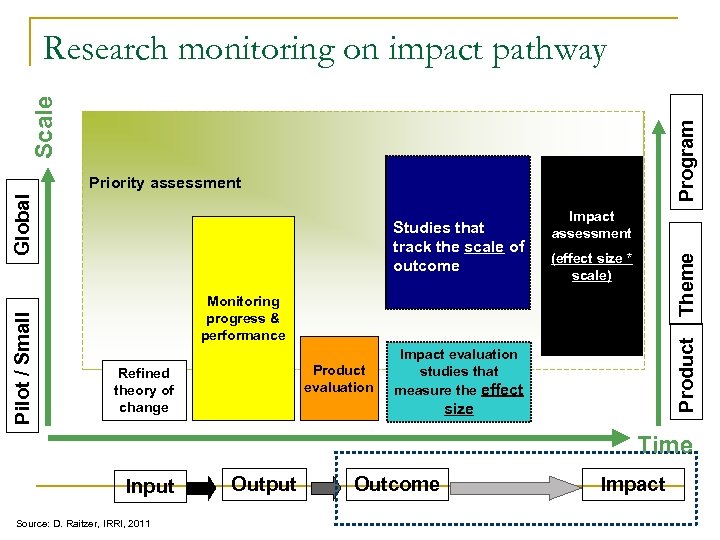 Program Scale Research monitoring on impact pathway Impact assessment (effect size * scale) Theme Studies that track the scale of outcome Monitoring progress & performance Product evaluation Refined theory of change Product Pilot / Small Global Priority assessment Impact evaluation studies that measure the effect size Time Input Source: D. Raitzer, IRRI, 2011 Output Outcome Impact
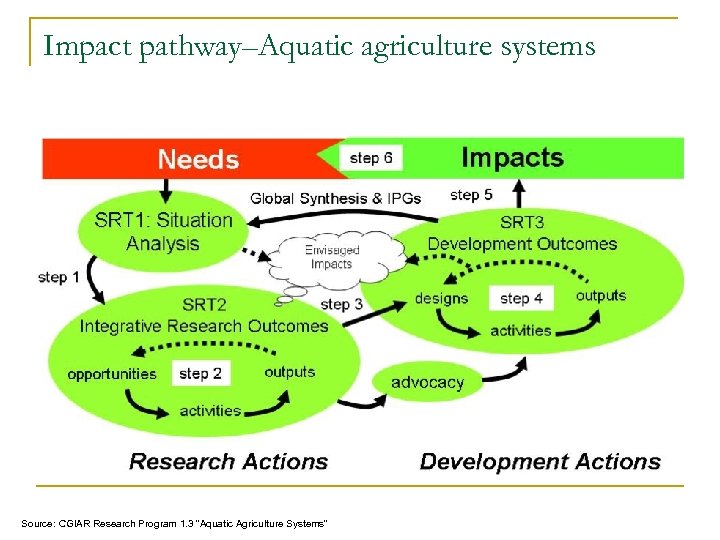 Impact pathway–Aquatic agriculture systems Source: CGIAR Research Program 1. 3 “Aquatic Agriculture Systems”
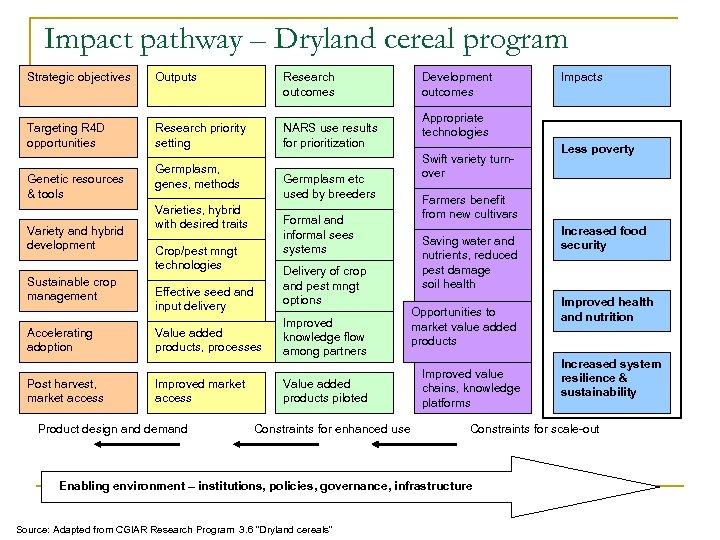 Impact pathway – Dryland cereal program Strategic objectives Outputs Research outcomes Targeting R 4 D opportunities Research priority setting NARS use results for prioritization Genetic resources & tools Variety and hybrid development Sustainable crop management Accelerating adoption Post harvest, market access Germplasm, genes, methods Germplasm etc used by breeders Varieties, hybrid with desired traits Formal and informal sees systems Crop/pest mngt technologies Effective seed and input delivery Value added products, processes Improved market access Product design and demand Delivery of crop and pest mngt options Improved knowledge flow among partners Value added products piloted Constraints for enhanced use Development outcomes Appropriate technologies Swift variety turnover Less poverty Farmers benefit from new cultivars Saving water and nutrients, reduced pest damage soil health Opportunities to market value added products Improved value chains, knowledge platforms Increased food security Improved health and nutrition Increased system resilience & sustainability Constraints for scale-out Enabling environment – institutions, policies, governance, infrastructure Source: Adapted from CGIAR Research Program 3. 6 “Dryland cereals” Impacts
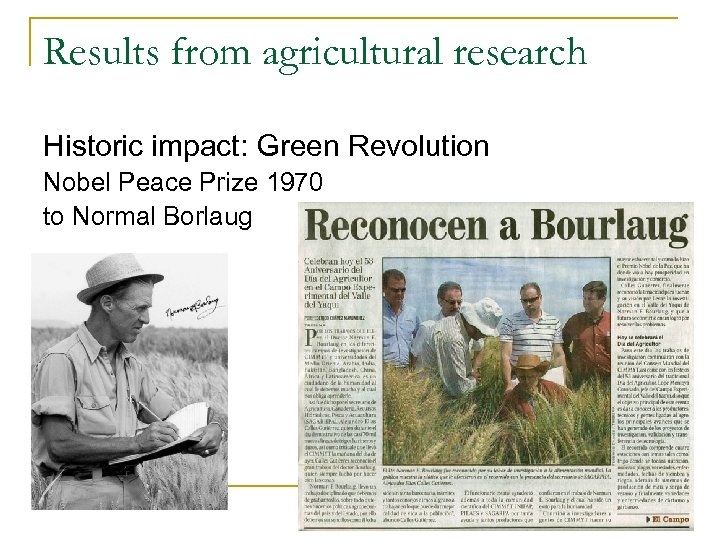 Results from agricultural research Historic impact: Green Revolution Nobel Peace Prize 1970 to Normal Borlaug
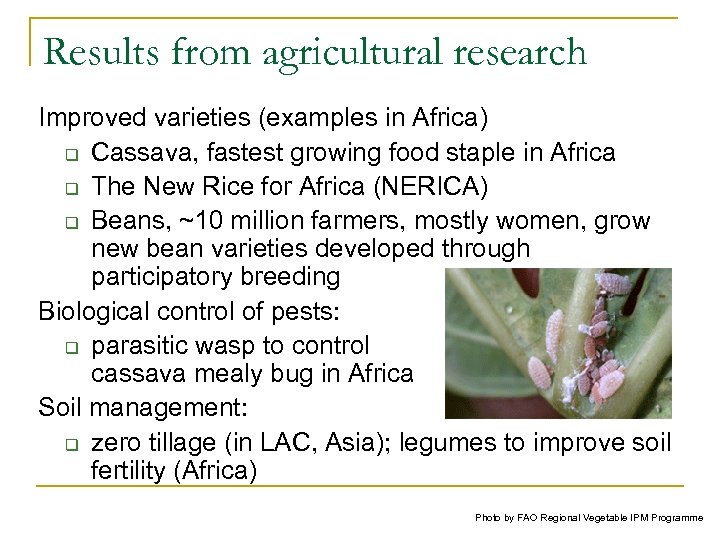 Results from agricultural research Improved varieties (examples in Africa) q Cassava, fastest growing food staple in Africa q The New Rice for Africa (NERICA) q Beans, ~10 million farmers, mostly women, grow new bean varieties developed through participatory breeding Biological control of pests: q parasitic wasp to control cassava mealy bug in Africa Soil management: q zero tillage (in LAC, Asia); legumes to improve soil fertility (Africa) Photo by FAO Regional Vegetable IPM Programme
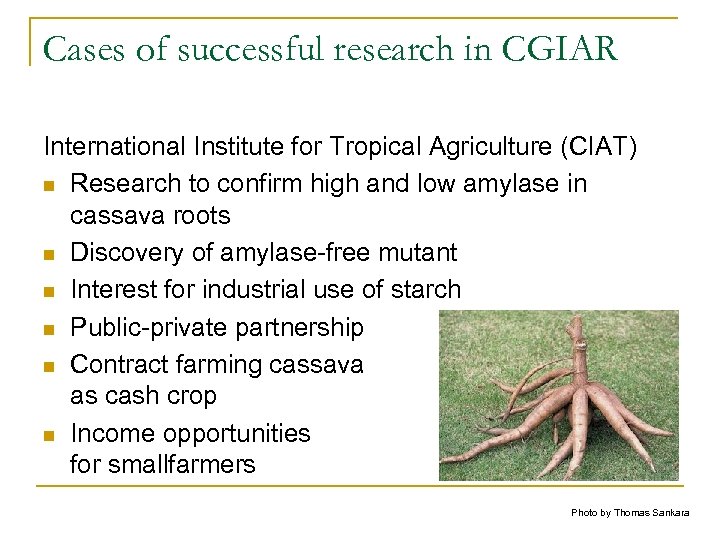 Cases of successful research in CGIAR International Institute for Tropical Agriculture (CIAT) n Research to confirm high and low amylase in cassava roots n Discovery of amylase-free mutant n Interest for industrial use of starch n Public-private partnership n Contract farming cassava as cash crop n Income opportunities for smallfarmers Photo by Thomas Sankara
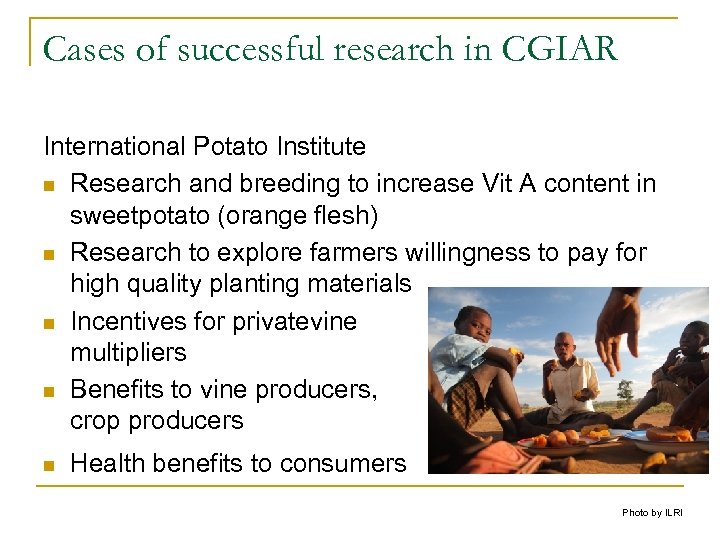 Cases of successful research in CGIAR International Potato Institute n Research and breeding to increase Vit A content in sweetpotato (orange flesh) n Research to explore farmers willingness to pay for high quality planting materials n Incentives for privatevine multipliers n Benefits to vine producers, crop producers n Health benefits to consumers Photo by ILRI
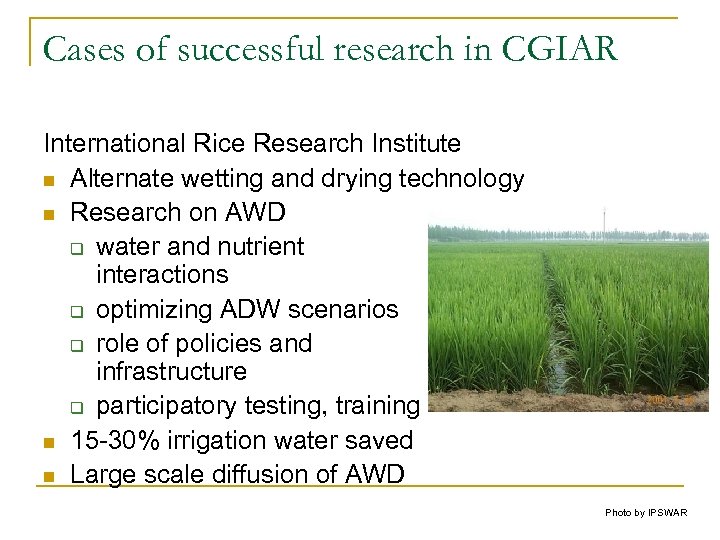 Cases of successful research in CGIAR International Rice Research Institute n Alternate wetting and drying technology n Research on AWD q water and nutrient interactions q optimizing ADW scenarios q role of policies and infrastructure q participatory testing, training n 15 -30% irrigation water saved n Large scale diffusion of AWD Photo by IPSWAR
 Cases of successful research in CGIAR Center for International Forestry Research n Research on forest certification for sustainable management n Criteria and indicators template with q n n n principles and criteria on policy, ecology, social conditions, biodiversity and production Adaptation to local contexts 1999 10 million ha forests certified worldwide 2006 79 million ha – most using the C&I standards
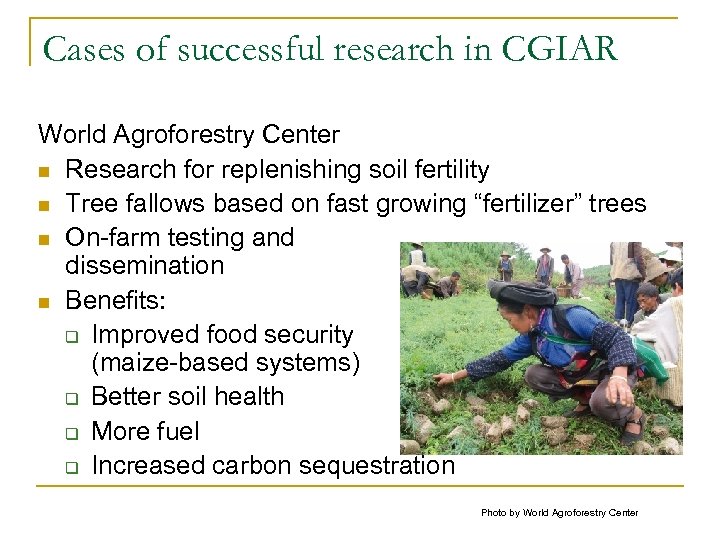 Cases of successful research in CGIAR World Agroforestry Center n Research for replenishing soil fertility n Tree fallows based on fast growing “fertilizer” trees n On-farm testing and dissemination n Benefits: q Improved food security (maize-based systems) q Better soil health q More fuel q Increased carbon sequestration Photo by World Agroforestry Center