 Скачать презентацию Challenges and Limitations in a Back-End Controlled Smart
7c5ece4ef3942964efa36c74249a6bf0.ppt
- Количество слайдов: 13



Challenges and Limitations in a Back-End Controlled Smart. Home Thesis Work Presentation 06. 2006 Niklas Salmela Supervisor: Prof. Jorma Virtamo Instructor: M. Sc. Heikki Loukojärvi © Siemens 2006 All Rights Reserved 1
Contents § § What is a Smart House? § Back-end controlled Smart. Home § Challenges § © Siemens 2006 All Rights Reserved Introduction Conclusions 2
Introduction § § Peoples need for security is rising § Researches show that the interest for “Smart Houses” is increasing § A ”normal” Smart House contain mostly functionalities which address home security and home automation § © Siemens 2006 All Rights Reserved New Internet based services are appearing (Vo. D, IPTV, Vo. IP, etc. ) In a back-end controlled Smart. Home there can further be included Internet based services 3
What is a Smart House? § There is not a single definition of a Smart House § A “smart device” does not make a Smart House § Interaction between smart devices is common in most of the definitions of a Smart House § Common services in Smart Houses: Home Automation Home Control Home Security Home Surveillance § § § © Siemens 2006 All Rights Reserved Usually controlled by external keypads or touch screens, in some cases by a PC in the house 4
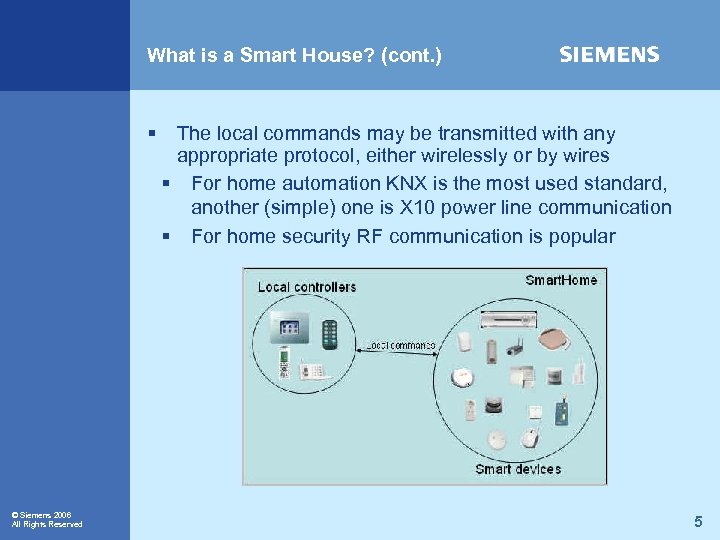
What is a Smart House? (cont. ) § © Siemens 2006 All Rights Reserved The local commands may be transmitted with any appropriate protocol, either wirelessly or by wires § For home automation KNX is the most used standard, another (simple) one is X 10 power line communication § For home security RF communication is popular 5
Back-end controlled Smart. Home § § All the functionalities of an ordinary Smart House stay the same § © Siemens 2006 All Rights Reserved A back-end controlled Smart. Home is a Smart House that is connected to the Internet § To get full functionality the connection should be an always on, broadband connection In the basic case no further services are introduced, the added value comes from the remote access 6
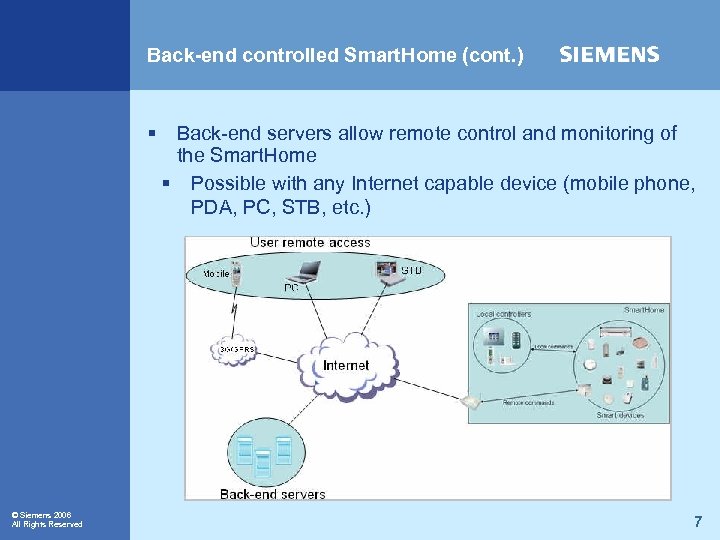
Back-end controlled Smart. Home (cont. ) § © Siemens 2006 All Rights Reserved Back-end servers allow remote control and monitoring of the Smart. Home § Possible with any Internet capable device (mobile phone, PDA, PC, STB, etc. ) 7
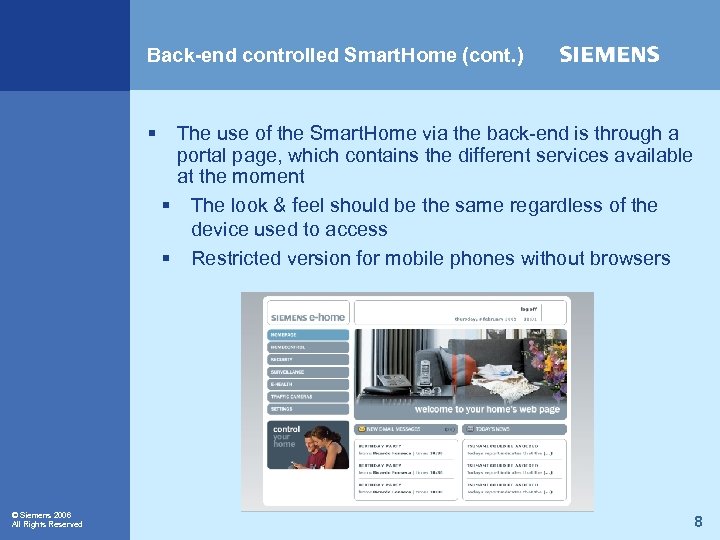
Back-end controlled Smart. Home (cont. ) § © Siemens 2006 All Rights Reserved The use of the Smart. Home via the back-end is through a portal page, which contains the different services available at the moment § The look & feel should be the same regardless of the device used to access § Restricted version for mobile phones without browsers 8
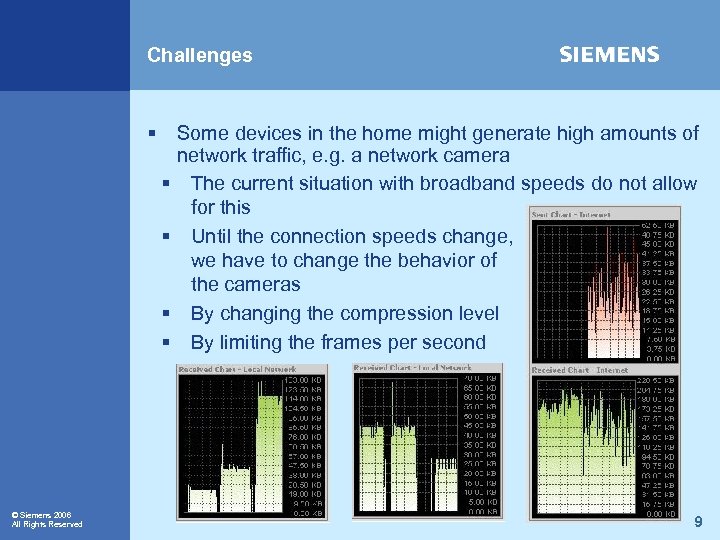
Challenges § § § © Siemens 2006 All Rights Reserved Some devices in the home might generate high amounts of network traffic, e. g. a network camera The current situation with broadband speeds do not allow for this Until the connection speeds change, we have to change the behavior of the cameras By changing the compression level By limiting the frames per second 9
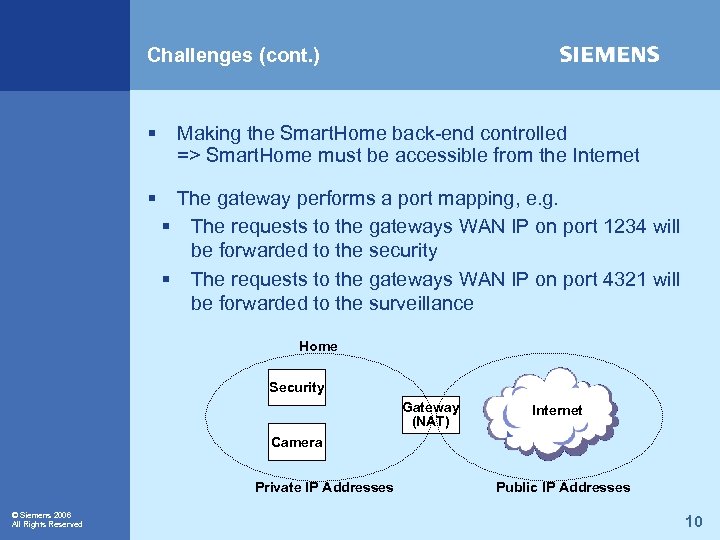
Challenges (cont. ) § § Making the Smart. Home back-end controlled => Smart. Home must be accessible from the Internet The gateway performs a port mapping, e. g. § The requests to the gateways WAN IP on port 1234 will be forwarded to the security § The requests to the gateways WAN IP on port 4321 will be forwarded to the surveillance Home Security Gateway (NAT) Internet Camera Private IP Addresses © Siemens 2006 All Rights Reserved Public IP Addresses 10
Challenges (cont. ) § § © Siemens 2006 All Rights Reserved Port mapping creates security issues as we cannot know who accesses the equipment. Especially critical in security and surveillance services § The equipment has password protection in itself, but is this enough? § Weak/default passwords a real hazard The access must be restricted § Requires not yet common features from the gateway § Source IP filtering in the port mapping => devices behind the NAT only accessible from a single (or a set of) IP address(es) § The use of VPN in the connection between the back-end and the home. Secure, but requires much from the Backend and from the home gateway (e. g. VPN and VLAN) 11
Conclusions § The services can already be implemented § The bandwidth will not be a problem much longer, speeds are constantly increasing § § © Siemens 2006 All Rights Reserved Biggest problems are in making the connections secure § Between the home and back-end § Between the user and back-end No single solution is yet decided § Much depends on the future of home gateways 12
Questions? Thank you! © Siemens 2006 All Rights Reserved 13
Скачать презентацию Challenges and Limitations in a Back-End Controlled Smart
7c5ece4ef3942964efa36c74249a6bf0.ppt