


 Скачать презентацию Chalker-Coddington network model and its applications to various
69d3f47c19e31f1cad49cb19e784b112.ppt
- Количество слайдов: 43
 Chalker-Coddington network model and its applications to various quantum Hall systems n n n INI V. Kagalovsky Sami Shamoon College of Engineering Beer-Sheva Israel 50 Years After : Mathematics and Physics of Anderson localization Delocalization Transitions and Multifractality 2 November to 6 November 2008
 Context Integer quantum Hall effect Semiclassical picture Chalker-Coddington network model Various applications Inter-plateaux transitions Floating of extended states New symmetry classes in dirty superconductors Effect of nuclear magnetization on QHE INI
 INI
INI
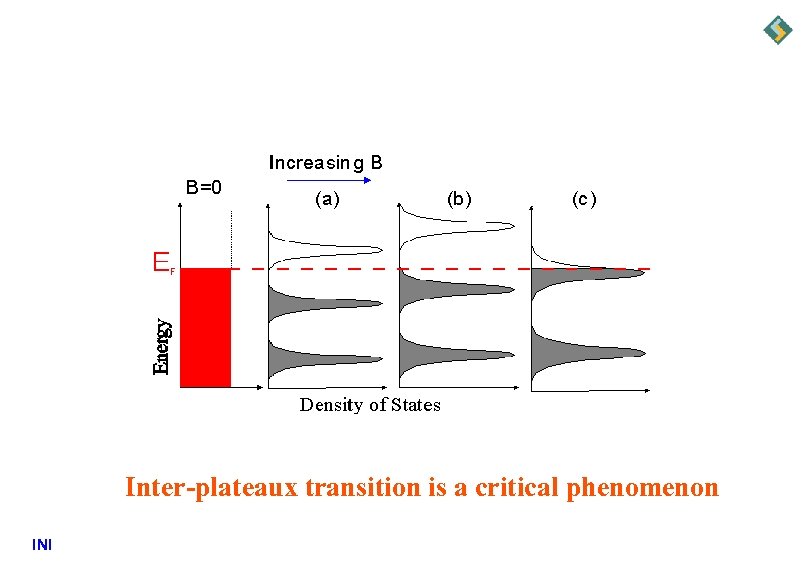 Inter-plateaux transition is a critical phenomenon INI
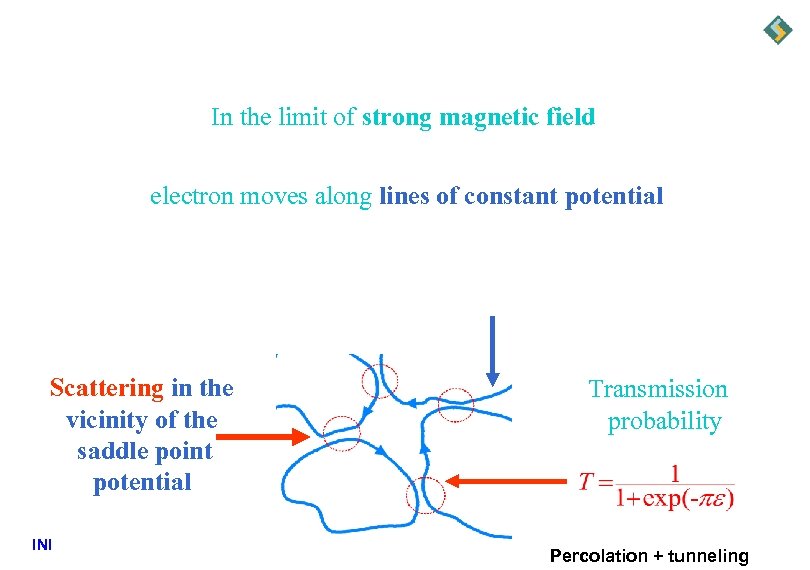 In the limit of strong magnetic field electron moves along lines of constant potential Scattering in the vicinity of the saddle point potential INI Transmission probability Percolation + tunneling
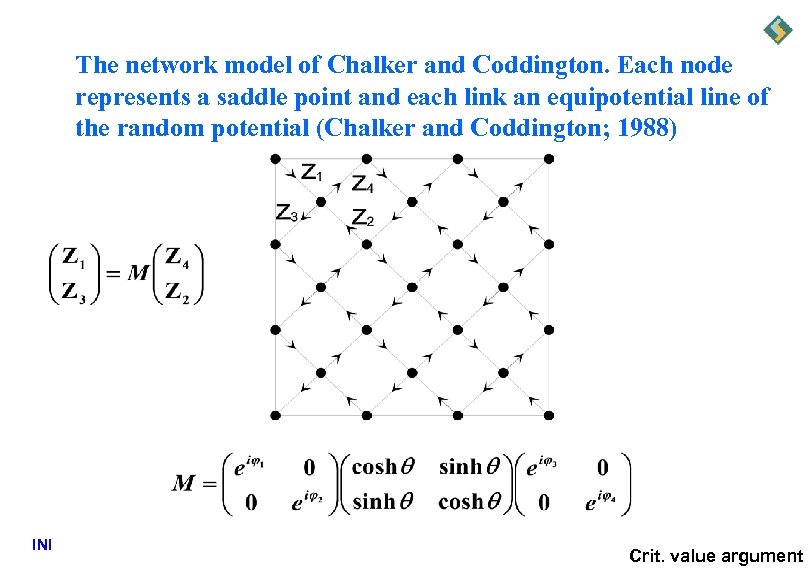 The network model of Chalker and Coddington. Each node represents a saddle point and each link an equipotential line of the random potential (Chalker and Coddington; 1988) INI Crit. value argument
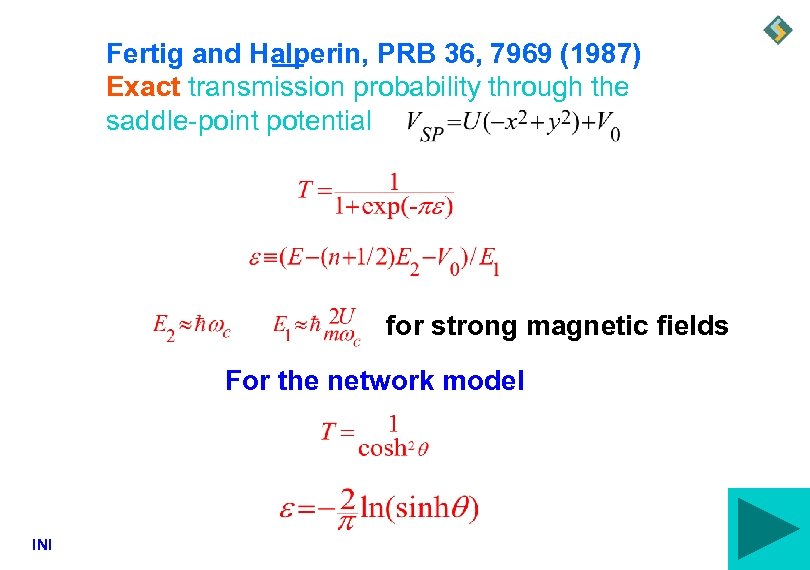 Fertig and Halperin, PRB 36, 7969 (1987) Exact transmission probability through the saddle-point potential for strong magnetic fields For the network model INI
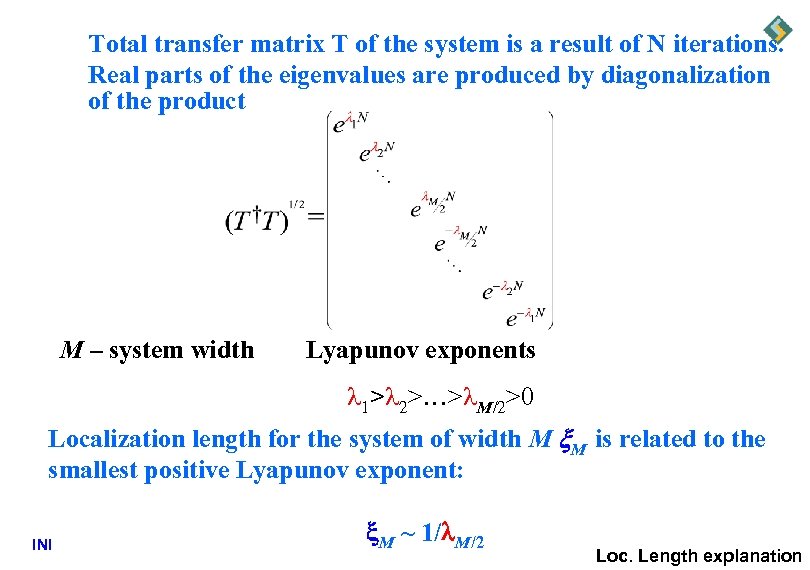 Total transfer matrix T of the system is a result of N iterations. Real parts of the eigenvalues are produced by diagonalization of the product M – system width Lyapunov exponents 1> 2>…> M/2>0 Localization length for the system of width M M is related to the smallest positive Lyapunov exponent: INI M ~ 1/ M/2 Loc. Length explanation
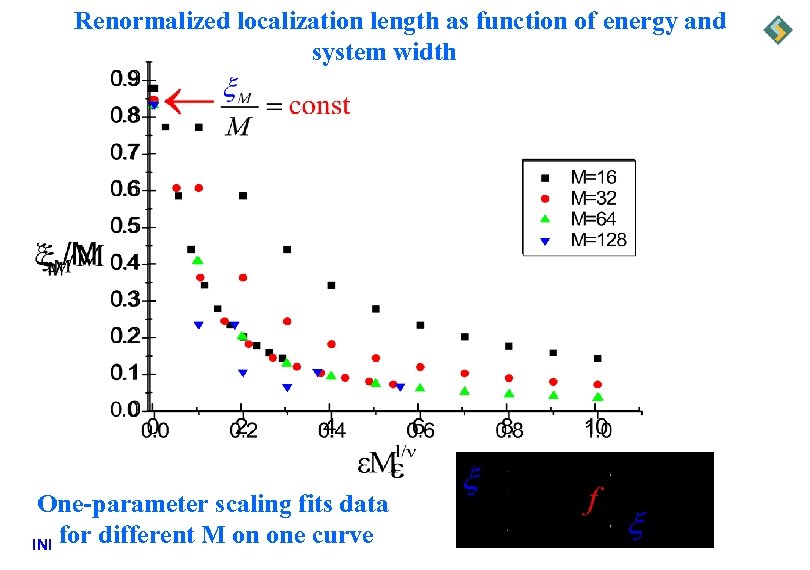 Renormalized localization length as function of energy and system width One-parameter scaling fits data INI for different M on one curve
 The thermodynamic localization length is then defined as function of energy and diverges as energy approaches zero Main result in agreement with experiment and other numerical simulations Is that it? INI
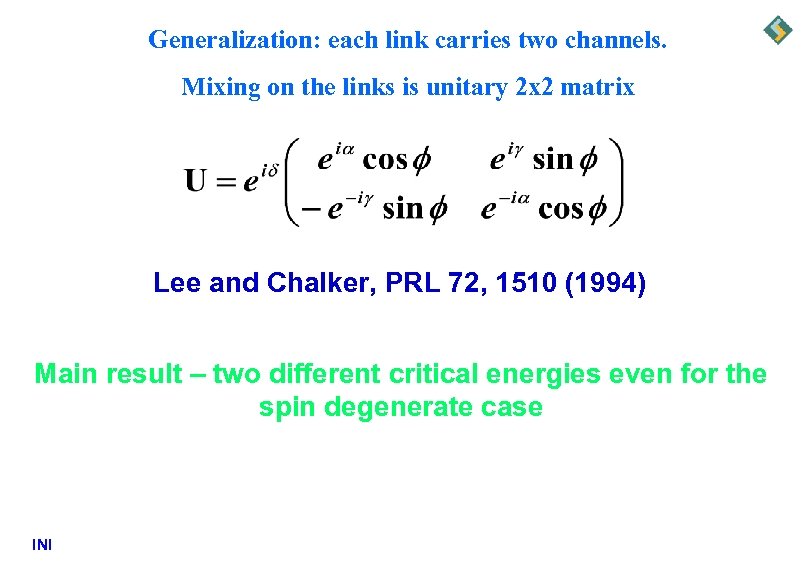 Generalization: each link carries two channels. Mixing on the links is unitary 2 x 2 matrix Lee and Chalker, PRL 72, 1510 (1994) Main result – two different critical energies even for the spin degenerate case INI
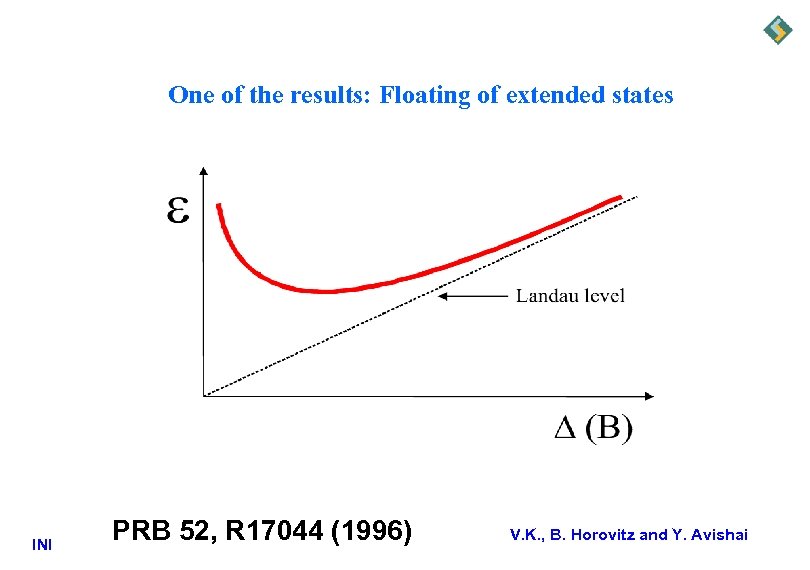 One of the results: Floating of extended states INI PRB 52, R 17044 (1996) V. K. , B. Horovitz and Y. Avishai
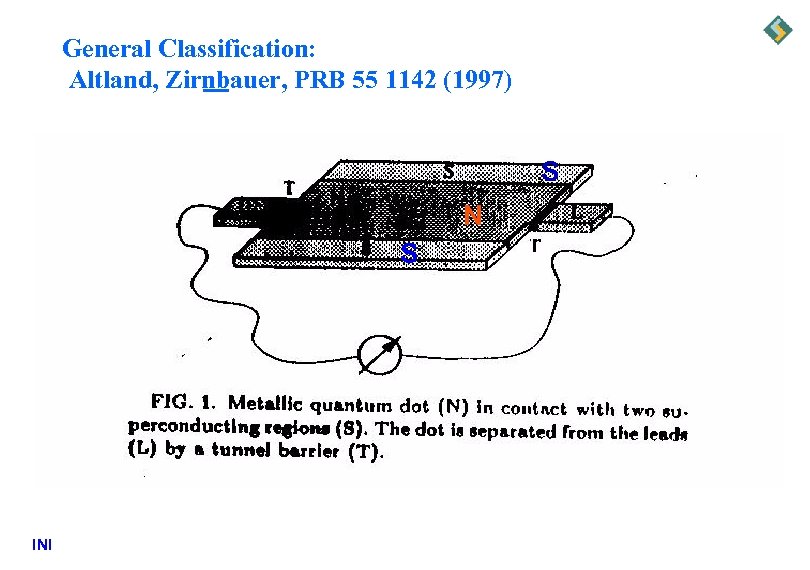 General Classification: Altland, Zirnbauer, PRB 55 1142 (1997) S N S INI
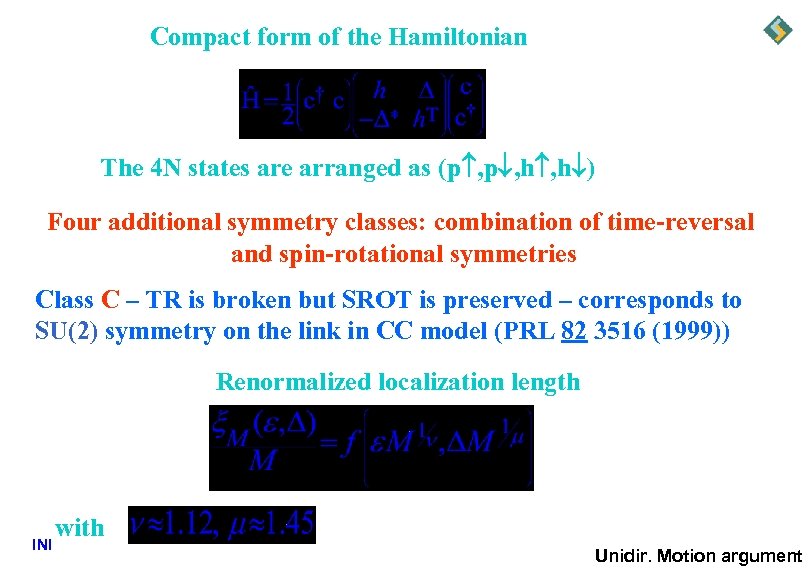 Compact form of the Hamiltonian The 4 N states are arranged as (p , h , h ) Four additional symmetry classes: combination of time-reversal and spin-rotational symmetries Class C – TR is broken but SROT is preserved – corresponds to SU(2) symmetry on the link in CC model (PRL 82 3516 (1999)) Renormalized localization length INI with Unidir. Motion argument
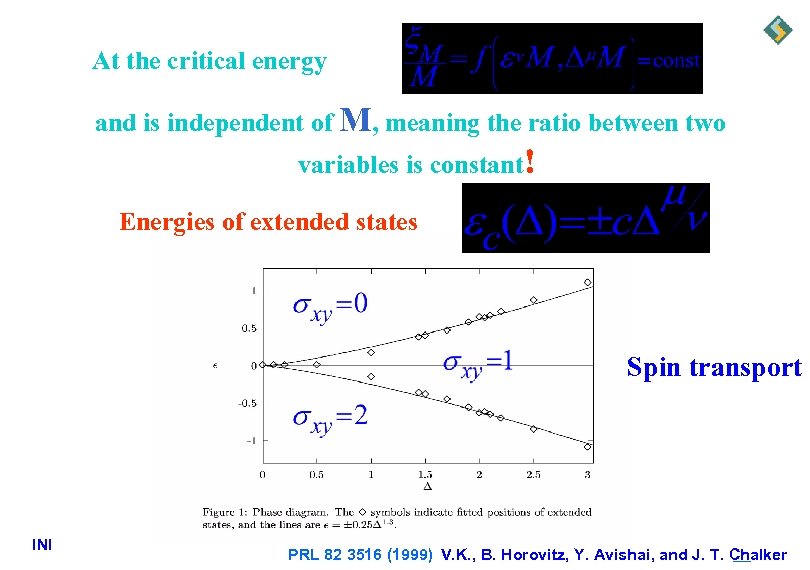 At the critical energy and is independent of M, meaning the ratio between two variables is constant! Energies of extended states Spin transport INI PRL 82 3516 (1999) V. K. , B. Horovitz, Y. Avishai, and J. T. Chalker
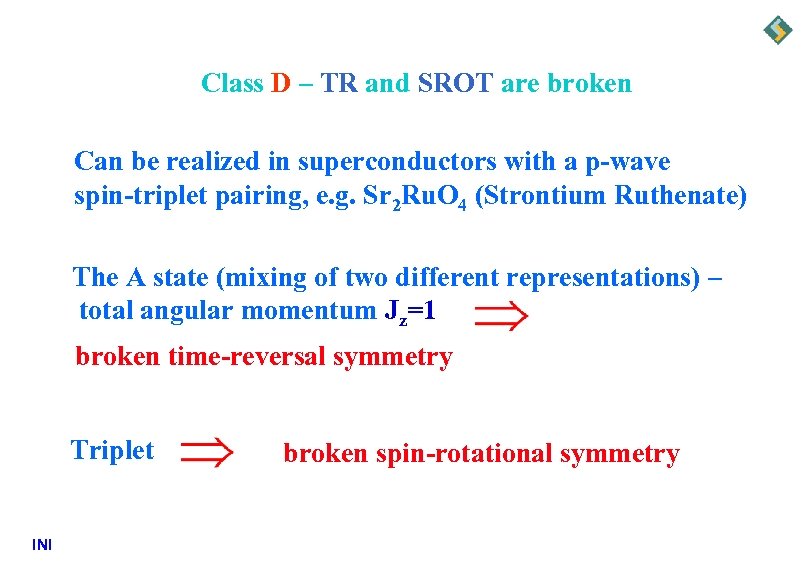 Class D – TR and SROT are broken Can be realized in superconductors with a p-wave spin-triplet pairing, e. g. Sr 2 Ru. O 4 (Strontium Ruthenate) The A state (mixing of two different representations) – total angular momentum Jz=1 broken time-reversal symmetry Triplet INI broken spin-rotational symmetry
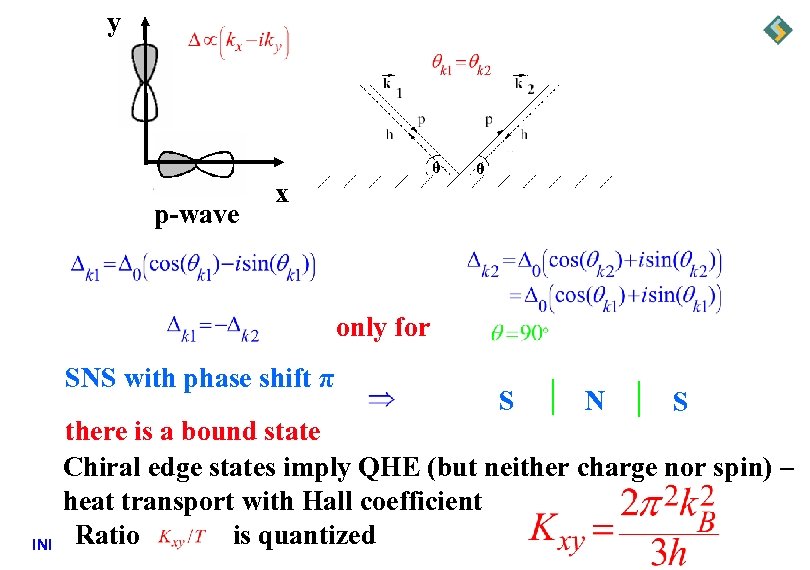 y θ p-wave θ x only for SNS with phase shift π INI S N S there is a bound state Chiral edge states imply QHE (but neither charge nor spin) – heat transport with Hall coefficient is quantized Ratio
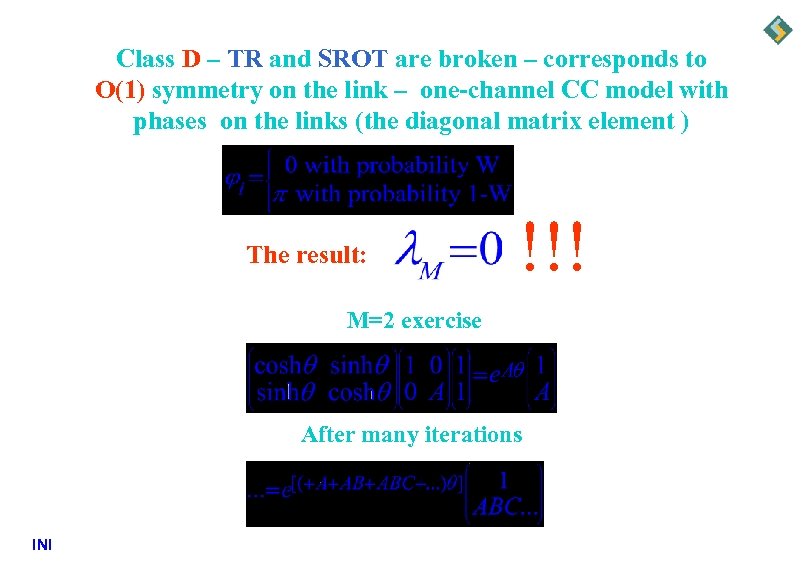 Class D – TR and SROT are broken – corresponds to O(1) symmetry on the link – one-channel CC model with phases on the links (the diagonal matrix element ) The result: !!! M=2 exercise After many iterations INI
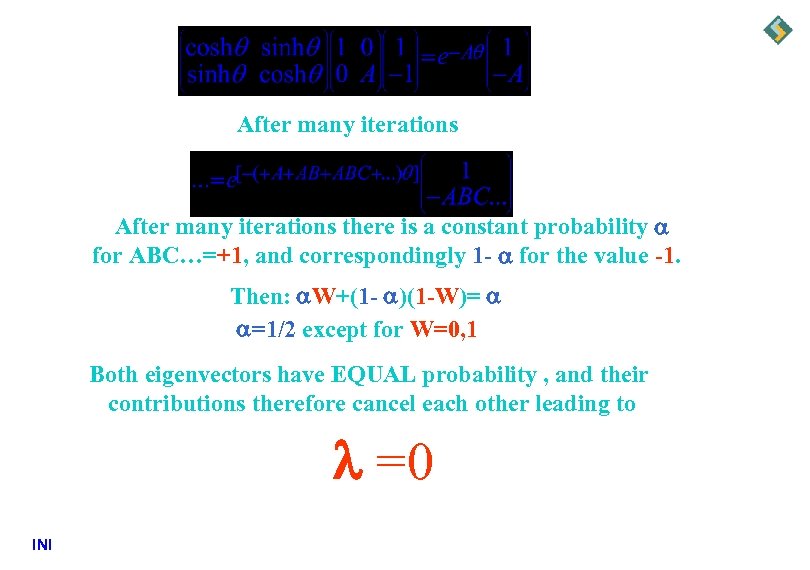 After many iterations there is a constant probability for ABC…=+1, and correspondingly 1 - for the value -1. Then: W+(1 - )(1 -W)= =1/2 except for W=0, 1 Both eigenvectors have EQUAL probability , and their contributions therefore cancel each other leading to =0 INI
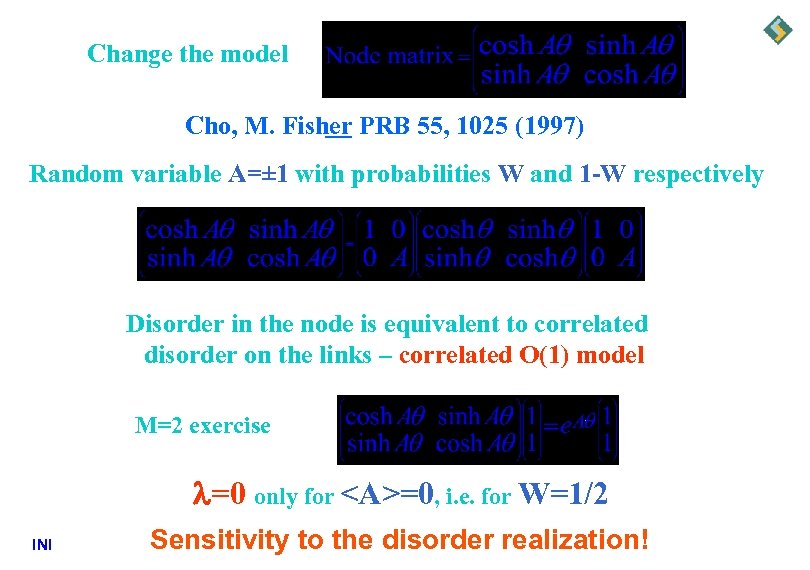 Change the model Cho, M. Fisher PRB 55, 1025 (1997) Random variable A=± 1 with probabilities W and 1 -W respectively Disorder in the node is equivalent to correlated disorder on the links – correlated O(1) model M=2 exercise =0 only for =0, i. e. for W=1/2 INI Sensitivity to the disorder realization!
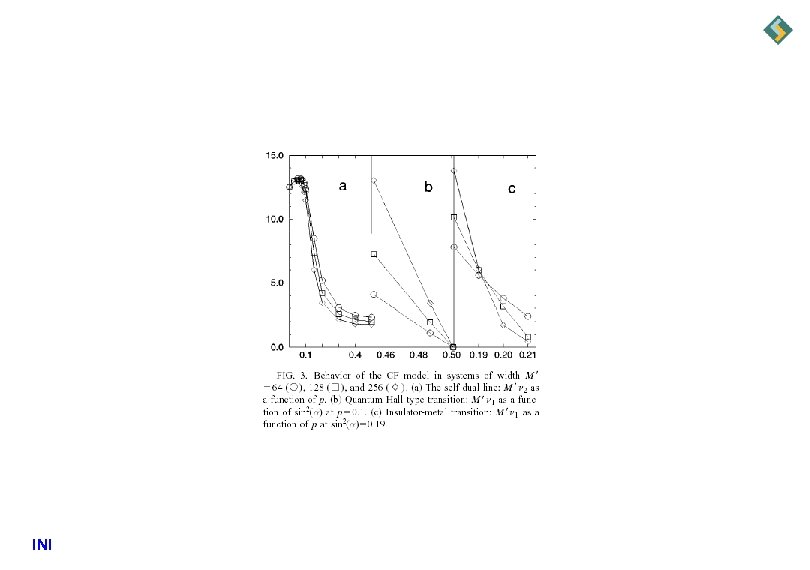 INI
INI
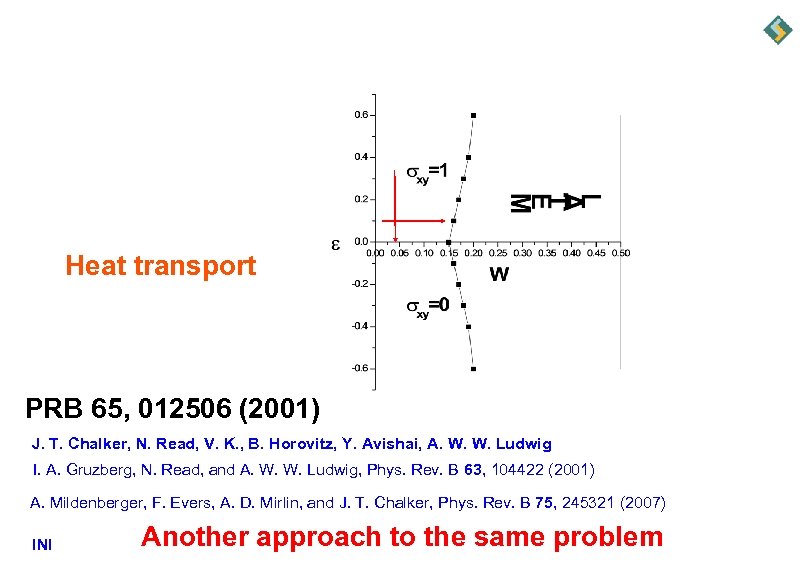 Heat transport PRB 65, 012506 (2001) J. T. Chalker, N. Read, V. K. , B. Horovitz, Y. Avishai, A. W. W. Ludwig I. A. Gruzberg, N. Read, and A. W. W. Ludwig, Phys. Rev. B 63, 104422 (2001) A. Mildenberger, F. Evers, A. D. Mirlin, and J. T. Chalker, Phys. Rev. B 75, 245321 (2007) INI Another approach to the same problem
 W=0. 1 is fixed INI =1. 4
 =0. 1 is fixed INI =1. 4
 INI =1. 4
 PRL 101, 127001 (2008) INI V. K. & D. Nemirovsky
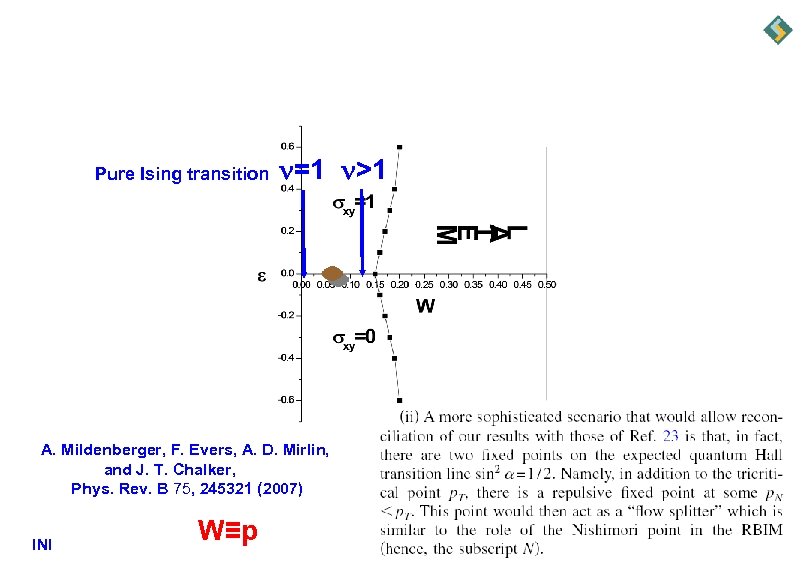 Pure Ising transition =1 >1 A. Mildenberger, F. Evers, A. D. Mirlin, and J. T. Chalker, Phys. Rev. B 75, 245321 (2007) INI W≡p
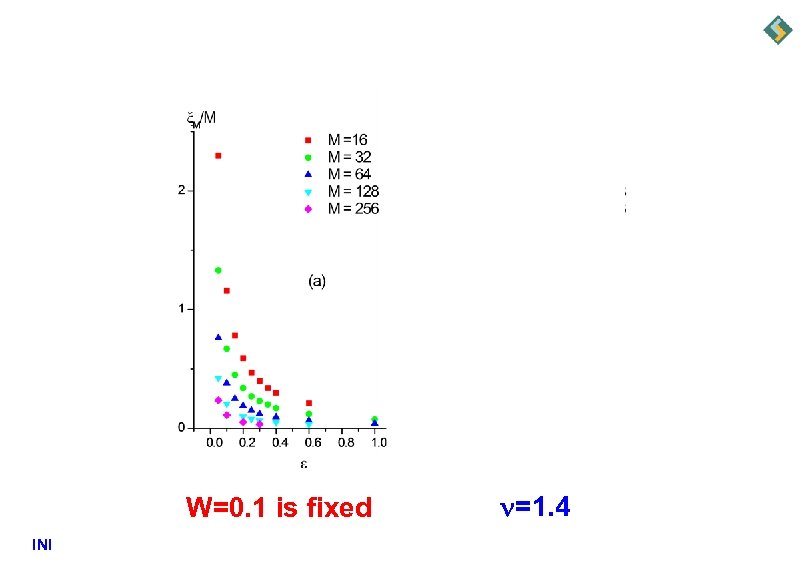
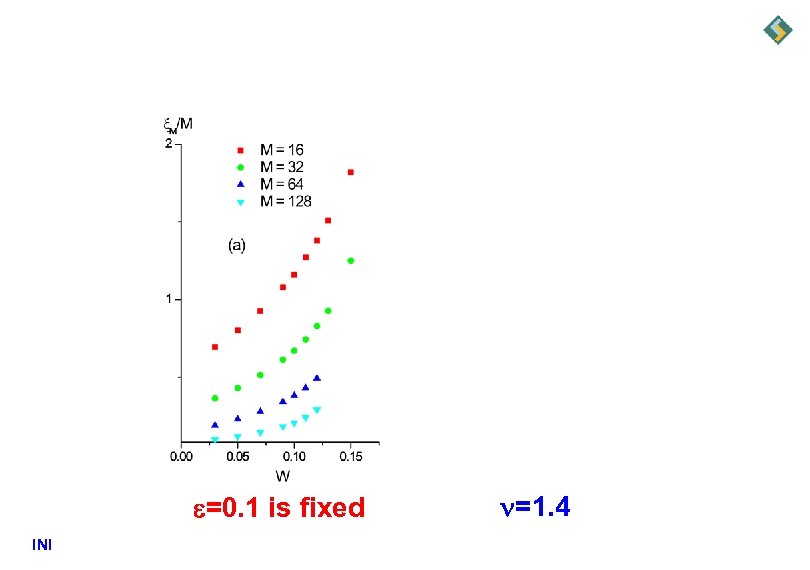
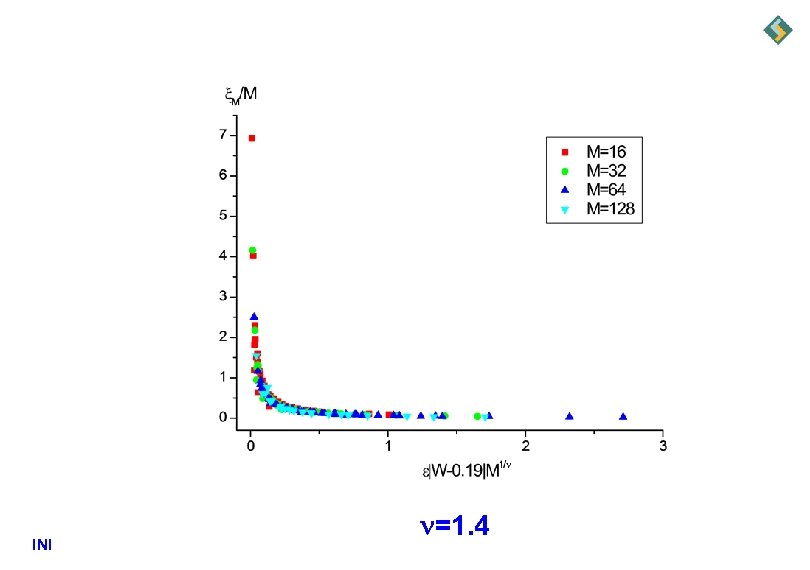
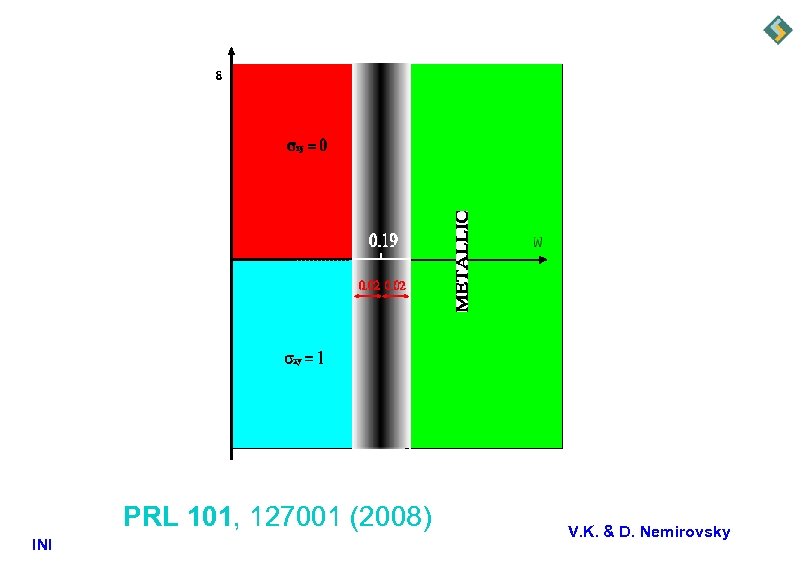
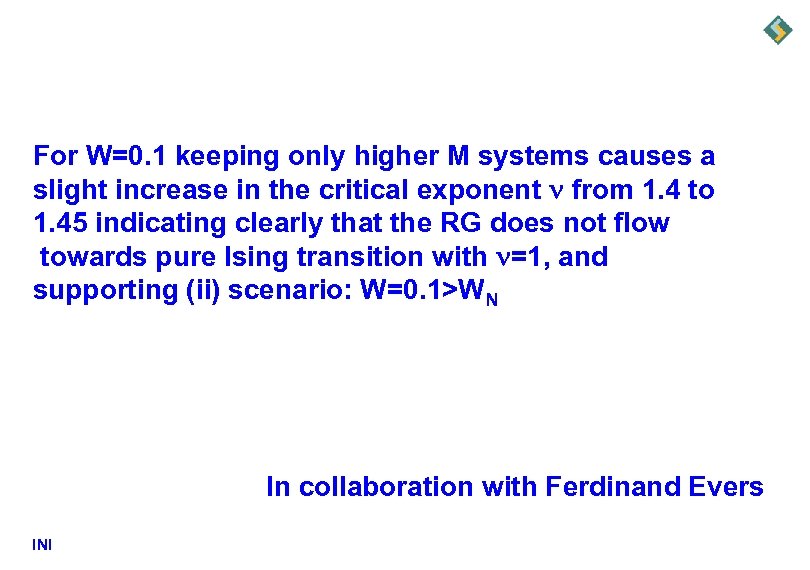 For W=0. 1 keeping only higher M systems causes a slight increase in the critical exponent from 1. 4 to 1. 45 indicating clearly that the RG does not flow towards pure Ising transition with =1, and supporting (ii) scenario: W=0. 1>WN In collaboration with Ferdinand Evers INI
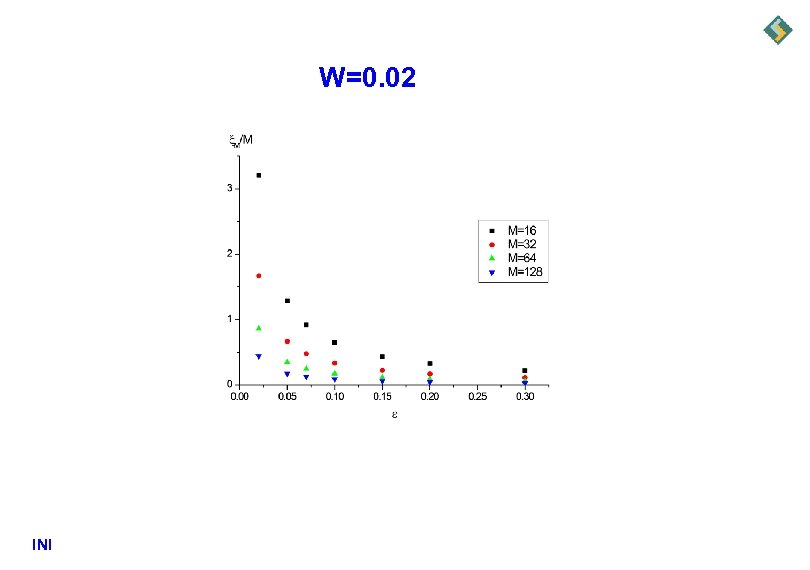 W=0. 02 INI
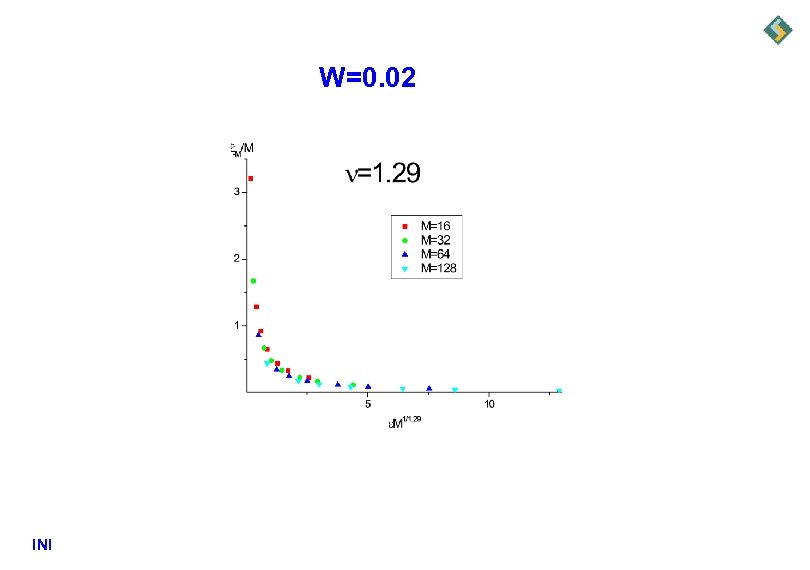 W=0. 02 INI
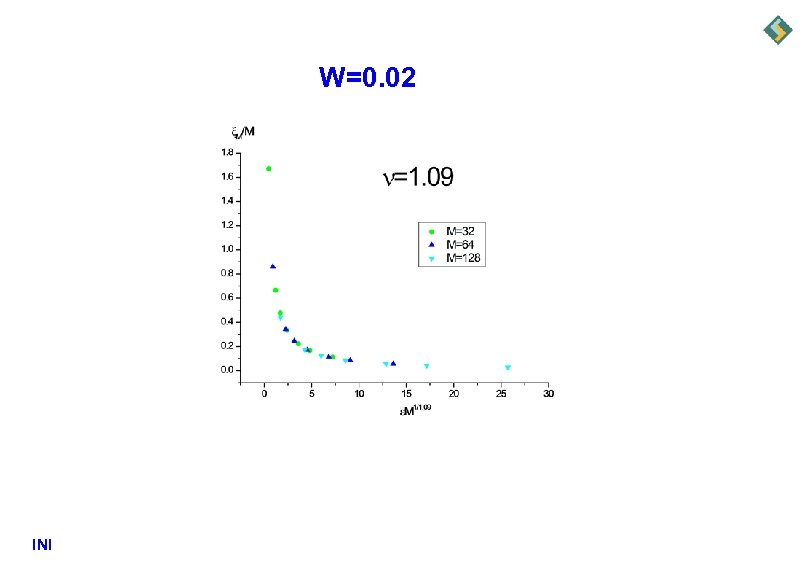 W=0. 02 INI
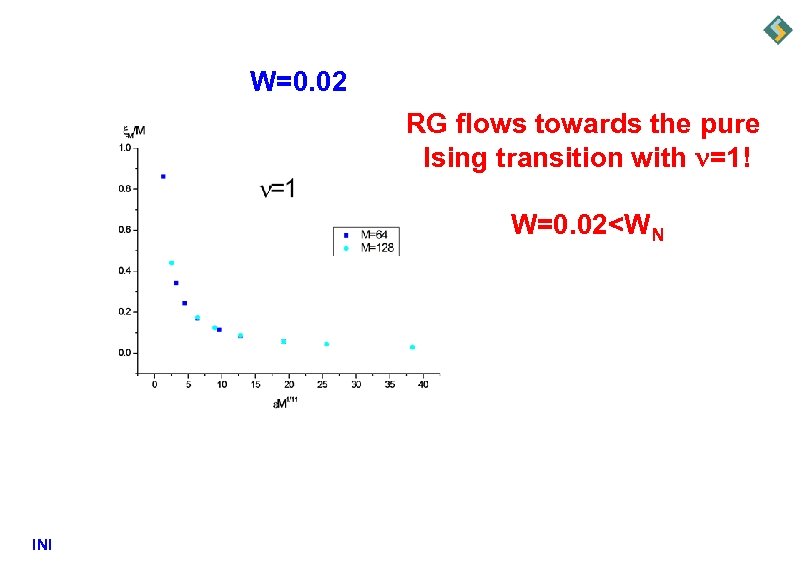 W=0. 02 RG flows towards the pure Ising transition with =1! W=0. 02
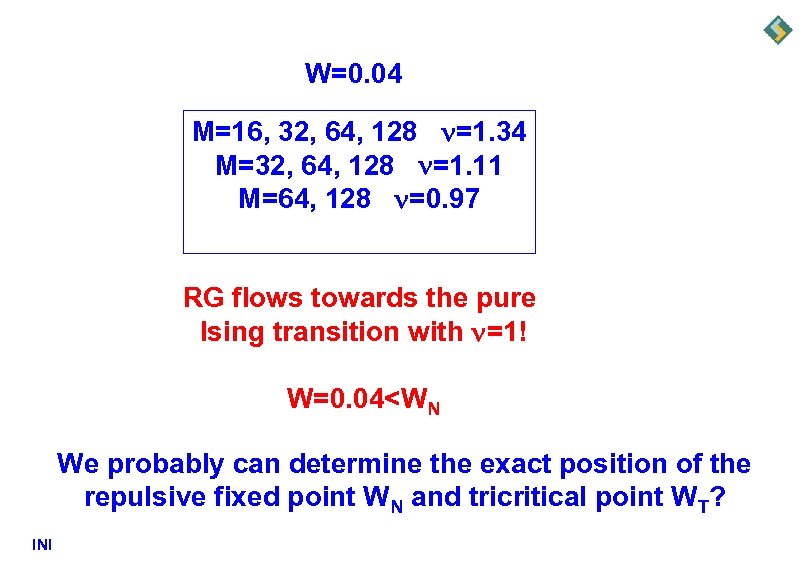 W=0. 04 M=16, 32, 64, 128 =1. 34 M=32, 64, 128 =1. 11 M=64, 128 =0. 97 RG flows towards the pure Ising transition with =1! W=0. 04
 Back to the original network model Height of the barriers fluctuate - percolation INI
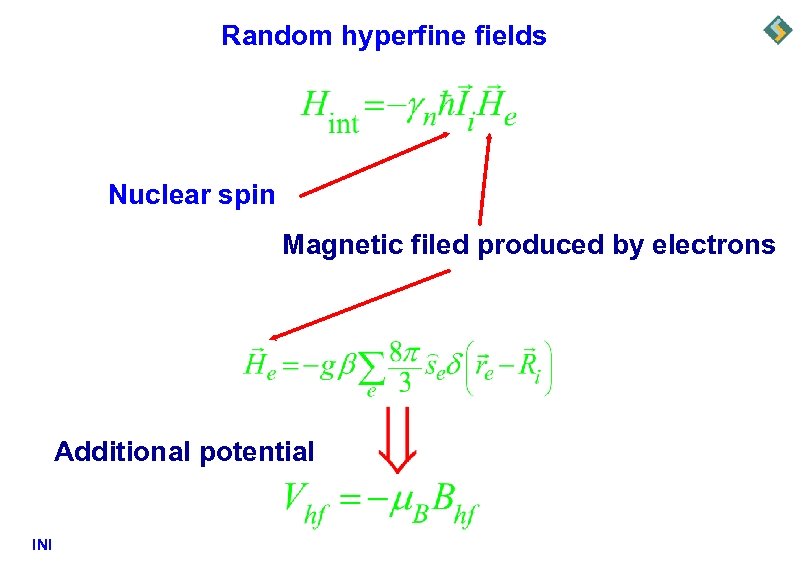 Random hyperfine fields Nuclear spin Magnetic filed produced by electrons Additional potential INI
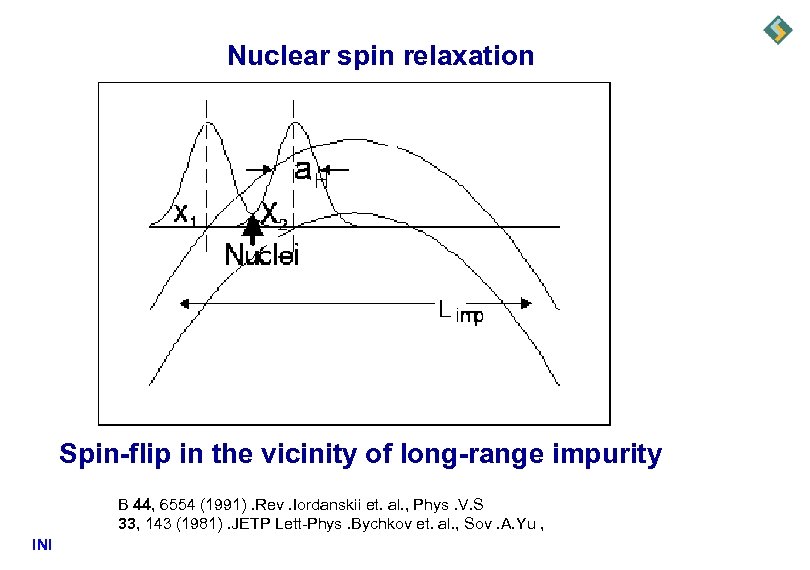 Nuclear spin relaxation Spin-flip in the vicinity of long-range impurity B 44, 6554 (1991). Rev. Iordanskii et. al. , Phys. V. S 33, 143 (1981). JETP Lett-Phys. Bychkov et. al. , Sov. A. Yu , INI
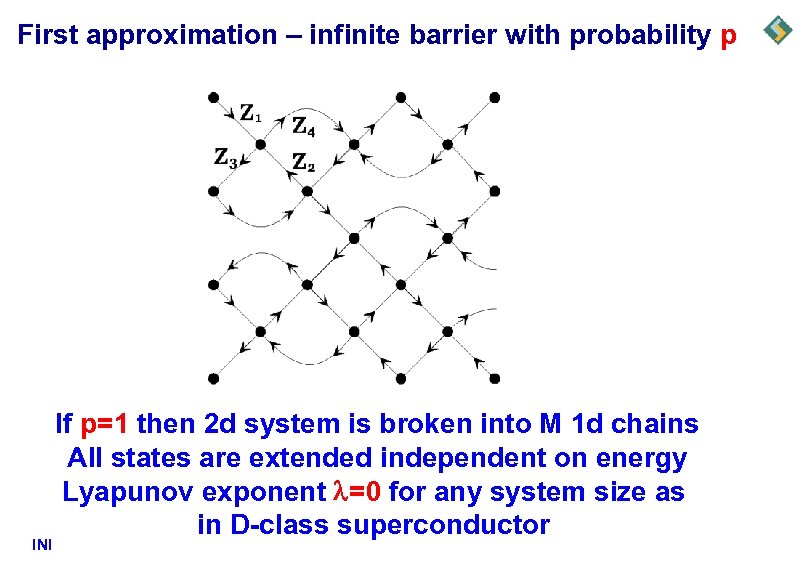 First approximation – infinite barrier with probability p INI If p=1 then 2 d system is broken into M 1 d chains All states are extended independent on energy Lyapunov exponent =0 for any system size as in D-class superconductor
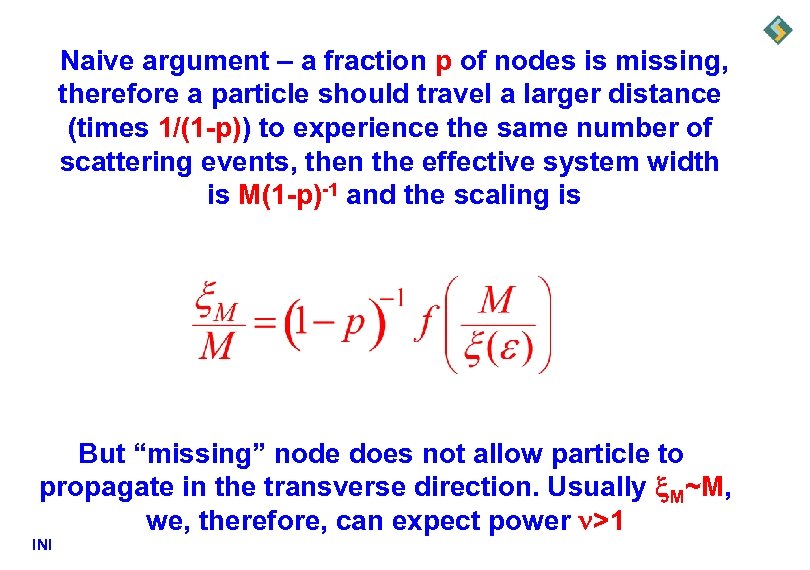 Naive argument – a fraction p of nodes is missing, therefore a particle should travel a larger distance (times 1/(1 -p)) to experience the same number of scattering events, then the effective system width is M(1 -p)-1 and the scaling is But “missing” node does not allow particle to propagate in the transverse direction. Usually M~M, we, therefore, can expect power >1 INI
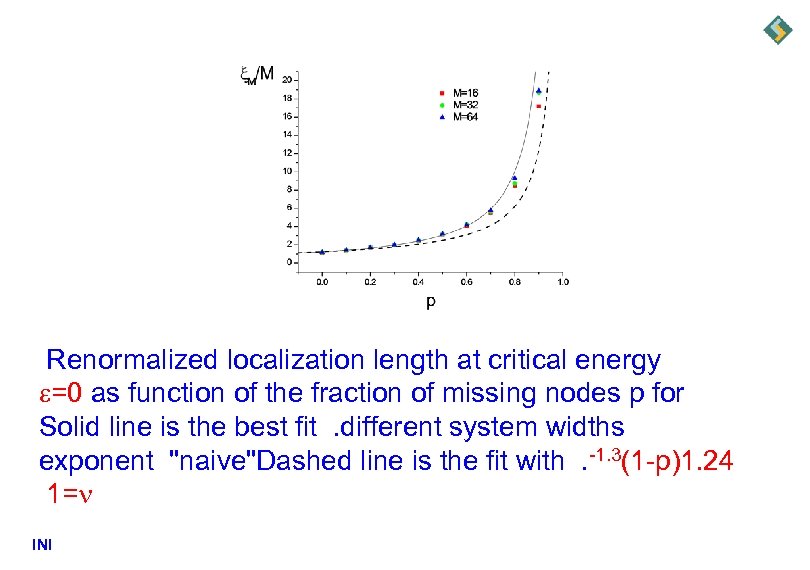 Renormalized localization length at critical energy =0 as function of the fraction of missing nodes p for Solid line is the best fit . different system widths exponent "naive"Dashed line is the fit with . -1. 3(1 -p)1. 24 1= INI
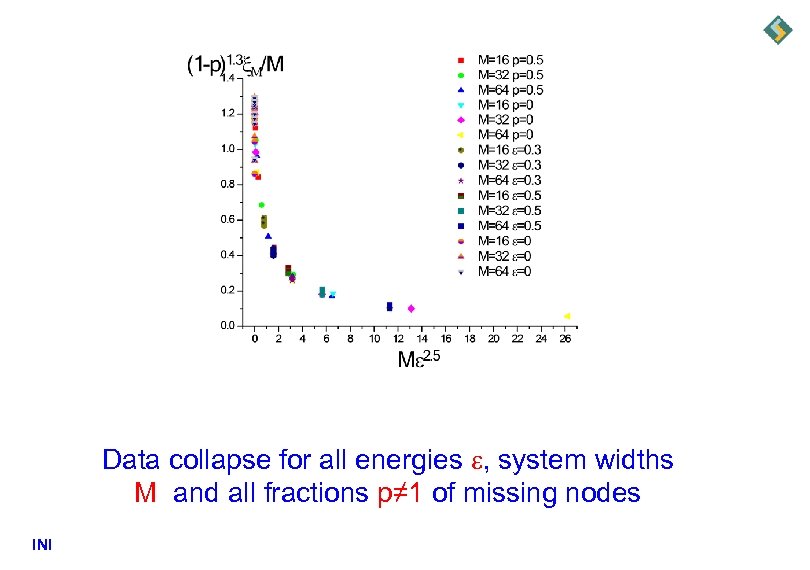 Data collapse for all energies , system widths M and all fractions p≠ 1 of missing nodes INI
 The effect of directed percolation can be responsible . for the appearance of the value ≈1. 3 By making a horizontal direction preferential, we have . introduced an anisotropy into the system Our result practically coincides with the value of critical exponent for the divergent temporal correlation length in 2 d critical nonequilibrium systems, described by directed percolation models H. Hinrichsen, Adv. Phys. 49, 815 )2000) G. Odor, Rev. Mod. Phys. 76, 663 )2004) S. Luebeck, Int. J. Mod. Phys. B 18, 3977 )2004) It probably should not come as a surprise if we recollect that each link in the network model can be associated with a unit of time C. M. Ho and J. T. Chalker, Phys. Rev. B 54, 8708 (1996). INI Thanks to Ferdinand Evers
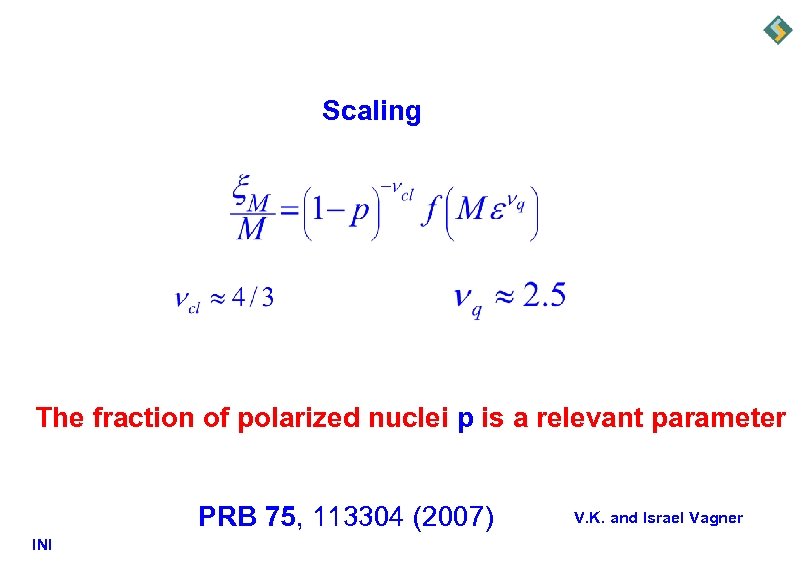 Scaling The fraction of polarized nuclei p is a relevant parameter PRB 75, 113304 (2007) INI V. K. and Israel Vagner
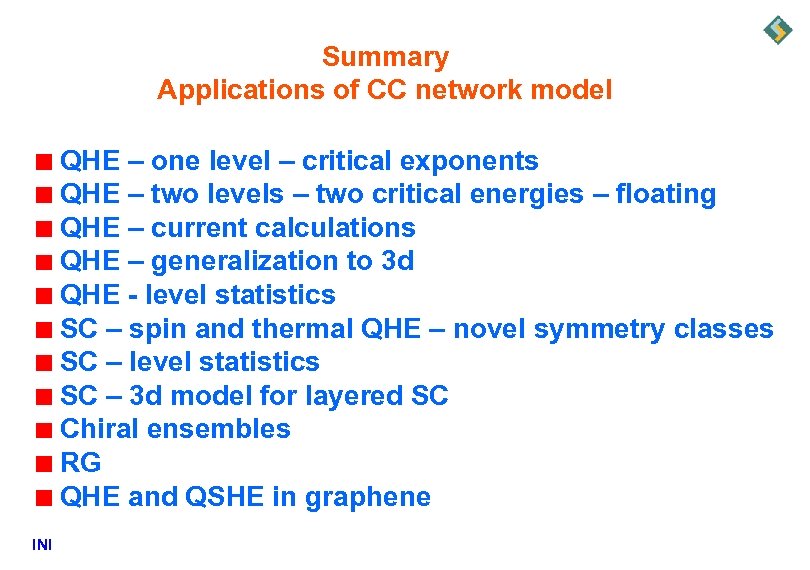 Summary Applications of CC network model QHE – one level – critical exponents QHE – two levels – two critical energies – floating QHE – current calculations QHE – generalization to 3 d QHE - level statistics SC – spin and thermal QHE – novel symmetry classes SC – level statistics SC – 3 d model for layered SC Chiral ensembles RG QHE and QSHE in graphene INI